

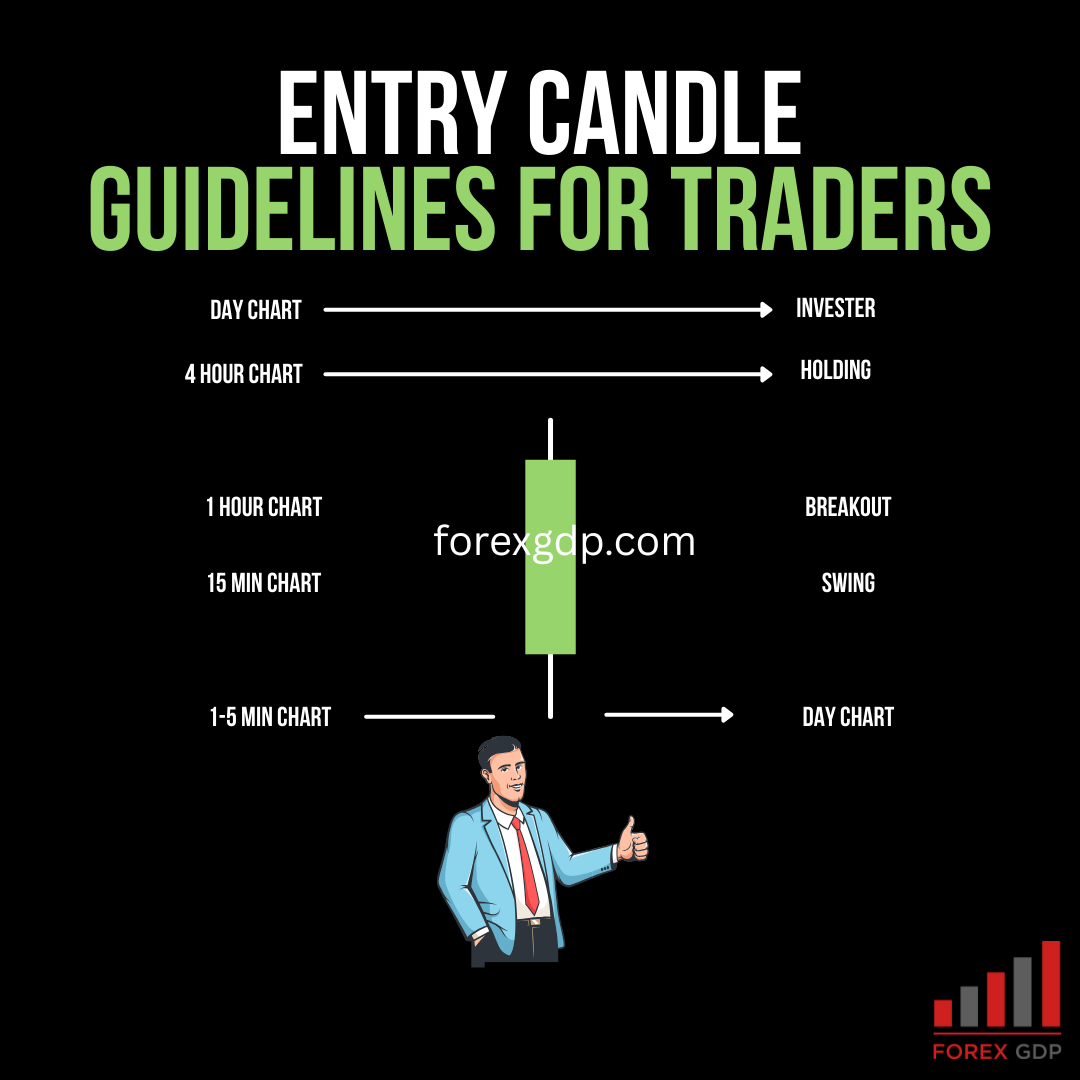
Trading is an endless battle between patience and impulse. One of the most overlooked yet crucial aspects of trading success is the entry candle. This simple concept often determines whether you enter a trade at the right time or end up regretting it moments later. The infographic you’ve seen lays out the guidelines for traders based on different timeframes, and in this article, we’re going to break it all down in detail.
If you’ve ever wondered why your entries are always late or why you miss the “perfect candle,” this guide will make things clear.
What Is an Entry Candle in Trading?
The entry candle is the specific candlestick on your chart that signals the right moment to jump into a trade. It’s not just about spotting any green or red bar; it’s about understanding the psychology behind that candle.
Think of the candle as a story:
-
The wick tells you the battle between buyers and sellers.
-
The body reveals the dominant side.
-
The close tells you who actually won.
Without analyzing this story properly, you’re just guessing your trades.
Why Entry Candles Matter More Than You Think
Ever entered a trade only to see the market immediately reverse against you? That usually happens when you ignore the right entry candle.
Here’s why it matters:
-
It prevents false breakouts.
-
It reduces drawdown risk.
-
It gives you confidence to hold your position.
Skipping the right entry candle is like trying to jump on a moving train—it’s either too late or too dangerous.
Understanding the Timeframe Factor
The infographic clearly shows that your entry decision depends heavily on the timeframe.
-
Day Chart → Investors who hold positions for weeks or months.
-
4 Hour Chart → Swing traders holding for days.
-
1 Hour & 15 Min Charts → Breakout traders and short-term swing setups.
-
1–5 Min Charts → Scalpers glued to the screen.
Choosing the wrong timeframe for your strategy is like wearing slippers to run a marathon—it simply won’t work.
Day Chart: The Investor’s Playground
On the daily chart, each candle represents an entire trading day. This means the entry candle here carries far more weight than on smaller timeframes.
-
Best For: Long-term investors.
-
What to Look For: Strong bullish/bearish engulfing candles, pin bars, or inside bars.
-
Mindset Required: Patience. You’re holding trades for weeks, not minutes.
Daily candles give you the bigger picture. If you’re the type who doesn’t want to check charts 24/7, this is your safe zone.
4-Hour Chart: The Sweet Spot for Holding Trades
The 4-hour chart is where most swing traders live. It balances between noise and clarity.
-
Best For: Swing traders who hold for 2–10 days.
-
What to Look For: Breakouts above resistance, retests with rejection candles, or momentum continuation candles.
-
Mindset Required: Moderate patience—you’re neither a long-term investor nor a hyperactive scalper.
The 4H chart filters out intraday noise but still gives plenty of trade opportunities.

1-Hour Chart: Breakout Hunters
The 1-hour chart is popular among breakout traders. It’s fast but not too fast.
-
Best For: Traders catching intraday breakouts.
-
What to Look For: Large impulsive candles breaking through key levels.
-
Mindset Required: Quick decision-making. Miss the candle, and you miss the move.
This chart is perfect for spotting momentum before it explodes on smaller timeframes.
15-Minute Chart: Swing and Intraday Entries
The 15-minute chart is versatile. It works for both breakout traders and short-term swing setups.
-
Best For: Intraday traders.
-
What to Look For: Smaller breakouts, pullback entries, or rejection candles.
-
Mindset Required: Active monitoring. You’ll need to stay sharp.
This chart offers enough speed for action without the chaos of 1-minute candles.
1–5 Minute Charts: Scalper’s Paradise
Welcome to the jungle—the 1 to 5-minute charts. This is where scalpers thrive, and chaos rules.
-
Best For: Scalpers who love fast-paced trading.
-
What to Look For: Micro breakouts, wicks at key levels, or momentum bursts.
-
Mindset Required: Iron nerves. One mistake here costs big.
The infographic suggests using these for confirmation rather than basing your entire strategy on them. Why? Because the noise is unbearable. One fake spike, and your stop loss is gone.
Breakout Trading and Entry Candles
Breakouts are where most traders mess up. They jump in too early or too late.
-
Right Entry Candle: The one that closes above resistance (for buy) or below support (for sell).
-
Wrong Entry Candle: The one that just pokes out but doesn’t close beyond the level.
Think of a breakout like breaking through a locked door. You don’t walk in while someone is still trying to kick it open—you wait until it’s actually broken.
Swing Trading and Entry Candles
Swing traders rely on entry candles that show rejection or continuation.
-
A pin bar rejection from support screams buy.
-
A bearish engulfing after a rally screams sell.
Here, you’re not chasing moves; you’re catching turns. Swing trading is like surfing—you wait for the right wave, not every splash.
The Trap of Lower Timeframes
Many beginners love the 1–5 min charts because they look exciting. But let’s face it: they’re a trap.
Why?
-
Too much market noise.
-
Too many false signals.
-
Too much stress.
If you’re new, stick to higher timeframes. Lower timeframes are like quicksand—you think you’re in control until you sink.
The Psychology Behind Entry Candles
Trading isn’t just numbers—it’s emotions. Entry candles often expose the psychology of the market:
-
A long wick? Traders tried to push but failed.
-
A full body candle? Strong conviction from buyers or sellers.
-
A doji? Confusion and indecision.
Understanding these emotions helps you avoid being trapped when the market is undecided.
Common Mistakes Traders Make With Entry Candles
-
Jumping in without confirmation.
Seeing a candle spike doesn’t mean it’s safe. Wait for the close. -
Ignoring timeframes.
Using a 1-min candle for an investor’s trade is pure madness. -
Overtrading every candle.
Not every candle is a signal—sometimes, it’s just noise. -
Forcing trades.
If the candle doesn’t meet your criteria, skip it. No trade is better than a bad trade.

Tips to Master Entry Candles
-
Stick to one or two timeframes that fit your lifestyle.
-
Always wait for the candle to close before deciding.
-
Use confluence—don’t just rely on candles, combine with trendlines, support, and indicators.
-
Backtest your entries to see what works consistently.
Think of entry candles like green lights at an intersection. Just because the light turns green doesn’t mean you hit the gas immediately—you still check for cross traffic.
Conclusion
The entry candle is more than just a bar on your screen—it’s the heartbeat of your trade. Get it wrong, and you’re doomed to frustration. Get it right, and you’ll find trading becomes less stressful and more profitable.
Whether you’re an investor studying daily charts or a scalper glued to the 1-minute screen, always respect the power of the entry candle. It’s not about chasing every move; it’s about waiting for the right moment to strike.
FAQs
1. What’s the best timeframe for beginners to use entry candles?
Stick to the daily or 4-hour charts. They’re cleaner, less noisy, and give more reliable signals.
2. Should I always wait for the candle to close before entering?
Yes. Entering before the close is gambling—you don’t know how the candle will finish.
3. Can entry candles work with indicators?
Absolutely. Combine them with moving averages, RSI, or support/resistance for stronger setups.
4. Why do I lose money on 1-minute candles?
Because they’re full of noise and false signals. Only advanced scalpers should touch them.
5. Are entry candles different for forex, stocks, and crypto?
The principle is the same across all markets. Price action is universal—only volatility differs.