

Trading isn’t just about picking the right entry point—it’s also about knowing when to cut your losses. That’s where stop losses come in. If you’ve been trading for a while, you’ve probably felt the sting of watching your trades crash without protection. And if you’re new, you might think, “Do I really need a stop loss? What if the market bounces back?” Spoiler alert: skipping a stop loss is like driving without brakes—you might enjoy the ride, but eventually, you’ll crash.
This article will walk you through everything you need to know about stop losses: what they are, why they matter, and how to set them effectively. Get ready, because by the end of this 2000-word breakdown, you’ll see stop losses as your best trading buddy—not your enemy.
What Is a Stop Loss?
A stop loss is a pre-set order you place with your broker to automatically close your trade if the market moves against you by a certain amount. Think of it as a safety net under a tightrope walker—it won’t stop you from falling, but it will save you from hitting the ground.
Without a stop loss, you’re gambling, not trading. The forex market is unpredictable, and no strategy wins all the time. A stop loss ensures you survive long enough to catch the next winning trade.
Why Stop Losses Are Non-Negotiable
Let’s be real: the number one reason most traders blow up their accounts isn’t because they don’t know how to trade. It’s because they refuse to take losses. They hold on, hoping the market will “come back.” Sometimes it does, but most times, it doesn’t.
A stop loss forces discipline. It says: “This is the maximum I’m willing to lose. If I’m wrong, I’m out.” That’s trading like a professional, not a gambler.
The Biggest Mistake Traders Make with Stop Losses
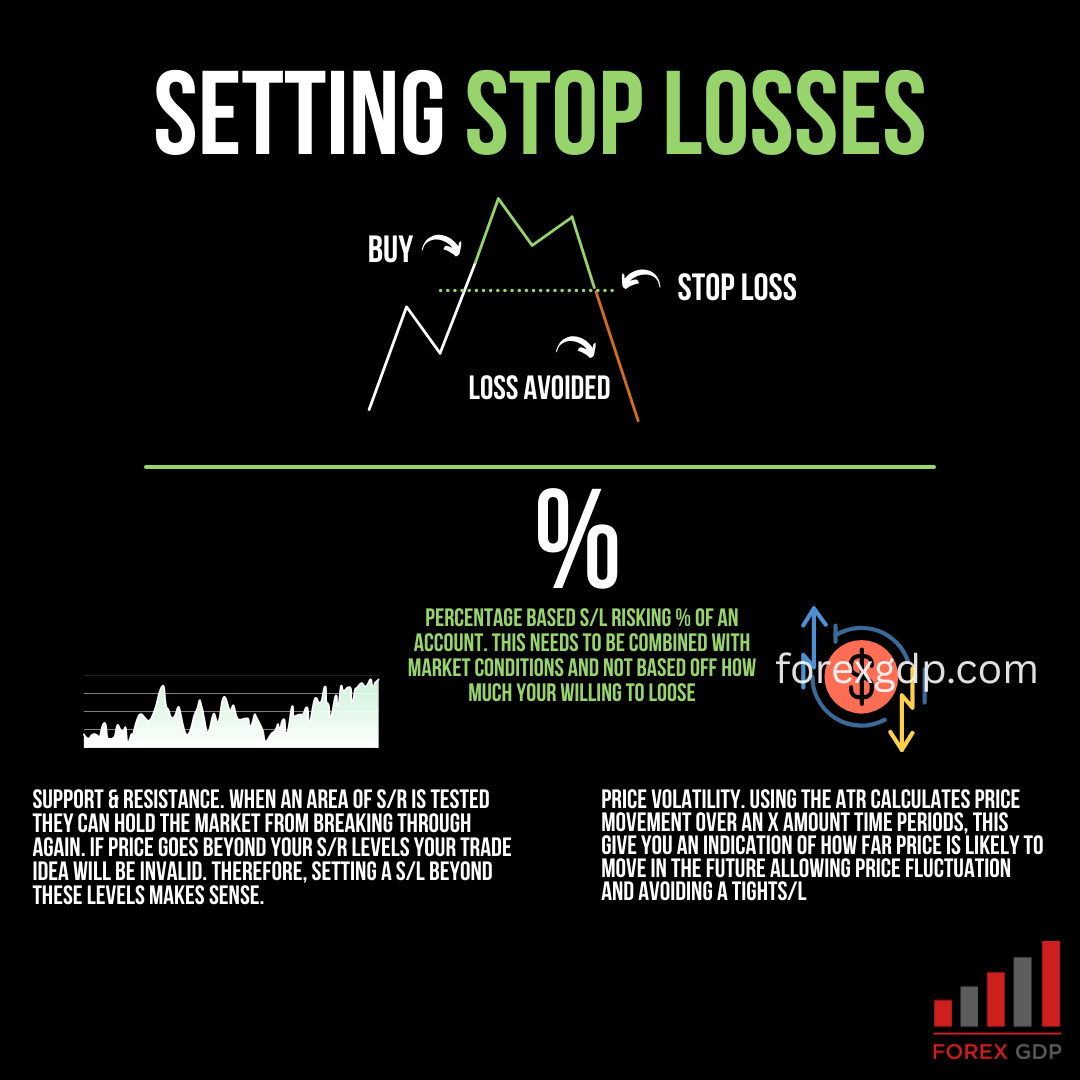
Here’s the trap: setting your stop loss based on how much money you want to risk rather than where the market tells you to place it.
Imagine this: you want to risk only $20, so you slap your stop loss 10 pips away from your entry. But the market’s natural fluctuation is 30–40 pips. Guess what happens? You get stopped out before the real move even begins.
Moral of the story? Stop losses must be based on market structure, not your personal comfort zone.

Percentage-Based Stop Losses
A common rule of thumb is risking 1–2% of your account per trade. That means if you have a $1,000 account, you’re only risking $10–$20 per trade.
But here’s the kicker: percentage-based stop losses only tell you how much to risk—not where to place the stop. You still need to combine this with technical analysis to avoid setting stops too tight or too wide.
Support and Resistance: The Natural Stop Zones
Support and resistance (S/R) levels are like invisible fences in the market. Prices bounce off them repeatedly, and when they finally break, it’s a big deal.
Placing your stop just beyond these levels makes sense because if price breaks through, your trade idea is invalid. It’s like saying, “If the market proves me wrong, I’m out.”
Example: If you’re buying near a support zone, put your stop a little below that support. If you’re selling at resistance, place your stop slightly above.
Using Price Volatility to Place Stops
Markets breathe—they expand and contract. If you set your stop loss too close, normal fluctuations will stop you out before the real trend plays out. That’s where volatility-based stops come in.
The Average True Range (ATR) indicator measures how much price moves on average over a set time. By multiplying the ATR by a factor (say 1.5 or 2), you can set a stop loss that accounts for market noise.
For example, if the ATR is 20 pips, setting your stop 30–40 pips away makes more sense than a random number.
Tight vs. Wide Stop Losses: Which Works Best?
This debate never ends. Tight stops limit your losses but increase the chance of being stopped out. Wide stops reduce the chance of premature exits but risk bigger losses.
The trick? Balance. Use tight stops in low-volatility conditions and wider stops when the market is more volatile. Always adjust based on the pair you’re trading—GBP/JPY moves differently from EUR/USD.

The Psychology of Stop Losses
Here’s the ugly truth: many traders hate stop losses because they feel like admitting defeat. But trading isn’t about being right—it’s about making money.
Think of stop losses as tuition fees. Every loss is a lesson the market teaches you. The key is keeping those lessons cheap so you can keep playing the game.
Trailing Stop Losses: Locking in Profits
A trailing stop moves with the market. If the price goes in your favor, your stop loss shifts closer to lock in profit. If the price reverses, you get stopped out but still walk away with gains.
Trailing stops are like insurance policies—they protect your profit without capping your upside.
Common Stop Loss Mistakes to Avoid
-
No Stop Loss at All – That’s financial suicide.
-
Setting Stops Too Close – You’ll get stopped out by random noise.
-
Moving Stops Further Away – You’re just delaying the pain.
-
Not Adapting to Market Conditions – A strategy that works in a calm market will fail in high volatility.
-
Ignoring News Events – Economic announcements can blow through stops like a hurricane.
Stop Loss vs. Take Profit: The Balancing Act
Stop losses and take profits go hand in hand. It’s not just about how much you’re willing to lose, but also how much you aim to gain. A solid rule is maintaining at least a 1:2 risk-to-reward ratio. That means risking $1 to make $2.
If your strategy only gives you setups where you risk $50 to make $30, you’re already fighting a losing battle.
Advanced Stop Loss Strategies
-
Time-Based Stops – Exit after a set time if the trade hasn’t moved.
-
Hedging Stops – Instead of closing, you open an opposite trade.
-
Volatility Breakout Stops – Place stops outside consolidation zones.
-
Partial Close Stops – Scale out of trades to reduce risk.
These methods aren’t for beginners, but as you gain experience, they can give you more flexibility.

Why Stop Losses Save Accounts
Without stop losses, one bad trade can wipe out weeks—or months—of profits. It’s like filling a bucket with water but leaving a hole at the bottom. You’ll never get ahead.
Stop losses patch that hole. They won’t guarantee success, but they will guarantee survival. And survival is the name of the game in trading.
Conclusion
Stop losses are the unsung heroes of successful trading. They protect you from catastrophic losses, enforce discipline, and let you trade with confidence. Yes, they sting when triggered, but they’re the reason professional traders survive while amateurs blow up their accounts.
If you want longevity in forex, mastering stop loss placement isn’t optional—it’s essential. So next time you place a trade, ask yourself: “Do I have an exit plan?” If the answer is no, you’re not trading—you’re gambling.
FAQs
1. Should I always use a stop loss?
Yes. Skipping a stop loss is like jumping out of a plane without a parachute. You might enjoy the free fall, but the landing won’t be pretty.
2. How do I know if my stop loss is too tight?
If you keep getting stopped out by small price movements before the market goes your way, your stop is too tight. Use ATR or S/R levels to fix it.
3. Can I trade profitably without stop losses?
Not long term. You might win a few trades, but eventually, one bad move will wipe you out.
4. Are trailing stops better than fixed stops?
Both have their place. Trailing stops are great for trending markets, while fixed stops are better for range-bound conditions.
5. What’s the ideal risk-to-reward ratio?
At least 1:2. If you risk $100, aim to make $200. This way, even if you’re wrong half the time, you still come out ahead.