

Trading myths have been around since the first person ever placed a bet on a market. One of the most dangerous—and surprisingly persistent—myths is the belief that you can predict market movements with high accuracy. It sounds appealing, doesn’t it? The idea that with the right strategy, enough charts, and maybe a crystal ball, you’ll always know where the market is headed. But here’s the harsh truth: markets are unpredictable, messy, and driven by forces beyond anyone’s full control.
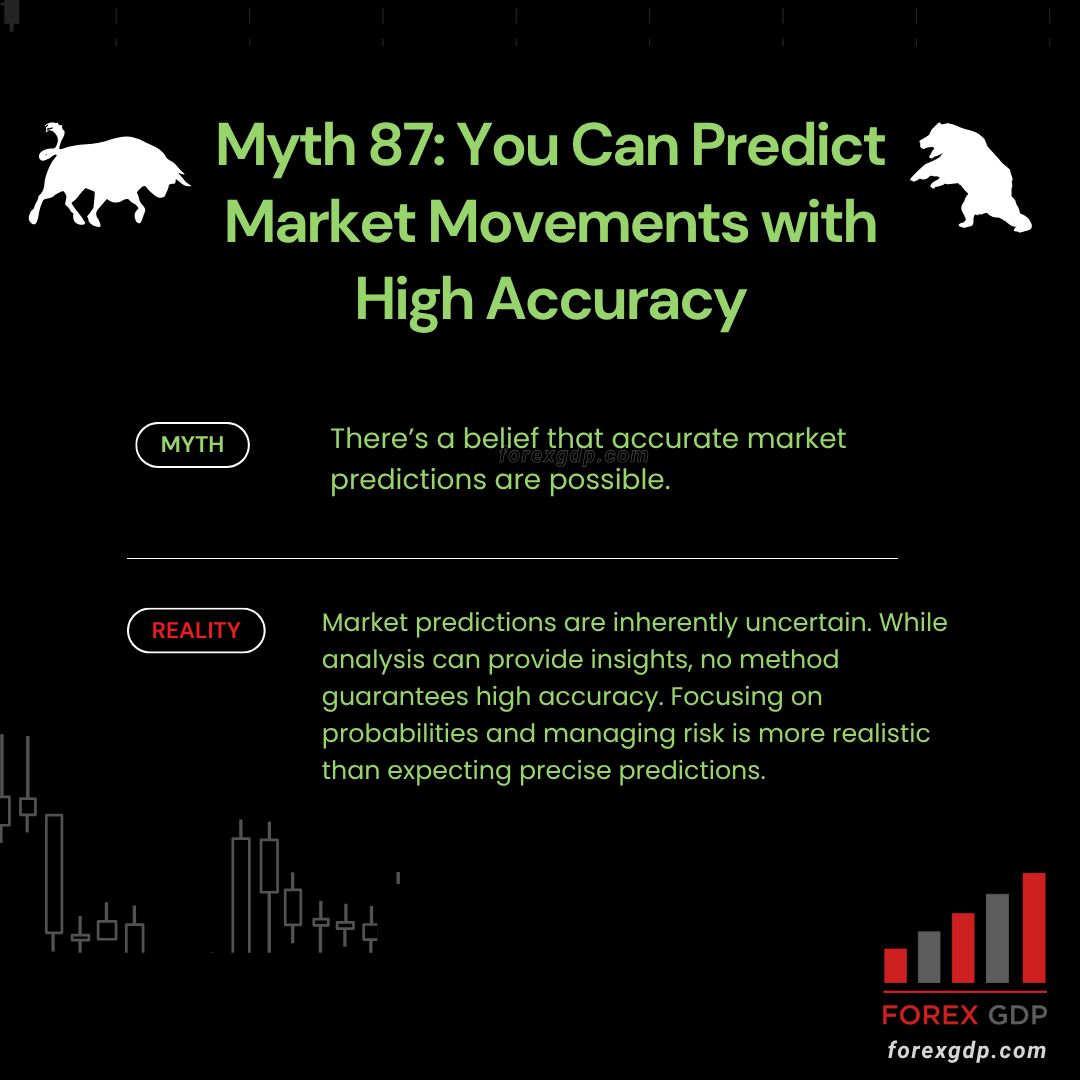
In this article, we’ll peel back the layers of this myth, uncover why people still fall for it, and most importantly, explain why risk management and probability-based thinking are far more valuable than chasing illusions of accuracy.
1. The Alluring Fantasy of Perfect Predictions
Why do so many traders want to believe in perfect predictions? It’s simple—certainty feels safe. When you think you know what’s coming, the stress melts away. It’s the same reason fortune tellers and horoscopes are popular: humans crave control.
But in trading, that craving for certainty is dangerous. It leads you to trust in “systems” or “gurus” who promise 95% win rates, magical indicators, or guaranteed profits. Spoiler alert—none of those things exist.
2. The Harsh Reality: Markets Don’t Follow a Script
Unlike a movie where the ending is already written, markets are like live theater—chaotic, unpredictable, and influenced by everything from central bank policy to Elon Musk’s latest tweet.
Sure, charts and analysis can highlight probabilities. But no matter how good your tools are, markets are moved by human emotion, economic surprises, and geopolitical shocks. Can anyone truly “predict” when the next war, inflation report, or sudden market panic will happen? Of course not.
3. Why People Still Chase Accuracy
If it’s impossible, why do traders still chase high accuracy predictions?
-
Greed: Who doesn’t want a shortcut to riches?
-
Fear of uncertainty: Losing money feels painful, so traders cling to anything that promises certainty.
-
Marketing traps: Countless “signal sellers” and scam brokers sell dreams of 90%+ accuracy.
The problem? Most traders find out the hard way that these promises collapse the moment the market behaves unpredictably.
4. The Role of Probability in Trading
Instead of thinking of trading as prediction, think of it like poker. Poker players don’t know the exact cards that will appear. What they know is probabilities—odds of winning based on the hand.
Successful traders play the same game. They don’t say, “The market will go up.” They say, “Based on this setup, there’s a 60% chance it goes up. If I manage my risk, I’ll profit over the long term.”
That shift—from prediction to probability—makes all the difference.
5. Risk Management Beats Accuracy Every Time

Here’s the funny thing about trading: you don’t need to be right most of the time to make money.
Imagine this:
-
You win only 40% of your trades.
-
But every time you win, you make twice what you risk.
-
Over time, you’re profitable.
Now compare that to a trader chasing 90% accuracy but risking big every trade. One bad loss can wipe out weeks or months of gains. That’s why seasoned traders always say: “Focus on risk, not predictions.”
6. The Danger of Overconfidence
Believing in high accuracy predictions creates overconfidence. Overconfidence makes you trade bigger, ignore stop-losses, and think you’ve “cracked the code.” And then—BOOM—the market slaps you with a massive loss.
Overconfidence is like driving blindfolded because you “just know” the road ahead is straight. You might get lucky for a while, but eventually, the crash is inevitable.
7. The Psychology Trap
The myth of high accuracy isn’t just technical—it’s psychological. Traders fall into cognitive biases like:
-
Confirmation bias: Only noticing signals that support their belief.
-
Recency bias: Assuming because the last three trades were winners, the next one must be too.
-
Gambler’s fallacy: Thinking the market “owes” them a win after a string of losses.
These biases fuel the illusion of predictability, making it even harder to accept reality.
8. Why Indicators Aren’t Magic
Let’s be honest—indicators can be helpful. RSI, moving averages, Fibonacci retracements—they all add value. But here’s the catch: indicators are tools, not crystal balls.
Indicators are based on past price data. They lag. They can highlight patterns, but they can’t predict the future with certainty. Believing otherwise is like driving forward while only looking in the rearview mirror.
9. The Influence of News and External Events

Another reason predictions fail? News.
You can have the perfect technical setup, and then a central bank suddenly announces a surprise rate cut. Your analysis doesn’t matter anymore—news just took control.
Markets are heavily influenced by events outside of charts and analysis. Political drama, natural disasters, sudden economic reports—all of these wreck the illusion of accuracy.
10. The Smarter Approach: Managing Risk
So, if perfect predictions don’t exist, what should traders do instead? Focus on:
-
Position sizing: Never risk more than you can afford to lose.
-
Stop-losses: Always have a clear exit point.
-
Diversification: Don’t put all your money in one pair or asset.
-
Risk-to-reward ratio: Aim for setups where the reward outweighs the risk.
This approach doesn’t guarantee winning every trade—but it guarantees survival, and in trading, survival is everything.
11. Case Studies: Accuracy vs. Risk
Consider two traders:
-
Trader A: Claims 90% accuracy but risks 20% of their account on each trade. One bad trade and their account is gone.
-
Trader B: Wins only 45% of trades but risks just 2% per trade and lets winners run. Over time, Trader B grows their account steadily.
Which one would you rather be?
12. The Freedom of Letting Go of Predictions
When you stop obsessing over being right, trading becomes less stressful. You don’t need to “predict” perfectly—you just need to manage risk and stay consistent.
It’s like surfing. You don’t predict the exact shape of every wave. You learn to ride the wave that comes, manage your balance, and stay on the board.
13. Why This Myth Refuses to Die
Even with all the evidence against it, the myth of accurate predictions keeps coming back. Why?
-
New traders: Every new generation of traders wants a shortcut.
-
Scammers: It’s profitable to sell dreams.
-
Hope: People cling to the fantasy because the reality feels harder.
But here’s the truth: facing reality makes you a stronger trader.
14. Building a Realistic Trading Mindset
If you want to last in the markets, your mindset matters more than your strategy.
-
Accept uncertainty as part of the game.
-
Focus on long-term consistency, not short-term perfection.
-
See losses as tuition fees for learning, not personal failures.
When you build a mindset rooted in probabilities and risk, you free yourself from the dangerous myth of high accuracy.
15. Conclusion
The idea that you can predict market movements with high accuracy is one of the most damaging myths in trading. It sets unrealistic expectations, fuels overconfidence, and leads countless traders to financial ruin.
The reality? Markets are inherently uncertain. No tool, strategy, or guru can give you guaranteed accuracy. The smarter path is to embrace uncertainty, focus on probabilities, and manage risk. It may not sound as exciting as “95% win rates,” but it’s the difference between burning out and building lasting success.
Stop chasing the illusion of accuracy and start focusing on what really matters—risk, probability, and discipline.
FAQs
1. Can anyone really predict the market?
No. No trader, system, or algorithm can predict market movements with guaranteed accuracy. The best you can do is identify probabilities.
2. Why do so many people claim 90% accuracy?
Because it sells. Many scammers exaggerate results to attract desperate traders. In reality, such accuracy is unsustainable.
3. If predictions don’t work, how do traders make money?
By managing risk, focusing on favorable risk-to-reward ratios, and maintaining consistency over time. Profit comes from discipline, not prediction.
4. Are indicators useless then?
Not at all. Indicators provide insights and context, but they should be used as tools—not relied on for exact predictions.
5. What’s the biggest mistake new traders make?
Chasing accuracy and ignoring risk. New traders want to be “right” instead of focusing on staying in the game long enough to grow steadily.