

When most people think of forex trading, the image that comes to mind is someone glued to multiple screens, staring at flickering candlesticks, sweating over every tick in the market. Sounds exhausting, right? But here’s the catch: this image is more myth than reality. While the forex market is indeed fast-moving, believing that you need to constantly monitor it is one of the biggest misconceptions holding traders back.
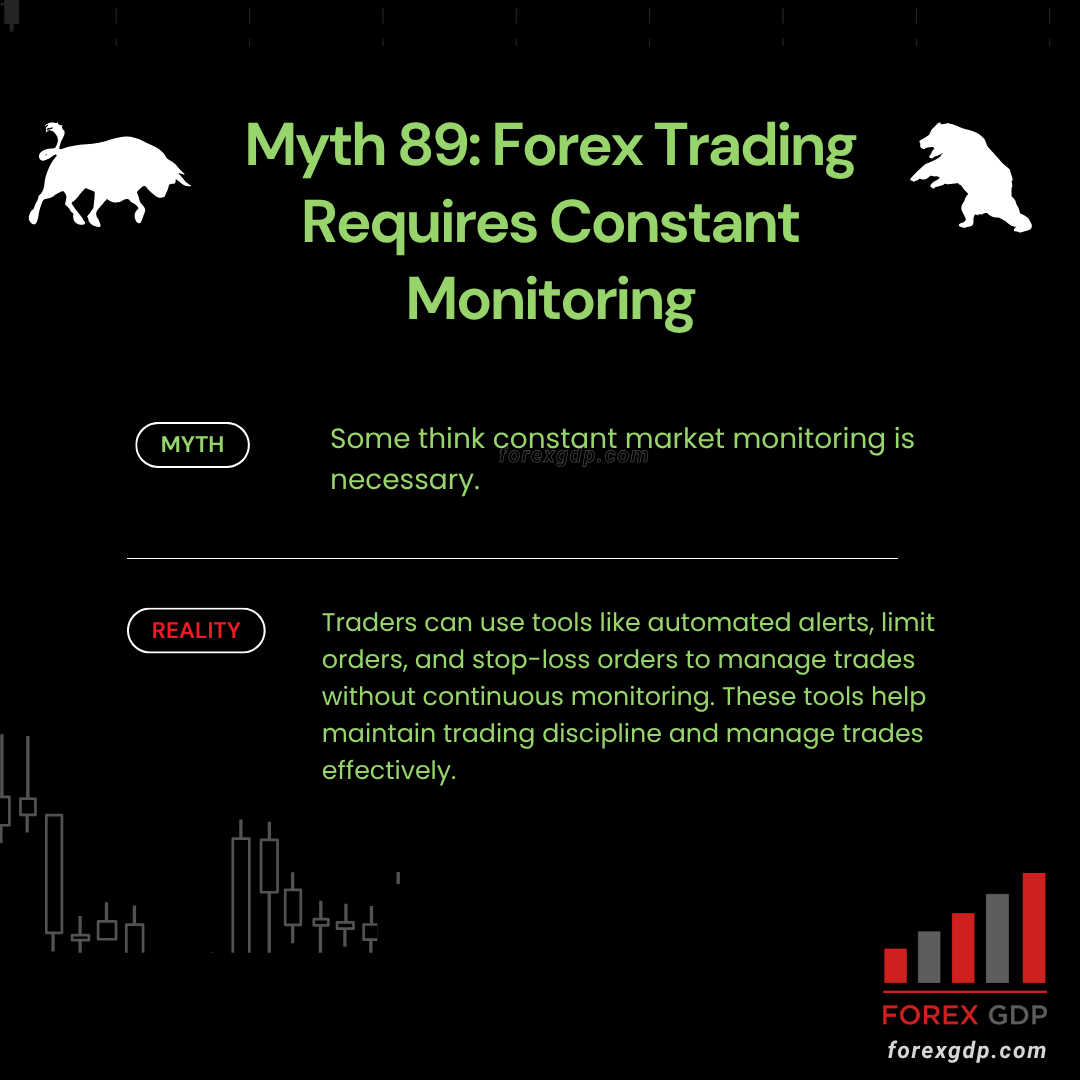
In this article, we’ll dig deep into why constant monitoring isn’t necessary, how smart traders actually manage their trades, and the tools that let you step away from your computer without risking your account. Let’s break the chains of this myth once and for all.
1. The Myth of Constant Monitoring
Many beginners assume that since the forex market runs 24 hours a day, five days a week, they must also be awake and watching their charts constantly. The fear of missing out (FOMO) convinces traders they need to hover over every candle.
But let’s face it — who can realistically watch charts for 24 hours straight without losing their sanity? Constant monitoring doesn’t make you a disciplined trader. It makes you a prisoner of the market.
2. The Reality: Tools That Do the Watching for You
The truth is, professional traders don’t babysit their trades. Instead, they set up systems that handle the heavy lifting. Tools like:
-
Stop-loss orders: Protect you from catastrophic losses while you sleep.
-
Take-profit orders: Secure your gains automatically when the price hits your target.
-
Limit orders: Enter trades at your preferred price without waiting at the screen.
-
Price alerts: Notify you when the market reaches a certain level.
These tools are your personal “market bodyguards,” freeing you from staring at screens endlessly.
3. Why Monitoring Feeds Stress and Bad Decisions
Let’s be brutally honest — the more time you spend staring at charts, the more likely you are to second-guess your plan. You start seeing patterns that aren’t really there. Your brain tricks you into thinking, “Just one more trade… maybe this one will hit big!”
Constant monitoring often leads to:
-
Overtrading – taking trades that don’t fit your strategy.
-
Emotional trading – making impulsive decisions based on fear or greed.

-
Burnout – trading stops being exciting and becomes a mental drain.
4. Trading Discipline Over Trading Addiction
Successful trading isn’t about being hyperactive in front of a screen. It’s about discipline — sticking to a plan, letting your rules work, and not getting swayed by every tick. Constant monitoring creates trading addiction. Discipline, on the other hand, creates consistent profits.
Think of it like a diet: if you obsessively weigh yourself every five minutes, you’ll panic at every small fluctuation. But if you stay disciplined, follow your plan, and check in at the right times, you’ll actually see progress.
5. The Psychology of Letting Go
Here’s the scary part for beginners: letting go of control. Many traders keep monitoring their trades because they don’t trust themselves or their strategy.
But successful traders learn this simple truth: once your trade is placed with proper risk management, there’s nothing more to do. Constant checking won’t make the market move in your favor. It just makes you anxious.
6. The Role of Automated Trading
If you truly can’t resist checking the charts, automation might be your best friend.
-
Expert Advisors (EAs) on MT4/MT5 can place and manage trades for you.
-
Copy trading platforms let you mirror professional traders without watching screens.
Automation doesn’t mean you’re lazy — it means you’re smart enough to let the system do what it’s built to do.
7. Risk Management: The True Secret Weapon
The reason traders feel the need to constantly monitor trades often boils down to fear of losing money. But here’s the thing: if you manage your risk properly, you won’t need to babysit trades.
A simple formula is this: never risk more than you’re comfortable losing. When your stop-loss is in place and your position size is correct, you can walk away without fear.
8. The Danger of Screen Addiction
Screen addiction in forex is real. Traders wake up in the middle of the night to check trades, sacrifice family time, and even compromise health. The irony? This constant monitoring usually leads to worse performance.
Instead of being sharper, your judgment becomes clouded. Instead of staying objective, you become emotionally entangled.
9. Swing Trading vs. Scalping: Which Needs More Monitoring?
Not all strategies are equal.
-
Scalping requires quick decision-making and short bursts of attention. You do need to watch the market more closely, but not for 24 hours.
-
Swing trading or position trading allows you to check charts once or twice a day. Perfect for traders who don’t want trading to consume their lives.
So, the level of monitoring depends on your trading style, not the market itself.
10. Why Beginners Fall for the Constant Monitoring Trap
Beginners often confuse activity with productivity. They think, “If I’m watching the market, I’m working hard.” In reality, sitting in front of the screen doesn’t guarantee profits — it just wastes your time.
Imagine a farmer digging up seeds every hour to see if they’ve grown. That’s what constant monitoring looks like in trading.
11. Practical Steps to Break Free
If you’re guilty of watching charts non-stop, here’s how to break free:
-
Set alerts instead of waiting for price levels.
-
Use pending orders to enter trades automatically.
-
Place stop-loss and take-profit before walking away.
-
Stick to your plan and resist interfering once the trade is live.
-
Limit your screen time – set specific check-in times.
12. Building a Stress-Free Trading Routine
Trading should not feel like a full-time hostage situation. Instead, build a simple, stress-free routine:
-
Analyze the market during your chosen time.

-
Place pending orders or alerts.
-
Walk away and live your life.
Remember, successful traders don’t sit in front of charts all day. They spend more time living life than watching candles.
Conclusion
The belief that forex trading requires constant monitoring is nothing more than a myth that traps beginners in stress and poor decision-making. With the right tools — stop-losses, alerts, pending orders, and risk management — you can step away from the screen and still manage trades effectively.
Constant monitoring doesn’t make you a better trader; it makes you a stressed one. The real pros know that trading success comes from discipline, patience, and letting go of the need to control every tick.
So, stop babysitting your trades. Trust your plan, set your tools, and let the market do its thing.
FAQs
1. Do professional traders monitor charts all day?
No, professionals rely on tools like alerts and stop-losses. They focus on strategy, not screen time.
2. Can I make money in forex without watching charts constantly?
Absolutely. With risk management and the right tools, you don’t need constant monitoring to succeed.
3. Which trading style requires less monitoring?
Swing trading and position trading require minimal monitoring compared to scalping.
4. What happens if I don’t watch my trades?
If you’ve set stop-loss and take-profit orders, nothing bad happens. Your trades will run according to plan.
5. Why do beginners feel the need to constantly monitor?
Mostly due to fear, lack of trust in their strategy, and the false belief that screen time equals productivity.