

Trading isn’t a straight road to success—it’s a winding path filled with potholes, detours, and the occasional crash. If you’ve ever felt crushed after a losing trade, you’re not alone. The truth is, losses don’t make you a bad trader; they make you a human trader. And more importantly, every losing trade carries valuable lessons—if you’re willing to see them.
In this article, we’ll dive deep into the mindset behind losses, why they shouldn’t be labeled as failures, and how you can use them as powerful feedback to improve your strategy. By the end, you’ll see losing trades not as dead ends, but as stepping stones to long-term profitability.
Why Losses Sting More Than Wins
Ever noticed how one losing trade hurts more than five winning trades feel good? That’s psychology at work. Humans are naturally wired to fear loss—it’s called loss aversion. In trading, this means you might obsess over a losing trade for days, ignoring the wins that came before it.
But here’s the kicker: when you let the sting of a loss cloud your judgment, you risk making rash decisions like revenge trading. Recognizing this bias is the first step to controlling it.
The Myth of “Failure” in Trading
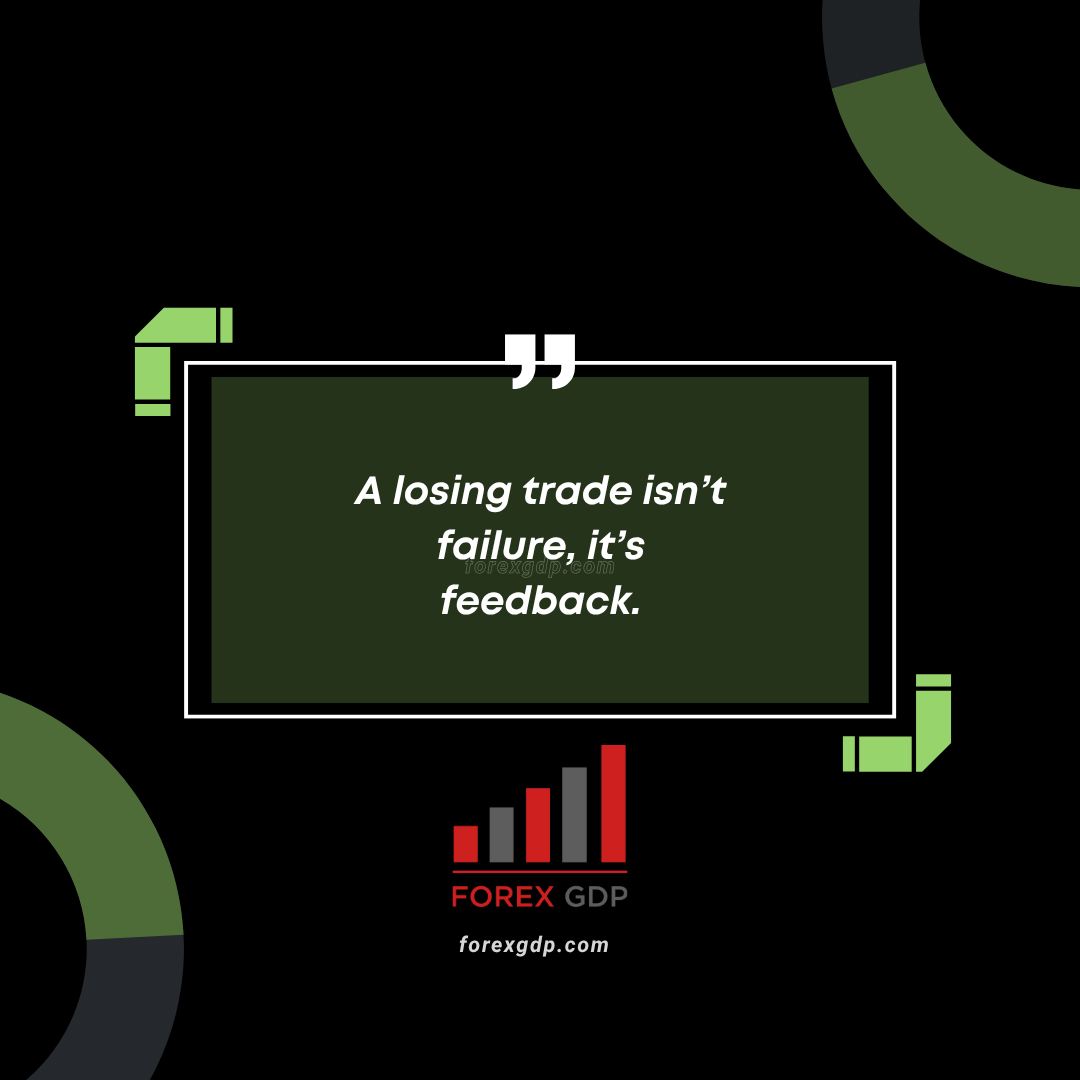
Most traders quit early because they see losing trades as failures. But ask yourself: is it really a failure if you learned something valuable from it? The market isn’t a school exam where wrong answers get you an “F.” It’s more like a coach—sometimes harsh, but always teaching.
If you reframe losses as feedback, you’ll stop fearing them and start analyzing them.
Feedback vs. Failure: The Subtle but Crucial Difference
Let’s get this straight:
-
Failure mindset: “I lost money, so I’m a bad trader.”
-
Feedback mindset: “I lost money, but why? What can I adjust?”
This simple shift turns a negative experience into a learning opportunity. Just like an athlete reviewing game footage, you can review trades to understand what went wrong.
Common Causes of Losing Trades
Not every loss comes from a bad strategy—sometimes it’s just market noise. But often, losses boil down to:
-
Poor risk management (risking too much on a single trade).
-
Lack of patience (jumping in too early or exiting too soon).
-
Ignoring stop-loss rules (holding and hoping).
-
Overtrading (trying to “make back” losses).
-
Emotional trading (fear, greed, or frustration taking the wheel).
Spotting which of these is tripping you up is half the battle.

The Importance of a Trading Journal
Think of a trading journal as your personal “black box recorder.” Every plane crash is investigated to find the cause, and trading should be no different. Record:
-
Reasons for entering the trade.
-
Market conditions.
-
Emotions felt during the trade.
Over time, patterns emerge. You might notice you lose more on Fridays, or when you skip analyzing fundamentals. That’s feedback you can use.
Learning from Losses: A Step-by-Step Approach
Here’s a practical way to turn losing trades into lessons:
-
Pause – Don’t react immediately. Breathe.
-
Review – Look at your trade entry, exit, and market context.
-
Identify mistakes – Was it strategy, risk management, or emotion-driven?
-
Adjust – Modify your approach for next time.
-
Move on – Don’t dwell. Apply the lesson and take the next opportunity.
Losses only become failures if you repeat them without change.
Why Chasing Perfection Will Kill Your Account
Many traders think they need a 90% win rate to succeed. Reality check: some of the most profitable traders only win 40–50% of the time. The difference? They manage risk so well that their wins outweigh their losses.
Stop aiming to never lose—it’s impossible. Instead, aim to lose small and win big.
Risk Management: The Safety Net for Traders
A losing trade doesn’t have to be catastrophic. That’s where risk management comes in:
-
Never risk more than 1–2% of your capital on a single trade.
-
Always use stop-loss orders.
-
Diversify—don’t put all your money into one currency pair.
Think of risk management like a seatbelt. You hope you don’t need it, but it saves you when things go wrong.
The Emotional Rollercoaster of Trading
Trading is 20% strategy and 80% psychology. A losing trade can make you angry, fearful, or desperate. If you don’t control those emotions, you’ll spiral into bad decisions. That’s why successful traders treat losses like business expenses—they’re part of the cost of doing business.
Would you shut down a restaurant because one customer complained? Of course not. So why quit trading over one bad trade?
Adapting Strategies: Markets Change, and So Should You
Sometimes, losing trades are a sign that the market has shifted. A strategy that worked during a trending market might fail in a choppy one. Instead of stubbornly clinging to one method, adapt. Just like a sailor adjusts sails to the wind, traders must adjust strategies to market conditions.
The Hidden Gift of Losing Trades
Here’s the silver lining: losing trades force you to improve. They expose weaknesses you’d otherwise ignore. Think of them as brutal teachers—they don’t sugarcoat the truth, but they make you stronger.
Without losing trades, you’d never refine your edge or develop discipline.
Building Resilience as a Trader
The traders who survive aren’t the ones who never lose—they’re the ones who keep showing up after losses. Resilience means:
-
Accepting that losses are part of the journey.
-
Staying calm under pressure.
-
Focusing on the bigger picture instead of short-term results.
Think marathon, not sprint.
Practical Examples: Losses as Feedback
-
Scenario 1: You risked 10% of your account on one trade and blew half your capital in a week. Lesson? Lower risk per trade.
-
Scenario 2: You ignored fundamentals and traded based only on charts. The market shifted after a central bank announcement. Lesson? Respect fundamentals.
-
Scenario 3: You let emotions push you into revenge trading after a loss. Lesson? Discipline beats impulse.
Each scenario shows how a losing trade isn’t wasted—it’s tuition paid to the “market university.”
Creating a Positive Feedback Loop
If you use losses as feedback, you’ll create a positive feedback loop:
-
Trade.
-
Lose (small).
-
Learn.
-
Improve.
-
Trade better.
Repeat this cycle, and your growth as a trader compounds over time.
When Losing Becomes Dangerous
Let’s be real: not all losses are harmless feedback. If you’re consistently blowing accounts, ignoring rules, or gambling instead of trading, that’s a red flag. At that point, the issue isn’t feedback—it’s reckless behavior. The line between learning and self-destruction is thin, so know when to step back.
Conclusion
A losing trade isn’t the end of the world—it’s just feedback. The market isn’t punishing you; it’s teaching you. If you stop seeing losses as failures and start treating them as stepping stones, you’ll shift from a fragile trader to a resilient one. Remember: consistency and discipline matter more than perfection. The best traders aren’t those who never lose—they’re the ones who never stop learning.
FAQs
1. How do I stop feeling bad after a losing trade?
Shift your mindset—remind yourself it’s feedback, not failure. Use journaling and review to turn the loss into a lesson.
2. Can I be profitable if I lose more trades than I win?
Yes! With proper risk management, you can lose 60% of trades and still profit if your winners are bigger than your losers.
3. What’s the best way to analyze a losing trade?
Break it down: Was it your strategy, emotions, or risk management? Write it out in a journal for clarity.
4. Should I keep trading after a big loss?
Usually, no. Take a break, clear your head, and review what went wrong. Trading emotionally leads to more mistakes.
5. Is it possible to completely avoid losing trades?
No. Losses are inevitable in trading. The goal isn’t to avoid them but to manage and learn from them.