

Busting the Forex Small Account Myth
You’ve probably heard it countless times: “Forex trading only works if you have a big account.” Sounds convincing, right? After all, how can you possibly compete with traders moving thousands (or even millions) of dollars? But here’s the truth — that’s just another myth holding you back from real opportunity.
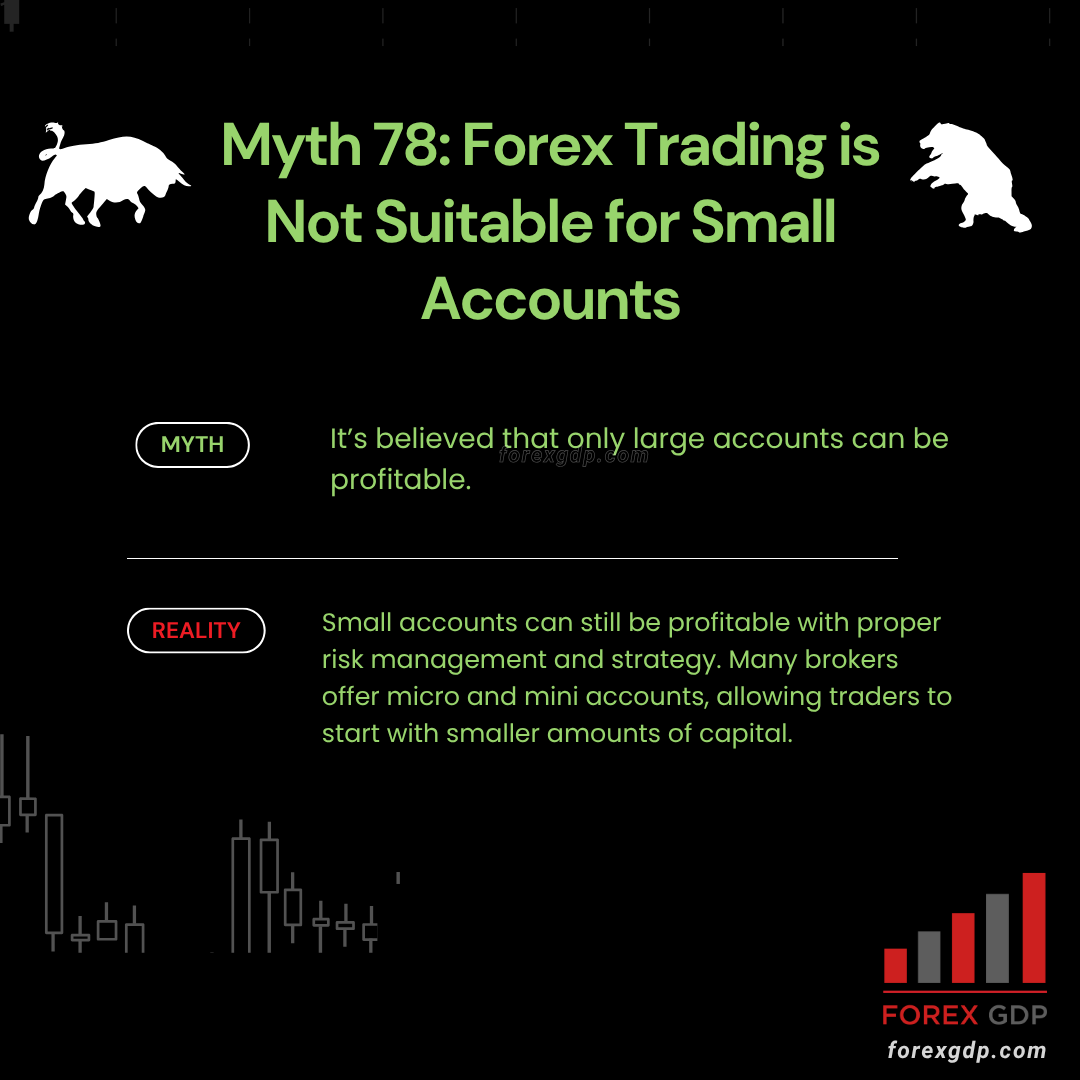
In this article, we’re diving deep into Myth 78: Forex trading is not suitable for small accounts — and completely tearing it apart. By the end, you’ll not only understand why small accounts can thrive in forex, but also how to make yours grow with smart risk management and strategy.
Let’s uncover the truth step by step.
The Origin of the “Big Account” Myth
This myth didn’t appear out of nowhere. For years, trading was dominated by big institutional players — hedge funds, banks, and high-net-worth investors. The perception was simple: more capital means more power.
And sure, in some ways, that’s true — large accounts allow bigger trades, which means larger profits per pip. But that doesn’t mean small traders are out of the game.
Today’s forex market is accessible to anyone with an internet connection and as little as $10. Brokers offer micro and mini accounts, allowing even beginners to start small. What used to be a game for the rich is now open to everyone — including you.
Why Small Accounts Are Misunderstood
Let’s be real — the forex world can be intimidating. Charts, technical jargon, and aggressive marketing by “big players” can make small traders feel like outsiders. Many new traders think they can’t make meaningful profits unless they have a large account.
But that’s like saying you can’t win a marathon unless you start with long legs — it’s not about the legs, it’s about endurance and strategy.
The same goes for trading. Small accounts fail not because they’re small, but because of poor planning, overleveraging, or unrealistic expectations. When managed properly, even a $100 account can grow over time.
The Power of Leverage in Forex
Leverage is one of the most powerful tools that make forex accessible to small traders. It allows you to control larger positions with smaller amounts of capital.
For instance, with a 1:100 leverage, a $100 deposit lets you control a $10,000 position. That’s the beauty of forex — small accounts can participate in big markets.
However, leverage is a double-edged sword. Used wisely, it amplifies profits. Used recklessly, it can wipe out an account in seconds. The trick is to use leverage strategically — treat it like a tool, not a weapon.
Micro and Mini Accounts: The Game-Changers

In the past, you couldn’t even enter the forex market without a hefty sum. Now, thanks to micro and mini accounts, anyone can start with $10, $50, or $100.
Micro accounts allow you to trade 0.01 lots, meaning you risk just a few cents per pip. This gives you flexibility to practice and grow without blowing your entire balance.
These smaller accounts are perfect for learning, testing strategies, and understanding market behavior before scaling up.
Risk Management: The Shield of Small Traders
If you remember just one thing from this article, make it this: risk management is the lifeblood of small account trading.
A big mistake beginners make is risking too much on one trade — hoping for a quick win. That’s not trading, that’s gambling.
Smart traders use the 1–2% rule — never risk more than 2% of your account on a single trade. So if you have $200, your max risk per trade should be around $4. It might sound small, but consistency beats aggression every time.
The Power of Compounding in Small Accounts
Ever heard the saying, “Small drops make an ocean”? That’s exactly how compounding works in forex.
Let’s say you make a modest 5% return per month. On a $100 account, that’s $5. Not exciting, right? But keep doing that for a year, and you’ll see steady growth. Compound that over several years, and your small account could turn into something substantial.
The secret is patience — forex isn’t a get-rich-quick scheme; it’s a long-term skill that rewards discipline.
Setting Realistic Expectations
Here’s a harsh truth: most traders fail because they expect to turn $100 into $10,000 overnight. That’s not realistic — and it’s the fastest way to blow your account.
Instead, focus on percentage growth, not dollar growth. If you’re consistently gaining 3–5% a month, you’re doing better than most traders out there — even some professionals.
Remember: trading is a marathon, not a sprint. You don’t have to be rich to start, but you have to be smart to survive.
The Role of Emotions in Small Account Trading
When your account balance is small, every trade feels personal. A $5 loss might not sound like much, but when it’s 5% of your account, it hurts.
This emotional rollercoaster can make you overtrade, revenge trade, or chase losses — all major account killers.
The best traders learn to detach emotions from decisions. Stick to your plan, trust your analysis, and don’t let temporary losses shake your confidence. After all, even the best traders lose sometimes — what matters is how you respond.
Building a Strategy That Fits Small Accounts


Your trading strategy doesn’t have to be fancy — it just needs to be consistent and realistic.
Small account traders should focus on high-probability setups, like trading around key support and resistance levels, or following simple price action strategies. Avoid overcomplicating things with 10 indicators on one chart.
Also, focus on higher timeframes (H4, daily) to avoid market noise. Patience pays more than constant trading.
Scaling Up: Turning Small Wins into Big Gains
Once you’ve proven your consistency, scaling up becomes easier. You don’t need to double your risk — simply increase your position size gradually as your balance grows.
For example, if you start with $200 and grow it to $400, you can slightly increase your lot size. But always maintain the same risk percentage per trade.
Slow, steady growth is sustainable growth. That’s how small accounts eventually evolve into large ones.
Common Mistakes Small Account Traders Make
Let’s be honest — small account traders face unique challenges. Here are some of the biggest pitfalls:
-
Overleveraging: Using high leverage for quick profits.
-
Overtrading: Taking too many trades without clear setups.
-
Ignoring stop-losses: Hoping the market “comes back.”
-
Unrealistic goals: Expecting to double the account every week.
-
Copying others blindly: Not understanding the strategy you’re using.
Each of these mistakes can destroy a small account. The good news? Every one of them is avoidable.
How Brokers Empower Small Traders
Many brokers now cater specifically to small account holders. They offer low minimum deposits, micro lots, and tight spreads, making forex more accessible than ever.
Some even provide demo accounts to practice trading without risking real money. This gives you a chance to develop confidence and test strategies before going live.
In short, brokers have leveled the playing field — it’s not about how much money you start with, but how you use it.
Patience: The Ultimate Secret Weapon


Patience is underrated in trading. The market doesn’t care how badly you want to make money — it rewards discipline, not desperation.
Small account traders often feel the urge to “catch up” by taking more trades. That’s the worst move you can make. Instead, wait for clean setups that align with your plan.
One well-planned trade can make up for five impulsive ones. Remember — quality over quantity.
Turning a Small Account into a Learning Opportunity
If you treat your small account like a training ground instead of a money machine, you’ll progress much faster.
Every trade teaches you something — whether it’s technical, emotional, or psychological. Think of it as paying tuition to the “school of trading.”
By managing a small account wisely, you’re building habits that will serve you when you handle larger sums later.
Real Examples of Small Account Success Stories
Plenty of successful traders started small. Many began with $100 or less, focusing on learning rather than earning. Over time, consistency paid off.
For instance, some traders use copy trading or signal services to supplement their learning, observing how experienced traders make decisions. By combining education with experience, they turn small beginnings into sustainable careers.
Your story could be next — but only if you treat your small account seriously.
Tools and Resources for Small Account Traders
Don’t underestimate the tools available to you. Use:
-
Trading journals to track progress and analyze mistakes.
-
Economic calendars to stay informed about market events.
-
Risk calculators to determine position sizes accurately.
-
Educational platforms (like ForexGDP, BabyPips, etc.) for continuous learning.
These tools help you think like a professional — even if your account is still small.
The Mindset Shift You Need


The biggest difference between a losing trader and a winning one isn’t capital — it’s mindset.
Stop thinking, “I have too little to make an impact.” Instead, think, “I’m learning to master this craft.” That shift in thinking changes everything.
When you trade with discipline and patience, your results start to reflect it. Before long, you’ll realize that a small account isn’t a limitation — it’s an opportunity.
Final Thoughts: The Size of Your Account Doesn’t Define You
At the end of the day, forex trading is about skill, discipline, and mindset — not the number on your account balance. A large account can magnify profits, but it also magnifies mistakes.
If you can grow a small account consistently, you’ve proven your mastery. That’s how professional traders are born — not from luck, but from resilience and smart choices.
So don’t wait to have “enough money” to start trading. Start with what you have, learn the ropes, and build your foundation. The market rewards those who respect the process.
Conclusion
The idea that forex trading isn’t suitable for small accounts is a myth — and a dangerous one at that. Small accounts can be just as profitable, provided you use solid risk management, realistic expectations, and emotional control.
In fact, starting small often gives you an edge — it forces discipline, patience, and strategic thinking. Remember, every successful trader was once a beginner with a small account and big dreams.
Your small start isn’t your weakness — it’s your training ground.
FAQs
1. Can I start forex trading with just $100?
Yes! Many brokers allow you to start with as little as $10–$100 through micro or mini accounts. Just make sure to manage your risk wisely.
2. How much profit can I realistically make from a small account?
That depends on your consistency. A steady 3–5% monthly growth is realistic and sustainable over time.
3. Is leverage safe for small accounts?
It can be — if used carefully. Avoid high leverage unless you fully understand how it works. Stick to moderate levels like 1:50 or 1:100 initially.
4. What’s the biggest mistake small account traders make?
Overtrading and unrealistic expectations. Trying to double your account overnight often leads to losses.
5. How long does it take to grow a small forex account?
There’s no fixed timeline. It depends on your discipline, learning pace, and consistency — but remember, slow growth is better than sudden loss.