
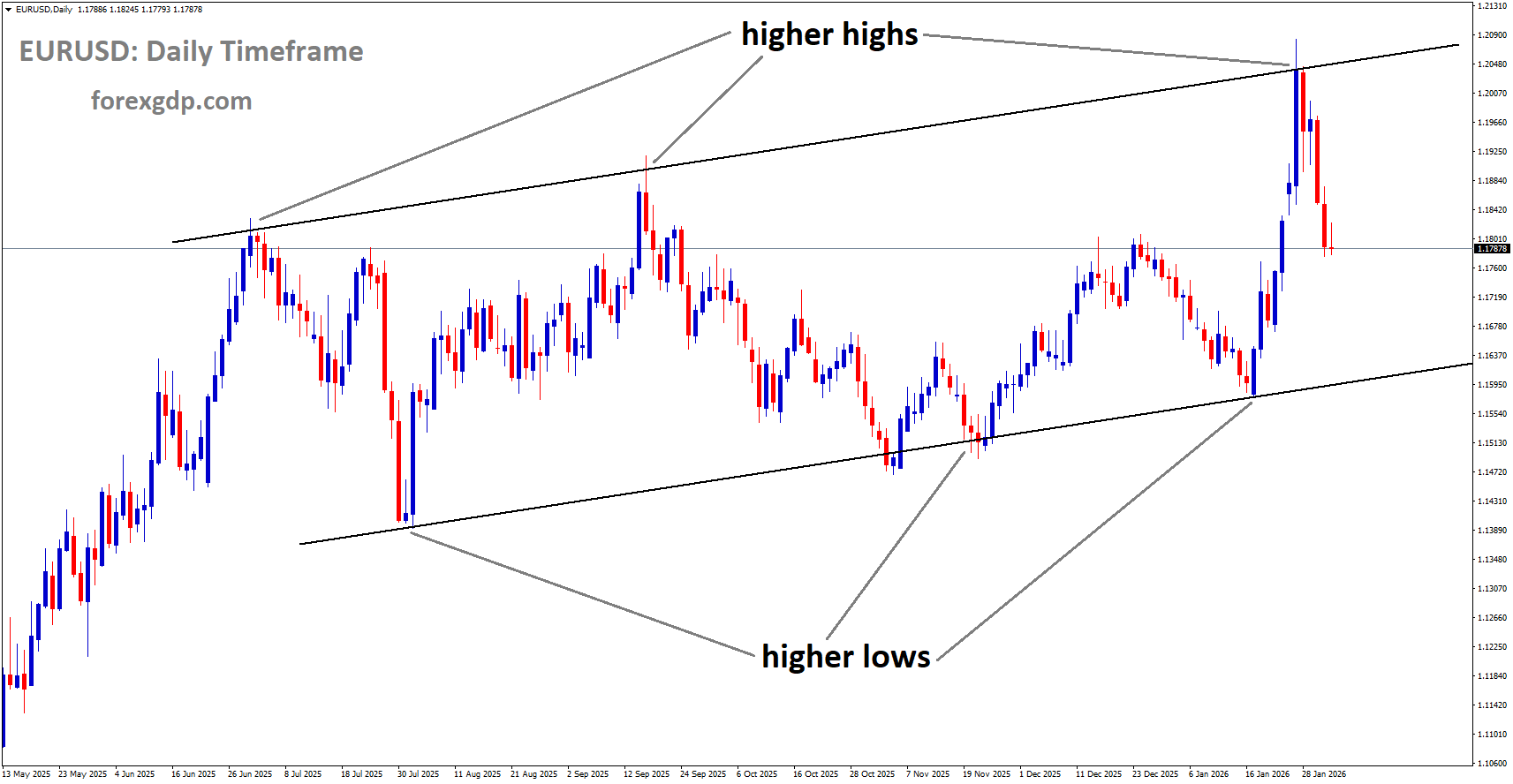
EURUSD is moving in an uptrend channel, and the market has fallen from the higher high area of the channel
EURUSD Pulls Back as Positive U.S. Developments Fuel Dollar Demand
The EUR/USD pair lost momentum on Tuesday as the US Dollar regained strength, pulling the Euro lower after a brief recovery. While the common currency attempted to build on earlier gains, it struggled to hold its ground as investors shifted their focus back to the United States. Positive developments on the trade front, improving economic data, and easing geopolitical tensions all helped restore confidence in the Greenback.
At the same time, lingering uncertainty around US government funding and delayed labor data has added an extra layer of caution to the market. With several key economic events lined up for the rest of the week, traders remain alert, adjusting their expectations as new information emerges.
Euro Weakens as Dollar Sentiment Improves
The Euro began the week on a firmer note but failed to maintain that strength as the US Dollar found renewed support. Early optimism around the shared currency faded once investors reassessed the broader economic picture. Strong signals from the US manufacturing sector and encouraging political developments shifted attention back toward the Dollar.
The balance between the Euro and the Dollar often reflects confidence in economic growth and policy stability. In this case, the flow of supportive news from the US side outweighed Eurozone-related factors, prompting a pullback in the pair. This move highlights how quickly market sentiment can change when fresh data and headlines enter the picture.
While the Eurozone continues to navigate its own economic challenges, there were no major catalysts on Tuesday strong enough to counter the upbeat tone coming from across the Atlantic.
Trade Deals Lift Confidence in the US Economy
One of the biggest drivers behind the Dollar’s renewed strength was news of progress on the trade front. The US administration announced a trade agreement with India that includes a significant reduction in tariffs on Indian goods. This move was welcomed by investors, as it signals improved cooperation between two major economies and reduces the risk of prolonged trade tensions.
Trade agreements often support a country’s currency because they can boost exports, strengthen business confidence, and encourage investment. In this case, the deal with India reinforced the view that the US is actively working to secure favorable trade relationships, which may support economic growth over the longer term.
Adding to the positive tone, there was also renewed optimism around US relations with Iran. Comments from Iran’s president suggesting that nuclear talks with the US will resume helped ease geopolitical concerns. Lower geopolitical risk typically supports the US Dollar, as investors feel more comfortable holding US assets when global tensions decline.
Strong Manufacturing Data Boosts the Dollar

Economic data also played a key role in supporting the US Dollar. Recent manufacturing reports showed a clear improvement in activity, exceeding market expectations and marking the strongest performance in several years. This rebound in factory activity suggests that parts of the US economy remain resilient despite higher interest rates and global uncertainty.
Manufacturing data is closely watched because it provides insight into business confidence, production levels, and future demand. Strong readings often point to healthier economic conditions, which can support a currency by reinforcing expectations that growth remains on track.
The positive data helped offset concerns linked to political uncertainty in Washington. Even as discussions around government funding continued, investors appeared more focused on the encouraging economic signals coming from the private sector.
Government Shutdown Concerns Take a Back Seat
Concerns about a partial US government shutdown had initially weighed on market sentiment. The failure of Congress to approve funding for certain federal agencies raised fears of disruptions to public services and economic reporting. However, these worries eased after the Senate approved a bill aimed at reopening affected agencies.
The legislation now awaits approval from the House of Representatives, which is expected to take up the vote shortly. While the situation is not fully resolved, investors appear confident that a prolonged shutdown will be avoided.
That said, the funding impasse has already had some impact. Several key labor market reports scheduled for this week will be delayed as a result of the partial shutdown. These delays reduce near-term clarity around the state of the US job market, which remains a critical factor for monetary policy decisions.
Focus Shifts to Central Banks and Labor Data
With immediate political concerns fading into the background, attention is turning to upcoming economic events. A speech from Federal Reserve Governor Michelle Bowman is set to draw interest, as markets look for clues about the central bank’s outlook on inflation, growth, and interest rates.
Central bank communication plays a major role in shaping currency movements. Any hints about future policy direction can influence expectations and drive shifts in the EUR/USD pair.
Later in the week, employment data will come into focus, starting with a private-sector jobs report. Although official government employment figures will be delayed, investors will still use available data to gauge the strength of the labor market. A resilient jobs picture would further support the US Dollar, while signs of weakness could revive demand for the Euro.
On the European side, the European Central Bank’s monetary policy decision is also approaching. While no dramatic changes are expected, traders will closely analyze the ECB’s tone and guidance for insight into how policymakers view the region’s economic outlook.
Market Mood Remains Cautious but Balanced
Overall, the current market environment reflects cautious optimism. The US Dollar is benefiting from a mix of strong data, improving trade relations, and easing geopolitical risks. At the same time, unresolved issues such as government funding and delayed economic reports prevent investors from becoming overly confident.
For the Euro, the challenge lies in finding fresh drivers that can shift sentiment back in its favor. Without major positive surprises from the Eurozone, the currency remains vulnerable to periods of Dollar strength.
As the week unfolds, the balance between political developments, economic data, and central bank messaging will continue to shape the direction of the EUR/USD pair. Traders are likely to remain flexible, responding quickly as new information becomes available.
Summary
The EUR/USD pair retreated as the US Dollar regained support from upbeat manufacturing data and positive trade developments. Agreements with key global partners and signs of easing geopolitical tensions helped lift confidence in the US outlook. While concerns over a partial government shutdown linger, investor focus has shifted toward upcoming central bank events and labor market indicators. With both political and economic factors in play, market participants remain watchful, prepared to adjust their expectations as the broader picture continues to evolve.
GBPUSD Loses Momentum Ahead of Key UK Policy Update
The Pound Sterling is trading with caution as investors wait for an important policy decision from the Bank of England later this week. Market participants are stepping back from taking strong positions, choosing instead to watch how the central bank plans to guide the economy in the coming months. This careful mood has pushed the Pound slightly lower against several major currencies, including the US Dollar and the Euro.
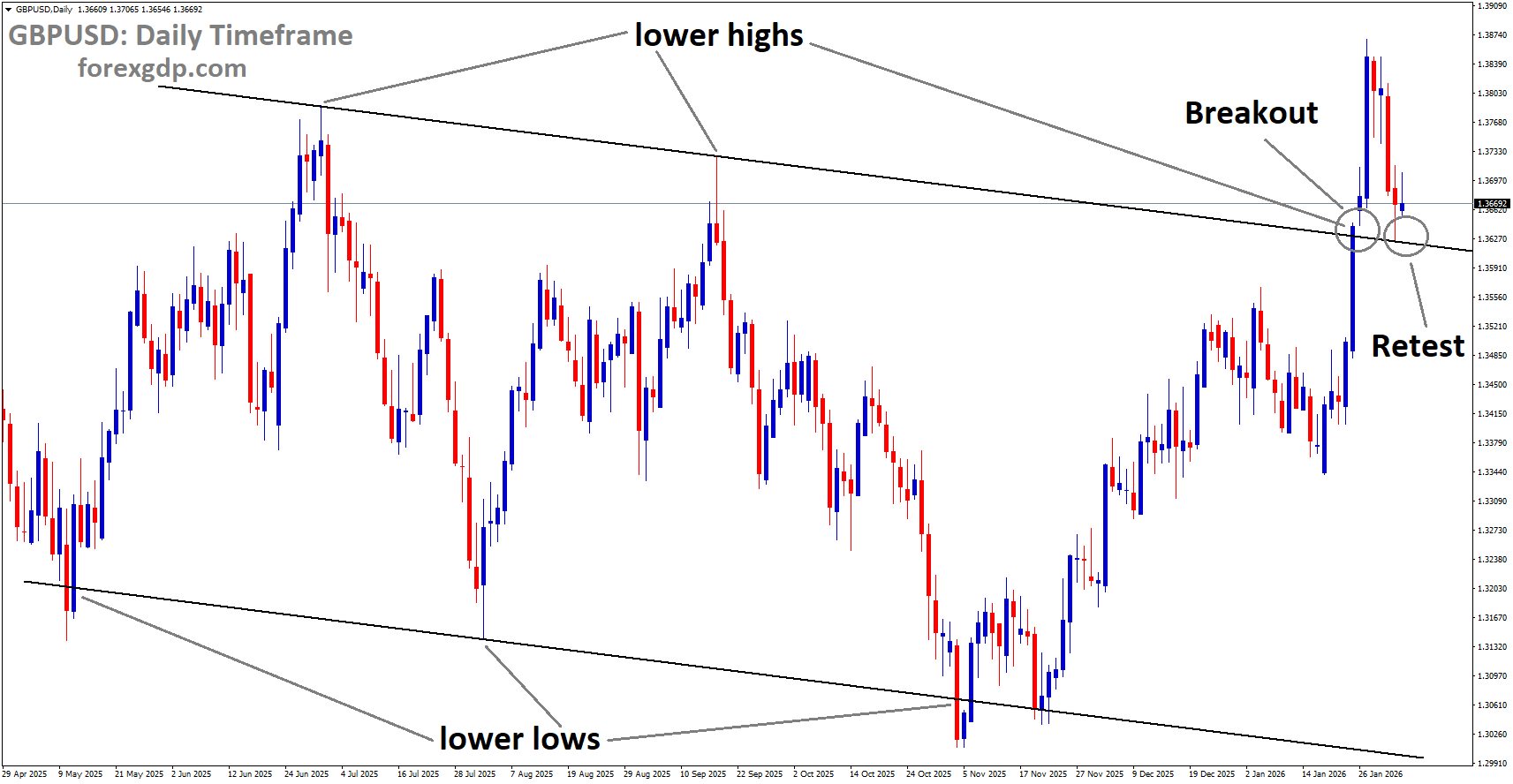
GBPUSD reached the retest area of the broken downtrend channel
The main focus is Thursday’s Bank of England announcement, which is expected to provide clarity on interest rates, inflation, and the state of the UK economy. With uncertainty still present across global markets, traders are paying close attention to every signal coming from policymakers on both sides of the Atlantic.
Bank of England Expected to Hold Steady
Most investors believe the Bank of England will leave interest rates unchanged at its upcoming meeting. After cutting rates in December, policymakers have emphasized that future changes will follow a slow and cautious path. This has helped set expectations for stability in the short term, even as economic conditions continue to evolve.
Recent meetings showed deep divisions among policymakers, but this time the vote is expected to show much stronger agreement. That shift suggests that officials are broadly aligned on the current outlook and are comfortable waiting to see how earlier policy changes affect the economy before taking further action.
While the decision itself is important, many traders see it as only part of the story. The Bank of England has made it clear that it wants to avoid moving too quickly, especially as inflation pressures gradually ease and economic growth remains uneven.
Why the Governor’s Comments Matter
Beyond the interest rate decision, attention will quickly turn to the press conference led by Governor Andrew Bailey. His remarks often provide valuable insight into how the central bank views key issues such as inflation, wage growth, and employment conditions.
At the previous meeting, officials expressed confidence that inflation is moving closer to the central bank’s target over the medium term. Investors will now be looking for confirmation that this outlook remains intact. Any change in tone, whether more optimistic or more cautious, could influence how markets view the future path of monetary policy.
Comments about the labor market will be especially important. Employment trends play a major role in shaping inflation expectations, and even subtle hints about rising or easing pressures could impact market sentiment toward the Pound.
Pound Faces Pressure Against Major Currencies
During the early part of the week, the Pound has slipped modestly against both the US Dollar and the Euro. This movement reflects a mix of domestic caution and external strength in other currencies rather than any major shift in the UK economic outlook.
Against the US Dollar, the Pound has struggled as the Greenback remained firm following a recent rally. Although the US currency has shown some signs of easing, it continues to benefit from strong economic signals and global demand for safe-haven assets.
The Pound has also edged lower against the Euro, as traders prepare for policy updates from both the Bank of England and the European Central Bank. With major announcements clustered together, many investors prefer to reduce exposure until there is more clarity.
US Dollar Strength and Government Shutdown Concerns
The US Dollar has been one of the stronger performers in recent sessions, supported by political developments and encouraging economic data. The nomination of a new Federal Reserve chair added to the sense of stability around US monetary policy, while fresh data suggested renewed momentum in the manufacturing sector.
However, gains in the Dollar have started to slow as concerns grow over a partial US government shutdown. While shutdowns have occurred before, they still introduce uncertainty, especially when key economic data releases are delayed or disrupted.
One notable impact is the delay of the highly watched US employment report. With official labor data postponed, investors are placing greater importance on alternative indicators that can offer insight into job market conditions.
Focus Shifts to US Employment and Services Data

In the absence of official employment figures, private-sector job reports have taken on added significance. These reports are now seen as a crucial source of information for understanding labor demand and overall economic health in the United States.
At the same time, investors are closely watching data from the US services sector. As services make up a large portion of economic activity, any signs of strength or weakness can quickly influence expectations for future interest rate decisions by the Federal Reserve.
Together, these data points are shaping how traders view the balance between economic resilience and potential risks, which in turn affects the performance of the US Dollar against currencies like the Pound.
Euro Gains Slightly Ahead of ECB Meeting
The Euro has shown mild strength against the Pound as markets look ahead to the European Central Bank’s policy decision. Like the Bank of England, the ECB is widely expected to keep interest rates unchanged, reflecting confidence that inflation is broadly under control.
Investors are also awaiting fresh inflation data from the Eurozone, which will be released ahead of the central bank meeting. These figures are expected to confirm that price pressures remain close to the ECB’s target, supporting the case for policy stability.
While the Euro’s gains have been modest, they reflect a broader trend of caution as traders assess how European policymakers will respond to slowing growth and lingering global uncertainties.
Global Uncertainty Keeps Markets on Edge
Across currencies, the current environment is defined by patience and caution. Central banks are signaling a desire to move slowly, balancing the need to support growth without reigniting inflation. This has led to smaller, more controlled market moves rather than sharp swings.
Political developments, such as government shutdowns and leadership changes, are adding another layer of uncertainty. Even when economic data appears positive, these factors can limit investor confidence and encourage a wait-and-see approach.
For the Pound Sterling, this means short-term pressure may persist until clearer signals emerge from policymakers and economic indicators provide stronger direction.
Final Summary
The Pound Sterling is trading cautiously as investors await guidance from the Bank of England and other major central banks. Expectations are firmly set for interest rates to remain unchanged, shifting the spotlight to official comments on inflation and employment. Meanwhile, the US Dollar has held firm despite political uncertainty, and the Euro has edged higher ahead of its own policy decision. With key data releases and central bank announcements approaching, markets remain focused on clarity, stability, and the next steps for global monetary policy.
USDJPY Surges Higher as Dollar Strength Returns and Markets Eye US Reports
The USD/JPY currency pair continues to show strength, extending its upward move for a third straight trading session. This steady advance reflects a broader trend of US Dollar dominance in global markets, driven by political developments in the United States and encouraging economic data. While the Japanese Yen struggles to gain traction, the balance of momentum remains firmly tilted in favor of the Dollar.
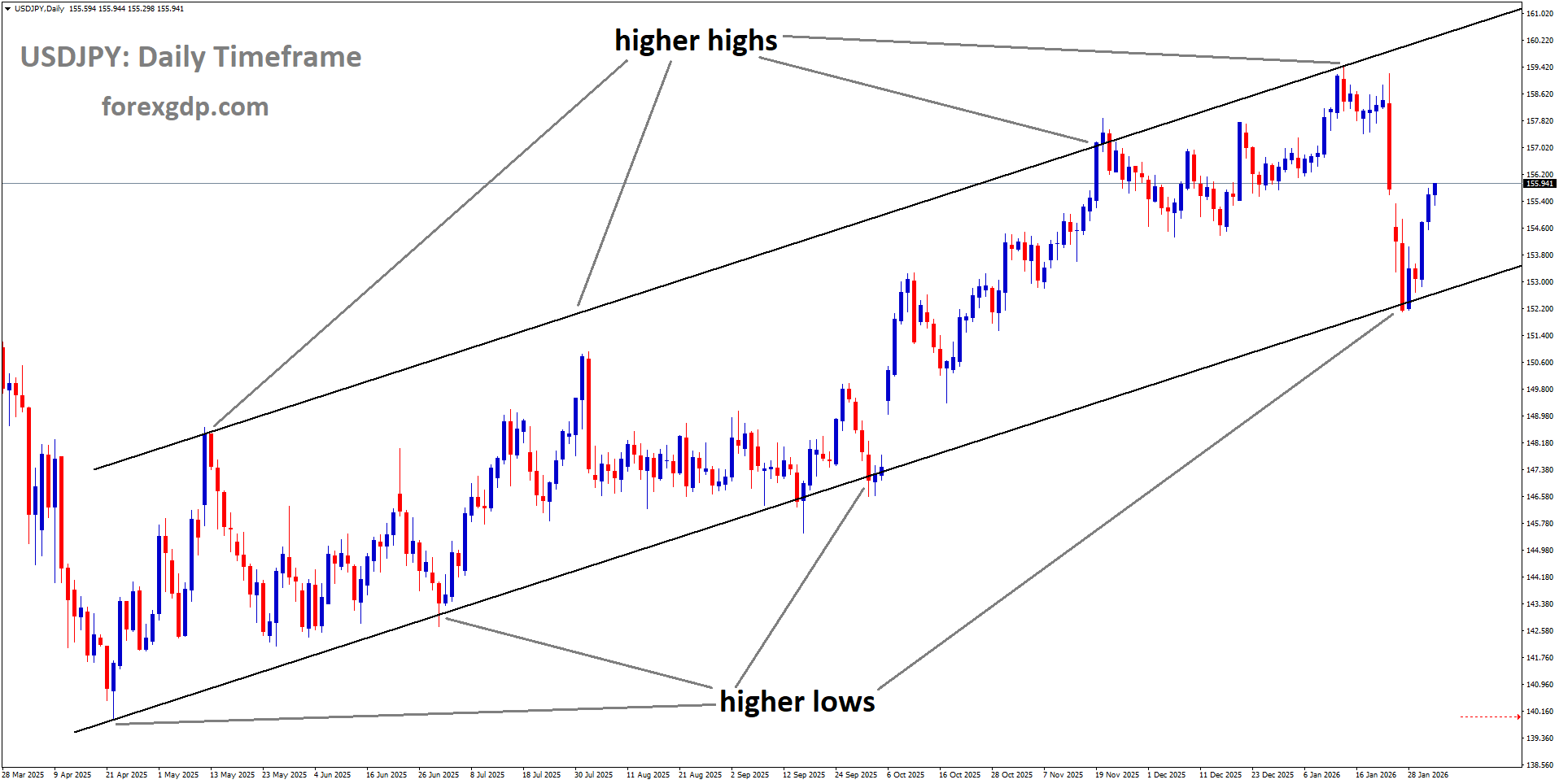
USDJPY is moving in an uptrend channel, and the market has rebounded from the higher low area of the channel
Investors are closely watching shifting expectations around US monetary leadership and economic resilience. At the same time, signals from Japan’s central bank suggest a more complex backdrop that has yet to provide meaningful support for the Yen.
US Dollar Strength Boosted by Policy Expectations
The recent outperformance of the US Dollar is closely linked to renewed confidence in the future direction of US monetary policy. A key driver behind this sentiment shift is the nomination of Kevin Warsh as the next Chairman of the Federal Reserve. Markets have responded quickly, viewing this decision as a sign that monetary policy could remain more cautious and disciplined in the years ahead.
Warsh is widely seen as someone who favors a careful approach to interest rate changes. This perception has led many investors to reassess their expectations for how quickly borrowing costs might be reduced in the future. Slower adjustments are often viewed as supportive for the Dollar, as higher yields tend to attract global capital.
As a result, demand for the Greenback has increased across the board, pushing it higher against several major currencies. The Yen, which is often sensitive to changes in yield differentials, has been particularly affected by this shift in outlook.
Positive US Data Reinforces Economic Confidence
Adding to the Dollar’s strength is a set of encouraging economic signals from the United States. Recent data from the manufacturing sector suggests that business activity has picked up after a prolonged period of contraction. This improvement has helped reinforce the narrative that the US economy remains resilient despite ongoing global uncertainty.
Manufacturing surveys showed that factory activity moved back into expansion territory, exceeding market expectations by a wide margin. Such readings are often interpreted as a sign of healthier demand, improved production levels, and stronger confidence among businesses. For currency markets, this kind of data tends to support the local currency, especially when it contrasts with weaker signals elsewhere.
Investors often look to these indicators as early clues about broader economic trends. When manufacturing shows signs of life, it can point to potential improvements in employment, investment, and overall growth. All of this feeds into a more optimistic view of the US economic outlook and supports continued Dollar strength.
What Markets Are Watching Next in the US
Looking ahead, attention is turning to upcoming labor market and services sector data from the United States. Employment-related figures are particularly important, as they provide insight into how businesses are responding to economic conditions and whether job creation remains strong.
Data from private payrolls is expected to offer an early glimpse into employment trends ahead of official government reports. At the same time, surveys of the services sector will shed light on activity in areas such as retail, hospitality, and professional services, which make up a large share of the US economy.
Strong results from these releases could further reinforce confidence in the US economic outlook. If the data confirms ongoing momentum, it may strengthen expectations that monetary policy will remain relatively firm, keeping the Dollar supported against lower-yielding currencies like the Yen.
Japanese Yen Struggles Despite Policy Signals

On the Japanese side, the Yen has remained under pressure even as policymakers signal a willingness to tighten monetary conditions. Recent discussions among Bank of Japan officials suggest that many believe further adjustments are needed to address inflation and stabilize the economy.
The central bank’s summary of opinions highlighted growing support for a gradual move away from ultra-loose policy settings. This marks a notable shift from the long-standing approach that has defined Japan’s monetary stance for years. In theory, such signals could provide support for the Yen by narrowing the policy gap with other major economies.
However, in practice, the currency has yet to benefit meaningfully from these discussions. One reason is that actual policy changes remain cautious and incremental. Markets often respond more strongly to concrete actions than to forward-looking statements, especially when those actions are expected to unfold slowly.
Another factor is the stark contrast between the US and Japanese economic outlooks. While US data has surprised to the upside, Japan’s recovery remains uneven. This divergence continues to weigh on the Yen, limiting its ability to recover against stronger counterparts.
Diverging Central Bank Paths Shape Currency Moves
The ongoing movement in USD/JPY highlights a broader theme in global markets: divergence in central bank policies. While the Federal Reserve appears set to maintain a careful and potentially restrictive stance for longer, the Bank of Japan is only beginning to consider tightening after years of aggressive easing.
This difference has important implications for currency flows. Investors tend to favor currencies linked to economies with higher returns and clearer policy direction. As long as the US offers relatively attractive conditions, the Dollar is likely to remain in demand.
For the Yen, the path forward may depend on how quickly and decisively Japanese policymakers act. Clear steps toward normalization could eventually help stabilize the currency, but until then, it may continue to lag behind stronger peers.
Final Summary
The USD/JPY pair continues to benefit from strong US Dollar momentum, supported by political developments and encouraging economic data from the United States. Expectations surrounding future Federal Reserve leadership have played a key role in shaping market sentiment, while signs of renewed strength in the manufacturing sector have reinforced confidence in the US economy.
At the same time, the Japanese Yen has struggled to gain ground despite growing discussion of tighter monetary conditions in Japan. The gap between policy outlooks and economic performance in the US and Japan remains a defining factor for the pair.
With more key data releases on the horizon, market participants will remain focused on whether the current trends can be sustained. For now, the balance of forces continues to favor the Dollar, keeping USD/JPY on a firm footing as investors weigh policy direction, economic resilience, and global risk sentiment.
USDCHF retreats as political uncertainty in the US favors the Swiss Franc
The US Dollar has been facing renewed pressure against the Swiss Franc as political uncertainty in Washington continues to dominate investor thinking. While recent economic reports from the United States point to underlying strength, concerns about federal funding and broader global risks are keeping traders cautious. In times like these, currencies often react more to confidence and stability than to data alone.
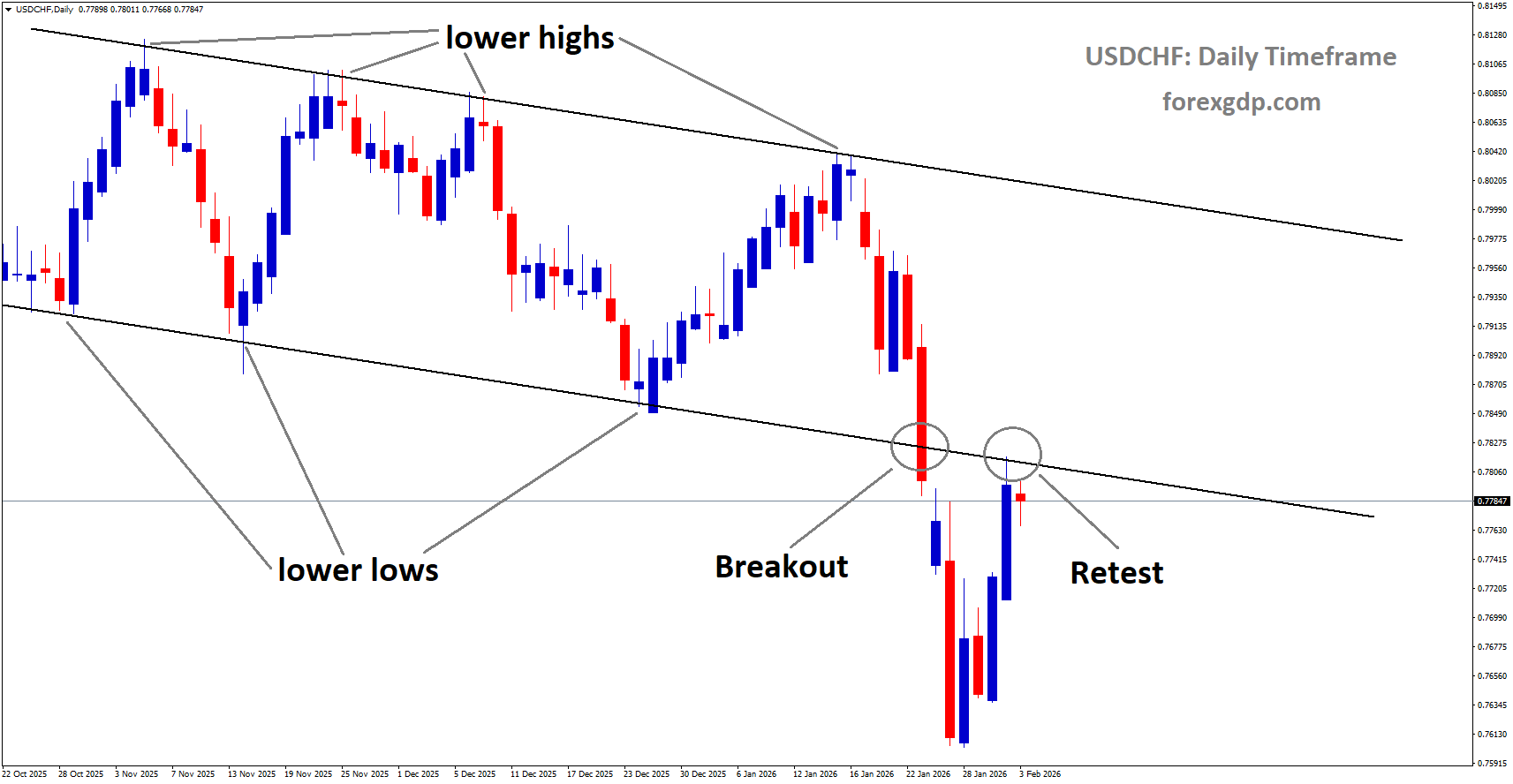
USDCHF reached the retest area of the broken downtrend channel
The Swiss Franc, known for its role as a safe-haven currency, has benefited from this environment. When doubts rise about political decision-making or global security, investors tend to move toward assets they believe will hold value during uncertainty. That shift has played a central role in recent currency movements.
Budget Standoff Weighs on Confidence
At the heart of the current situation is the ongoing debate over US federal funding. A partial government shutdown has highlighted divisions in Congress and raised questions about the ability of lawmakers to reach timely agreements. This uncertainty has had a direct impact on market sentiment, particularly toward the US Dollar.
One immediate consequence of the funding impasse has been delays in the release of important economic reports. Data related to employment and other key indicators has been postponed, leaving investors without a complete picture of the economy. Even when underlying conditions are solid, a lack of information can make markets uneasy.
A congressional vote on a temporary funding bill is seen as a critical moment. If approved and signed into law, it could restore government operations and help calm nerves. On the other hand, a prolonged shutdown would likely continue to erode confidence, not only in short-term economic management but also in broader institutional stability.
Why the Swiss Franc Attracts Demand
The Swiss Franc has long been viewed as a refuge during uncertain times. Switzerland’s political neutrality, stable financial system, and strong institutions contribute to this reputation. When global or domestic risks rise elsewhere, demand for the Franc often increases.
In the current environment, political gridlock in the United States has reinforced that trend. Investors seeking to reduce exposure to uncertainty have been drawn toward currencies that are perceived as more insulated from political disputes. As a result, the Swiss Franc has gained ground even without any major domestic developments in Switzerland.
This dynamic shows how currency markets are not driven solely by local factors. Sometimes, it is what is happening elsewhere that matters most. In this case, uncertainty in the United States has been enough to tilt the balance in favor of the Franc.
Geopolitical Tensions Add Another Layer of Risk
Beyond domestic politics, global developments are also influencing investor behavior. Reports of potential diplomatic talks between the United States and Iran have kept markets alert. While dialogue can be a positive sign, the situation remains delicate, and any setback could quickly raise tensions.
Geopolitical uncertainty tends to amplify demand for safe-haven assets. When the outlook becomes less predictable, investors often prioritize preservation of capital over higher returns. This environment naturally supports currencies like the Swiss Franc while putting pressure on risk-sensitive assets.
Even the possibility of unexpected headlines can shape market decisions. Traders often position themselves defensively ahead of key geopolitical events, which can influence currency flows regardless of whether tensions actually escalate.
Strong Economic Data Offers Some Relief
Despite these challenges, the US Dollar has not been without support. Recent economic data has painted a more optimistic picture of the US manufacturing sector. A key survey showed a notable improvement in factory activity, signaling a return to expansion after a softer period.
This stronger-than-expected performance has helped remind investors that the US economy still has solid momentum. Manufacturing plays an important role in overall growth, and signs of improvement can boost confidence in future economic prospects.

As a result, expectations around monetary policy have adjusted slightly. Investors have become less convinced that interest rate cuts will happen in the near term, with many now anticipating any changes later in the year. This shift has helped limit the downside for the US Dollar, even as political concerns persist.
Trade Developments Support the Medium-Term Outlook
Another factor helping to stabilize sentiment around the US Dollar is progress on trade agreements. Recent announcements from the US administration have suggested a more constructive approach to international trade relations. For markets, this is an encouraging sign.
Trade agreements can improve business confidence, support investment, and strengthen growth over time. While the immediate impact may be limited, the broader implications are important for long-term economic stability. Investors tend to factor these developments into their outlook, even amid short-term uncertainty.
This combination of solid economic data and improving trade prospects has prevented a more pronounced decline in the US Dollar. It highlights how multiple forces often act at once in currency markets, sometimes pulling in opposite directions.
Focus Shifts to Central Bank Communication
With some official data delayed, attention has increasingly turned to comments from Federal Reserve officials. Speeches and public appearances can provide valuable insight into how policymakers view the economy and inflation trends.
In periods of uncertainty, these qualitative signals take on greater importance. Investors look for hints about future policy direction, especially when hard data is limited. Any indication of confidence or caution from central bank officials can quickly influence market expectations.
As a result, upcoming remarks from Fed representatives are likely to be closely watched. They may help clarify whether recent economic strength is enough to offset political and geopolitical risks in the months ahead.
Summary: Balancing Uncertainty and Economic Strength
The recent movement between the US Dollar and the Swiss Franc reflects a broader struggle between uncertainty and resilience. Political gridlock and geopolitical risks have increased demand for safe-haven currencies, giving the Swiss Franc an edge. At the same time, strong US economic data and positive trade developments have helped prevent deeper losses for the Dollar.
Markets remain sensitive to headlines, whether they come from Washington, international diplomacy, or central bank officials. Until greater clarity emerges on government funding and global risks, investor caution is likely to persist. In this environment, currency trends will continue to be shaped by confidence, stability, and the balance between risk and reassurance.
XAGUSD pauses momentum as silver demand softens
Silver’s recent price action has caught the attention of traders and long-term investors alike, as shifting global narratives continue to influence demand for the metal. After a sharp pullback, silver managed to regain some ground during Asian trading, reflecting a market that is still searching for balance. The rebound came amid cautious sentiment surrounding US monetary policy, easing geopolitical tensions, and changes in speculative behavior, particularly in China.
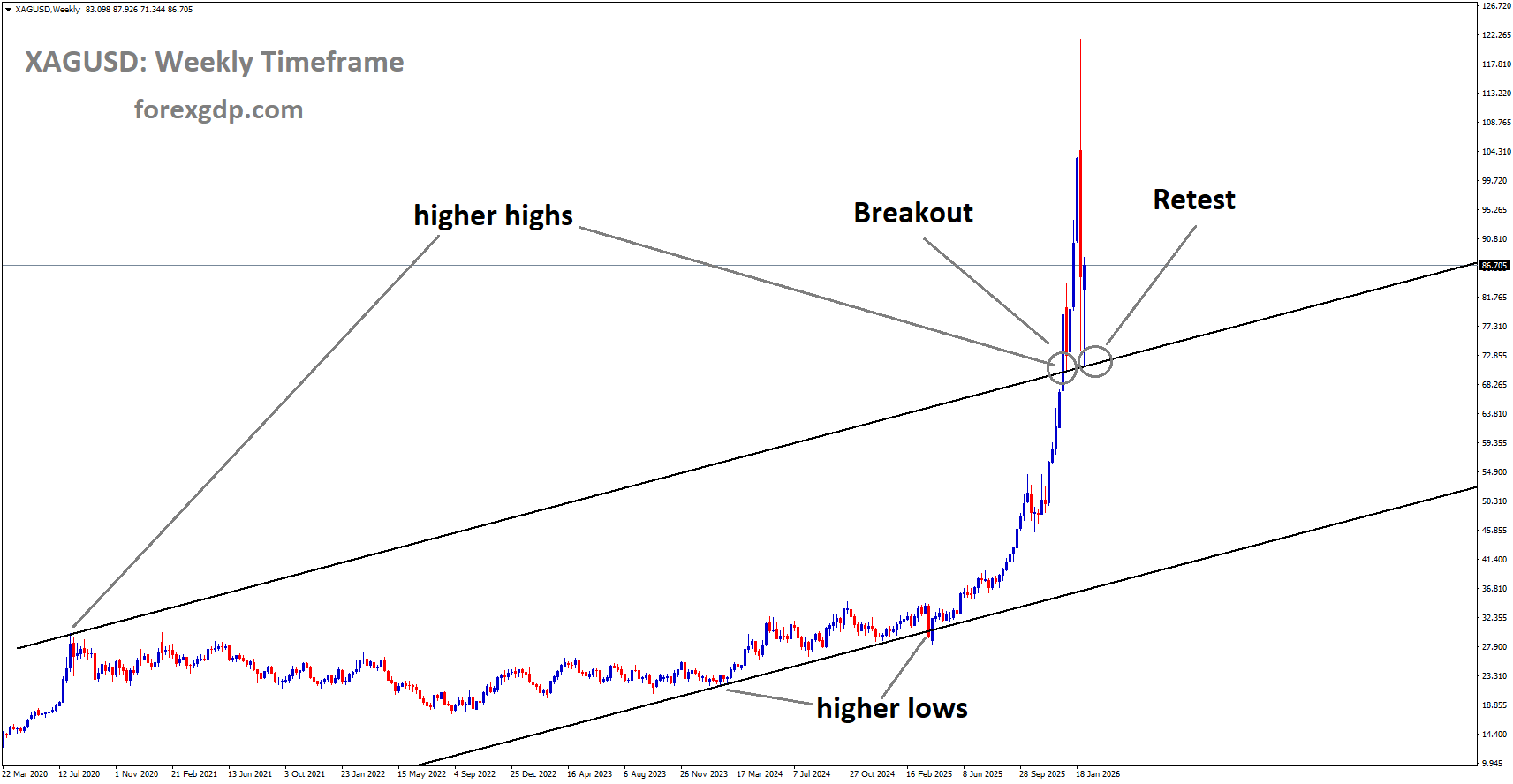
XAGUSD reached the retest area of the broken uptrend channel
While silver remains supported by long-term structural factors, short-term movements show how sensitive the metal is to policy signals and investor psychology. Understanding these drivers helps explain why silver has been so volatile and what may shape its path ahead.
Federal Reserve Signals Shake Silver Sentiment
One of the key triggers behind silver’s recent downturn was a shift in expectations around US monetary policy. Markets reacted strongly after President Donald Trump nominated Kevin Warsh as the next Chair of the Federal Reserve. The nomination was widely interpreted as a signal that the central bank may take a more disciplined and cautious approach when it comes to easing policy.
Silver, like other non-yielding assets, tends to benefit when interest rates are expected to fall or remain low. Lower rates reduce the opportunity cost of holding metals that do not generate income. When investors began to reassess the likelihood of aggressive easing, enthusiasm for silver cooled quickly.
The reaction was swift. Traders who had built large positions on the assumption of a more accommodative central bank moved to reduce exposure. This shift in sentiment did not reflect a sudden loss of faith in silver’s long-term role, but rather a reassessment of near-term conditions.
Fed Officials Reinforce a Cautious Tone
Adding to the pressure were comments from senior Federal Reserve officials who emphasized patience and restraint. Policymakers suggested that the current policy stance is already close to neutral and that further cuts may not be necessary in the near future. Others stressed the importance of keeping policy somewhat restrictive until inflation risks are clearly under control.
These remarks reinforced the idea that the Fed is not in a rush to loosen financial conditions. For silver, this translated into reduced short-term demand from investors who had positioned for faster and deeper policy support.
The Role of Chinese Speculative Flows
Another major factor behind silver’s recent slide was a rapid unwinding of speculative positions by Chinese investors. Over recent months, silver had attracted strong interest from this group, driven by concerns over currency stability, limited domestic investment alternatives, and the metal’s appeal as a tangible store of value.
When sentiment shifted, these speculative positions were unwound just as quickly as they were built. The scale and speed of this move amplified the downside, contributing to the sharp drop seen over a short period of time.
However, this same dynamic could work in silver’s favor going forward. Chinese investors have shown a willingness to return when prices appear attractive or when uncertainty rises again. Dip-buying behavior has been a recurring theme in past market cycles, and silver’s fundamentals could still appeal to those seeking diversification and protection.
Speculation Versus Long-Term Investment
It is important to distinguish between short-term speculation and longer-term investment demand. While speculative flows can increase volatility, they do not necessarily undermine the broader investment case. In fact, periods of rapid unwinding are often followed by more stable accumulation once emotions settle and valuations adjust.
From Safe Haven Star to Cooling Demand
Earlier this year, silver benefited from a powerful mix of geopolitical and economic concerns. Fears around global conflict, questions over currency debasement, and worries about the independence of major central banks all boosted demand for safe-haven assets. Silver, alongside gold, attracted strong inflows as investors sought protection from uncertainty.
That wave of buying pushed silver to unprecedented levels, marking a historic moment for the metal. However, as conditions evolved, some of those supportive factors began to fade.
Recent diplomatic engagement between the United States and Iran helped ease immediate geopolitical fears. Although tensions remain and rhetoric on both sides is still strong, the mere fact that talks took place reduced the sense of urgency that had driven safe-haven demand. When risk perceptions ease, assets like silver often lose some of their shine in the short term.
Shifting Risk Appetite
As geopolitical risks cooled slightly and financial markets adjusted to a steadier policy outlook, investors became more selective. Capital rotated toward assets perceived as offering clearer short-term returns, leaving silver temporarily out of favor. This does not eliminate silver’s role as a hedge, but it does highlight how quickly sentiment can shift.
Structural Support Beneath the Surface

Despite recent volatility, silver continues to benefit from strong underlying fundamentals. The global silver market has been facing a structural supply deficit, meaning demand has consistently outpaced new supply. Industrial usage, particularly in sectors tied to energy transition and technology, remains a key pillar of demand.
At the same time, investment interest has broadened geographically. Beyond traditional Western markets, demand from Asia has become increasingly important. This diversification of buyers can help provide a more resilient base for the market over time.
Rising awareness of silver’s dual role as both an industrial metal and a store of value also supports its longer-term outlook. While short-term price movements are often driven by macro headlines, the deeper supply-demand balance continues to matter.
Volatility as a Feature, Not a Flaw
Silver has always been more volatile than gold, and recent moves are consistent with that history. Sharp rallies followed by equally sharp pullbacks are not unusual. For many investors, this volatility is part of the appeal, offering opportunities while also demanding patience and discipline.
What to Watch Going Forward
Looking ahead, silver’s direction will likely depend on a combination of policy signals, global risk sentiment, and investor behavior. Any shift in the Federal Reserve’s tone, whether toward greater caution or renewed flexibility, could quickly influence demand. Likewise, developments in global politics have the potential to revive safe-haven interest.
Chinese investor activity will remain another key variable. Whether speculative money returns in force or takes a more measured approach could shape short-term momentum. At the same time, long-term investors may continue to focus on supply constraints and industrial demand trends.
The market appears to be in a period of recalibration rather than reversal. After an intense rally and an equally intense correction, silver is searching for a level where confidence can rebuild.
Final Summary
Silver’s recent pullback and rebound reflect a market adjusting to new information rather than abandoning its broader narrative. A more cautious outlook from the Federal Reserve, combined with easing geopolitical tensions and speculative unwinding, weighed on prices in the short term. Yet beneath the volatility, structural supply deficits and diversified investment demand continue to support the metal’s longer-term appeal.
As global conditions evolve, silver remains sensitive to shifts in policy and sentiment. While the road ahead may remain uneven, the underlying forces that have driven interest in silver are still very much in place, suggesting that the metal’s story is far from over.
Don’t trade all the time, trade forex only at the confirmed trade setups
Get more confirmed trade signals at premium or supreme – Click here to get more signals, 2200%, 800% growth in Real Live USD trading account of our users – click here to see , or If you want to get FREE Trial signals, You can Join FREE Signals Now!