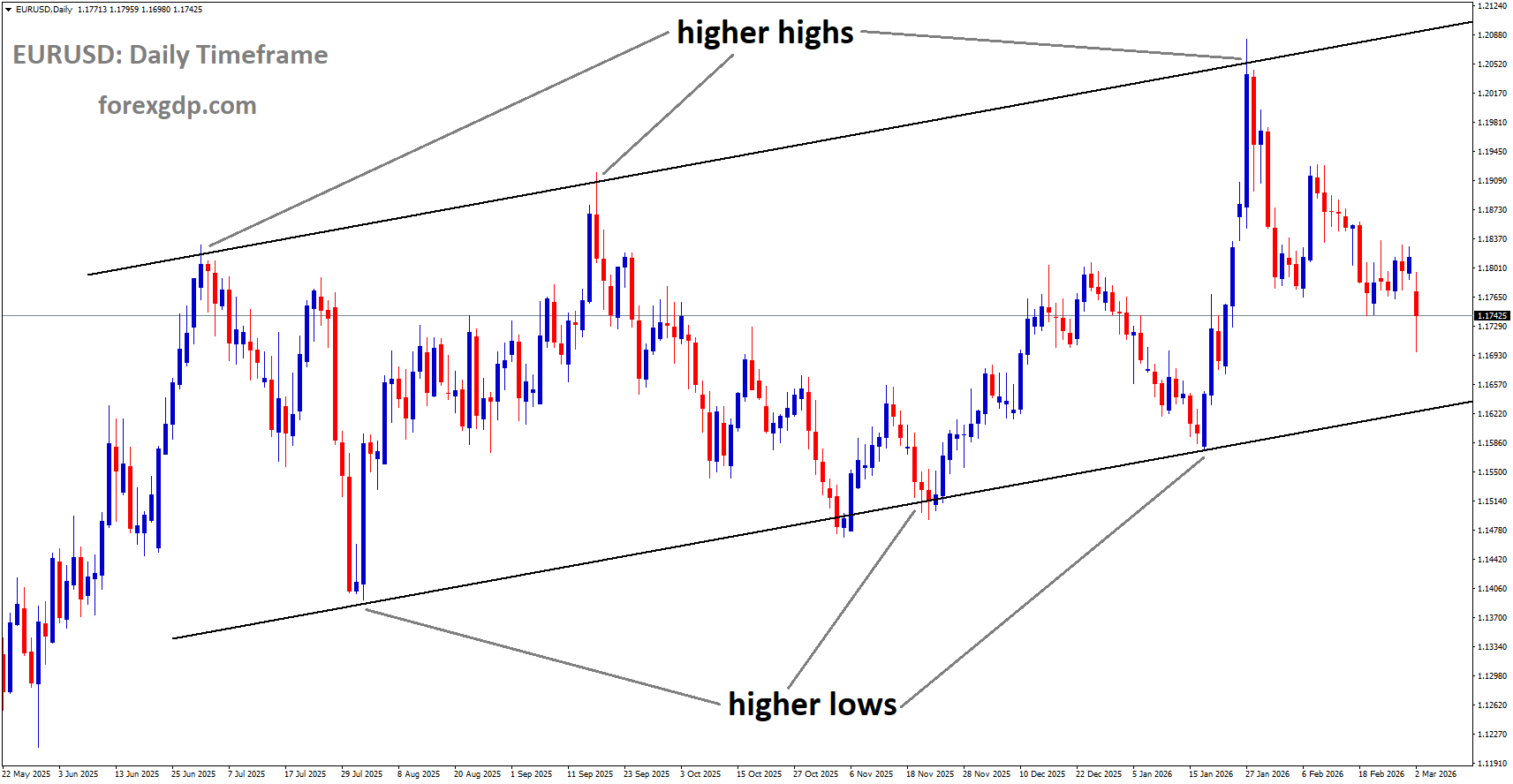
EURUSD is moving in an uptrend channel, and the market has fallen from the higher high area of the channel
EURUSD Struggles Around 1.1750 as Weak German Sales Data Weighs on Euro
The EUR/USD currency pair started the week on a softer note, falling sharply during European trading hours. The Euro came under pressure after disappointing economic data from Germany, while the US Dollar gained strength as global tensions increased and inflation concerns remained in focus.
A mix of weak consumer spending in Germany, rising geopolitical risks, and firm US inflation data has shifted investor sentiment. As a result, demand for the US Dollar increased, pushing EUR/USD lower.
Weak German Retail Sales Weigh on the Euro
Germany, the largest economy in the Eurozone, reported a notable drop in Retail Sales. Monthly sales fell by 0.9% in January, much worse than expectations of a small 0.2% decline. This sharp fall reversed the previous month’s strong upwardly revised increase of 1.2%.
On a yearly basis, retail sales still showed growth of 1.2%. However, this was slower than December’s 2.5% annual increase, which had been the strongest pace in five months. Although retail sales have risen overall in 2025 so far, the January data raised concerns about the strength of consumer spending at the start of the year.
Consumer spending plays a major role in economic growth. When retail sales fall more than expected, it often signals that households are becoming cautious. This can happen for several reasons, such as high living costs, economic uncertainty, or weaker confidence about the future. For the Euro, weaker retail activity suggests slower growth ahead, which can reduce its appeal among investors.
Manufacturing Data Offers Some Support, But Not Enough
While retail sales disappointed, manufacturing data from Germany and the broader Eurozone showed improvement.
The HCOB Germany Manufacturing Purchasing Managers’ Index (PMI) rose to 50.9 in February, up from 49.1 in January. Similarly, the Eurozone Manufacturing PMI was confirmed at 50.8, compared to 49.5 previously. Both readings marked their strongest levels in 44 months.
A PMI reading above 50 usually signals expansion in the sector. This suggests that manufacturing activity is slowly recovering after a period of weakness. For many investors, this is a positive sign that the industrial sector may be stabilizing.
However, the improvement in manufacturing was not strong enough to offset the negative impact of weak retail sales. Consumer demand remains a key pillar of the economy, and signs of slowing spending can outweigh gains in factory activity. As a result, the Euro continued to struggle despite better PMI figures.
Rising Geopolitical Tensions Boost the US Dollar

Beyond economic data, global political developments played a major role in driving the US Dollar higher.
Over the weekend, the United States and Israel reportedly carried out coordinated military strikes on Iran. According to reports, the operation led to the death of Iran’s Supreme Leader, Ayatollah Ali Khamenei. This marked a major turning point in the region and significantly increased geopolitical uncertainty.
US President Donald Trump stated that military operations in Iran were “ahead of schedule,” reinforcing the seriousness of the situation.
When global tensions rise, investors often become more cautious. In times of uncertainty, many turn to assets that are considered safer. The US Dollar is widely viewed as a safe-haven currency. This means that during periods of geopolitical stress or market volatility, demand for the Dollar tends to increase.
As risk aversion spread through the markets, traders reduced exposure to risk-sensitive assets, including the Euro. This shift in sentiment added further downward pressure on the EUR/USD pair.
Focus Turns to US Manufacturing Data
Investors are also closely watching upcoming economic data from the United States.
The ISM Manufacturing Purchasing Managers’ Index is expected to show a slight decline, moving to 52.3 from the previous reading of 52.6. Even if the index eases slightly, it would still remain above 50, signaling continued expansion in the US manufacturing sector.
Traders will also pay attention to the ISM Manufacturing Employment Index. Employment data is especially important because it can offer clues about the strength of the labor market and overall economic momentum.
Strong economic data from the US tends to support the Dollar. If the figures show that the manufacturing sector remains stable, it could reinforce the current trend of Dollar strength.
Inflation Concerns Cloud Fed Rate Cut Expectations
Another key factor supporting the US Dollar is recent inflation data. Reports suggest that inflation remains stronger than expected. There are signs that companies are passing higher tariff costs on to consumers, leading to increased prices.
When inflation stays elevated, central banks are usually cautious about cutting interest rates. Lower interest rates can stimulate the economy, but they can also fuel inflation further. Because of this, stronger inflation reduces the likelihood of quick rate cuts from the Federal Reserve.
Expectations around interest rates play a major role in currency markets. If investors believe that US rates will remain high for longer, the Dollar often benefits. Higher rates can attract foreign capital, increasing demand for the currency.
However, not all policymakers share the same view. Federal Reserve Governor Stephen Miran recently called for significant interest rate cuts as soon as possible. He argued that underlying price pressures remain subdued and suggested that current inflation measurements may be distorted. According to him, interest rates are staying high due to these measurement issues rather than true inflation pressure.
This difference of opinion within the Federal Reserve highlights the ongoing debate about the future direction of US monetary policy. While some officials see room for rate cuts, stronger inflation data makes the timing uncertain.
Why EUR/USD Is Under Pressure
Several factors are combining to weigh on EUR/USD:
-
Weak German retail sales are raising concerns about consumer strength in Europe.
-
Geopolitical tensions in the Middle East are increasing demand for safe-haven assets like the US Dollar.
-
US inflation data suggests that interest rates may remain elevated for longer.
-
Investors are awaiting fresh US economic data that could further influence sentiment.
Together, these elements have created a challenging environment for the Euro. Even though manufacturing activity in Europe is improving, it has not been enough to offset the broader concerns.
At the same time, the US Dollar is benefiting from its status as a safe-haven currency and from expectations that US interest rates may not fall quickly.
Summary
The EUR/USD pair has moved lower as a combination of weak German retail sales, rising geopolitical tensions, and firm US inflation data strengthened the US Dollar. While manufacturing activity in Germany and the Eurozone shows signs of recovery, softer consumer spending has raised concerns about economic momentum in Europe.
Meanwhile, increased risk aversion following military action involving the US and Israel has boosted demand for the Dollar. Stronger inflation signals in the United States have also reduced expectations for near-term Federal Reserve rate cuts, further supporting the Greenback.
With investors closely watching upcoming US economic data and developments in global politics, volatility in the currency markets may remain elevated in the days ahead.
GBPUSD Weakens While Geopolitical Turmoil Fuels Safe-Haven Rush
The Pound Sterling has come under pressure against most major currencies as global tensions rise and investors grow more cautious. Fresh conflict in the Middle East has shaken financial markets, leading many traders to pull back from riskier assets. As a result, safer currencies like the US Dollar have gained strength, while the British Pound has struggled to keep up.
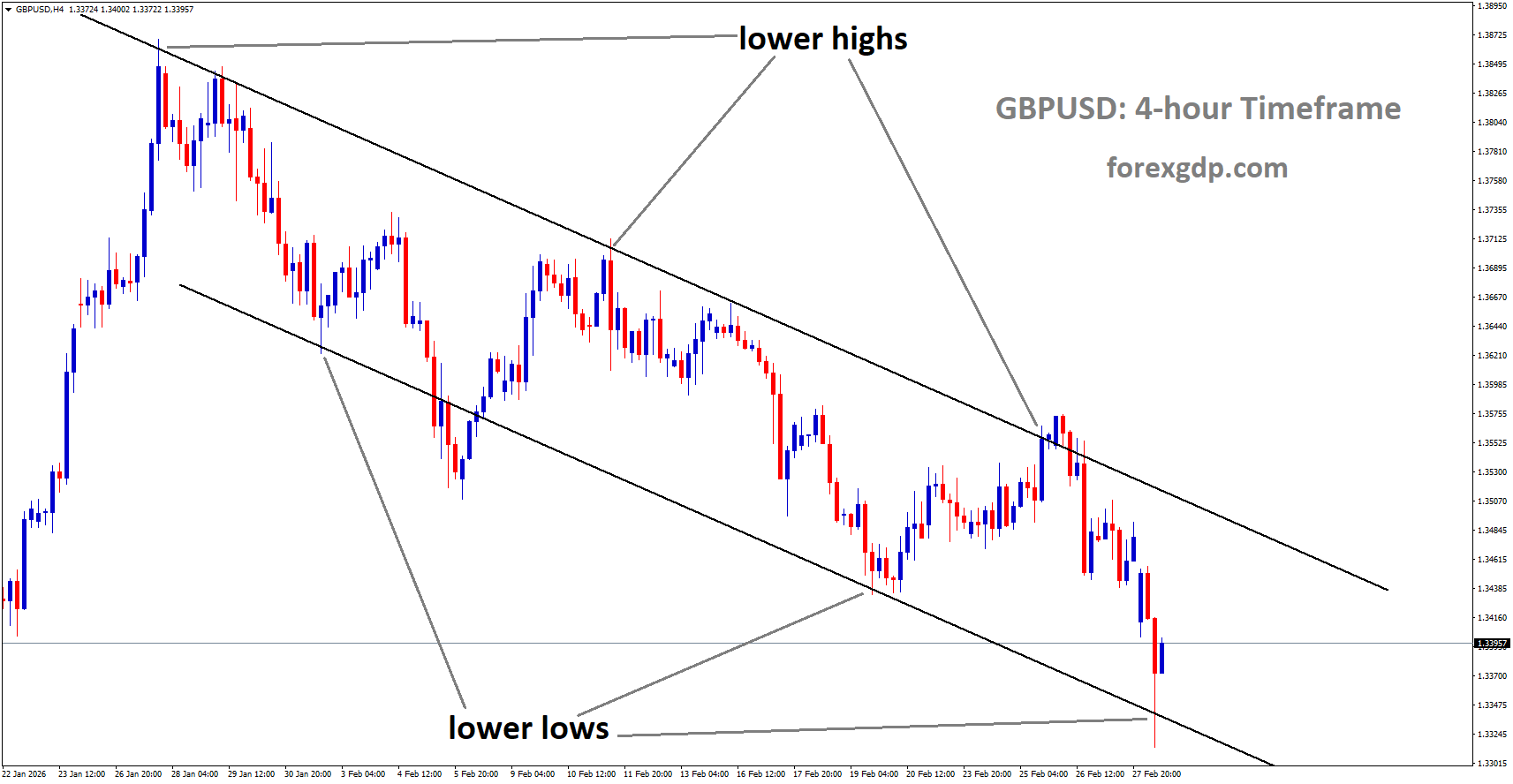
GBPUSD is moving in a descending channel, and the market has reached the lower low area of the channel
At the same time, comments from the Bank of England about inflation risks in the United Kingdom have added another layer of uncertainty. With key US economic data also due this week, investors are carefully watching how events unfold.
Rising Middle East Conflict Sparks Risk-Off Mood
Global markets reacted strongly after a major escalation in the Middle East over the weekend. The United States and Israel carried out missile and drone strikes against Iran. These attacks reportedly killed several top Iranian leaders, including Supreme Leader Ayatollah Ali Khamenei.
In response, Iran quickly vowed to retaliate. Tehran named Ayatollah Alireza Arafi as interim leader and launched attacks targeting Israel and US military bases across the region. This rapid escalation has increased fears of a broader regional conflict.
Whenever geopolitical tensions rise to this level, financial markets often shift into what is known as a “risk-off” mode. In simple terms, investors become more careful. They reduce exposure to assets seen as risky and move their money into safer options.
This shift has had a direct impact on currencies. The Pound Sterling has weakened, while the US Dollar has attracted stronger demand.
Why the US Dollar Is Gaining Strength
The US Dollar is widely considered a safe-haven currency. During times of global uncertainty, investors often buy Dollars because of the size and stability of the US economy. The Dollar is also heavily used in international trade and financial transactions, which increases its appeal during crises.
As tensions between the US, Israel, and Iran intensified, demand for the Dollar increased. Even after giving back some earlier gains, the Dollar remained stronger against most major currencies.
The Pound Sterling, on the other hand, has struggled. It fell against many of its peers, reflecting weaker investor confidence. While it managed to hold up better against some currencies linked to commodity-driven economies, overall performance remained soft.
The main reason is simple: when fear rises, investors tend to reduce positions in currencies like the Pound and increase holdings in safe-haven assets.
Bank of England Warns on Inflation Risks
Beyond global politics, domestic concerns are also weighing on the British Pound. The Bank of England has signaled that inflation risks in the UK remain a concern.
Huw Pill, the Bank of England’s Chief Economist, recently spoke before the UK Parliament’s Treasury Committee. He warned that the process of bringing inflation down has been slower than expected. According to Pill, the trend of falling inflation has not been as smooth or as quick as policymakers had hoped.
He also suggested that too much attention has been placed on current inflation levels being close to target. Instead, he emphasized the importance of focusing on future inflation expectations. In other words, what matters most is not just where inflation stands today, but where it is likely to head in the coming months.
Why Inflation Expectations Matter
Inflation expectations play a key role in shaping economic behavior. If businesses and consumers believe that prices will continue to rise quickly, they may act in ways that actually push inflation higher. For example, workers may demand higher wages, and companies may increase prices in anticipation of rising costs.
By keeping a close watch on inflation expectations, the Bank of England aims to prevent inflation from becoming deeply rooted in the economy.
For currency markets, this creates a tricky situation. On one hand, concerns about inflation could lead to tighter monetary policy in the future, which might support the Pound. On the other hand, uncertainty about how persistent inflation will be can make investors nervous, especially when combined with global risks.
Focus Shifts to Key US Economic Data

While geopolitical tensions dominate headlines, economic data from the United States is also in sharp focus this week.
Investors are awaiting the release of the US ISM Manufacturing Purchasing Managers’ Index (PMI) for February. This report measures activity in the manufacturing sector and provides insight into business conditions. A slight slowdown is expected compared to the previous month.
Even small changes in this data can influence market sentiment. If the manufacturing sector shows signs of weakening, it could raise concerns about the strength of the US economy. On the other hand, stronger-than-expected results may further support the Dollar.
Nonfarm Payrolls in the Spotlight
Later in the week, attention will turn to the US Nonfarm Payrolls (NFP) report. This is one of the most closely watched economic releases each month.
The NFP report provides information about job creation in the United States. It offers a snapshot of the labor market, including how many jobs were added and how unemployment is trending.
A strong labor market typically supports consumer spending and overall economic growth. If the report shows solid job gains, it could reinforce confidence in the US economy and further strengthen the Dollar. If the data disappoints, markets may react quickly.
Because of its importance, the NFP release often triggers sharp movements in currency markets.
What This Means for the Pound Sterling
The Pound Sterling is currently facing pressure from multiple directions. Global geopolitical tensions are pushing investors toward safer currencies. At the same time, ongoing concerns about inflation in the UK add uncertainty about the future path of monetary policy.
While the UK economy has shown resilience in some areas, the broader global environment remains fragile. Any further escalation in the Middle East could increase market volatility and continue to weigh on risk-sensitive currencies like the Pound.
At the same time, upcoming US economic data could shape the near-term direction of the US Dollar. Strong US figures may keep the Dollar supported, while weaker data could offer some relief to the Pound.
For now, caution appears to be the dominant theme in financial markets. Investors are balancing geopolitical risks, inflation concerns, and economic data releases, all at once.
Final Thoughts
The Pound Sterling has weakened as rising tensions in the Middle East triggered a wave of caution across global markets. The conflict involving the United States, Israel, and Iran has pushed investors toward safe-haven currencies, boosting the US Dollar.
Meanwhile, the Bank of England has warned that inflation in the UK may remain a risk, highlighting the importance of managing expectations about future price growth. This adds another layer of uncertainty for the British currency.
With key US economic reports on the way, including manufacturing data and the Nonfarm Payrolls report, markets are likely to remain sensitive to fresh developments. In times like these, both geopolitical headlines and economic figures can quickly influence currency movements.
As global events continue to unfold, the Pound Sterling will remain closely tied to shifts in investor confidence, inflation outlooks, and the broader direction of the US Dollar.
USDJPY Pushes Higher as Safe-Haven Dollar Outshines a Weak Yen
The USD/JPY currency pair started the week on a strong note, gaining upward momentum during Monday’s trading session. The US Dollar found fresh demand, helping the pair move closer to last week’s highs. However, despite the early push higher, the move lacked strong follow-through buying, and the pair stayed below the 157.00 level during the Asian trading hours.
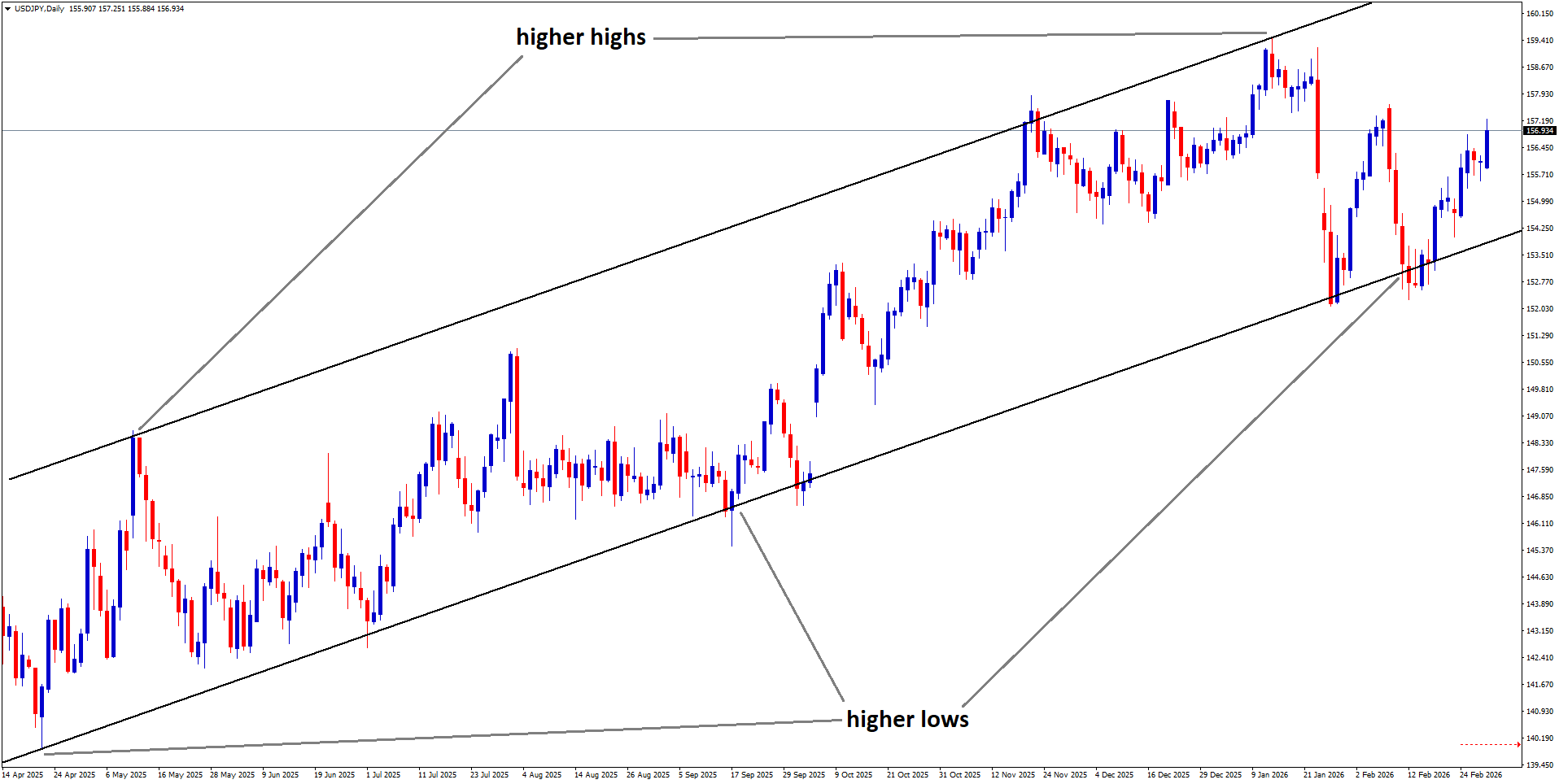
USDJPY is moving in an uptrend channel, and the market has rebounded from the higher low area of the channel
Behind this price action lies a mix of global political tensions, safe-haven demand, and shifting expectations around central bank policies. These factors are shaping how investors view both the US Dollar and the Japanese Yen in the current environment.
Rising Middle East Tensions Support the US Dollar
One of the main drivers behind the Dollar’s strength is the sudden escalation of military conflict in the Middle East. A coordinated military strike involving the United States and Israel against Iran has significantly increased geopolitical tensions. Events like these tend to shake global markets, creating uncertainty about economic stability and future growth.
When uncertainty rises, investors often look for safer assets to protect their capital. The US Dollar has long held the status of the world’s primary reserve currency. This means it is widely used in global trade, international transactions, and held by central banks around the world. Because of this, the Dollar is often seen as a safe and reliable choice during times of crisis.
As concerns grow over potential retaliation and wider regional conflict, global investors have been increasing their exposure to the US Dollar. This increased demand has provided support for USD/JPY, pushing the pair higher at the start of the week.
Strait of Hormuz Concerns Add to Market Anxiety
Another key factor adding to the tension is the fear surrounding the Strait of Hormuz. This narrow waterway is one of the most important oil shipping routes in the world. A significant portion of global oil supply passes through it daily.
There are rising concerns that the ongoing conflict could disrupt shipping in this region. If the Strait of Hormuz were to be closed or restricted, global oil supplies could be affected. That scenario could drive energy costs higher and increase inflationary pressures worldwide.
Higher oil prices can strain economies, reduce consumer spending power, and slow down global growth. The possibility of such an outcome has made investors more cautious. Once again, this cautious mood supports demand for safer assets like the US Dollar.
Safe-Haven Flows Also Support the Japanese Yen
While the US Dollar is benefiting from its reserve currency status, the Japanese Yen is also receiving support from safe-haven flows. Traditionally, the Yen is considered a safe asset during times of global uncertainty. When risk appetite declines, investors often move funds into both the Dollar and the Yen.
This dual safe-haven demand creates a balancing act for the USD/JPY pair. On one hand, the Dollar is gaining strength due to geopolitical risks. On the other hand, the Yen is not weakening significantly because it too attracts buyers in uncertain times.
This explains why USD/JPY has struggled to extend its gains decisively. The upward move has been steady but limited, reflecting competing forces in the market.
Bank of Japan Policy Expectations Add Another Layer

Another important factor influencing the Japanese Yen is the outlook for the Bank of Japan (BoJ). In recent months, the BoJ has signaled its intention to continue moving away from ultra-loose monetary policy. This shift toward policy normalization has strengthened expectations that Japanese interest rates could gradually move higher.
A more hawkish stance from the BoJ tends to support the Yen. If investors believe that Japanese interest rates will rise or that monetary policy will tighten further, the currency becomes more attractive.
Even though global tensions are helping the Dollar, expectations of continued normalization from the BoJ are preventing the Yen from weakening sharply. This keeps a cap on how far USD/JPY can rise.
Intervention Fears Limit Yen Weakness
There is another factor that is keeping traders cautious: the possibility of intervention by Japanese authorities. In the past, when the Yen has weakened too quickly or moved beyond certain levels, Japanese officials have stepped in to support the currency.
Currency intervention can involve direct market action or strong verbal warnings aimed at slowing excessive moves. These actions are designed to prevent rapid depreciation that could hurt Japan’s economy.
Because of this history, traders remain alert to the risk that authorities could act if the Yen falls too much. This fear of intervention makes investors less willing to push USD/JPY aggressively higher.
Why Follow-Through Buying Is Limited
Despite the positive momentum at the start of the week, the lack of strong follow-through buying suggests that traders are still cautious. There are several reasons for this:
-
Safe-haven demand is supporting both currencies.
-
BoJ policy expectations are helping the Yen.
-
Intervention risks discourage heavy speculative positioning.
-
Markets remain sensitive to new headlines from the Middle East.
In uncertain environments, investors often prefer to wait for clearer signals before making large commitments. This cautious approach explains why USD/JPY is climbing but not surging.
The Broader Market Picture
The current situation highlights how global politics, energy markets, and central bank policies are deeply connected. A military strike in one region can quickly affect currencies around the world. Oil supply concerns can influence inflation expectations. Central bank decisions can change the direction of capital flows.
For the US Dollar, its reserve currency role continues to act as a powerful advantage. In times of stress, global investors naturally turn toward it.
For the Japanese Yen, its reputation as a safe-haven asset and the evolving stance of the Bank of Japan are key pillars of support.
The tug-of-war between these two forces is clearly visible in the USD/JPY pair’s behavior.
What Traders Are Watching Next
Going forward, markets will closely monitor several developments:
-
Any further escalation or de-escalation in the Middle East.
-
Updates regarding shipping activity in the Strait of Hormuz.
-
Comments from US and Japanese officials.
-
Signals from the Bank of Japan about future policy moves.
Even small changes in these areas could shift sentiment quickly. In a climate where headlines can drive market moves, caution remains a dominant theme.
Final Summary
USD/JPY began the week with renewed strength as rising geopolitical tensions boosted demand for the US Dollar. The coordinated military action in the Middle East and fears surrounding oil supply disruptions have increased global uncertainty. In such conditions, the Dollar’s status as the world’s reserve currency provides strong support.
At the same time, the Japanese Yen is benefiting from its own safe-haven appeal and growing expectations that the Bank of Japan will continue normalizing policy. Concerns about potential government intervention to protect the Yen are also limiting its downside.
As a result, while USD/JPY is moving higher, gains remain measured rather than explosive. The pair is being shaped by a complex mix of geopolitical risk, energy concerns, and central bank policy expectations. In the current environment, caution and flexibility are likely to remain key themes for market participants.
USDCHF Rises Close to 0.7700 on Firm Dollar as Traders Watch PMI Release
The USD/CHF currency pair started the week on a stronger note, climbing closer to the 0.7695 level during early European trading hours. The move came as the US Dollar gained momentum against the Swiss Franc, supported by fresh economic data and expectations surrounding the Federal Reserve’s next policy decisions.
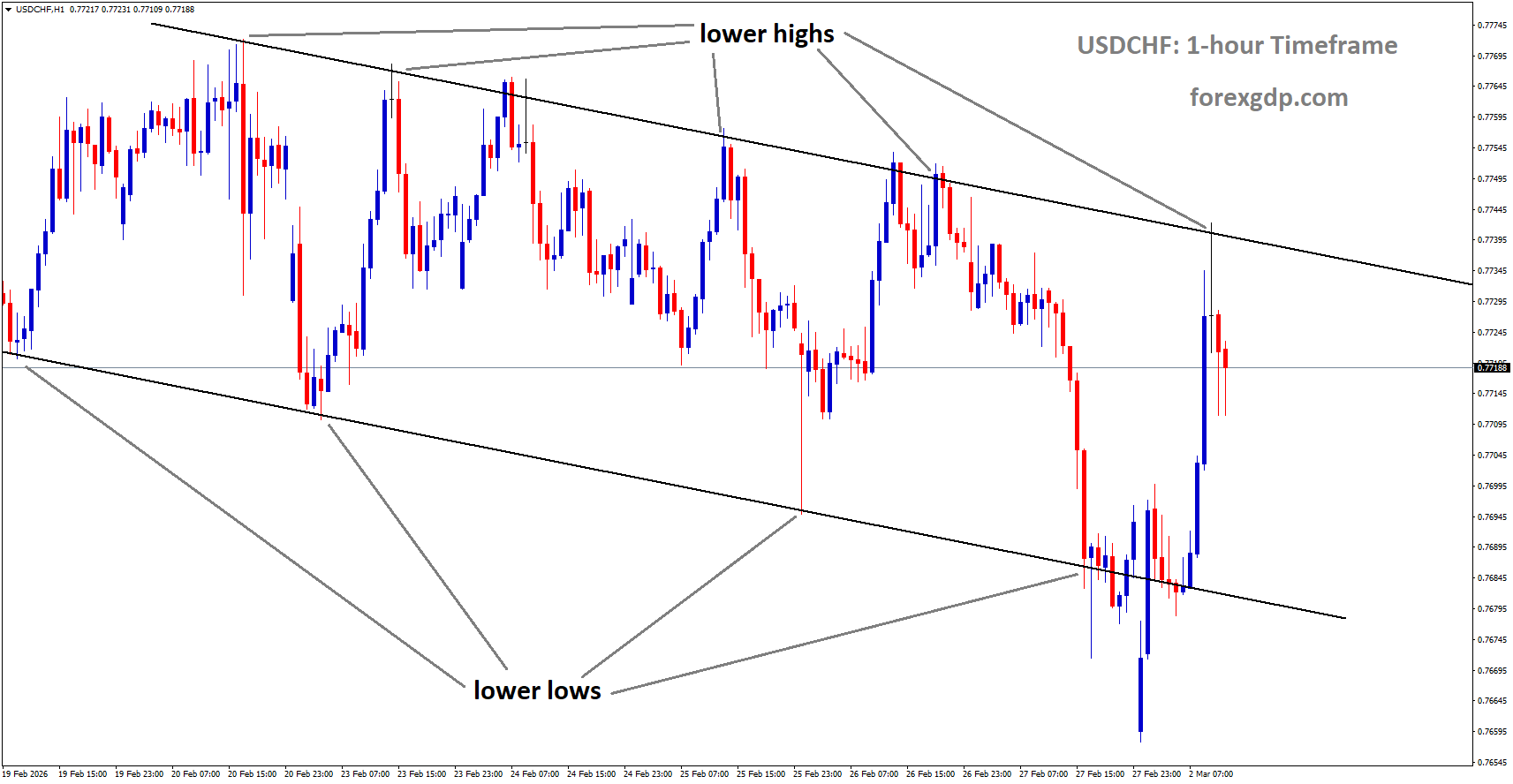
USDCHF is moving in a descending channel, and the market has fallen from the lower high area of the channel
At the same time, rising geopolitical tensions in the Middle East and political statements from Iran have added another layer of uncertainty to global markets. Investors are now closely watching upcoming US economic reports for further direction.
Strong US Inflation Data Supports the Dollar
The US Dollar found support after the latest inflation data came in stronger than expected. On Friday, the Bureau of Labor Statistics released the January Producer Price Index (PPI) report. This report measures changes in prices that producers receive for their goods and services and is often seen as an early sign of inflation trends.
The headline PPI increased by 0.5% in January compared to the previous month. This was higher than December’s 0.4% rise and also above market expectations of 0.3%. The stronger reading suggests that price pressures at the producer level remain firm.
Even more notable was the core PPI figure, which excludes food and energy prices due to their volatility. Core PPI rose by 0.8% in January, compared to a 0.6% increase in December. Analysts had expected a smaller rise of 0.3%. The higher-than-expected result indicates that underlying inflation pressures are still present in the US economy.
Why PPI Matters for the Federal Reserve
The Federal Reserve closely monitors inflation data when deciding on interest rates. When inflation remains elevated, the central bank may choose to keep interest rates steady or even raise them to prevent prices from rising too quickly.
The stronger PPI figures have reinforced the view that the Fed is likely to keep interest rates unchanged at its upcoming March meetings. Many investors believe the central bank will maintain its current policy stance at least until the summer.
Although US President Donald Trump has publicly pushed for lower interest rates, markets currently expect the Fed to remain cautious. Stable or higher interest rates tend to support the US Dollar because they can attract foreign investment seeking better returns.
USD/CHF Benefits from Dollar Strength
As a result of the strong US data and steady rate expectations, the USD/CHF pair gained ground. When the US Dollar strengthens, it often pushes this pair higher, especially if the Swiss Franc remains stable or weakens.
However, the situation is not entirely one-sided. The Swiss Franc is known as a safe-haven currency. This means that during times of global uncertainty or geopolitical tension, investors often move their money into the Franc to protect their capital.
Middle East Tensions Add Uncertainty
Over the weekend, joint US-Israeli strikes in Iran significantly increased tensions in the region. Reports suggest that the strikes resulted in the death of Iran’s Supreme Leader, Ayatollah Ali Khamenei. In response, US President Donald Trump stated that military operations would continue until America’s objectives in Iran are achieved.
Such developments can create volatility in financial markets. In times of geopolitical risk, safe-haven currencies like the Swiss Franc often gain demand. This dynamic can limit the upside potential of the USD/CHF pair, even when the US Dollar is strong.
Iran Refuses Negotiations
Adding to the tension, Iran’s national security chief, Ali Larijani, said that the country will not negotiate with the United States. His statement came in response to reports suggesting that he had reached out to Washington through mediators in Oman.
According to Bloomberg, these reports were denied by Iranian officials. Larijani’s firm stance signals that diplomatic solutions may not be immediate, which keeps uncertainty high.
When geopolitical risks remain unresolved, investors tend to remain cautious. This cautious mood can support the Swiss Franc, balancing out some of the strength seen in the US Dollar.
Market Focus Shifts to ISM Manufacturing PMI
While geopolitical news has grabbed headlines, traders are also paying close attention to upcoming economic data. The next key event on the calendar is the US ISM Manufacturing Purchasing Managers Index (PMI) report for February.
The ISM Manufacturing PMI measures business activity in the manufacturing sector. A reading above 50 indicates expansion, while a reading below 50 signals contraction. The report provides insight into production levels, new orders, employment, and overall business conditions.
Why the PMI Report Is Important

Manufacturing plays an important role in the US economy. If the PMI report shows stronger-than-expected growth, it could further support the US Dollar. Strong business activity would suggest that the economy remains resilient despite high interest rates and global uncertainty.
On the other hand, a weaker reading could slow the Dollar’s recent gains. Investors may interpret softer data as a sign that the economy is cooling, which could influence future rate decisions.
Given the recent strong inflation data, markets are particularly sensitive to any new information that might confirm or challenge the current outlook for US monetary policy.
Balancing Economic Strength and Global Risk
The current movement in USD/CHF reflects a balance between two powerful forces. On one side, strong US economic data and expectations of steady interest rates are boosting the US Dollar. On the other side, rising geopolitical tensions are supporting the Swiss Franc’s safe-haven appeal.
This push and pull creates a dynamic environment for traders and investors. Economic indicators suggest resilience in the US economy, but political developments in the Middle East add uncertainty to the broader global picture.
Investors often adjust their positions based on both factors. Positive economic data tends to strengthen the Dollar, while geopolitical risks can increase demand for the Franc.
What to Watch Going Forward
In the days ahead, market participants will likely focus on several key themes:
-
Additional updates on the situation in Iran and any further military actions.
-
Comments from US officials regarding foreign policy and economic conditions.
-
The outcome of the ISM Manufacturing PMI report.
-
Signals from the Federal Reserve about future interest rate decisions.
Each of these elements can influence the direction of USD/CHF. Strong data and stable policy expectations may keep the Dollar supported, while ongoing geopolitical uncertainty may continue to provide a floor for the Swiss Franc.
Final Summary
The USD/CHF pair moved higher near 0.7695 as the US Dollar gained strength following stronger-than-expected inflation data. The January Producer Price Index showed rising price pressures, reinforcing expectations that the Federal Reserve will keep interest rates unchanged in the near term.
At the same time, escalating tensions in Iran and firm statements from Iranian officials have increased global uncertainty. The Swiss Franc, known for its safe-haven status, has found support amid these developments.
With the ISM Manufacturing PMI report due soon, markets are waiting for fresh economic signals. The combination of strong US data and geopolitical risk continues to shape the outlook for USD/CHF, making the pair sensitive to both economic trends and global events.
USDCAD Stays Firm Above 1.3650 as Markets Await Key US Factory Data
The USD/CAD currency pair is moving higher as global events reshape investor sentiment. Rising tensions in the Middle East have increased demand for the US Dollar, often seen as a safe-haven currency during times of uncertainty. At the same time, oil markets are reacting sharply to geopolitical risks, which could offer support to the Canadian Dollar.
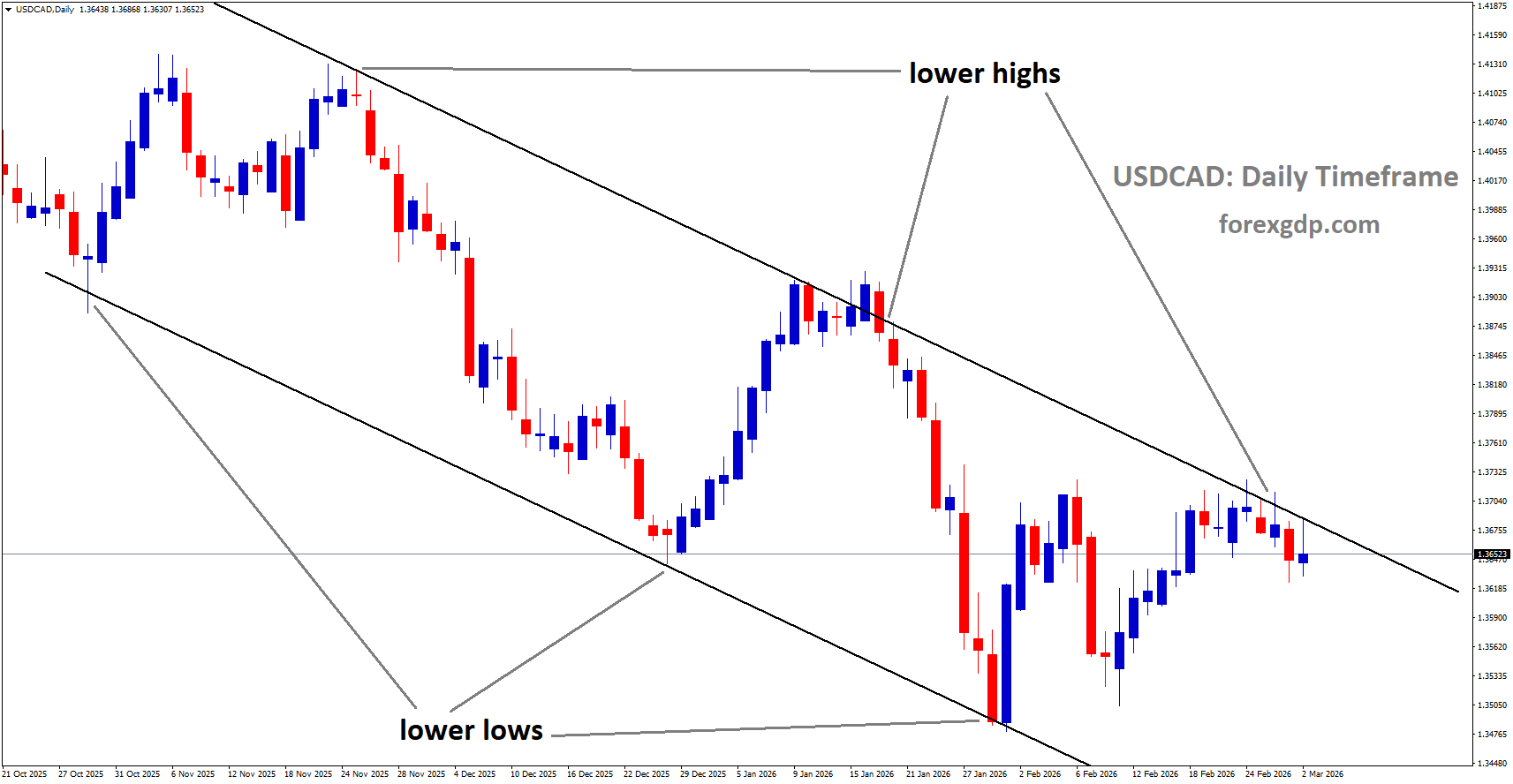
USDCAD is moving in a descending channel, and the market has reached the lower high area of the channel
As traders watch economic data and political developments closely, the balance between a stronger US Dollar and firm oil prices is shaping the direction of USD/CAD.
Safe-Haven Demand Lifts the US Dollar
The US Dollar has gained strength as investors seek safety amid growing instability in the Middle East. When global risks rise, many investors turn to the US Dollar because it is widely considered a stable and reliable currency. This shift in demand has pushed USD/CAD higher during Asian trading hours, after the pair recorded modest losses in the previous session.
Heightened tensions began after Israeli forces launched heavy strikes on areas in Beirut controlled by Hezbollah. The strikes followed missile attacks fired from Lebanon into Israel. In response, Israeli authorities issued evacuation orders for several nearby towns, raising fears of a broader regional conflict.
Over the weekend, coordinated US and Israeli military operations targeted Iran. Reports indicated that several high-level targets were struck, including facilities linked to the Revolutionary Guard, air defense systems, naval infrastructure, and multiple vessels. US President Donald Trump stated that hundreds of targets were hit and said military operations would continue until all objectives are achieved.
These developments have increased global uncertainty. When geopolitical tensions rise to this level, markets often react quickly. The US Dollar tends to benefit because investors see it as a safe place to park their money during volatile times.
Oil Market Volatility Adds Another Layer
While the US Dollar has strengthened, oil prices have also seen sharp movement. West Texas Intermediate (WTI) crude opened higher at the start of the week after Iran’s Islamic Revolutionary Guard Corps (IRGC) Navy announced a halt to shipments through the Strait of Hormuz.
Why the Strait of Hormuz Matters
The Strait of Hormuz is one of the most important oil transit routes in the world. More than 20% of global oil shipments pass through this narrow waterway. Any disruption in this area can quickly shake global energy markets.
Iran is one of the largest oil producers within OPEC, and any interruption to its exports has a direct impact on supply expectations. When traders fear supply shortages, oil prices often move higher. That is exactly what happened as news of halted shipments spread.
The combination of military conflict and restricted oil flow has increased uncertainty in energy markets. Oil prices are reacting to both supply risks and the broader geopolitical climate.
How Oil Prices Affect the Canadian Dollar

Canada is the largest oil exporter to the United States. Because of this, the Canadian Dollar is often closely linked to oil prices. When oil prices rise, Canada’s export revenues typically increase. This can support the Canadian economy and strengthen the Canadian Dollar.
Canada’s Oil Connection
The Canadian economy relies heavily on energy exports. Higher oil prices generally improve Canada’s trade balance and government revenues. As a result, the Canadian Dollar can gain support when crude prices move higher.
In the current situation, rising oil prices could limit how much USD/CAD climbs. While the US Dollar is benefiting from safe-haven demand, the Canadian Dollar may find strength from firm oil markets. This creates a push-and-pull effect between the two currencies.
If oil prices continue to hold steady or rise further, the Canadian Dollar could offset some of the US Dollar’s gains. However, if geopolitical tensions escalate even more, safe-haven flows into the US Dollar could dominate.
Economic Data Remains in Focus
Beyond geopolitical developments, traders are also paying close attention to US economic data. The ISM Manufacturing Purchasing Managers’ Index (PMI) is one of the key reports investors are waiting for. This index provides insight into the health of the US manufacturing sector.
Stronger economic data tends to support the US Dollar, especially if it reduces expectations for interest rate cuts from the Federal Reserve.
Inflation and Interest Rate Expectations
Recent US inflation data has shown firmness, suggesting that price pressures remain present. Some analysts believe this reflects the impact of tariffs being passed on to consumers. As inflation holds steady, expectations for aggressive interest rate cuts have eased.
When markets believe the Federal Reserve will keep interest rates higher for longer, the US Dollar often benefits. Higher rates generally attract investors seeking better returns on US assets.
However, there is not complete agreement within the Federal Reserve. Governor Stephen Miran has called for significant rate cuts as soon as possible. He argues that underlying inflation pressures are not as strong as headline numbers suggest and that current inflation readings may be distorted by measurement factors.
This difference in opinion within the Fed adds another layer of uncertainty. While some policymakers favor keeping rates elevated, others believe easing policy could support economic growth.
The Balance Between Risk and Opportunity
The direction of USD/CAD now depends on several competing forces. On one side, rising geopolitical tensions are boosting demand for the US Dollar. On the other, higher oil prices are supporting the Canadian Dollar.
If Middle East tensions continue to escalate, safe-haven flows into the US Dollar could intensify. Investors tend to prioritize stability during global crises, and the US Dollar often becomes the primary beneficiary.
At the same time, any further disruption in oil supply could push crude prices higher. This would likely provide more support to the Canadian Dollar, potentially slowing or limiting gains in USD/CAD.
Economic data from both countries will also play a role. Strong US data could reinforce Dollar strength, while positive Canadian economic indicators could strengthen the loonie.
Global Markets Remain on Edge
Financial markets are highly sensitive to geopolitical headlines. Military actions, sanctions, and shipping disruptions can quickly shift investor behavior. In this environment, currency pairs like USD/CAD can move sharply in response to new developments.
The situation in the Middle East remains fluid. Military operations are ongoing, and diplomatic efforts appear limited at the moment. Any change in tone, whether escalation or de-escalation, could influence market sentiment almost instantly.
At the same time, central bank messaging and economic reports will continue to guide expectations around interest rates. This combination of geopolitical risk and monetary policy uncertainty creates a complex trading environment.
Final Thoughts
USD/CAD is currently supported by a stronger US Dollar driven by safe-haven demand amid escalating Middle East tensions. Military actions involving Israel, Iran, and Lebanon have heightened global uncertainty, pushing investors toward the Dollar.
At the same time, oil market volatility caused by disrupted shipments through the Strait of Hormuz has lifted crude prices. Since Canada is a major oil exporter, higher oil prices could strengthen the Canadian Dollar and limit further gains in the currency pair.
Economic data, particularly US manufacturing and inflation figures, will remain key drivers in the days ahead. Diverging views within the Federal Reserve on interest rate policy add another element of uncertainty.
With geopolitical risks and economic factors both in play, USD/CAD is likely to remain sensitive to headlines and data releases. The balance between safe-haven flows and oil-driven support for the Canadian Dollar will continue to shape the pair’s direction.