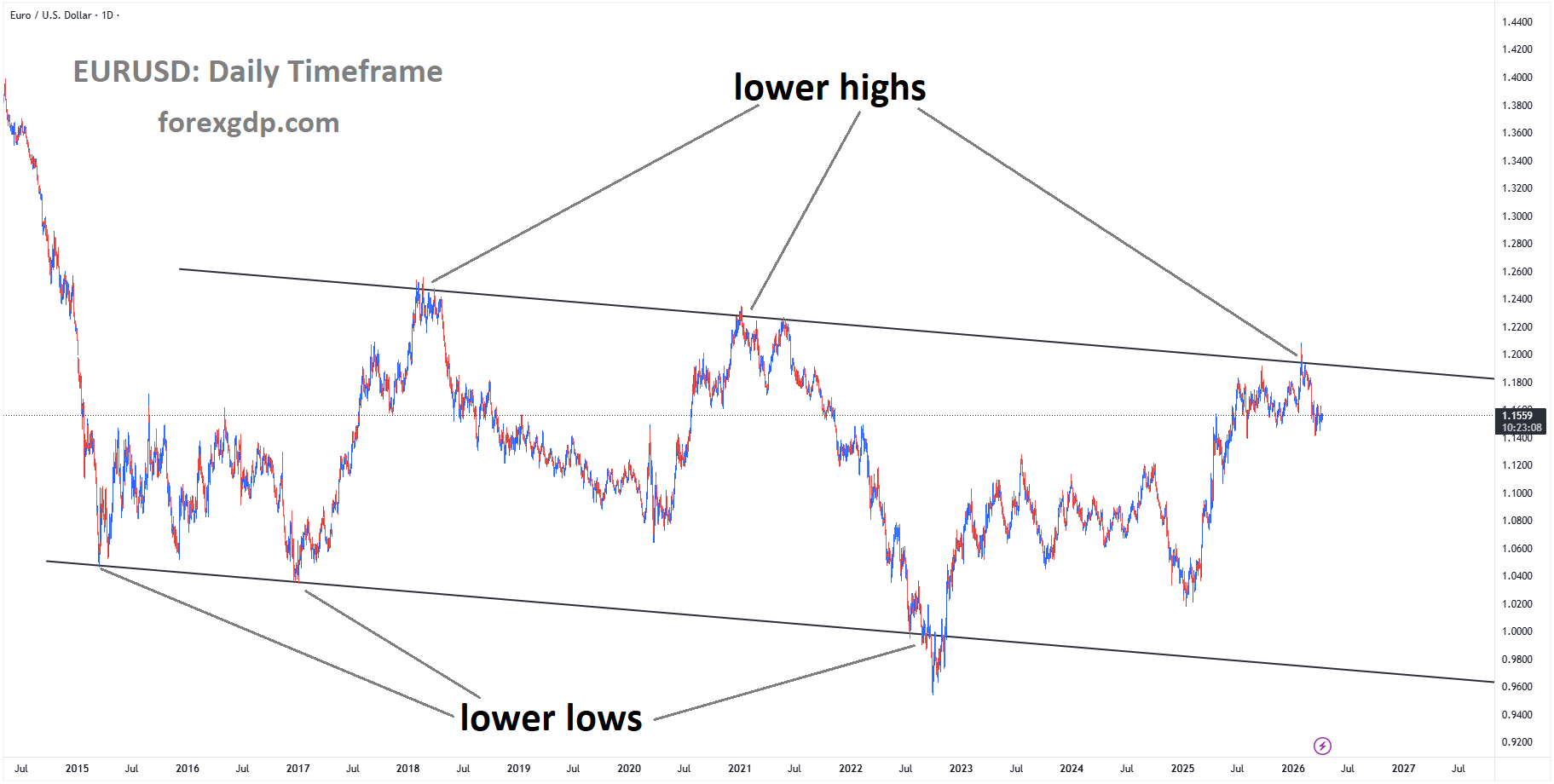
EURUSD is moving in a descending channel, and the market has fallen from the lower high area of the channel
EURUSD surges past 1.1570 as investor confidence rebounds
The Euro has shown a notable recovery against the US Dollar, climbing above the 1.1570 level during Tuesday’s European trading session. This move marks a fresh weekly high and reflects a shift in overall market sentiment. After facing earlier weakness, the shared European currency found renewed strength as investors responded to improving economic signals and a more positive mood in financial markets.
European stock markets, which initially opened on a weaker note, turned positive as the session progressed. This rebound in equities helped lift confidence among investors and supported demand for the Euro. A better-than-expected update in Eurozone services activity also played a role in strengthening the currency.
While the Euro’s upward movement signals growing optimism, the broader market environment remains cautious due to ongoing geopolitical tensions and uncertainty about future policy decisions.
Eurozone Services Sector Shows Modest Improvement
A key factor supporting the Euro’s recovery has been the latest data from the Eurozone’s services sector. The HCOB Services Purchasing Managers’ Index (PMI) for March was revised slightly higher to 50.2, compared to the preliminary estimate of 50.1. Although the improvement is small, it is enough to indicate slight growth in the sector.
However, the figure still falls below February’s stronger reading of 51.9, suggesting that momentum has slowed compared to earlier in the year. This mixed performance highlights that while the services sector is expanding, it is doing so at a slower pace.
Country-Level Performance Varies
A closer look at individual countries reveals uneven growth across the Eurozone:
Spain continues to stand out with a strong services PMI of 53.3, showing solid expansion.
Germany, the region’s largest economy, recorded a modest reading of 50.9, slightly lower than earlier estimates.
France remains a weak spot, with its services sector contracting for the third month in a row.
This variation shows that while the overall Eurozone economy is holding up, not all member countries are experiencing the same level of growth. Stronger performance in countries like Spain helps balance out weaker data from others, but the overall picture remains mixed.
Market Sentiment Improves but Caution Remains
The Euro’s rise is also closely tied to a broader improvement in market sentiment. When investors feel more confident, they are more willing to move away from safe-haven assets like the US Dollar and invest in currencies such as the Euro.
The recovery in European equities is one sign of this improved mood. As stock markets stabilized and moved higher, confidence spread across other asset classes, including currencies.
However, this positive sentiment is still fragile. Investors are not fully convinced that risks have disappeared, and many are choosing to remain cautious.
Geopolitical Tensions Weigh on Confidence
One of the main sources of uncertainty comes from rising geopolitical tensions involving the United States and Iran. Investors are closely watching developments as a critical deadline approaches.
US President Donald Trump has issued strong warnings to Iran, stating that serious action could be taken if key demands are not met. Specifically, he emphasized that the Strait of Hormuz must be reopened by a set deadline. This region is vital for global oil shipments, making it a major point of concern for markets worldwide.
The situation has become more tense after both the US and Iran rejected a proposed 45-day ceasefire put forward by Pakistan. Although Iran has suggested an alternative plan, it has not fully satisfied US expectations.
These developments have created a sense of unease among investors. While markets have shown some resilience, the possibility of sudden escalation continues to limit risk appetite.
Central Bank Caution Adds to Uncertainty
Another factor influencing the Euro’s movement is the outlook for monetary policy in the Eurozone. Investors are paying close attention to signals from the European Central Bank (ECB), especially regarding future interest rate decisions.
Dimitar Radev, a member of the ECB’s Governing Council, recently commented that it is still too early to determine whether the bank will raise interest rates in April. He stressed that policymakers need more data before making any firm decisions, especially given the current level of uncertainty.
Waiting for Clearer Economic Signals
The ECB’s cautious stance reflects the complex economic environment:
Growth remains uneven across the Eurozone.
Inflation pressures are still being monitored.
External risks, including geopolitical tensions, add to uncertainty.
By taking a wait-and-see approach, the ECB aims to avoid making premature decisions that could disrupt the fragile recovery. However, this cautious tone also means that investors have less clarity about the future direction of interest rates, which can influence currency movements.
What This Means for the Euro and Investors
The Euro’s recent strength highlights how quickly market sentiment can shift. A combination of slightly better economic data and improving confidence in equity markets has helped the currency recover from earlier losses.
At the same time, the broader environment remains uncertain. Investors are balancing positive economic signals with ongoing geopolitical risks and unclear central bank policies.
Key Drivers Behind the Euro’s Movement
Several factors are currently shaping the Euro’s performance:
Improved services sector data in the Eurozone
Recovery in European stock markets
Ongoing geopolitical tensions affecting global risk sentiment
Uncertainty around ECB policy decisions
Each of these elements plays a role in determining how the Euro moves against the US Dollar. When positive factors outweigh risks, the currency tends to strengthen. When uncertainty increases, gains may be limited or reversed.
Summary
The Euro has regained strength against the US Dollar, reaching new weekly highs as market sentiment improves. Better-than-expected data from the Eurozone services sector and a rebound in European equities have supported the currency’s recovery.
However, the overall picture remains mixed. Growth across the Eurozone is uneven, with strong performance in some countries and weakness in others. At the same time, geopolitical tensions involving the United States and Iran continue to create uncertainty, limiting investor confidence.
The European Central Bank’s cautious approach to interest rates adds another layer of complexity, as policymakers wait for clearer economic signals before making decisions.
While the Euro’s recent gains reflect growing optimism, the path ahead is still uncertain. Investors remain alert to both economic developments and global events that could influence market direction in the coming days.
GBPUSD Pulls Back as Rising Iran Tensions Weigh on Pound Against Dollar
The Pound Sterling started the day with some strength against the US Dollar, but that momentum did not last long. As global uncertainty grew, the currency quickly gave up its early gains and settled into a flat position. This shift reflects a broader change in market mood, where investors are becoming more cautious due to rising geopolitical tensions and uncertainty surrounding key global developments.
GBPUSD is moving in a descending channel, and the market has reached the lower high area of the channel
Growing Global Tensions Shift Market Mood
One of the main reasons behind the Pound’s reversal is the change in overall market sentiment. Investors are moving toward safer assets as concerns increase over international stability. This shift, often described as a “risk-off” environment, typically benefits the US Dollar while putting pressure on currencies like the British Pound.
The recent developments involving Iran and the United States have played a major role in this change. Iran has rejected a temporary ceasefire proposal from the US, instead demanding a permanent agreement. This decision has added uncertainty to an already tense situation, making investors more cautious about taking risks in the financial markets.
When uncertainty rises, traders often reduce exposure to assets that are considered more volatile. As a result, currencies like the Pound tend to weaken, while the US Dollar gains support as a safer option.
Iran’s Stance Adds to Uncertainty
The situation between Iran and the United States has become a key focus for global markets. A senior Iranian official made it clear that the country is not interested in a short-term ceasefire. Instead, Iran is seeking a long-lasting solution that includes specific conditions.
These conditions reportedly include the reopening of the Strait of Hormuz, assurances that there will be no further acts of aggression, and compensation for damages. The Strait of Hormuz is a critical route for global oil shipments, so any disruption or uncertainty in this region can have wide-reaching effects on the global economy.
Iran’s firm stance has created additional tension, as it signals that a quick resolution may not be possible. This has led investors to adopt a more cautious approach, which is reflected in the weakening of the Pound against the Dollar.
Awaiting the US Response
Markets are now closely watching how the United States will respond to Iran’s rejection of the ceasefire proposal. The situation has become even more urgent due to a deadline set by US President Donald Trump.
Over the weekend, President Trump issued strong warnings, suggesting that failure to meet US demands could lead to severe consequences, including potential action against Iranian infrastructure. He later reinforced this message, describing the deadline as final and urging Iran to reconsider its position.
With the deadline approaching, investors are on edge. Any response from the US could have immediate and significant effects on global markets. This uncertainty is another factor contributing to the cautious mood among traders.
When markets face such high-stakes developments, even small changes in tone or policy can lead to sharp reactions. As a result, many investors prefer to wait on the sidelines until there is more clarity.
Impact on Financial Markets
The shift in sentiment is not limited to currency markets. Broader financial markets are also showing signs of caution. Futures tied to major US stock indices have moved lower, indicating that investors are pulling back from riskier assets.
At the same time, the US Dollar has found support. The Dollar Index, which measures the currency’s strength against a basket of major currencies, has stabilized after earlier weakness. This reflects a common pattern where the Dollar benefits during periods of uncertainty.
For the Pound, this environment presents a challenge. Without strong domestic factors to support it, the currency becomes more vulnerable to global influences. As a result, even external developments, such as geopolitical tensions, can have a noticeable impact on its performance.
Focus Shifts to Federal Reserve Signals
While geopolitical tensions are currently dominating headlines, monetary policy remains an important factor for investors. Attention is now turning toward the upcoming release of the Federal Reserve’s meeting minutes.
These minutes will provide insights into the thinking of policymakers during their most recent meeting. At that meeting, the Federal Reserve decided to keep interest rates unchanged, signaling a cautious approach.
Officials also emphasized that their decisions are not based on a fixed plan. Instead, they will continue to assess economic conditions before making any changes. This flexible approach means that future policy decisions could shift depending on how the economy evolves.
Investors will be looking for clues about the Fed’s outlook on inflation, growth, and potential future rate moves. Any new information could influence expectations and, in turn, affect currency markets.
Why the Pound Struggles in Risk-Off Conditions
The Pound Sterling is often seen as a currency that performs better when investors are willing to take risks. This means it can struggle during times of uncertainty.
In contrast, the US Dollar is widely viewed as a safe-haven currency. When global tensions rise or economic concerns increase, investors tend to move funds into the Dollar. This shift in demand naturally strengthens the Dollar while weakening other currencies.
In the current situation, the combination of geopolitical uncertainty and cautious market behavior has created a challenging environment for the Pound. Without positive news to offset these pressures, the currency has found it difficult to maintain its earlier gains.
What Investors Are Watching Next
Looking ahead, several key factors will shape the direction of the Pound and the US Dollar. The most immediate focus is on the response from the United States regarding Iran’s position. Any escalation or signs of progress could quickly change market sentiment.
At the same time, the Federal Reserve’s meeting minutes will provide valuable insights into the future of US monetary policy. These details could influence expectations about interest rates and economic conditions.
Investors are also keeping an eye on broader market trends, including movements in equities and other major currencies. These signals help provide a clearer picture of overall market sentiment.
Summary
The Pound Sterling’s early strength faded as global uncertainty pushed investors toward safer assets. Rising tensions between Iran and the United States have played a central role in shifting market sentiment, creating a more cautious environment.
Iran’s rejection of a temporary ceasefire and its demand for a permanent agreement have added to the uncertainty. Meanwhile, markets are waiting for a response from the United States, with a key deadline adding urgency to the situation.
At the same time, attention is turning to the Federal Reserve, as investors look for guidance on future monetary policy. In this environment, the US Dollar has gained support, while the Pound has struggled to maintain its position.
As events continue to unfold, markets are likely to remain sensitive to both geopolitical developments and economic signals.
USDJPY Edges Higher as Japan’s Spending Slump Weighs on Yen
The USD/JPY currency pair showed modest strength on Tuesday, reaching its highest level in about a week during the Asian trading session. However, the upward movement lacked strong momentum, indicating that traders remain cautious. Despite the gains, the pair stayed below the important 160.00 level, reflecting a mix of economic and geopolitical factors influencing market sentiment.
USDJPY is moving in an uptrend channel, and the market has rebounded from the higher low area of the channel
Weak Japanese Data Weighs on the Yen
Recent economic data from Japan has played a significant role in weakening the Japanese Yen. According to figures released by Japan’s Ministry of Internal Affairs, household spending dropped by 1.8% in February compared to the same month last year. This decline was sharper than January’s 1.0% fall and marked the third straight month of contraction.
Although there was a slight improvement on a monthly basis—with spending rising by 1.5% after a steep drop in January—the increase fell short of expectations. This suggests that consumer activity in Japan is still struggling to gain momentum.
Why Household Spending Matters
Household spending is a key indicator of economic health. When people spend more, it often signals confidence in the economy. On the other hand, declining spending can point to uncertainty or financial pressure among consumers.
In this case, the continued weakness in spending has reduced expectations that the Bank of Japan (BoJ) will raise interest rates anytime soon. Lower interest rate expectations typically weaken a currency, which is exactly what has happened with the Yen.
Global Tensions Add Pressure on Japan’s Economy
Beyond domestic economic data, global developments are also impacting the Japanese currency. Ongoing tensions involving Iran have raised concerns about energy supply and rising oil prices. This is particularly important for Japan, which relies heavily on oil imports from the Middle East.
If energy costs continue to rise, Japan’s economy could face additional strain. Higher import costs can increase inflation while also slowing economic growth. This combination makes it less likely that the BoJ will tighten monetary policy in the near future.
Impact of Oil Dependency
Japan’s dependence on imported oil makes it vulnerable to disruptions in global supply chains. Any instability in the Middle East can quickly translate into higher costs for businesses and consumers in Japan. This adds another layer of pressure on the Yen, as investors factor in the potential economic slowdown.
Intervention Fears Limit Yen Weakness
Despite the negative outlook, the Japanese Yen has not weakened significantly. One major reason is the growing expectation that Japanese authorities could step in to support the currency if it falls too quickly.
Currency intervention typically involves the government or central bank buying its own currency in the market to stabilize its value. While no action has been confirmed, the mere possibility of intervention is enough to make traders cautious.
Why Intervention Matters
When markets believe that authorities might intervene, they tend to avoid pushing the currency too far in one direction. This creates a natural limit on how much the Yen can weaken, even when economic conditions suggest otherwise.
US Dollar Gains Support from Global Uncertainty
On the other side of the pair, the US Dollar has been benefiting from its status as a global safe-haven currency. Rising geopolitical tensions and uncertainty often lead investors to move their funds into assets perceived as stable, such as the US Dollar.
Recent developments in the US-Iran situation have further strengthened this trend. Iran has reportedly rejected a ceasefire proposal, while the US has signaled the possibility of stronger action if key shipping routes are not reopened.
Inflation Concerns in the US
Higher oil prices could also push inflation higher in the United States. If inflation rises, the Federal Reserve may choose to keep interest rates elevated or even tighten policy further. This would support the US Dollar by making it more attractive to investors seeking better returns.
Market Focus Shifts to Upcoming US Data
Traders are now closely watching upcoming economic data from the United States, particularly the Durable Goods Orders report. This data provides insights into business investment and overall economic activity.
While this report could influence short-term movements in the USD/JPY pair, the broader focus remains on geopolitical developments and central bank expectations. The ongoing uncertainty surrounding global conflicts continues to play a dominant role in shaping market direction.
Outlook for USD/JPY Remains Positive
Taking all factors into account, the overall trend for USD/JPY appears to favor further upside, although gains may be gradual. Weak economic data from Japan, combined with reduced expectations for interest rate hikes, continues to weigh on the Yen.
At the same time, the US Dollar is supported by global uncertainty and the possibility of tighter monetary policy in response to inflation risks. However, any sharp moves could be limited by fears of intervention from Japanese authorities.
Key Factors to Watch
Future economic data from Japan, especially consumer spending and inflation
Developments in global oil markets and Middle East tensions
Signals from the Bank of Japan regarding monetary policy
US economic indicators and Federal Reserve decisions
Summary
The USD/JPY pair is currently being influenced by a complex mix of economic data and geopolitical developments. Weak household spending in Japan has reduced confidence in the Yen, while global tensions and rising oil prices are adding further pressure.
Meanwhile, the US Dollar continues to benefit from its safe-haven appeal and the possibility of sustained higher interest rates. Although the pair has moved higher, uncertainty remains, and intervention risks could limit extreme movements.
As markets navigate these competing forces, the direction of USD/JPY will likely depend on how economic conditions and global events evolve in the coming days.
USDCAD drifts lower with unclear US-Iran developments weighing on sentiment
The Canadian Dollar has started the week on a stronger note, gaining ground against the US Dollar after a brief period of losses. This shift comes as global developments, especially those related to tensions between the United States and Iran, influence investor sentiment. While the US Dollar remains supported by uncertainty, changing headlines have created a mixed environment that continues to drive fluctuations in currency markets.
USDCAD is moving in a descending triangle pattern, and the market has reached the lower high area of the pattern
Geopolitical Developments Influence Market Mood
Global politics are once again playing a key role in shaping financial markets. Recent reports suggesting the possibility of a temporary ceasefire between the United States and Iran initially boosted confidence among investors. This improvement in sentiment led to a softer US Dollar, allowing the Canadian Dollar to recover from its earlier weakness.
However, the situation remains far from stable. Conflicting reports and differing responses from both sides have kept uncertainty high. Iran has reportedly pushed for a permanent resolution rather than a temporary ceasefire, while also rejecting certain proposals presented through diplomatic channels. At the same time, US officials have indicated that negotiations are still unclear, with no firm agreement in place.
This ongoing tension means that investors are cautious. Even small updates or rumors can quickly shift market direction, making currencies like the US Dollar and Canadian Dollar highly sensitive to news.
Uncertainty Limits US Dollar Decline
Although the US Dollar weakened earlier in the day, it managed to recover some of its losses as doubts about a quick resolution resurfaced. The US Dollar Index, which measures the currency against several major peers, showed signs of stabilization after dipping earlier.
This pattern highlights an important trend: while improved risk sentiment can weaken the US Dollar, uncertainty often brings buyers back. Investors tend to view the US Dollar as a safe place during times of global tension, which limits how far it can fall even when conditions seem favorable for other currencies.
The current situation reflects this balance. Optimism about a ceasefire pushed the US Dollar lower, but ongoing concerns quickly slowed that decline.
Canadian Dollar Finds Support from Changing Sentiment
The Canadian Dollar has benefited from this shifting environment. After experiencing two days of losses, it managed to bounce back as the US Dollar softened. This recovery shows how closely the Canadian currency is tied to global sentiment and external factors.
Canada’s economy is heavily linked to commodities, especially oil. When global tensions rise, oil prices often increase due to concerns about supply disruptions. Higher oil prices can support the Canadian Dollar, as they boost the country’s export revenues.
Oil Prices and Their Role
Rising oil prices have become an important factor in the current situation. The ongoing conflict has raised concerns about disruptions in key supply routes, including the Strait of Hormuz. Any threat to this region can impact global energy markets, pushing prices higher.
For Canada, this can be a positive development in the short term. Stronger oil prices often translate into increased demand for the Canadian Dollar. However, there is also a downside. Higher energy costs can contribute to inflation, creating challenges for central banks.
Economic Impact and Central Bank Challenges
Beyond immediate market reactions, the broader economic impact of geopolitical tensions is becoming more visible. Rising oil prices and increased uncertainty can slow global growth while also pushing inflation higher. This combination creates a difficult situation for central banks.
Both the Federal Reserve in the United States and the Bank of Canada must carefully balance their decisions. On one hand, they need to control inflation. On the other, they must avoid slowing the economy too much.
This balancing act becomes even more complicated when external factors, such as geopolitical conflicts, influence inflation and growth at the same time.
Recent Economic Data Adds to the Picture
Economic data from the United States has also played a role in shaping market expectations. The latest reading of the ISM Services Purchasing Managers Index showed a decline compared to the previous month and came in below forecasts.
This suggests that growth in the services sector may be slowing slightly. While the reading still indicates expansion, the drop has raised some concerns about the pace of economic activity.
For currency markets, such data can influence expectations about future policy decisions. If economic growth shows signs of slowing, central banks may take a more cautious approach.
Key Data Releases to Watch This Week
Looking ahead, traders are focusing on several important economic reports that could influence the direction of both the US Dollar and the Canadian Dollar.
US Inflation Data
Inflation figures from the United States are expected to draw significant attention. The Consumer Price Index and the Personal Consumption Expenditures Price Index are both key indicators used to measure inflation trends.
These reports will provide insight into whether inflation pressures are easing or remaining persistent. The outcome could have a direct impact on expectations for future interest rate decisions by the Federal Reserve.
Canada Employment Report
In Canada, the upcoming employment data will be closely watched. The job market is a crucial indicator of economic health, and any surprises in the report could influence the Canadian Dollar.
Strong employment figures could support the currency by signaling a stable economy. On the other hand, weaker data might limit gains, especially if combined with ongoing global uncertainty.
Market Sentiment Remains Fragile
Despite moments of optimism, overall sentiment remains fragile. The situation between the United States and Iran continues to evolve, and there is still a risk of further escalation. Deadlines set by political leaders and warnings of potential actions add another layer of tension.
This uncertainty means that markets are likely to remain sensitive to news. Currency movements could be driven more by headlines than by traditional economic factors in the short term.
Summary
The Canadian Dollar has gained strength as the US Dollar softened amid shifting global developments. Early optimism about a possible ceasefire improved market sentiment, but ongoing uncertainty has kept investors cautious. Rising oil prices have provided additional support to the Canadian currency, while also adding complexity to the global economic outlook.
At the same time, recent economic data and upcoming reports are shaping expectations for both countries. Inflation figures in the United States and employment data in Canada will be key drivers in the days ahead.
With geopolitical tensions still unresolved, currency markets are likely to remain volatile. Traders and investors will continue to monitor both political developments and economic indicators as they navigate an uncertain environment.
USDCHF Rises Toward 0.8000 with Fed Hawkishness Outpacing SNB Strategy
The USD/CHF currency pair has been gaining momentum, reaching around 0.7990 during early European trading hours on Tuesday. This upward movement reflects a stronger US Dollar against the Swiss Franc, driven by a mix of economic expectations, central bank policies, and rising geopolitical tensions.
USDCHF is moving in an uptrend channel, and the market has rebounded from the higher low area of the channel
Several factors are shaping this trend, including shifting expectations around US interest rates, rising energy prices, and growing uncertainty in global markets. Together, these elements are influencing how traders position themselves and how currencies respond in the short term.
Rising US Dollar Driven by Policy Expectations
One of the main reasons behind the recent strength of the US Dollar is the changing outlook for interest rates in the United States. Traders are now expecting fewer rate cuts than previously anticipated. This shift has provided support for the Dollar, making it more attractive compared to other currencies.
When interest rates are expected to stay higher for longer, investors tend to favor that currency because it can offer better returns. In this case, the US Federal Reserve appears less likely to ease policy quickly, which has helped push the Dollar higher.
Comments from Federal Reserve officials have also played a role. There is growing concern that inflation in the US may remain above the target level of 2%. If that happens, the central bank may consider keeping rates steady or even raising them further. This cautious stance reinforces confidence in the Dollar.
Swiss Franc Faces Pressure Despite Rising Inflation
On the other side of the equation, the Swiss Franc has been under some pressure. Interestingly, this comes even as Switzerland’s inflation rate has increased. In March, inflation rose to 0.3%, marking the highest level in a year.
This rise in inflation has been largely driven by higher energy costs. Ongoing tensions in the Middle East have disrupted energy supplies, leading to increased prices for heating oil and other fuels. As a result, living costs in Switzerland have edged higher.
While rising inflation might normally support a currency, the situation in Switzerland is slightly different. The Swiss National Bank has previously maintained very low interest rates, even dipping into negative territory. Now, with inflation picking up, there is less urgency for the central bank to return to negative rates. However, this shift has not been strong enough to significantly boost the Swiss Franc against the Dollar.
Geopolitical Tensions Add Uncertainty
Global political developments are also playing a major role in currency movements. Tensions in the Middle East have intensified, particularly surrounding discussions between the United States and Iran.
A key point of concern is the Strait of Hormuz, a vital route for global oil shipments. Any disruption in this area can have serious implications for energy markets and the global economy. The United States has made it clear that maintaining access to this waterway is a top priority.
Recent statements from US leadership have added to the uncertainty. A deadline has been set for Iran to agree to certain conditions, and there are warnings of possible actions if those conditions are not met. This situation has created a sense of urgency and caution among traders.
Whenever geopolitical risks rise, investors often move toward safer or more stable assets. The US Dollar tends to benefit in such scenarios because of its global reserve status and perceived stability.
Oil Prices and Their Impact on Currency Markets
The connection between oil prices and currency movements is becoming more evident in this situation. As tensions in the Middle East affect supply, crude oil prices have been climbing.
Higher oil prices can contribute to inflation, especially in countries that rely heavily on energy imports. In the United States, this has added to concerns that inflation may remain elevated. As a result, expectations for rate cuts have been pushed further into the future.
For Switzerland, higher energy costs have also contributed to rising inflation. However, the overall impact on the Swiss Franc has been more limited compared to the boost seen in the US Dollar.
Upcoming Economic Data to Watch
Traders are also keeping an eye on upcoming economic reports from the United States. Key data releases, such as Durable Goods Orders and employment figures, can provide insights into the strength of the US economy.
If these reports show strong economic activity, they could further support the idea that the Federal Reserve will maintain its current policy stance. This would likely continue to favor the US Dollar.
On the other hand, weaker data could shift expectations again. Currency markets are highly sensitive to such changes, and even small surprises can lead to noticeable movements.
Monetary Policy Divergence Shapes the Trend
A major theme behind the USD/CHF movement is the difference in monetary policy between the US Federal Reserve and the Swiss National Bank.
The Federal Reserve appears cautious about lowering rates too quickly, especially with inflation still a concern. Meanwhile, the Swiss National Bank is dealing with a different set of challenges, including relatively low inflation and a history of very loose monetary policy.
This divergence creates a gap between the two currencies. When one central bank is seen as more restrictive than the other, its currency often strengthens. In this case, the US Dollar is benefiting from that dynamic.
Market Sentiment and Investor Behavior
Market sentiment is another important factor influencing the USD/CHF pair. When uncertainty rises, whether due to economic concerns or geopolitical tensions, investors tend to look for stability.
The US Dollar often serves as a safe haven during uncertain times. This means that demand for the Dollar can increase even if the underlying economic data is mixed.
At the same time, the Swiss Franc is also traditionally seen as a safe-haven currency. However, in the current environment, the Dollar appears to have the upper hand due to stronger economic signals and policy expectations.
Summary
The recent rise in the USD/CHF pair reflects a combination of economic trends, central bank policies, and global events. The US Dollar has gained strength as expectations for interest rate cuts have been reduced and inflation concerns remain present. At the same time, the Swiss Franc has faced challenges despite rising inflation at home.
Geopolitical tensions in the Middle East and rising oil prices have added another layer of complexity, influencing both inflation and market sentiment. As traders continue to monitor economic data and political developments, the balance between these factors will shape the direction of the currency pair.
Understanding these dynamics provides a clearer picture of why the USD/CHF is moving higher and what may influence its path in the coming days.
BTCUSD Trades Sideways Near $69K with Global Attention on Trump’s Next Move
Bitcoin is currently trading around the $69,000 level, showing a surprising level of stability despite growing uncertainty in global markets. Investors are closely watching developments in the Middle East, particularly tensions involving Iran, which have become a major influence on financial markets worldwide. While traditional assets like gold and equities are reacting more sharply, Bitcoin appears to be holding its ground.
BTCUSD is moving in a descending channel, and the market has reached the lower high area of the pattern
This steady performance comes at a time when traders are cautious and waiting for key geopolitical decisions that could shape market direction in the coming days.
Market Sentiment Driven by Geopolitics
The ongoing conflict involving Iran has taken center stage, becoming the primary factor influencing market sentiment. A major deadline set by former U.S. President Donald Trump has added further tension. The deadline revolves around reopening the Strait of Hormuz, a critical global oil route. Failure to reach an agreement could lead to serious consequences, which markets are already pricing in.
Iran has rejected a temporary ceasefire proposal and instead pushed for a permanent resolution along with the removal of sanctions. This disagreement has created uncertainty, keeping investors on edge.
Global markets are reacting cautiously. U.S. stock futures are largely flat, signaling hesitation among investors. At the same time, oil prices remain elevated, reflecting concerns about supply disruptions in one of the world’s most important energy regions.
Oil Prices and Inflation Concerns
Oil prices have surged significantly since the conflict began, rising more than 50% overall. They are currently holding above $110 per barrel, although they have pulled back slightly from recent highs.
This sharp increase in oil prices is not just about energy—it has wider economic implications. Higher oil prices tend to push inflation upward, as energy costs affect transportation, production, and everyday goods.
When inflation remains high, central banks like the U.S. Federal Reserve are less likely to lower interest rates. Instead, they may keep rates elevated for longer to control rising prices.
This environment usually creates challenges for assets like Bitcoin. Higher interest rates can reduce investor appetite for risk, as safer investments become more attractive. Despite this, Bitcoin has shown notable resilience.
Bitcoin vs Gold: A Shift in Behavior?
Traditionally, gold has been seen as a safe-haven asset during times of uncertainty. However, recent market movements tell a different story. Gold prices have dropped significantly, falling more than 10% as expectations for interest rate cuts have weakened.
Bitcoin, on the other hand, has managed to hold steady. While it has not experienced a major rally, it has avoided the sharp declines seen in other assets. This behavior suggests that Bitcoin may be evolving in how it responds to global events.
There are a few possible reasons behind this resilience. Investor positioning appears to be stronger, with fewer panic-driven sell-offs. In addition, growing institutional involvement is providing a level of support that was not as prominent in earlier market cycles.
Institutional Demand Supporting Bitcoin
One of the key factors helping Bitcoin maintain its position is the return of institutional investment. After several months of outflows, Bitcoin exchange-traded funds (ETFs) have started to attract fresh capital.
Recent data shows strong inflows into spot Bitcoin ETFs, including a single-day surge that marked the highest level since early in the year. This renewed interest suggests that large investors are regaining confidence in Bitcoin, even in uncertain conditions.
Institutional participation often brings stability to markets. Unlike retail investors, institutions tend to take a longer-term view and are less likely to react quickly to short-term news. Their presence can help reduce volatility and support price levels during periods of stress.
Bitcoin has remained above the $65,000 mark for much of the recent period, which indicates that this support is having a real impact.
What Could Drive the Next Move?
While Bitcoin has shown strength, it has not yet broken into a strong upward trend. For that to happen, the market will likely need a clear and positive catalyst.
One of the most important potential triggers would be a resolution to the conflict involving Iran. If tensions ease and a ceasefire is reached, oil prices could fall below $100 per barrel. This would reduce inflation pressure and improve the overall economic outlook.
Lower inflation could increase the chances of interest rate cuts, which would generally be positive for risk assets like Bitcoin. Combined with continued institutional demand, this could create the conditions needed for a stronger upward move.
Another factor to watch is regulatory progress in the United States. Developments related to crypto legislation, such as clarity around rules and frameworks, could boost investor confidence and attract more capital into the market.
Seasonal Trends and Market Patterns
Historical data also offers some optimism. April has often been a strong month for Bitcoin, with average gains that stand out compared to other months. While past performance does not guarantee future results, seasonal trends can influence investor expectations and behavior.
Traders sometimes position themselves based on these patterns, which can create additional momentum if enough participants act on similar expectations.
That said, current market conditions are heavily influenced by global events, which may outweigh typical seasonal effects. Investors are therefore balancing historical trends with real-time developments.
A Market in Waiting
At the moment, Bitcoin is in a holding pattern. It is not showing strong upward momentum, but it is also not breaking down under pressure. This type of stability often reflects a market that is waiting for clarity.
Key decisions related to geopolitics, energy markets, and monetary policy are likely to determine the next major move. Until then, cautious trading is expected to continue.
Investors are closely monitoring headlines, especially those related to the Middle East and global economic policy. Even small changes in these areas could quickly shift market sentiment.
Summary
Bitcoin’s ability to hold near $69,000 during a period of global uncertainty highlights its growing maturity as an asset. While traditional markets react sharply to rising oil prices and geopolitical tensions, Bitcoin has remained relatively stable.
Strong institutional inflows, changing investor behavior, and potential capital rotation are helping support its position. At the same time, broader economic factors such as inflation and interest rates continue to play a major role in shaping expectations.
The next major move for Bitcoin will likely depend on external developments, particularly any resolution to geopolitical tensions and shifts in monetary policy. Until then, the market remains cautious, with investors watching closely for signs of a clear direction.
Don’t trade all the time, trade forex only at the confirmed trade setups