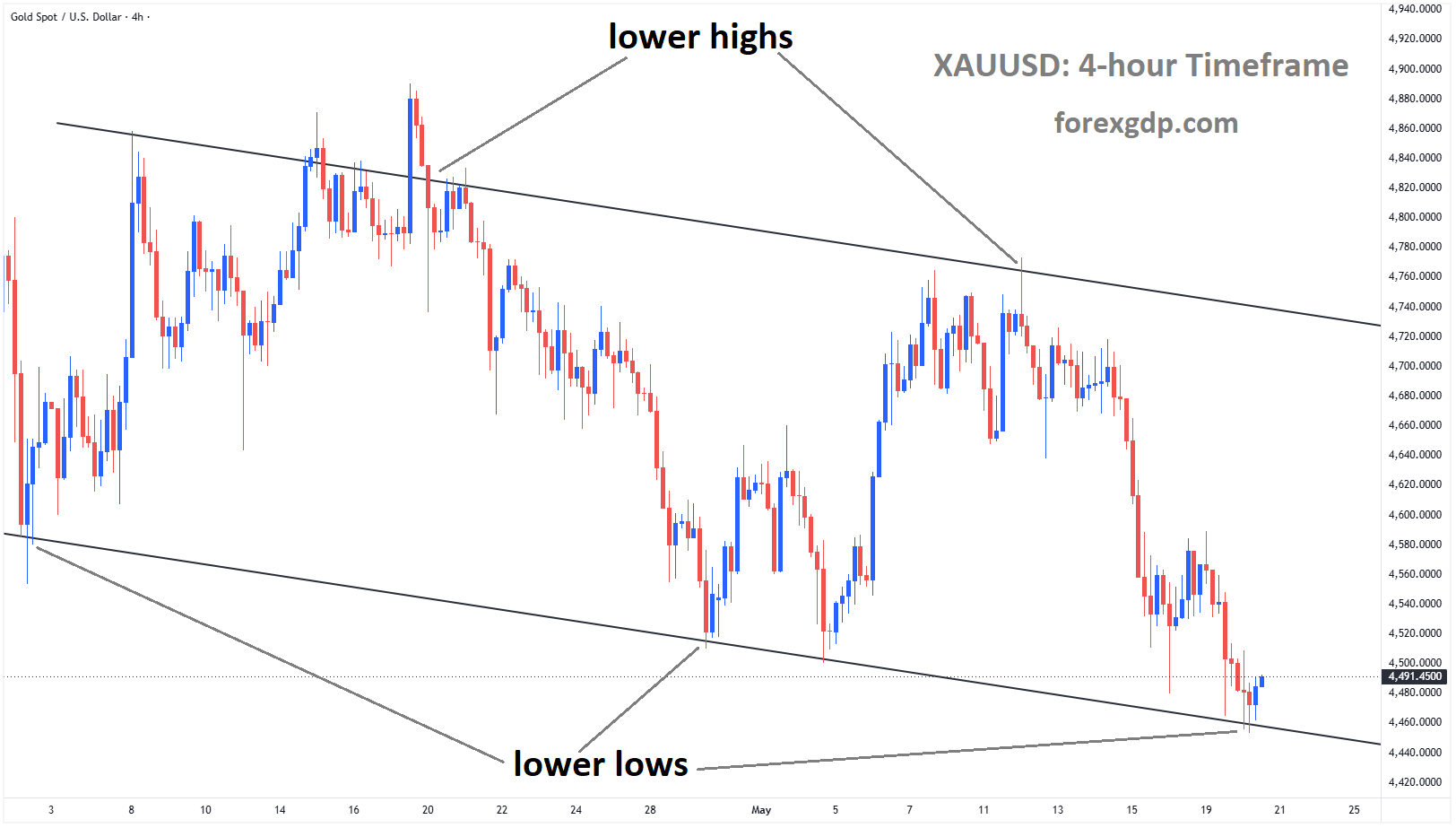
XAUUSD reached a lower low area of the descending channel
Gold prices remained under pressure on Wednesday as the US Dollar stayed strong and investors reacted to rising expectations of tighter monetary policy from the US Federal Reserve. Although the precious metal managed to recover slightly from its recent lows, the overall market mood continued to favor the US currency.
The latest movement in gold prices comes at a time when global investors are closely watching geopolitical tensions in the Middle East, inflation concerns, and signals from the Federal Reserve regarding future interest rates. Together, these factors are shaping the direction of both the US Dollar and gold.
Stronger US Dollar Limits Gold Recovery
Gold often moves in the opposite direction of the US Dollar. When the dollar strengthens, gold becomes more expensive for buyers using other currencies, which can reduce demand for the metal.
On Wednesday, the US Dollar remained near its highest level in six weeks. This strength came mainly from investor demand for safer assets amid uncertainty surrounding US-Iran relations and expectations that the Federal Reserve may keep interest rates higher for longer.
Even though gold recovered slightly after falling to its lowest level since late March, the rebound remained limited. Traders appeared cautious about making aggressive purchases because the broader market environment still supports the dollar.
The strong dollar has become one of the biggest obstacles for gold in recent sessions. Investors continue to view the US currency as a safe and stable option during uncertain times, especially when geopolitical tensions increase.
Middle East Tensions Continue to Influence Markets
One of the key drivers behind current market sentiment is the ongoing uncertainty surrounding relations between the United States and Iran.
US President Donald Trump recently stated that military action against Iran could still happen if diplomatic efforts fail. According to his comments, he was very close to approving an attack before delaying the decision after discussions with Gulf leaders.
At the same time, Vice President JD Vance offered a more optimistic tone, saying that talks between the US and Iran have shown progress and that both sides want to avoid further military conflict.
Despite these comments, investors remain doubtful about the chances of a final agreement. Major disagreements continue over Iran’s nuclear activities and control of the Strait of Hormuz, one of the world’s most important oil shipping routes.
Because of these unresolved issues, market participants continue to seek safety in the US Dollar. This ongoing demand for the greenback has reduced interest in gold, even though gold is also traditionally considered a safe-haven asset.
Rising Oil Prices Add to Inflation Concerns

Another important factor affecting gold is the recent rise in crude oil prices. Concerns about instability in the Middle East have pushed oil prices closer to monthly highs.
Higher oil prices can increase inflation because energy costs affect transportation, manufacturing, and consumer goods. As inflation fears grow, investors begin to expect stronger action from central banks, especially the Federal Reserve.
Many traders now believe the Fed could keep borrowing costs elevated for a longer period or even raise interest rates again in the future. According to market expectations, there is now a growing chance of another rate increase in 2026.
Higher interest rates generally hurt gold because the metal does not offer interest or yield. Investors often move toward assets such as bonds or savings instruments that provide returns when rates rise.
This shift in investor preference has added more pressure on gold prices in recent days.
Federal Reserve Expectations Remain a Major Focus
The Federal Reserve continues to play a central role in shaping global financial markets. Investors are paying close attention to every comment from Fed officials and every economic report for clues about future policy decisions.
Recent remarks from Philadelphia Fed President Anna Paulson strengthened expectations that the central bank could take a more aggressive stance if inflation risks continue or if economic growth remains strong.
These comments contributed to a rise in US Treasury bond yields. Higher bond yields usually support the US Dollar because they attract global investors looking for better returns.
As bond yields increase, gold often struggles because holding non-yielding assets becomes less attractive compared to interest-paying investments.
Market participants are now waiting for the release of the Federal Open Market Committee (FOMC) meeting minutes. The report could provide deeper insight into how Fed policymakers view inflation, growth, and future interest rate decisions.
Any signals suggesting a more hawkish approach from the Fed could strengthen the dollar even further and keep gold under pressure.
Investor Sentiment Remains Cautious
Although gold has managed to stabilize slightly after its recent decline, the overall sentiment in the market remains cautious.
Many investors believe that the combination of a strong US Dollar, rising Treasury yields, and expectations of tighter monetary policy creates a difficult environment for gold to gain momentum.
At the same time, geopolitical risks and inflation concerns continue to prevent a larger sell-off in the precious metal. This balance between safe-haven demand and monetary pressure is creating mixed conditions for the market.
Traders are likely to remain highly sensitive to any updates related to the Middle East conflict, oil prices, inflation data, and Federal Reserve communication.
Why Gold Still Matters During Uncertain Times
Despite recent weakness, gold continues to hold an important place in global financial markets. Investors often turn to gold during periods of economic uncertainty, geopolitical instability, or inflation fears.

XAUUSD is breaking the lower high area of the descending channel
The metal has historically been viewed as a store of value and a hedge against financial instability. However, short-term price movements are heavily influenced by interest rate expectations and currency strength.
When central banks raise rates and bond yields increase, gold usually faces pressure. But when uncertainty rises sharply or inflation becomes harder to control, demand for gold can return quickly.
This is why traders continue to monitor both economic and political developments closely before making larger investment decisions.
Final Summary
Gold prices remain under pressure as the US Dollar stays strong and investors expect the Federal Reserve to maintain a firm stance on interest rates. Ongoing tensions between the United States and Iran, combined with rising oil prices and inflation concerns, continue to influence global markets.
While gold has shown some signs of recovery from recent lows, the overall market environment still favors the US Dollar. Investors are now focused on upcoming Federal Reserve signals and further geopolitical developments, which could determine the next major move for both gold and the broader financial markets.