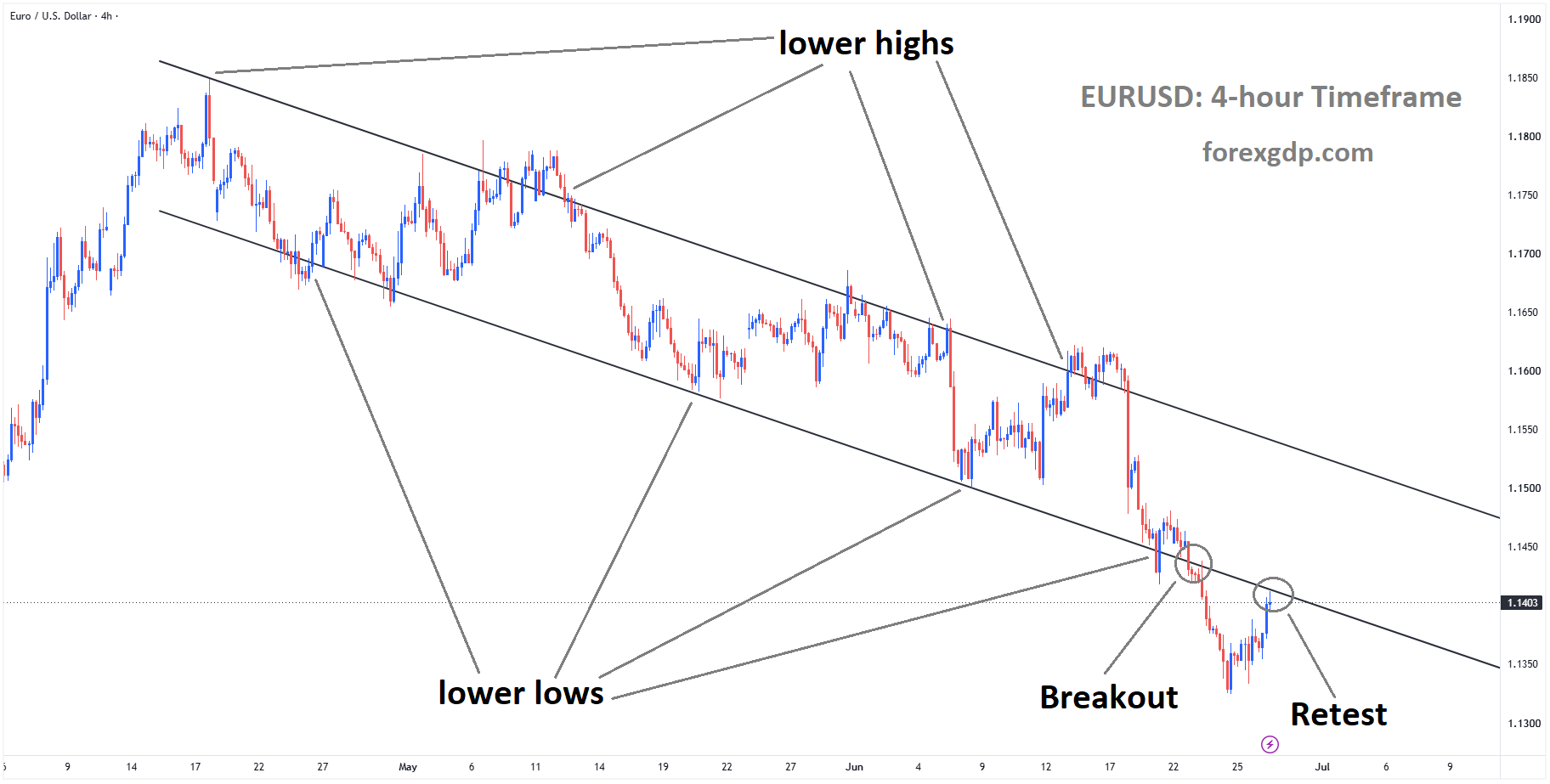
EURUSD reached the retest area of the broken descending channel
EURUSD Climbs Higher with Weaker Dollar and Improved Market Sentiment
The EUR/USD currency pair regained some ground on Friday after experiencing a difficult week. The Euro managed to recover from recent lows as weaker oil prices improved confidence across European markets. At the same time, the US Dollar lost a small amount of strength, giving the Euro room to move higher.
Although the latest rebound has offered some relief to Euro buyers, the overall market outlook remains cautious. Investors continue to pay close attention to inflation, central bank decisions, and economic reports from both Europe and the United States, as these factors are expected to shape the direction of the currency pair in the coming weeks.
Falling Oil Prices Bring Relief to the Euro
One of the biggest reasons behind the Euro’s recovery is the significant decline in global oil prices. Lower energy costs are generally positive for countries in the Eurozone because many of them rely heavily on imported oil. When energy becomes cheaper, businesses and consumers spend less on fuel, reducing pressure on the overall economy.
This recent fall in oil prices has improved market confidence and eased concerns about rising costs across Europe. Lower energy expenses may also help reduce inflation over time, allowing households and companies to manage their budgets more comfortably.
As a result, investors became slightly more optimistic about the Euro, helping the common currency recover after several days of weakness.
Lower Energy Costs Could Change ECB Expectations

While cheaper oil supports economic growth, it also creates a different challenge for the European Central Bank (ECB). If energy prices continue to fall, inflation may cool faster than expected, reducing the need for aggressive interest rate increases.
This has led to mixed expectations about the ECB’s next moves. Some policymakers continue to argue that borrowing costs should remain high until inflation is fully under control. Others believe recent economic improvements suggest that a more balanced approach may be appropriate.
These differing opinions highlight the uncertainty surrounding future monetary policy. Investors are carefully watching every public statement from ECB officials for clues about what may happen next.
Consumers Expect Inflation to Slow
Fresh survey data released by the European Central Bank also provided some encouraging news. Consumers across the Eurozone now expect inflation to ease over the next year compared to previous expectations.
Lower inflation expectations often indicate growing confidence that price pressures are gradually coming under control. This can improve consumer sentiment and support spending, although challenges still remain.
However, the survey also showed that many Europeans expect economic growth to remain weak in the coming months. A slower economy could encourage the ECB to act more cautiously when considering future policy decisions.
This combination of improving inflation expectations and weaker growth forecasts creates a complicated environment for both policymakers and investors.
Softer US Dollar Helps the Euro Recover
The Euro also received support from a modest pullback in the US Dollar. After a strong rally, the Dollar paused, allowing other major currencies to recover some lost ground.
Currency markets often experience temporary corrections after extended periods of strength. In this case, the slight weakening of the Dollar provided additional momentum for the Euro’s recovery.
Even so, many analysts believe the Dollar’s downside could remain limited because the broader economic picture in the United States continues to look relatively strong.
Strong US Economy Continues to Support the Dollar
Recent economic reports from the United States have reinforced confidence in the country’s economy. Inflation remains above the Federal Reserve’s preferred level, suggesting that price pressures have not completely disappeared.
Persistent inflation increases the possibility that the Federal Reserve could maintain a stricter monetary policy for longer than previously expected. Higher interest rates generally make the US Dollar more attractive to investors because they offer better returns on dollar-based assets.
This ongoing support for the Dollar means that any periods of weakness could prove temporary unless economic conditions change significantly.
Inflation Data Keeps Investors Focused
One of the most closely watched inflation measures in the United States recently showed that price growth remains stronger than policymakers would like.
Although lower energy prices have helped reduce inflation in some areas, broader price pressures continue to stay elevated. This reinforces the Federal Reserve’s cautious approach toward easing monetary policy.
Because inflation remains stubbornly high, investors are paying close attention to every new economic report for signs that price growth is finally slowing on a more sustainable basis.
Future inflation readings will likely play an important role in shaping expectations for interest rates and, ultimately, the direction of the US Dollar.
Consumer Confidence Remains an Important Indicator
Alongside inflation reports, investors are also monitoring consumer confidence surveys for additional clues about the health of the US economy.
Strong consumer confidence usually suggests that households remain willing to spend despite higher borrowing costs. Healthy consumer spending supports economic growth and can keep inflation elevated for longer.
If confidence remains strong, it may reinforce expectations that the Federal Reserve will continue maintaining a cautious stance.
On the other hand, weaker confidence could signal slowing economic momentum, potentially affecting future policy decisions.
Markets Continue Watching Central Banks Closely
The coming weeks are expected to remain heavily influenced by decisions from both the European Central Bank and the Federal Reserve.
Investors will continue comparing economic performance on both sides of the Atlantic while monitoring inflation, employment, consumer spending, and business activity.
Any changes in central bank guidance could quickly influence market sentiment and currency movements. For this reason, traders remain cautious even during periods of short-term recovery.
Global Factors Still Influence Currency Markets
Currency markets rarely move based on a single event. Instead, they react to a combination of economic reports, geopolitical developments, commodity prices, and investor confidence.
The recent drop in oil prices has certainly helped improve sentiment toward the Euro, but broader economic uncertainty remains.
At the same time, the resilience of the US economy continues to provide long-term support for the Dollar. This creates a balanced environment where both currencies are influenced by changing economic expectations.
Summary
The Euro managed to recover after falling oil prices improved confidence across the Eurozone and a softer US Dollar provided additional support. Lower energy costs have eased pressure on European economies, but they have also reduced expectations for aggressive action from the European Central Bank.
Meanwhile, the United States continues to show resilient economic performance, with inflation remaining above desired levels. This supports expectations that the Federal Reserve may maintain a firm policy stance, helping the US Dollar retain its underlying strength.
As markets await fresh economic data and future central bank guidance, both the Euro and the US Dollar are likely to remain sensitive to changing expectations. Investors will continue watching inflation trends, economic growth, and policy signals closely as they assess the next direction for the EUR/USD pair.
GBPUSD Edges Higher as British Pound Fights Back Following Recent Weakness
The British Pound has regained some strength against the US Dollar after facing heavy pressure earlier in the week. The currency pair has recovered for a second straight trading session as the US Dollar eased and global market sentiment improved. While this rebound has helped the Pound recover from recent lows, traders are still approaching the market with caution.
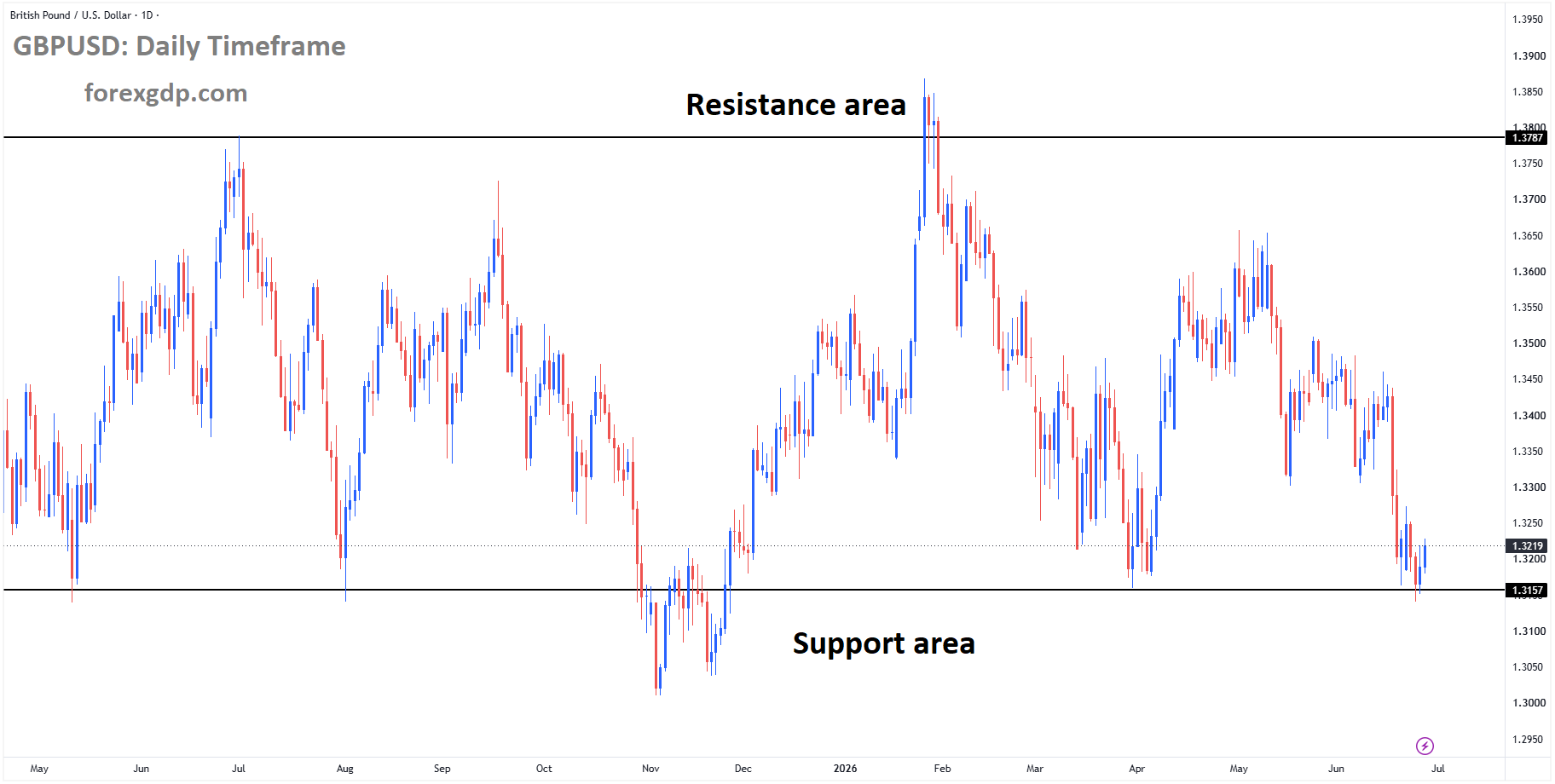
GBPUSD is moving in a box pattern, and the market has rebounded from the support area of the pattern
A combination of lower crude oil prices, a weaker US Dollar, and improving investor confidence has created room for the Pound to recover. However, concerns surrounding the United Kingdom’s political situation continue to prevent stronger buying interest. At the same time, confidence in the US economy remains firm, limiting the possibility of a long-lasting decline in the Dollar.
Lower Oil Prices Ease Pressure on Financial Markets
One of the biggest reasons behind the recent improvement in the Pound has been the decline in crude oil prices. As concerns surrounding geopolitical tensions eased, oil prices moved back toward earlier levels, helping to reduce fears about rising inflation and supply disruptions.
Lower energy prices often improve overall market confidence because businesses and consumers face less pressure from higher fuel costs. When investors become more comfortable taking risks, they usually reduce their demand for safe-haven assets such as the US Dollar. This shift has provided temporary support for currencies like the British Pound.
The improvement in global sentiment has also encouraged investors to return to assets that had previously been under pressure. Although this has helped the Pound recover, market participants remain careful because several larger economic and political risks still remain unresolved.
US Dollar Faces Short-Term Weakness but Keeps Strong Foundations
The recent slowdown in the US Dollar does not necessarily signal a major shift in its overall outlook. Many investors continue to believe that the American economy remains one of the strongest among developed nations.
This confidence is supported by resilient economic performance, healthy business activity, and continued investment in fast-growing industries such as artificial intelligence. Large amounts of global capital continue flowing into the United States, helping to strengthen demand for the Dollar over the longer term.
While temporary pullbacks are normal after strong rallies, many market participants believe the Dollar still has enough support to remain relatively strong unless economic conditions change significantly.
Inflation Keeps the Federal Reserve Under Pressure
Inflation remains one of the most closely watched factors influencing the US economy. Even though lower oil prices may eventually reduce some price pressures, inflation across many sectors continues to remain above the Federal Reserve’s long-term target.
Recent inflation data showed that price growth accelerated again, reinforcing expectations that the Federal Reserve could continue maintaining a restrictive monetary policy. Investors increasingly believe that interest rates may stay higher for longer if inflation does not slow down in a meaningful way.
Higher interest rates generally make the US Dollar more attractive because investors can earn better returns on Dollar-based assets. This expectation helps prevent significant declines in the currency, even during periods of temporary weakness.
As long as inflation remains stubborn, many traders expect the Federal Reserve to stay cautious before considering any meaningful policy easing.
Political Uncertainty Continues to Limit Pound Strength
While external market conditions have supported the Pound, domestic political developments continue to create uncertainty for investors.
The recent resignation of Prime Minister Keir Starmer initially sparked optimism as markets anticipated potential political changes. However, that optimism quickly turned into a more cautious approach as investors waited for greater clarity regarding the country’s future leadership.
Political transitions often create uncertainty because financial markets prefer stability. Investors want to understand the economic priorities of any new leadership before making significant investment decisions.
Andrew Burnham has emerged as one of the leading candidates to replace Starmer, but markets remain focused on learning more about his economic plans and policy direction before building larger positions involving the British Pound.
Until greater political certainty returns, many investors are likely to remain cautious about making aggressive bets on Sterling.
Investor Confidence Depends on Both Politics and Economics

Currency markets are rarely influenced by a single factor. Instead, investors carefully evaluate a combination of economic data, political stability, global events, and central bank decisions before making investment choices.
For the British Pound, the current environment presents both opportunities and challenges. Improving global risk sentiment and a softer US Dollar have created room for short-term gains, but ongoing domestic uncertainty continues to weigh on confidence.
Meanwhile, strong economic performance in the United States continues supporting the Dollar, making it difficult for the Pound to build sustained momentum.
Investors are closely monitoring upcoming economic reports from both countries while also watching political developments in the UK that could shape future market expectations.
Global Risk Sentiment Remains an Important Driver
Financial markets have become increasingly sensitive to changes in global sentiment. Events such as geopolitical tensions, inflation trends, central bank decisions, and energy prices all influence investor confidence.
When global risks begin to ease, investors often move away from defensive assets and seek opportunities in currencies and markets that offer higher potential returns. This has recently benefited the Pound alongside several other risk-sensitive currencies.
However, market sentiment can change quickly if new economic concerns emerge. Unexpected inflation surprises, geopolitical events, or political uncertainty could easily shift investors back toward safer assets like the US Dollar.
For this reason, many traders continue monitoring both global and domestic developments rather than relying on a single market trend.
Markets Continue Waiting for Clear Direction
Although the Pound has managed to recover some ground, many investors believe the market is still searching for a stronger directional catalyst.
The combination of improving risk appetite and temporary Dollar weakness has supported Sterling, but ongoing uncertainty surrounding UK politics and expectations of continued Federal Reserve policy restraint continue balancing market sentiment.
Until clearer signals emerge from economic data or political developments, many investors are expected to maintain a cautious approach. Market participants are likely to remain flexible, adjusting their positions as new information becomes available.
Final Summary
The British Pound has staged a modest recovery as lower oil prices and a softer US Dollar improved overall market sentiment. Better investor confidence has helped Sterling regain some lost ground, but its progress remains limited by ongoing political uncertainty in the United Kingdom.
At the same time, the US Dollar continues to benefit from a resilient economy, persistent inflation, and expectations that the Federal Reserve may maintain tighter monetary policy for longer. These factors continue providing underlying support for the Greenback despite periods of short-term weakness.
Going forward, investors will closely monitor economic indicators, central bank decisions, and political developments in both the UK and the United States. Together, these factors will play an important role in determining the next phase for the GBP/USD currency pair.
USDJPY Reacts to Stronger Tokyo CPI as Japan’s Inflation Shows Fresh Momentum
Japan’s inflation remained in focus after the latest Tokyo Consumer Price Index (CPI) report showed a stronger annual increase in June. The figures provided another early indication of how price pressures are developing in the country and what they could mean for future decisions by the Bank of Japan (BoJ).
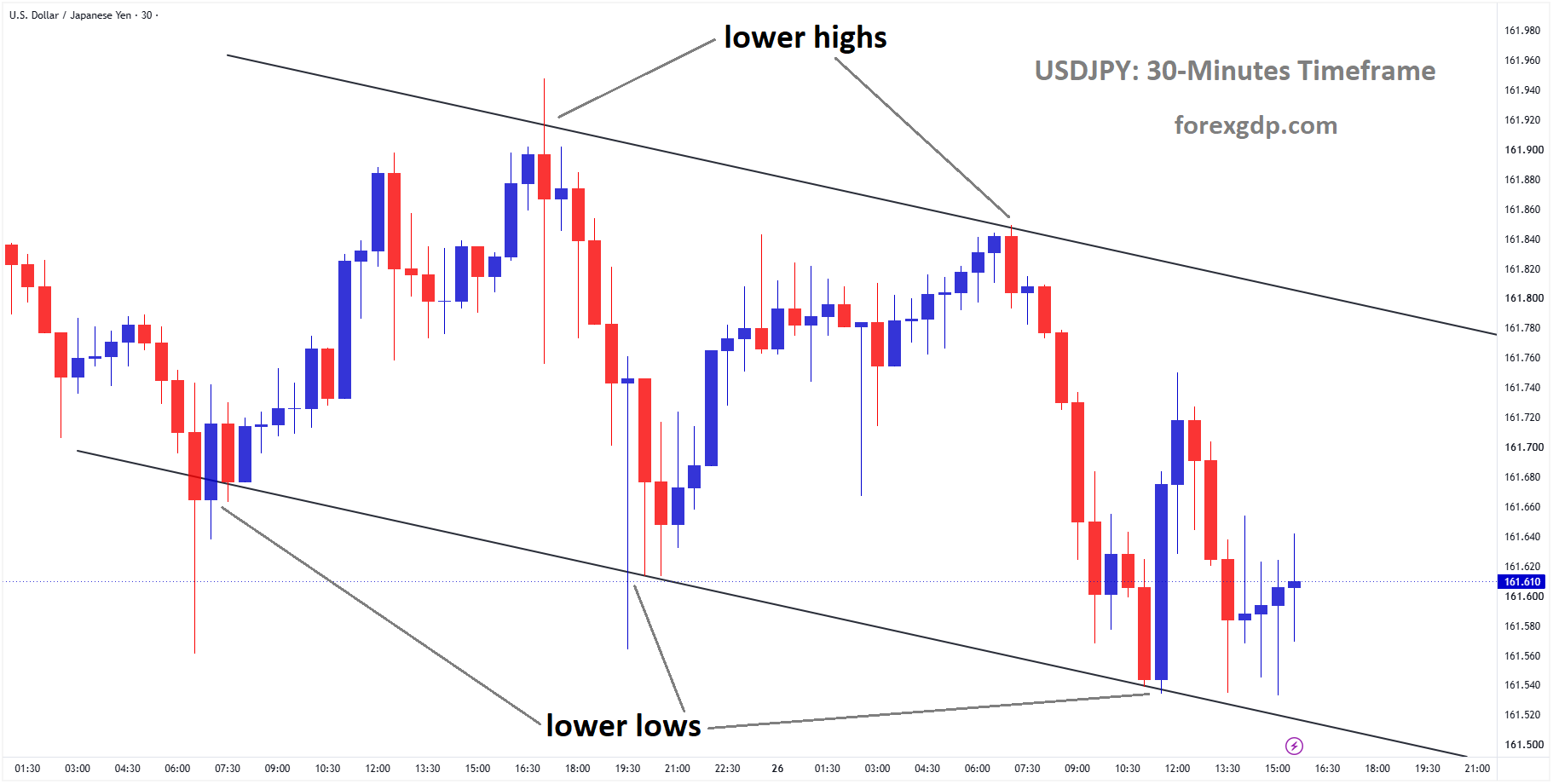
USDJPY is moving in a descending channel, and the market has rebounded from the lower low area of the channel
The Tokyo CPI is closely followed by economists, investors, and policymakers because it often gives an early preview of nationwide inflation trends. Since Tokyo is Japan’s largest city and a major economic center, changes in consumer prices there can offer valuable insight into the direction of inflation across the country.
Tokyo Inflation Picks Up in June
According to the latest data released by Japan’s Statistics Bureau, Tokyo’s headline Consumer Price Index increased by 1.7% year-over-year in June. This marked an improvement from the previous month’s annual increase of 1.4%, showing that inflation continued to gain momentum.
The report also highlighted stronger underlying inflation. The Tokyo CPI excluding fresh food, one of the most closely watched inflation measures, rose by 1.6% compared with the same month last year. This matched market expectations while improving from the previous reading of 1.3%.
Another important measure, which excludes both fresh food and energy prices, climbed by 1.9% year-over-year. This represented a noticeable increase from the earlier reading of 1.6%, suggesting that price growth is becoming more widespread across different sectors of the economy rather than being driven by only a few categories.
Why the Tokyo CPI Matters
The Tokyo Consumer Price Index serves as one of Japan’s most important economic indicators. Because it is released before the nationwide inflation report, it helps provide an early look at how consumer prices are changing across the country.
Economists use this data to understand whether inflation is accelerating, slowing, or remaining stable. Investors also pay close attention because inflation plays a major role in shaping monetary policy decisions made by the Bank of Japan.
When inflation remains firm, policymakers may feel more confident that rising prices are becoming sustainable. If inflation weakens, however, there may be less urgency to adjust monetary policy.
Understanding the Different Inflation Measures
The inflation report includes several versions of the Consumer Price Index, each offering a different perspective on price movements.
The headline CPI measures overall changes in consumer prices across a broad range of goods and services. While this provides the most complete picture, it can sometimes be affected by temporary swings in food or energy prices.
The CPI excluding fresh food removes one of the most volatile categories, making it easier to identify longer-term inflation trends. This measure is widely followed by both financial markets and the Bank of Japan.
The index excluding both fresh food and energy goes one step further by focusing on more stable price movements. Rising figures in this category often suggest that inflation is spreading through the broader economy rather than being driven by temporary factors.
What Stronger Inflation Means for the Bank of Japan

Inflation data plays a central role in the Bank of Japan’s policy decisions. For many years, Japan struggled with low inflation and weak price growth, leading the central bank to maintain highly supportive monetary policies.
As inflation becomes stronger and more consistent, the Bank of Japan may become more comfortable gradually adjusting its policy settings. Stable inflation can indicate healthier demand, stronger wage growth, and improving business confidence.
However, policymakers also need to make sure that inflation remains sustainable. Temporary increases alone may not be enough to justify major policy changes. Instead, the central bank carefully evaluates whether price growth is supported by broader economic improvements.
This is why each inflation report receives significant attention from markets around the world.
How Inflation Influences the Japanese Yen
The value of the Japanese Yen is often influenced by inflation expectations because they affect future monetary policy decisions.
When inflation comes in stronger than expected, investors may believe the Bank of Japan could continue moving toward a less accommodative policy stance. Such expectations often improve confidence in the Yen and may attract additional investor interest.
On the other hand, weaker inflation figures can reduce expectations for future policy adjustments. If investors believe the central bank is likely to maintain loose monetary conditions for longer, the Japanese Yen may face downward pressure.
Because of this relationship, inflation reports frequently lead to immediate reactions in the currency market as traders reassess future policy expectations.
Initial Market Reaction
Following the release of the June Tokyo inflation data, the Japanese Yen recorded a modest gain as investors responded to the stronger inflation figures.
Although the initial movement remained relatively limited, the report reinforced the view that inflation in Japan continues to show resilience. Market participants will likely continue monitoring future economic releases to determine whether this trend can be maintained over the coming months.
Short-term market reactions are common after major economic announcements, but longer-term currency direction usually depends on a combination of inflation, economic growth, employment conditions, and central bank guidance.
What Investors Will Watch Next
While the Tokyo CPI offers an early indication of inflation, investors will now look toward upcoming nationwide inflation reports and future statements from the Bank of Japan.
Additional economic indicators, including wage growth, consumer spending, and business activity, will also help determine whether inflation remains strong enough to support future policy adjustments.
If inflation continues to strengthen alongside broader economic improvements, expectations regarding the Bank of Japan’s future actions could continue evolving. Conversely, if inflation begins to weaken again, markets may revise those expectations.
Summary
Japan’s latest Tokyo Consumer Price Index report showed that inflation strengthened in June, with both headline and core measures recording higher annual growth than the previous month. The figures suggest that price pressures remain present across the economy and continue to provide important signals for policymakers.
As one of the earliest indicators of Japan’s inflation trends, the Tokyo CPI remains a closely watched economic release. Its results help shape expectations for future Bank of Japan decisions and often influence movements in the Japanese Yen. Going forward, investors will continue monitoring inflation and other economic data to better understand the outlook for Japan’s economy and monetary policy.
USDCAD Falls as Softer US PCE Data Boosts the Canadian Dollar
The USD/CAD currency pair moved lower during Friday’s early European trading session as the US Dollar lost momentum against the Canadian Dollar. A softer-than-expected US inflation report reduced expectations that the Federal Reserve will raise interest rates in the near future, putting pressure on the Greenback. Investors are now turning their attention to the upcoming Michigan Consumer Sentiment Index, which could provide fresh clues about the strength of the US economy and consumer confidence.
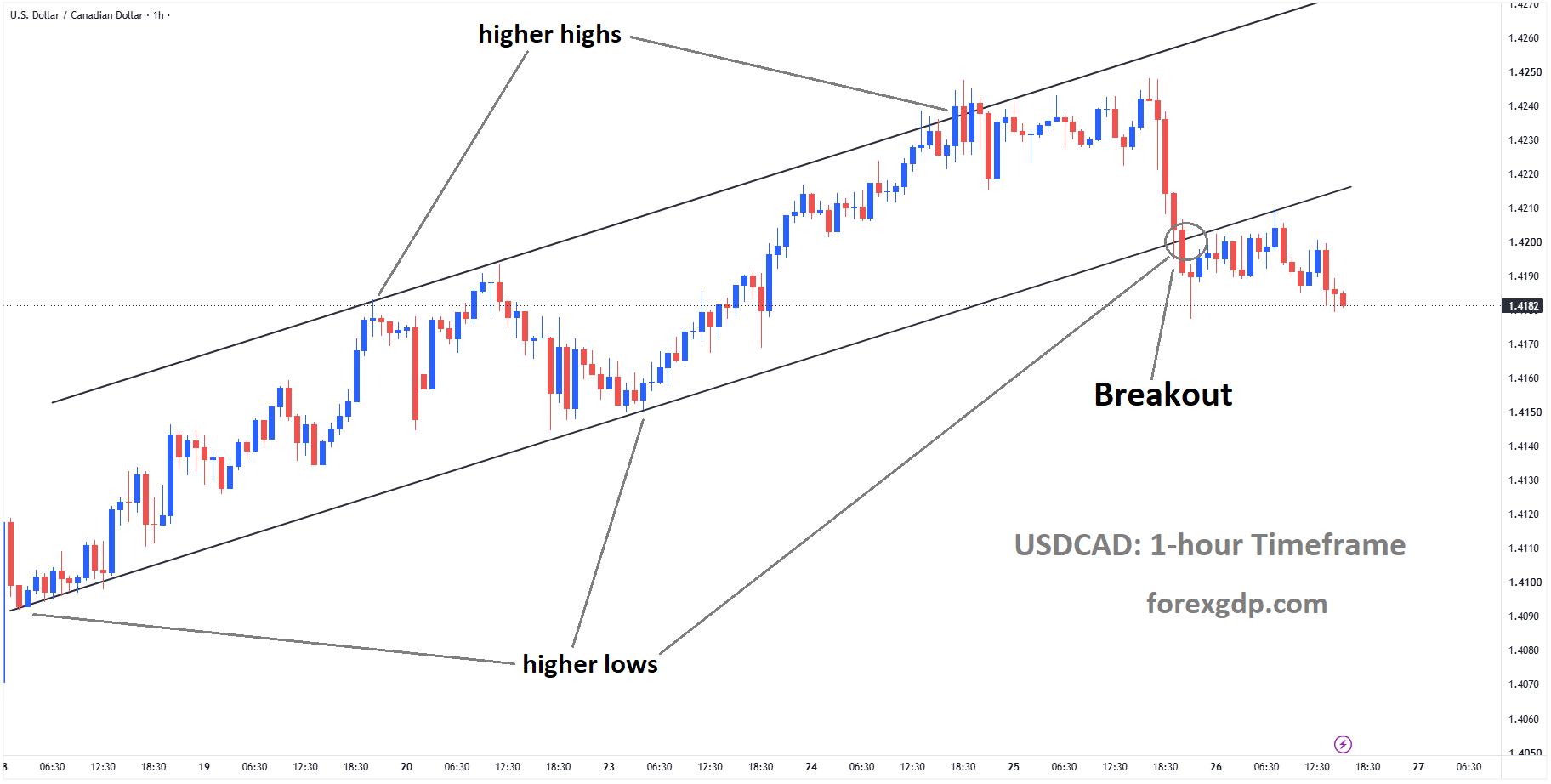
USDCAD has broken the ascending channel on the downside
Although the Canadian Dollar found some support from the weaker US Dollar, expectations surrounding the Bank of Canada’s future policy decisions continue to limit stronger gains. With both central banks carefully watching inflation and economic growth, traders remain focused on upcoming data and policy signals.
US Inflation Data Cools Expectations for Another Fed Rate Increase
One of the biggest reasons behind the weaker US Dollar was the latest Personal Consumption Expenditures (PCE) Price Index report, which is the Federal Reserve’s preferred measure of inflation.
According to data released by the US Bureau of Economic Analysis, annual PCE inflation reached 4.1% in May compared to the same period last year. While this marked the first reading above 4.0% since April 2023, the result matched market expectations and therefore did not surprise investors.
More importantly, the monthly inflation reading increased by only 0.4%, slightly below economists’ expectations of 0.5%. This smaller-than-expected monthly rise suggested that inflation pressures may be slowing, giving markets greater confidence that the Federal Reserve may not need to tighten monetary policy as aggressively as previously expected.
As inflation begins to stabilize, investors believe the central bank could take a more cautious approach over the coming months.
Lower Oil Prices Add to Inflation Relief
Another important factor supporting this view is the recent decline in global oil prices.
Energy costs play a major role in overall inflation, and lower oil prices often reduce pressure on businesses and consumers alike. Analysts noted that oil prices returned to levels seen before recent geopolitical tensions after the United States and Iran reached a preliminary peace agreement.
The easing in energy costs has strengthened expectations that inflation may have already reached its highest point or is very close to doing so. If energy prices remain stable, inflation could continue to ease in the months ahead, reducing the need for further aggressive action from the Federal Reserve.
This shift in market expectations has weakened demand for the US Dollar, allowing other currencies, including the Canadian Dollar, to perform better.
Markets Reduce Expectations for a July Fed Move
Following the latest inflation figures, financial markets quickly adjusted their outlook for the Federal Reserve’s next policy meeting.
The probability of another interest rate increase in July declined noticeably compared to the previous trading session. Investors are becoming less convinced that policymakers will see an urgent need for another rate hike if inflation continues to cool and economic growth remains balanced.
This change in expectations has affected overall market sentiment, with investors becoming more comfortable taking positions away from the US Dollar.
However, Federal Reserve officials are expected to continue monitoring incoming economic reports before making any final decision. Future employment figures, consumer spending data, and inflation reports will remain key factors influencing the central bank’s next move.
Bank of Canada Maintains a Flexible Policy Approach

While attention remains focused on the Federal Reserve, the Bank of Canada is also carefully assessing its own economic outlook.
Minutes from the Bank of Canada’s latest policy meeting showed that policymakers agreed to keep monetary policy flexible. Rather than committing to a specific direction, officials want to remain prepared to respond to changing economic conditions as they develop.
Several risks continue to influence Canada’s economic outlook. These include the possible effects of new US trade restrictions, fluctuations in energy prices, and broader global economic uncertainty. Policymakers believe staying flexible will allow them to react quickly if these factors begin to affect inflation or economic growth.
This cautious strategy reflects the uncertain global environment facing many central banks today.
Canadian Rate Expectations Continue to Ease
Investors now expect the Bank of Canada to keep interest rates unchanged for the rest of the year unless economic conditions change significantly.
Recent market expectations suggest only limited additional policy tightening by year-end. This represents a noticeable shift from earlier expectations, when investors believed the Canadian central bank might need to raise rates more aggressively.
As expectations for future Canadian rate increases decline, the Canadian Dollar may find it more difficult to gain stronger momentum despite periods of US Dollar weakness.
At the same time, differences between US and Canadian interest rate expectations continue to influence currency movements, making both central bank policies equally important for traders.
Michigan Consumer Sentiment Report Comes Into Focus
With the inflation report now behind them, investors are looking ahead to the release of the Michigan Consumer Sentiment Index.
This report measures how consumers feel about current and future economic conditions. Strong consumer confidence often points to healthy spending activity, while weaker confidence may indicate growing concerns about inflation, employment, or the overall economy.
Because consumer spending represents a major part of economic growth, the report could influence expectations for future Federal Reserve policy if the results differ significantly from forecasts.
Market participants will watch the data closely for additional signals about the direction of the US economy.
Summary
The US Dollar weakened against the Canadian Dollar after softer monthly inflation data reduced expectations of another Federal Reserve rate increase in the near future. Lower oil prices also helped ease inflation concerns, encouraging investors to believe price pressures may be approaching their peak.
Meanwhile, the Bank of Canada continues to maintain a flexible policy stance as officials monitor trade developments, energy markets, and economic conditions. Expectations for limited policy changes from the Canadian central bank may keep gains for the Canadian Dollar relatively restrained.
As markets await the latest consumer confidence data from the United States, investors will continue evaluating incoming economic reports for clearer guidance on the future direction of both the Federal Reserve and the Bank of Canada.
USDCHF Moves Higher as Hawkish Fed Outlook Weighs on the Swiss Franc
The USDCHF currency pair moved higher during Friday’s Asian trading session as growing expectations of another interest rate increase from the US Federal Reserve supported the US Dollar. Investors continue to assess fresh inflation data from the United States, while weaker economic confidence in Switzerland has added pressure to the Swiss Franc.
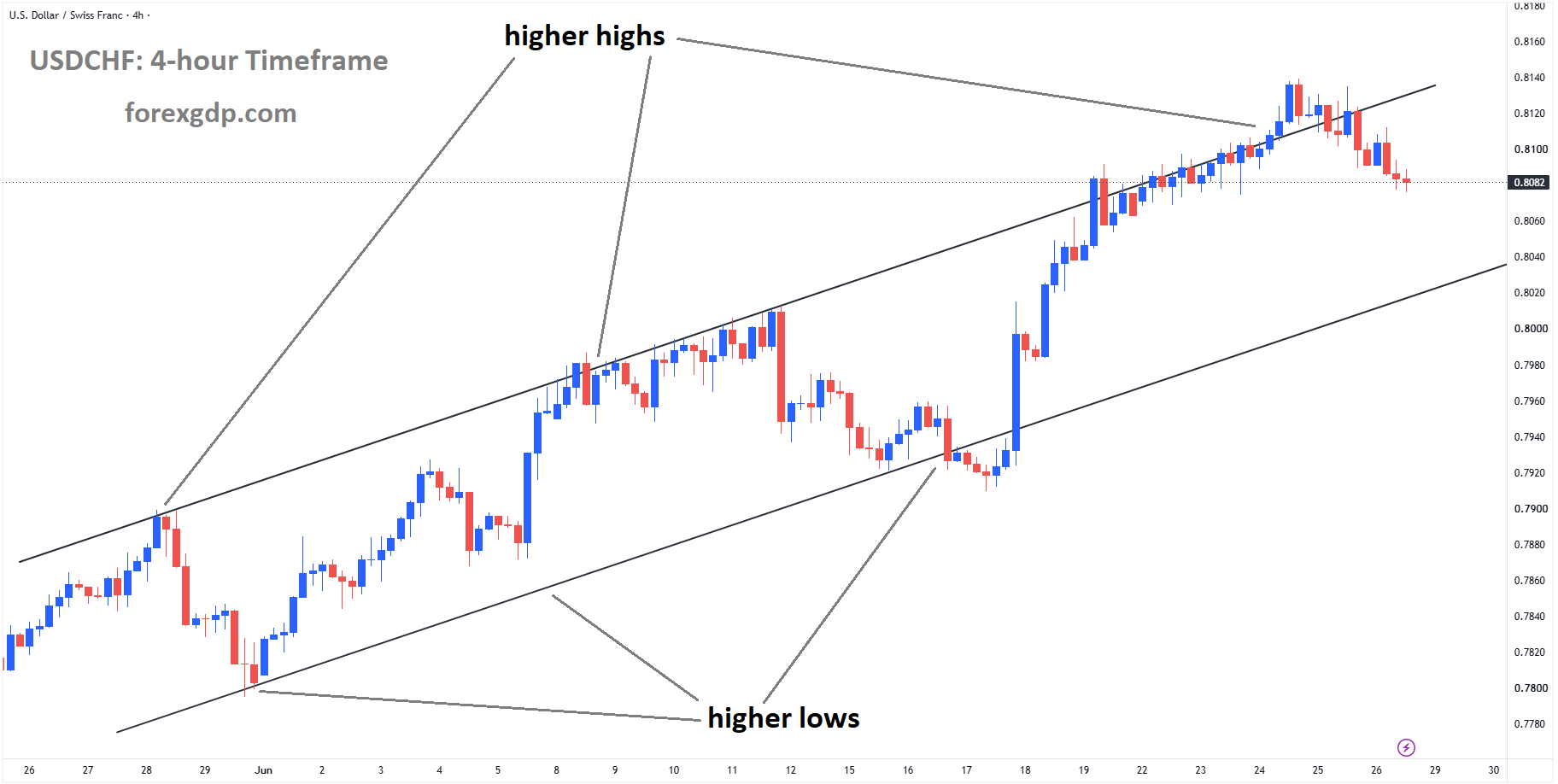
USDCHF is moving in an ascending channel, and the market has fallen from the higher high area of the channel
The latest developments have shifted attention back to central bank policies, inflation trends, and investor confidence. With both the Federal Reserve and the Swiss National Bank taking different policy paths, traders are closely watching how these factors may influence the currency pair in the coming months.
Fed Rate Hike Expectations Lift the US Dollar
The US Dollar found fresh support after markets increased their expectations that the Federal Reserve could raise interest rates again later this year. According to the CME FedWatch Tool, investors now see a stronger chance of another rate increase at the Federal Reserve’s September policy meeting.
Expectations of higher interest rates generally strengthen the US Dollar because they often lead to better returns on US-based investments. As a result, investors tend to increase demand for the currency whenever they believe borrowing costs will remain higher for longer.
Recent comments from policymakers and stronger-than-expected inflation data have encouraged markets to believe that the Federal Reserve may not be finished with its tightening cycle.
Inflation Remains a Key Concern for the Federal Reserve
One of the biggest reasons behind changing market expectations is the latest inflation report from the United States. The Personal Consumption Expenditures (PCE) Price Index, which is one of the Federal Reserve’s preferred measures of inflation, showed that price pressures increased during May.
Headline inflation accelerated compared to the previous month, moving above the 4% annual level for the first time in several years. The increase was largely linked to higher energy costs, which have been affected by ongoing geopolitical tensions in the Middle East.
Higher energy prices continue to create challenges for policymakers because they push up the cost of transportation, manufacturing, and daily consumer expenses. This makes it more difficult for inflation to return to the Federal Reserve’s long-term target.
As inflation remains stubbornly high, markets believe the central bank may keep interest rates elevated or even introduce another increase if price pressures fail to ease.
Core Inflation Also Shows Continued Strength
Alongside headline inflation, the Federal Reserve also pays close attention to the Core PCE Price Index, which removes the more volatile food and energy categories. This measure is often viewed as a better indicator of underlying inflation trends.
The latest report showed that core inflation also moved slightly higher compared to the previous reading. It reached its strongest annual pace since late 2023, reinforcing the view that inflation is proving more persistent than many had expected.
Although the increase was relatively modest, it was enough to strengthen expectations that policymakers may continue maintaining a cautious approach before considering any future rate reductions.
For investors, this means interest rates could remain higher for longer, providing ongoing support for the US Dollar.
Swiss Investor Confidence Falls Sharply
While the US Dollar benefited from stronger economic expectations, the Swiss Franc faced pressure after disappointing economic sentiment data from Switzerland.
The latest UBS and CFA Society Switzerland survey revealed that investor confidence weakened significantly during June. The economic expectations index dropped deeper into negative territory, showing that financial professionals have become increasingly cautious about the country’s near-term economic outlook.
A negative reading suggests that more respondents expect economic conditions to worsen rather than improve. The sharp monthly decline highlights growing uncertainty among investors and reflects concerns over both domestic and global economic conditions.
Weak confidence does not necessarily signal an immediate slowdown in economic activity, but it often influences market sentiment and future investment decisions.
Swiss National Bank Maintains Its Current Policy

The Swiss National Bank recently decided to leave its benchmark interest rate unchanged for the fourth consecutive policy meeting. Officials believe that maintaining the current policy stance continues to support both economic growth and overall price stability.
Even though interest rates remained unchanged, the central bank acknowledged that inflation forecasts have increased. This suggests that policymakers continue to monitor inflation risks closely despite choosing not to tighten policy further at this stage.
The SNB also repeated that it remains ready to intervene in foreign exchange markets whenever necessary. Such interventions are designed to limit excessive currency movements if they threaten economic stability or inflation objectives.
By keeping this option available, the central bank aims to maintain flexibility as global financial conditions continue to evolve.
Different Central Bank Approaches Shape Currency Markets
One of the major themes influencing USDCHF is the growing difference between the monetary policy outlooks of the Federal Reserve and the Swiss National Bank.
The Federal Reserve is currently focused on ensuring inflation moves back toward its target, even if that requires keeping interest rates higher for an extended period. Stronger inflation data has reinforced this cautious approach.
Meanwhile, the Swiss National Bank has chosen to maintain its existing policy settings while continuing to monitor inflation and economic developments. Although it remains prepared to act if necessary, it has not indicated an immediate need for additional policy tightening.
These contrasting policy directions often play a major role in determining how investors allocate capital between different currencies.
What Investors Will Be Watching Next
Looking ahead, market participants will continue monitoring incoming economic data from both the United States and Switzerland.
In the US, future inflation reports, employment figures, consumer spending, and comments from Federal Reserve officials will all influence expectations for future monetary policy decisions.
In Switzerland, investors will focus on business activity, inflation trends, consumer confidence, and any new guidance from the Swiss National Bank regarding its outlook or possible currency market interventions.
Global developments, including energy prices and geopolitical events, are also expected to remain important factors as they continue influencing inflation across major economies.
Summary
The USDCHF pair gained support as investors increased expectations that the Federal Reserve could deliver another interest rate hike following stronger US inflation data. Rising headline and core inflation reinforced the belief that policymakers may keep borrowing costs higher for longer.
At the same time, weaker investor confidence in Switzerland placed additional pressure on the Swiss Franc. Although the Swiss National Bank kept interest rates unchanged and reaffirmed its commitment to supporting economic stability, it also acknowledged higher inflation forecasts and maintained its willingness to intervene in currency markets if needed.
With inflation, central bank decisions, and economic confidence remaining key market drivers, investors will continue watching upcoming data releases for fresh clues about the future direction of both the US Dollar and the Swiss Franc.
Don’t trade all the time, trade forex only at the confirmed trade setups
Get more confirmed trade signals at premium or supreme – Click here to get more signals, 2200%, 800% growth in Real Live USD trading account of our users – click here to see , or If you want to get FREE Trial signals, You can Join FREE Signals Now!