
A prop firm challenge usually requires you to pay an evaluation fee before you can start trading. A pay-after-you-pass model changes this by letting you pay a smaller amount upfront, with the remaining fee due only if you successfully complete the challenge.
This setup can appeal to traders who want to keep their initial costs low. You still need to hit the firm’s profit target and follow its trading rules, so paying less at the start does not make the evaluation easier.
Keep reading to learn how pay-after-you-pass challenges work, how deferred fees are handled, and what happens after you pass.
What Is a Pay After You Pass Prop Firm?
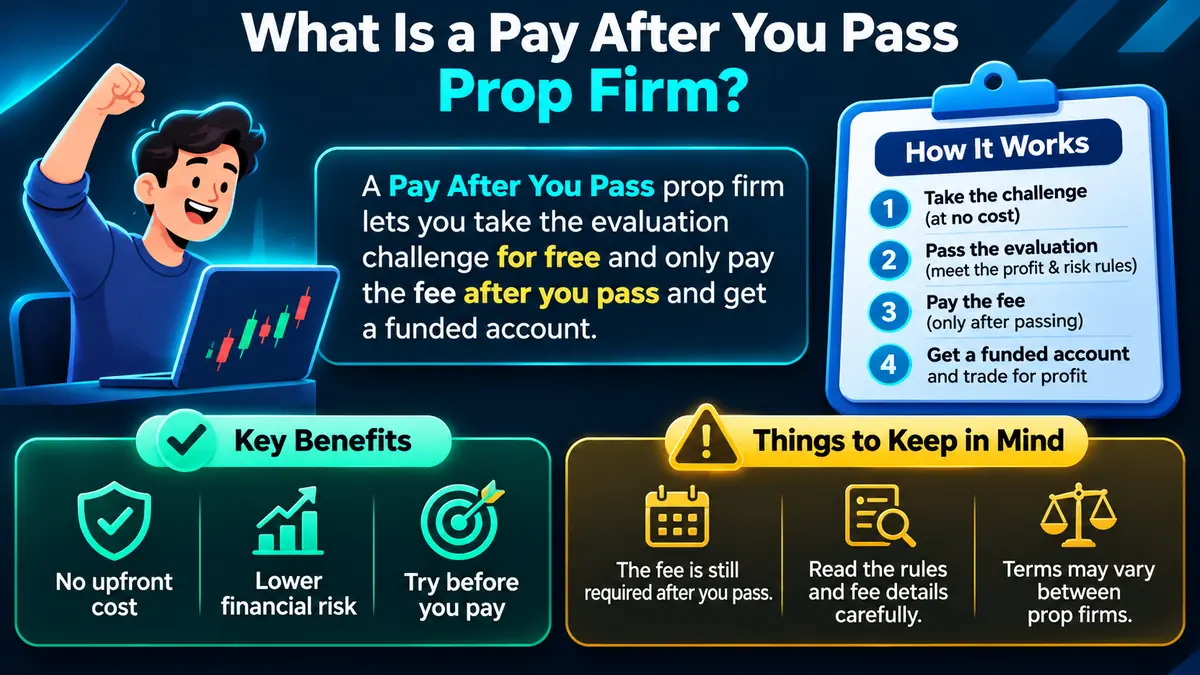
A pay-after-you-pass prop firm lets you start an evaluation without paying the full challenge fee upfront. You make a smaller initial payment, then pay the remaining amount after meeting the firm’s requirements.
For example, a challenge could cost $10 to enter and have a $200 deferred fee. If you fail, you would generally only lose the initial $10, while passing would mean paying the additional $200 before moving to the next stage.
The remaining payment may be called a deferred fee, activation fee, or post-pass fee, depending on the firm. The names can vary, so check the terms carefully to see what you will pay, when it is due, and what you receive after making the payment.
How Does a Pay Later Challenge Work?
The process starts with the smaller upfront payment, followed by the evaluation. You still need to meet requirements such as a profit target, maximum drawdown, daily loss limit, minimum trading days, or other trading conditions set by the prop firm.
The important thing is to look beyond the initial price. A challenge advertised at $10 could have a $150 or $200 deferred fee after passing, making the total cost much higher than the amount you initially paid. Some firms may also set a deadline for paying the deferred amount.
A pay later prop firm challenge can be useful if you want to limit your initial spending. Just make sure you understand the full cost and trading rules before you start, including restrictions on news trading, overnight positions, automated strategies, or other trading practices.
Pay After You Pass vs Paying Upfront
The table below compares the two payment models, including the upfront cost, fees after passing, total cost, and what happens if you fail the challenge.
| Feature | Pay After You Pass | Pay Upfront |
| Initial payment | Usually a small entry fee | Full challenge fee |
| Deferred fee | Paid after passing, often as an activation fee | Usually not applicable |
| Cost if you fail | Usually limited to the initial fee | Full challenge fee may be lost |
| Cost if you pass | Initial fee + deferred/activation fee | Initial fee, although some firms may refund it later |
| Upfront financial risk | Lower | Higher |
| Total cost | Not necessarily cheaper | Can be cheaper depending on the firm |
| Cash needed after passing | Yes, if an activation fee applies | Usually no additional challenge fee |
| Trading requirements | Profit targets, drawdown and other rules still apply | Same type of evaluation rules apply |
| Refund potential | Depends on the firm’s terms | Some firms refund or credit the original fee after certain milestones |
| What to compare | Entry fee, activation fee and total cost | Challenge fee, refund terms and payout conditions |
What Happens When You Pass?
Passing the evaluation usually means you have met the firm’s trading requirements, but there may still be another step before you receive the next account. In this model, you will normally need to pay the deferred or activation fee before the account is activated.
The amount and payment deadline depend on the provider. You should know these details before starting because you may need to have the full deferred amount available shortly after passing.
After activation, the firm’s normal trading and payout rules still apply. Passing the evaluation does not remove drawdown limits or other account conditions, so you need to keep following the rules if you want to remain eligible for payouts.

Is a Pay After You Pass Challenge Worth It?
This type of challenge can make sense if you want to reduce the amount you spend upfront. If you fail the evaluation, you generally don’t have to pay the larger deferred fee, which can limit the financial loss.
The deferred fee is still an important part of the decision. Work out the total amount you could pay, check when it becomes due, and make sure you can afford it if you pass.
You should also compare the complete trading conditions instead of focusing only on the entry price. If the rules suit your strategy, the total cost is reasonable, and you are comfortable with the payment after passing, a pay-after-you-pass challenge may be worth considering.