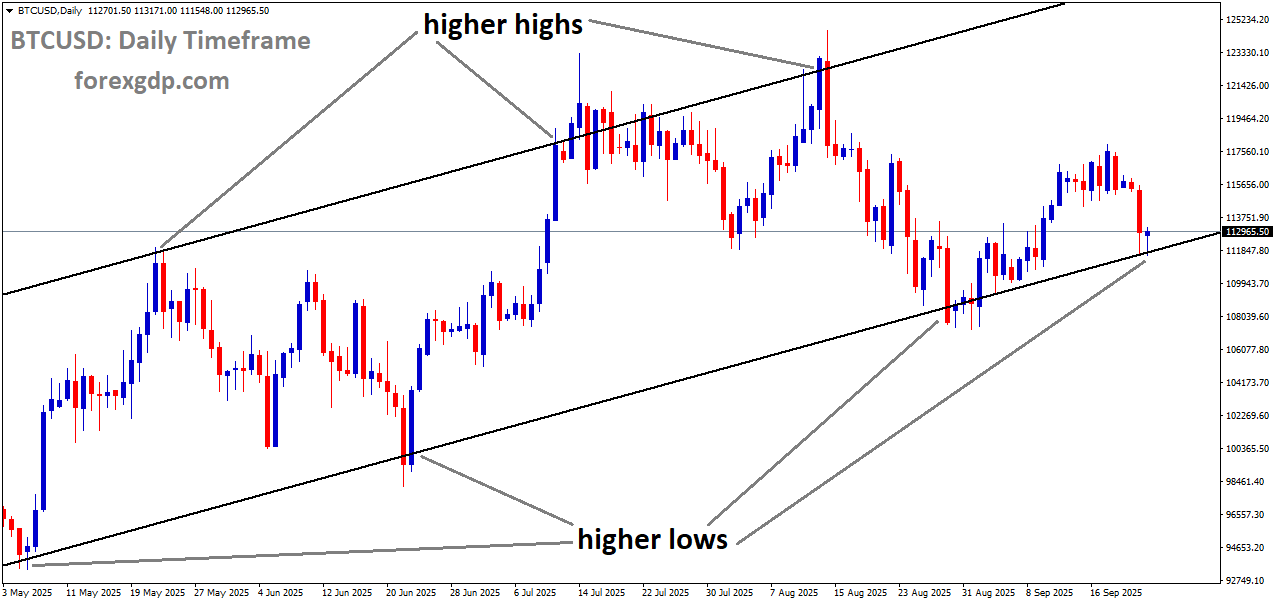
XAUUSD Loses Momentum After Surprise US Hiring Surge Shifts Interest Rate Outlook
Gold came under selling pressure on Friday after stronger-than-expected US employment figures changed expectations for the Federal Reserve’s next interest rate decision. The latest jobs report showed that the American labor market remains resilient, encouraging investors to consider the possibility of tighter monetary policy in December.
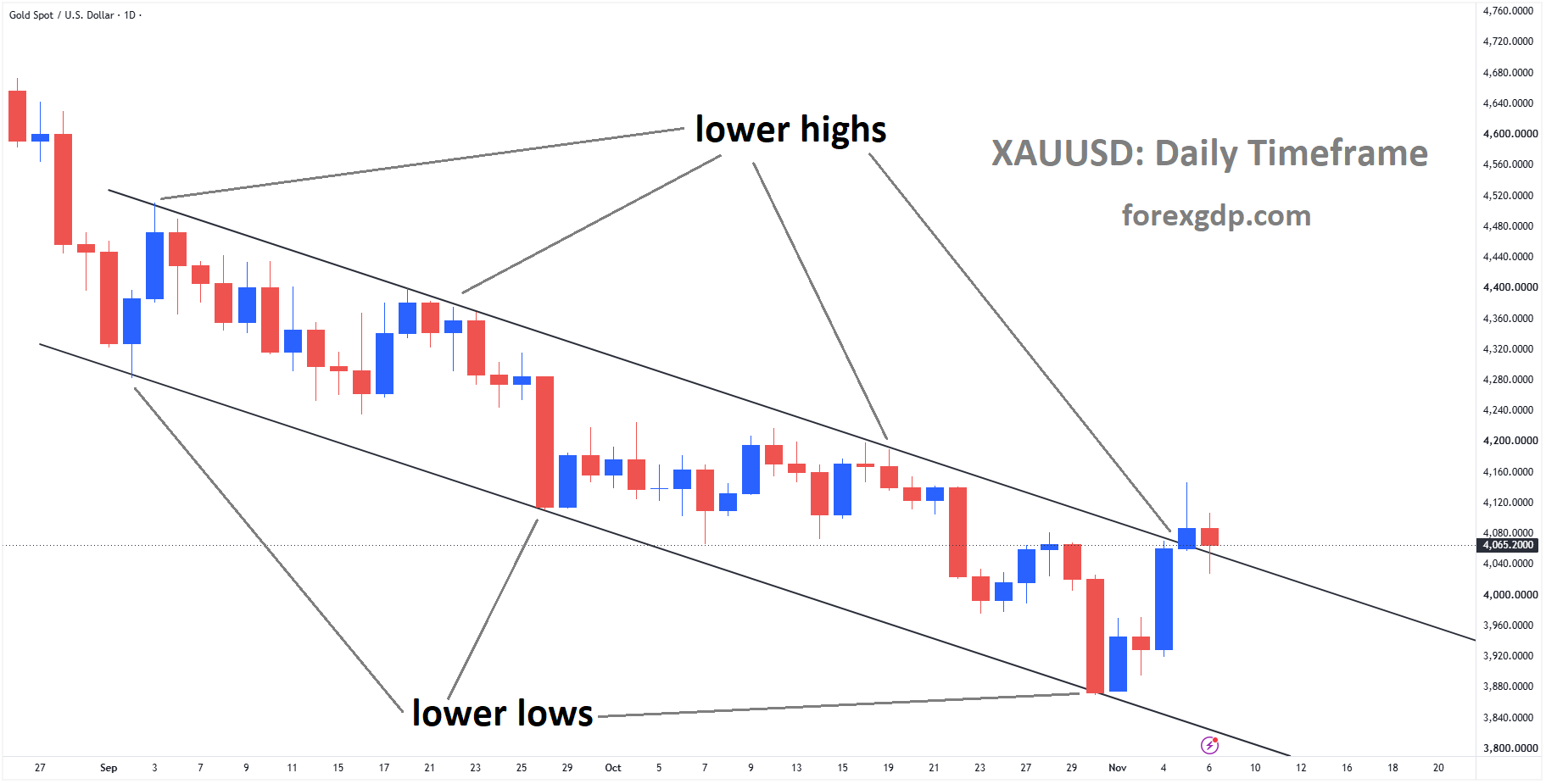
XAUUSD reached the lower high area of the descending channel
The encouraging employment numbers also strengthened the US Dollar, making gold less attractive to international buyers. Although geopolitical uncertainty continues to support interest in safe-haven assets, the latest economic developments have shifted investor attention toward US inflation and the Federal Reserve’s future policy decisions.
With several important economic reports scheduled for the coming week, gold investors are closely watching whether the US economy can maintain its strength without creating additional inflation concerns.
Strong US Employment Data Puts Pressure on Gold
The latest US Nonfarm Payrolls report delivered a positive surprise, showing that American employers added 165,000 jobs in October. Economists had expected a much smaller increase of 65,000 jobs, making the actual results a clear sign of continued labor market strength.
The report also included an upward revision to the previous month’s employment figures. September’s job growth was revised from 29,000 to 60,000, suggesting that hiring activity had been stronger than initially reported.
Another encouraging development was the decline in the US unemployment rate from 4.2% to 4.1%. This improvement indicates that businesses are continuing to hire workers despite economic uncertainty and changing borrowing conditions.
Employment gains across different industries further supported the view that the US economy remains on stable ground.
For gold, however, strong employment figures can create challenges. When the labor market performs well, the Federal Reserve has less reason to reduce borrowing costs or introduce policies designed to stimulate economic activity.
Higher interest rates generally make interest-bearing investments more appealing compared with gold, which does not provide regular income.
As a result, the unexpectedly strong jobs report encouraged investors to reassess their expectations for monetary policy, contributing to weaker demand for the precious metal.
Federal Reserve Rate Hike Expectations Increase After Jobs Report
The Federal Reserve’s December policy meeting has become a major focus for financial markets following the release of the employment data.
According to the CME FedWatch Tool figures cited in the report, the probability of an interest rate increase at the December meeting climbed from 67% on Thursday to 77% following the stronger employment results.
This change highlights how quickly investor expectations can respond to important economic information.
The Federal Reserve considers several factors when making interest rate decisions, including employment conditions, consumer spending, inflation, and overall economic growth.
A strong labor market can support household income and consumer spending. However, continued economic strength may also make it harder for inflation to return to the central bank’s desired level.
For this reason, policymakers must balance the need to control inflation with the goal of maintaining healthy economic activity.
St. Louis Federal Reserve President Alberto Musalem also addressed inflation concerns, noting that consumers remain worried about elevated inflation.
He suggested that inflation expectations remain relatively stable despite ongoing pressures linked to energy disruptions and investment associated with artificial intelligence infrastructure.
His remarks underline the difficult decisions facing the Federal Reserve as it evaluates whether existing monetary conditions are sufficient to manage inflation.
For gold investors, the central bank’s next steps will remain particularly important because changes in interest rate expectations can influence demand for assets that do not generate interest.
US Dollar Strengthens as Investors Respond to Economic Resilience
The US Dollar gained momentum following the employment report as investors responded to evidence of a stronger American economy.
A stronger Dollar often creates difficulties for gold because the precious metal is generally traded in US currency.
When the Dollar appreciates, buyers using other currencies may face higher purchasing costs. This can reduce international demand and encourage some investors to reconsider their exposure to gold.
The relationship between gold and the Dollar is not always straightforward, however.
During periods of serious financial uncertainty, both assets can attract demand because investors may view them as relatively secure places to preserve wealth.
Nevertheless, the latest employment figures have encouraged greater confidence in the US economy, supporting the American currency while reducing some of gold’s immediate appeal.
US Treasury bond yields also attracted attention following the report. Although yields moved away from their earlier session highs, the broader outlook for borrowing costs remains an important consideration.
Government bonds can become more attractive when investors expect interest rates to remain elevated or increase further.
This creates additional competition for gold, particularly among investors who prioritize income-generating assets.
Consumer Confidence Improves Despite Inflation Concerns
Alongside the employment report, fresh consumer sentiment figures offered another encouraging signal about the US economy.
The University of Michigan’s Consumer Sentiment Index improved from 48 in October to 51 in November.
Although consumer confidence remains relatively subdued, the increase suggests that Americans are becoming somewhat more optimistic about economic conditions.
The report also showed an improvement in short-term inflation expectations.
Consumers’ expected inflation rate for the coming year declined from 4.7% to 4.3%, indicating that concerns about future price increases have eased slightly.
This development matters because inflation expectations can influence household spending decisions, wage negotiations, and business pricing behavior.
When consumers believe inflation will remain high, they may change their purchasing habits or demand higher wages to protect their spending power.
Lower inflation expectations can therefore provide some reassurance to policymakers.
However, the Federal Reserve is unlikely to base its decisions on consumer sentiment alone.
Officials will continue examining actual inflation figures, employment conditions, and broader economic activity before deciding whether additional monetary tightening is necessary.
For gold, the combination of improving confidence and a strong labor market creates a mixed environment. Economic stability can reduce safe-haven demand, while persistent inflation concerns may continue to encourage investors to hold precious metals.
US-Iran Tensions Keep Geopolitical Risks in Focus

While US economic developments dominated investor attention, geopolitical uncertainty in the Middle East remained another important factor affecting gold sentiment.
Reports indicated that negotiations between the United States and Iran were continuing, with the possibility of a diplomatic agreement still under discussion.
Progress toward an agreement could help ease regional tensions and reduce concerns about a wider confrontation.
However, the situation remains complicated by continuing security threats and military activity.
Reports of Houthi attacks involving Saudi Arabia have added to concerns about regional stability.
Meanwhile, separate reports suggested that Iran was preparing for the possibility of further escalation despite ongoing diplomatic discussions.
Al Arabiya, citing Israeli media, also reported claims about potential American military action intended to strengthen Washington’s negotiating position.
These reports highlight the uncertainty surrounding the diplomatic process, although the reported possibilities should not be treated as confirmed military plans.
Geopolitical tensions often influence gold because investors may seek assets perceived as reliable during periods of conflict or instability.
Even when economic conditions place pressure on gold, unexpected international developments can quickly change market sentiment.
The direction of US-Iran negotiations and any further regional escalation will therefore remain important considerations for investors.
Upcoming US Inflation Data Could Shape Gold’s Next Direction
Attention is now turning toward the next round of US economic releases, particularly the Consumer Price Index report.
Inflation data will provide fresh information about whether consumer price pressures are easing or remaining persistent.
A stronger-than-expected inflation report could reinforce expectations that the Federal Reserve may need to maintain restrictive monetary policy or consider additional tightening.
Alternatively, evidence of cooling inflation could reduce the urgency for further rate increases.
Weekly US jobless claims will also help investors assess whether the labor market is maintaining its strength.
Although monthly employment figures provide a broad picture of hiring activity, unemployment claims offer more frequent information about changing labor conditions.
Comments from Federal Reserve officials will be equally important as investors look for clearer guidance on the central bank’s policy outlook.
Together, these developments could influence the US Dollar, Treasury yields, and demand for gold.
Investors will also monitor geopolitical developments, particularly any progress in diplomatic negotiations involving the United States and Iran.
Summary
Gold faced renewed pressure after an unexpectedly strong US employment report highlighted the resilience of the American economy and increased expectations of a Federal Reserve interest rate hike in December.
Stronger hiring, lower unemployment, and improving consumer confidence have supported the US Dollar while raising questions about how long restrictive monetary policy may continue.
At the same time, easing short-term inflation expectations offer some encouragement, although policymakers remain concerned about persistent price pressures.
Geopolitical uncertainty in the Middle East continues to provide a potential source of safe-haven demand, creating a complex environment for the precious metal.
Looking ahead, US inflation figures, unemployment claims, Federal Reserve commentary, and international developments will be the main factors shaping gold market sentiment. Investors will be watching closely to determine whether economic resilience continues to favor tighter monetary policy or whether new developments renew interest in gold as a defensive asset.
EURUSD Faces Heavy Selling Pressure Following Surprise US Employment Surge
The EUR/USD currency pair came under heavy selling pressure on Friday as stronger-than-expected US employment data increased demand for the US Dollar. The latest jobs report showed that the American labour market remains resilient despite ongoing economic uncertainty, giving investors fresh confidence in the strength of the US economy.
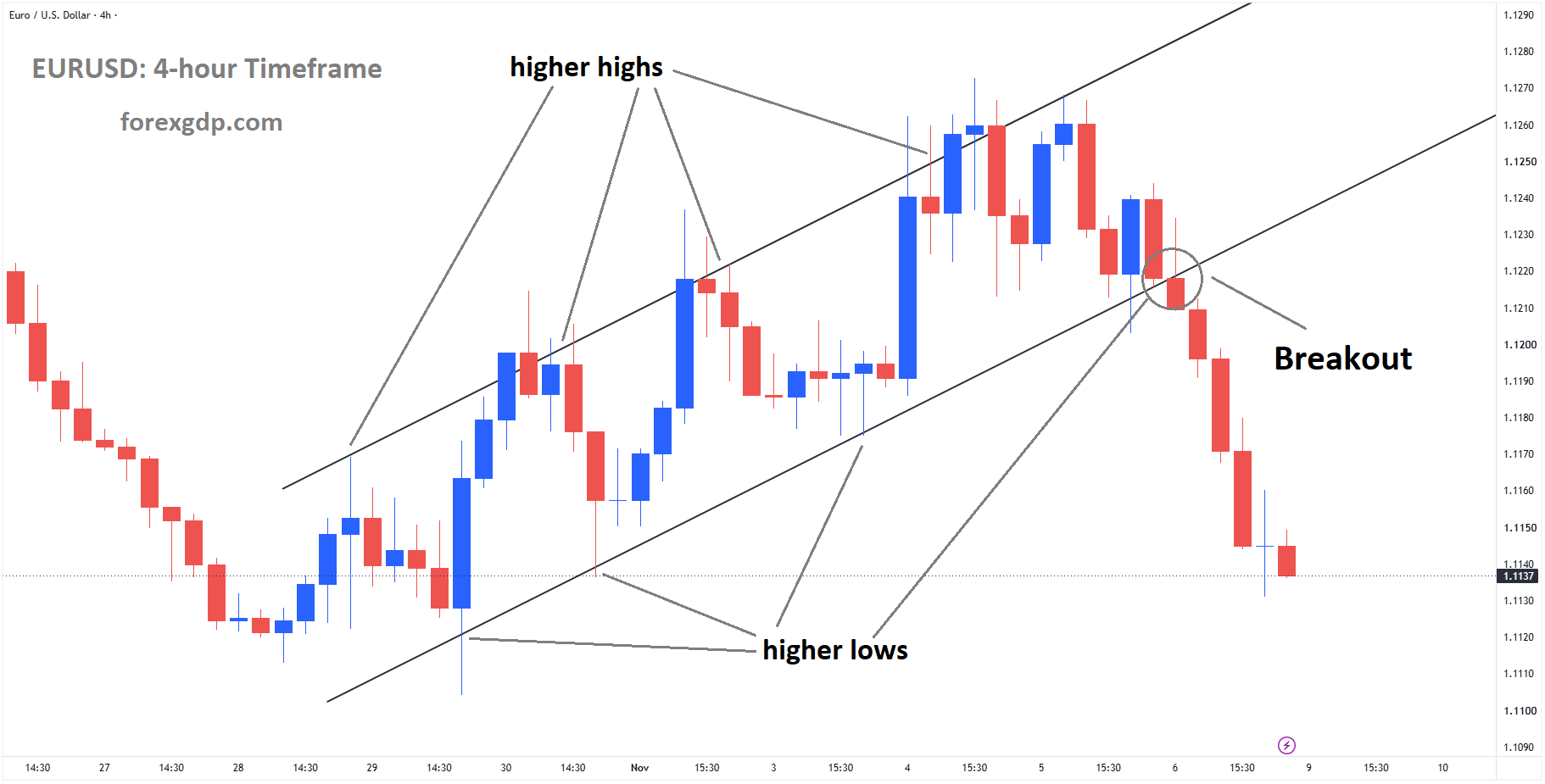
EURUSD has broken the ascending channel to the downside
Meanwhile, disappointing retail sales figures from the Eurozone and cautious comments from European Central Bank (ECB) officials added to the challenges facing the Euro. The combination of positive US economic data and weaker European economic conditions shifted market sentiment in favour of the Greenback.
Investors are now paying closer attention to the monetary policy outlook of the Federal Reserve (Fed) and the ECB, as differences in economic performance could influence the direction of the EUR/USD currency pair in the coming months.
US Nonfarm Payrolls Exceed Expectations in October
The latest US Nonfarm Payrolls (NFP) report delivered a positive surprise, showing that the American economy created 165,000 jobs in October. Economists had expected an increase of just 65,000 jobs, making the actual result significantly stronger than anticipated.
The report also included an upward revision to September’s employment figures. Previously reported job creation of 29,000 was revised to 60,000, suggesting that hiring activity had been stronger than initially estimated.
These figures indicate that American businesses continue to recruit workers despite higher borrowing costs, inflation concerns, and uncertainty surrounding the global economy.
Another encouraging development was the decline in the US Unemployment Rate, which dropped to 4.1% in October from 4.2% in September.
A falling unemployment rate generally suggests that the labour market remains healthy and that employment opportunities are still available across different sectors.
For the Federal Reserve, these developments provide important information about the overall condition of the economy. Strong employment growth can support household spending and economic activity, but it may also make controlling inflation more challenging.
Strong Wage Growth Adds to US Economic Resilience
Alongside the encouraging employment figures, the October jobs report revealed stronger-than-expected wage growth.
Average Hourly Earnings increased by 0.4% on a monthly basis, exceeding economists’ expectations of a 0.3% rise. This suggests that employers continue to offer higher wages to attract and retain workers.
On an annual basis, wage growth slowed slightly to 3.1% from 3.2%. However, the figure remained above the market forecast of 2.9%.
Although slower annual wage growth may indicate some easing in labour-related inflation pressures, the stronger monthly increase suggests that wage pressures have not disappeared.
Higher earnings can benefit households by improving their purchasing power and supporting consumer spending. When people earn more, they may have greater financial flexibility to purchase goods and services.
However, wage increases can also create challenges for inflation management. Businesses facing higher labour expenses may pass some of those costs on to customers through increased prices.
This creates a difficult balance for the Federal Reserve, which must consider both employment conditions and inflation when making monetary policy decisions.
The latest wage figures reinforce the view that the US economy remains relatively strong, even as policymakers continue their efforts to bring inflation under control.
Federal Reserve Faces Important December Interest Rate Decision
The stronger employment report has renewed attention on the Federal Reserve’s next monetary policy decision.
Federal Reserve officials have repeatedly emphasized the importance of returning inflation to the central bank’s 2% target. While inflation has shown signs of improvement in some areas, policymakers remain concerned about factors that could keep consumer prices elevated.
The resilience of the US labour market gives the Fed additional flexibility to maintain a restrictive monetary policy stance.
With businesses continuing to hire and wages rising faster than expected, another interest rate increase in December remains a possibility under the policy outlook described in the report.
However, the central bank’s decision will depend on a broader assessment of economic conditions rather than employment figures alone.
Policymakers will also consider inflation reports, consumer spending, business activity, and developments in the global economy.
Energy costs remain another important concern. Tensions in the Middle East could contribute to higher energy expenses, potentially increasing transportation and production costs for businesses.
Such developments could complicate efforts to bring inflation back toward the Fed’s target.
For currency markets, expectations surrounding US monetary policy are particularly important. A relatively firm Federal Reserve stance can make the US Dollar more attractive to international investors, especially when other major central banks face weaker economic conditions.
Eurozone Retail Sales Highlight Weak Consumer Demand

While the United States reported encouraging employment figures, economic data from the Eurozone painted a less positive picture.
Eurozone Retail Sales declined by 0.7% in September, significantly worse than the expected 0.1% decrease.
The disappointing result followed a substantial 2% decline in August, highlighting continued weakness in consumer spending across the region.
Annual retail sales growth also slowed to 0.4%, compared with 1.3% previously. Economists had expected a reading of 0.6%.
These figures suggest that European households remain cautious about their spending decisions.
Retail sales are an important measure of economic activity because consumer purchases contribute to overall economic growth. When households reduce spending, businesses may experience lower revenues, which can eventually affect hiring, investment, and production decisions.
Several factors can influence consumer behaviour, including inflation, borrowing costs, household income, and confidence in future economic conditions.
Weak retail activity may indicate that consumers are prioritizing essential purchases while limiting discretionary spending.
For the Eurozone economy, a prolonged period of subdued household demand could make economic recovery more difficult.
The disappointing retail sales report also creates additional uncertainty for the European Central Bank as it attempts to control inflation without placing excessive pressure on economic growth.
European Central Bank Maintains Cautious Policy Approach
The European Central Bank faces its own challenges as policymakers evaluate the balance between inflation risks and slowing economic activity.
Although expectations of another interest rate increase in December remain part of the policy outlook, ECB officials have avoided making firm commitments about their next decision.
ECB Chief Economist Philip Lane emphasized the importance of bringing inflation back to the central bank’s target within a reasonable period, ideally over the next one or two years.
At the same time, he acknowledged that financial conditions across the Eurozone have already become tighter.
Tighter financial conditions can make borrowing more expensive for households and businesses, potentially reducing consumption and investment.
Lane indicated that policymakers would continue gathering economic information before deciding on the appropriate course of action in December.
His comments reflected the cautious position expressed by ECB President Christine Lagarde, who also highlighted the importance of assessing incoming economic data.
This approach suggests that the ECB remains concerned about inflation but recognizes the risks associated with further pressure on an already fragile economy.
The central bank must carefully evaluate whether additional monetary tightening is necessary or whether existing measures are sufficient to guide inflation toward its target.
Differences Between US and Eurozone Economies Influence EUR/USD
The contrasting economic developments in the United States and the Eurozone have become an important factor influencing sentiment toward the EUR/USD currency pair.
In the United States, stronger employment growth, falling unemployment, and resilient wage increases suggest that economic activity remains relatively healthy.
In contrast, weaker retail sales across the Eurozone raise concerns about consumer demand and the region’s broader growth prospects.
These differences can influence expectations about how the Federal Reserve and European Central Bank will approach monetary policy.
When investors believe that US monetary policy may remain tighter than European policy, demand for the Dollar can increase.
However, currency movements are influenced by several factors, and economic data can change expectations quickly.
Future employment reports, inflation developments, central bank statements, and geopolitical events will all play important roles in shaping investor confidence.
Final Summary
The EUR/USD currency pair faced renewed pressure after stronger-than-expected US Nonfarm Payrolls data highlighted the continued resilience of the American labour market.
October’s employment growth exceeded forecasts, the unemployment rate declined, and wage increases remained firm. Together, these developments strengthened expectations that the Federal Reserve could maintain a cautious approach toward easing monetary restrictions.
Meanwhile, disappointing Eurozone retail sales figures raised concerns about weak consumer demand and the region’s economic outlook.
Cautious remarks from ECB officials further emphasized the uncertainty surrounding future European monetary policy decisions.
Looking ahead, the relationship between US economic strength, Eurozone growth conditions, and central bank policy expectations will remain central to the EUR/USD outlook. Investors will continue monitoring upcoming economic reports and official statements for greater clarity about the direction of both economies.
GBPUSD Faces Heavy Selling Pressure as US Employment Surge Boosts Dollar Strength
The British Pound came under heavy selling pressure against the US Dollar after stronger-than-expected US employment figures highlighted the resilience of the American economy. The latest Nonfarm Payrolls (NFP) report showed that US employers continued hiring at a healthy pace, strengthening expectations that the Federal Reserve could maintain its restrictive monetary policy or introduce further interest rate increases.
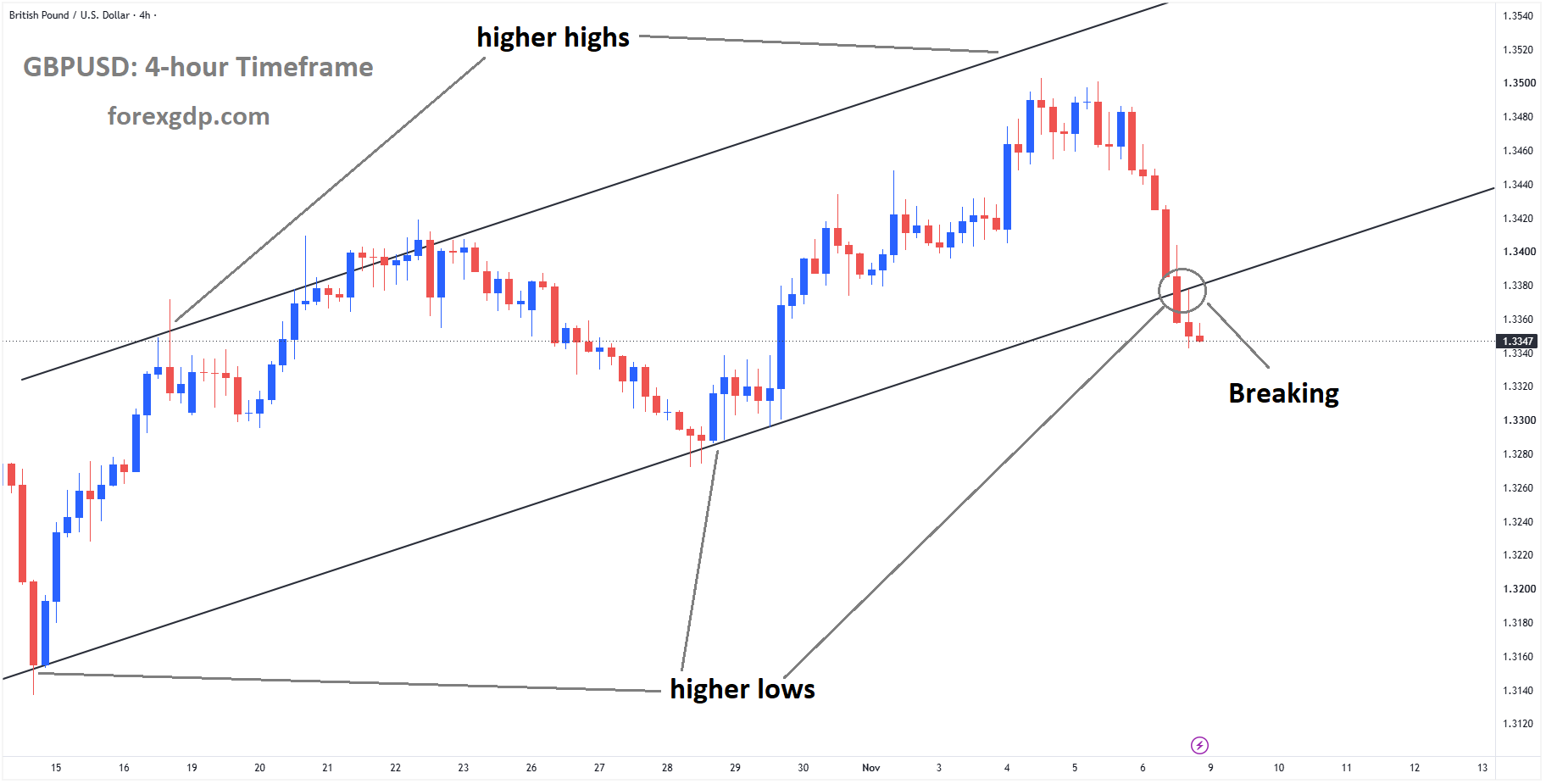
GBPUSD is breaking the higher low area of the ascending channel
The encouraging employment data gave the US Dollar a significant boost, making it difficult for the Pound Sterling to maintain its earlier strength. Although the Bank of England (BoE) recently raised interest rates and suggested that additional tightening could be necessary, those developments were not enough to protect the British currency from renewed pressure.
Investors are now closely watching economic developments in both countries, particularly upcoming inflation reports, central bank statements, and UK growth figures. These releases could provide fresh clues about the future direction of monetary policy and influence sentiment toward the GBP/USD currency pair.
Strong US Nonfarm Payrolls Highlight Labor Market Resilience
The latest US Nonfarm Payrolls report delivered a positive surprise, showing that the American labor market remains stronger than economists had anticipated.
According to the October employment report, the US economy created 165,000 jobs, comfortably exceeding expectations of 65,000. The previous month’s employment figures were also revised upward, with September’s job creation adjusted from 29,000 to 60,000.
These improvements suggest that American businesses continue to hire workers despite higher borrowing costs and ongoing economic uncertainty.
Another encouraging development was the decline in the US unemployment rate to 4.1%. A lower unemployment rate generally indicates that more people are finding employment and that demand for workers remains relatively healthy.
For the Federal Reserve, a resilient labor market creates an important monetary policy consideration. Strong employment conditions can support consumer spending, which helps economic growth but may also keep inflationary pressures elevated.
When businesses continue hiring and households maintain their spending power, inflation can become more difficult to control. Consequently, policymakers may feel less pressure to reduce borrowing costs and could consider keeping interest rates elevated for longer.
The stronger employment figures therefore reinforced expectations of a more restrictive Federal Reserve policy stance, supporting demand for the US Dollar.
Federal Reserve Rate Hike Expectations Strengthen After Employment Data
The US employment report significantly influenced expectations surrounding the Federal Reserve’s next monetary policy decision.
Following the release, market expectations for a December interest rate increase strengthened noticeably. The CME FedWatch Tool indicated that the probability of another rate hike had risen from approximately 67% the previous day to nearly 77%.
This shift reflected growing confidence that the Federal Reserve could continue prioritizing inflation control rather than moving toward easier monetary conditions.
A strong labor market gives central bank officials greater flexibility when making interest rate decisions. If employment remains stable, policymakers may believe the economy can withstand additional borrowing costs without experiencing a sharp slowdown.
However, employment figures are only one part of the Federal Reserve’s decision-making process.
Officials also consider consumer inflation, wage growth, household spending, business activity, and broader financial conditions before adjusting monetary policy.
The latest jobs report strengthened the case for maintaining a cautious approach, but future decisions will still depend on incoming economic evidence.
For the British Pound, the possibility of further US monetary tightening creates an additional challenge. Higher American interest rates can make Dollar-denominated assets more attractive to international investors, increasing demand for the US currency.
US Consumer Sentiment Improves as Inflation Expectations Ease
Alongside the encouraging employment figures, the University of Michigan released preliminary consumer sentiment data showing an improvement in American household confidence.
The November Consumer Sentiment Index increased to 51 from the previous reading of 48, exceeding economists’ expectations.
Although confidence remained relatively subdued, the improvement suggested that consumers were becoming slightly more optimistic about economic conditions.
The survey also revealed a decline in inflation expectations, offering some encouraging news for policymakers concerned about persistent price pressures.
One-year inflation expectations eased to 4.3% from 4.7%, while five-year expectations declined to 3.4% from 3.5%.
These figures suggest that consumers anticipate some moderation in inflation over both shorter and longer periods.
Lower inflation expectations are important because they can influence household spending decisions, wage negotiations, and business pricing behavior.
When consumers expect inflation to slow, the risk of persistent price increases may gradually diminish.
Nevertheless, expectations remain above the Federal Reserve’s long-term inflation objective, meaning policymakers are unlikely to declare victory over inflation based on sentiment data alone.
The combination of improving consumer confidence and easing inflation expectations presents a mixed but generally constructive picture of the US economy.
Federal Reserve Officials Remain Focused on Inflation Risks

Comments from Federal Reserve policymakers added another dimension to the discussion surrounding future US interest rates.
St. Louis Federal Reserve President Alberto Musalem acknowledged that inflation continues to concern American households.
He emphasized that people remain worried about the current level of inflation, even though longer-term inflation expectations appear relatively stable.
Musalem also pointed to energy-related disruptions and growing investment in artificial intelligence infrastructure as factors contributing to inflationary pressures.
Energy costs can affect transportation, manufacturing, electricity, and household expenses. Meanwhile, rapid investment in AI infrastructure can increase demand for equipment, electricity, construction services, and other resources.
These developments illustrate why inflation may remain challenging even when some economic indicators show improvement.
For Federal Reserve officials, the key objective remains bringing inflation under control without unnecessarily damaging employment and economic activity.
The balance between these goals will continue shaping monetary policy discussions and influencing confidence in the US Dollar.
Bank of England Interest Rate Increase Fails to Sustain Pound Sterling Strength
In the United Kingdom, the Bank of England’s recent interest rate increase initially provided support for the British Pound.
Higher interest rates can make a currency more attractive because investors may receive better returns from assets denominated in that currency.
However, the positive impact of the BoE’s decision proved insufficient as stronger US economic data shifted attention toward the Federal Reserve.
The Pound struggled to maintain its earlier momentum, demonstrating how developments in the United States can outweigh domestic monetary policy decisions.
The Bank of England also indicated that additional interest rate increases could remain necessary if inflation fails to ease sufficiently.
Despite this possibility, policymakers acknowledged that they had not identified clear evidence of second-round inflation effects.
Such effects can occur when initial increases in prices lead workers to demand higher wages, prompting businesses to raise prices further.
The absence of clear evidence of these pressures may give policymakers some flexibility, although inflation remains an important concern.
As a result, the outlook for UK interest rates remains dependent on future economic developments rather than a predetermined policy path.
US-Iran Diplomatic Developments Add Uncertainty to the Economic Outlook
Geopolitical developments involving the United States and Iran also attracted attention.
According to reports citing an Iranian source, Tehran responded positively to a proposal presented by mediators, raising hopes of potential diplomatic progress.
However, uncertainty remained after unconfirmed reports suggested that a US aircraft had issued an emergency notice near the coast of Oman.
These developments highlighted the fragile nature of regional tensions and their possible implications for the global economy.
A successful diplomatic agreement could reduce uncertainty surrounding energy supplies and international trade.
The Bank of England acknowledged that a potential US-Iran peace agreement could benefit economic conditions by easing some external pressures.
However, the central bank also warned that such an agreement might not be enough to bring inflation down sustainably.
Domestic wage pressures, services inflation, and broader economic conditions would still require careful monitoring.
Upcoming UK and US Economic Reports Could Shape GBP/USD Sentiment
Attention now turns toward several important economic releases and central bank appearances scheduled for the following week.
In the United Kingdom, upcoming gross domestic product (GDP) figures will offer fresh information about the health of the British economy.
Stronger economic growth could reinforce expectations that the Bank of England has room to maintain restrictive monetary policy. Weaker activity, however, could raise concerns about the economic impact of elevated borrowing costs.
Speeches from Bank of England officials will also be closely followed for further guidance on inflation and future interest rate decisions.
In the United States, the Consumer Price Index (CPI) report will be particularly important because it provides a broad measure of inflation affecting households.
Weekly unemployment claims will offer additional evidence about labor market conditions, while comments from Federal Reserve officials may clarify how policymakers interpret recent economic developments.
Together, these events could influence expectations for both central banks and determine which currency attracts stronger investor interest.
Summary
The British Pound faced renewed pressure against the US Dollar after a stronger-than-expected US employment report reinforced confidence in the American economy.
Healthy job creation, a lower unemployment rate, and improving consumer sentiment strengthened expectations that the Federal Reserve could maintain a restrictive monetary policy stance.
Meanwhile, the Bank of England’s recent interest rate increase and the possibility of additional tightening failed to provide lasting support for Sterling.
Geopolitical uncertainty and persistent inflation concerns added further complexity to the economic outlook.
Looking ahead, UK GDP figures, US inflation data, labor market updates, and comments from central bank officials will remain essential in shaping expectations for GBP/USD. The balance between economic growth, inflation, and future interest rate decisions is likely to remain the main influence on sentiment toward both currencies.
USDJPY Rebounds Sharply as Employment Surprise Puts Pressure on the Yen
The USD/JPY currency pair regained momentum on Friday, ending two consecutive days of losses after stronger-than-expected US employment figures provided fresh support for the US Dollar. The latest jobs report showed that the American labour market remains resilient, strengthening expectations that the Federal Reserve could raise interest rates again in December.
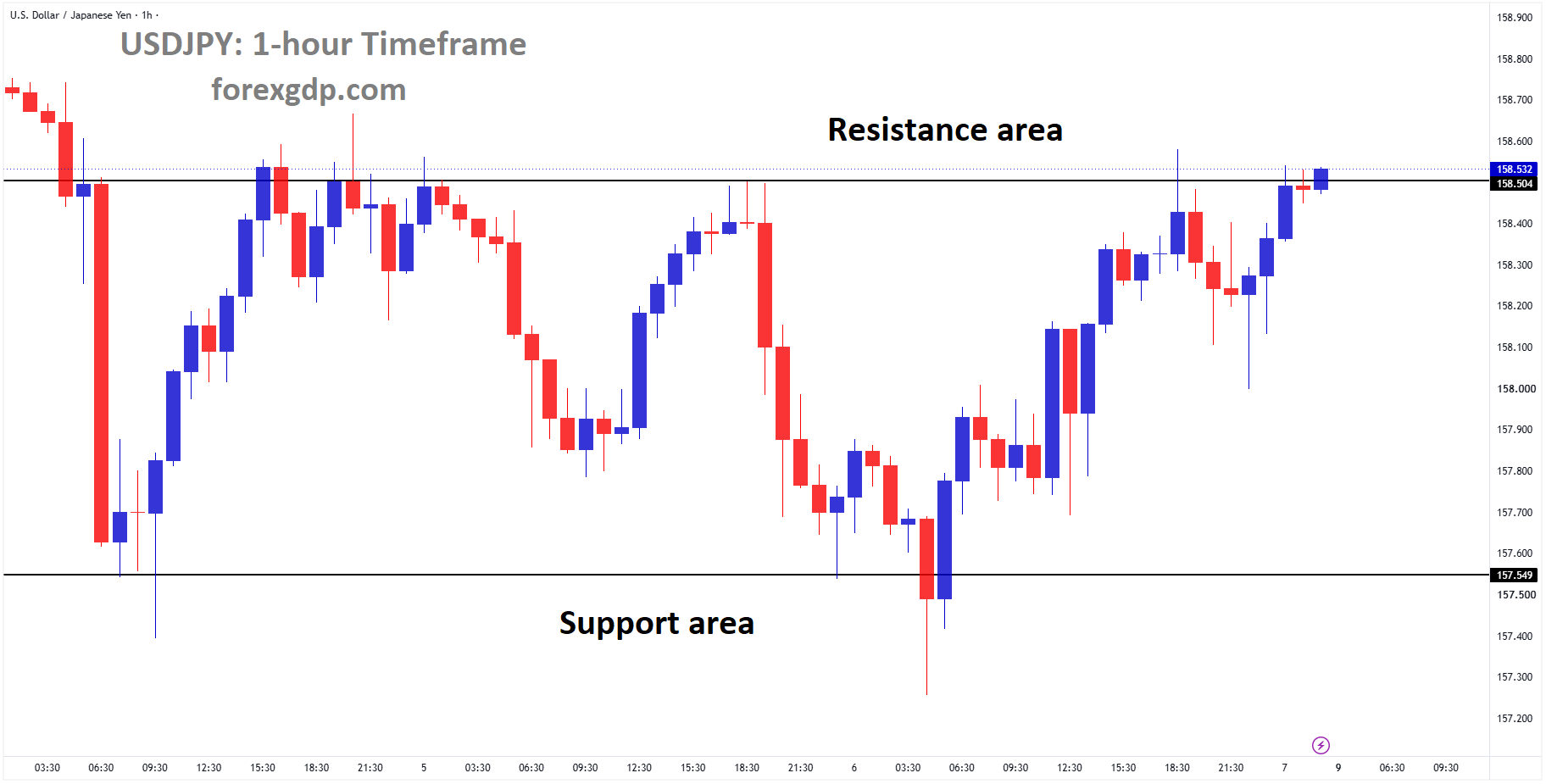
USDJPY reached the resistance area of the box pattern
Meanwhile, the Japanese Yen struggled to maintain its strength as falling Japanese government bond yields reduced its appeal. Although uncertainty in global equity markets encouraged some investors to seek safer assets, the Yen received limited support because of changing bond market conditions.
The latest developments highlight how employment data, central bank policies, and investor confidence continue to influence the relationship between the US Dollar and the Japanese Yen.
Strong US Nonfarm Payrolls Report Supports the US Dollar
The US labour market delivered a positive surprise in October, with employers adding significantly more jobs than economists had anticipated.
According to the latest Nonfarm Payrolls (NFP) report, the US economy created 165,000 jobs during the month, comfortably exceeding the forecast of 65,000. This stronger hiring activity suggests that American businesses continue to expand their workforce despite concerns about economic uncertainty and borrowing costs.
The employment report also included encouraging revisions to September’s hiring figures, indicating that job creation had been stronger than initially estimated.
Another important development was the decline in the unemployment rate to 4.1%. A lower unemployment rate generally reflects healthier labour market conditions and suggests that businesses continue to require workers.
Wage growth also exceeded expectations, adding another positive element to the employment report.
Higher wages can support household spending by increasing consumers’ purchasing power. However, they can also create challenges for policymakers when businesses pass rising labour expenses on to customers.
Together, these developments suggest that the US economy continues to demonstrate resilience, even as the Federal Reserve maintains its focus on controlling inflation.
For the US Dollar, stronger employment conditions can be supportive because they reduce the immediate pressure on the central bank to adopt a more accommodative monetary policy.
Federal Reserve Rate Hike Expectations Strengthen After Employment Data
The stronger-than-expected jobs report has renewed attention on the Federal Reserve’s next interest rate decision.
The central bank has been working to bring inflation back toward its long-term target of 2%. Although inflation pressures have eased in certain areas, policymakers remain cautious about declaring their efforts complete.
A resilient labour market gives the Federal Reserve more flexibility to maintain restrictive monetary conditions without immediately threatening employment growth.
As a result, expectations of another interest rate increase in December have remained an important factor supporting the US Dollar.
Fed Officials Continue to Focus on Inflation Risks
St. Louis Federal Reserve President Alberto Musalem reinforced the central bank’s commitment to controlling inflation during comments on Friday.
Musalem emphasized that inflation needs to return to the Fed’s 2% target within an appropriate timeframe.
He also identified energy-related disruptions and increased investment in artificial intelligence infrastructure as contributors to current inflation pressures.
These comments suggest that policymakers remain concerned about factors that could keep inflation elevated for longer than expected.
The rapid expansion of artificial intelligence infrastructure, including data centres and related energy requirements, has introduced additional demand across several parts of the economy.
When demand increases faster than available supply, businesses may face higher operating expenses, potentially adding to inflation pressures.
For currency markets, the Federal Reserve’s willingness to maintain higher interest rates remains significant because US assets can become more attractive to international investors seeking income.
US Treasury Yields Recover as Investors Respond to Jobs Data
The positive employment report also encouraged a recovery in US Treasury yields.
Government bond yields often respond to changing expectations about economic growth, inflation, and future central bank decisions.
When economic figures exceed forecasts, investors may anticipate that interest rates will remain elevated for an extended period.
This can increase the appeal of US government securities compared with similar investments in countries where interest rates are lower.
The resulting difference in potential returns can encourage international investors to favour Dollar-denominated assets.
For USD/JPY, this relationship is particularly important because Japan has historically maintained lower borrowing costs than the United States.
When US Treasury yields strengthen while Japanese government bond yields decline, the difference between the two countries’ borrowing costs becomes more noticeable.
This can encourage demand for the US Dollar while making the Japanese Yen relatively less attractive.
However, bond yield movements are only one part of the broader currency market environment. Economic uncertainty, investor sentiment, and central bank communication can also influence currency demand.
Lower US Inflation Expectations Limit Dollar Strength

Despite the encouraging employment figures, separate US consumer sentiment data introduced a more cautious element into the Dollar’s outlook.
Preliminary figures from the University of Michigan showed that American consumers had become somewhat less concerned about future inflation.
One-year inflation expectations declined to 4.3% in November from 4.7% previously.
Longer-term expectations also softened, with the five-year measure falling to 3.4% from 3.5%.
These changes suggest that consumers anticipate slower increases in the cost of goods and services over time.
Lower inflation expectations can be encouraging for the Federal Reserve because they may indicate that confidence in future price stability is improving.
However, they can also reduce the perceived need for additional interest rate increases.
This creates a mixed environment for the US Dollar.
On one hand, strong employment growth supports the argument for keeping monetary policy restrictive. On the other hand, easing inflation expectations could give policymakers more room to adopt a patient approach.
Investors must therefore consider both employment strength and inflation developments when assessing the Federal Reserve’s future decisions.
Japanese Yen Faces Pressure as Government Bond Yields Decline
While the US Dollar benefited from positive economic news, the Japanese Yen faced challenges of its own.
Japanese government bond yields moved lower as investors increased their demand for domestic government securities.
Bond prices generally rise when investors purchase more bonds, while their yields move in the opposite direction.
The increased demand for Japanese government bonds reflected a cautious mood in financial markets, particularly as concerns surrounding artificial intelligence-related equities affected investor confidence.
However, falling domestic yields reduced the income appeal of Japanese bonds compared with US government securities.
This weakened an important source of support for the Yen.
Safe-Haven Demand Provides Only Limited Relief
The Japanese Yen is traditionally considered a safe-haven currency because investors often turn toward it during periods of financial uncertainty.
Japan’s position as a major international creditor and the Yen’s role in global funding markets contribute to this reputation.
During the latest equity market weakness, some investors initially increased their exposure to the Japanese currency.
However, the benefit proved limited as declining Japanese bond yields made the currency less attractive from an income perspective.
This combination created competing influences on the Yen.
Concerns about global financial markets encouraged defensive investment decisions, while the difference between US and Japanese borrowing costs continued to favour the Dollar.
Bank of Japan Policy Outlook Remains Important for the Yen
The Bank of Japan’s monetary policy direction remains another major factor influencing the Japanese currency.
A more hawkish central bank outlook generally suggests greater willingness to increase interest rates or maintain tighter financial conditions.
Such an approach can support a country’s currency by improving the potential returns available to investors.
However, the Bank of Japan’s relatively firm policy stance has provided only limited assistance to the Yen amid falling domestic bond yields.
Investors continue to compare Japan’s monetary policy direction with that of the Federal Reserve.
If US borrowing costs remain comparatively attractive, demand for Dollar-denominated investments may continue to influence currency flows.
At the same time, any meaningful change in the Bank of Japan’s policy communication could alter expectations about future interest rate differences.
This makes upcoming statements from Japanese policymakers particularly relevant.
Japanese Currency Intervention Concerns Keep Investors Cautious
Another important consideration for USD/JPY is the possibility of intervention by Japanese authorities.
Japan has previously taken action in foreign exchange markets when rapid currency movements raised concerns about financial stability and the broader economy.
A weaker Yen can benefit Japanese exporters by making their products more competitive overseas.
However, it can also increase the cost of imported goods, particularly energy, food, and raw materials.
These higher import expenses may place additional pressure on Japanese households and businesses.
Because of these competing economic effects, Japanese officials closely monitor foreign exchange developments.
The possibility of government action can discourage investors from building excessively large positions against the Yen.
Even when economic conditions favour the US Dollar, intervention concerns can create uncertainty about how long that advantage may persist.
Summary
The USD/JPY recovery reflects a combination of stronger US employment conditions, renewed expectations of Federal Reserve monetary tightening, and declining Japanese government bond yields.
October’s impressive Nonfarm Payrolls figures demonstrated continued resilience in the American labour market, while stronger wage growth and lower unemployment reinforced confidence in the US economy.
At the same time, softer US consumer inflation expectations introduced some uncertainty about the need for further Federal Reserve action.
In Japan, safe-haven demand offered temporary support to the Yen, but lower government bond yields limited its strength.
Looking ahead, Federal Reserve policy decisions, Bank of Japan communication, inflation developments, and the possibility of Japanese currency intervention will remain central to the USD/JPY outlook.
The balance between US economic resilience and Japan’s monetary policy direction is likely to remain an important influence on both currencies.
USDCAD Climbs Sharply as Robust US Payrolls Expose Canada’s Economic Weakness
The US Dollar gained strength against the Canadian Dollar on Friday as fresh employment reports revealed a growing difference between the economic conditions of the United States and Canada. Stronger-than-expected hiring in the US helped improve confidence in the American economy, while disappointing employment figures from Canada raised concerns about the country’s economic outlook.
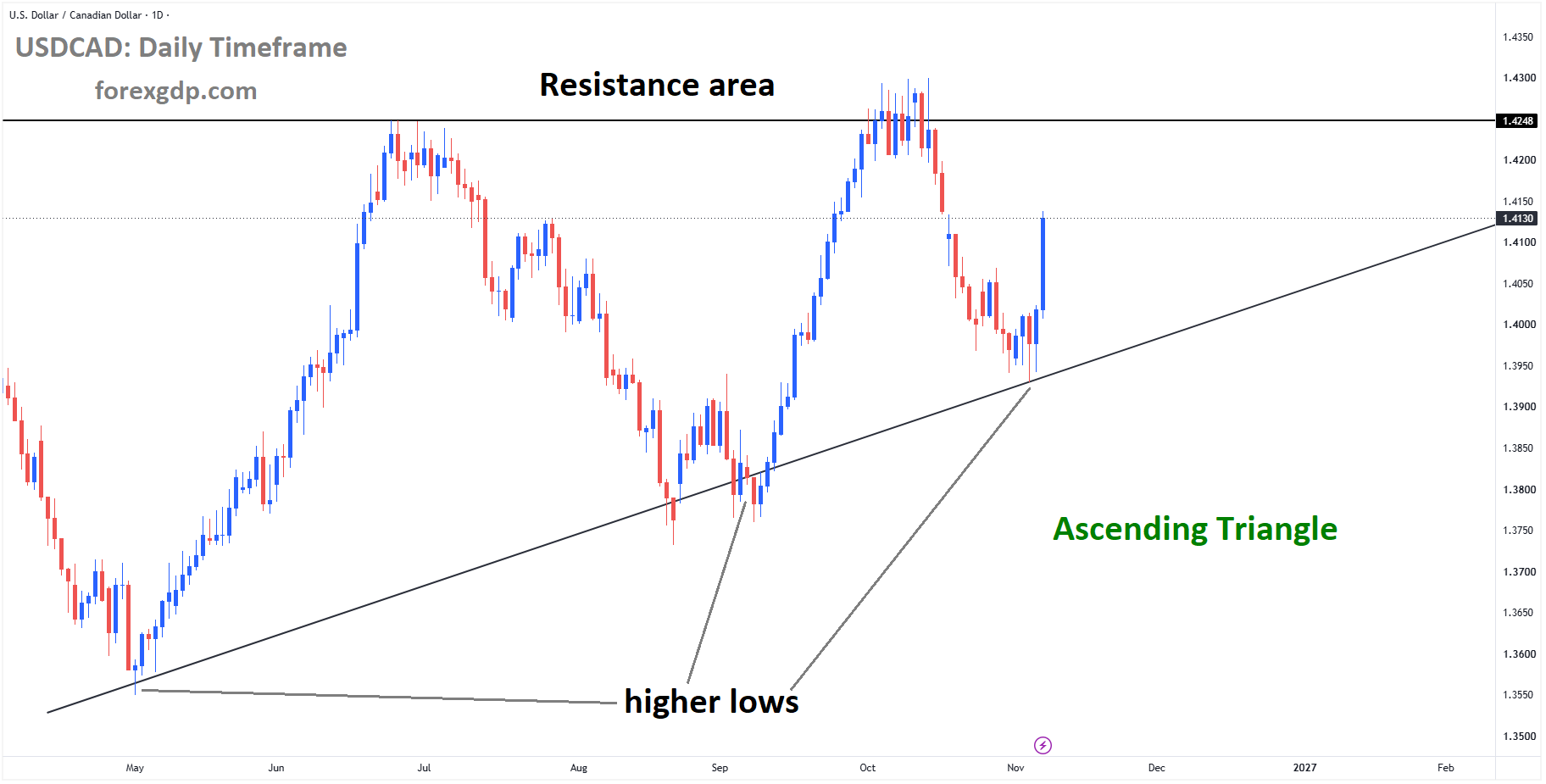
USDCAD is moving in an ascending triangle pattern, and the market has rebounded from the higher low area of the pattern
The latest reports showed that American businesses continued to create jobs at a healthy pace in October, exceeding economists’ expectations by a wide margin. Meanwhile, Canada experienced another month of job losses, accompanied by a rise in unemployment.
These contrasting developments have drawn attention to the different challenges facing the Federal Reserve and the Bank of Canada. While the US economy continues to demonstrate resilience, Canada’s weakening labour market could make future monetary policy decisions more difficult.
US Employment Growth Exceeds Expectations in October
The United States delivered a surprisingly strong employment report in October, suggesting that the country’s labour market remains healthier than many economists had anticipated.
According to the US Bureau of Labor Statistics, the economy added 165,000 jobs during the month. Economists had expected an increase of only 65,000 positions, making the actual result considerably stronger than forecasts.
The positive report suggests that American employers are continuing to hire despite economic uncertainty and the effects of higher borrowing costs.
Employment growth is an important measure of economic health because it reflects business confidence and consumer spending potential. When companies continue hiring, it often indicates that they expect demand for their products and services to remain stable.
The October figures therefore provided encouraging evidence that the American economy continues to withstand economic pressures.
Previous US Employment Figures Receive Positive Revisions
The October employment report also included upward revisions to job creation figures from previous months.
September’s employment increase was revised from 29,000 to 60,000 jobs. Similarly, August’s figure was adjusted from 133,000 to 186,000 jobs.
Together, these changes added 84,000 jobs to earlier estimates, suggesting that employment conditions had been stronger than initially reported.
Such revisions are significant because monthly employment figures are often updated as government agencies receive more complete information from businesses and other sources.
The improvements to August and September data indicate that the strength of the US labour market was not limited to October.
Another encouraging development was the decline in the US unemployment rate, which fell from 4.2% in September to 4.1% in October.
A lower unemployment rate, combined with stronger hiring, suggests that employment opportunities remain available across the economy.
However, policymakers must also consider whether continued employment growth could contribute to inflationary pressures, particularly if consumer demand remains strong.
Strong Labour Market Influences Federal Reserve Policy Expectations
The latest US employment figures have important implications for the Federal Reserve, which is responsible for managing monetary policy and maintaining economic stability.
The central bank closely monitors employment conditions when deciding whether to raise, lower, or maintain interest rates.
Strong job creation can encourage the Federal Reserve to keep borrowing costs elevated when inflation remains a concern. A resilient labour market may give policymakers greater flexibility to focus on controlling inflation without immediately worrying about a sharp increase in unemployment.
Following the October employment report, expectations of a more restrictive Federal Reserve policy stance strengthened.
The CME FedWatch tool indicated that expectations for an interest rate increase at the December meeting had risen compared with the previous day.
This change reflected growing confidence that the American economy could continue operating under tighter financial conditions.
Nevertheless, employment data represents only one part of the Federal Reserve’s decision-making process.
Officials also examine inflation, wage growth, consumer spending, business investment, and broader economic activity before determining the appropriate direction of monetary policy.
Future economic reports will therefore remain important in shaping expectations for the central bank’s next steps.
Canada’s Labour Market Continues to Show Signs of Weakness
While the United States reported encouraging employment growth, Canada’s October labour market figures presented a much less positive picture.
Statistics Canada reported that the Canadian economy lost 4,700 jobs during the month, surprising economists who had expected employment to increase by 13,600 positions.
Although October’s decline was smaller than the substantial loss of 68,300 jobs recorded in September, the latest figures still pointed to ongoing weakness in hiring.
Canada’s unemployment rate also increased from 6.5% in September to 6.7% in October.
Economists had expected the unemployment rate to remain unchanged, making the increase another disappointing development.
A rising unemployment rate can indicate that businesses are becoming more cautious about hiring or that available employment opportunities are not keeping pace with the number of people seeking work.
For Canadian households, weaker employment conditions may create uncertainty about income stability and future spending decisions.
Businesses could also face challenges if reduced consumer confidence leads to slower demand for goods and services.
Canadian Economy Faces Continued Employment Challenges

Canada’s employment difficulties extend beyond a single disappointing monthly report.
Over the previous three months, the country recorded a combined loss of 114,700 jobs, highlighting a broader period of labour market weakness.
The sustained decline raises questions about the economy’s ability to generate sufficient employment opportunities in the coming months.
One important concern involves uncertainty surrounding US trade tariffs and their potential effects on Canadian businesses.
Because Canada and the United States maintain extensive trade relationships, changes in American trade policy can influence Canadian manufacturing, exports, investment, and employment.
Businesses exposed to international trade uncertainty may delay expansion plans or postpone hiring until they have a clearer understanding of future operating conditions.
This cautious approach can affect employment opportunities even before the full economic consequences of trade restrictions become visible.
Continued job losses could also weigh on household confidence, potentially encouraging consumers to reduce discretionary spending.
If these conditions persist, Canada’s economic recovery could face additional obstacles.
Bank of Canada Faces Difficult Interest Rate Decisions
The weakening Canadian labour market presents a challenge for the Bank of Canada as it considers its future monetary policy decisions.
The central bank raised its benchmark interest rate on October 28, marking its first increase in more than three years.
However, the disappointing October employment report could complicate the case for further monetary tightening.
Higher interest rates generally increase borrowing costs for households and businesses. While this can help control inflation, it may also reduce spending, discourage investment, and slow employment growth.
When unemployment is already increasing, additional borrowing costs can create further pressure on economic activity.
The Bank of Canada must therefore balance its responsibility to maintain price stability against the risk of weakening economic conditions.
If employment continues to deteriorate, policymakers may become more cautious about introducing additional interest rate increases.
On the other hand, persistent inflation could limit the central bank’s ability to adopt a more supportive policy approach.
The direction of future decisions will likely depend on incoming employment reports, inflation developments, and signs of improvement or further weakness in the broader Canadian economy.
Different Economic Conditions Shape the US and Canadian Dollar Outlook
The contrasting employment reports highlight an important difference between the economic situations facing the United States and Canada.
In the United States, stronger hiring and lower unemployment suggest that economic activity remains relatively resilient.
In Canada, continued job losses and rising unemployment point toward a more challenging environment.
These differences can influence expectations about how the Federal Reserve and the Bank of Canada will manage interest rates.
When investors expect one central bank to maintain tighter monetary conditions than another, the difference can affect demand for their respective currencies.
Stronger US economic performance may support confidence in the American Dollar, while concerns about Canadian employment can reduce confidence in Canada’s economic outlook.
However, currency movements depend on several factors beyond employment, including inflation, trade developments, economic growth, and changes in global investor sentiment.
The coming months will be particularly important as both countries release additional economic information.
Summary
October’s employment reports revealed a clear contrast between the United States and Canada.
The American economy added substantially more jobs than expected, while positive revisions to earlier employment figures reinforced evidence of labour market resilience. A decline in unemployment provided further encouragement.
Canada, meanwhile, experienced unexpected job losses and a higher unemployment rate, adding to concerns about the country’s economic performance.
These developments have created different challenges for the Federal Reserve and the Bank of Canada. Strong US employment may support a cautious approach to easing monetary conditions, while Canadian job market weakness could make additional interest rate increases more difficult to justify.
Looking ahead, employment trends, inflation, central bank decisions, and trade developments will remain essential in determining the economic outlook for both countries and the relative strength of their currencies.
USDCHF Holds Firm as Global Uncertainty Fuels Defensive Currency Interest
The Swiss Franc (CHF) is attracting renewed interest from investors as uncertainty surrounding US politics, economic growth, and monetary policy encourages demand for safer currencies. Meanwhile, the US Dollar (USD) is struggling to maintain its strength as declining US Treasury yields and changing expectations for Federal Reserve interest rates influence investor sentiment.
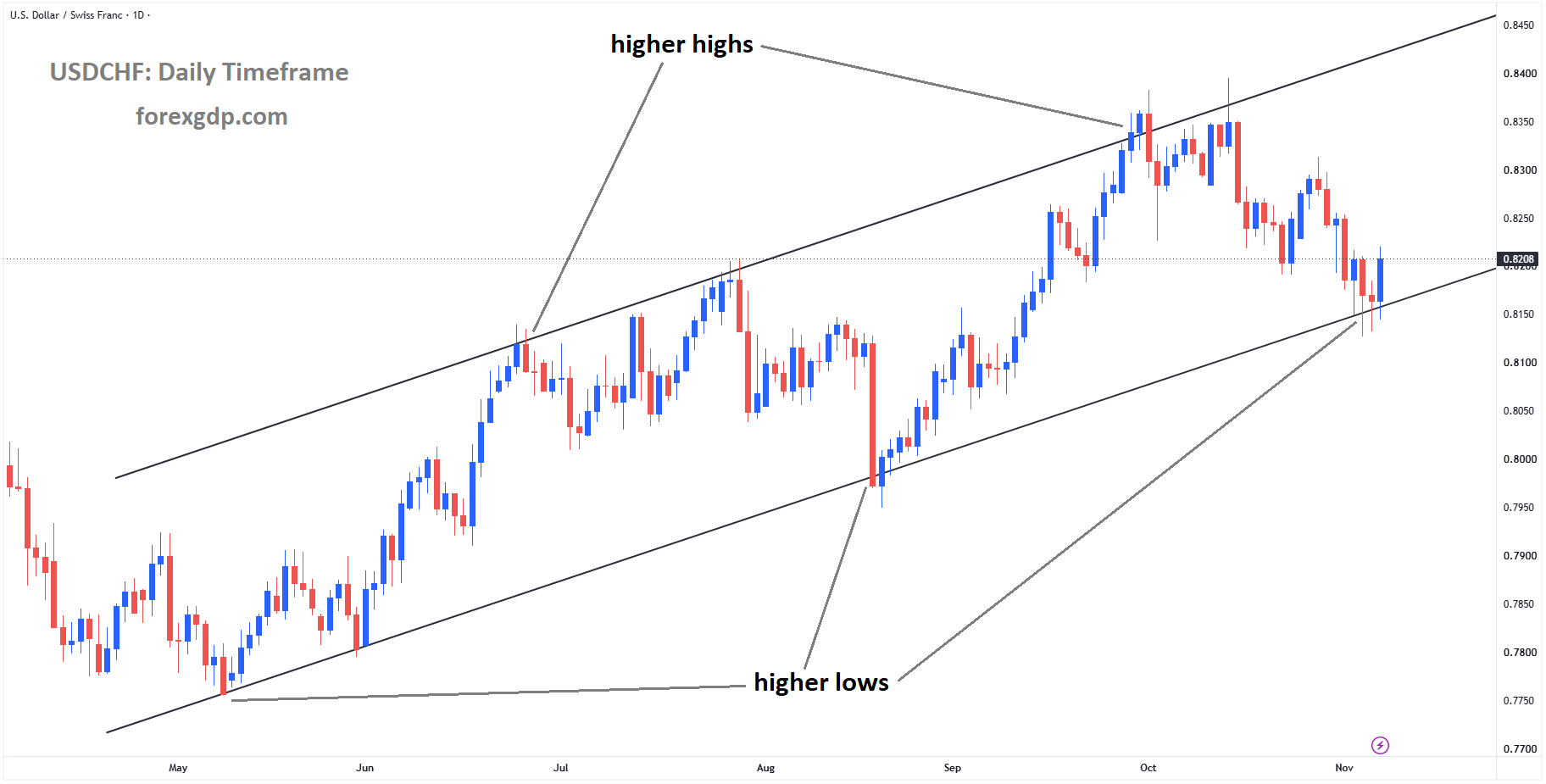
USDCHF reached the higher low area of the ascending channel
The USD/CHF currency pair has experienced mixed movement, reflecting the competing forces affecting both currencies. While cautious market sentiment has provided some support for the US Dollar, the Swiss Franc continues to benefit from its reputation as a reliable safe-haven currency during uncertain times.
Investors are now focusing on upcoming US employment data, potential political gridlock in Washington, and the monetary policy outlook of the Swiss National Bank (SNB). These developments could play an important role in determining the direction of the two currencies in the coming weeks.
Swiss Franc Benefits From Growing Safe-Haven Demand
The Swiss Franc has strengthened as investors become increasingly concerned about political uncertainty and the possibility of slower economic growth in the United States.
Switzerland’s currency is widely considered a safe-haven asset because of the country’s political stability, strong financial institutions, and relatively stable economy. During periods of global uncertainty, investors often increase their exposure to the franc to reduce risks associated with more volatile assets.
Recent political developments in the United States have added to this demand. A Democratic election sweep has raised expectations of changes in government policy, including potentially stricter regulations affecting artificial intelligence development and related investments.
These developments have encouraged investors to reassess their exposure to riskier assets. As a result, the Swiss Franc has gained support from investors seeking financial stability.
Concerns about possible political gridlock in Washington have also contributed to the cautious mood. If disagreements between political institutions make it difficult to approve major spending plans or economic reforms, businesses and investors may become less confident about future US growth.
Such uncertainty can increase demand for defensive currencies, including the Swiss Franc.
US Dollar Faces Pressure From Falling Treasury Yields
The US Dollar has received some support from cautious investor sentiment, but its ability to strengthen further remains limited by developments in the US bond market.
Declining US Treasury yields have reduced part of the Dollar’s appeal to international investors. Government bond yields are an important factor in currency markets because they influence the returns investors can earn from holding assets denominated in a particular currency.
When US yields fall, Dollar-based investments may become less attractive compared with alternatives in other countries.
Another important factor is the changing outlook for Federal Reserve monetary policy.
Investors have adjusted their expectations for future US interest rate increases as economic and political developments create uncertainty about inflation and growth.
Changes in expectations for borrowing costs can influence the Dollar because higher US interest rates generally make Dollar-denominated assets more attractive. Conversely, reduced expectations for additional rate increases can weaken demand for the currency.
The Federal Reserve’s future decisions will therefore remain an important influence on the USD/CHF outlook.
US Nonfarm Payrolls Report Takes Center Stage

Investors are closely watching the upcoming US Nonfarm Payrolls (NFP) report for fresh information about the strength of the American labor market.
The monthly employment report is one of the most closely followed economic releases in the United States. It provides valuable information about job creation, unemployment, and wage growth.
These figures help investors assess whether the US economy is expanding at a healthy pace or showing signs of weakness.
A strong employment report could suggest that businesses continue to hire workers despite economic uncertainty. It could also indicate that consumer spending may remain resilient, supporting overall economic activity.
On the other hand, weaker employment growth could raise concerns about slowing economic momentum.
The Federal Reserve closely monitors labor market conditions when making monetary policy decisions. As a result, the NFP report could influence expectations surrounding its December policy meeting.
Employment figures that suggest persistent inflation pressures may strengthen arguments for keeping monetary policy restrictive. However, evidence of weakening labor demand could encourage a more cautious approach.
For the US Dollar, the reaction will depend not only on the employment figures themselves but also on how they change expectations for future Federal Reserve decisions.
Political Gridlock Could Influence US Economic Growth
Political uncertainty in Washington has become another important consideration for currency investors.
The Democratic election sweep has raised questions about future government spending, regulatory policies, and the ability of lawmakers to reach agreements on major economic decisions.
Political gridlock can develop when competing political interests prevent important legislation from moving forward.
Although such situations may limit government spending and reduce concerns about excessive fiscal expansion, they can also delay policies designed to support economic growth.
Businesses may postpone investment decisions if they are uncertain about future regulations, taxes, or government priorities.
The possibility of tighter regulation surrounding artificial intelligence infrastructure has attracted particular attention. The AI industry requires significant investment in technology, energy, and physical infrastructure, making regulatory changes potentially important for corporate planning.
Meanwhile, expectations surrounding geopolitical developments, including the possibility of reduced tensions involving Iran, have influenced broader investor sentiment.
Any easing of geopolitical risks could affect energy costs and inflation expectations, which may also influence Federal Reserve policy.
Together, these political and economic developments create a complicated environment for the US Dollar.
Swiss Franc Carry Trades Face Changing Conditions
Another factor supporting the Swiss Franc is the possibility that investors may reduce their reliance on franc-funded carry trades.
A carry trade involves borrowing money in a currency with relatively low interest rates and investing those funds in assets that offer higher returns elsewhere.
Switzerland has maintained some of the lowest borrowing costs among major economies, making the franc attractive as a funding currency for international investors.
Under this strategy, investors borrow Swiss Francs and exchange them for currencies associated with higher interest rates.
However, the strategy becomes less attractive when market uncertainty increases or when expectations for interest rate differences between countries begin to narrow.
Investors may then close their positions by buying back the Swiss Francs they previously borrowed.
This process can create additional demand for Switzerland’s currency and contribute to its appreciation.
If global risk sentiment remains fragile, the unwinding of carry trades could continue to influence the franc’s performance.
Swiss National Bank Expected to Maintain Stable Interest Rates
The Swiss National Bank is widely expected to maintain its current monetary policy stance in the near term, supported by relatively contained inflation pressures.
SNB Chairman Martin Schlegel has indicated that inflation in Switzerland remains manageable, reducing the immediate need for tighter monetary policy.
Although Swiss inflation increased in October, the rise was partly associated with higher energy costs and the earlier weakness of the franc.
A stronger Swiss Franc can help reduce imported inflation because foreign goods and services become less expensive when purchased using the domestic currency.
This effect is particularly important for Switzerland, which depends on international trade and imports a wide range of products.
Lower imported costs can help limit inflationary pressures across the economy.
However, an excessively strong franc can also create difficulties for Swiss exporters by making their products more expensive for overseas customers.
The SNB must therefore balance inflation stability with broader economic conditions when determining its policy approach.
For now, contained inflation gives the central bank room to remain patient while monitoring currency developments and international economic risks.
USD/CHF Outlook Depends on Economic Data and Investor Confidence
The near-term outlook for USD/CHF remains uncertain as investors evaluate several competing influences.
UOB Group analysts have maintained a cautious view of the US Dollar against the Swiss Franc, reflecting concerns about the Dollar’s ability to sustain a broader recovery.
However, the bank has also acknowledged that recent currency movements have not provided clear confirmation of a sustained decline.
Beyond short-term fluctuations, the direction of USD/CHF will depend heavily on changes in investor confidence, US economic performance, and monetary policy expectations.
Strong US employment figures and improved economic confidence could help support the Dollar. In contrast, weaker economic data, declining Treasury yields, and continued political uncertainty could increase the appeal of the Swiss Franc.
The Swiss National Bank’s policy decisions will also remain relevant, particularly if currency appreciation begins to affect inflation or Switzerland’s export competitiveness.
Summary
The Swiss Franc continues to benefit from safe-haven demand as political uncertainty and concerns about US economic growth influence global investor sentiment.
Meanwhile, falling US Treasury yields and shifting Federal Reserve interest rate expectations are limiting the US Dollar’s strength.
The upcoming US Nonfarm Payrolls report could provide important guidance about the health of the American economy and the Federal Reserve’s December policy outlook.
At the same time, Switzerland’s contained inflation and expectations of steady SNB interest rates provide a relatively stable domestic policy environment.
Ultimately, the USD/CHF outlook will be shaped by the balance between US economic resilience, global risk sentiment, and continued demand for the Swiss Franc as a safe-haven currency.
AUDUSD Struggles for Momentum as Upbeat US Payrolls Strengthen Dollar Demand
The Australian Dollar continues to face selling pressure against the US Dollar as investors react to stronger US employment figures, growing uncertainty in global financial markets, and a cautious outlook from the Reserve Bank of Australia (RBA). The AUD/USD currency pair has extended its recent decline, reaching its weakest levels in several months as economic developments in both countries influence investor confidence.
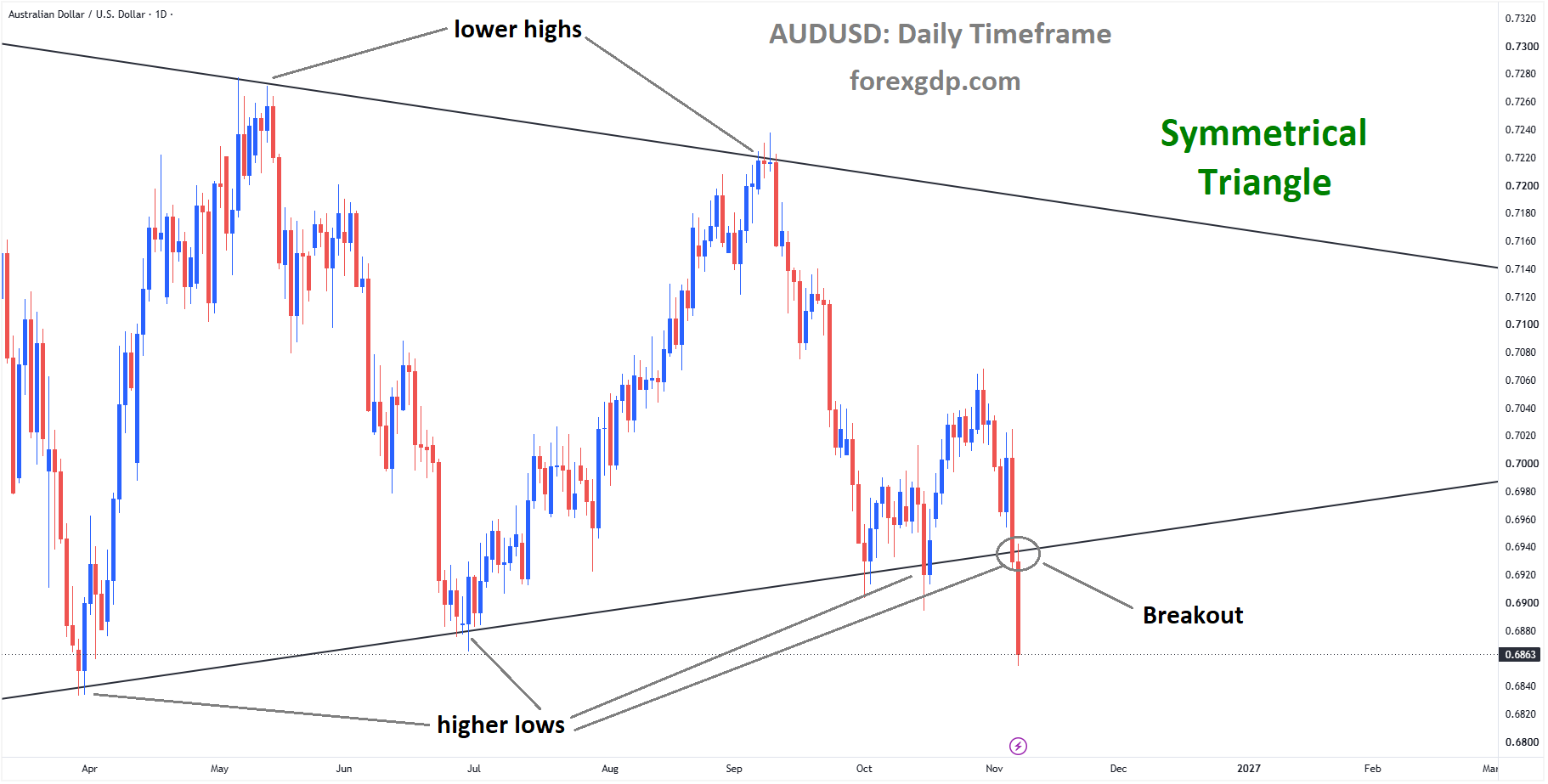
AUDUSD has broken the symmetrical triangle on the downside
The latest weakness in the Australian Dollar reflects a combination of domestic and international factors. Stronger-than-expected US job growth has increased expectations that the Federal Reserve may continue raising interest rates. Meanwhile, concerns about the global economy and a sharp decline in technology stocks have encouraged investors to move away from currencies that are sensitive to market uncertainty.
In Australia, the central bank’s decision to raise interest rates again has done little to strengthen the local currency. Instead, its cautious comments about future monetary policy have raised questions about whether additional increases are likely in the coming months.
Strong US Dollar Adds Pressure to AUD/USD
The US Dollar has regained strength following the release of encouraging employment data from the United States. The figures suggest that the American labour market remains relatively healthy despite the Federal Reserve’s efforts to slow economic activity through higher borrowing costs.
A stronger US Dollar often creates challenges for the Australian Dollar because the two currencies respond differently to changes in global economic confidence. The US Dollar is widely considered a safe-haven currency, meaning investors frequently turn to it during periods of uncertainty.
The Australian Dollar, on the other hand, is more closely connected to global economic growth, international trade, and demand for commodities. When investors become concerned about economic conditions, they may reduce their exposure to currencies such as the Aussie.
This difference has become particularly important as financial markets experience renewed volatility. Investors are paying close attention to developments in the United States, where economic resilience continues to shape expectations about future monetary policy.
The combination of stronger American economic data and cautious global sentiment has created a difficult environment for the Australian currency.
US Nonfarm Payrolls Exceed Expectations
One of the main reasons behind the US Dollar’s renewed strength is the latest Nonfarm Payrolls report.
The report showed that the US economy added 165,000 jobs in October, significantly exceeding economists’ expectations of 65,000 new positions. This stronger employment growth suggests that American businesses continue to hire workers despite tighter financial conditions.
The previous month’s employment figures were also revised upward. September’s job growth was adjusted from an initially reported 29,000 to 60,000, providing further evidence of resilience in the labour market.
Another encouraging development was the unexpected decline in the US unemployment rate. The rate fell from 4.2% to 4.1%, indicating that employment conditions remained relatively stable.
These figures are important because the Federal Reserve closely monitors labour market developments when making interest rate decisions.
A strong employment market can support household spending, which helps maintain economic activity. However, continued consumer demand may also make it more difficult for inflation to return to the central bank’s target.
As a result, better-than-expected employment figures can strengthen expectations that US interest rates will remain elevated or increase further.
Federal Reserve Faces Continued Inflation Challenges
The Federal Reserve remains focused on bringing inflation back toward its long-term target of 2%.
Although higher interest rates are intended to reduce spending and ease inflationary pressure, a resilient labour market can complicate this process. When employment remains strong, households generally have more confidence in their financial situation and may continue spending.
This ongoing demand can keep pressure on businesses and consumer prices, making inflation more difficult to control.
Energy costs represent another concern for policymakers. Rising oil and energy expenses can increase transportation, manufacturing, and household costs. These increases may eventually affect the prices consumers pay for everyday goods and services.
With inflation still above the Fed’s preferred level, stronger employment data gives policymakers additional reasons to maintain a restrictive monetary policy.
Expectations of further US interest rate increases can also influence international currency markets. Higher American borrowing costs may attract overseas investors seeking returns from US financial assets.
This increased demand for Dollar-denominated investments can support the US currency while creating additional pressure on other major currencies, including the Australian Dollar.
However, future Federal Reserve decisions will depend on a wider range of economic information, including inflation, consumer spending, business activity, and employment trends.
Reserve Bank of Australia Raises Interest Rates Again
While the Federal Reserve continues to assess inflation risks, the Reserve Bank of Australia is dealing with similar challenges at home.
The RBA recently increased its benchmark cash rate by 25 basis points, bringing borrowing costs to their highest level since 2008. The decision marked the central bank’s fifth interest rate increase of the year.
The move was widely expected as Australian policymakers continued their efforts to control inflation.
Higher interest rates are designed to reduce borrowing and encourage saving. When loans become more expensive, households and businesses may limit spending, helping ease demand across the economy.
However, these measures can also create financial pressure for mortgage holders, businesses, and consumers who depend on credit.
Australia has faced additional inflation concerns linked to rising energy costs, particularly oil. Higher fuel expenses can affect transportation and production costs, contributing to broader increases in consumer prices.
The RBA must therefore balance the need to control inflation against the risk of slowing economic growth too sharply.
Although the latest increase demonstrated the central bank’s commitment to price stability, its accompanying guidance suggested a more cautious approach to future decisions.
RBA Signals a Possible Pause in Further Rate Hikes
One of the most significant developments following the RBA’s policy meeting was the change in its communication about future interest rate increases.
Previously, the central bank had indicated that additional tightening could be necessary if inflation remained persistent. However, its latest statement removed the explicit reference to further increases.
RBA Governor Michele Bullock also suggested that policymakers may prefer to pause and evaluate incoming economic information before deciding on their next move.
This shift indicates that the central bank wants more time to understand how previous interest rate increases are affecting the Australian economy.
Monetary policy changes do not influence economic activity immediately. It can take several months for higher borrowing costs to affect household spending, business investment, employment, and inflation.
By adopting a wait-and-see approach, the RBA can assess whether its existing measures are producing the desired results without placing unnecessary pressure on economic growth.
For the Australian Dollar, this cautious guidance has reduced expectations of aggressive monetary tightening.
Investors often consider the difference between interest rate expectations in Australia and the United States when evaluating the two currencies. If American interest rates are expected to rise while Australian policymakers appear more willing to pause, the US Dollar may become relatively more attractive.
Global Risk Aversion Weakens Demand for the Australian Dollar
Beyond central bank policy, changes in global investor sentiment have also contributed to the Australian Dollar’s weakness.
A sharp decline in technology shares, particularly companies connected to artificial intelligence, has increased concerns across financial markets.
When major stock markets experience significant losses, investors often become more cautious about holding assets that are sensitive to economic uncertainty.
The Australian Dollar is especially exposed to these changes because Australia’s economy depends heavily on international trade and commodity exports.
Demand from major trading partners, particularly China, plays an important role in Australia’s economic outlook. Any slowdown in global manufacturing, construction, or industrial activity can affect demand for Australian exports.
During periods of uncertainty, investors may prefer assets they consider more stable and liquid, including the US Dollar.
This movement toward safety can weaken demand for the Australian currency even when domestic economic conditions remain relatively stable.
As a result, developments outside Australia can sometimes have as much influence on the Aussie as decisions made by the country’s own central bank.
Economic Data and Central Bank Guidance Remain in Focus
Looking ahead, investors will continue monitoring economic developments in both Australia and the United States.
In the US, upcoming inflation and employment reports will help determine whether the Federal Reserve has sufficient reason to maintain its restrictive policy stance.
In Australia, attention will remain focused on consumer inflation, employment conditions, household spending, and the broader impact of higher borrowing costs.
Comments from central bank officials will also be important because they can provide insight into how policymakers interpret changing economic conditions.
Global investor confidence will remain another major influence. Improvements in financial market sentiment could help support demand for the Australian Dollar, while renewed concerns about economic growth may encourage further interest in the US Dollar.
The direction of AUD/USD will therefore depend on how these domestic and international developments evolve.
Summary
The Australian Dollar has come under significant pressure as stronger US employment data, cautious RBA guidance, and growing uncertainty in global financial markets support the US Dollar.
The latest US Nonfarm Payrolls report has reinforced expectations that the Federal Reserve may need to keep monetary policy restrictive to address persistent inflation.
Meanwhile, the Reserve Bank of Australia’s decision to adopt a more patient approach after another interest rate increase has reduced expectations of immediate additional tightening.
Weakness in technology stocks and broader concerns about global economic growth have added to the challenges facing the Australian currency.
Going forward, inflation trends, employment figures, central bank decisions, and changes in global risk sentiment will remain the key factors shaping the outlook for AUD/USD.
NZDUSD Loses Ground as Fed Policy Expectations Keep Currency Markets on Edge
The New Zealand Dollar (NZD) continues to face pressure against the US Dollar (USD) as investors remain cautious ahead of important economic and political developments. The NZD/USD currency pair has weakened for a second consecutive day, reflecting growing uncertainty about the direction of US monetary policy, disappointing employment figures in New Zealand, and the country’s upcoming general election.
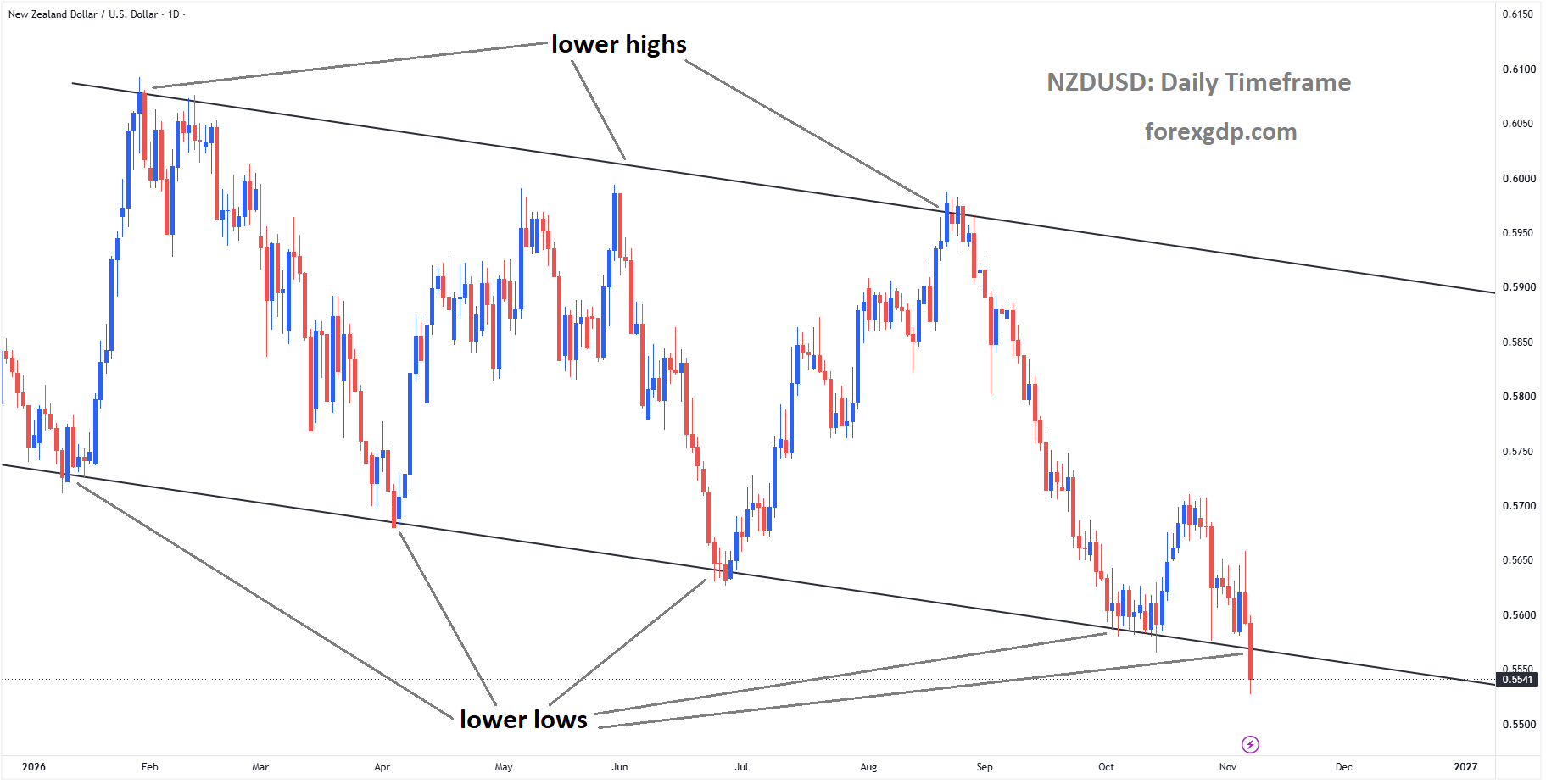
NZDUSD reached the lower low area of the descending channel
The US Dollar has received some support as market participants prepare for the release of the US Nonfarm Payrolls (NFP) report. This closely watched employment report could influence the Federal Reserve’s next interest rate decision and shape expectations about the broader US economy.
At the same time, declining US government bond yields, falling oil prices, and changing political expectations in Washington may prevent the Greenback from strengthening significantly. In New Zealand, concerns about rising unemployment and the cost of living continue to affect confidence in the domestic economy.
US Nonfarm Payrolls Report Keeps Investors Cautious
The upcoming US Nonfarm Payrolls report is one of the main factors influencing investor sentiment. Released by the US Bureau of Labor Statistics, the report provides important information about employment growth across the American economy, excluding agricultural workers and certain other categories.
Investors closely follow this data because employment conditions play a major role in the Federal Reserve’s monetary policy decisions.
A strong employment report could suggest that the US economy remains resilient despite higher borrowing costs and ongoing economic uncertainty. Such an outcome may strengthen expectations that the Federal Reserve will maintain a restrictive monetary policy stance.
On the other hand, weaker employment growth could indicate that businesses are becoming more cautious about hiring. This may increase concerns about slowing economic activity and encourage expectations of a less restrictive approach from the central bank.
The report also provides information about wage growth and unemployment, both of which help policymakers assess inflation pressures and overall economic conditions.
With the Federal Reserve’s December policy meeting approaching, investors are particularly interested in whether the latest employment figures will support expectations of another interest rate increase.
According to the expectations described by CME Group’s FedWatch tool, investors have assigned a significant probability to a December rate hike. However, these expectations can change quickly when new economic information becomes available.
Until the employment report provides greater clarity, uncertainty surrounding US monetary policy may continue to influence demand for the US Dollar.
Falling US Bond Yields May Limit Dollar Strength
Although the US Dollar has benefited from cautious investor sentiment, several developments could restrict its broader strength.
One important factor is the decline in US government bond yields. Bond yields reflect several economic expectations, including future interest rates, inflation, and demand for relatively safe investments.
When US bond yields fall, the income advantage associated with holding certain Dollar-denominated assets may become less attractive to international investors.
This can reduce demand for the US Dollar, particularly when investors believe the Federal Reserve could adopt a more cautious approach to monetary policy.
Political developments in the United States are also influencing expectations about government spending and economic growth.
The prospect of stronger Democratic control following US elections has encouraged discussion about possible changes in fiscal policy and international relations. However, the economic consequences will depend on the final political outcome and the policies that follow.
Expectations of political gridlock in Washington could also affect confidence. When lawmakers struggle to reach agreements on major spending proposals, the government’s ability to introduce new economic measures may become limited.
Reduced government spending could contribute to slower economic growth, particularly if businesses and households are already facing financial pressure.
These developments create a complicated environment for the US Dollar. While uncertainty may encourage demand for relatively safe assets, weaker growth expectations and declining bond yields could offset some of that support.
Falling Oil Prices Add Another Layer of Uncertainty
Developments in the global energy market are also contributing to changes in investor sentiment.
Oil prices have come under pressure amid speculation that political changes in the United States could improve the prospects for easing tensions involving Iran.
Any meaningful reduction in geopolitical conflict could ease concerns about disruptions to global energy supplies. This would potentially improve confidence among businesses and consumers, especially in countries that depend heavily on imported energy.
Lower oil costs can benefit economic activity by reducing transportation expenses, manufacturing costs, and household energy bills.
However, falling oil prices can also influence inflation expectations. If energy becomes less expensive, overall consumer price pressures may ease, potentially giving central banks greater flexibility when considering future interest rate decisions.
For the United States, weaker inflation expectations could encourage investors to reassess how long the Federal Reserve may need to maintain restrictive monetary conditions.
The relationship between energy prices and currencies is not always straightforward. Much depends on whether falling oil costs reflect improving supply conditions or concerns about weaker global demand.
As a result, developments in energy markets remain an important part of the broader economic picture.
New Zealand Unemployment Rises to an Almost 11-Year High

While international developments are influencing the US Dollar, domestic economic challenges are placing additional pressure on the New Zealand Dollar.
Recent employment figures from Statistics New Zealand have raised concerns about the strength of the country’s labour market.
The unemployment rate increased to 5.7% during the three months ending in September, compared with 5.6% in the previous quarter.
This represented the highest unemployment level in nearly 11 years and exceeded economists’ expectations of 5.5%.
The increase suggests that New Zealand businesses may be facing difficult operating conditions, with some employers reducing recruitment or becoming more cautious about expanding their workforce.
Higher unemployment can affect the economy in several ways.
When more people struggle to find work, household income growth may weaken. Families may respond by reducing spending on non-essential goods and services, which can create additional challenges for businesses.
Lower consumer spending can also reduce demand across the economy, potentially affecting investment and future employment opportunities.
For the Reserve Bank of New Zealand (RBNZ), weaker labour market conditions are an important consideration when assessing monetary policy.
The central bank must balance the need to maintain price stability with the broader effects of interest rates on economic activity.
If unemployment continues to rise and economic growth remains subdued, policymakers may face increasing pressure to support domestic demand.
These concerns can influence international investors’ confidence in New Zealand’s economic outlook and reduce the appeal of the New Zealand Dollar.
New Zealand General Election Creates Political Uncertainty
Political developments are another major concern for investors as New Zealand prepares for its general election on Saturday, November 7.
The election comes at a challenging time for the domestic economy, with voters increasingly focused on household expenses, employment opportunities, and long-term financial stability.
Prime Minister Christopher Luxon’s centre-right National Party-led coalition faces pressure to demonstrate that its economic policies can deliver stronger growth and improve living standards.
Recent Ipsos polling has highlighted inflation and the cost of living as leading concerns among New Zealand voters.
These issues have become particularly important as households continue to manage the effects of elevated everyday expenses and uncertain economic conditions.
For businesses, the election outcome could influence expectations about taxation, government spending, infrastructure investment, and regulatory policy.
Investors will be watching closely to determine whether the next government can provide a stable policy environment and address the country’s economic challenges.
Political uncertainty can sometimes discourage investment decisions, particularly when businesses are unsure about future regulations or fiscal priorities.
However, an election can also create opportunities for renewed confidence if the resulting government presents a credible plan to strengthen economic growth.
The New Zealand Dollar’s response will likely depend on how investors assess the election outcome and its implications for the country’s longer-term economic prospects.
Final Summary
The New Zealand Dollar remains under pressure against the US Dollar as investors assess several important economic and political developments.
In the United States, attention is focused on the upcoming Nonfarm Payrolls report and its potential influence on the Federal Reserve’s December interest rate decision. Although cautious sentiment has supported the Greenback, declining government bond yields, falling oil prices, and uncertainty surrounding US fiscal policy could limit its broader strength.
Meanwhile, New Zealand faces its own challenges. The unemployment rate has reached its highest level in nearly 11 years, raising concerns about household spending, business confidence, and economic growth.
The upcoming general election adds another source of uncertainty, with voters demanding solutions to rising living costs and economic pressures.
Together, these developments suggest that the outlook for NZD/USD will remain closely connected to US employment conditions, central bank expectations, New Zealand’s economic performance, and the direction of government policy following the election.
EURJPY Slides as Sluggish Consumer Activity Meets Growing Expectations of a BoJ Rate Hike
The EUR/JPY currency pair came under pressure on Friday as disappointing economic figures from the Eurozone raised fresh concerns about consumer spending and economic growth. At the same time, the Japanese Yen gained support from growing expectations that the Bank of Japan (BoJ) could raise interest rates in December.
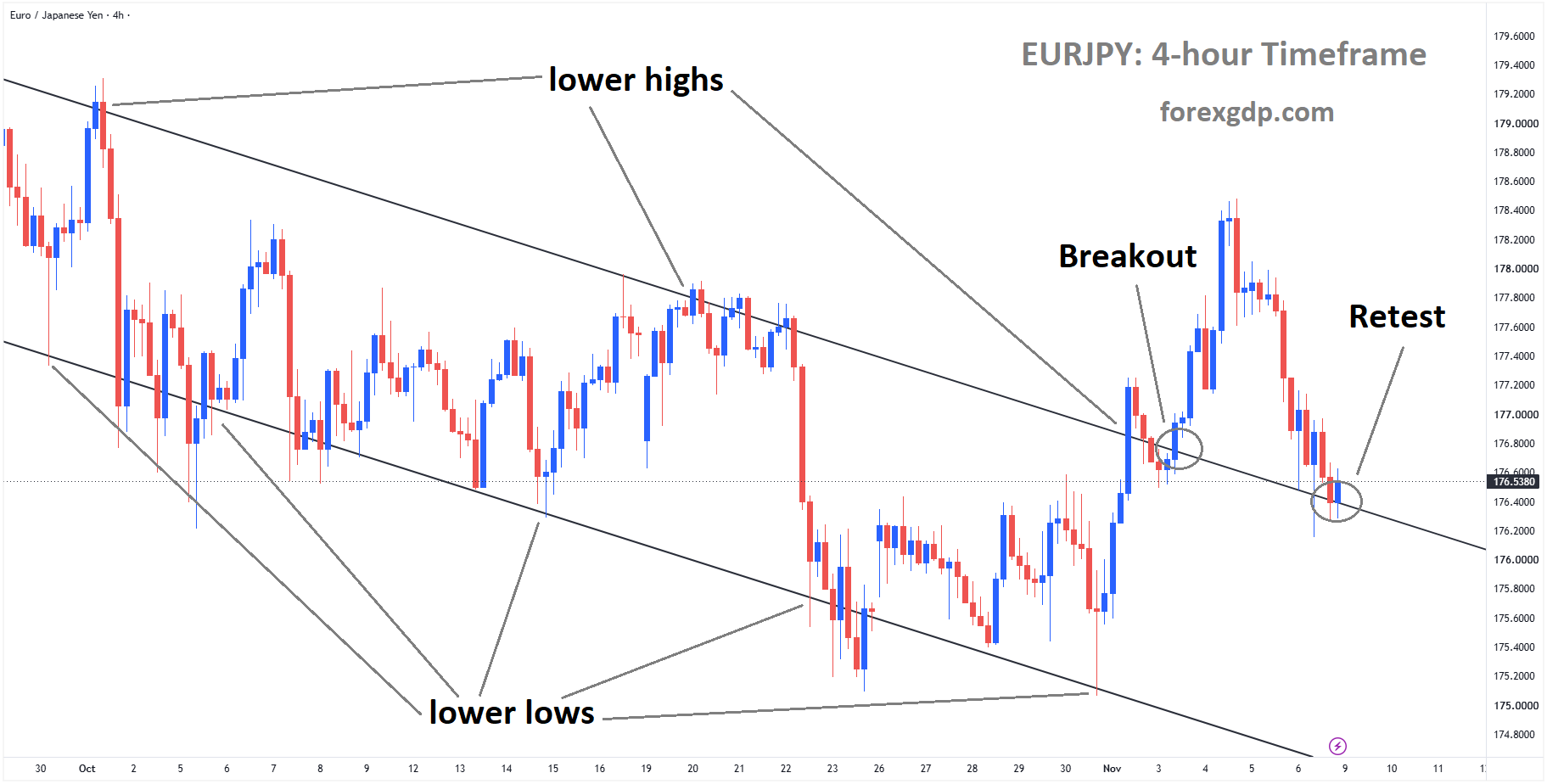
EURJPY reached the retest area of the broken descending channel
The latest developments highlight the different economic challenges facing Europe and Japan. While European policymakers continue to balance inflation concerns with slowing economic activity, Japanese officials appear increasingly confident about gradually moving away from their long-standing accommodative monetary policy.
Weak retail sales across the Eurozone, mixed industrial activity in Germany, and cautious comments from European Central Bank (ECB) officials have added uncertainty to the Euro’s outlook. Meanwhile, expectations of higher Japanese interest rates and increased demand for safer currencies have strengthened the Yen’s position.
Eurozone Retail Sales Raise Concerns About Consumer Spending
One of the main reasons behind the Euro’s weakness was the disappointing Eurozone Retail Sales report released on Friday.
According to Eurostat, retail sales across the Eurozone declined by 0.7% in September compared with the previous month. Economists had expected a much smaller decrease of 0.1%, making the actual result considerably weaker than anticipated.
The latest decline followed a revised 2% contraction in August, suggesting that consumer spending remained under pressure for another month.
Annual figures also reflected slower growth in retail activity. Retail sales increased by just 0.4% compared with September of the previous year, down from 1.3% in August. The result also fell short of economists’ expectations for a 0.6% increase.
These figures suggest that European households are becoming more cautious about their spending decisions.
Consumer spending plays an important role in supporting economic activity. When households reduce purchases, businesses may experience weaker sales, which can eventually affect production, employment, and investment decisions.
Persistent weakness in retail activity could therefore create additional challenges for the Eurozone economy.
For the Euro, disappointing consumer data raises questions about the strength of the region’s economic recovery. If household demand remains weak, businesses may struggle to maintain growth, making it harder for the European economy to build lasting momentum.
German Industrial Production Offers Some Encouragement
Although Eurozone retail figures disappointed, economic news from Germany provided a more positive development.
German Industrial Production increased by 0.7% in September compared with August, exceeding economists’ expectations for no monthly growth.
However, the increase was slower than the revised 1% expansion recorded in August.
The improvement was largely supported by stronger activity in Germany’s automotive and pharmaceutical industries. Both sectors contributed positively to overall industrial output, helping offset weakness elsewhere in the economy.
Germany’s automotive industry remains particularly important because of its role in manufacturing, employment, and exports. Stronger production in this sector can provide support to businesses and suppliers across the country.
The pharmaceutical industry also contributed to September’s improvement, showing resilience despite broader economic uncertainty.
However, not every industry experienced stronger activity.
Construction output declined, while manufacturers of machinery and equipment also reported weaker production. These differences suggest that Germany’s industrial recovery remains uneven.
The mixed results are important because Germany is the Eurozone’s largest economy. Changes in German manufacturing activity can influence economic conditions throughout the wider region.
While the industrial production report offered some encouragement, it was not enough to remove concerns created by weak consumer spending.
ECB Maintains Cautious Approach as Inflation Risks Remain

Monetary policy developments also attracted attention after European Central Bank Chief Economist Philip Lane discussed inflation, financial conditions, and the outlook for future policy decisions.
Speaking on Friday, Lane warned that energy inflation could influence wage negotiations and business pricing decisions.
Higher energy costs can affect the wider economy because businesses often depend on electricity, fuel, and transportation to operate. When these expenses increase, companies may attempt to recover their costs by charging customers more.
Workers may also seek higher wages to compensate for rising living expenses.
According to Lane, the ECB must remain focused on preventing these inflation pressures from spreading throughout the economy.
He reiterated the importance of bringing inflation back toward the central bank’s target over the next one to two years.
His comments suggest that policymakers remain concerned about inflation even as parts of the European economy show signs of weakness.
Financial Conditions and Fiscal Policy Add to Uncertainty
Lane also acknowledged that financial conditions had become tighter, potentially creating additional challenges for households and businesses.
More restrictive financial conditions can discourage borrowing and investment, particularly when businesses are uncertain about future demand.
He further noted that government fiscal policy had been more supportive than previously expected but could become more restrictive from the following year.
Reduced government support may place additional pressure on economic activity if private-sector demand remains weak.
Regarding the ECB’s upcoming December meeting, Lane avoided signaling a firm policy decision.
Instead, he emphasized the importance of reviewing additional economic information before determining the appropriate course of action.
This cautious approach reflects the difficult balance facing European policymakers as they attempt to control inflation without placing unnecessary pressure on economic growth.
Bank of Japan Rate Hike Expectations Strengthen the Yen
While European economic developments created uncertainty for the Euro, expectations surrounding Japanese monetary policy provided support for the Yen.
Minutes from the Bank of Japan’s September policy meeting, published on Thursday, revealed that officials broadly agreed on the need to continue gradually increasing interest rates.
Policymakers also discussed reducing the level of monetary support provided to the Japanese economy.
For many years, Japan maintained exceptionally loose monetary conditions to encourage borrowing, spending, and economic growth.
However, changes in inflation and economic conditions have encouraged the central bank to reconsider how much support the economy requires.
The September meeting minutes showed that some officials favored moving more quickly toward tighter monetary policy.
These discussions strengthened expectations that the BoJ could announce another interest rate increase as early as December.
Although such a decision remains uncertain, the possibility of higher borrowing costs has improved sentiment toward the Japanese currency.
Higher domestic interest rates can make a currency more attractive to investors, especially when other central banks are taking a more cautious approach.
The contrast between the BoJ’s gradual tightening plans and the ECB’s careful policy outlook has become an important factor influencing the relationship between the Euro and Japanese Yen.
Global Risk Aversion Increases Demand for the Japanese Yen
Beyond central bank expectations, broader investor sentiment has also supported the Japanese Yen.
The Yen is widely regarded as a safe-haven currency, meaning investors often turn toward it during periods of financial uncertainty.
When confidence in the global economic outlook weakens, investors may reduce their exposure to assets considered more sensitive to economic risks.
During these periods, demand for traditionally defensive currencies can increase.
Japan’s position as a major international creditor and the Yen’s established role in global financial markets contribute to its reputation as a defensive currency.
However, the Yen does not strengthen during every period of uncertainty. Its performance also depends on interest rate expectations, international investment flows, and broader economic conditions.
In the current environment described by the latest reports, concerns about economic growth have combined with expectations of tighter Japanese monetary policy.
These two developments have created a supportive environment for the Yen.
For EUR/JPY, this means that uncertainty surrounding European growth is occurring alongside factors that favor Japan’s currency.
Diverging Central Bank Policies Shape the EUR/JPY Outlook
The different approaches of the ECB and BoJ remain central to understanding the latest developments affecting EUR/JPY.
In Europe, policymakers face the challenge of managing inflation while responding to signs of weaker household demand.
Disappointing retail sales figures suggest that consumers remain cautious, even though some areas of industrial activity are improving.
In Japan, central bank officials appear increasingly focused on gradually reducing monetary accommodation as economic conditions evolve.
The possibility of another Japanese interest rate increase adds to the difference between the two monetary policy outlooks.
Upcoming economic releases and official central bank communications will be important in determining whether these expectations continue.
For the Eurozone, consumer spending, industrial production, wage developments, and inflation will remain closely watched.
In Japan, investors will pay particular attention to inflation, wage growth, and statements from BoJ policymakers ahead of the December policy decision.
Any meaningful changes in these areas could influence confidence in both currencies.
Final Summary
EUR/JPY faced downward pressure on Friday as weaker-than-expected Eurozone Retail Sales raised concerns about the strength of European consumer demand.
Although German Industrial Production delivered a positive surprise, uneven performance across different industries highlighted continuing economic challenges.
Meanwhile, ECB Chief Economist Philip Lane emphasized the need to remain alert to inflation risks while gathering more information before future monetary policy decisions.
In Japan, the Bank of Japan’s September meeting minutes reinforced expectations that policymakers could continue raising interest rates, potentially as early as December.
Broader global uncertainty also encouraged demand for the Japanese Yen, adding another source of pressure on the Euro.
Together, these developments show how economic performance, central bank policy expectations, and investor confidence continue to influence EUR/JPY. The direction of both currencies will depend heavily on incoming economic information and how policymakers respond to changing conditions.
GBPJPY Loses Momentum as Rising Financial Fears Strengthen Japan’s Currency
The British Pound is facing renewed pressure against the Japanese Yen as growing uncertainty in global financial markets encourages investors to move toward safer assets. A sharp sell-off in technology stocks, driven by concerns surrounding artificial intelligence (AI), has weakened investor confidence and increased demand for the Japanese currency.
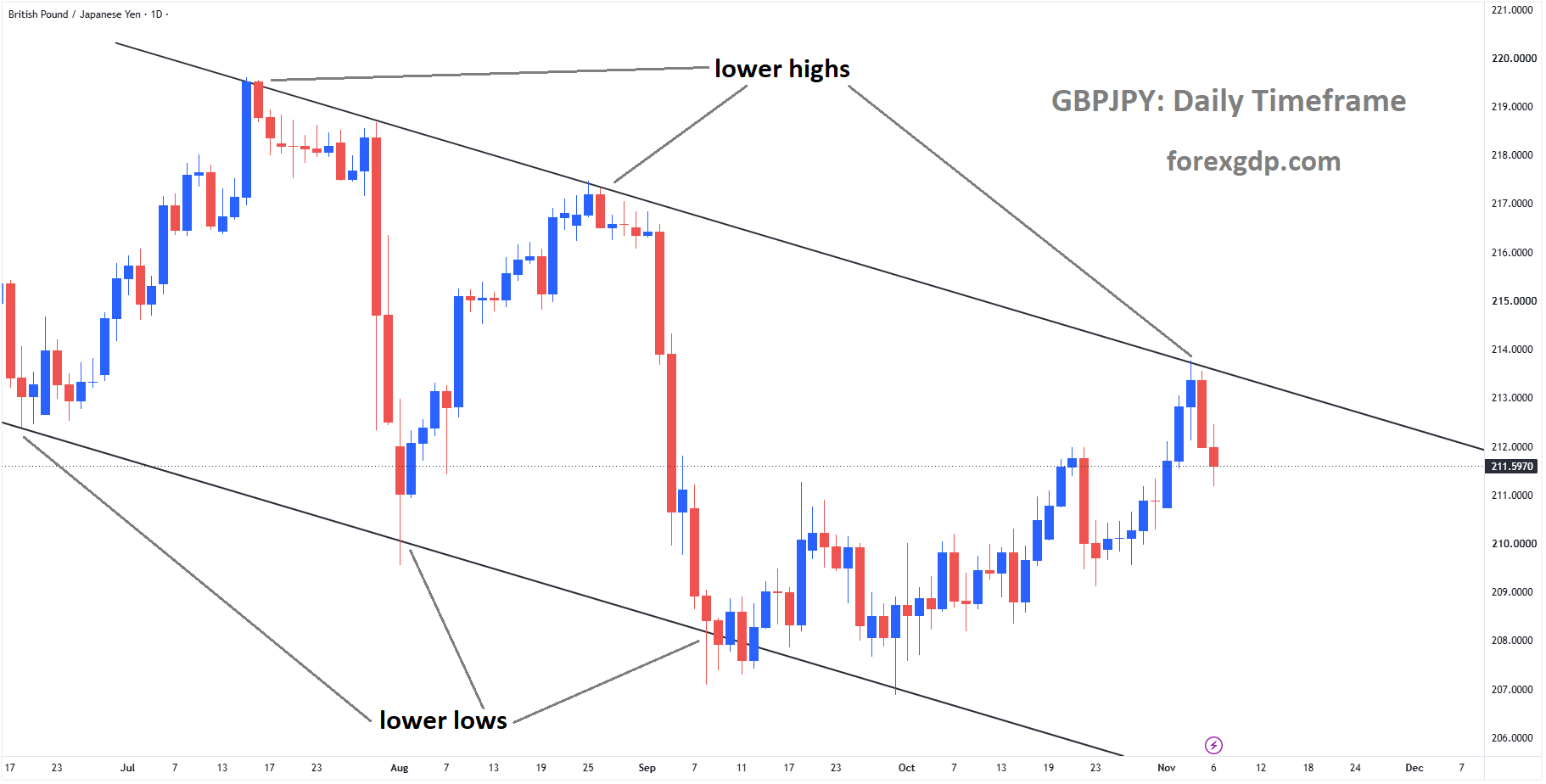
GBPJPY is falling from the lower high area of the descending channel
The Japanese Yen is widely considered a safe-haven currency, meaning investors often prefer it during periods of financial instability. As global stock markets experience increased selling pressure, this traditional role has helped the Yen attract fresh interest.
However, the currency’s strength remains limited by developments in Japan’s government bond market. Falling Japanese government bond yields have reduced the appeal of holding Yen-denominated assets, creating a challenge for the currency despite stronger safe-haven demand.
Meanwhile, monetary policy decisions from the Bank of England (BoE) and the Bank of Japan (BoJ) continue to influence the broader outlook for GBP/JPY. Both central banks remain focused on controlling inflation, although their economic conditions and approaches to interest rates differ.
AI-Led Stock Market Sell-Off Increases Demand for the Japanese Yen
The latest weakness in GBP/JPY comes as investors become increasingly cautious about the outlook for global equity markets. Technology companies associated with artificial intelligence have faced significant selling pressure, raising concerns about broader financial market stability.
AI-related businesses have attracted substantial investor interest in recent years, supported by expectations of rapid technological development and strong future earnings. However, uncertainty about company valuations, investment spending, and the potential returns from AI projects has made investors more sensitive to negative developments.
When confidence in these companies weakens, the effects can spread across other areas of the financial market.
During such periods, investors often reduce their exposure to assets considered relatively risky and seek alternatives that may provide greater stability.
The Japanese Yen has historically benefited from this shift in sentiment. Its reputation as a safe-haven currency is partly linked to Japan’s position as a major creditor nation and the tendency for investors to unwind overseas investments during periods of uncertainty.
As a result, growing concerns about the technology sector have supported demand for the Yen while placing pressure on the British Pound.
Nevertheless, the relationship between global stock market weakness and Yen strength is not always straightforward. Domestic economic conditions, interest rate expectations, and government bond developments can influence how strongly the Japanese currency responds.
Falling Japanese Government Bond Yields Limit Yen Strength
Although the Japanese Yen has attracted safe-haven demand, declining Japanese government bond yields have prevented it from gaining stronger momentum.
Japanese government bonds, commonly known as JGBs, are generally viewed as relatively secure investments. During periods of global uncertainty, investors often increase their purchases of government debt to protect their portfolios from financial market volatility.
Higher demand for these bonds typically pushes their yields lower.
This development creates a mixed environment for the Japanese Yen. On one hand, demand for Japanese assets can support the currency. On the other hand, lower bond yields can make Japanese investments less attractive compared with similar assets in countries offering higher returns.
Japan has maintained comparatively low interest rates for many years, even as other major economies have operated with tighter monetary policies.
This difference has encouraged some international investors to seek higher returns outside Japan.
When Japanese bond yields decline further, the return disadvantage can become more noticeable, potentially limiting demand for the Yen.
Consequently, the Japanese currency faces competing influences. Global market uncertainty encourages investors to seek safety, while lower domestic yields reduce the financial incentive to hold Japanese assets.
The balance between these factors remains important for understanding the broader direction of GBP/JPY.
Bank of Japan Maintains Its Commitment to Gradual Monetary Tightening

The Bank of Japan continues to move away from the highly accommodative monetary policies that shaped the country’s economy for decades.
Japanese policymakers have gradually increased interest rates as inflation becomes a more persistent concern. This shift represents an important change for an economy that previously struggled with weak consumer demand and prolonged periods of very low inflation.
Despite recent policy adjustments, the BoJ has maintained a cautious approach to further tightening.
Minutes from its September monetary policy meeting showed that officials generally supported continuing interest rate increases while gradually reducing monetary support.
The discussions also highlighted growing concerns about inflation developing more strongly than expected.
One policymaker suggested that the central bank might need to accelerate its tightening process if inflation began exceeding expectations.
Such comments indicate that the BoJ remains prepared to respond if domestic economic conditions require stronger action.
Rising Energy Costs Add to Japan’s Inflation Concerns
Higher crude oil prices remain a significant concern for Japanese policymakers.
Japan depends heavily on imported energy, making its economy particularly sensitive to changes in global oil markets.
When energy costs increase, businesses may face higher transportation, manufacturing, and operating expenses. These additional costs can eventually reach consumers through more expensive goods and services.
Persistent energy inflation can also affect household spending and business confidence.
For the Bank of Japan, the challenge is to contain inflation without placing excessive pressure on economic growth.
Further interest rate increases could help manage inflation expectations, but policymakers must also consider the potential impact on borrowing costs, investment, and consumer demand.
This balancing act explains why the central bank continues to emphasize gradual policy adjustments rather than aggressive tightening.
Bank of England Adopts a Hawkish Approach to Inflation
The Bank of England has also demonstrated its commitment to controlling inflation through tighter monetary policy.
Its latest interest rate decision reflected growing concern about persistent inflationary pressures in the United Kingdom, particularly those associated with rising energy costs.
The decision received strong support from members of the Monetary Policy Committee (MPC), although there was disagreement over how aggressively the central bank should respond.
External MPC member Catherine Mann supported a larger increase, reflecting her concerns about the need for stronger action against inflation.
This difference of opinion highlights the challenges facing UK policymakers as they attempt to maintain economic stability while preventing inflation from becoming entrenched.
The Bank of England must consider several factors when making policy decisions, including wage growth, consumer spending, business investment, and changes in household living costs.
Higher borrowing costs can help reduce inflation by discouraging excessive spending and lending. However, they can also slow economic activity and increase financial pressure on households and businesses.
The central bank therefore faces the difficult task of restoring price stability without causing unnecessary damage to economic growth.
Middle East Conflict Creates Additional Inflation Risks
Geopolitical tensions in the Middle East have added another layer of uncertainty to the outlook for both the British and Japanese economies.
The region plays a major role in global energy production and transportation. Any disruption to oil supplies or important shipping routes can create uncertainty about future energy availability.
Rising energy costs can affect inflation across multiple sectors, including transportation, manufacturing, agriculture, and household utilities.
For the United Kingdom, higher energy expenses can increase pressure on businesses and consumers while complicating the Bank of England’s efforts to control inflation.
Japan faces similar challenges because of its dependence on imported fuel.
These shared risks help explain why both central banks remain cautious about easing monetary conditions too quickly.
If energy-related inflation persists, policymakers may need to maintain restrictive monetary policies for longer than previously expected.
However, the economic consequences could differ between the two countries because of variations in domestic demand, wage growth, and dependence on imported resources.
Diverging Economic Conditions Shape the GBP/JPY Outlook
The broader outlook for GBP/JPY depends on how investors assess economic developments in the United Kingdom and Japan.
Both central banks have expressed concerns about inflation, but the economic environments influencing their decisions remain different.
The Bank of England is focused on managing inflation while protecting an economy facing pressure from higher borrowing costs and household expenses.
The Bank of Japan, meanwhile, is working to normalize monetary policy after years of exceptionally supportive financial conditions.
Global investor sentiment adds another important influence.
If uncertainty surrounding artificial intelligence companies and global stock markets continues, demand for the Japanese Yen could remain supported.
However, falling Japanese bond yields may continue to limit the currency’s appeal.
Future central bank communications, inflation developments, energy market conditions, and changes in global risk appetite will remain important influences on the currency pair.
Summary
GBP/JPY remains under pressure as concerns about an AI-driven stock market sell-off encourage investors to favour the safe-haven Japanese Yen.
However, declining Japanese government bond yields are limiting the Yen’s strength by reducing the relative attractiveness of Japanese assets.
At the same time, the Bank of Japan and the Bank of England continue to maintain hawkish monetary policy outlooks as persistent inflation creates challenges for both economies.
Rising energy costs and geopolitical uncertainty in the Middle East have further complicated the outlook, increasing the importance of future central bank decisions.
Ultimately, the direction of GBP/JPY will depend on the interaction between global market confidence, inflation risks, monetary policy expectations, and investor demand for safer assets.
EURGBP Sees Limited Movement as UK Rate Hike Expectations Strengthen Sterling
The Euro is struggling to build momentum against the British Pound as investors weigh encouraging economic figures from Germany against expectations of further interest rate increases in the United Kingdom. Despite signs of improvement in German industrial activity, the European currency has failed to attract strong buying interest.
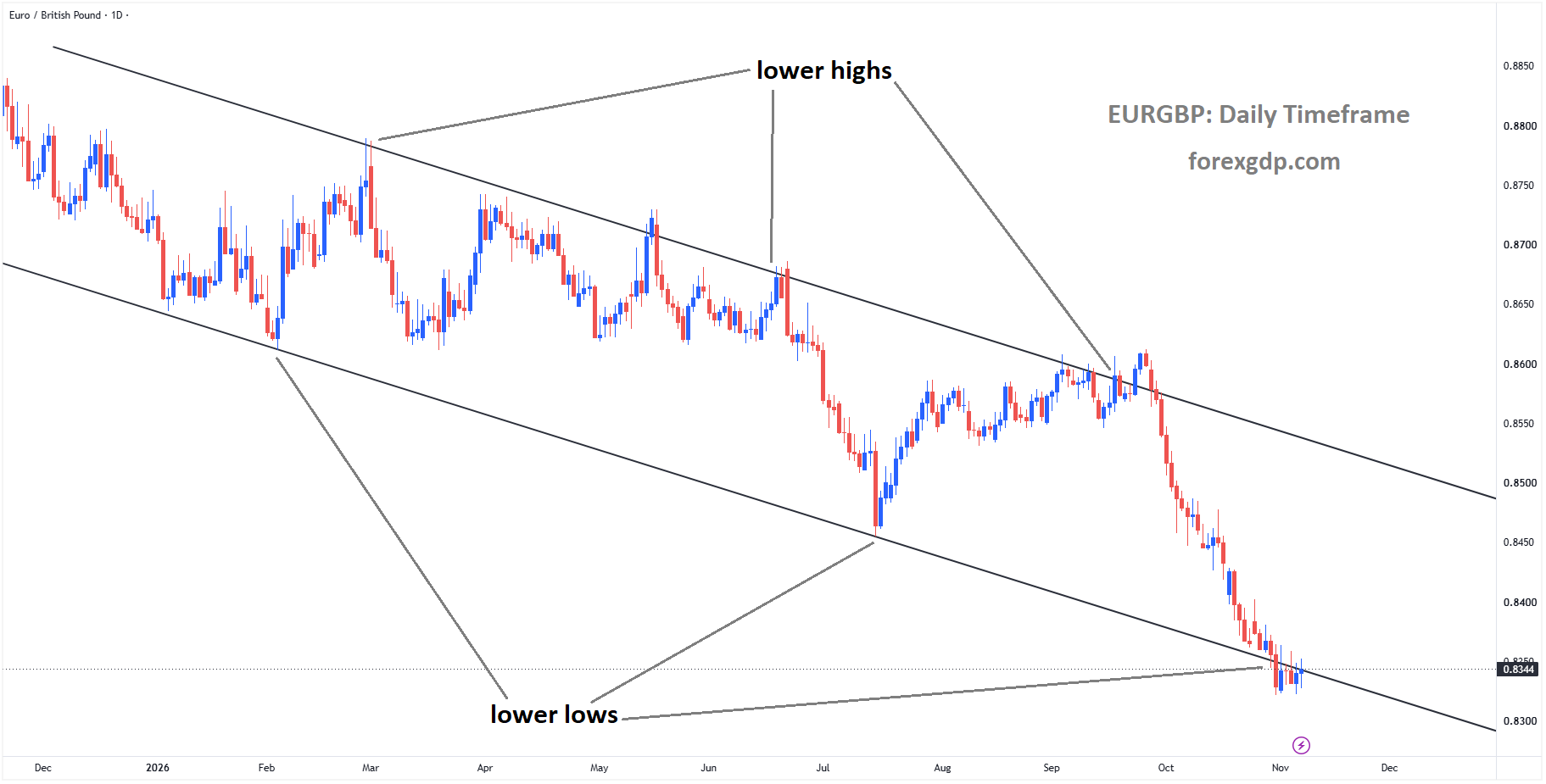
EURGBP reached the lower low area of the descending channel
Meanwhile, the British Pound continues to benefit from expectations that the Bank of England (BoE) could maintain a tighter monetary policy to control inflation. This difference in expectations between the two economies has become an important factor influencing the EUR/GBP currency pair.
Investors are also keeping a close watch on upcoming Eurozone economic reports, global uncertainty, and developments in the Middle East. These factors could influence confidence in both currencies as markets assess the economic outlook for Europe and the UK.
German Industrial Production Shows Encouraging Signs of Recovery
Germany delivered a positive economic surprise on Friday after official figures showed stronger-than-expected growth in industrial production during September.
Industrial output increased by 0.7% during the month, comfortably exceeding economists’ expectations of no growth. The improvement also followed a modest 0.1% rise recorded in August, suggesting that activity in parts of Germany’s manufacturing sector had started to strengthen.
The latest figures offered some encouragement for Europe’s largest economy, which has faced several challenges related to weak demand, high operating costs, and uncertainty surrounding international trade.
Germany plays a major role in the Eurozone economy, making its industrial performance particularly important for the wider region. Stronger factory activity can support employment, business investment, and economic confidence.
However, the positive report was not enough to generate a meaningful improvement in demand for the Euro.
Investors appeared reluctant to respond strongly to a single encouraging economic release, particularly while broader concerns about the European economy remained unresolved.
This cautious reaction suggests that market participants are looking for more consistent evidence of economic improvement before becoming more optimistic about the Eurozone’s growth prospects.
Automotive and Pharmaceutical Industries Lead German Growth
A closer look at Germany’s industrial production figures revealed that the recovery was not evenly distributed across the economy.
The automotive and pharmaceutical industries were among the strongest contributors to September’s improvement.
Germany’s automotive industry remains a major source of manufacturing activity, employment, and exports. Better performance in this sector can have a positive effect on suppliers, transportation businesses, and other industries connected to vehicle production.
The pharmaceutical industry also delivered encouraging results, helping support overall manufacturing output.
However, other parts of the German economy continued to experience difficulties.
Construction activity weakened, while manufacturers of machinery and equipment also reported declining production. These industries are important indicators of business confidence because their performance often reflects demand for new buildings, equipment, and long-term investment.
The mixed results highlight an important challenge facing Germany. Although some industries are recovering, others continue to struggle with economic uncertainty and changing demand.
For the Euro to receive more lasting support from German economic developments, investors may need to see improvements across a wider range of industries.
Eurozone Retail Sales Report Becomes the Next Important Focus
With German industrial production failing to provide a meaningful boost to the Euro, attention is turning toward the upcoming Eurozone retail sales report.
Eurostat is expected to release figures showing a 0.1% decline in retail sales during September, following a 0.1% increase in August.
Retail sales provide valuable information about consumer spending, which is an important part of economic growth.
When households spend more on goods and services, businesses generally benefit from stronger demand. This can encourage companies to increase production, expand operations, and hire additional workers.
On the other hand, weaker retail activity may indicate that consumers are becoming more cautious about their finances.
Several factors can influence household spending, including inflation, wage growth, employment conditions, and borrowing costs.
A decline in retail sales would suggest that consumers across the Eurozone remain under pressure, potentially adding to concerns about the region’s economic outlook.
If the figures turn out significantly better than expected, they could improve confidence in the European economy. However, a result close to forecasts may do little to change the cautious attitude toward the Euro.
Investors will therefore be watching whether consumer demand shows signs of resilience or continues to weaken.
Bank of England Interest Rate Expectations Support the British Pound

While the Euro faces uncertainty, the British Pound continues to receive support from expectations surrounding the Bank of England’s monetary policy.
The UK central bank recently raised its benchmark interest rate to 4%, delivering a decision that investors had widely anticipated.
The increase marked an important step in the Bank’s efforts to address inflation and maintain economic stability.
More importantly, comments from policymakers suggested that additional interest rate increases could remain possible.
Bank of England Governor Andrew Bailey reinforced this message during the press conference following the decision, indicating that the central bank remained focused on controlling inflation.
Expectations of higher interest rates can make a currency more attractive to international investors because they may improve returns on certain financial assets denominated in that currency.
This helps explain why the Pound has remained relatively resilient despite the absence of a particularly strong immediate reaction to the Bank’s announcement.
However, future monetary policy decisions will depend heavily on incoming economic information.
Inflation developments, employment conditions, wage growth, and consumer activity will all influence whether policymakers believe additional tightening is necessary.
The central bank must also consider the potential consequences of higher borrowing costs for households and businesses.
Global Uncertainty and Middle East Developments Influence Currency Sentiment
Beyond economic reports and central bank decisions, international developments are also influencing the outlook for the Euro and British Pound.
Investors remain cautious amid uncertainty surrounding the conflict involving Iran and its potential consequences for global energy supplies.
Geopolitical tensions can affect business confidence, inflation expectations, and international investment decisions.
Energy developments are especially important for the United Kingdom and the Eurozone because both economies are sensitive to changes in energy costs.
If tensions in the Middle East ease, concerns about energy supply disruptions could diminish.
Lower energy costs may help reduce inflationary pressure by making transportation, manufacturing, and household energy consumption less expensive.
For the United Kingdom, a sustained reduction in inflation could influence expectations about the Bank of England’s future interest rate decisions.
If policymakers become more confident that inflation is moving toward their target, the need for additional monetary tightening may weaken.
Such a shift could reduce one of the factors currently supporting the British Pound.
At the same time, easing energy pressures could benefit businesses and consumers across the Eurozone, potentially improving the region’s economic outlook.
However, the overall effect would depend on how global developments influence inflation, economic growth, and investor confidence in both regions.
Different Economic Priorities Shape the Euro and Pound Outlook
The Euro and British Pound are currently being influenced by different economic considerations.
For the Euro, the main challenge is convincing investors that the Eurozone economy can achieve a more sustained recovery.
Positive German manufacturing figures provide some encouragement, but weaknesses in other industries and uncertainty surrounding consumer spending continue to limit optimism.
For the Pound, attention remains focused on the Bank of England’s commitment to managing inflation.
Expectations of further monetary tightening have helped maintain confidence in the UK currency, although this support could change if economic conditions develop differently from current forecasts.
The relationship between the two currencies will therefore depend on more than individual economic announcements.
Investors will be looking at the broader direction of economic growth, inflation, consumer confidence, and central bank communication.
Final Summary
The Euro continues to face difficulties gaining strength against the British Pound despite encouraging German industrial production figures.
September’s improvement in German manufacturing offered a positive signal, particularly from the automotive and pharmaceutical industries. However, weaker construction and machinery production highlighted ongoing challenges within Europe’s largest economy.
Attention is now shifting toward Eurozone retail sales, which could provide further insight into household spending and the region’s economic health.
Meanwhile, the British Pound remains supported by expectations that the Bank of England could continue raising interest rates to address inflation.
Developments in the Middle East and their potential impact on energy costs add another layer of uncertainty to the outlook.
Ultimately, the direction of EUR/GBP will depend on whether the Eurozone can demonstrate stronger economic resilience and whether UK inflation conditions continue to justify the Bank of England’s tighter monetary policy.
USD Index Strengthens Sharply as Wall Street Sell-Off Fuels Dollar Demand
The US Dollar (USD) gained strength on Friday as growing uncertainty in global financial markets encouraged investors to move toward safer assets. A sharp decline in technology stocks, combined with expectations of stronger US employment figures, helped the American currency outperform other major currencies.
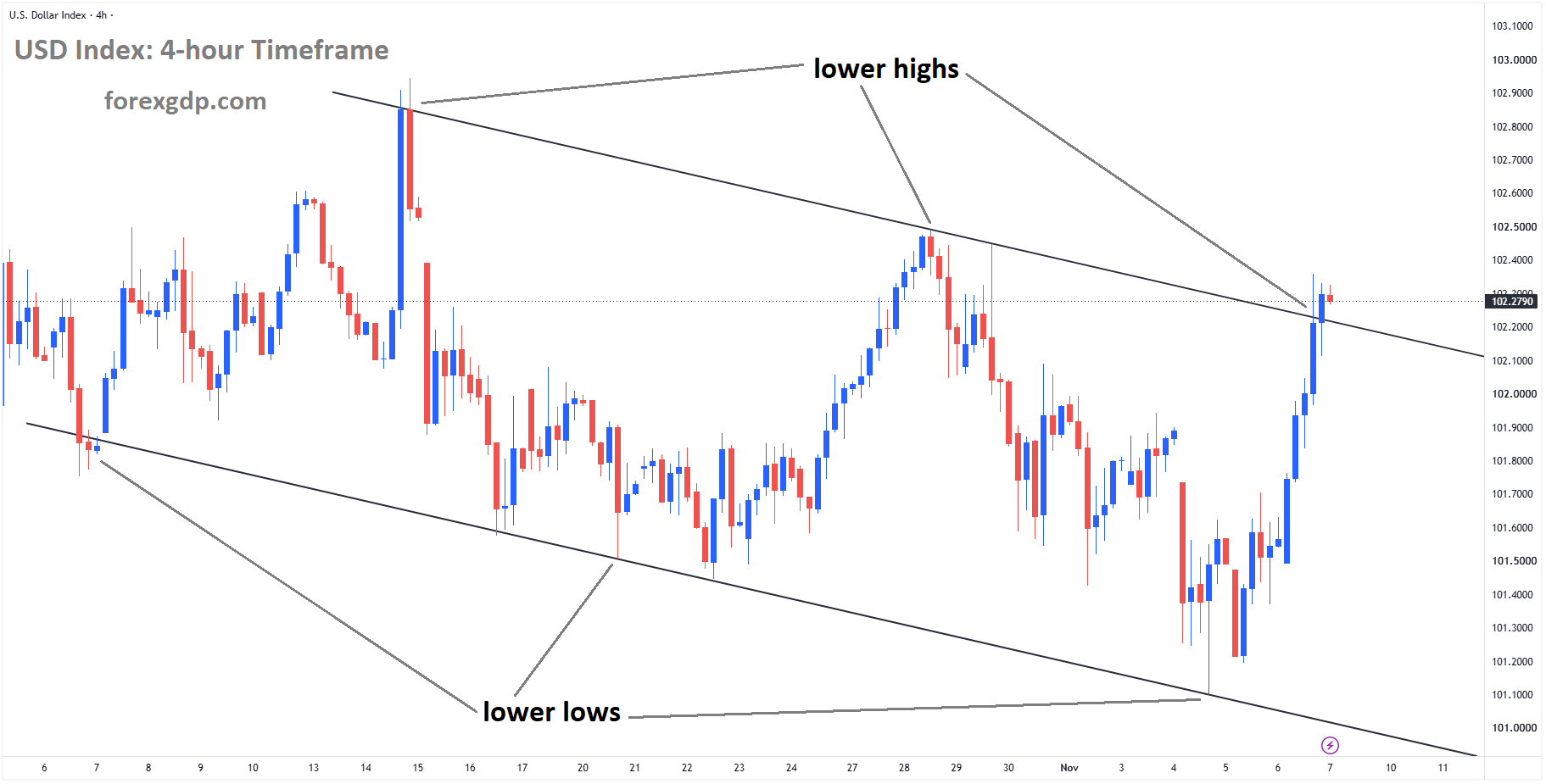
USD Index reached the lower high area of the descending channel
The US Dollar Index (DXY), which measures the Dollar’s performance against a basket of leading global currencies, continued its recovery as investors became increasingly cautious about the economic outlook.
The latest developments highlight how changes in investor confidence, stock market performance, and employment expectations can influence demand for the US Dollar. With global equities under pressure and an important US jobs report approaching, market participants are closely watching developments that could shape the Federal Reserve’s future monetary policy decisions.
US Dollar Benefits From Growing Risk Aversion
The US Dollar has traditionally been viewed as a safe-haven currency during periods of financial uncertainty. When investors become concerned about economic stability or falling stock markets, they often increase their exposure to assets considered relatively secure.
This behavior became particularly noticeable on Friday as global equity markets experienced widespread selling pressure.
Technology companies were among the hardest hit, with semiconductor manufacturers facing significant investor concerns. The weakness in technology shares contributed to a broader decline in market confidence, encouraging investors to reconsider their exposure to riskier assets.
As a result, demand for the US Dollar increased, allowing it to perform better than several other major currencies.
The Dollar’s appeal during uncertain periods is supported by the size and importance of the US financial system. The currency plays a central role in international trade, global banking, and financial transactions, making it an important destination for investors seeking stability.
However, safe-haven demand does not necessarily indicate that investors expect the US economy to outperform every other major economy. Instead, it often reflects a preference for liquidity and financial security when market conditions become unpredictable.
Technology Stock Sell-Off Raises Concerns About US Economic Growth
The recent weakness in global stock markets has been closely connected to developments in the technology sector.
Investors have become increasingly concerned about the possibility of stricter government regulations affecting artificial intelligence companies following the Democratic Party’s victory in the US midterm elections.
These concerns have created uncertainty about the future of AI-related investment, particularly among semiconductor manufacturers and businesses involved in developing large-scale data centers.
Artificial intelligence has become an important source of investment and business expansion in recent years. Technology companies have committed significant resources to building the infrastructure required to support advanced AI systems.
However, the possibility of additional regulatory requirements has raised questions about whether some of these expansion plans could face delays.
Regulatory Uncertainty Affects Investor Confidence
Changes in government policy can have a meaningful impact on business decisions, especially in industries experiencing rapid technological development.
For AI companies, potential regulatory changes could affect infrastructure planning, operating requirements, and the pace of future investment.
Although the full impact of any new regulations remains uncertain, investors are already considering how these developments might influence corporate growth.
The selling pressure in technology shares also raises a broader question: Could weakness in a major industry eventually affect the wider US economy?
Technology investment has supported business activity and contributed to expectations of future productivity growth. A prolonged slowdown in the sector could influence corporate spending, hiring decisions, and overall economic confidence.
For now, the extent of these possible effects remains unclear.
US Nonfarm Payrolls Report Takes Center Stage
Alongside developments in global stock markets, investors are focusing on the October US Nonfarm Payrolls report.
The employment report is one of the most closely followed economic releases in the United States because it provides valuable information about the health of the labor market.
Nonfarm Payrolls measure changes in the number of employed workers across most sectors of the US economy, excluding certain categories such as agricultural workers.
Economists expect October’s report to show an increase of approximately 65,000 jobs, compared with the 29,000 jobs added in September.
Such an improvement would suggest that hiring activity has strengthened after a relatively modest increase in employment during the previous month.
The report is particularly important because labor market conditions influence household spending, business confidence, and the Federal Reserve’s assessment of economic stability.
A stronger employment environment generally supports consumer purchasing power, helping businesses maintain demand for their products and services.
However, the broader implications depend on several factors, including wage growth, unemployment, and changes in labor force participation.
Positive US Labor Market Reports Support Employment Optimism

Expectations for a favorable Nonfarm Payrolls release have strengthened following encouraging employment data published earlier in the week.
Wednesday’s ADP Employment Change report delivered better-than-expected results, suggesting that private-sector hiring remained resilient.
Thursday’s weekly Initial Jobless Claims figures also exceeded expectations, adding to the view that the US labor market continues to demonstrate underlying strength.
Together, these reports have increased optimism that the official employment figures could deliver a positive surprise.
Although ADP employment figures and unemployment claims provide useful insights, they do not always accurately predict the final Nonfarm Payrolls outcome.
Each report measures different aspects of labor market activity and uses its own methodology.
For this reason, investors generally consider several employment indicators rather than relying on a single release.
The official jobs report will provide a more comprehensive picture of hiring conditions and help determine whether the recent improvement in employment data reflects a broader trend.
Federal Reserve Policy Expectations Remain Important for the Dollar
The strength of the US labor market is closely connected to expectations surrounding Federal Reserve monetary policy.
The Federal Reserve considers employment conditions alongside inflation when making decisions about interest rates.
A healthy labor market can give policymakers greater confidence that the economy remains resilient, potentially reducing the urgency for additional monetary easing.
Conversely, weaker employment growth could increase concerns about economic activity and encourage policymakers to consider more supportive financial conditions.
ING analyst Chris Turner believes that a respectable employment report would reinforce the Federal Reserve’s assessment that the US labor market remains solid.
Such an outcome could support expectations for US interest rates and strengthen demand for the Dollar.
However, the relationship between employment data and currency performance is not always straightforward.
Investors must also consider inflation developments, economic growth expectations, and monetary policy decisions in other major economies.
Changing Interest Rate Expectations Create a More Complex Outlook
Despite the Dollar’s recent strength, the broader economic environment presents several uncertainties.
Turner has noted that shorter-term US interest rates have declined considerably since late September, reducing some of the interest rate advantage previously enjoyed by the American currency.
This development matters because differences in interest rates between countries can influence international investment flows.
When US financial assets offer relatively attractive returns, foreign investors may have a greater incentive to hold Dollar-denominated investments.
If that advantage becomes smaller, the currency may receive less support from interest rate differences.
At the same time, growing concerns about technology stocks introduce another layer of uncertainty.
A temporary decline in technology shares might primarily affect investor sentiment. However, a prolonged downturn could influence expectations for US economic growth, corporate investment, and inflation.
The direction of these developments will depend on whether the technology sector’s difficulties remain contained or spread into other areas of the economy.
Final Summary
The US Dollar has strengthened as investors respond to falling global stock markets and growing uncertainty surrounding the technology industry.
Concerns about potential AI regulations and delays in data center investment have contributed to weaker investor confidence, increasing demand for the Dollar as a safe-haven currency.
Meanwhile, encouraging US labor market reports have raised expectations for a stronger October Nonfarm Payrolls release. A positive employment outcome could reinforce confidence in the resilience of the US economy and influence expectations for Federal Reserve monetary policy.
Nevertheless, declining short-term interest rate advantages and uncertainty surrounding the technology sector could complicate the Dollar’s longer-term outlook.
The coming employment figures, future Federal Reserve decisions, and developments in global equity markets will remain important factors shaping investor confidence and the direction of the US Dollar.
Crude Oil Maintains Upward Momentum as Strait of Hormuz Tensions Spark Fresh Supply Concerns
West Texas Intermediate (WTI) crude oil has regained some momentum as fresh security concerns in the Middle East bring renewed attention to global energy supplies. Reports of attacks involving oil tankers near the Strait of Hormuz have increased fears of possible disruptions to crude shipments, highlighting the ongoing risks facing one of the world’s most important energy transportation routes.
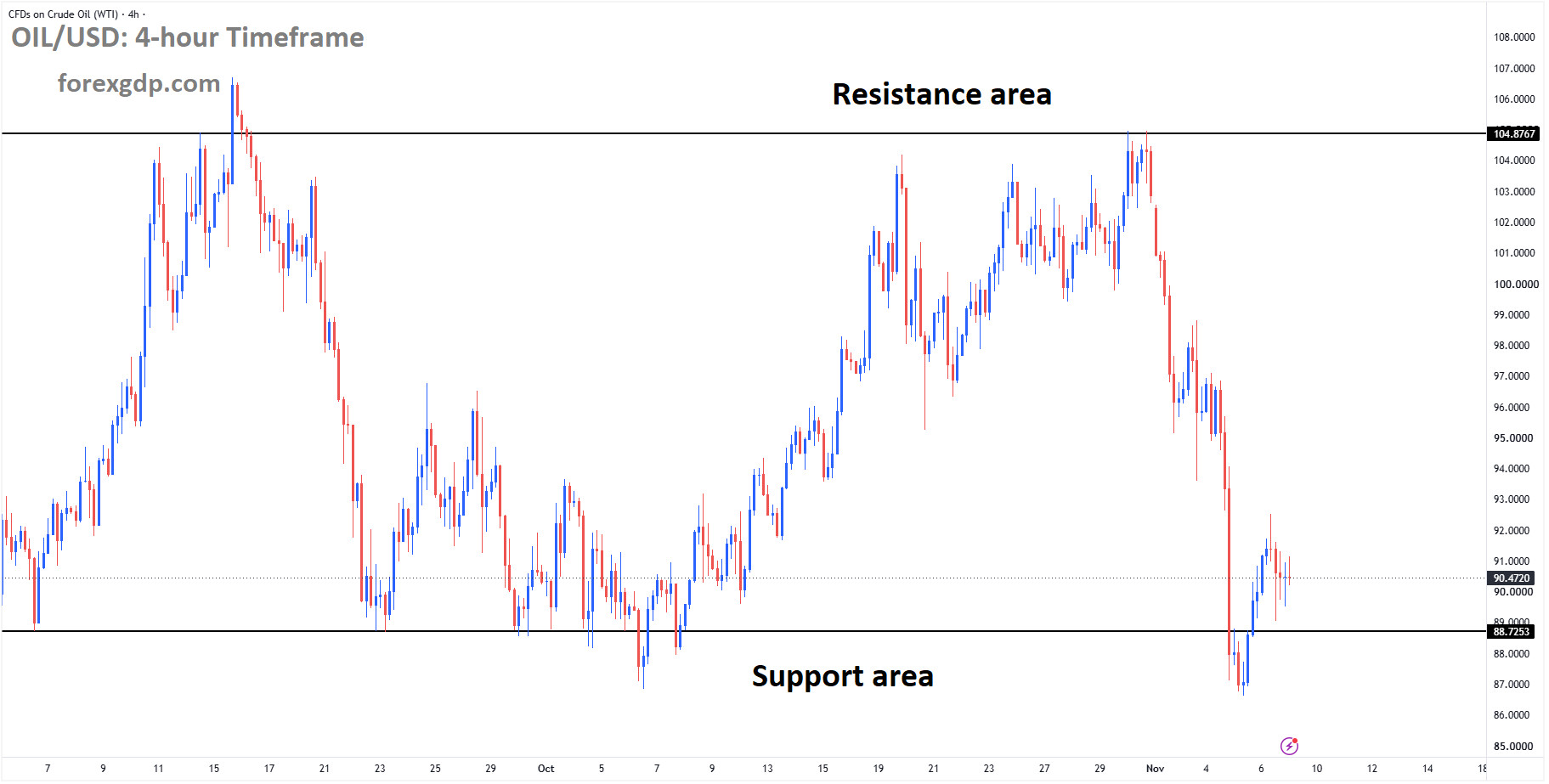
Crude Oil is moving in a box pattern, and the market has reached the support area of the pattern
The recovery comes during a challenging week for the oil market, as political developments in the United States have raised expectations that tensions involving Iran could gradually ease. While hopes for a diplomatic solution have improved the broader outlook for regional stability, recent maritime incidents suggest that the situation remains uncertain.
Oil market participants are now weighing two competing developments: the possibility of reduced geopolitical tensions and the continued threat to energy transportation across the Gulf. Both factors could influence global oil supply conditions in the coming weeks.
Strait of Hormuz Security Threats Renew Global Oil Supply Fears
The Strait of Hormuz remains at the center of growing concerns about the security of Middle Eastern oil exports. Located between Iran and Oman, this narrow waterway connects the Persian Gulf with the Gulf of Oman and the wider international shipping network.
It serves as a critical passage for crude oil shipments from major energy-producing countries, including Saudi Arabia, Iraq, Kuwait, and the United Arab Emirates. Any disruption along this route can create significant challenges for international energy transportation.
Recent reports of attacks on vessels operating near the strait have brought these vulnerabilities back into focus. The incidents have raised questions about whether commercial tankers can continue moving safely through the region while military and political tensions remain unresolved.
For oil-producing nations, reliable access to international shipping routes is essential for maintaining exports. Shipping companies also depend on predictable security conditions to transport cargo without unnecessary delays or additional operational risks.
When maritime security deteriorates, companies may face higher insurance costs, stricter safety requirements, and difficulties arranging transportation. These challenges can affect the movement of crude oil even when production facilities remain fully operational.
As a result, developments in the Strait of Hormuz continue to attract attention from governments, energy companies, and international shipping operators.
Iranian Revolutionary Guard Reports Maritime Incident in Key Shipping Route
Fresh concerns emerged after Iran’s Revolutionary Guard reported an incident involving several vessels in the Strait of Hormuz.
According to information highlighted by analysts at Danske Bank, two oil tankers and a tugboat reportedly caught fire after allegedly attempting to travel through unauthorized routes in the waterway.
The circumstances surrounding the incident remain important, particularly because the reported explanation came from Iranian authorities. Independent confirmation of the precise sequence of events would help establish what happened and whether the vessels were directly affected by the broader regional conflict.
Nevertheless, the incident demonstrates how quickly maritime security concerns can return to the forefront of international energy discussions.
Even isolated events involving commercial vessels can create uncertainty among shipping operators. Companies transporting crude oil must consider the safety of crews, the protection of cargo, and the possibility of additional restrictions along established routes.
The situation also highlights the limited alternatives available for certain Gulf oil exports. Although some countries operate pipelines that bypass the Strait of Hormuz, these routes cannot fully replace the waterway’s importance to international energy trade.
Continued instability could therefore create logistical challenges extending well beyond the immediate conflict zone.
US Election Results Strengthen Hopes for Diplomatic Progress With Iran

Political developments in the United States have introduced a different influence on the oil market.
The reported midterm election results, which shifted control of both chambers of Congress to the Democratic Party, have encouraged expectations that Washington could face greater pressure to pursue a diplomatic approach toward Iran.
The election outcome represents a political setback for President Donald Trump’s party and could influence discussions surrounding American involvement in the prolonged US-Israeli conflict with Iran.
The conflict, which has continued for approximately nine months in the reported account, has created considerable uncertainty across the Middle East. Its consequences extend beyond military operations, affecting diplomatic relationships, international trade, and regional energy security.
A stronger Democratic presence in Congress could encourage greater scrutiny of the administration’s regional policies. Lawmakers may seek additional debate over military commitments, diplomatic engagement, and the broader economic consequences of continued confrontation.
However, changes in congressional control do not automatically produce a shift in foreign policy. The executive branch retains substantial authority over diplomatic negotiations and national security decisions.
Any meaningful reduction in hostilities would likely require negotiations, cooperation among regional governments, and agreements addressing the security concerns of the countries involved.
For the global energy industry, credible diplomatic progress could help restore confidence in the reliability of Middle Eastern supply routes.
Energy Market Remains Cautious Despite Expectations of De-Escalation
Although the possibility of diplomatic progress has improved sentiment surrounding regional stability, uncertainty continues to shape the energy sector.
The main challenge is determining whether political expectations will translate into meaningful improvements in security.
A reduction in military activity could make commercial shipping safer, lower transportation-related risks, and allow energy companies to plan operations with greater confidence.
However, negotiations involving several countries can take time, particularly when disagreements concern national security, military activity, and regional influence.
Even if diplomatic discussions begin, shipping operators may remain cautious until they see clear evidence that vessels can travel through the Gulf without facing serious threats.
This distinction between political optimism and operational safety is especially important for the Strait of Hormuz.
Energy transportation depends on more than public statements or expectations of peace. Shipping companies need reliable navigation conditions, predictable regulations, and confidence that crews and cargo will remain protected.
Until those conditions improve, uncertainty surrounding Middle Eastern oil exports may continue.
KCM Analyst Tim Waterer Highlights Persistent Gulf Transit Risks
KCM chief analyst Tim Waterer has emphasized that unresolved shipping risks remain an important consideration for the crude oil market.
In comments reported by Reuters, Waterer described the recent recovery as occurring after a substantial decline linked to the US election outcome. However, he also stressed that the underlying security challenges affecting Gulf transportation have not disappeared.
His assessment draws attention to the difference between expectations of diplomatic progress and actual improvements in maritime conditions.
The Strait of Hormuz remains vulnerable to unexpected developments, including military incidents, restrictions on vessel movements, and confrontations involving regional forces.
Waterer’s broader message suggests that a lasting improvement in the energy transportation environment would require a credible framework for safer and more affordable shipping through the Gulf.
Without such progress, renewed security incidents could continue to influence confidence among energy companies and shipping operators.
His comments also reflect the importance of monitoring developments on the ground rather than relying exclusively on political expectations.
For the international oil industry, sustained stability would depend on practical security improvements supported by diplomatic cooperation.
Middle East Conflict Continues to Influence Global Energy Security
The ongoing confrontation involving Iran has highlighted the close relationship between geopolitical stability and global energy security.
Middle Eastern producers remain essential to international crude oil supplies, making regional transportation networks particularly important to countries that depend on imported energy.
Major Asian economies, including China, India, Japan, and South Korea, rely heavily on crude shipments from the Gulf. Disruptions to maritime routes can complicate supply planning for refiners, shipping companies, and industrial consumers.
European energy markets also have an interest in maintaining secure international shipping routes, even when their direct dependence on particular Gulf suppliers differs.
Prolonged uncertainty can encourage importing countries to diversify supply relationships, strengthen strategic reserves, and review their exposure to vulnerable transportation corridors.
At the same time, producing nations have strong incentives to protect export infrastructure and maintain reliable access to overseas customers.
These shared economic interests may create opportunities for diplomatic cooperation, particularly if governments recognize the wider consequences of continued maritime instability.
Final Summary
WTI crude oil’s recent recovery reflects renewed attention to security risks surrounding the Strait of Hormuz, where reported tanker incidents have raised concerns about the reliability of Middle Eastern energy shipments.
Meanwhile, US election developments have encouraged hopes that diplomatic efforts could eventually reduce tensions involving Iran. However, political changes alone cannot guarantee safer maritime transportation or an immediate resolution to the regional conflict.
The reported vessel fires, continuing security concerns, and comments from KCM analyst Tim Waterer all underline the importance of restoring confidence in Gulf shipping operations.
Looking ahead, the outlook for global oil supply stability will depend heavily on whether diplomatic progress produces lasting improvements in regional security. Until a credible path toward safer transportation emerges, the Strait of Hormuz is likely to remain a major focus of international energy discussions.
BTCUSD Bullish Momentum Fades as Sellers Dominate Crypto Sentiment
Bitcoin is facing another difficult week as growing uncertainty across financial markets puts pressure on the world’s largest cryptocurrency. The digital asset has fallen more than 3% this week and is heading toward its fifth consecutive weekly decline, reflecting weakening investor confidence and reduced appetite for risky investments.
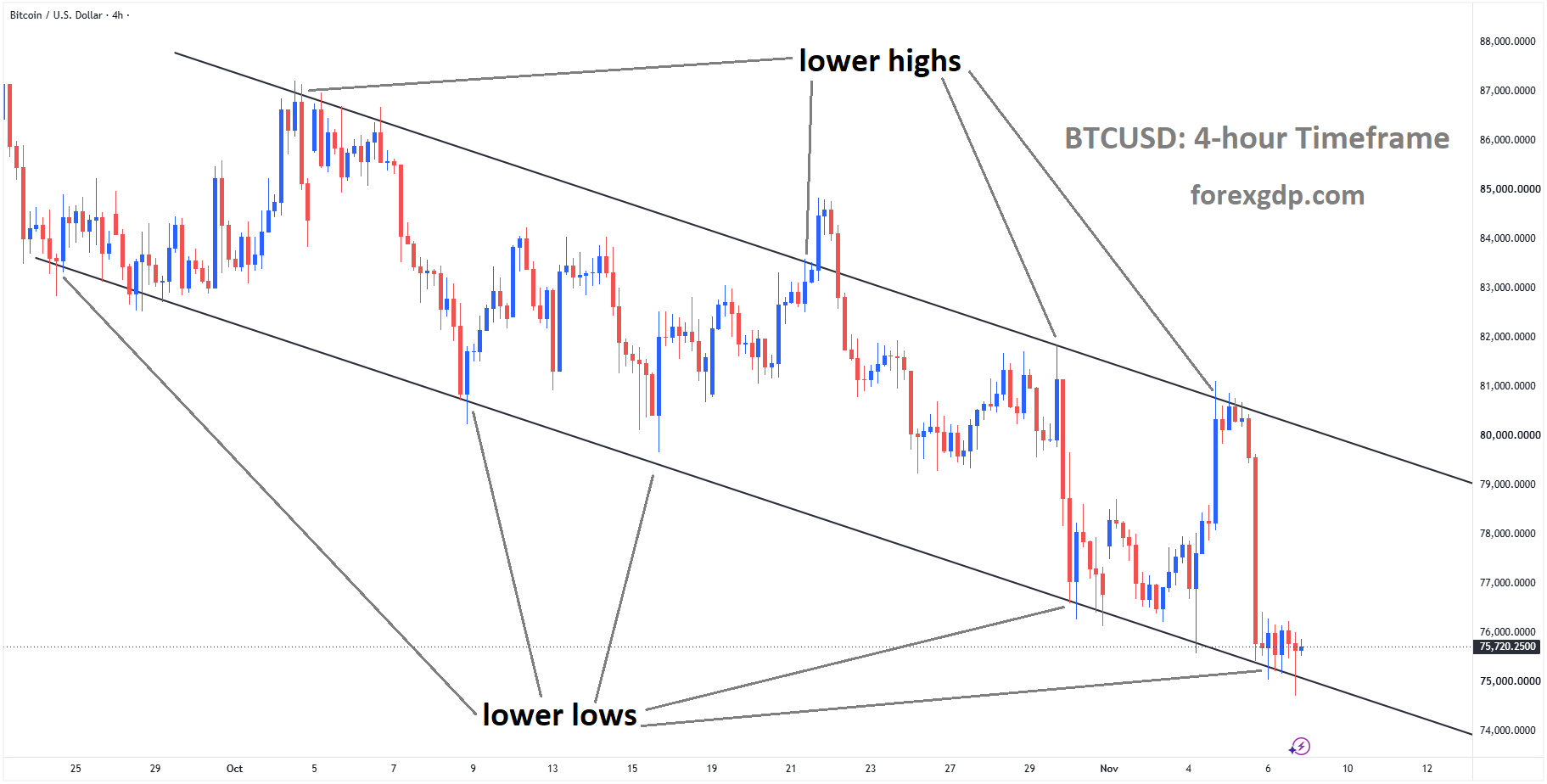
BTCUSD reached the lower-low area of the descending channel
Several developments have contributed to Bitcoin’s recent struggles. Continued withdrawals from US-listed spot Bitcoin exchange-traded funds (ETFs), a major decline in American technology stocks, and widespread cryptocurrency liquidations have created a challenging environment for investors.
Meanwhile, political developments following the US midterm elections and stronger-than-expected employment figures have added new questions about the direction of the economy and the future of digital assets.
Bitcoin Struggles as Market Confidence Weakens
Bitcoin has experienced significant changes in investor sentiment throughout the week. Although the cryptocurrency briefly benefited from positive reactions to the US midterm election results, the optimism quickly disappeared as broader financial markets came under pressure.
The latest weakness highlights how closely Bitcoin is connected to developments in traditional financial markets. While many investors consider Bitcoin an alternative financial asset, its performance often reflects changes in confidence toward technology companies, economic policies, and global investment conditions.
When uncertainty increases, investors frequently reduce their exposure to assets considered more volatile. Cryptocurrencies are particularly sensitive to these changes because market sentiment can shift rapidly.
The ongoing decline also suggests that investors are becoming more cautious about Bitcoin’s near-term prospects. Rather than rushing to increase their holdings, many market participants appear to be waiting for greater clarity about economic conditions and regulatory developments.
Institutional Bitcoin Demand Slows as ETF Withdrawals Increase
One of the biggest concerns affecting Bitcoin is the slowdown in institutional investment through spot Bitcoin ETFs.
These investment products allow individuals and institutions to gain exposure to Bitcoin through traditional financial markets without directly purchasing or storing the cryptocurrency.
Since their introduction in the United States, spot Bitcoin ETFs have become an important channel for institutional participation in the digital asset market.
However, recent fund activity suggests that demand is weakening.
According to data from SoSoValue, US-listed spot Bitcoin ETFs recorded approximately $869.82 million in net withdrawals through Thursday. This followed net outflows of $202.59 million during the previous week, putting the funds on course for a second consecutive week of withdrawals.
The increase in redemptions indicates that some investors are reducing their Bitcoin exposure amid growing uncertainty.
Why Bitcoin ETF Outflows Matter
ETF activity provides useful information about how traditional investors are approaching cryptocurrencies.
When these funds attract sustained investment, it can suggest that institutions and other market participants are becoming more comfortable holding Bitcoin.
On the other hand, continued withdrawals may indicate caution, portfolio adjustments, or a temporary shift toward investments perceived as less risky.
Institutional investors often manage large portfolios and respond to changes in economic expectations, financial conditions, and regulatory policies.
As a result, their decisions can influence broader cryptocurrency sentiment.
However, ETF withdrawals do not necessarily mean that institutions have permanently lost interest in Bitcoin. Some investors may simply be adjusting their exposure while waiting for economic and political uncertainty to ease.
US Midterm Elections Create a Brief Wave of Bitcoin Optimism
Political developments in the United States played a major role in shaping cryptocurrency sentiment during the week.
Bitcoin initially benefited from the results of the US midterm elections, which saw Democrats gain control of both the House of Representatives and the Senate.
The outcome reduced some political uncertainty and encouraged investors to reconsider the outlook for financial markets.
Another factor supporting sentiment was the belief that the election results could reduce the likelihood of renewed US military action against Iran under President Donald Trump.
Lower expectations of military escalation helped improve confidence in investments generally considered sensitive to geopolitical risks.
Bitcoin participated in this broader improvement in sentiment, reflecting renewed interest in digital assets following the election outcome.
However, the positive reaction proved temporary.
As investors examined the potential consequences of the political shift, new concerns emerged about technology development, government policy, and the regulatory environment for cryptocurrencies.
These worries soon overshadowed the initial optimism.
Technology Stock Sell-Off Adds Pressure to Bitcoin
The sharp decline in US technology stocks became another major source of weakness for Bitcoin.
The technology-heavy Nasdaq Index fell more than 6% on Thursday as investors reassessed the possible effects of the Democratic election victory on the technology sector.
Concerns about slower artificial intelligence development contributed to the negative reaction.
Artificial intelligence has become an important driver of investment interest in technology companies, making changes in expectations about the industry’s future particularly significant.
When major technology companies face selling pressure, the effects can spread to other investments that depend heavily on investor confidence.
Bitcoin is one of those assets.
Although cryptocurrencies operate independently of traditional stock exchanges, investors often treat them as part of a broader group of higher-risk investments.
This relationship means that a sharp decline in technology stocks can encourage investors to reduce cryptocurrency exposure as well.
The situation demonstrates that Bitcoin remains sensitive to developments outside the digital asset industry.
Cryptocurrency Regulation Becomes a Growing Concern

The US election results also raised questions about the future of cryptocurrency regulation.
With Democrats gaining control of Congress, investors began considering whether lawmakers might introduce stricter oversight of digital assets.
Potential changes could affect cryptocurrency exchanges, investment products, trading platforms, and businesses operating within the industry.
Regulatory uncertainty can make investors hesitant because new rules may influence operating costs, compliance requirements, and access to cryptocurrency services.
However, stronger regulation does not automatically produce negative outcomes.
Clearer legal standards could eventually help established financial institutions participate in the cryptocurrency industry with greater confidence.
Much depends on the specific policies introduced and how regulators choose to implement them.
For now, uncertainty surrounding future legislation remains an important consideration for Bitcoin investors.
Widespread Crypto Liquidations Highlight Market Uncertainty
Rapid changes in cryptocurrency sentiment triggered substantial liquidations throughout the week.
According to Coinglass data, more than $500 million worth of Bitcoin trading positions were liquidated during the period.
Liquidations occur when leveraged traders can no longer maintain the required funds to keep their positions open, forcing exchanges to close those positions.
The week’s market activity affected traders on both sides.
During Wednesday’s recovery, traders who had positioned themselves for further declines experienced significant liquidations.
Thursday’s reversal then affected traders who had expected Bitcoin to continue recovering.
This sequence illustrates the risks associated with leveraged cryptocurrency trading.
When traders borrow funds to increase their exposure, even relatively short periods of market turbulence can create substantial losses.
Large liquidation events can also intensify uncertainty because forced position closures may contribute to additional selling or buying activity.
For ordinary investors, these developments highlight the importance of understanding how quickly conditions can change in cryptocurrency markets.
Strong US Employment Report Adds Another Economic Consideration
Alongside political developments and institutional investment activity, fresh US employment figures provided important information about the American economy.
The US Bureau of Labor Statistics reported that Nonfarm Payrolls increased by 165,000 in October, significantly exceeding economists’ expectations of 65,000 additional jobs.
The September employment figure was also revised upward to 60,000 from the previously reported 29,000.
These results suggest that the US labor market remains relatively resilient despite ongoing inflation concerns and broader economic uncertainty.
Other employment indicators also showed improvement.
The unemployment rate declined to 4.1% from 4.2%, while the labor force participation rate increased to 61.9% from 61.8%.
Meanwhile, annual growth in average hourly earnings eased to 3.1% from 3.2%.
What Strong Employment Data Means for Bitcoin
Employment figures are closely watched because they help shape expectations about US monetary policy.
A resilient labor market can give the Federal Reserve greater flexibility when deciding how to address inflation and economic growth.
If employment remains strong, policymakers may feel less pressure to introduce measures designed to stimulate economic activity.
For Bitcoin, the implications are mixed.
A healthy economy can support investor confidence, but expectations of restrictive monetary conditions may reduce enthusiasm for speculative investments.
The slowdown in wage growth could also offer some reassurance regarding inflation pressures.
Ultimately, Bitcoin’s response depends on how investors interpret the combined outlook for employment, inflation, and Federal Reserve policy.
Summary
Bitcoin continues to face a difficult market environment as several economic, political, and institutional factors influence investor sentiment.
Persistent withdrawals from US spot Bitcoin ETFs suggest that institutional demand has weakened, while the sharp decline in technology stocks has increased caution across risk-sensitive investments.
The US midterm elections initially improved confidence, but concerns about artificial intelligence development and possible cryptocurrency regulation quickly changed the mood.
Meanwhile, widespread liquidations demonstrated the risks created by leveraged trading during periods of uncertainty.
Stronger US employment data has added another dimension to the outlook, raising questions about future Federal Reserve decisions and broader financial conditions.
Bitcoin’s ability to regain investor confidence will likely depend on improvements in institutional demand, greater regulatory clarity, and a more stable economic environment. Until these factors become clearer, uncertainty may continue to shape sentiment across the cryptocurrency market.
Don’t trade all the time, trade forex only at the confirmed trade setups
Get more confirmed trade signals at premium or supreme – Click here to get more signals, 2200%, 800% growth in Real Live USD trading account of our users – click here to see , or If you want to get FREE Trial signals, You can Join FREE Signals Now!