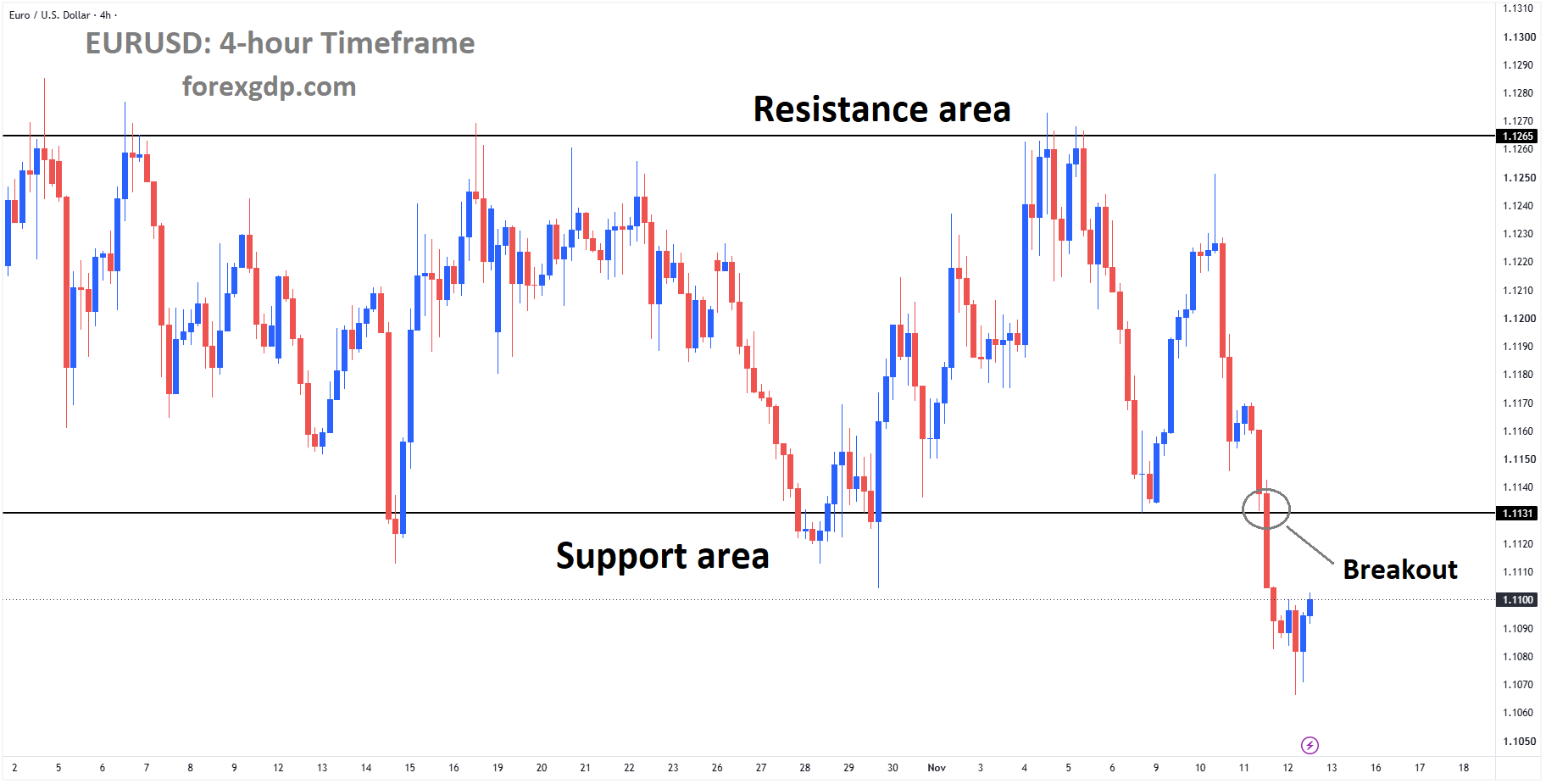
EURUSD has broken the box pattern to the downside
EURUSD Regains Momentum as Uncertainty Grows Over Fed and ECB Policies
The Euro (EUR) has shown signs of recovery against the US Dollar (USD) after facing significant selling pressure. However, the broader outlook for the European currency remains uncertain as investors continue to assess the different monetary policy approaches of the Federal Reserve (Fed) and the European Central Bank (ECB).
The US Dollar remains supported by growing expectations that the Federal Reserve will maintain a restrictive monetary policy following stronger-than-expected US inflation data. Meanwhile, concerns about economic growth in the Eurozone have raised doubts about whether the ECB will continue increasing interest rates beyond December.
These contrasting expectations have become an important influence on the EUR/USD currency pair, with investors closely watching upcoming economic reports and central bank decisions.
Euro Finds Temporary Relief After Recent Weakness
The Euro has managed to recover some ground against the US Dollar following a period of sustained weakness. The modest improvement comes as the American currency gives back part of its earlier gains, allowing the European currency to regain some stability.
However, this recovery does not necessarily indicate a lasting improvement in the Euro’s outlook. The currency continues to face pressure from economic uncertainty across the Eurozone and expectations that the ECB may soon finish its current interest rate tightening cycle.
The US Dollar, on the other hand, continues to benefit from confidence in the American economy and the possibility that borrowing costs will remain elevated for longer than previously expected.
Investors are paying particular attention to the differences between the two economies. While the United States continues to show signs of persistent inflation, the Eurozone is dealing with weaker growth prospects and concerns about the effects of higher interest rates.
These differences could continue to influence demand for both currencies in the coming months.
Strong US Inflation Reinforces Federal Reserve’s Hawkish Outlook
Recent inflation figures from the United States have strengthened expectations that the Federal Reserve will maintain a firm approach toward controlling consumer prices.
The latest Consumer Price Index (CPI) report suggested that inflationary pressures remain a concern for policymakers. This development has encouraged investors to reconsider how quickly the Fed might move toward a less restrictive monetary policy.
A hawkish monetary policy generally means that a central bank is willing to keep interest rates elevated or raise them further to bring inflation under control.
For the Federal Reserve, persistent inflation creates a difficult situation. Although higher borrowing costs can help reduce consumer spending and ease price pressures, they can also slow economic activity.
Nevertheless, the central bank has repeatedly emphasized the importance of restoring price stability.
As a result, investors increasingly believe that the Fed may need to maintain tighter financial conditions until there is clearer evidence that inflation is moving sustainably toward its target.
This expectation has helped support the US Dollar, as relatively higher interest rates can make dollar-denominated financial assets more attractive to international investors.
Fed Interest Rate Expectations Shift Following CPI Report
The latest US inflation report has also influenced expectations surrounding future Federal Reserve policy meetings.
Economists at Deutsche Bank observed that the inflation figures continued to affect interest rate futures even while US Treasury cash markets were closed.
According to the bank’s assessment, investors adjusted their expectations toward a more restrictive Federal Reserve policy path following the CPI release.
The change suggests that financial markets are becoming less confident about the possibility of an early shift toward easier monetary conditions.
Importantly, the effects of stronger inflation expectations are not limited to the Fed’s next policy decision. Investors are also reconsidering the potential direction of interest rates over a longer period.
This reflects a broader concern that inflation could remain difficult to control, requiring the central bank to maintain its restrictive stance for an extended period.
For the US Dollar, such expectations can provide continued support. When investors anticipate relatively high American interest rates, demand for US financial assets may increase.
However, the Federal Reserve’s decisions will ultimately depend on incoming economic information, including inflation, employment, consumer spending, and broader economic conditions.
Upcoming US Producer Inflation Data Draws Attention
Following the CPI report, attention is turning toward the United States Producer Price Index (PPI) for October.
The PPI measures changes in prices received by domestic producers for their goods and services. It provides useful information about inflation pressures within the production process before some of those costs reach consumers.
Investors monitor this report because rising producer costs can eventually contribute to higher consumer prices, although the relationship is not always direct.
A stronger-than-expected PPI reading could reinforce concerns that inflation remains persistent across the American economy.
Such an outcome may strengthen expectations that the Federal Reserve will continue prioritizing inflation control over monetary easing.
Conversely, evidence of easing producer price pressures could provide some reassurance that inflation is gradually becoming more manageable.
The report will therefore offer another opportunity to assess whether the recent strength in consumer inflation reflects a broader trend.
For EUR/USD, the implications are important because changes in US monetary policy expectations can influence the relative attractiveness of the Dollar and Euro.
European Central Bank Faces Growing Economic Challenges
While the Federal Reserve remains focused on persistent inflation, the European Central Bank faces a different set of challenges.
The ECB has already increased interest rates twice during the year covered by the report, with another increase expected at its December meeting.
However, economists increasingly question whether additional tightening will be appropriate after that decision.
The main concern is the Eurozone’s economic outlook.
Higher interest rates increase borrowing costs for households and businesses, potentially reducing consumer spending, business investment, and overall economic activity.
For an economy already experiencing weak growth, further increases could create additional pressure.
This leaves the ECB balancing two important responsibilities: controlling inflation and avoiding unnecessary damage to economic activity.
Although maintaining price stability remains the central bank’s primary objective, policymakers must also consider how their decisions affect economic conditions across the region.
The possibility that the ECB is approaching the end of its tightening cycle has contributed to uncertainty surrounding the Euro.
Rabobank Expects ECB to Become More Cautious After December

Economists at Rabobank have suggested that the European Central Bank may be reluctant to continue increasing interest rates beyond December.
Their assessment reflects growing concern among ECB policymakers about the Eurozone’s economic performance.
According to Rabobank, comments made during the ECB’s previous press conference indicated that members of the Governing Council were becoming increasingly worried about the region’s growth prospects.
These concerns could encourage policymakers to adopt a more cautious approach when considering future interest rate decisions.
If economic conditions continue to weaken, the ECB may prefer to evaluate the effects of its previous tightening measures before introducing additional increases.
Monetary policy changes often take time to influence borrowing, spending, and investment decisions. Therefore, central banks must consider the delayed effects of earlier actions when determining their next steps.
A pause in further tightening would not necessarily mean that the ECB is preparing to reduce interest rates immediately.
Instead, it could indicate that policymakers believe existing borrowing costs are sufficiently restrictive to help control inflation without creating additional economic risks.
Differences Between Fed and ECB Policies Shape EUR/USD Outlook
The contrasting policy expectations surrounding the Federal Reserve and European Central Bank remain central to the outlook for EUR/USD.
In the United States, persistent inflation has encouraged expectations that monetary policy will remain restrictive.
In Europe, concerns about slowing economic growth have increased the likelihood that the ECB will take a more cautious approach after December.
This difference may influence international investment flows and demand for the two currencies.
However, currency movements depend on more than interest rate expectations alone. Economic growth, inflation developments, geopolitical uncertainty, and changes in investor confidence can all affect the relationship between the Euro and US Dollar.
Upcoming economic reports and statements from central bank officials will therefore remain important in shaping expectations.
Final Summary
The Euro has experienced a modest recovery against the US Dollar, but its broader outlook remains challenged by differences in monetary policy expectations.
Stronger US consumer inflation has reinforced the view that the Federal Reserve may maintain restrictive interest rates for longer. Meanwhile, growing concerns about Eurozone economic growth have raised doubts about further ECB tightening beyond December.
The upcoming US Producer Price Index report could provide additional insight into inflation pressures and influence expectations for Federal Reserve policy.
For the Euro, future developments will depend heavily on whether the Eurozone economy can demonstrate greater resilience and whether the ECB sees enough justification to continue its tightening cycle.
Until the economic outlook becomes clearer, the differing approaches of the Federal Reserve and European Central Bank are likely to remain important drivers of EUR/USD sentiment.
GBPUSD Holds Firm as Investors Brace for Key UK Economic Growth Report
The British Pound remained largely unchanged against the US Dollar during Thursday’s early Asian trading session as investors continued to assess the monetary policy outlook in the United Kingdom and the United States. With both central banks signaling concerns about persistent inflation, market participants are paying close attention to upcoming economic reports and comments from policymakers.
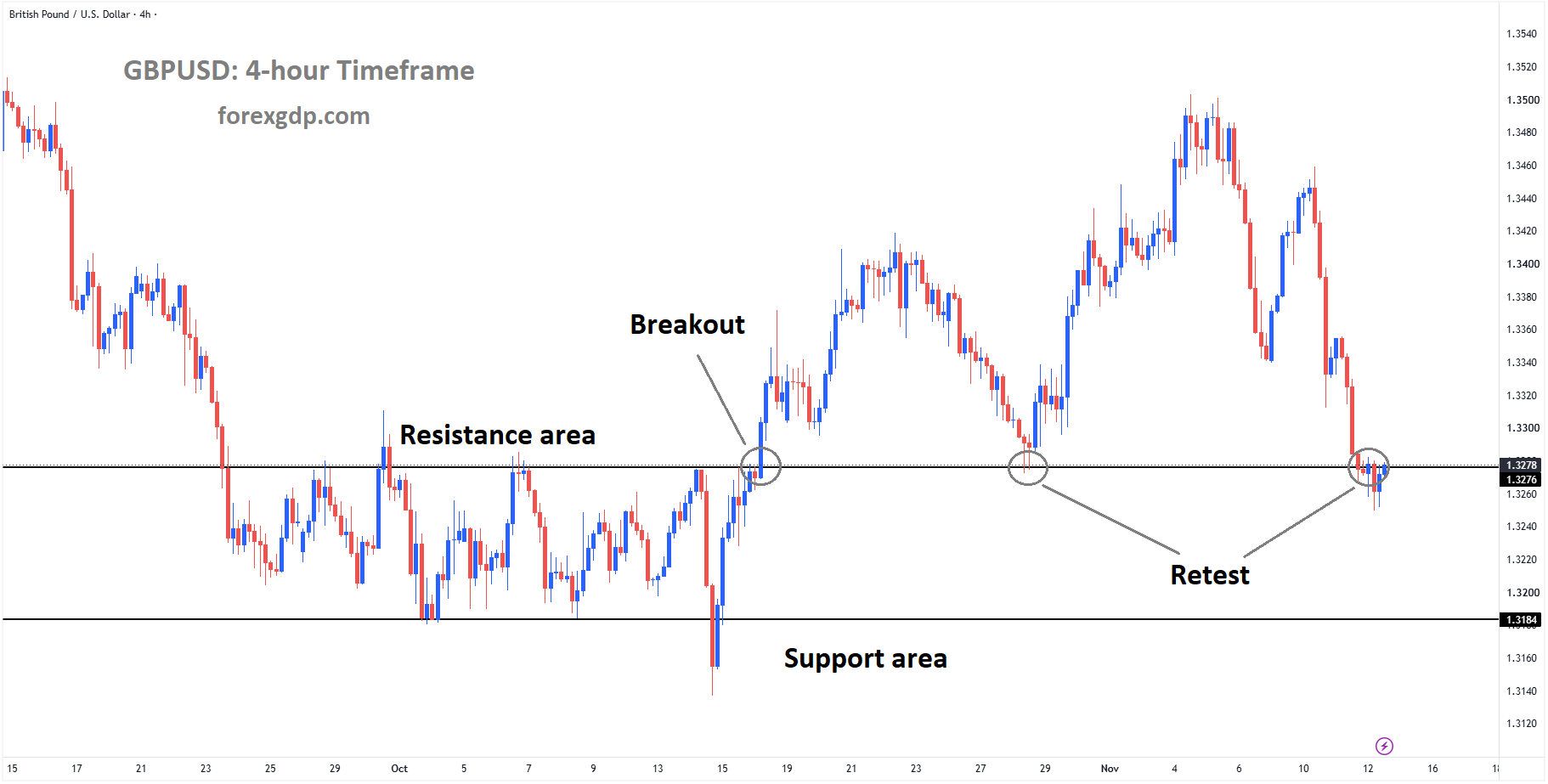
GBPUSD reached the retest area of the broken box pattern
The Bank of England (BoE) has maintained a cautious but increasingly firm approach toward inflation, particularly as wage growth continues to create pressure across the British economy. Meanwhile, the US Federal Reserve (Fed) faces similar challenges after stronger-than-expected inflation figures raised expectations of further monetary tightening.
The upcoming release of the UK’s preliminary third-quarter Gross Domestic Product (GDP) report is another important development. The figures could offer valuable insight into the health of the British economy and influence expectations surrounding future interest rate decisions.
Bank of England’s Megan Greene Calls for Proactive Monetary Tightening
Bank of England policymaker Megan Greene has delivered a strong message about the need to address persistent inflation risks in the United Kingdom.
Speaking on Wednesday, Greene emphasized that policymakers should take proactive steps to tighten monetary conditions rather than wait for inflation pressures to become more deeply established.
Her concerns focused primarily on wage growth, which remains an important challenge for the British economy. When businesses face rising labor expenses, they may increase the prices of their products and services to protect their profit margins.
This process can contribute to persistent inflation, making it more difficult for the central bank to restore price stability.
Greene also suggested that the UK labor market may have less spare capacity than previously believed. This means employers could continue facing difficulties finding suitable workers, potentially keeping wage demands elevated.
Her comments indicate that the Bank of England may need to maintain a restrictive monetary policy stance to prevent inflation from becoming a longer-term economic problem.
For the British Pound, expectations of tighter monetary policy can provide some support. However, the currency’s overall direction also depends on economic conditions in the United States and the Federal Reserve’s response to inflation.
Persistent UK Wage Growth Creates Challenges for Inflation Control
Wage growth has become one of the most closely watched economic developments for Bank of England officials.
Higher wages can benefit households by improving their purchasing power, especially when families are struggling with rising living expenses. However, rapid wage increases can also create additional inflationary pressure when they are not matched by improvements in productivity.
Businesses operating in labor-intensive industries, including hospitality, retail, and professional services, may be particularly sensitive to increasing employment costs.
If companies respond by raising consumer prices, inflation can remain elevated even after other sources of price pressure begin to ease.
This creates a difficult balancing act for the Bank of England.
Policymakers must control inflation without placing unnecessary pressure on economic activity, employment, and household finances.
Greene’s recent remarks suggest that she considers the risks of persistent inflation significant enough to justify a proactive policy response.
Her position also highlights the importance of labor market information in shaping future monetary policy decisions.
Employment trends, wage settlements, hiring activity, and business costs will remain important considerations as the central bank evaluates the appropriate level of monetary restraint.
Federal Reserve Rate Hike Expectations Strengthen After US Inflation Data
Across the Atlantic, the Federal Reserve is facing renewed pressure to maintain a firm approach toward inflation.
Stronger-than-expected US Consumer Price Index (CPI) data has increased expectations that the central bank could raise interest rates at its December policy meeting.
The inflation report suggested that consumer price pressures remained more persistent than many investors had anticipated.
As a result, market participants have reassessed the likelihood of additional monetary tightening.
Federal Reserve Governor Christopher Waller reinforced these expectations by expressing support for another interest rate increase in December.
Waller also indicated that a larger policy adjustment could be appropriate if upcoming inflation figures showed further deterioration.
His remarks underline the Federal Reserve’s determination to bring inflation under control, even if doing so requires additional restrictions on borrowing and spending.
According to the CME FedWatch Tool figures cited in the market report, traders assigned an 87.3% probability to a quarter-percentage-point increase at the December meeting, while a larger half-percentage-point increase carried a 12.7% probability.
These expectations reflect the growing belief that US policymakers may need to maintain tighter financial conditions to prevent inflation from remaining elevated.
However, expectations can change quickly as new economic information becomes available.
US Dollar Benefits From a More Restrictive Federal Reserve Outlook

The US Dollar has received support from changing expectations surrounding Federal Reserve policy.
When investors anticipate higher US interest rates, dollar-denominated assets can become more attractive relative to assets in countries with less restrictive monetary policies.
This can encourage international demand for the American currency.
Elias Haddad, global head of markets strategy at Brown Brothers Harriman & Co., attributed the Dollar’s broad strength to increasingly restrictive Federal Reserve expectations following the stronger October inflation report.
He also highlighted the influence of recent comments from Federal Reserve officials, which reinforced the possibility of further monetary tightening.
The combination of persistent inflation and firm central bank communication has strengthened the case for a cautious US monetary policy approach.
For GBP/USD, this creates competing influences.
While hawkish Bank of England comments may benefit Sterling, similar signals from the Federal Reserve can strengthen the US Dollar.
The relative outlook for both economies and their central banks will therefore remain an important factor in shaping investor sentiment.
UK Third-Quarter GDP Report Becomes a Major Focus
Attention is also turning toward the United Kingdom’s preliminary third-quarter GDP release, scheduled for Thursday.
The report will provide an early assessment of economic growth during the period and help investors understand how the British economy is responding to tighter monetary conditions.
Economists at Societe Generale forecast quarterly growth of 0.7%, suggesting an expectation of continued economic expansion.
A stronger-than-anticipated GDP reading could indicate that businesses and households are demonstrating resilience despite higher borrowing costs.
Such an outcome might give the Bank of England greater confidence that the economy can withstand restrictive monetary policy.
On the other hand, weaker growth could raise concerns about the impact of elevated interest rates on consumer spending, business investment, and overall economic activity.
A slowdown would present policymakers with a more complicated decision, particularly if inflation remained stubbornly high.
The GDP figures will therefore be important not only for understanding the UK’s economic performance but also for assessing the central bank’s future policy choices.
Bank of England Governor Andrew Bailey’s Remarks Draw Attention
Investors are also monitoring comments from Bank of England Governor Andrew Bailey.
His scheduled speech in Zurich represents an important opportunity to gain further insight into the central bank’s thinking following its recent Monetary Policy Committee decision.
Market participants will be interested in whether Bailey shares Greene’s concerns about persistent wage pressures and the need for proactive action.
His assessment of inflation, employment conditions, and economic growth could help clarify the Bank of England’s broader policy direction.
Comments from the governor often receive significant attention because they can provide context for how the central bank evaluates competing economic risks.
However, individual speeches do not necessarily indicate that a particular policy decision has already been agreed upon.
Future decisions will depend on incoming economic evidence and the collective judgment of the Monetary Policy Committee.
Global Economic Reports Add to Central Bank Uncertainty
Beyond developments in Britain and the United States, investors are following a busy international economic calendar.
Upcoming US inflation releases, including consumer and producer price reports, will provide further information about inflationary pressures across the American economy.
Speeches from Federal Reserve officials, including Christopher Waller and John Williams, may also offer additional insight into policymakers’ priorities.
In Europe, updated third-quarter GDP figures will help clarify the region’s economic performance.
China’s trade balance report will provide information about international demand and activity in one of the world’s largest economies.
Inflation releases from countries including India, Mexico, Norway, the Czech Republic, and Hungary will add to the broader picture of global price pressures.
Together, these developments could influence international investor confidence and expectations about the direction of monetary policy.
Summary
The GBP/USD outlook remains closely connected to monetary policy developments in the United Kingdom and the United States.
Bank of England policymaker Megan Greene has emphasized the need for proactive tightening to prevent persistent wage growth from sustaining inflation. Her comments suggest that controlling domestic price pressures remains a central priority for UK policymakers.
Meanwhile, stronger US inflation data and firm statements from Federal Reserve officials have increased expectations of another American interest rate increase.
The UK’s upcoming GDP figures and remarks from Governor Andrew Bailey will provide additional information about the balance between economic growth and inflation control.
With both central banks focused on restoring price stability, future economic releases and official communication will remain essential in shaping expectations for the British Pound and US Dollar.
USDJPY Under Pressure as Intervention Warnings Strengthen Japanese Yen Sentiment
The Japanese Yen has regained some strength against the US Dollar as Japanese authorities increase their warnings about possible currency intervention. Growing concerns over rapid currency movements have brought renewed attention to Japan’s willingness to protect its currency from excessive weakness.
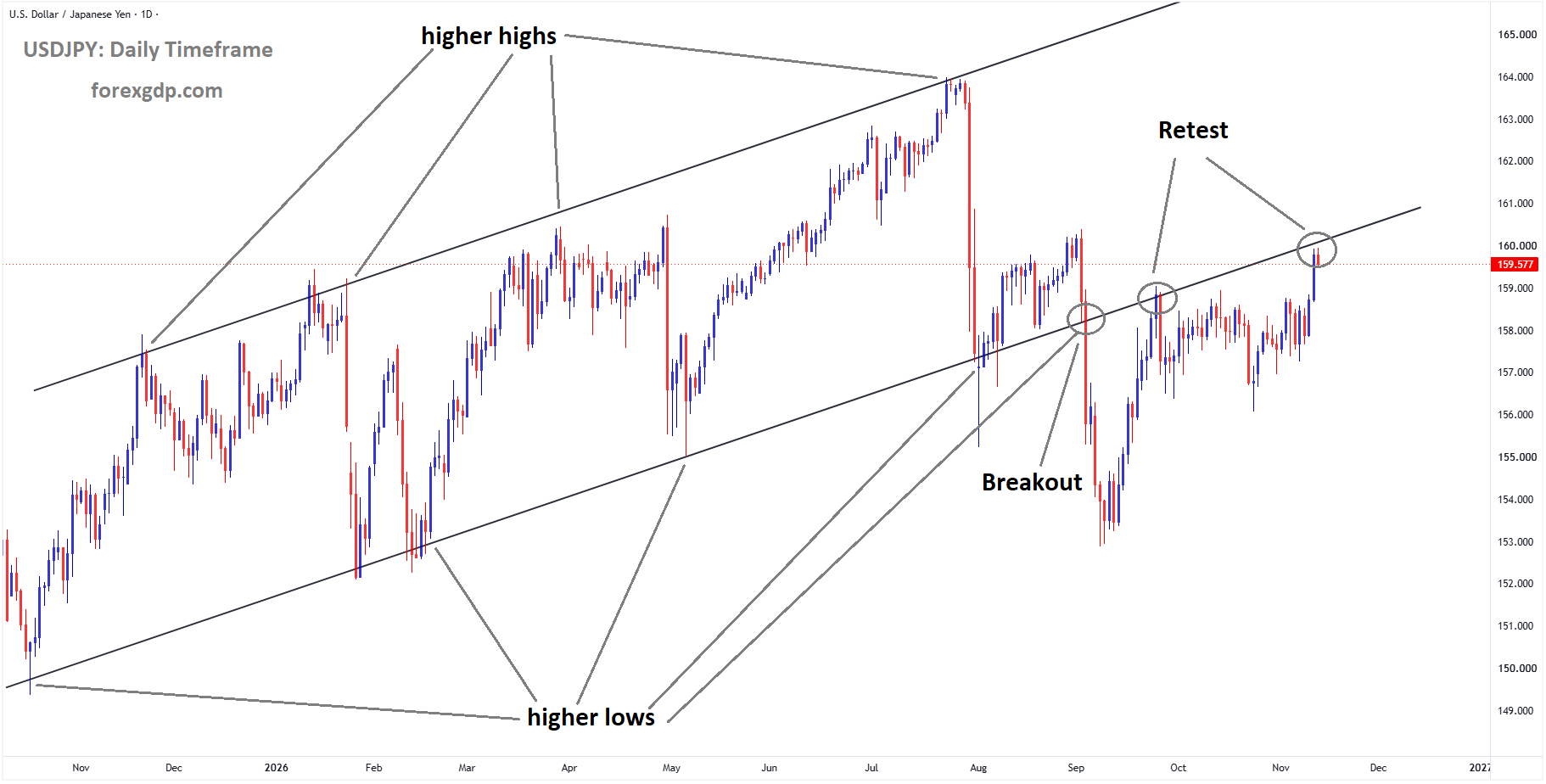
USDJPY reached the retest area of the broken ascending channel
At the same time, the US Dollar remains supported by expectations that the Federal Reserve will continue raising interest rates to control inflation. This creates a challenging environment for the Japanese Yen, as the monetary policy outlooks of the United States and Japan continue to move in different directions.
While a slight decline in the US Dollar has provided temporary relief for the Yen, uncertainty surrounding the Bank of Japan’s next policy decisions is limiting the currency’s recovery.
Investors are now closely watching statements from Japanese officials, upcoming US economic reports, and central bank policy signals to understand how the relationship between the two currencies may develop.
Japanese Yen Gains Support From Growing Intervention Warnings
The Japanese Yen has found some support following fresh warnings from senior Japanese government officials about unusually rapid currency movements.
Japan’s top currency diplomat, Atsushi Mimura, expressed concern about the speed of recent changes in foreign exchange markets. His comments suggested that authorities are closely monitoring developments and remain prepared to respond if currency movements become disorderly.
Mimura also reminded investors of previous episodes when Japan took direct action to support its currency. His remarks highlighted the government’s continued concern about the economic consequences of a weaker Yen.
Currency intervention is an important tool available to Japanese authorities. When the Yen weakens sharply, the government may enter the foreign exchange market to purchase its own currency. Such action is intended to reduce excessive volatility and discourage speculative activity.
Japan has previously committed substantial financial resources to defending the Yen. Those actions demonstrated that officials are willing to intervene when they believe currency movements threaten economic stability.
However, intervention does not guarantee a lasting recovery. Its effectiveness often depends on broader economic conditions, especially the strength of the US Dollar and the monetary policies followed by major central banks.
Why Japan Is Concerned About a Weaker Yen
A weaker Japanese Yen can create both opportunities and challenges for Japan’s economy.
For exporters, currency depreciation can be beneficial because Japanese products become more competitive in overseas markets. Companies that earn revenue in foreign currencies may also benefit when those earnings are converted into Yen.
However, the situation is more difficult for businesses and households that depend on imported goods.
Japan imports significant amounts of energy, food, and industrial materials. When the Yen loses value, these imports become more expensive, increasing costs throughout the economy.
Higher import expenses can eventually affect consumers through rising electricity bills, transportation costs, and everyday household spending.
This creates a difficult balance for Japanese policymakers. While some businesses benefit from a weaker currency, prolonged depreciation can reduce household purchasing power and place additional pressure on domestic consumption.
Government officials are particularly concerned when currency movements happen too quickly. Sudden changes can make financial planning difficult for businesses and increase uncertainty across the economy.
For this reason, Japan’s intervention warnings are not simply about defending the Yen. They also reflect a broader effort to maintain financial stability and protect economic confidence.
Federal Reserve Rate Hike Expectations Continue to Support the US Dollar
Despite renewed support for the Japanese Yen, the US Dollar remains relatively strong because of expectations surrounding Federal Reserve monetary policy.
Recent US inflation figures have increased concerns that price pressures may remain persistent. As a result, investors have strengthened their expectations that the Federal Reserve could introduce additional interest rate increases.
The Fed uses interest rates as one of its main tools for managing inflation. Higher borrowing costs can reduce consumer spending and business investment, helping to ease demand and slow price increases.
However, higher US interest rates can also make Dollar-denominated financial assets more attractive to international investors.
When investors seek higher returns in the United States, demand for the US Dollar may increase. This can create additional pressure on currencies from countries where interest rates remain comparatively low.
The difference between US and Japanese monetary policies is therefore an important factor influencing the Yen.
Although the US Dollar has experienced a modest pullback, expectations of tighter Federal Reserve policy continue to limit the Japanese currency’s ability to recover.
US Inflation Remains an Important Factor
Inflation continues to play a central role in shaping Federal Reserve decisions.
When consumer prices rise faster than expected, policymakers may become more concerned about inflation remaining above their preferred target.
Federal Reserve officials have repeatedly emphasized the importance of restoring price stability. Their willingness to maintain restrictive monetary conditions can influence investor confidence in the US Dollar.
Future policy decisions will depend heavily on whether incoming economic information shows that inflation is slowing or remaining persistent.
Bank of Japan Signals Caution Over Further Interest Rate Increases

While the Federal Reserve faces pressure to maintain tighter monetary conditions, the Bank of Japan is dealing with a different set of economic challenges.
Bank of Japan board member Toichiro Asada has expressed concerns about the potential consequences of raising interest rates too quickly.
According to Asada, additional increases in borrowing costs could weaken economic activity and reduce underlying inflation.
His remarks suggest that Japanese policymakers remain cautious about introducing further monetary tightening without clear evidence of sustainable economic growth.
Asada also highlighted that rising prices in Japan are not necessarily being driven by strong consumer demand.
This distinction matters because inflation caused by higher import costs differs from inflation supported by stronger wages, household spending, and business activity.
If prices increase while consumer demand remains weak, higher interest rates could create additional difficulties for the economy.
Weak Consumer Spending Complicates Monetary Policy
Household consumption is an important part of Japan’s economic growth.
When consumers face higher living expenses, they may reduce spending on nonessential products and services. This can weaken business revenue and discourage investment.
Raising interest rates under these conditions could make borrowing more expensive for households and companies.
The Bank of Japan must therefore consider whether the economy is strong enough to withstand additional policy tightening.
A cautious approach may help protect economic growth, but it can also reduce support for the Yen when other major central banks maintain higher interest rates.
This difference in policy priorities remains a major challenge for Japanese authorities.
Can Currency Intervention Deliver Lasting Support for the Yen?
Japan’s repeated warnings about possible intervention may discourage investors from taking aggressive positions against the Yen.
However, economists recognize that government intervention alone may struggle to reverse currency weakness when broader economic forces favor the US Dollar.
Analysts at MUFG/BTMU believe that Japan’s official statements demonstrate a clear willingness to take action if necessary.
At the same time, they acknowledge that strong demand for the US Dollar could make any intervention less effective over a longer period.
This creates an important distinction between short-term currency stabilization and a sustainable improvement in the Yen’s outlook.
Intervention can help reduce sudden fluctuations, but lasting currency strength generally requires support from economic fundamentals and monetary policy expectations.
If the Federal Reserve continues tightening policy while the Bank of Japan remains cautious, the difference between their approaches could continue influencing investor behavior.
The Yen may also experience changing demand against other major currencies as investors reassess global interest rate expectations.
Upcoming US Economic Reports Could Influence Currency Sentiment
Investors are turning their attention toward upcoming US economic releases for additional clues about the Federal Reserve’s next steps.
Weekly US jobless claims will provide information about conditions in the American labor market.
A resilient labor market could give Federal Reserve officials greater confidence that the economy can withstand higher borrowing costs. On the other hand, signs of weakening employment conditions may encourage a more cautious policy approach.
The US Producer Price Index will also attract attention because it measures changes in prices received by domestic producers.
Producer inflation can provide useful information about cost pressures that may eventually affect consumer prices.
Together, these reports could influence expectations about future Federal Reserve decisions and shape demand for the US Dollar.
Investors will also continue monitoring comments from Japanese policymakers for signs of a possible change in the Bank of Japan’s monetary policy outlook.
Summary
The Japanese Yen is receiving renewed support as Japanese authorities warn against excessive currency movements and signal their willingness to intervene if necessary.
However, the currency faces continuing challenges from expectations of further Federal Reserve interest rate increases and the Bank of Japan’s cautious approach to monetary tightening.
Japan’s policymakers must balance the need to protect the Yen with concerns about weak consumer spending, rising import costs, and the potential economic effects of higher interest rates.
Meanwhile, the Federal Reserve’s response to inflation and employment conditions will remain an important influence on the US Dollar.
The direction of the Japanese Yen will therefore depend on several connected factors, including central bank decisions, economic performance, investor confidence, and the possibility of government intervention.
For now, uncertainty surrounding monetary policy in both countries is likely to keep the Japanese Yen and US Dollar relationship firmly in focus.
AUDUSD Struggles to Recover as Hawkish Fed Outlook and RBA Caution Weigh on Aussie
The Australian Dollar continues to struggle against the US Dollar as a combination of stronger US economic data, changing central bank expectations, and rising geopolitical tensions creates a challenging environment for the AUD/USD currency pair. The US Dollar has maintained its upward momentum following the latest American inflation report, while the Reserve Bank of Australia’s cautious monetary policy approach has weakened confidence in the Australian currency.
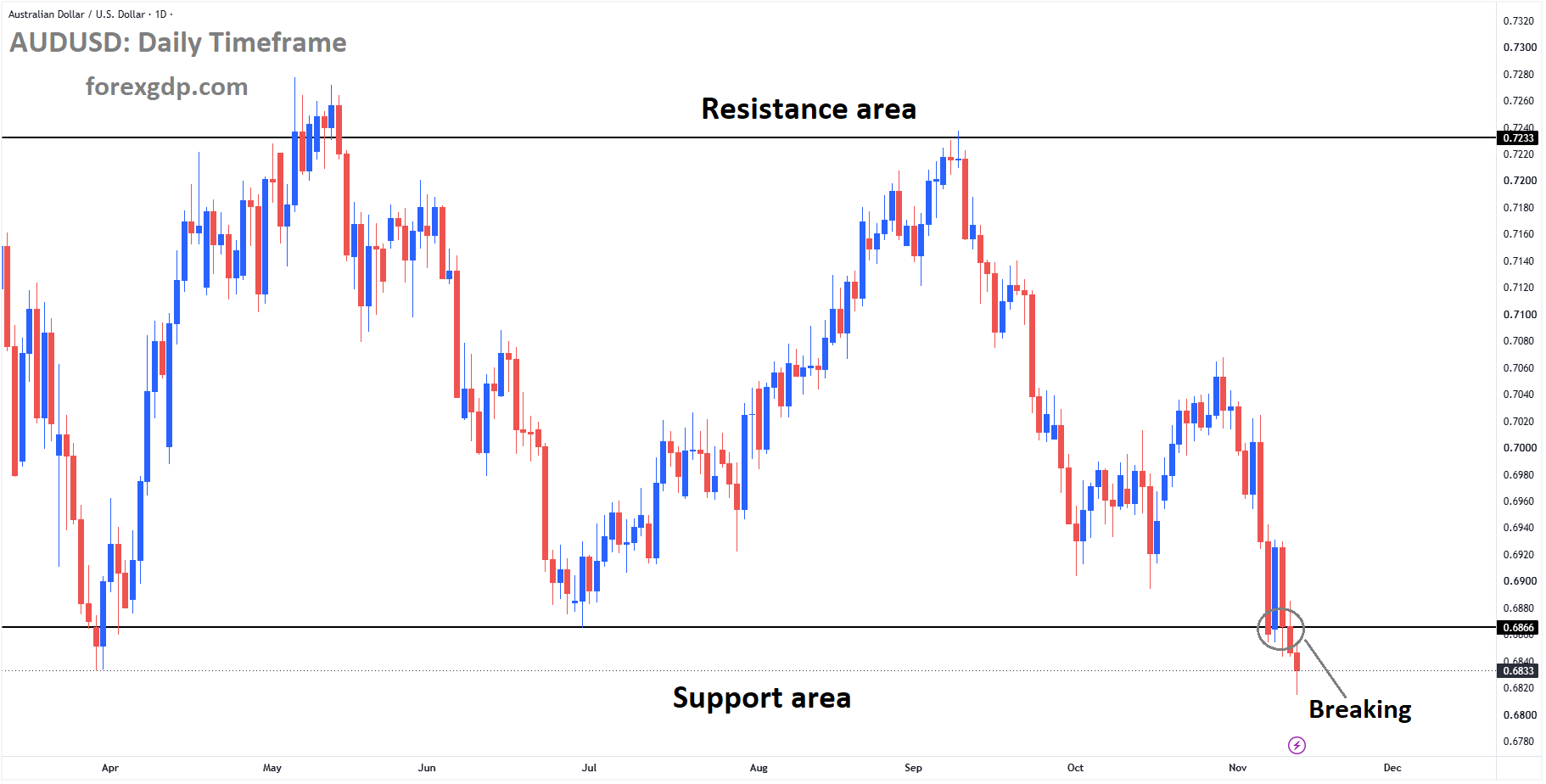
AUDUSD is breaking the support area of the box pattern
The growing possibility of another interest rate increase by the US Federal Reserve has become an important factor influencing currency market sentiment. At the same time, uncertainty surrounding the Middle East conflict has encouraged investors to seek safety in the US Dollar, adding further pressure on the Australian Dollar.
With several economic and political developments unfolding simultaneously, market participants are closely watching central bank statements, US employment figures, and international tensions to understand what could influence the AUD/USD outlook in the coming days.
AUD/USD Remains Under Pressure as US Dollar Strengthens
The Australian Dollar has faced persistent selling pressure as investors increasingly favor the US Dollar. The latest weakness reflects concerns about the difference between monetary policy expectations in Australia and the United States.
The US Dollar has benefited from renewed confidence that the Federal Reserve may continue raising interest rates to control inflation. Higher interest rates can make a currency more attractive to international investors, particularly when other major central banks appear less willing to tighten monetary policy.
For the Australian Dollar, this creates a difficult situation. Australia remains closely connected to global trade, commodity demand, and investor confidence in economic growth. When uncertainty increases, investors often reduce their exposure to currencies considered more sensitive to global economic conditions.
The US Dollar, meanwhile, tends to benefit from its position as a major international reserve currency. This difference in investor behavior has become increasingly important as financial markets respond to both economic developments and geopolitical concerns.
Federal Reserve Rate Hike Expectations Support the US Dollar
One of the main reasons behind the US Dollar’s strength is the growing belief that the Federal Reserve may introduce another interest rate increase.
Recent US inflation figures have reinforced concerns that consumer prices remain difficult to control. The October Consumer Price Index report showed stronger inflation than economists had expected, raising questions about whether existing monetary policy measures are sufficient to bring inflation under control.
Persistent inflation creates challenges for the Federal Reserve because the central bank must balance price stability with economic growth and employment conditions.
When inflation remains elevated, policymakers may consider keeping borrowing costs higher or introducing additional increases to discourage excessive spending and reduce pressure on prices.
US Inflation Data Changes Interest Rate Expectations
The stronger-than-expected inflation report has encouraged investors to reconsider the future direction of American monetary policy.
Before the release, some market participants had hoped that inflation would ease enough to reduce the need for additional tightening. However, the latest figures have strengthened expectations that the Federal Reserve may need to maintain a restrictive approach.
Comments from several Federal Reserve officials have also supported this view. Their emphasis on controlling inflation has encouraged speculation about another rate increase at the December policy meeting.
Some investors have even considered the possibility of a larger interest rate adjustment if inflation continues to show signs of persistence.
Although the Federal Reserve has not committed to a specific decision, the changing expectations have increased demand for the US Dollar.
Reserve Bank of Australia’s Cautious Approach Weakens the Aussie
While the Federal Reserve is attracting attention for its potentially firm monetary policy stance, the Reserve Bank of Australia has delivered a more cautious message.
The RBA raised interest rates during its November meeting, but the accompanying communication suggested that policymakers were becoming less certain about the need for further increases.
The decision was supported by a six-to-three vote, highlighting differences of opinion among policymakers about the appropriate direction of monetary policy.
More importantly, the central bank removed language that had previously suggested additional tightening could be necessary.
This change has influenced how investors view the Australian Dollar.
Why the RBA’s Policy Message Matters
Currency markets respond not only to interest rate decisions but also to signals about what central banks may do next.
Even when a central bank raises rates, its currency can weaken if investors believe the decision marks the end of a tightening cycle.
The RBA’s more cautious communication has encouraged expectations that Australian borrowing costs may remain unchanged for some time.
This contrasts with the Federal Reserve’s firmer approach, creating a difference in monetary policy expectations between the two countries.
The Australian central bank must also consider domestic economic challenges, including household spending, mortgage costs, business activity, and the impact of previous interest rate increases.
Further tightening could place additional pressure on households and businesses, particularly those already dealing with higher borrowing expenses.
As a result, the RBA may prefer to assess incoming economic information before making further policy changes.
This uncertainty has reduced support for the Australian Dollar at a time when the US Dollar is benefiting from stronger interest rate expectations.
Middle East Tensions Increase Demand for Safe-Haven Assets
Geopolitical developments have added another layer of uncertainty to global financial markets.
The reported confrontation between the United States and Iran around the Strait of Hormuz has raised concerns about regional stability and international shipping.
The Strait of Hormuz is one of the world’s most important maritime routes, particularly for energy shipments moving from the Persian Gulf to international markets.
Any disruption to navigation through this waterway can create concerns about energy supplies, transportation costs, and broader economic stability.
Reports of military activity involving US forces and Iranian targets have increased fears that the conflict could become more difficult to resolve through diplomacy.
Additional reports of interference with maritime navigation systems have further highlighted the potential risks facing commercial shipping in the region.
Geopolitical Uncertainty Favors the US Dollar
During periods of international instability, investors frequently move toward assets and currencies they consider relatively secure.
The US Dollar often benefits from this behavior because of its widespread use in global trade, international finance, and central bank reserves.
The Australian Dollar, by comparison, is generally more sensitive to changes in global economic confidence.
Australia’s strong trading relationships with Asian economies and its dependence on international demand for raw materials can make its currency vulnerable when investors become concerned about global growth.
If tensions in the Middle East continue, demand for the US Dollar could remain supported by defensive investment decisions.
However, any meaningful diplomatic progress could help reduce uncertainty and improve confidence in currencies linked more closely to global economic activity.
US Employment Data and Fed Comments Remain in Focus

Investors are now turning their attention toward upcoming US economic releases and statements from Federal Reserve officials.
Weekly Initial Jobless Claims data will be particularly important because it provides an indication of changing conditions in the American labor market.
The report measures the number of people filing new applications for unemployment benefits and can offer useful information about the strength of employment conditions.
A resilient labor market could give the Federal Reserve greater confidence that the economy can withstand restrictive borrowing costs.
On the other hand, signs of increasing unemployment claims could raise concerns about slowing economic activity and encourage policymakers to reconsider the need for further tightening.
Key Developments That Could Influence AUD/USD Sentiment
Beyond employment figures, investors will continue monitoring several broader developments:
-
Federal Reserve communication: Statements from policymakers could clarify whether additional interest rate increases remain likely.
-
Australian monetary policy: Future RBA comments may reveal whether officials are becoming more concerned about inflation or economic growth.
-
Middle East developments: Changes in regional tensions could influence demand for safe-haven currencies.
-
Global economic confidence: Shifts in international trade expectations and business activity could affect demand for the Australian Dollar.
-
Upcoming inflation reports: New consumer price information could influence monetary policy expectations in both countries.
Together, these factors will help shape investor confidence in the relative strength of the Australian and US economies.
AUD/USD Outlook Depends on Monetary Policy and Global Stability
The broader outlook for AUD/USD remains influenced by the contrasting approaches of the Federal Reserve and the Reserve Bank of Australia.
Stronger American inflation data and expectations of additional Federal Reserve tightening have supported the US Dollar. Meanwhile, the RBA’s cautious policy message has limited confidence in the Australian currency.
Geopolitical uncertainty has reinforced this difference by encouraging investors to prioritize financial security over exposure to currencies that are more sensitive to global growth.
Nevertheless, currency market conditions can change as new information becomes available.
A softer US inflation outlook, signs of weakness in the American labor market, or progress toward resolving international tensions could reduce demand for the US Dollar.
Similarly, stronger Australian economic data or a more determined policy stance from the RBA could improve sentiment toward the Australian Dollar.
For now, the combination of monetary policy uncertainty and geopolitical risks continues to create a challenging environment for AUD/USD.
Summary
The Australian Dollar remains under pressure against the US Dollar as investors respond to stronger US inflation, growing Federal Reserve rate hike expectations, and the Reserve Bank of Australia’s cautious monetary policy stance.
Rising tensions involving the United States and Iran have also increased demand for the US Dollar as investors seek relative safety during geopolitical uncertainty.
The coming US employment figures, Federal Reserve statements, and developments in the Middle East will play an important role in shaping currency market sentiment.
Although changing economic conditions could eventually improve confidence in the Australian Dollar, the current fundamental environment continues to favor the US Dollar, leaving AUD/USD sensitive to further changes in monetary policy expectations and global risk appetite.
BTCUSD Loses Momentum as Monetary Tightening Risks Shake Investor Confidence
Bitcoin is facing a difficult period as several economic and political developments create uncertainty across the cryptocurrency market. Stronger-than-expected US inflation, concerns about future Federal Reserve interest rate decisions, delays in cryptocurrency regulation, and selling by major institutional holders have all contributed to weaker investor confidence.
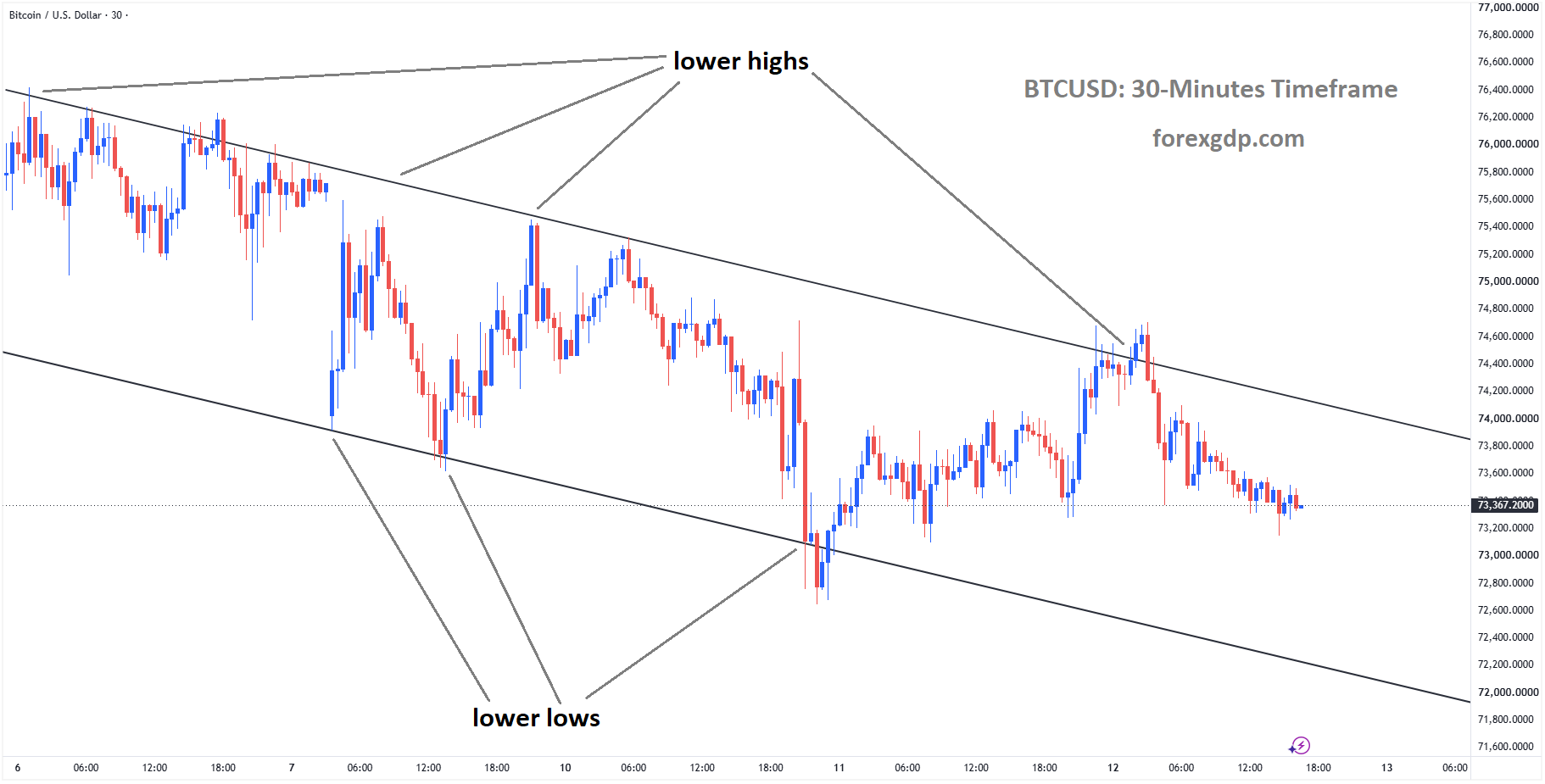
BTCUSD is moving in a descending channel, and the market has fallen from the lower high area of the channel
The cryptocurrency market initially welcomed the results of the US midterm elections, but that optimism quickly faded. Investors are now paying closer attention to economic developments, government policy, and the actions of large Bitcoin holders.
With several important events approaching, Bitcoin investors may face continued uncertainty as they assess whether the broader economic environment will become more supportive of digital assets.
US Inflation Data Adds Pressure to Bitcoin Market Sentiment
One of the biggest challenges facing Bitcoin is the latest inflation report from the United States.
On November 10, the US Bureau of Labor Statistics released its Consumer Price Index (CPI) report for October. The figures showed that consumer inflation increased by 0.4% compared with the previous month, exceeding economists’ expectations of 0.3%.
Although the difference may appear small, it carries important implications for financial markets.
Higher inflation suggests that the Federal Reserve may need to maintain tighter monetary policies to prevent consumer prices from rising too quickly. This creates uncertainty for investments such as Bitcoin, which can be sensitive to changes in interest rates and overall financial conditions.
When borrowing costs increase, investors often become more cautious about putting money into assets that experience significant volatility.
The latest inflation figures have therefore raised concerns about whether the Federal Reserve will introduce another interest rate increase at its December policy meeting.
For Bitcoin investors, the central question is whether inflation will begin to ease or remain strong enough to influence future monetary policy decisions.
Federal Reserve Interest Rate Expectations Create Uncertainty
The Federal Reserve plays an important role in shaping investor sentiment across global financial markets.
Its decisions influence borrowing costs, business investment, consumer spending, and the availability of money throughout the economy.
Following the latest US inflation report, expectations of another interest rate increase strengthened considerably.
According to CME Group’s FedWatch tool, market participants assigned an 88.8% probability to a quarter-percentage-point interest rate increase at the Federal Reserve meeting scheduled for December 8–9.
The tool also indicated an 11.2% probability of a larger half-percentage-point increase.
These expectations suggest that investors are preparing for the possibility of tighter financial conditions.
For the cryptocurrency industry, higher interest rates can create additional challenges. Investors may become more interested in traditional financial products that offer returns with relatively lower risk.
At the same time, businesses operating within the digital asset industry may face higher financing costs.
However, Federal Reserve expectations can change as new economic information becomes available. Upcoming reports on inflation, employment, and business activity could influence policymakers before their next meeting.
As a result, uncertainty surrounding US monetary policy remains an important factor affecting Bitcoin market sentiment.
US Cryptocurrency Regulation Remains Unresolved
Beyond economic concerns, regulatory uncertainty continues to weigh on the cryptocurrency industry.
The CLARITY Act, a proposed law designed to establish clearer federal rules for cryptocurrency markets, has encountered significant obstacles in Congress.
Although the legislation passed the US House of Representatives in 2025, progress in the Senate has been limited.
A procedural vote held on September 15 failed to secure the 60 votes required to begin debate, falling short by 11 votes.
The delay has left cryptocurrency companies and investors without the regulatory clarity many had hoped to receive.
Why the CLARITY Act Matters for Cryptocurrency
Clear regulations could help businesses understand their legal responsibilities while giving investors greater confidence in how digital assets are supervised.
A consistent federal framework could also reduce confusion surrounding the responsibilities of different government agencies.
Without such clarity, cryptocurrency companies may face difficulties planning long-term operations, developing new products, and attracting institutional investment.
Political changes could further complicate the situation.
The new US Congress is scheduled to begin its term on January 3, 2027. Changes in political control may influence the direction of cryptocurrency legislation and determine whether existing proposals receive enough support.
According to reporting from NPR before the midterm elections, a shift in control of either congressional chamber could make passing the legislation more difficult.
Stronger Oversight Could Affect Cryptocurrency Businesses
Regulatory concerns extend beyond the delayed CLARITY Act.
Investors are also considering the possibility of increased government oversight of cryptocurrency companies, particularly regarding anti-money-laundering procedures and financial risk management.
These requirements are intended to protect the financial system and prevent illegal activity.
However, stronger compliance obligations could increase operating expenses for cryptocurrency businesses.
Companies may need to invest more resources in monitoring transactions, verifying customers, and improving internal controls.
For established businesses, these changes could become part of normal operations. Smaller cryptocurrency firms, however, may find additional compliance requirements more challenging.
Although stronger regulation could eventually improve trust in the industry, uncertainty about how new rules will be introduced may discourage investment in the near term.
MARA Holdings Bitcoin Sales Highlight Financial Pressures
Another development attracting attention is the decision by major Bitcoin mining company MARA Holdings to sell a substantial portion of its cryptocurrency reserves.
In its third-quarter shareholder letter, filed with the US Securities and Exchange Commission on November 9, MARA disclosed that it had sold 13,597 Bitcoin after the reporting period ended.
The company used $750 million from the transaction to fully repay loans secured by its Bitcoin holdings.
The amount sold represented approximately 40% of the 34,012 Bitcoin the company held at the end of September.
This decision highlights how cryptocurrency businesses may use their digital asset reserves to manage debt and strengthen their financial position.
While reducing debt can improve a company’s financial flexibility, large sales by major holders may also affect confidence among other market participants.
MARA additionally indicated that future Bitcoin sales remain possible.
This has raised questions about whether other cryptocurrency mining companies could take similar steps to manage financial obligations.
Strategy Continues Bitcoin Accumulation While Managing Capital

Not every major corporate Bitcoin holder is reducing its exposure.
Strategy, a company widely recognized for its substantial Bitcoin holdings, reported additional cryptocurrency purchases in a filing with the Securities and Exchange Commission on November 9.
The company acquired 1,036 Bitcoin during the previous week, increasing its total holdings to 850,364 Bitcoin.
However, Strategy also directed considerable resources toward repurchasing its preferred shares.
The company spent $188.3 million on these repurchases, more than twice the amount allocated to its latest Bitcoin acquisition.
This combination of activities demonstrates how major corporate investors are balancing cryptocurrency accumulation with broader financial management priorities.
Strategy’s continued purchases suggest that some institutional participants remain committed to Bitcoin as a long-term asset.
Nevertheless, its capital allocation decisions also show that even dedicated Bitcoin investors must consider financing needs and shareholder interests.
Spot Bitcoin ETF Outflows Signal Weaker Institutional Demand
Institutional investment remains another important concern for the cryptocurrency market.
US spot Bitcoin exchange-traded funds experienced significant withdrawals during the week ending November 6.
According to data from Farside Investors, these funds recorded $1.28 billion in net outflows, their largest weekly withdrawals since late June.
The withdrawals continued into the following week, adding to concerns about weakening demand.
Spot Bitcoin ETFs allow investors to gain exposure to Bitcoin through traditional investment accounts without directly purchasing or storing the cryptocurrency.
Because these products provide an accessible route for institutional and individual investors, their investment flows are closely watched as a measure of market interest.
Persistent withdrawals can suggest that investors are reducing cryptocurrency exposure or moving capital toward other opportunities.
However, ETF outflows do not necessarily mean that investors have permanently lost interest in Bitcoin. Portfolio adjustments, risk management decisions, and changing economic expectations can also influence fund activity.
Upcoming US Economic Reports Could Shape Bitcoin Sentiment
Investors are now preparing for the next important US economic release.
The Producer Price Index report for October is scheduled for November 13.
Unlike consumer inflation figures, which measure changes in prices paid by households, producer inflation tracks changes in prices received by businesses for goods and services.
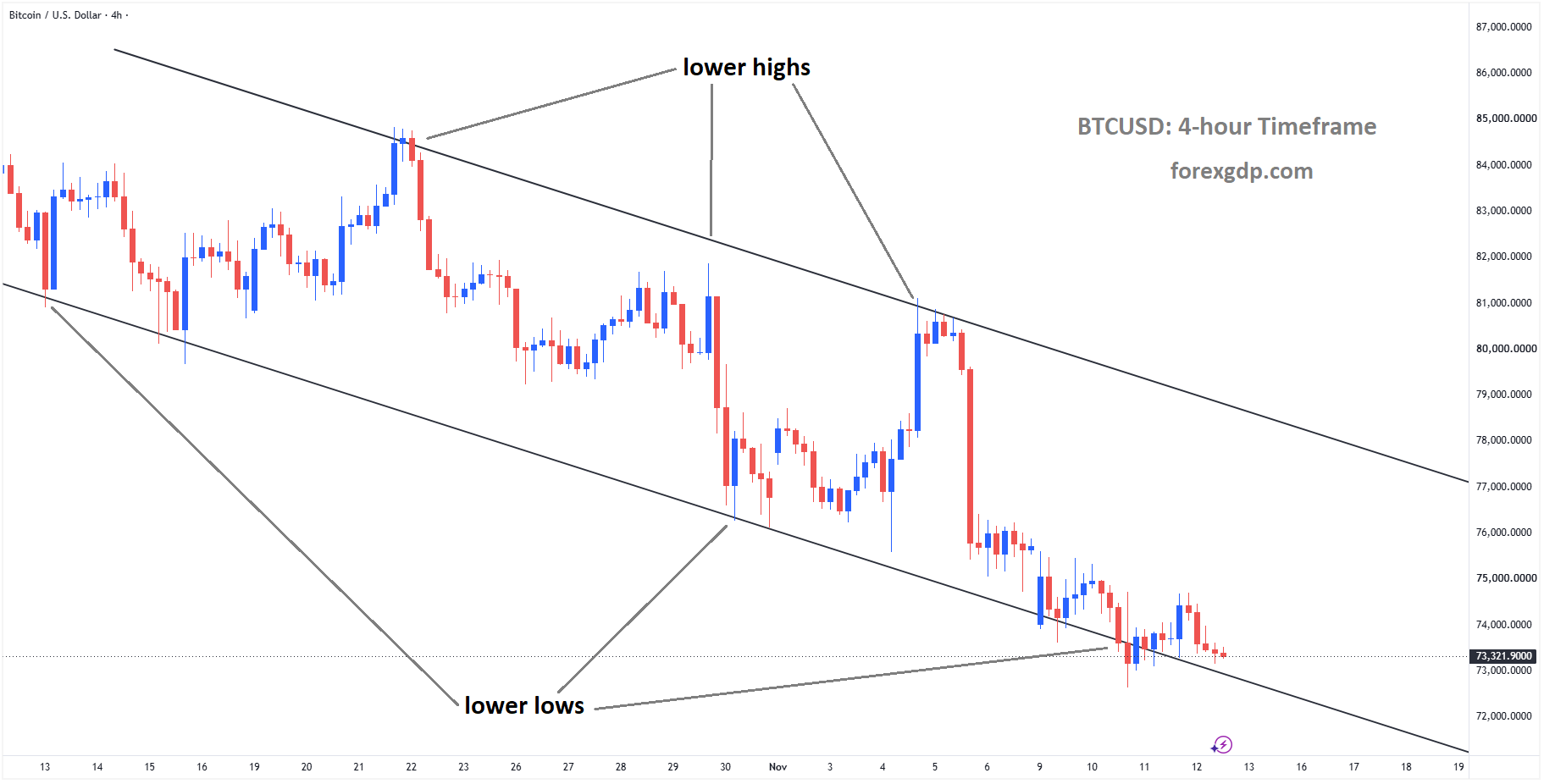
BTCUSD reached the lower low area of the descending channel
The report could provide additional information about inflation pressures across the US economy.
Christopher Tahir, Senior Financial Markets Strategist at Exness, has highlighted the combination of political uncertainty, monetary policy expectations, and weaker institutional demand as important influences on Bitcoin.
He also noted that some major holders are selling cryptocurrency to reduce debt, with further sales possible if supportive developments remain limited.
Together, these factors suggest that investor confidence may remain sensitive to economic news and policy announcements.
Summary
Bitcoin is navigating a challenging environment shaped by persistent US inflation, Federal Reserve interest rate expectations, unresolved cryptocurrency legislation, and changing institutional investment activity.
Large Bitcoin sales by mining companies and continued withdrawals from spot Bitcoin ETFs have added to concerns about demand. Meanwhile, Strategy’s ongoing accumulation demonstrates that long-term corporate interest has not disappeared.
The upcoming US producer inflation report and December Federal Reserve meeting could provide greater clarity about the direction of monetary policy.
Regulatory developments in the new Congress will also be important for the cryptocurrency industry’s longer-term outlook.
For now, Bitcoin’s broader market environment remains uncertain, with economic conditions, institutional confidence, and government policy likely to play central roles in shaping investor sentiment.
Don’t trade all the time, trade forex only at the confirmed trade setups
Get more confirmed trade signals at premium or supreme – Click here to get more signals, 2200%, 800% growth in Real Live USD trading account of our users – click here to see , or If you want to get FREE Trial signals, You can Join FREE Signals Now!