
Trading the forex market isn’t just about predicting where a currency pair will go next. It’s about reading the story that price action tells you. And candlestick charts are one of the best storytellers in the trading world. Every candle holds a piece of the puzzle, but when patterns emerge, the narrative gets louder and clearer. That’s where candlestick paths like Engulfing, Pinbar, and Doji step in.
In this article, we’ll dive deep into these candlestick patterns, break them down into simple terms, and explain how traders like you can use them effectively. Think of this as your roadmap to understanding how emotions, psychology, and market forces show themselves through candlesticks.
What Are Candlestick Patterns?
Candlestick patterns are visual cues on a price chart. Each candlestick shows you the battle between buyers (bulls) and sellers (bears) within a certain timeframe. The body tells you where price opened and closed, while the wicks (or shadows) show the highs and lows.
When these candles combine in specific ways, they form patterns. These patterns are like footprints left behind by big market players. Learn to read them, and you’re no longer guessing—you’re following the clues.
Why Traders Swear by Candlestick Patterns
If you’ve ever wondered why so many traders obsess over candlesticks, here’s why:
-
They’re visual and simple. You don’t need to calculate formulas—just recognize shapes.
-
They reveal psychology. Fear, greed, hesitation—it’s all there.
-
They work across markets. Whether you’re trading forex, stocks, or crypto, candlesticks don’t discriminate.
-
They can act as leading indicators. Instead of reacting late, you often get early signs of reversals or continuations.
The Three Major Paths: Engulfing, Pinbar, and Doji
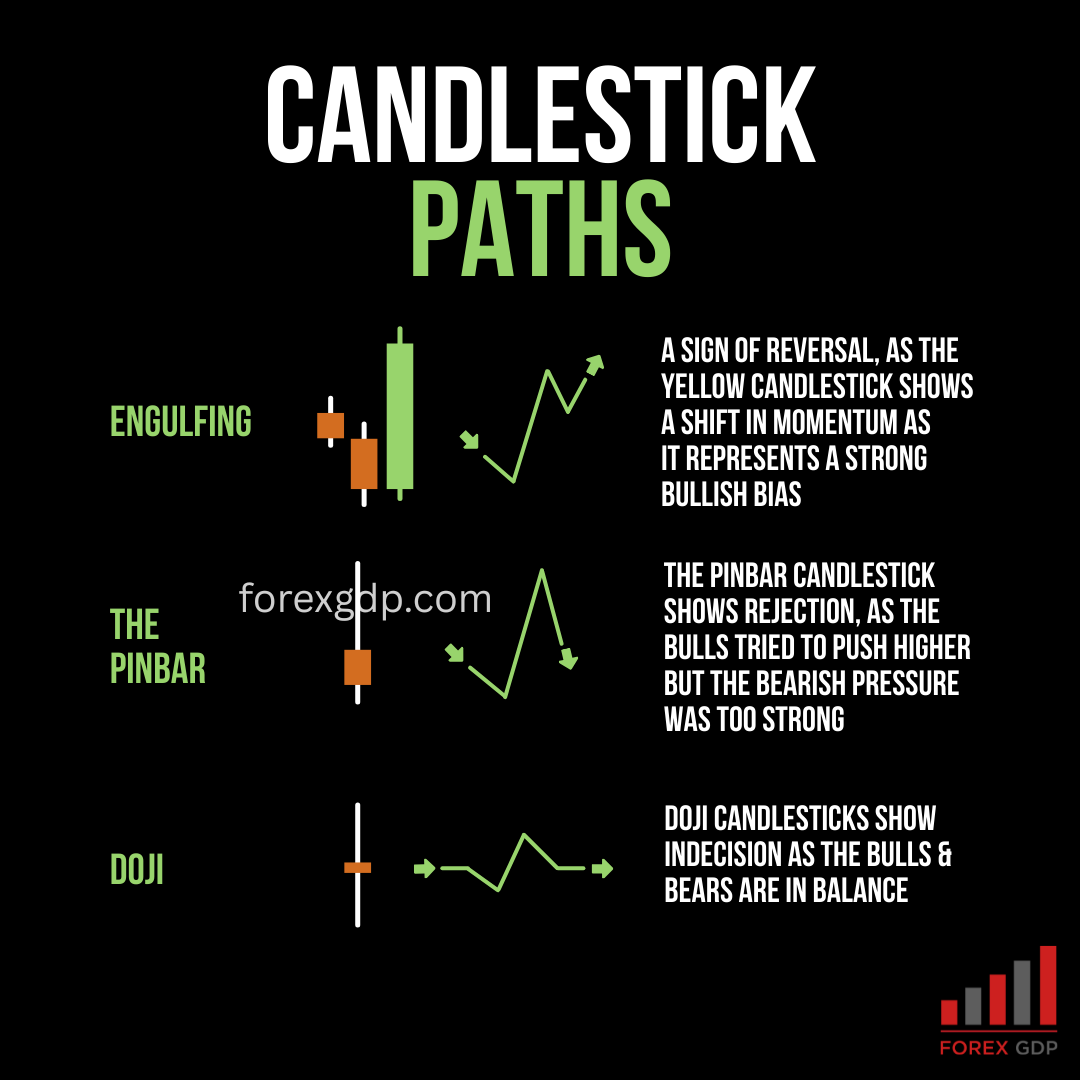
The infographic highlights three critical candlestick paths:
-
Engulfing – A reversal powerhouse.
-
Pinbar – A sign of rejection and market pushback.
-
Doji – A symbol of indecision.
Let’s break each down in detail.
Engulfing Candlestick: The Market’s Wake-Up Call
What It Looks Like
An engulfing pattern happens when a large candle completely swallows the body of the previous candle.
-
Bullish Engulfing: A green candle covers the prior red one.
-
Bearish Engulfing: A red candle covers the prior green one.
What It Means
This is a sign of reversal. It screams, “Momentum has shifted!”
For example:
-
In a bullish engulfing, sellers lose control, and buyers suddenly dominate.
-
In a bearish engulfing, buyers get crushed as sellers take charge.
How Traders Use It
-
Spotting trend reversals at support or resistance zones.
-
Combining it with indicators like RSI or moving averages for confirmation.
-
Entering trades with stop-losses tucked safely behind the engulfing candle.
The Psychology Behind Engulfing
Think of it like a tug-of-war. The first candle shows one team pulling ahead, but then the second candle not only pulls the rope back but drags it past the starting point. The sudden shift shows overwhelming strength from one side—momentum traders love this.
Pinbar Candlestick: The Rejection Signal
What It Looks Like
The pinbar (short for “Pinocchio bar”) is all about a long wick and a small body.
-
Long wick above the body: Signals bearish rejection.
-
Long wick below the body: Signals bullish rejection.
What It Means
Pinbars shout rejection. The market tried to go in one direction but failed.
-
Bulls push higher, but bears slam it back down → bearish pinbar.
-
Bears push lower, but bulls force it back up → bullish pinbar.
How Traders Use It
-
Trading reversals at major levels like supply and demand zones.
-
Setting entries after confirmation from the next candle.
-
Placing stops behind the wick for safety.
The Psychology Behind Pinbars
Imagine walking up to a locked door. You push hard, it doesn’t budge, and you’re forced back. That’s exactly what a pinbar shows—buyers or sellers tried, but the door (support/resistance) didn’t open.
Doji Candlestick: The Market’s Pause Button
What It Looks Like
A Doji has almost no body—just wicks. This means price opened and closed at nearly the same level.
What It Means
Doji patterns symbolize indecision. Bulls and bears fought, but nobody won.
It’s like the market taking a breather before deciding its next move.
How Traders Use It
-
As a warning sign of possible reversal.
-
Waiting for confirmation before trading (because Dojis alone aren’t reliable).
-
Identifying areas of market consolidation.
The Psychology Behind Doji
Picture two equally strong wrestlers locking hands in the middle of the ring. Neither gains ground, and the match stalls. That’s a Doji—balance and hesitation.
Common Mistakes Traders Make with These Patterns
-
Trading blindly: Jumping in on every pattern without confirmation.
-
Ignoring the context: A bullish engulfing in the middle of a choppy market? Worthless.
-
Over-leveraging: Trusting one candlestick to make them rich overnight.
-
Forgetting risk management: No stop-loss? That’s asking for disaster.

Tips to Use Candlestick Paths Like a Pro
-
Always check the bigger picture—use higher timeframes for confirmation.
-
Pair patterns with support/resistance zones.
-
Use them alongside technical indicators.
-
Don’t ignore fundamental news—a Doji won’t save you during an interest rate announcement.
Real-World Example: Engulfing in Action
Imagine EUR/USD is in a steady downtrend. Suddenly, you see a bullish engulfing at a key support level. The next candles push higher, confirming buyers have taken over. If you had jumped in, you’d have caught a fresh uptrend from the start.
Why Candlestick Patterns Work Across Markets
These patterns aren’t unique to forex. You’ll see them in stocks, commodities, and even crypto. Why? Because they’re based on human psychology, and human behavior doesn’t change. Fear and greed drive all markets.
Should You Trade Every Pattern You See?
Absolutely not. Think of these patterns as road signs. Just because you see a stop sign doesn’t mean you slam the brakes—it depends on traffic. Similarly, only act when the market context supports the signal.
Advanced Strategies with Candlestick Paths
-
Multi-timeframe analysis: A pinbar on the daily chart carries more weight than one on the 5-minute chart.
-
Pattern clusters: A Doji followed by an engulfing candle can be powerful.
-
Confluence trading: Combine candlestick paths with Fibonacci retracements, moving averages, or trendlines.
Conclusion
Candlestick patterns like Engulfing, Pinbar, and Doji are more than shapes on a chart. They’re reflections of trader psychology, power struggles, and market sentiment. Mastering them doesn’t mean you’ll never lose, but it gives you a sharper edge. The trick is not to use them in isolation—combine them with other tools, respect risk management, and always keep the bigger picture in mind.
The market speaks through candlesticks. The question is—are you listening?
FAQs
1. Are candlestick patterns reliable for beginners?
Yes, but only if combined with context and confirmation. Alone, they’re not foolproof.
2. What timeframe works best for candlestick patterns?
Higher timeframes (like 4H, Daily) generally provide stronger signals than lower ones.
3. Can candlestick paths predict 100% accurate outcomes?
No. They increase probability but don’t guarantee results. Always use risk management.
4. Which is stronger: Engulfing or Pinbar?
Engulfing often carries more weight because it shows a complete shift in momentum.
5. Do candlestick patterns work in crypto trading?
Absolutely. Since they’re based on human psychology, they apply to all markets.