

Innovation has always been a double-edged sword. On one hand, it opens doors to progress, convenience, and prosperity. On the other, it triggers waves of fear, skepticism, and resistance. Just take a look at the image above: electricity, trains, planes, the internet, and now Bitcoin. Each of these innovations was once labeled dangerous, unnecessary, or even evil. Yet today, most of them are part of our daily lives, and the same fate might just await Bitcoin.
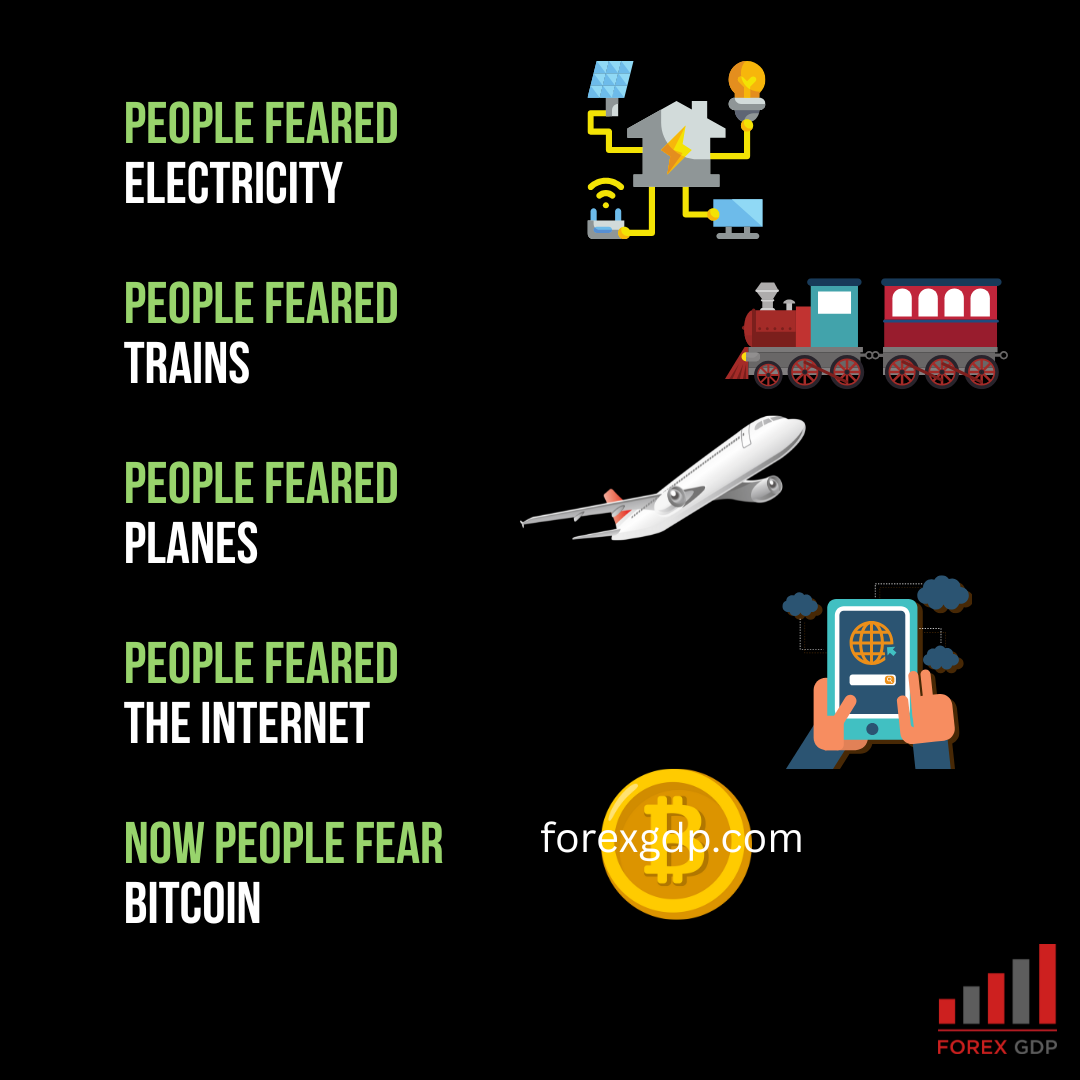
In this article, we’ll dive deep into why humans instinctively fear new technology, explore the history of fear around major inventions, and draw lessons from the past that could reshape how we view Bitcoin today.
Why Do People Fear Innovation?
Fear of the unknown is a survival instinct. For centuries, humans associated change with risk, danger, or loss of control. When a new technology emerges, it disrupts the status quo. That disruption makes people uncomfortable—because what’s familiar feels safe, even if it isn’t the best.
Think of it this way: our brains are wired to avoid danger, not to embrace uncertainty. Innovation brings uncertainty, and that sparks fear.
Electricity: The “Invisible Killer”
When electricity was first introduced, it wasn’t hailed as the miracle we see it today. In fact, people called it “the devil’s fire.”
-
Common fears: Many thought electric wires could explode anytime. Others believed it would kill plants, animals, or even people by simply being near it.
-
Reality check: Today, electricity powers every aspect of modern civilization. Without it, our homes, hospitals, and economies would collapse.
Yet, during its birth, electricity was viewed with the same suspicion people now reserve for Bitcoin.

Trains: “Too Fast for the Human Body”
Back in the 1800s, when trains first started running, critics claimed the human body wasn’t designed to move that fast.
-
Strange beliefs: Some doctors argued traveling at speeds above 30 mph could suffocate passengers. Others feared cows grazing near tracks would stop producing milk.
-
Outcome: Trains revolutionized travel, trade, and economic growth worldwide.
It sounds laughable now, but those fears were deadly serious to people at the time—just as today’s critics say Bitcoin will destroy economies.
Airplanes: Flying Coffins in the Sky
When the Wright brothers first took flight, the world didn’t celebrate. Instead, most people mocked or condemned the idea.
-
Public fear: Many said humans weren’t meant to fly, and airplanes were “suicide machines.”
-
Reality: Today, air travel is one of the safest forms of transportation, moving millions daily.
What was once a “death trap” is now a vital part of globalization. Doesn’t that sound eerily similar to the skepticism Bitcoin faces?
The Internet: A Dangerous Playground
The internet was branded a “fad” by critics in the 1990s. Some even believed it would destroy society.
-
Main fears: People thought online shopping was a scam, emails were unsafe, and websites were a waste of time.
-
Today: The internet drives global commerce, communication, and connection.
Remember when people said “don’t put your credit card online”? Now, we don’t think twice about ordering dinner or booking flights online.
Bitcoin: The Modern Scapegoat
And now, Bitcoin. Just like electricity, trains, planes, and the internet, Bitcoin is painted as a threat.
-
What people say today:
-
“It’s only for criminals.”
-
“It’s too volatile, you’ll lose everything.”
-
“Governments will ban it.”
-
“It has no real value.”
-
-
What Bitcoin really is: A decentralized digital currency that challenges traditional finance, offers transparency, and empowers individuals.
Of course, Bitcoin isn’t perfect. It’s volatile, misunderstood, and still evolving. But doesn’t every new innovation start that way?

Fear vs. Opportunity
Here’s the catch: the very thing people fear is usually the source of opportunity. Electricity birthed entire industries. Trains built economies. The internet created billion-dollar companies. Those who embraced these technologies early reaped the rewards.
So, what does that say about Bitcoin?
Why Governments Resist Bitcoin
Governments and banks thrive on control. Bitcoin threatens that by offering a system where money isn’t printed or controlled by any authority.
-
Centralized system: Banks act as middlemen, governments set policies, and people have limited say.
-
Decentralized system: Bitcoin allows peer-to-peer transactions with no gatekeepers.
That shift of power explains why authorities call Bitcoin “dangerous.” But history shows us that resistance often precedes acceptance.
Common Myths Around Bitcoin
Let’s bust some popular fears:
-
“Bitcoin is a bubble.”
Every innovation looks like a bubble before it stabilizes. Remember the dot-com crash? The internet survived and thrived. -
“It’s only for criminals.”
Fact: The majority of Bitcoin transactions are legal. Criminals use cash far more than crypto. -
“It has no backing.”
Neither does paper money. Bitcoin is backed by cryptographic proof and scarcity.
Lessons from the Past
Looking at the fears around electricity, trains, planes, and the internet, one pattern emerges: initial fear, followed by gradual acceptance, and finally, total dependence.
-
Electricity went from being “deadly” to indispensable.
-
Trains went from “unnatural” to essential.
-
Planes went from “unsafe” to mainstream.
-
The internet went from “a fad” to life itself.
So, why would Bitcoin’s journey be any different?
The Emotional Side of Fear
Fear isn’t just logical—it’s emotional. People don’t just ask, “Is this safe?” They also worry, “Will this change make me irrelevant? Will I lose control? Will I get left behind?”
Bitcoin represents a new financial order, and that scares people who are comfortable with the old one.

Will Bitcoin Follow the Same Path?
If history repeats itself (and it usually does), Bitcoin’s trajectory will mirror that of past innovations:
-
Fear and rejection.
-
Slow adoption.
-
Integration into daily life.
-
Dependence.
Someday, using Bitcoin might feel as normal as flipping a light switch or browsing the internet.
Conclusion
The image says it best: people once feared electricity, trains, planes, and the internet. All of these fears seem silly now, but they were very real back then. Bitcoin is simply the next chapter in this story. Fear today doesn’t mean failure tomorrow. It means opportunity is knocking, and history suggests it’s worth paying attention.
FAQs
1. Why do people compare Bitcoin to electricity or the internet?
Because every major innovation was once feared, dismissed, or ridiculed before becoming essential. Bitcoin is following that same historical pattern.
2. Is Bitcoin actually safe to use?
Yes, Bitcoin transactions are secure thanks to blockchain technology. The real risks come from scams, hacks on exchanges, or poor personal security.
3. Why is Bitcoin so volatile compared to other currencies?
Because it’s still in its early adoption phase. As more people and institutions use it, volatility is expected to decrease.
4. Can Bitcoin replace traditional money?
It may not completely replace it, but it can coexist. Just like digital payments didn’t erase cash entirely, Bitcoin could become a mainstream alternative.
5. Should I invest in Bitcoin despite the fear?
That’s a personal decision. But history shows that those who embraced innovations early often benefited the most. Just remember: never invest more than you can afford to lose.