

Trading successfully is not about guessing where the market will go next—it’s about understanding why the market moves the way it does. One of the most overlooked yet powerful concepts in trading is the difference between impulsive and corrective market structures. If you can recognize these two behaviors in price action, you’ll know when to stay patient, when to strike, and when to step aside.
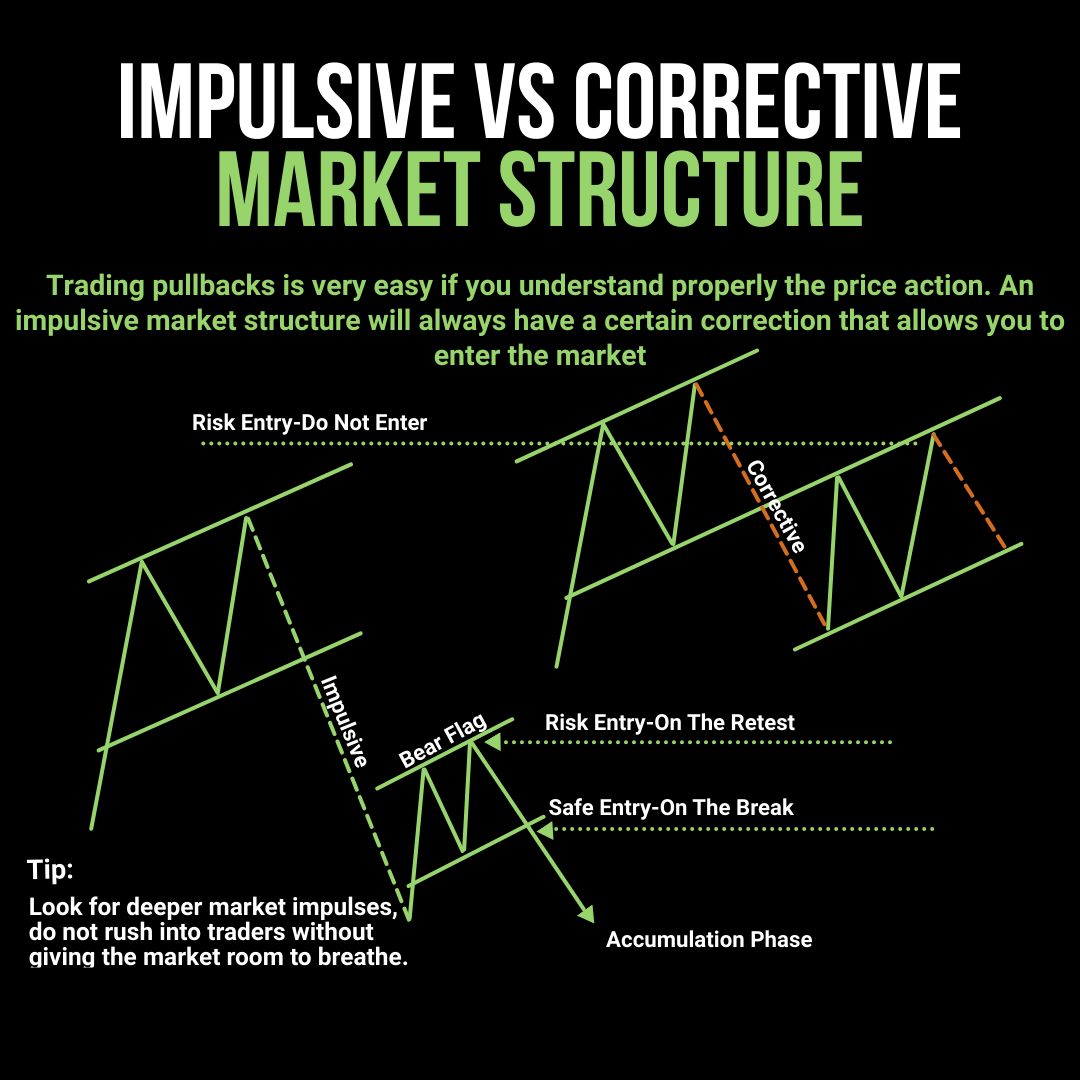
In this article, we’ll break down impulsive and corrective waves in detail, explore their psychology, and show you how to use them to improve your trading entries and exits. So, buckle up—we’re about to dive into the blueprint of market behavior.
What Is an Impulsive Market Structure?
An impulsive market structure is like a burst of energy. Imagine a sprint runner exploding out of the blocks—that’s what impulsive moves look like on a price chart. They’re fast, sharp, and usually cover a lot of ground in a short time.
In trading terms, an impulsive move happens when buyers or sellers dominate the market, driving price aggressively in one direction. Think of it as the market shouting, “I know exactly where I’m going!”
These moves often break key levels, smash through resistance or support zones, and leave little time for traders to think. That’s why impulsive waves are exciting but also dangerous if you chase them without a plan.
What Is a Corrective Market Structure?
If impulsive moves are sprints, corrective moves are jogs. They’re slower, more controlled, and filled with stops and turns. A corrective structure usually follows an impulsive move and represents the market catching its breath.
During corrections, price often moves sideways or slightly against the main trend. This is when traders argue: some take profits, others enter in the opposite direction, and the result is choppiness.
Corrections might feel boring compared to impulsive moves, but they’re essential. They set the stage for the next big wave. For disciplined traders, corrections are golden opportunities to plan safe entries instead of gambling on unpredictable impulses.
The Psychology Behind Impulsive Moves
Why do impulsive moves happen? The answer lies in trader psychology. Imagine a strong piece of news hits—like an interest rate hike or a shocking economic report. Suddenly, everyone rushes to buy or sell, and price explodes.
Fear and greed fuel impulsive waves. Traders hate missing out (FOMO), so they jump in late, pushing the price even further. But here’s the catch: once the panic or excitement fades, price often stalls or reverses sharply.
This is why blindly chasing impulsive moves is risky. If you’re not already in at the start, you’re probably too late.
The Psychology Behind Corrective Moves
Corrections tell a different psychological story. After the chaos of an impulsive wave, traders pause. Some take profits, while others look for entry opportunities. The tug-of-war creates a slower, more balanced structure.

It’s like the market is “resting” before deciding its next big move. Impatient traders may see corrections as wasted time, but smart traders know this is where you prepare your entries.
Think of corrections as the market whispering, “I’m getting ready—watch closely.”
How To Spot Impulsive Market Structures
Spotting impulsive moves isn’t rocket science. Here’s what to look for:
-
Strong Candles: Large, consecutive bullish or bearish candles.
-
Breakouts: Price smashing through resistance or support zones.
-
High Volume: Trading activity spikes as everyone piles in.
-
Steep Angles: The chart looks like it’s climbing or falling off a cliff.
If you see these signs, you’re likely witnessing an impulsive structure. But remember—if you’re late to the party, don’t crash it.
How To Spot Corrective Market Structures
Corrective waves look completely different:
-
Small Candles: Price moves in short bursts with indecision.
-
Sideways Action: The chart moves within a narrow range.
-
Channel Formations: Parallel trendlines forming flags or wedges.
-
Reduced Volume: Fewer traders active compared to impulsive waves.
Corrections may feel dull, but they’re safe zones for planning trades. Don’t underestimate them—they’re the quiet before the storm.
Common Mistakes Traders Make With Impulsive Moves


Many traders lose money because they misread impulsive moves. Here are classic mistakes:
-
Chasing After It’s Too Late: Entering at the peak of momentum only to watch price reverse.
-
Ignoring Risk Management: Going “all in” because the move feels obvious.
-
Mistaking Impulse for Trend: Believing every impulse is the start of a long-term trend.
These mistakes are costly because impulsive waves often snap back like rubber bands.
Common Mistakes Traders Make With Corrective Moves
Corrective moves come with their own traps:
-
Overtrading: Getting impatient and entering trades in the chop.
-
Forcing Trends: Trying to predict big moves when the market is resting.
-
Ignoring the Bigger Picture: Forgetting that corrections usually continue in the direction of the impulse.
The lesson? Don’t fight corrections—learn from them.
Safe vs Risky Entry Points
The infographic gives a crystal-clear lesson:
-
Risky Entry: Jumping into trades at the wrong spots, like during impulsive highs or lows. This feels tempting but often ends in losses.
-
Safe Entry: Waiting for corrections, breakouts, or retests before committing. It’s slower, but your odds of success skyrocket.
Patience is your shield. Rushing into the market is like stepping into traffic without looking both ways.
Trading Strategies for Impulsive Structures
If you want to trade impulsive waves, you need a solid plan:
-
Breakout Trading: Enter as soon as a level breaks, but only with a tight stop-loss.
-
News Trading: React quickly to high-impact news events.
-
Momentum Riding: Use indicators like RSI or MACD to confirm strong momentum.
The golden rule? Get in early or stay out. Never chase.
Trading Strategies for Corrective Structures


Corrections offer safer strategies:
-
Flag and Pennant Trading: Identify continuation patterns and enter on the breakout.
-
Retest Entries: Wait for price to retest broken levels before entering.
-
Accumulation Phase Trading: Spot accumulation zones and prepare for the next impulse.
These methods feel less exciting than impulse chasing but often deliver steadier profits.
Combining Impulsive and Corrective Structures
Here’s the real magic: don’t treat impulsive and corrective waves separately—combine them.
-
Spot an impulsive move.
-
Wait patiently for the corrective phase.
-
Enter strategically when the correction ends.
This is like surfing: you wait for the big wave (impulse), then position yourself during the lull (correction), and ride it safely when it picks up again.
Using Stop-Loss and Risk Management
No matter how good your analysis is, the market can still slap you in the face. That’s why risk management is non-negotiable.
Place stop-loss orders below corrective patterns or above resistance zones. Always risk what you can afford to lose. Remember: survival comes before profits.
Why Impulsive and Corrective Structures Repeat
Markets are driven by human behavior, and human behavior is predictable. Fear, greed, and patience cycle endlessly. That’s why impulsive and corrective structures appear again and again across all timeframes—from one-minute charts to weekly charts.
Once you master spotting them, you’ll realize the market is less random than it seems.
Practical Tips for Traders
-
Don’t rush into trades during impulses.
-
Respect corrections as preparation phases.
-
Always zoom out—look at higher timeframes.
-
Combine technical patterns with fundamental news.
-
Stay disciplined even when FOMO screams at you.


Conclusion
At the heart of every market move lies a dance between impulsive and corrective structures. The impulsive waves are powerful but risky, while corrections are calmer yet crucial for safe entries. The best traders aren’t those who chase every impulse but those who patiently wait for the correction and strike with discipline.
If you want consistency, remember this: the market isn’t a sprint; it’s a marathon. Trade safe, trade smart, and never forget that survival is the first victory.
FAQs
Q1: Are impulsive moves always followed by corrections?
Yes, almost always. The market needs to “breathe,” so after an impulse, a correction typically follows.
Q2: Can I make money just trading impulses?
You can, but it’s risky. Unless you’re fast and disciplined, you’ll likely get caught at the wrong end.
Q3: Which timeframe is best to spot these structures?
They exist on all timeframes. Beginners should focus on 1H or 4H charts for clarity.
Q4: What indicators work best with impulsive/corrective trading?
Volume, RSI, and trendlines are useful. But raw price action is often the clearest signal.
Q5: Is it better to trade corrections or impulses?
Corrections usually offer safer and more reliable entries. Impulses are exciting but often dangerous if chased.