

If you’ve been around forex charts for a while, you’ve probably noticed how the market has this funny way of rejecting certain levels. Prices test them, tease them, and then snap back like a rubber band. That’s where rejection structures come into play. These patterns are like the footprints left by big players in the market—clues that help us figure out whether buyers or sellers are secretly running the show.
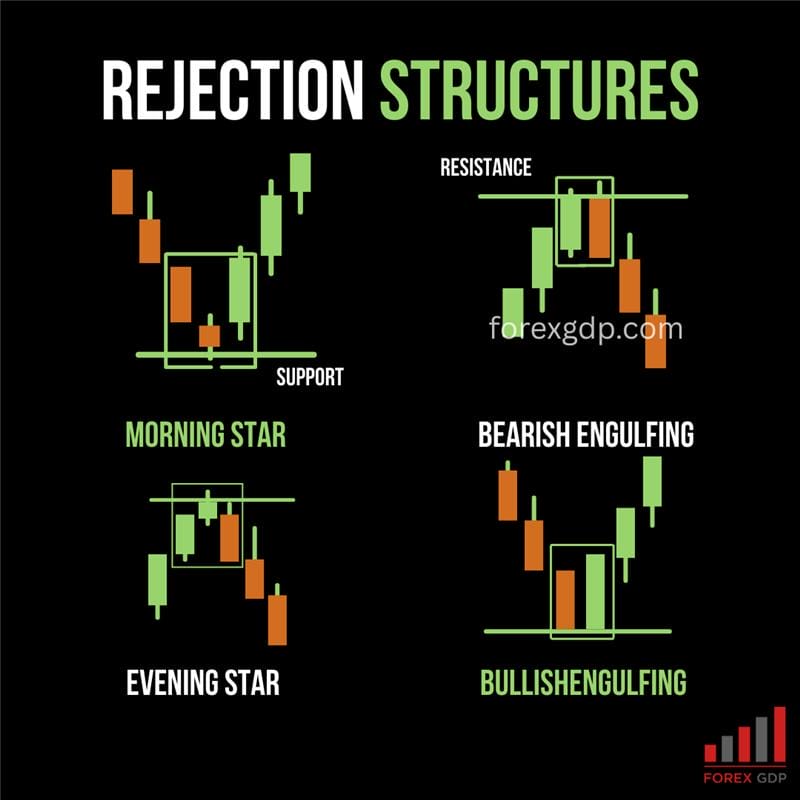
In this article, we’ll break down rejection structures in detail. We’ll explore candlestick formations like Morning Star, Evening Star, Engulfing Patterns, and the way support and resistance levels hold their ground. By the end, you’ll not only know what these setups look like but also how to trade them with confidence.
What Are Rejection Structures?
At their core, rejection structures are chart patterns that tell us the market tried to move in one direction but failed miserably. Picture someone pushing against a locked door—after a while, they give up and walk away. That’s exactly what happens when price tests a support or resistance zone and gets shoved back.
These rejections matter because they hint at market sentiment shifts. Buyers couldn’t push through resistance? Sellers might take over. Sellers failed at support? Buyers could step in aggressively.
Why Rejection Matters in Forex
Rejection isn’t just about one candle—it’s about the story it tells. When the market rejects a level, it screams:
-
“Enough is enough!” Sellers can’t push lower, so buyers rush in.
-
“Not today!” Buyers get overpowered at a resistance point, and sellers slam prices down.
These setups are golden because they often mark turning points in the market. They’re like road signs telling you, “Hey, the trend might be changing here.”
Support and Resistance Rejections
One of the simplest rejection structures is when price reacts at support or resistance levels.
-
Support Rejection: Price dips into a support zone, maybe even pierces it a little, but then shoots back up. It’s like the market saying, “This floor is solid.”
-
Resistance Rejection: Price climbs into resistance, wicks above it, and then crashes down. Think of it as hitting a glass ceiling—no matter how hard you try, you just can’t break through.
Both of these scenarios create trading opportunities because they show where supply and demand are battling it out.
Morning Star: The Hopeful Reversal
The Morning Star is like a light breaking through the dark night—it signals a potential bullish reversal. It’s a three-candle pattern:
-
A big bearish candle (sellers in control).
-
A small indecisive candle (buyers creeping in, sellers losing steam).
-
A strong bullish candle (buyers take over).
This rejection pattern usually forms at the bottom of a downtrend and says, “The bears are tired, the bulls are back.”
Evening Star: The Bearish Counterpart
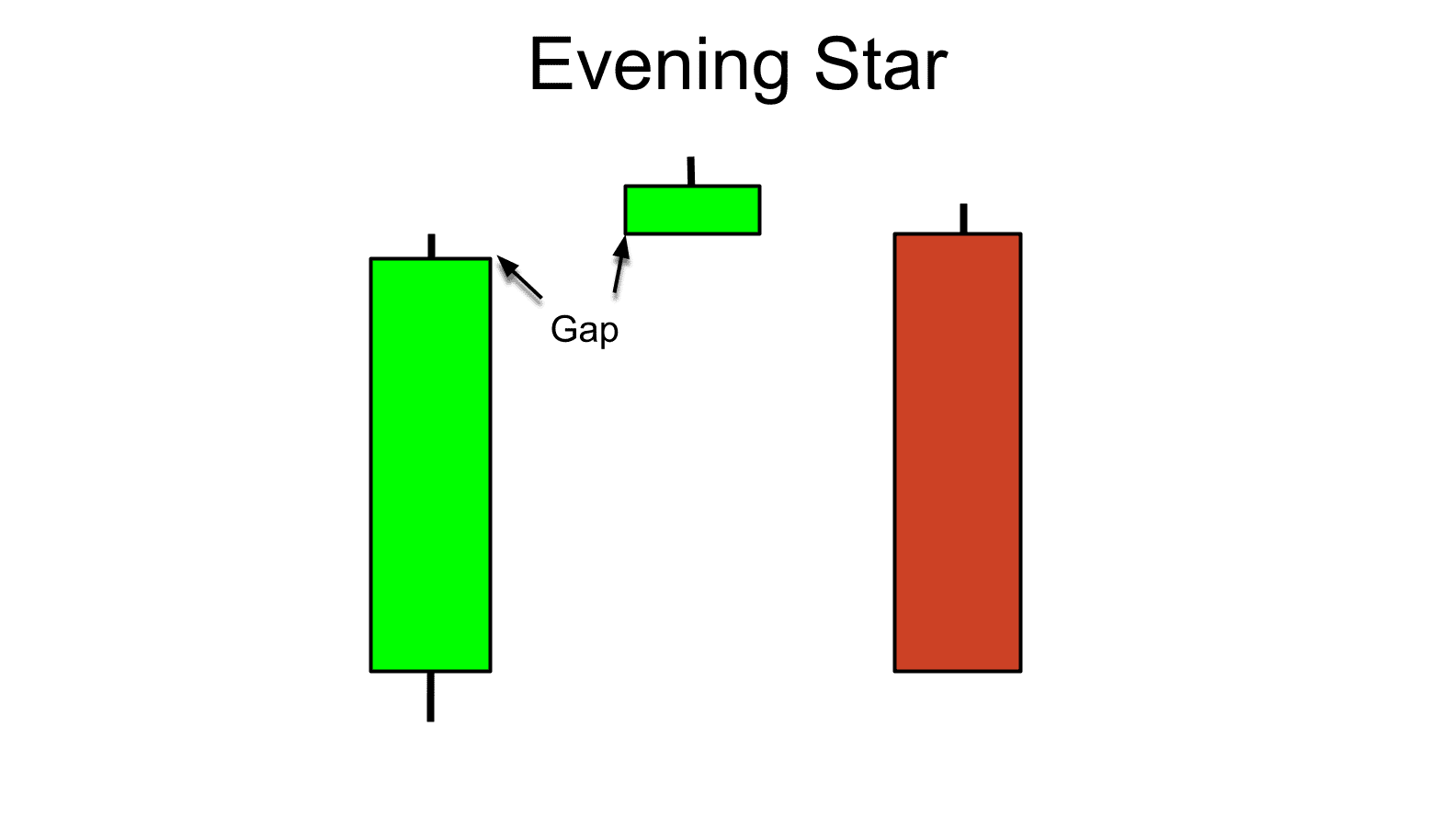
If the Morning Star is sunrise, the Evening Star is sunset. It’s also a three-candle formation:
-
A strong bullish candle.
-
A small candle showing hesitation.
-
A big bearish candle crashing down.
It typically forms at the top of an uptrend and hints that sellers are ready to grab the steering wheel.
Bullish Engulfing: The Buyer’s Takeover
The Bullish Engulfing pattern is one of the most dramatic rejection structures. It shows up after a downtrend and tells us buyers have had enough.
-
A small bearish candle forms first.
-
Then, a massive bullish candle completely swallows the previous one.
It’s like watching a tiny fire get swallowed up by a giant wave. The bears thought they had control, but the bulls said, “Not today.”
Bearish Engulfing: The Seller’s Strike
On the flip side, the Bearish Engulfing pattern is where sellers slam the brakes on a rally.
-
A small bullish candle forms first.
-
Then a huge bearish candle engulfs it entirely.
This structure screams rejection at resistance levels. The market tried to push higher but got smacked down with force.
How to Identify Strong Rejections
Not all rejections are created equal. Some are just noise, while others are powerful signals. Here’s how you know you’ve found a strong one:
-
Clear Support/Resistance Zone: Rejection is much stronger when it happens at a key level everyone is watching.
-
Long Wicks: Candles with long wicks show failed attempts to push through a level.
-
Volume Confirmation: Rejections backed by high trading volume carry more weight.
-
Pattern Clarity: If it looks like a Morning Star or Engulfing, don’t overthink it—it probably is.
Trading Rejection Structures

So how do you actually trade these setups without blowing up your account?
-
Wait for Confirmation: Don’t jump in on the first candle. Let the rejection pattern complete itself.
-
Use Stop-Loss Wisely: Place it just beyond the support or resistance level. If price breaks through, you’re wrong—get out.
-
Target the Next Level: Your take-profit should be the next logical support/resistance zone.
-
Combine with Indicators: Use RSI, Moving Averages, or Volume to filter out weak signals.
Common Mistakes Traders Make
Even though rejection structures look simple, traders often mess them up. Here’s how:
-
Jumping In Too Early: Seeing one wick and assuming it’s a rejection.
-
Ignoring Market Context: Trading a bullish engulfing pattern right into resistance is asking for trouble.
-
No Risk Management: Forgetting stop-losses is the fastest way to blow an account.
-
Overtrading: Not every rejection deserves your money. Pick the clean ones.
Psychology Behind Rejection Patterns
Rejection structures aren’t just about candles—they’re about psychology. Imagine a crowd at a concert trying to push into a packed venue. At first, people push hard (like price testing resistance). But once they realize there’s no way in, they give up and move back (price reverses).
That’s the psychology behind these moves. Sellers get exhausted at support, buyers get rejected at resistance—it’s all about herd behavior.
Rejections in Different Timeframes
One trap many traders fall into is sticking to a single timeframe. A rejection on the 5-minute chart doesn’t carry the same weight as one on the daily chart.
-
Lower Timeframes: Great for scalping, but noisy.
-
Higher Timeframes: More reliable, fewer false signals.
If you see a Morning Star on the daily chart, it’s a bigger deal than one on the 1-minute chart.
Why Rejections Fail
Here’s the ugly truth: not every rejection works. Sometimes price does break through support or resistance after faking a rejection. Why?
-
False Breakouts: Market makers love trapping retail traders.
-
Strong Trend: If you’re trading against a strong trend, rejections often fail.
-
Low Liquidity: Thin markets produce unreliable signals.

This is why confirmation and risk management are non-negotiable.
Conclusion
Rejection structures are like the market’s way of saying “Nope!” They highlight failed attempts by buyers or sellers to push price further. Patterns like Morning Star, Evening Star, Bullish Engulfing, and Bearish Engulfing give us clear signals that momentum might be shifting.
But here’s the catch—don’t blindly trade every pattern you see. Context matters. A rejection at a major support zone on the daily chart is powerful. One on a random 5-minute chart in the middle of nowhere? Not so much.
The beauty of rejection structures lies in their simplicity. They’re not complicated indicators or fancy algorithms. They’re just raw price action telling you where the fight between buyers and sellers is happening. And if you learn to read them properly, you’ll have one of the most powerful tools in your trading arsenal.
FAQs
1. Are rejection structures reliable for beginners?
Yes, but only if beginners combine them with risk management and wait for clear patterns instead of jumping in on every wick.
2. Which timeframe is best for spotting rejection patterns?
Daily and 4-hour charts give the most reliable signals, while lower timeframes can be too noisy.
3. Can rejection structures be used in crypto and stocks?
Absolutely. These patterns work anywhere price action exists—forex, crypto, stocks, commodities—you name it.
4. What’s the difference between a rejection and a breakout?
Rejection shows price failing at a level, while a breakout means price has successfully smashed through and continues.
5. Do I need indicators with rejection structures?
Not necessarily. Price action alone is enough, but indicators like RSI or volume can help confirm the strength of a rejection.