

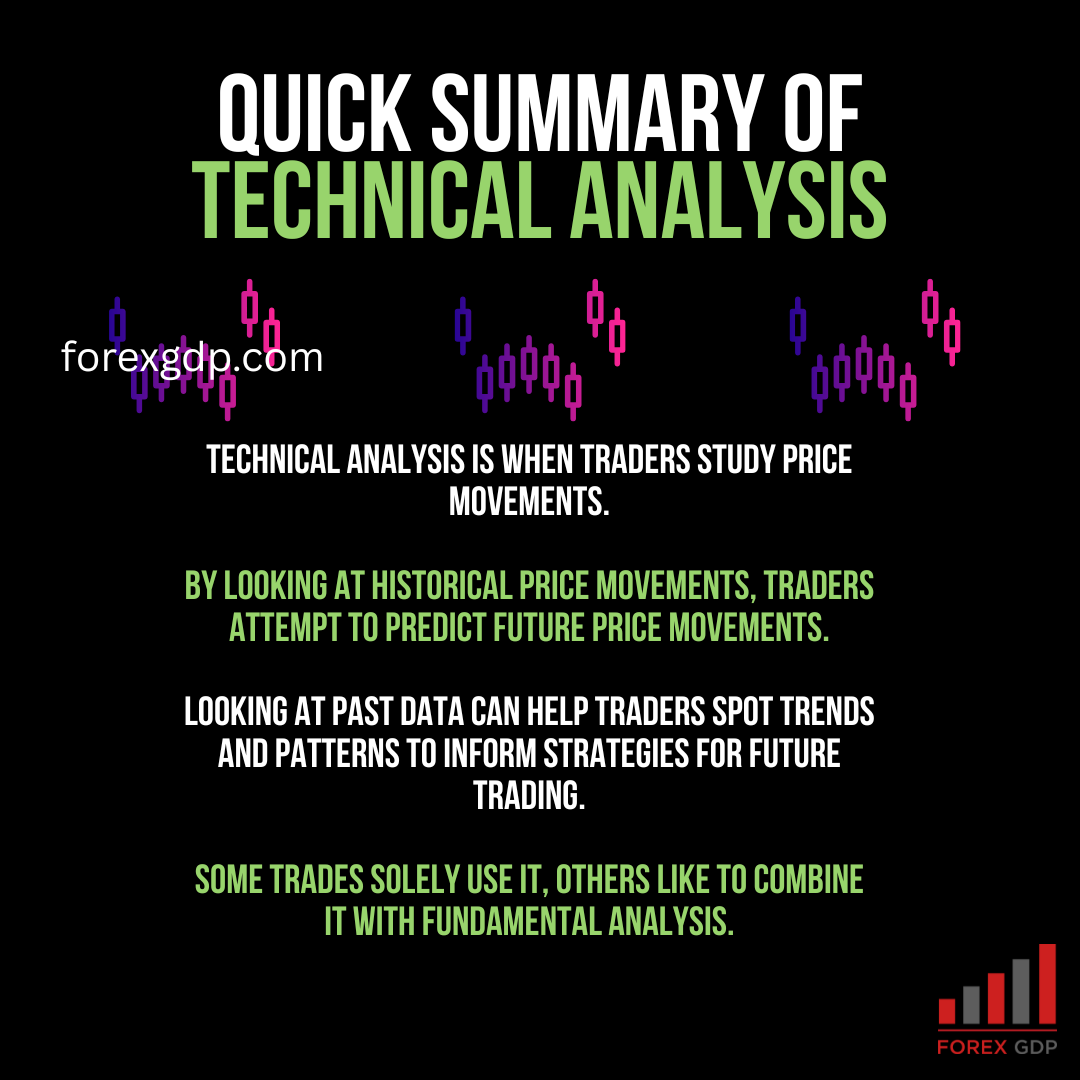
Technical analysis often feels like learning a new language—candlesticks, trends, and patterns can look like cryptic codes to beginners. But once you understand its essence, it becomes one of the most powerful tools in trading. The infographic you shared gives a quick summary, but here, we’ll go much deeper. Let’s expand on it into a detailed, 2000-word guide that unpacks technical analysis, its strategies, and why traders can’t seem to live without it.
What is Technical Analysis?
Technical analysis is the art of studying past price movements to predict where the market might go next. Instead of asking “Why did the price move?”, technical analysts ask “What is the price telling me?”
It strips away the news, rumors, and economic data to focus on the one thing that truly matters: price. If the price is moving up, something is driving it; if it’s falling, something else is at play. Traders believe that all factors—political, economic, emotional—are already baked into the price.
The Core Idea Behind Technical Analysis
At its heart, technical analysis rests on three principles:
-
Market action discounts everything.
All news, events, and trader psychology are already reflected in the price. -
Prices move in trends.
A trend isn’t just random noise—it’s a story unfolding. -
History repeats itself.
Patterns that appeared in the past tend to show up again because human behavior doesn’t change.
Think of it like weather forecasting. Meteorologists look at historical data to predict rain. Traders look at price history to predict market storms.
Historical Price Movements: Why They Matter
Ever wondered why traders are obsessed with old charts? It’s because past price behavior often repeats. For example:
-
If a stock bounced multiple times at $50 before, it’s likely to do the same again.
-
If a currency pair collapsed after hitting $1.20, traders watch that level carefully.
It’s like knowing a friend’s habits—you can guess their next move because you’ve seen it before.
The Role of Charts in Trading
Charts are the backbone of technical analysis. Without them, traders are blind. There are three main chart types:
-
Line Charts – Simple and easy, but lack details.
-
Bar Charts – Show open, high, low, and close.
-
Candlestick Charts – The most popular, rich with patterns and emotions.
Candlesticks are so revealing they’ve been called the “body language of the market.” A green candle shows optimism; a red candle shows fear.

Candlestick Patterns: The Trader’s Alphabet
Candlesticks form patterns that traders use like traffic signals. Some classics include:
-
Doji – Market indecision.
-
Hammer – A possible reversal from downtrend to uptrend.
-
Engulfing Pattern – Signals a strong change in sentiment.
Spotting these is like recognizing someone’s facial expression—you instantly know how they feel.
Support and Resistance: The Invisible Walls of the Market
Support and resistance are psychological levels where price tends to bounce or stall.
-
Support is like a trampoline. Price falls, hits support, and bounces back.
-
Resistance is like a ceiling. Price rises, hits resistance, and falls.
Traders live and die by these levels because they often mark great entry or exit points.
Trendlines and Channels: Reading Market Direction
Markets love trends—up, down, or sideways. Drawing trendlines helps traders spot direction.
-
Uptrend: Higher highs and higher lows.
-
Downtrend: Lower highs and lower lows.
-
Sideways: Stuck in a range.
Channels are like guardrails—if price stays within them, traders can ride the wave confidently.
Indicators and Oscillators: Tools That Add Clarity
Sometimes, raw charts aren’t enough. That’s where indicators come in:
-
Moving Averages – Smooth out price action.
-
RSI (Relative Strength Index) – Shows overbought/oversold conditions.
-
MACD (Moving Average Convergence Divergence) – Reveals momentum shifts.
Think of indicators as glasses—they don’t change the world but help you see it better.
The Psychology Behind Price Movements
Markets aren’t moved by numbers alone—they’re driven by fear and greed.
-
Fear makes traders sell too soon.
-
Greed makes them hold too long.

Technical analysis taps into this psychology by showing where traders are likely to panic or get greedy. That’s why patterns repeat—because emotions repeat.
Technical vs. Fundamental Analysis
Technical analysis looks at what the market is doing.
Fundamental analysis looks at why it’s doing it.
-
Technical traders: “I don’t care about earnings; I care about charts.”
-
Fundamental traders: “Charts are noise. Show me balance sheets.”
Many smart traders combine both—like using GPS and a paper map together.
Limitations of Technical Analysis
Here’s the hard truth: technical analysis isn’t foolproof.
-
False signals happen often.
-
Patterns don’t always work.
-
Indicators can lag.
It’s like predicting the weather—sometimes the forecast is wrong, and you end up in the rain without an umbrella.
How to Avoid Common Mistakes in Technical Analysis
Most traders fail not because of bad charts but because of bad habits:
-
Overcomplicating charts with too many indicators.
-
Ignoring risk management—technical analysis won’t save you if you trade recklessly.
-
Chasing signals instead of waiting patiently.
Remember: the goal isn’t to predict perfectly; it’s to manage risk smartly.
Should You Rely Solely on Technical Analysis?
Some traders swear by it, others dismiss it. The truth lies in between. Relying solely on technical analysis is risky, but ignoring it is foolish.
It’s like driving a car—you need both the speedometer (technical) and the GPS (fundamental) to navigate safely.

Building a Trading Strategy With Technical Analysis
To trade effectively, you need a structured plan:
-
Identify the trend (up, down, sideways).
-
Mark support and resistance levels.
-
Use candlestick patterns for entry signals.
-
Confirm with indicators like RSI or MACD.
-
Always set stop-loss orders.
A strategy is like a recipe—follow it consistently, and you’ll avoid cooking disasters.
Conclusion
Technical analysis is both an art and a science. It doesn’t promise perfection, but it equips you with tools to navigate the chaotic markets. By studying past price movements, spotting patterns, and respecting support and resistance, you gain an edge.
But remember: technical analysis isn’t magic. It’s a guide, not a guarantee. Combine it with discipline, patience, and maybe a pinch of fundamental analysis, and you’ll have a much better shot at surviving the wild world of trading.
FAQs
Q1: Can beginners use technical analysis effectively?
Yes, but start simple. Learn candlestick basics, draw support/resistance, and avoid using too many indicators at once.
Q2: Is technical analysis better than fundamental analysis?
Not better, just different. Technical tells you what’s happening now, while fundamental tells you why it’s happening.
Q3: Do candlestick patterns always work?
No. They work best when combined with other tools like volume, trendlines, and indicators.
Q4: How much history should I look at when analyzing charts?
It depends on your trading style. Day traders may only look at a few weeks, while swing traders study months or even years.
Q5: Can technical analysis predict black swan events?
No. Sudden, unpredictable events like crashes can’t be forecasted with charts. That’s why risk management is crucial.