

Trading can be exciting, addictive, and even life-changing. But let’s face it—most traders lose money not because they lack knowledge, but because they hold on to toxic habits that sabotage their progress. These habits are often hard to notice until they’ve drained your account and your confidence. If you’ve ever wondered why your trades keep going south even when your analysis is spot-on, chances are one (or more) of these bad habits is holding you back.
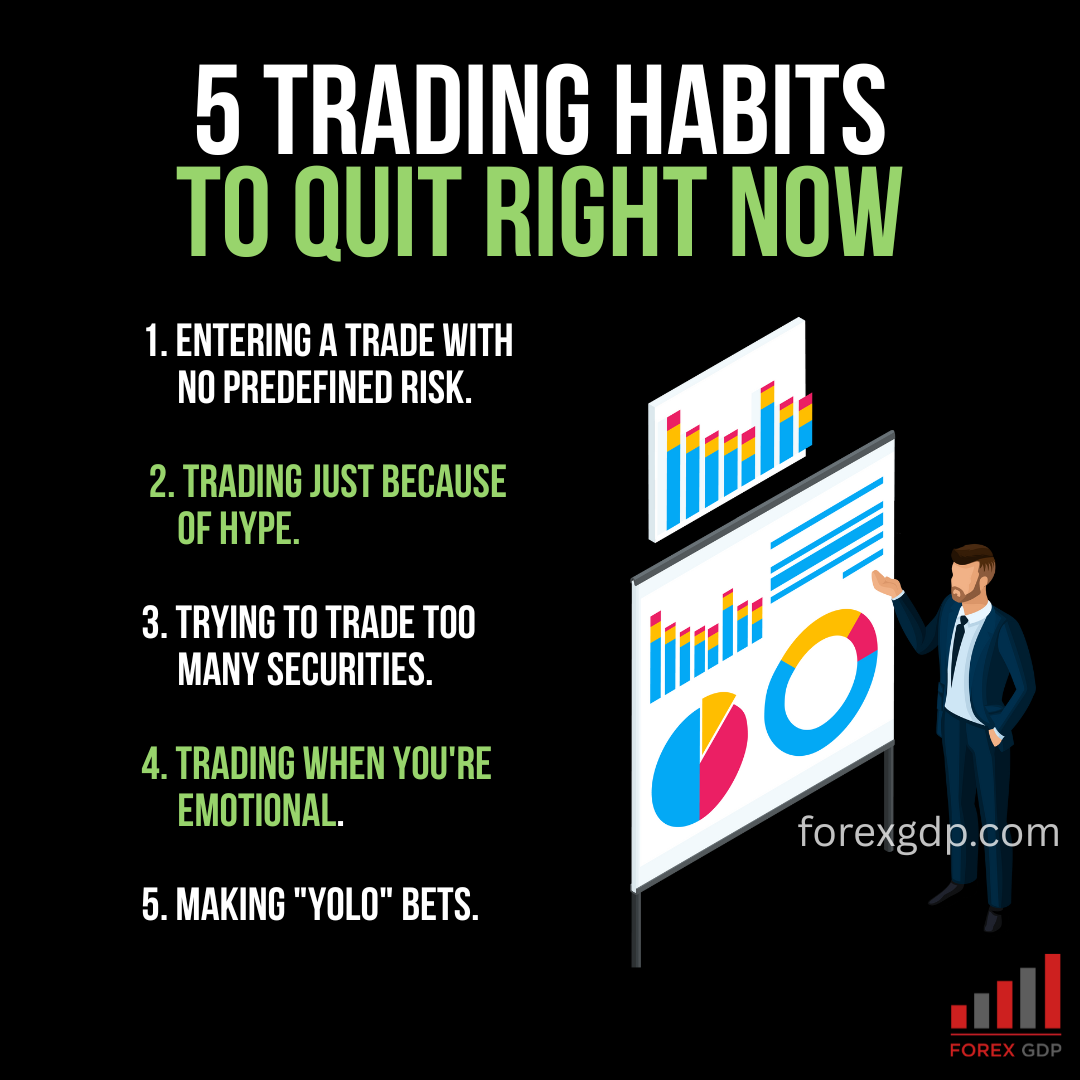
In this article, we’ll break down five dangerous trading habits you need to quit immediately, explain why they’re so destructive, and show you how to replace them with better strategies. By the end, you’ll not only recognize these pitfalls but also learn how to take control of your trading journey.
1. Entering a Trade With No Predefined Risk
One of the biggest mistakes traders make is entering trades without knowing how much they’re willing to lose. It’s like driving at full speed with no brakes—you’re asking for disaster.
Without a predefined risk, every trade becomes a gamble. You could wipe out weeks of gains in one bad move. Professional traders always know their risk-to-reward ratio before entering a position. If the numbers don’t make sense, they skip the trade.
Think of it this way: if you risk $100 to make $50, you’re not trading—you’re donating money to the market. On the other hand, if you risk $100 for the chance to make $300, you’re setting yourself up for sustainable growth.
Fix it: Always use stop-loss orders. Decide how much of your capital you’re willing to risk per trade (usually 1-2% of your account). Stick to it like glue.
2. Trading Just Because of Hype
We’ve all been there. Social media, chat rooms, and news outlets buzz about the “next big thing.” Everyone’s jumping in, and you feel like you’ll miss out if you don’t. But hype-driven trading is a trap.
Hype doesn’t equal profitability. By the time the noise reaches you, the smart money has already made its move. What’s left is usually a pump-and-dump scenario where latecomers take the fall.
It’s like buying a ticket to a party just as everyone’s leaving—you end up paying for the fun you never got to experience.
Fix it: Filter the noise. Stick to your analysis, not someone else’s excitement. If a trade setup doesn’t align with your strategy, let it go—no matter how “hot” it looks.
3. Trying to Trade Too Many Securities

Some traders think the more charts they watch, the better their chances of success. In reality, spreading yourself too thin dilutes your focus and leads to sloppy decisions.
When you try to trade 15 different securities, you don’t give yourself the time to deeply understand any of them. It’s like trying to juggle flaming swords—you’ll drop one, and it’ll hurt.
The best traders often specialize. They learn the behavior of a few markets or pairs so well that they can almost “feel” their moves.
Fix it: Pick a handful of securities (maybe 3–5) and master them. Quality beats quantity every time.
4. Trading When You’re Emotional
Emotions are the silent killers of trading accounts. Whether it’s fear, greed, or revenge trading after a loss, emotions cloud judgment.
Ever notice how you trade better when you’re calm? That’s no coincidence. Emotional trading is like drunk driving—you might get lucky once or twice, but eventually, you’ll crash.
The market doesn’t care how you feel. It rewards discipline and punishes recklessness.
Fix it: Step away when you’re stressed, angry, or overly excited. Use a trading journal to recognize emotional triggers. Sometimes, the best trade you can make is no trade at all.
5. Making “YOLO” Bets
We’ve all heard the phrase, “You only live once.” But when it comes to trading, YOLO bets are just reckless gambles dressed up as courage.
Throwing your entire account on one “sure thing” might sound thrilling, but it’s financial suicide. Even if you win once, you’ll likely get cocky and lose it all later.
Trading isn’t about swinging for the fences every time. It’s about staying in the game long enough to let your edge play out.
Fix it: Avoid oversized positions. Stick to consistent, calculated risks. Remember, steady gains beat one lucky jackpot every time.
6. The Illusion of Control
Many traders believe they can control the market with enough charts, indicators, or fancy tools. But the truth is harsh—the market is bigger than all of us. Thinking you can bend it to your will only sets you up for heartbreak.
The only thing you can control is yourself: your entries, your exits, your risk. That’s it.
Fix it: Stop obsessing over what you can’t control. Focus on building a solid routine, refining your strategy, and sticking to it.
7. Overtrading

Some traders can’t resist the urge to always be in the market. If they’re not in a trade, they feel like they’re missing out. This leads to impulsive entries, tiny gains, and big losses.
Overtrading is like overeating—you might enjoy it in the moment, but it’ll cost you dearly later.
Fix it: Quality setups only. If your system gives you 3–4 solid trades per week, accept it. The market will always be there tomorrow.
8. Ignoring Risk Management
You can have the best strategy in the world, but without risk management, it’s useless. Risk management is the seatbelt that keeps you alive during market crashes.
Many traders blow accounts not because their strategy failed but because they ignored position sizing, stop-losses, or capital allocation.
Fix it: Set rules for how much of your capital to risk per trade and per day. Follow them religiously.
9. Chasing Losses
Few things are as dangerous as trying to “win back” money you just lost. Revenge trading turns your plan into chaos. You end up doubling down on bad trades, hoping to break even.
It’s like trying to put out a fire with gasoline—you just make the damage worse.
Fix it: Accept losses as part of the game. Take a break after a losing streak. Reset your mind before coming back.
10. Ignoring the Bigger Picture
Many traders zoom in too close on charts, obsessing over tiny moves. They miss the overall trend, which is where real profits lie.
Trading on a 1-minute chart without checking the daily trend is like reading one page of a novel and thinking you know the whole story.
Fix it: Always zoom out before zooming in. Start with higher timeframes, then drill down. Let the bigger trend guide your decisions.
11. Blindly Following Gurus
It’s tempting to copy trades from so-called “experts.” But blindly following others robs you of independence. You never really learn, and when things go wrong, you don’t know why.
Fix it: Learn to trust your own analysis. Use others’ opinions as input, not instructions.
12. Neglecting a Trading Journal
Not tracking your trades is like playing a sport without keeping score. You’ll never know what works and what doesn’t.
A journal shows patterns in your behavior—both good and bad. It helps you fine-tune your edge and avoid repeating mistakes.
Fix it: Write down every trade. Note why you entered, how you felt, and what happened. Over time, you’ll uncover invaluable insights.
13. Thinking Trading Will Make You Rich Overnight
This is perhaps the most toxic mindset of all. Many beginners dive into trading expecting instant riches. When reality hits, they either blow their accounts or give up entirely.
Trading is not a get-rich-quick scheme. It’s a long game requiring patience, discipline, and constant learning.
Fix it: Adjust your expectations. Aim for steady progress, not overnight wealth.
Conclusion
The harsh truth? Trading is less about finding the perfect strategy and more about avoiding destructive habits. Bad habits will drain your account faster than any losing trade. By quitting these habits—like trading without risk, chasing hype, or making YOLO bets—you’ll not only protect your capital but also give yourself the mental clarity to trade smarter.
Remember, trading success isn’t about being right all the time; it’s about surviving long enough to let your edge work. So drop the toxic habits, tighten up your discipline, and trade with purpose. The market rewards patience, consistency, and self-control—not reckless behavior.
FAQs
1. Why is trading without predefined risk so dangerous?
Because you expose yourself to unlimited losses. A single bad trade could wipe out your entire account if you don’t cap the risk.
2. How do I know if I’m trading out of hype?
If your main reason for entering a trade is “everyone else is doing it,” you’re trading hype, not analysis.
3. Can trading too many securities really hurt my results?
Yes. It divides your focus and prevents you from truly understanding the behavior of each market.
4. How do I stop emotional trading?
Step away when you feel overwhelmed. Keep a journal to track emotional triggers and develop discipline.
5. Are YOLO trades always bad?
Yes, because they’re based on luck, not skill. Even if you win once, it encourages reckless behavior that usually ends in disaster.