

Trading in the forex market is often described as a battlefield. You walk into the market armed with charts, indicators, and strategies, but at the end of the day, one thing determines whether you walk away with profit or loss: your entry and exit levels. This is where the concept of Take Profit Levels comes into play.
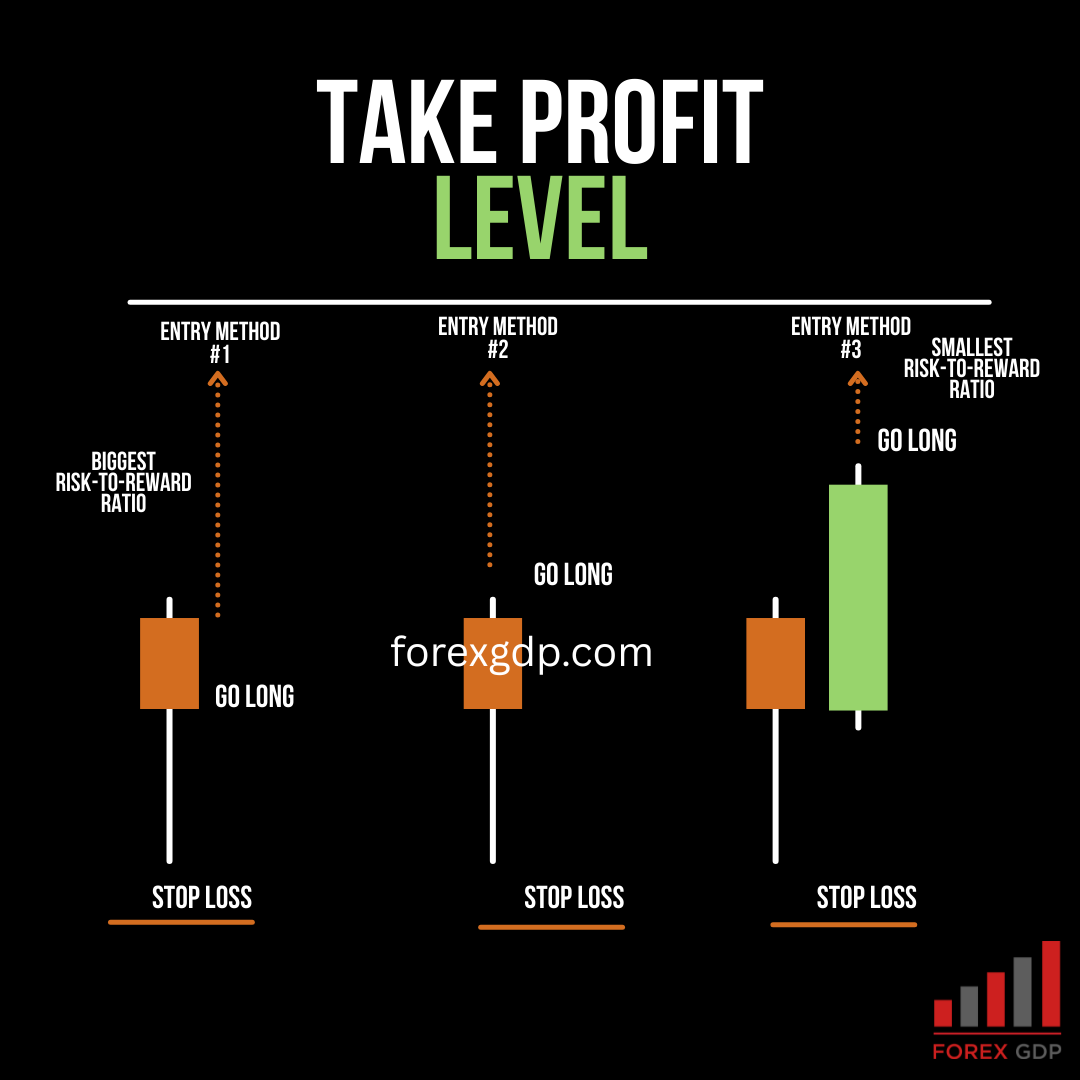
In this article, we’ll dive deep into the image you provided about different entry methods, risk-to-reward ratios, and why the right strategy can make or break your trades. If you’ve ever been frustrated about hitting stop loss more often than take profit, or if you struggle to understand why risk-to-reward matters so much, then buckle up. We’re about to break it down step by step.
What is a Take Profit Level?
A Take Profit (TP) level is the price point where you automatically close a trade to secure profits. Think of it as a safety net that grabs your winnings before the market turns against you. Without a TP, you’re basically gambling that the price will keep moving in your favor indefinitely. Spoiler alert: it rarely does.
Just like setting a Stop Loss (SL) protects you from devastating losses, setting a TP ensures that you actually lock in gains instead of watching them evaporate.
Why Do Traders Struggle With Take Profit?
Most traders fail not because they don’t understand how to enter a trade, but because they don’t know when to exit. Here’s why:
-
They get greedy and don’t set a TP at all.
-
They set TP too close and miss out on potential profits.
-
They set TP too far, and the price never reaches it.
-
They don’t consider the risk-to-reward ratio when setting TP.
The image clearly shows three different entry methods, each affecting the risk-to-reward ratio. This is the secret sauce that separates winning traders from those constantly blowing accounts.
Understanding Risk-to-Reward Ratio (RRR)
The Risk-to-Reward Ratio (RRR) measures how much you risk compared to how much you aim to gain.
For example:
-
If you risk $100 to gain $300, your ratio is 1:3 (great!).
-
If you risk $100 to gain $100, your ratio is 1:1 (meh).
-
If you risk $100 to gain $50, your ratio is 2:1 against you (terrible).
Now, let’s tie this to the three entry methods shown in the image.
Entry Method #1 – The Best Risk-to-Reward Ratio
In this method, you enter a trade right at the rejection zone, close to the wick low.
-
Stop Loss: Just below the wick.
-
Take Profit: Farther away, giving you a huge RRR.
-
Advantage: Biggest profit potential with minimal risk.
-
Disadvantage: Higher chance of being stopped out if the market retests the level.
This is the “smart sniper” approach. You take your shot early with tight risk but potentially massive reward.
Entry Method #2 – The Balanced Approach
Here, you wait for confirmation before entering.
-
Stop Loss: Below the candle wick.
-
Take Profit: Still reasonable, but not as high as Method #1.
-
Advantage: More reliable entry since you have confirmation.
-
Disadvantage: You sacrifice some of the risk-to-reward ratio.
This is like being cautious—you wait for the market to show its hand before committing.
Entry Method #3 – The Worst Risk-to-Reward Ratio
This method has the smallest risk-to-reward ratio because you enter late, after the big green candle confirms the trend.
-
Stop Loss: Still far below the wick.
-
Take Profit: Much closer compared to the risk.
-
Advantage: Very high probability of winning trades.
-
Disadvantage: Even if you win, your profits are tiny compared to your risk.
This is the “chasing the bus” strategy. Sure, you’ll catch a ride, but it won’t take you very far.
Why Risk-to-Reward Beats Win Rate
Many traders fall for the trap of chasing a high win rate. They think winning 80% of trades means they’re profitable. Wrong.
Imagine this:
-
You win 8 trades, each giving you $50. That’s $400.
-
You lose 2 trades, each costing you $200. That’s -$400.

Net profit? Zero.
Now compare with a trader who wins only 40% of trades but uses a 1:3 risk-to-reward ratio:
-
4 wins × $300 = $1200.
-
6 losses × $100 = -$600.
Net profit? $600.
See the difference? Profitability isn’t about how many trades you win, but how much you win when you’re right versus how much you lose when you’re wrong.
Psychology of Take Profit Levels
Trading isn’t just charts and numbers; it’s also about psychology.
-
Greed makes traders hold positions too long, waiting for “just a little more.”
-
Fear makes them close too early, missing out on bigger moves.
-
Overconfidence makes them set unrealistic take profits that the market never reaches.
This is why having a solid TP plan based on risk-to-reward is crucial. It keeps emotions out of the game.
How to Choose the Right Entry Method
So, should you always go for Method #1 since it gives the biggest RRR? Not necessarily.
-
If you’re a risk-taker, Method #1 is perfect.
-
If you prefer confirmation, Method #2 is safer.
-
If you want higher win rates, Method #3 may suit you, though your profits will be smaller.
The trick is finding what works best for your trading style, risk tolerance, and psychology.
Common Mistakes Traders Make
Here are the pitfalls you should avoid when setting TP levels:
-
Ignoring market structure – Placing TP randomly instead of at key resistance/support levels.
-
Using the same TP for every trade – Each setup is unique; adjust accordingly.
-
Risking more than 2% per trade – Even the best RRR can’t save poor money management.
-
Not adjusting TP when conditions change – The market isn’t static; adapt as it evolves.
-
Setting TP beyond market reach – Unrealistic expectations often lead to disappointment.
Practical Tips for Better Take Profit Levels
Here are some real-world tips to sharpen your TP strategy:
-
Use ATR (Average True Range): Helps you gauge realistic price moves.
-
Combine with Fibonacci: Place TP near 1.618 or 2.618 extensions.
-
Look left on the chart: Previous support/resistance often signals reversal zones.
-
Trail your stop: Move SL to break-even once the price moves in your favor.
-
Partial profits: Close part of your trade early and let the rest run.

The Negative Reality of Ignoring TP
Let’s face it—many traders blow accounts because they ignore proper TP planning. They either:
-
Close too soon and miss the big moves.
-
Hold too long and turn winners into losers.
-
Take tiny profits but eat massive losses.
Skipping TP is like climbing a mountain with no plan to come down. Sure, reaching the top feels amazing, but without a safe descent, you’ll eventually fall.
Final Thoughts
The concept of Take Profit Levels and Risk-to-Reward Ratios is the backbone of successful forex trading. Whether you’re a sniper (Method #1), a cautious player (Method #2), or a trend chaser (Method #3), what matters most is consistency and discipline.
Stop obsessing over win rates. Start focusing on risk management. After all, trading isn’t about being right all the time—it’s about making more when you’re right than you lose when you’re wrong.
FAQs
1. Should I always go for the biggest risk-to-reward ratio?
Not necessarily. Bigger ratios are tempting, but they also have higher chances of stop-outs. Balance is key.
2. What’s the ideal risk-to-reward ratio in forex?
Most pros aim for 1:2 or 1:3, meaning you risk $1 to make $2 or $3.
3. Can I trade profitably with a 1:1 ratio?
Yes, but only if your win rate is very high, which is hard to maintain long-term.
4. Should I move my TP once the trade is active?
Only if the market conditions change. Otherwise, stick to your plan to avoid emotional decisions.
5. Is it okay to trade without a take profit level?
No. That’s gambling. Always plan your exits just like you plan your entries.