

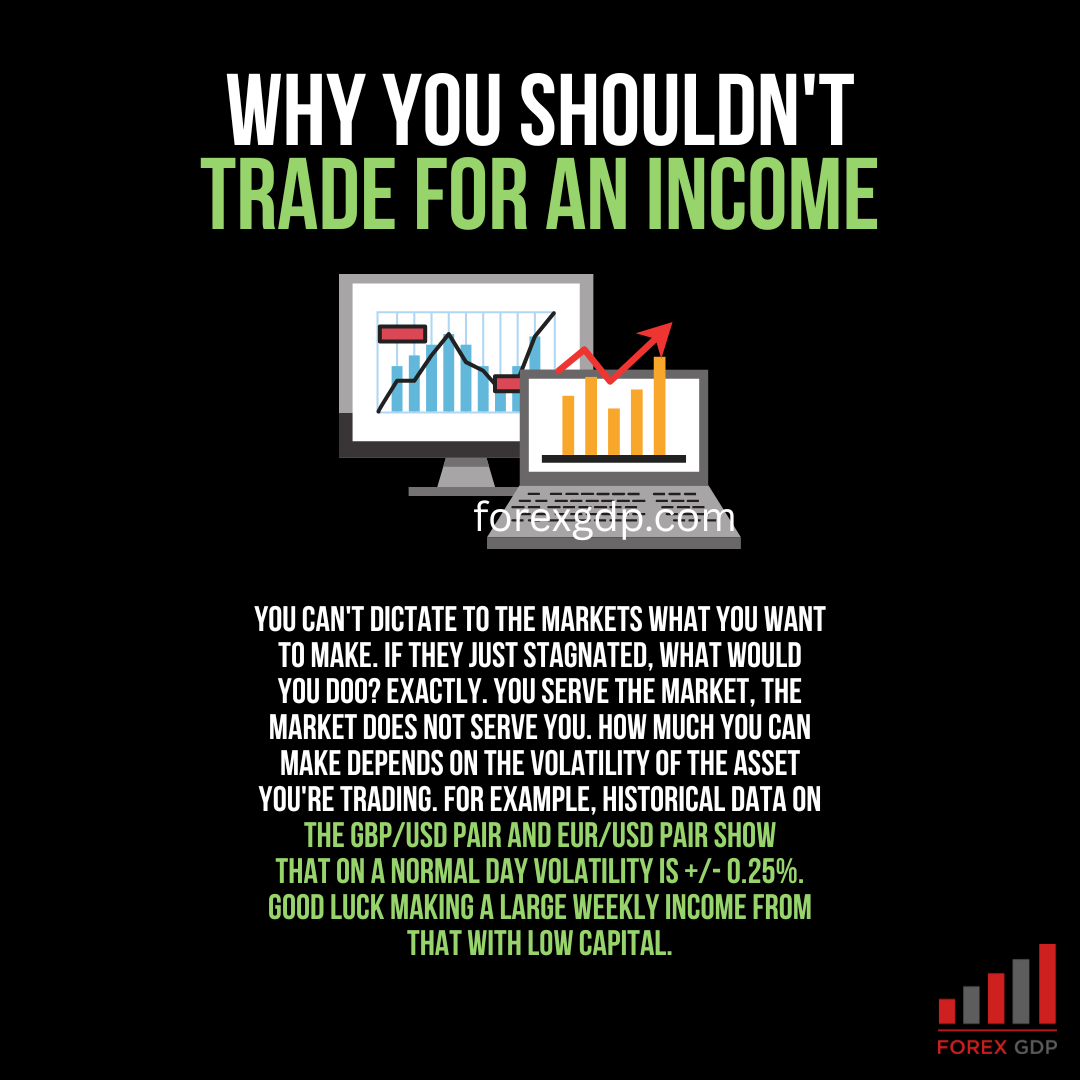
Trading often gets marketed as the ultimate dream—work from anywhere, no boss, unlimited profits. Sounds amazing, right? But here’s the harsh reality: trading is not a steady paycheck. The image you shared captures the essence perfectly—you can’t dictate to the markets what you want to earn. The market doesn’t care about your rent, your bills, or your lifestyle. If you’re trying to trade as a full-time income with little capital, you’re setting yourself up for disappointment.
In this article, we’ll go deep into why trading should not be your primary income source, uncovering the risks, myths, and realities that most beginners ignore. Buckle up—because this is going to sting a little.
The Illusion of Steady Trading Income
Most people step into trading thinking it’s like a job. You put in hours and expect money to roll in every week. But markets don’t operate on your schedule. Unlike a salary, trading income is inconsistent. Some weeks you’ll make profits, other weeks you’ll lose money. That’s not an “income stream”—that’s gambling with fluctuating odds.
Why the Market Doesn’t Care About You
Here’s the thing: the market doesn’t know you exist. It doesn’t care if you need $1,000 this week to cover bills. If volatility is low, if prices stagnate, you won’t see the moves you need. For example, historical data shows the GBP/USD and EUR/USD pairs move only about +/-0.25% on a normal day. That’s peanuts. Unless you’re trading with huge capital, you’re not making life-changing money out of that.
The Dangerous Dependence on Low Capital
Many traders start with small accounts—$100, $500, maybe $1,000. Then they dream of turning that into a full-time income. But here’s reality: with low volatility and small capital, you’d need to over-leverage just to see meaningful returns. That’s like playing Russian roulette with your money. One bad trade? Account blown.
Over-Leverage: The Silent Killer
Leverage is often sold as your best friend in Forex. Brokers love it because it keeps you hooked. But the truth? Leverage is a double-edged sword. Sure, it magnifies your profits, but it magnifies your losses even faster. When you’re trading for income, you’re tempted to push leverage harder—until the market snaps back and wipes you out.
The Psychological Trap of Income Trading
Imagine relying on trading to pay your bills. Every trade you place comes with added pressure: “If I lose this, I can’t pay rent.” That mindset makes you desperate. Desperation leads to overtrading, revenge trading, ignoring your stop loss, and chasing the market. Instead of being a strategist, you become an emotional gambler.
Consistency is a Myth
Have you ever seen a trader who makes money every single week? Probably not. Even the best hedge funds in the world have down months. Expecting consistency in your trades is like expecting sunny weather every day. Unrealistic. You might have profitable months, but there will also be losing streaks—and when your bills don’t wait, that becomes a disaster.

The Small Moves Problem
Let’s do some math. Say the EUR/USD pair moves 0.25% in a day. With a $1,000 account, unleveraged, that’s a $2.50 move. Not much of a “salary,” right? Even with 10x leverage, that’s $25. Now subtract spreads, commissions, and a bad trade or two. You’re left with scraps. This is why most traders chase unrealistic leverage just to feel like they’re making money—and that’s a recipe for ruin.
Why Income Trading Breeds Bad Habits
When your goal is “I need $500 a week,” you start forcing trades. You’ll take setups that don’t meet your criteria just to chase income. You’ll hold trades longer than you should, hoping they’ll turn profitable. You’ll double down on losers. Slowly, you destroy your discipline—and once discipline is gone, so is your account.
Markets Are Seasonal, Not Predictable
Think of the market like the ocean. Sometimes it’s calm, sometimes it’s stormy. You can’t demand waves when you want to surf. Trading works the same way—there are volatile seasons (news releases, global crises) and quiet seasons (summer months, holidays). If you depend on weekly income, you’re essentially begging for waves in a flat ocean.
Why Professionals Don’t Trade for Income
Look at hedge funds, prop traders, or professional portfolio managers. Do they rely on trading as a weekly paycheck? No. They think in terms of quarters, years, and long-term compounding. They manage risk, allocate capital wisely, and aim for steady growth over time. That’s sustainable. Weekly income trading? Not so much.
Trading as a Side Hustle, Not a Salary
Here’s the smarter approach: treat trading as a side hustle, not your main job. Use it to grow wealth slowly, not to pay rent tomorrow. With patience, discipline, and a long-term outlook, trading can supplement your income. But relying on it to replace a salary? That’s financial suicide.

The Reality Check: You Serve the Market
At the end of the day, the market doesn’t bend to your will. You serve the market—it doesn’t serve you. Your job is to adapt to what the market gives, not force it to provide you an “income.” Once you accept that truth, your mindset shifts from desperation to discipline. And that’s when you actually start seeing progress.
Conclusion
Trading for an income sounds glamorous, but it’s a dangerous illusion. The volatility is too low, the risks are too high, and the psychological pressure is unbearable. You can’t force the market to pay your bills—it simply doesn’t work that way. Instead of treating trading like a job, treat it like an investment journey. Grow your skills, build your capital, and focus on long-term consistency. Only then can trading become truly rewarding—without the crushing stress of chasing income every week.
FAQs
1. Can I quit my job and trade full-time with $1,000 capital?
No. With $1,000 and normal volatility, your profits will be tiny unless you over-leverage—and that will likely blow your account.
2. How much money do I need to realistically trade for a living?
Most professionals suggest at least $100,000+ in capital with strict risk management. Even then, consistency isn’t guaranteed.
3. Why do brokers advertise trading as a way to earn weekly income?
Because it attracts beginners. The harsh reality is brokers make money when you lose, so selling the “income dream” benefits them, not you.
4. Is it possible to make money trading at all?
Yes—but not as a steady paycheck. Think of trading as capital growth, not income replacement. Aim for long-term compounding instead.
5. What’s the best approach for beginners?
Start small, trade part-time, and focus on education, strategy, and discipline. Treat trading like a skill you’re mastering, not a lottery ticket.