

Trading in the Forex market has long been associated with high-tech computers, multiple screens, and sophisticated setups. But let’s face it — that image is outdated. In today’s world, you don’t need to be glued to a computer screen all day to become a successful trader. The reality is that mobile trading has taken over, giving traders the freedom to trade from anywhere — even while sipping coffee at their favorite café or relaxing on the beach.
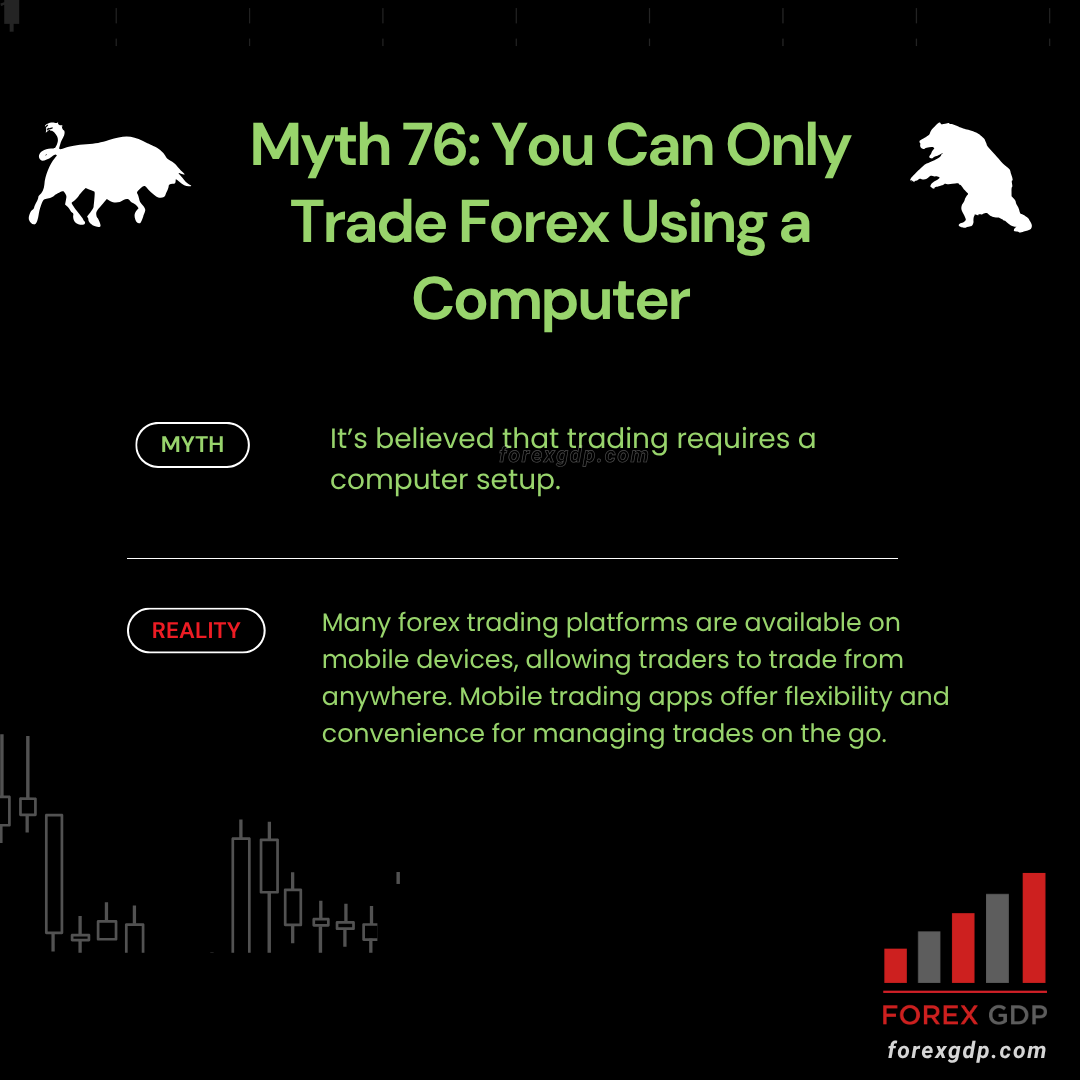
In this article, we’ll bust the myth that Forex trading is only for those with computer setups. We’ll explore the rise of mobile trading, its benefits, challenges, and how you can manage trades effectively right from your smartphone.
The Outdated Belief: Trading Requires a Computer
For years, traders believed that Forex trading was something that could only be done on a computer. And it made sense back then — trading platforms were complex, data-heavy, and optimized only for desktops.
People imagined professional traders surrounded by charts, graphs, and flashing monitors — a “Wall Street” image that became hard to shake off. This setup created the false impression that serious trading required a fancy computer setup.
But here’s the truth: technology has evolved. Modern Forex platforms no longer tie you to your desk. The rise of mobile apps has changed the entire landscape of trading.
The Rise of Mobile Trading
Today, mobile trading isn’t just a trend — it’s a revolution. With trading apps like MetaTrader 4 (MT4), MetaTrader 5 (MT5), and cTrader, traders can access the same features available on desktops but with added portability.
Smartphones and tablets now offer real-time price feeds, interactive charts, analytical tools, and instant order execution. You can literally manage your trades from your pocket.
Think about it: why would anyone want to be tied to a desk when the market never sleeps? Mobile trading brings the world of Forex to your fingertips.
Why the Computer Myth Still Exists
Despite technological advances, many people still cling to the belief that Forex trading must be done using a computer. Why? Because of outdated perceptions and fear of change.
New traders often see large monitors filled with charts on YouTube tutorials and assume that’s the only way to trade seriously. Others think that trading on a phone is “risky” or “unprofessional.”
In reality, these beliefs come from a lack of exposure. Mobile trading has matured drastically — it’s not just for checking prices anymore; it’s for managing entire portfolios.
Mobile Trading Apps: Compact Yet Powerful
Don’t underestimate what a mobile trading app can do. Platforms like MT4 and MT5 mobile versions are equipped with:
-
Interactive charts and indicators
-
Real-time quotes
-
Order management tools
-
Push notifications for trade alerts
-
One-click trading
It’s like having a mini trading desk right in your pocket. Sure, the screen is smaller, but the functionality is incredibly powerful. Traders can perform technical analysis, execute orders, and monitor performance anytime, anywhere.
Flexibility and Freedom: The Real Advantage
Imagine being able to monitor your trades while traveling, during lunch breaks, or even while waiting for a flight. That’s the freedom mobile trading gives you.
With mobile apps, you’re not confined to a physical location. Markets move fast — news breaks instantly — and being mobile means you can respond instantly. Whether it’s closing a losing trade or catching a new trend, every second counts.
This flexibility gives modern traders an undeniable edge over those tied to desktop setups.
Convenience Without Compromise
One of the biggest misconceptions about mobile trading is that it’s “less effective.” But that’s not true. Most mobile trading apps offer nearly identical functionalities as desktop versions.
You can analyze candlestick patterns, apply technical indicators, and even automate parts of your trading. The convenience factor is unmatched. No need to carry laptops or rely on Wi-Fi; your smartphone and data connection are enough.
Think of it like this — your mobile phone becomes your trading command center. Compact, efficient, and always within reach.
The Downsides of Mobile Trading (And How to Overcome Them)

Let’s be real — mobile trading isn’t perfect. There are downsides, and pretending otherwise wouldn’t be fair.
-
Smaller screen size: Analyzing multiple charts can be tricky.
-
Battery and internet dependency: Power loss or poor connection can interrupt trades.
-
Distractions: Notifications, calls, and apps can easily sidetrack you.
But here’s the thing: these are manageable. You can overcome them by:
-
Using tablets for bigger screen space.
-
Keeping a portable charger or power bank.
-
Setting your phone to “Do Not Disturb” mode during trading sessions.
Remember, it’s about discipline, not the device.
The Evolution of Trading Technology
Gone are the days when traders had to rely on dial-up connections and clunky software. Today, trading technology has advanced to a point where even AI-powered apps assist in decision-making.
Modern mobile platforms offer cloud synchronization, meaning your trades update across all devices — desktop, tablet, and phone — instantly. You can start a trade on your laptop and close it on your mobile within seconds.
The seamless integration between devices shows that the industry has embraced mobility wholeheartedly.
Can You Really Trade Effectively from a Mobile Device?
Absolutely! Successful traders aren’t defined by their equipment but by their strategy and mindset. Many professionals use mobile trading apps daily to manage open positions, monitor alerts, or make quick adjustments.
You don’t need to sit in front of multiple screens to analyze the market. What matters most is your understanding of market movements and your ability to make quick, informed decisions.
If your strategy is solid, your device doesn’t matter. It’s the trader — not the tool — that makes the difference.
Mobile Trading vs. Computer Trading


Let’s break it down with a fair comparison.
| Feature | Mobile Trading | Computer Trading |
|---|---|---|
| Accessibility | Anywhere, anytime | Fixed location |
| Charting Tools | Limited but functional | Advanced and detailed |
| Execution Speed | Fast with 4G/5G | Fast, depends on internet |
| Convenience | High | Moderate |
| Data Analysis | Basic to intermediate | Advanced, multitasking possible |
| User Interface | Simplified | Complex and detailed |
As you can see, both have their strengths. Many traders use a hybrid approach — analyzing charts on a computer and executing trades on mobile for flexibility.
Best Mobile Trading Platforms
If you’re planning to trade on the go, you need reliable apps. Here are a few of the best:
1. MetaTrader 4 (MT4)
The classic choice. MT4’s mobile app is smooth, simple, and efficient. It offers advanced charting tools, real-time quotes, and customizable alerts.
2. MetaTrader 5 (MT5)
The upgraded version of MT4 — it includes more indicators, more timeframes, and access to multiple asset classes.
3. cTrader
Known for its clean interface and excellent charting capabilities. It’s popular among advanced traders who need precision.
4. TradingView
A favorite for chart analysis and social trading insights. It’s not a broker itself but integrates seamlessly with major brokers.
These platforms prove that mobile trading is no longer a compromise — it’s a competitive advantage.
How to Get Started with Mobile Trading
Starting with mobile trading is simple:
-
Choose a reputable broker that supports mobile platforms.
-
Download the app (MT4, MT5, etc.) from Google Play or the App Store.
-
Log in with your trading account credentials.
-
Customize your dashboard with indicators, chart styles, and favorite pairs.
-
Start small. Test trades before going live.
Within minutes, you can start monitoring live charts, executing trades, and managing positions right from your phone.
Security Concerns in Mobile Trading


Many traders worry about security — and rightly so. But here’s the good news: modern mobile trading apps are designed with strong encryption and two-factor authentication (2FA).
Still, you should take precautions:
-
Avoid using public Wi-Fi for trading.
-
Enable fingerprint or face lock.
-
Regularly update your app.
-
Use VPNs for an added layer of security.
Your mobile can be as secure as a desktop if you handle it responsibly.
The Psychological Edge of Mobile Trading
Here’s something most people overlook — trading on mobile can reduce overtrading. Since your screen space is limited, you’re less likely to jump impulsively into random trades.
Mobile trading encourages simplicity. You focus only on the essentials — entry, exit, stop-loss, and targets — without getting lost in unnecessary details.
This helps build discipline and emotional control — two vital traits every trader needs.
The Future of Forex Trading
The future is mobile, there’s no doubt about it. With AI integration, cloud analytics, and voice-assisted commands, trading apps are becoming smarter every day.
Imagine saying, “Hey Siri, close my EUR/USD trade,” and it’s done. We’re almost there.
As mobile technology evolves, trading will become even more accessible. The barrier to entry is lower than ever, empowering more people worldwide to participate in the Forex market.
Why the Myth Needs to Die
It’s time to stop believing that serious trading requires a computer setup. The Forex market is evolving — and so should our mindset.

The real myth isn’t about computers or mobiles; it’s about what traders think they need to succeed. You don’t need multiple monitors, you don’t need a fancy office, and you definitely don’t need to be chained to a desk.
What you do need is knowledge, strategy, and the ability to adapt. That’s what separates real traders from dreamers.
Conclusion
So, let’s put this myth to rest once and for all — you do NOT need a computer to trade Forex.
Your smartphone is more than capable of helping you analyze, execute, and manage trades effectively. Whether you’re traveling, working, or just relaxing, mobile trading keeps you connected to the market 24/7.
Technology has made Forex trading more flexible, accessible, and convenient than ever before. The only limitation now is your mindset. Adapt to the change, embrace mobile trading, and trade smart — wherever you are.
FAQs
1. Can I trade Forex only using my smartphone?
Yes! Modern apps like MT4, MT5, and cTrader allow full control — from chart analysis to order execution — directly on your smartphone.
2. Are mobile trading apps safe to use?
Absolutely, provided you use official apps and secure connections. Always enable 2FA and avoid public Wi-Fi.
3. Is trading on a mobile device as accurate as on a computer?
Yes, the data and charts are identical. The only difference is screen size and multitasking capability.
4. Can I use both mobile and computer for trading?
Of course! Many traders analyze on a computer and execute on mobile. It’s the best of both worlds.
5. Which mobile trading app is best for beginners?
MetaTrader 4 (MT4) is ideal for beginners. It’s user-friendly, stable, and widely supported by brokers worldwide.