

Forex trading has always been wrapped in myths, and one of the biggest ones is the belief that it’s all about technical indicators. You’ve probably heard traders brag about their moving averages, RSI setups, or MACD signals as if these tools alone are the holy grail of trading success. But here’s the truth: relying solely on technical indicators is like trying to drive a car with just one wheel—it won’t get you far.
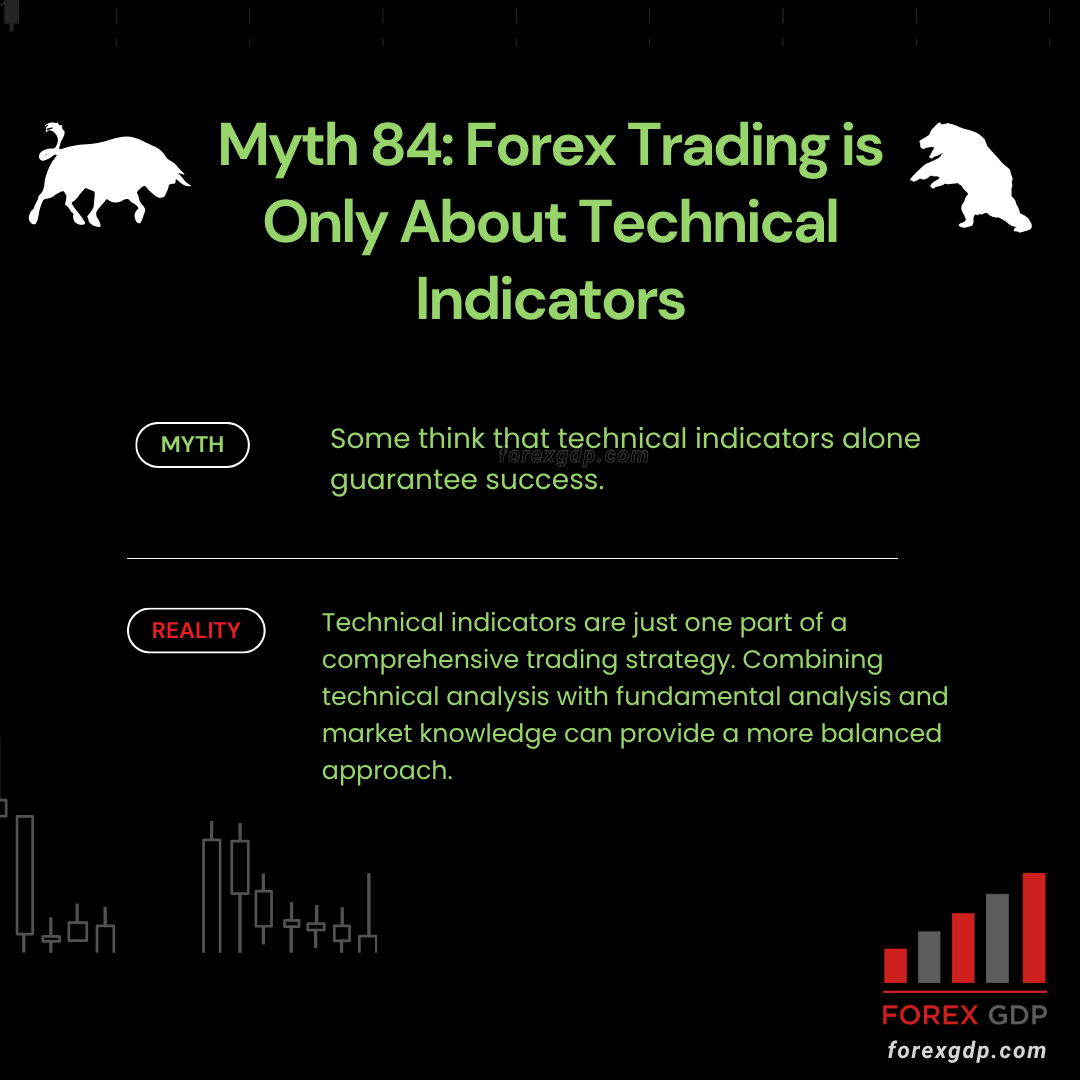
In this article, we’ll dive deep into why forex trading is not only about technical indicators, explore the limitations of depending on them, and uncover the other crucial elements every trader must consider. By the end, you’ll see why a balanced strategy that includes technical, fundamental, and psychological factors is the real key to success.
What Are Technical Indicators, Really?
Technical indicators are mathematical calculations applied to price charts. They analyze price, volume, or open interest to predict future market behavior. Tools like RSI, MACD, Bollinger Bands, and Moving Averages are widely used by traders to find entry and exit points.
Think of them as a trader’s toolbox—handy, yes, but they can’t build the entire house by themselves.
The Myth of Technical Indicators Guaranteeing Success
Many beginners jump into forex believing that once they master a few indicators, profits will roll in automatically. Why? Because indicators look clean, logical, and often give that false sense of certainty.
But let’s be honest—if indicators alone could guarantee success, every trader would be rich by now. The harsh reality is markets are unpredictable, and indicators often lag behind real market moves.
Why Relying Only on Indicators Is Dangerous
Indicators can trick traders into false confidence. Here’s why:
-
Lagging Nature: Most indicators are based on past price action. By the time an indicator flashes a signal, the move might already be over.
-
False Signals: Market noise often causes indicators to give fake entry/exit points.
-
Overcrowding: Millions of traders use the same tools. If everyone reacts the same way, liquidity thins out and moves become less predictable.
In short, technical indicators without context can lead you straight into the trap of overtrading and constant losses.
The Missing Piece: Fundamental Analysis
Here’s where most traders go wrong—they ignore the why behind price moves. Fundamental analysis digs into the economic, political, and financial factors driving currency markets.
Think about central bank interest rate decisions, inflation reports, employment data, or geopolitical conflicts. These events can wipe out technical setups in seconds. For example, you might see a perfect bullish signal on your chart, but if the U.S. Federal Reserve suddenly raises interest rates, your trade could flip red instantly.
Market Sentiment: The Invisible Force
Beyond technicals and fundamentals lies market sentiment—the collective psychology of traders. Ever noticed how sometimes markets move irrationally, even against all data and analysis? That’s sentiment at play.
Fear, greed, and herd mentality often override logic. If you don’t factor in sentiment, you’ll constantly be blindsided by sudden spikes and crashes.
The Role of Risk Management

Here’s the truth no one likes to admit: even the best strategy fails without solid risk management. You could use 10 indicators and still blow your account if you risk too much on one trade.
Setting stop-losses, managing position sizes, and sticking to a risk-to-reward ratio aren’t exciting, but they’re what keep traders alive in the long run.
The Psychological Battle in Trading
Trading isn’t just numbers—it’s a mental game. Many traders lose not because their strategy is wrong, but because they panic, overtrade, or can’t control emotions.
Indicators won’t stop you from revenge trading after a loss or getting greedy after a win. That’s where discipline and mindset come in. Without mastering your psychology, no indicator can save you.
Why Technical Indicators Still Matter
Don’t get it twisted—indicators are useful tools. They help spot trends, confirm signals, and filter out noise. But the point is, they’re not the only thing that matters. They should complement other aspects of trading, not dominate them.
Think of indicators as headlights in the dark. They illuminate part of the road, but they don’t show you the whole journey ahead.
A Balanced Approach to Forex Trading
So, what does a balanced trading strategy look like?
-
Technical Analysis: Identify entry and exit zones.
-
Fundamental Analysis: Understand the market drivers behind price moves.
-
Sentiment Analysis: Gauge crowd psychology and market mood.
-
Risk Management: Protect capital with rules.
-
Trading Psychology: Maintain discipline and emotional control.
Combining all these elements is like having a fully loaded car—engine, wheels, fuel, and GPS. That’s how you actually reach your destination.
Common Mistakes Traders Make with Indicators

-
Overloading Charts: Using five or more indicators at once, leading to confusion.
-
Ignoring Context: Believing a buy/sell signal without considering the news.
-
Blind Following: Treating indicators like fortune-tellers instead of tools.
-
Neglecting Backtesting: Trusting signals without testing them historically.
If you’ve done any of these, don’t worry—you’re not alone. The key is to learn and adapt.
The Truth About Indicator-Based Strategies
There’s no “magic indicator” that works in all conditions. Markets change—sometimes they trend, sometimes they range. An indicator that works in one situation may fail miserably in another. That’s why flexibility and adaptability are more valuable than rigid setups.
How Professionals Use Indicators
Professional traders don’t treat indicators as crystal balls. They use them as confirmation tools. For example, if fundamentals suggest USD is strong, a trader might use technical indicators to fine-tune their entry point.
The difference? Pros don’t blindly follow—they interpret indicators within a bigger picture.
The Balanced Reality
At the end of the day, forex trading is a cocktail of art and science. Technical indicators are just one ingredient. Without fundamentals, psychology, and risk control, the drink is incomplete.
Believing that forex trading is only about indicators is like believing you can bake a cake with only flour. You need sugar, eggs, and heat too.
Conclusion
Forex trading isn’t a one-dimensional game of chasing indicator signals. It’s a dynamic battlefield where economic events, psychology, and global sentiment collide. While technical indicators have their place, they’re just one piece of the puzzle.
To succeed, traders must embrace a holistic approach—combining technicals with fundamentals, sentiment, and disciplined risk management. Ignore these, and you’ll keep falling for the myth that forex is just about charts and signals. Accept them, and you’ll finally start trading with the clarity and balance needed to win.
FAQs
1. Can I trade forex using only technical indicators?
You can try, but you’ll likely struggle. Indicators alone often fail without considering fundamentals and market sentiment.
2. Which is more important: technical or fundamental analysis?
Neither is superior. Both complement each other. Technicals show “when,” fundamentals show “why.”
3. Why do technical indicators give false signals?
Because they’re based on past data and often lag behind real-time market moves, making them unreliable alone.
4. How many indicators should I use at once?
Stick to two or three that complement each other. Overloading charts only creates confusion.
5. What’s the biggest myth about forex trading?
That mastering a few indicators guarantees success. In reality, success comes from a mix of analysis, psychology, and risk management.