
In active trading environments, execution speed is rarely limited to market conditions alone. The movement of capital between exchanges, wallets, and trading strategies often introduces delays that can affect timing and opportunity. For this reason, blockchain networks are increasingly evaluated not as ecosystems, but as transfer infrastructure.
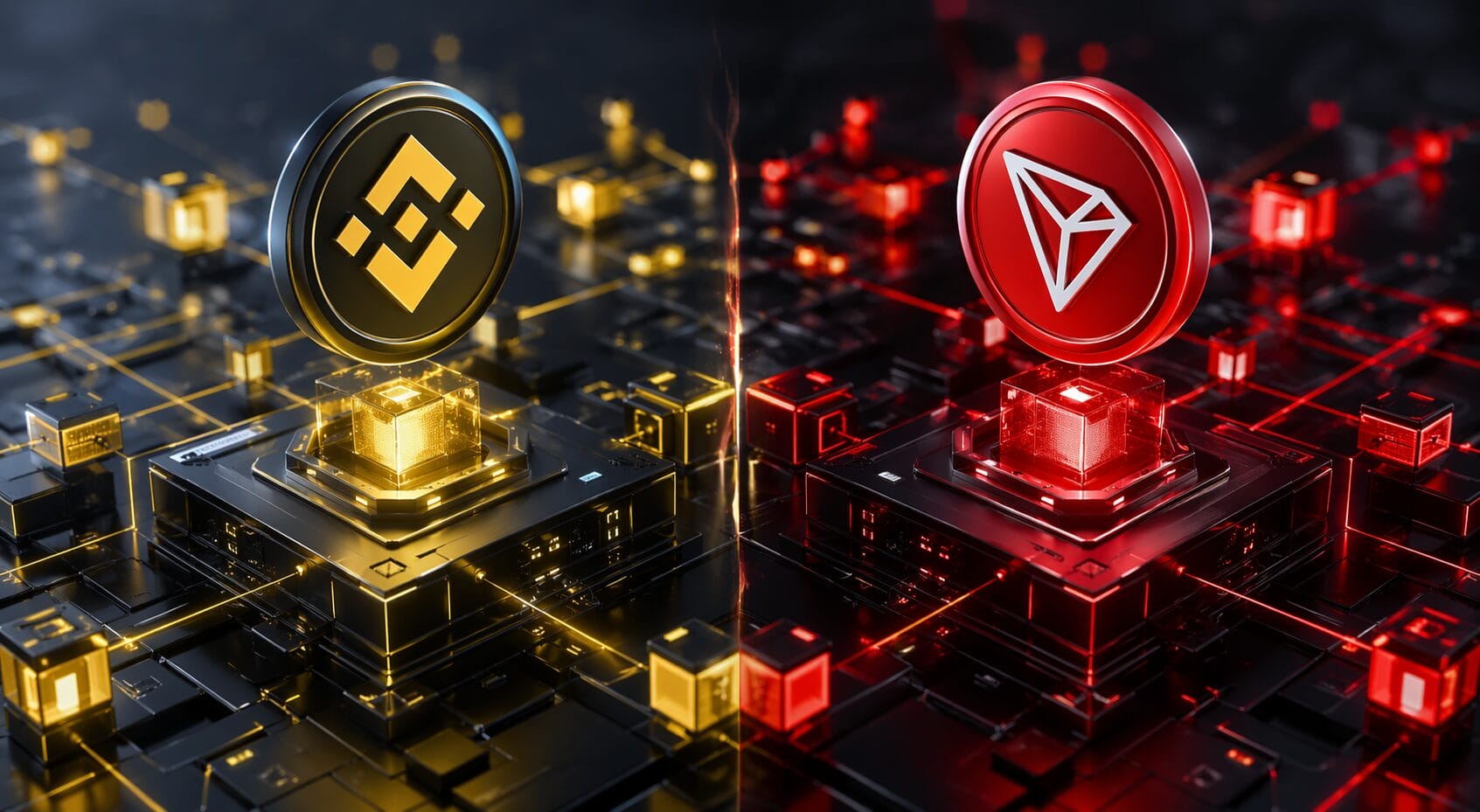
Among the most widely used options for this purpose are Binance Smart Chain and Tron. Both are optimized for fast and low-cost transactions, but they serve slightly different operational roles within the trading stack.
Network Design and Functional Positioning
BNB Smart Chain was designed as a general-purpose smart contract platform. It supports decentralized exchanges, lending protocols, staking mechanisms, and broader DeFi applications. This makes it more than a transfer layer. It is a full execution environment where capital can remain active rather than idle.
TRON, on the other hand, is structurally simpler in its usage pattern. While it supports smart contracts, its dominant real-world function is the transfer of stablecoins, particularly USDT TRC20. Over time, it has effectively become a settlement network rather than a development-heavy ecosystem.
This distinction is important: BSC is used to deploy capital, while Tron is primarily used to move it.
Transaction Speed and Network Behavior
Both networks process blocks quickly, but their operational consistency differs.
- Binance Smart Chain produces blocks roughly every 3 seconds, with confirmation times typically remaining stable under normal network load.
- Tron also produces blocks at approximately 3-second intervals, but its confirmation model is often perceived as more predictable for simple transfers.
In practice, both networks are fast enough for retail and professional trading use. The difference is not raw speed, but behavioral reliability during high usage periods.
Fees and Transfer Efficiency
Cost structure is one of the key differentiators.
On BSC, transaction fees are generally low, often well below $1 depending on network conditions. However, they are variable and tied to network demand and gas pricing dynamics.
On Tron, USDT TRC20 transfers are typically extremely low-cost, often close to a fraction of a dollar in normal conditions. In many exchange environments, Tron remains the cheapest and most widely used option for stablecoin transfers.
This is a key reason why TRC20 USDT dominates global stablecoin circulation in terms of everyday transfers.
Ecosystem Depth vs Operational Specialization
BSC offers significantly broader functionality through its DeFi ecosystem. Traders can lend, stake, swap, and farm assets within the same network, including participation in NFT drops like those featured in top BSC NFT drops. This makes it suitable for strategies where capital remains on-chain for extended periods.
Tron is far more specialized. Its ecosystem is narrower, but its efficiency for stablecoin transfers has made it a default rail for exchange-to-exchange movement of funds.
This leads to a clear structural split in usage:
- BSC is used for active capital deployment
- Tron is used for capital relocation
Real Trading Workflow Usage
In professional trading behavior, networks are rarely chosen in isolation.
A common operational pattern is:
- Funds are held or traded on Binance Smart Chain for DeFi or strategic positioning
- USDT is moved via Tron when liquidity needs to be shifted quickly between centralized exchanges
This dual-network approach reflects a broader reality: traders optimize for function, not ideology.
Cross-Chain Infrastructure and Liquidity Movement
As trading strategies become more fragmented across platforms, cross-chain movement has become a standard requirement rather than an edge case.
Instead of relying solely on centralized exchanges, traders increasingly use cross-chain tools that allow stablecoins to be moved between networks with minimal friction, and a BNB to USDT exchange is a practical example of this convert workflow. This reduces dependency on single-chain liquidity and improves operational flexibility. In this environment, both BSC and Tron act as complementary layers within a broader liquidity routing system.
Conclusion
The comparison between Binance Smart Chain and Tron is not about superiority but about specialization.
BSC functions as a versatile execution layer for decentralized finance activity. Tron functions as a high-efficiency settlement layer for stablecoin movement.
Active traders typically use both, depending on whether capital needs to be deployed or simply transferred. In modern crypto markets, the advantage lies not in selecting a single network, but in understanding how each fits into a multi-layered liquidity system.
A Practical Perspective from Market Usage
Beyond technical differences, actual trader behavior shows a consistent pattern: network choice is driven less by ideology and more by execution requirements. Speed, fees, and exchange compatibility remain the dominant factors in decision-making.
Frequently Asked Questions (FAQ)
Why do traders choose Tron when they need to transfer USDT?
Traders often pick Tron for moving USDT because it has very low fees and transactions happen quickly. A lot of the time, TRC20 transfers finish in just a few seconds and only cost a tiny bit of money, which makes it handy for moving funds between different exchanges frequently.
Is Binance Smart Chain actually faster than Tron?
Both networks usually process blocks in about 3 seconds. In practice, you won’t really find one significantly faster than the other. The main difference actually comes down to how consistently they perform when there’s a lot of activity, and how each network manages itself during busy times.
Which network offers cheaper transfers for stablecoins?
Tron is usually more affordable for moving stablecoins, particularly for USDT on Tron (TRC20). The fees are often very low, which is different from Binance Smart Chain, where gas costs can go up and down depending on how much demand there is on the network.
Can traders use both Binance Smart Chain and Tron?
Yes, a lot of traders actually use both networks, choosing one over the other depending on what they need to do. Binance Smart Chain is frequently used for activities in decentralized finance (DeFi) and certain trading approaches, while Tron is often picked for quick and inexpensive transfers between centralized exchanges.
Why is USDT so commonly used on Tron?
USDT on Tron (TRC20) grew popular because it gives you both speed and really low transaction fees. This combination made it a highly effective way to transfer stable value across exchanges worldwide.
Do cross-chain transfers play a role in trading strategies?
Yes. Since traders often use many different platforms, moving funds between networks has become a regular part of their trading activities. Cross-chain tools help to make this smoother and prevent them from depending solely on one blockchain system.