

Most forex traders lose money because they ignore what the market is actually showing them. They chase indicators, copy signals, and enter trades blindly without understanding price action. But the market leaves clues everywhere. Every candlestick tells a story about buyers, sellers, fear, greed, and momentum.
That’s why experienced traders say, “Every candle is a clue.” A candle is not just a red or green box on the chart. It reflects the emotions and decisions of traders around the world. Learning to read those clues can completely change the way you trade.
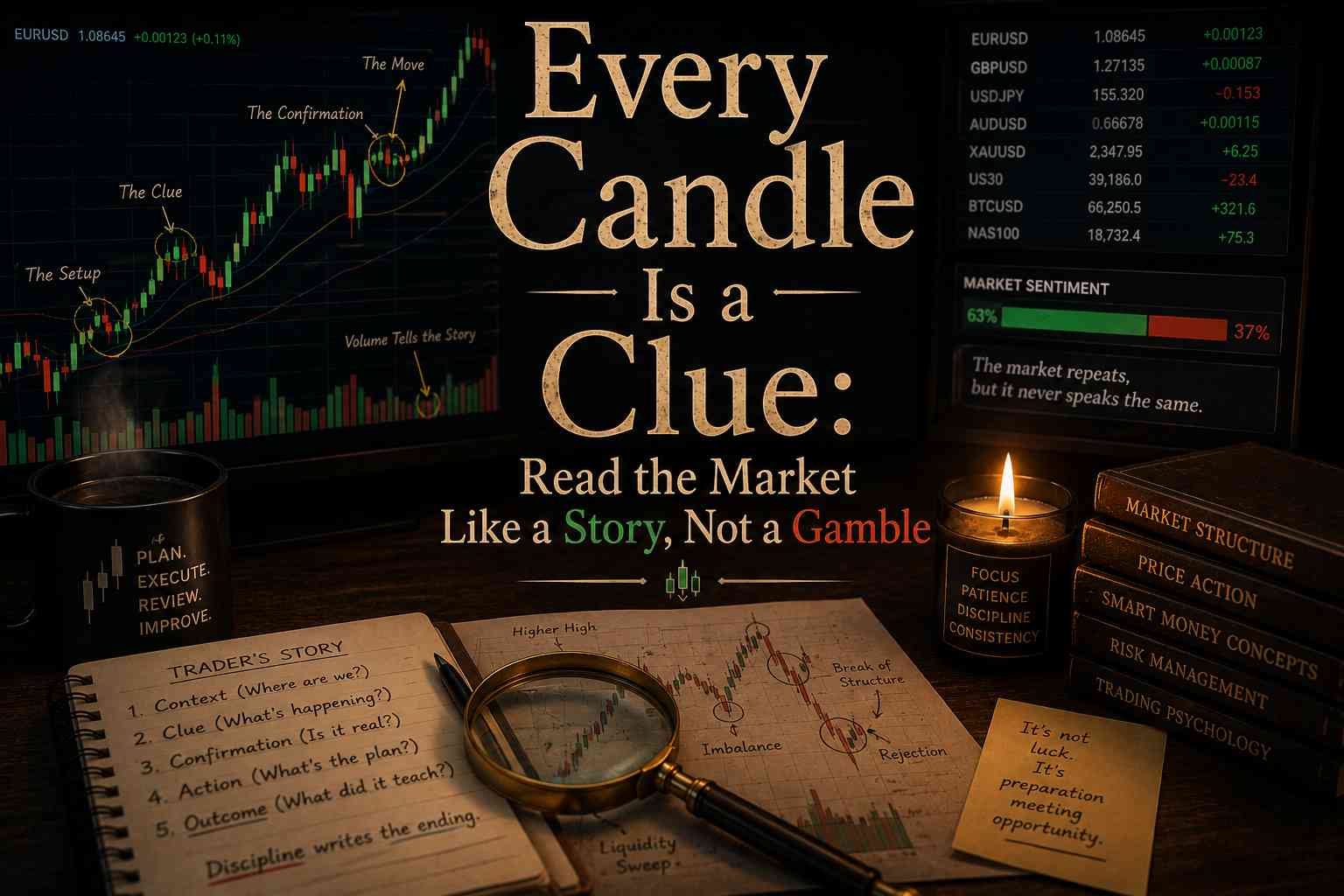
What Does “Every Candle Is a Clue” Mean?
Candlesticks reveal what happened during a certain period of time. They show the opening price, closing price, highest point, and lowest point. But beyond numbers, they reveal market psychology.
A strong bullish candle shows buyers are dominating. A bearish candle often signals panic or selling pressure. Small candles can show hesitation, while long wicks reveal rejection. Every movement has meaning if you know how to read it.
Think of candles like footprints at a crime scene. Detectives study clues to understand what happened. Traders should do the same with charts.
Why Most Traders Fail to Read Candles Properly
Most beginners only focus on candle color. Green means buy, red means sell. That mindset destroys accounts quickly because candles must always be read in context.
For example, a bullish candle near strong resistance may actually signal weakness instead of strength. Likewise, a bearish candle at support might fail immediately. Without understanding the surrounding market structure, candlestick patterns become meaningless.
Trading isn’t about guessing. It’s about understanding the story behind price movement.
Understanding Basic Candle Structure
Every candlestick has two important parts: the body and the wick.
The body shows the distance between the opening and closing price. Large bodies usually indicate strong momentum, while small bodies suggest uncertainty or weak pressure.
The wick shows rejection. A long upper wick means buyers pushed price higher but failed. A long lower wick means sellers tried to push lower but lost control. Wicks often reveal hidden battles happening in the market.
Candles Reflect Human Emotion
Forex charts are driven by emotions. Fear and greed control the market more than people realize. Candles capture these emotions in real time.
A huge bullish candle often appears because traders fear missing out on a move. A sudden bearish candle may show panic selling. The market constantly shifts between confidence and fear, and candles expose those shifts clearly.
That’s why price action trading works so well. It focuses on behavior rather than complicated systems.
Powerful Candlestick Patterns Traders Watch
Pin Bars
Pin bars usually signal rejection. A long wick with a small body shows the market attempted to move in one direction but failed badly.
A pin bar near support or resistance can become a powerful reversal signal. However, context still matters. A random pin bar in the middle of nowhere means very little.
Engulfing Candles
Engulfing patterns show strong momentum shifts. A bullish engulfing candle completely covers the previous bearish candle, signaling buyers taking control. Bearish engulfing candles suggest sellers are becoming dominant.
These patterns often appear during trend reversals or breakouts.
Doji Candles
Doji candles represent indecision. Buyers and sellers are fighting, but neither side wins clearly. When doji candles appear after strong trends, they may signal slowing momentum or possible reversals.
Why Market Structure Matters
Candles alone are not enough. Smart traders combine candlestick analysis with market structure.
Support and resistance zones help traders understand where price reactions are likely to happen. A bullish candle at support is much more meaningful than one appearing randomly.
Trend direction also matters. Trading against a strong trend is like swimming against a powerful current. It’s possible, but extremely risky.
The Problem With Indicators
Many traders depend too heavily on indicators. Their charts become crowded with RSI, MACD, Bollinger Bands, and dozens of confusing signals.
The problem is simple: indicators lag behind price.
Candles show market behavior instantly, while indicators react after the move has already happened. That’s why many professional traders prefer clean charts and focus directly on price action.
Simple trading often works better than overcomplicated systems.

How Wicks Expose Market Traps
Wicks are extremely important because they reveal failed moves.
A long upper wick often means buyers lost momentum and sellers pushed price back down. A long lower wick usually shows sellers failed to maintain control.
This becomes especially useful during fake breakouts. Sometimes price breaks resistance, attracting emotional buyers, then suddenly reverses. Candlestick behavior often exposes these traps before the move collapses completely.
Patience Is a Trader’s Biggest Weapon
Not every candle matters. Many market movements are simply noise.
Professional traders wait for strong clues at important price levels before entering trades. Beginners usually overtrade because they feel the need to constantly be in the market.
But trading rewards patience more than excitement. Sometimes the best trade is no trade at all.
That sounds boring, but boring traders often survive longer.
Candlestick Analysis Is About Probability
No candlestick pattern guarantees success. Trading is always based on probabilities, not certainty.
Even the strongest setup can fail. That’s why risk management is critical. Smart traders never risk too much on a single trade because losses are unavoidable in forex.
The goal isn’t to win every trade. The goal is to stay profitable over time.
How Beginners Can Improve Candle Reading
The best way to improve is by studying reactions at key market areas. Focus on candles near support, resistance, breakouts, and trend reversals.
Instead of memorizing patterns blindly, ask questions:
- Why did buyers fail here?
- Why did sellers lose control?
- Why did momentum suddenly change?
Keeping a trading journal also helps massively. Reviewing screenshots of trades allows traders to recognize repeating behaviors over time.

Conclusion
Every candle truly is a clue. It reveals the emotional battle happening between buyers and sellers every second in the forex market.
Most traders fail because they ignore these clues and search for shortcuts instead. They rely too much on indicators, signals, and predictions without understanding price behavior itself.
Successful traders learn to observe carefully. They combine candlestick analysis with patience, discipline, market structure, and proper risk management. Over time, charts stop looking random and start telling clear stories. The market constantly speaks through candles. The real question is: are you listening?
FAQs
1. Why are candlesticks important in forex trading?
Candlesticks help traders understand market psychology, momentum, and possible reversals by showing price behavior clearly.
2. Can candlestick patterns predict the market?
No. Candlestick patterns only provide probabilities, not guarantees. Proper risk management is still necessary.
3. What is the best candlestick pattern for beginners?
Pin bars and engulfing candles are often easier for beginners to understand because they clearly show rejection and momentum shifts.
4. Do professional traders use candlestick analysis?
Yes. Many professional traders rely heavily on price action and candlestick behavior instead of depending only on indicators.
5. How long does it take to master candlestick trading?
It depends on practice and experience. Most traders need months or even years to read candles confidently and consistently.