
XAUUSD Sinks as Warsh’s Remarks Fuel US Dollar Strength
Gold came under heavy selling pressure after Federal Reserve Chair Kevin Warsh delivered firm remarks about inflation at the Jackson Hole gathering. His message suggested that the central bank may still have more work to do before it can confidently declare victory over rising prices.
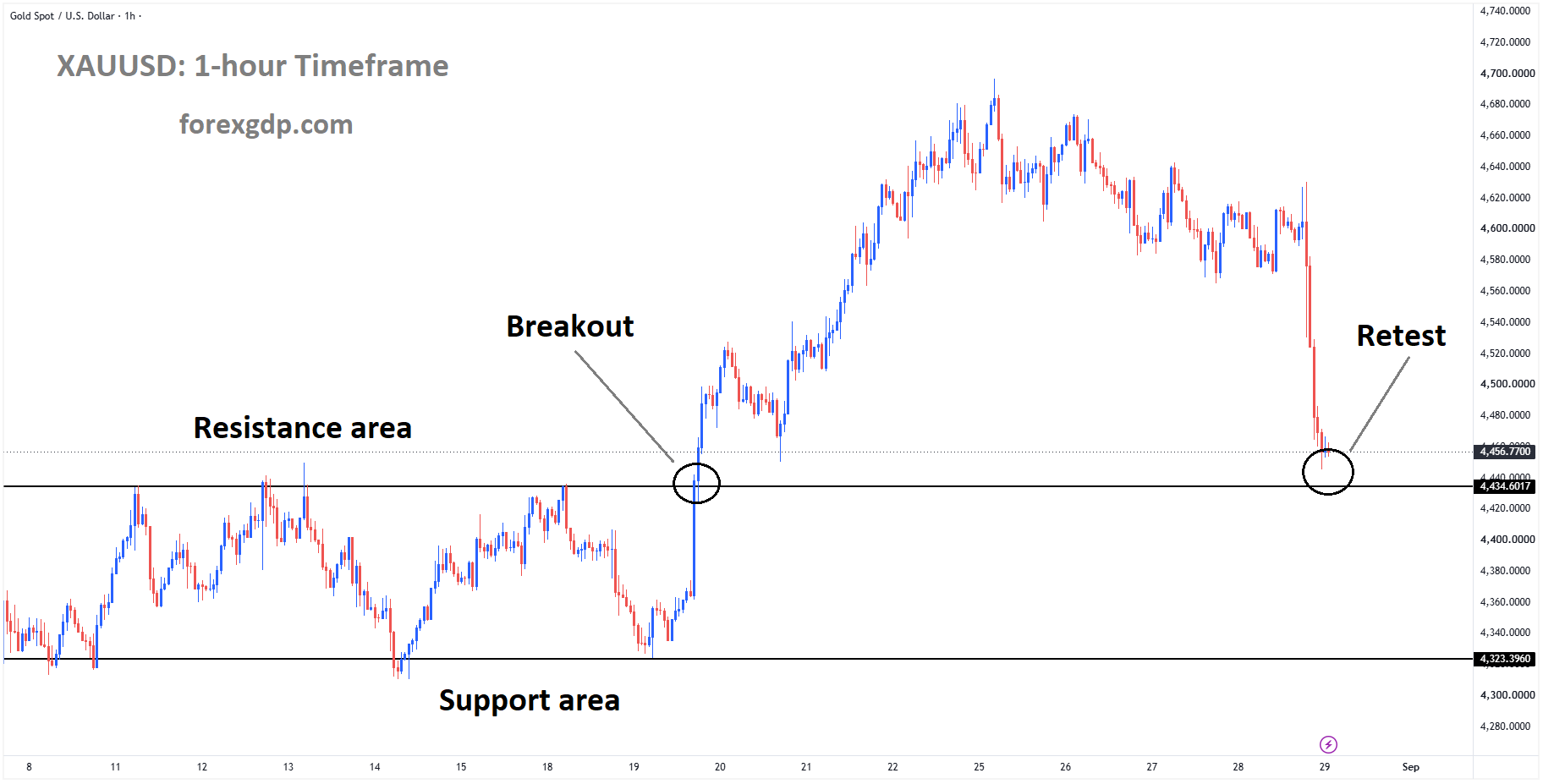
XAUUSD Reaches the Retest Area of the Broken Box Pattern
The comments quickly changed the mood across global markets. Investors increased their expectations for another Federal Reserve interest rate hike, pushing the US Dollar and Treasury yields upward. This created a difficult environment for gold, which often struggles when the American currency becomes stronger and government bonds offer more attractive returns.
Although US consumer confidence showed a small improvement, inflation expectations remained uncomfortable. This reinforced the belief that the Fed may continue following a strict monetary policy instead of moving toward easier financial conditions.
Warsh Keeps Inflation at the Centre of Fed Policy
Kevin Warsh used his Jackson Hole speech to make it clear that inflation remains a serious concern for the Federal Reserve. While some parts of the US economy continue to perform well, he warned that underlying inflation has not improved enough.
The Fed wants reliable evidence that inflation is moving sustainably toward its long-term target. Without that confidence, policymakers may feel forced to take further action. Warsh’s remarks reflected this cautious position and reminded investors that the battle against inflation is far from finished.
His tone was more aggressive than many market participants had expected. Traders had been looking for signs that the central bank might become less strict, especially after mixed economic reports. Instead, Warsh focused on the risks of leaving inflation unchecked.
That message carried significant weight because central banks cannot afford to ignore persistent price pressure. If inflation remains high for too long, it can affect household budgets, business costs, wages, and long-term economic stability. As a result, the Fed may prefer to maintain firm financial conditions until the data shows clearer progress.
Strong US Economy Gives the Fed More Flexibility
Warsh also acknowledged that consumer spending remains healthy and the US labor market continues to show strength. These areas are important because they help the economy absorb the impact of higher borrowing costs.
When employment is stable and people continue spending, the Federal Reserve has more freedom to concentrate on inflation. Policymakers may feel less pressure to support economic growth if the broader economy is still functioning well.
However, this creates a challenging situation for investors. Strong economic activity is generally positive, but it can also keep demand elevated. When demand stays firm, inflation may take longer to cool. That possibility can encourage the Fed to keep interest rates high or consider another increase.
For gold, this is not an ideal combination. A solid economy, persistent inflation, and a firm central bank can all support the US Dollar. They can also make interest-bearing assets more appealing compared with precious metals.
Rate Hike Expectations Return to the Market
Following Warsh’s remarks, investors raised their expectations for a possible interest rate increase at an upcoming Fed meeting. Although those expectations later eased slightly, the overall shift was still important.
Markets had previously been uncertain about whether the central bank would need to tighten policy further. Warsh’s inflation-focused comments brought that risk back into the spotlight. Investors are now paying closer attention to upcoming economic reports and speeches from other Fed officials.
Expectations for action later in the year also strengthened. This suggests that market participants believe the Fed could remain firm for longer, even if it does not immediately raise rates.
This change in expectations can affect several financial markets at once. It can influence currencies, government bonds, commodities, equities, and borrowing costs. Gold is particularly sensitive because it does not pay interest. When investors expect higher returns from US bonds, some may reduce their exposure to the precious metal.
US Dollar Strength Adds Pressure to Gold

The US Dollar gained momentum after investors interpreted Warsh’s message as supportive of tighter monetary policy. A stronger Dollar often makes gold more expensive for buyers using other currencies, which can weaken international demand.
The relationship is not always perfect, but the Dollar remains one of the most important forces affecting gold. When confidence in the US currency rises, precious metals may lose some of their appeal. This pressure can become stronger when the move is supported by changing interest rate expectations.
The Dollar also benefited from the view that the US economy remains more resilient than expected. Healthy spending and a stable labor market reduce concerns about an immediate economic slowdown. At the same time, persistent inflation encourages the Fed to maintain a strict policy position.
Together, these factors created a strong headwind for XAUUSD. Investors who had previously turned to gold for protection began reconsidering their positions as the outlook for US monetary policy changed.
Treasury Yields Rise as Investors Adjust Their Outlook
US Treasury yields moved upward as traders increased their expectations for another rate hike. Rising yields show that investors are demanding greater returns from government debt, partly because they expect borrowing costs to remain elevated.
This matters for gold because the metal does not provide regular interest payments. When bond yields increase, investors can earn more from assets considered relatively secure. That can reduce the attraction of holding gold, particularly during periods when fear is not dominating the market.
Higher yields can also influence the wider economy. They may increase borrowing costs for households and businesses, affecting mortgages, loans, investment decisions, and consumer spending. However, these effects often take time to appear.
For now, the market is mainly responding to the possibility that inflation will force the Fed to stay aggressive. As long as Treasury yields remain supported by that belief, gold may face continued pressure from investors searching for income-producing alternatives.
Economic Data Sends a Mixed Message
Recent US reports offered a combination of encouraging and concerning signals. The revision to employment growth was better than the previous adjustment, but it still failed to meet expectations. This suggests that the labor market may be stable without being as strong as some forecasts had predicted.
Consumer sentiment also improved slightly compared with expectations. However, confidence remained weaker than in the previous month. This shows that households are still dealing with uncertainty, even though they may feel somewhat less negative about the economy.
The mixed data does not provide the Fed with a simple answer. A weakening labor market could eventually encourage a softer policy approach. Yet continued consumer activity and stubborn inflation expectations may push policymakers in the opposite direction.
The central bank will likely need more evidence before making its next major decision. One report is rarely enough to change the direction of monetary policy, especially when inflation and employment are sending different signals.
Inflation Expectations Remain a Major Concern
Households expect inflation to ease slightly over the coming year, which offers some limited encouragement. However, longer-term expectations remain elevated and show little improvement.
This matters because inflation expectations can influence real economic behaviour. If consumers believe prices will keep rising, they may buy products sooner. Workers may also demand higher wages, while businesses may increase prices to protect their profit margins.
Such behaviour can make inflation more difficult to control. The Fed therefore watches these expectations carefully, as they can reveal whether price pressure is becoming deeply rooted in the economy.
Warsh’s cautious tone appears connected to this risk. Even if headline inflation improves, the central bank may hesitate to relax policy while households continue expecting stronger price increases in the future.
What the Changing Fed Outlook Means for XAUUSD
Gold is now caught between its traditional role as an inflation hedge and the negative impact of a stronger Dollar and rising Treasury yields. Persistent inflation can sometimes support demand for precious metals, but aggressive central bank action may produce the opposite effect.
The next direction for XAUUSD will depend heavily on how the Fed communicates its plans. Upcoming inflation reports, employment updates, consumer data, and comments from policymakers could all influence market expectations.
If inflation remains stubborn and the economy continues to show resilience, investors may expect the Fed to stay firm. That environment could keep the Dollar and yields supported while limiting gold’s appeal.
On the other hand, clear signs of weaker economic activity could reduce expectations for further tightening. Until the picture becomes clearer, gold traders may continue reacting strongly to every major economic release and central bank statement.
Summary
XAUUSD weakened after Kevin Warsh reinforced the Federal Reserve’s commitment to controlling inflation. His comments encouraged investors to consider the possibility of another interest rate increase, strengthening the US Dollar and lifting Treasury yields.
Consumer sentiment offered a small positive surprise, but inflation expectations remained too high for comfort. With spending still healthy and the labor market showing resilience, the Fed has room to maintain a strict policy stance.
Gold may remain sensitive to changing interest rate expectations, US economic reports, and further comments from Fed officials. The market’s attention is firmly focused on whether inflation will improve enough to reduce the need for additional monetary tightening.
EURUSD Retreats as Warsh Strengthens the US Dollar
EURUSD came under strong selling pressure after Federal Reserve Chair Kevin Warsh delivered a hawkish message at the Jackson Hole Symposium. His comments placed inflation control at the center of monetary policy and encouraged investors to reconsider the possibility of another interest-rate increase in September.
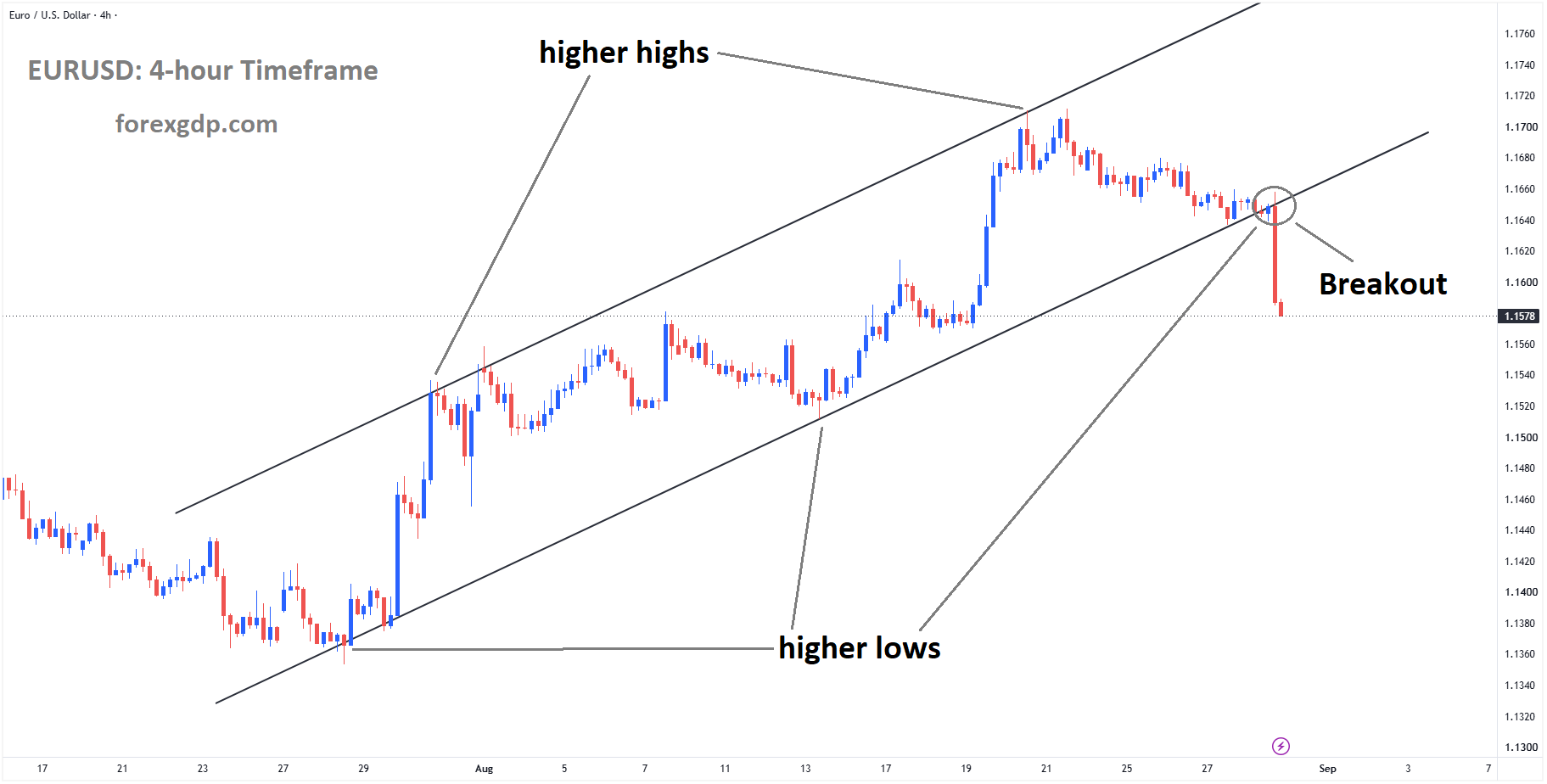
EURUSD has broken the ascending channel on the downside
The US Dollar strengthened as traders responded to Warsh’s firm position on price stability. He made it clear that the Federal Reserve still has more work to do before it can confidently say inflation is moving back toward its long-term target. This message reduced expectations that policymakers would soon adopt a softer approach.
Although recent inflation data have shown some improvement, Warsh warned that a few encouraging reports are not enough to confirm a lasting change. His remarks suggested that the Fed may keep monetary policy tight or even raise rates again if inflation continues to cause concern.
Warsh Keeps Price Stability at the Center of Fed Policy
The most important part of Warsh’s speech was his strong focus on price stability. He argued that the Federal Reserve must remain committed to controlling inflation, even if that means maintaining higher borrowing costs for longer.
Warsh explained that policymakers need clear and convincing evidence that underlying inflation is moving toward the Fed’s objective. Without that evidence, the central bank cannot assume that its job is complete. In his view, the latest improvement in inflation is welcome, but it has not yet changed the broader direction enough to justify confidence.
The Fed Chair also repeated that the central bank’s inflation target remains firm. This statement was important because it rejected the idea that policymakers might accept permanently stronger inflation to avoid tighter monetary conditions.
For investors, the message was direct: the Federal Reserve is not ready to declare victory over inflation. That position supported the US Dollar and placed pressure on the euro.
Financial Conditions May Not Be Tight Enough
Warsh also questioned whether current financial conditions are truly restrictive. He said he would find it difficult to describe them that way because credit remains available and loan markets show limited signs of serious pressure.
This matters because restrictive financial conditions normally slow borrowing, investment, and consumer demand. Over time, weaker demand can help reduce inflation. However, if businesses and households continue to access credit without major difficulty, the economy may remain stronger than the Fed expected.
Such resilience can complicate the central bank’s task. A healthy economy is generally positive, but strong demand may keep inflation elevated. That could force policymakers to maintain a tougher stance for longer than markets previously anticipated.
Warsh’s comments therefore challenged the belief that monetary policy was already doing enough to control inflation. If financial conditions remain relatively comfortable, the Fed may see less reason to reduce rates and more reason to consider further action.
September Rate-Hike Expectations Rise Sharply
The speech caused a major change in market expectations. Before Warsh spoke, investors saw a September rate increase as possible but far from certain. After his remarks, the estimated probability rose to around 57%, compared with approximately 36% beforehand.
This rapid adjustment shows how strongly markets reacted to his message. Investors now view a September hike as a realistic outcome rather than a distant risk.
Interest-rate expectations often have a powerful effect on currencies. When traders expect a central bank to raise rates, that country’s currency can become more attractive because investors may receive stronger returns from assets connected to it. In this case, renewed expectations of tighter Fed policy increased demand for the US Dollar.
The euro struggled as a result. Even though the movement was driven mainly by developments in the United States, the contrast between the two currencies became more important. A stronger outlook for US rates placed EURUSD under additional pressure.
The US Economy Continues to Show Resilience

Warsh also offered a positive assessment of the American economy. He said overall economic activity appeared to have strengthened and highlighted several areas that continue to perform well.
Consumer spending remains healthy, suggesting that households are still willing and able to purchase goods and services. The labor market also appears stable, which supports household income and confidence. At the same time, business investment is rising quickly, indicating that companies remain willing to expand their operations.
These conditions provide the Federal Reserve with more room to concentrate on inflation. When economic activity is weak, central banks often hesitate to tighten policy because higher rates could deepen the slowdown. However, a resilient economy reduces that concern.
Strong consumer demand and business investment can also keep inflationary pressure alive. Warsh’s positive view of economic growth therefore supported his argument for maintaining a careful and disciplined monetary stance.
Employment Revision Brings Limited Concern
Economic figures released alongside the Jackson Hole speech presented a mixed picture. A preliminary review of US employment data showed that total job growth for the twelve months through March had been revised downward.
However, the adjustment was relatively small compared with the much larger revision recorded the previous year. As a result, it did not significantly change the broader view of the US labor market.
Some investors had feared that the figures would reveal a much weaker employment situation. The modest revision eased those concerns and suggested that the labor market remained reasonably stable during the reviewed period.
This supported Warsh’s view that the economy is holding up well. While the revision showed that employment growth was slightly weaker than first reported, it was not severe enough to challenge the broader case for a firm Fed policy stance.
Consumer Confidence Improves but Remains Weak
The University of Michigan’s latest consumer survey added another layer to the economic picture. Consumer sentiment was revised slightly higher than the preliminary reading, while expectations about future conditions also improved.
Despite these upward revisions, confidence remained weaker than in the previous month. This suggests that households are still cautious about the economic outlook, even if their mood is not quite as negative as first estimated.
Consumer confidence can influence spending decisions. When people feel uncertain about employment, inflation, or their financial future, they may delay large purchases and increase their savings. However, Warsh’s comments indicated that actual consumer spending remains healthy despite the softer survey results.
The difference between sentiment and spending shows that households may feel worried while continuing to support economic activity. For the Fed, real economic behavior may carry more weight than confidence surveys alone.
Inflation Expectations Provide Only Modest Relief
The consumer survey also showed a decline in short-term inflation expectations. Households now expect slightly less inflation over the coming year than they did previously. This development may offer the Federal Reserve some relief because expectations can influence wage demands, spending habits, and business pricing decisions.
Longer-term inflation expectations, however, remained unchanged. That stability suggests consumers are not expecting a major improvement in inflation over a longer period.
The softer short-term figure was not enough to weaken the US Dollar’s response to Warsh’s speech. Investors appeared more focused on his warning that underlying inflation has not improved enough to justify a softer approach.
One favorable inflation reading or survey result is unlikely to change Fed policy by itself. Policymakers will want to see a consistent series of reports showing that price pressures are moving sustainably toward the official target.
Summary
EURUSD weakened as Kevin Warsh used his Jackson Hole speech to deliver a firm message on inflation and monetary policy. He emphasized that price stability remains the Federal Reserve’s main responsibility and warned that recent inflation improvements have not yet created enough confidence.
His view that financial conditions are not particularly restrictive strengthened expectations that the Fed could raise interest rates in September. Market expectations changed sharply after the speech, supporting the US Dollar and weighing on the euro.
US economic data offered a mixed but generally stable picture. The employment revision was modest, consumer confidence improved slightly, and short-term inflation expectations eased. However, none of these developments outweighed Warsh’s hawkish position. Investors will now closely watch upcoming inflation, employment, and consumer data for clearer signs of whether the Federal Reserve will take further action.
GBPUSD Drops as Warsh’s Hawkish Message Lifts the US Dollar
The Pound Sterling weakened sharply against the US Dollar after Federal Reserve Chair Kevin Warsh delivered a firm message on inflation. His comments suggested that the US central bank may need to keep monetary policy tight and could consider another interest rate increase if inflation does not move steadily toward its target.
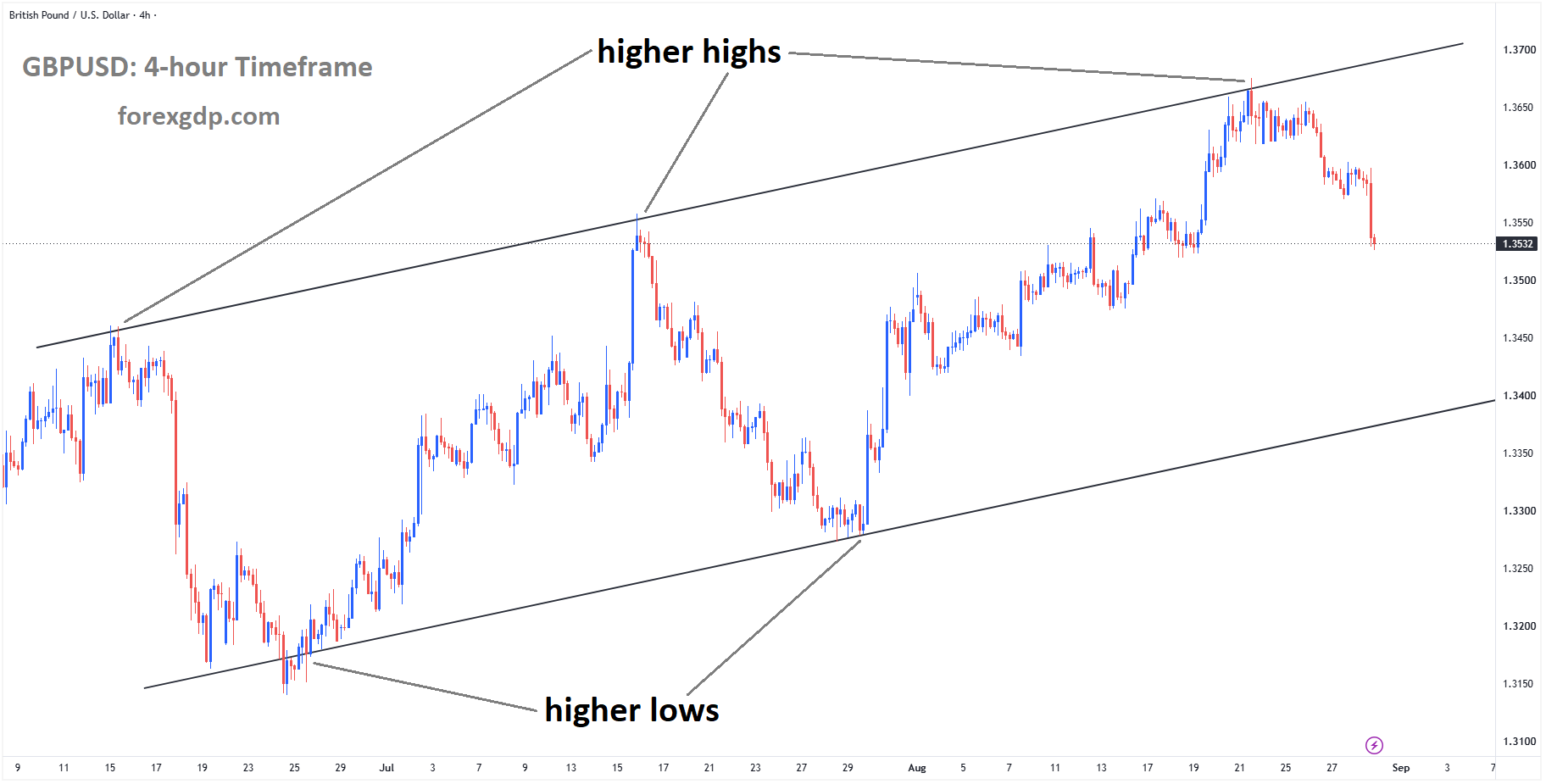
GBPUSD is moving in an ascending channel, and the market has fallen from the higher high area of the ascending channel
Warsh had previously avoided revealing his position through the Federal Reserve’s interest rate projections. His latest remarks, however, gave investors a much clearer view of his thinking. While he acknowledged that inflation figures released during the summer were better than expected, he remained concerned about the lack of meaningful improvement in underlying price pressures.
The Fed Chair stressed that policymakers must have strong confidence that inflation is returning to the central bank’s target. If that confidence is missing, he said further action may be necessary. This message immediately strengthened expectations that the Federal Reserve could raise borrowing costs at an upcoming meeting.
The Federal Reserve’s Inflation Target Remains Firm
Warsh made it clear that the Fed’s inflation goal is not open to adjustment. He described the central bank’s target as firm and fixed, reinforcing the idea that policymakers will not tolerate inflation remaining above the desired level for an extended period.
This position matters because some investors had hoped that softer inflation reports would encourage the Fed to adopt a more relaxed approach. Warsh’s comments challenged that view. Although recent data offered signs of improvement, he warned that the broader inflation picture was still concerning.
Underlying inflation often receives greater attention from central bankers because it removes categories that can experience sudden and temporary changes. When this measure remains elevated, it can indicate that price pressures are spreading across the economy. That makes it more difficult for the Fed to declare victory in its inflation fight.
Warsh’s message suggested that a few encouraging reports would not be enough to change the central bank’s direction. Policymakers want to see lasting evidence that inflation is falling and will continue moving toward the official target.
Healthy Spending Gives the Fed Room to Act
The Federal Reserve is also watching consumer activity and employment conditions. Warsh described consumer spending as healthy and the labor market as stable. These factors reduce the immediate pressure on the central bank to support economic growth through easier monetary policy.
When households continue spending and employment remains steady, the economy is usually better able to handle higher borrowing costs. This gives the Fed more freedom to focus on inflation without creating an urgent threat to economic activity.
However, this balance creates a difficult situation for financial markets. A strong economy is generally positive, but it can also keep inflation under pressure. If demand remains healthy, businesses may find it easier to raise prices, while workers may continue asking for stronger wage growth.
The Fed must therefore decide whether economic strength reflects a sustainable expansion or creates a risk of renewed inflation. Warsh’s comments showed that price stability remains the main concern.
September Rate Hike Expectations Return
Investors responded quickly to Warsh’s remarks by increasing their expectations of a possible interest rate hike at the Federal Reserve’s September meeting. Before his comments, markets viewed such a move as possible but far from certain. His firm inflation message made the risk of tighter policy appear much more serious.
This shift supported the US Dollar because higher interest rates can make dollar-based assets more attractive to global investors. Expectations often influence currencies before an official central bank decision takes place. As traders adjusted their outlook, demand for the US currency increased and the Pound came under pressure.
US government bond yields also moved upward, reflecting the market’s changing view of Federal Reserve policy. Rising yields often indicate that investors expect interest rates to remain elevated or increase further.
The response showed how closely markets are listening to every Federal Reserve statement. Even without an immediate policy change, a clear warning about inflation can reshape expectations and influence the Dollar.
Jobs Revision Fails to Damage the US Dollar

The annual revision to US employment figures showed weaker job growth than economists had expected. However, the adjustment was considerably better than the previous revision, limiting its negative impact on the Dollar.
Employment revisions can change the wider picture of the labor market because they provide a more accurate estimate of how many jobs were created. Still, one revision rarely determines the Federal Reserve’s next decision. Policymakers examine a wide collection of figures, including monthly job creation, wage growth, unemployment and participation in the workforce.
The final benchmark revision will be released in February 2027 alongside the January employment report. Until then, investors will continue studying incoming labor data for signs that the job market is either maintaining its strength or beginning to slow.
For now, the revision was not weak enough to outweigh Warsh’s inflation concerns. The Dollar maintained its strength as markets focused more heavily on the possibility of tighter monetary policy.
Consumer Confidence Offers a Mixed Message
The University of Michigan’s consumer sentiment report also delivered a mixed picture. Confidence was slightly stronger than economists had predicted, although it had weakened compared with the previous month.
The survey’s inflation expectations provided some relief. Short-term expectations were revised lower, suggesting that consumers became slightly less worried about immediate price increases. Longer-term expectations remained unchanged and matched forecasts.
These figures are important because consumer expectations can influence actual inflation. When people believe prices will rise rapidly, they may spend sooner, demand higher wages or change their financial behavior. Those actions can make inflation more difficult to control.
Despite the modest improvement in short-term expectations, the report did not significantly weaken the US Dollar. Investors remained focused on Warsh’s warning that inflation was still too concerning for the Fed to relax its position.
Lack of UK Data Leaves the Pound Exposed
The UK economic calendar offered little fresh information to guide the Pound. Without major domestic reports, GBPUSD was mainly driven by developments in the United States and wider geopolitical uncertainty.
This left Sterling vulnerable to the renewed strength of the Dollar. When one side of a currency pair receives a powerful policy signal and the other side lacks a strong domestic catalyst, the stronger currency often controls the direction.
The absence of UK data also meant that investors had limited evidence to reassess the Bank of England’s policy outlook. Questions remain about inflation, economic growth and the future path of UK interest rates. Until clearer information appears, the Pound may remain sensitive to changes in global risk sentiment and US monetary policy expectations.
A Busy Week Ahead for GBPUSD
Attention will now turn to several important events in both the United Kingdom and the United States. The UK schedule will include the Bank of England’s Monetary Policy Report Hearings and remarks from Governor Andrew Bailey.
Investors will listen closely for clues about how the Bank views inflation and whether policymakers believe further tightening may be required. Bailey’s comments could also help clarify the balance between controlling prices and protecting economic growth.
The US calendar will be much busier, featuring major business activity surveys and several labor market reports. The August Nonfarm Payrolls release will be one of the most closely watched events because it may influence expectations for the Fed’s September decision.
Summary
GBPUSD weakened after Kevin Warsh placed inflation firmly at the top of the Federal Reserve’s agenda. His comments revived the possibility of a September rate hike and strengthened demand for the US Dollar.
Employment revisions and consumer sentiment figures presented a mixed economic picture, but neither report was strong enough to challenge the Fed’s inflation-focused message. With little UK data available, the Pound lacked domestic support.
The next round of central bank remarks, business surveys and US employment reports will be crucial. They could determine whether expectations of tighter Federal Reserve policy continue to grow or begin to fade.
USDJPY Jumps as Japan’s Currency Support Begins to Unwind
USDJPY continued its upward move for a fifth consecutive session as the Japanese Yen struggled to benefit from encouraging inflation and employment figures. Japan released the kind of economic data that could support another Bank of Japan policy change, but investors remained more focused on growing expectations of further interest rate increases from the Federal Reserve.
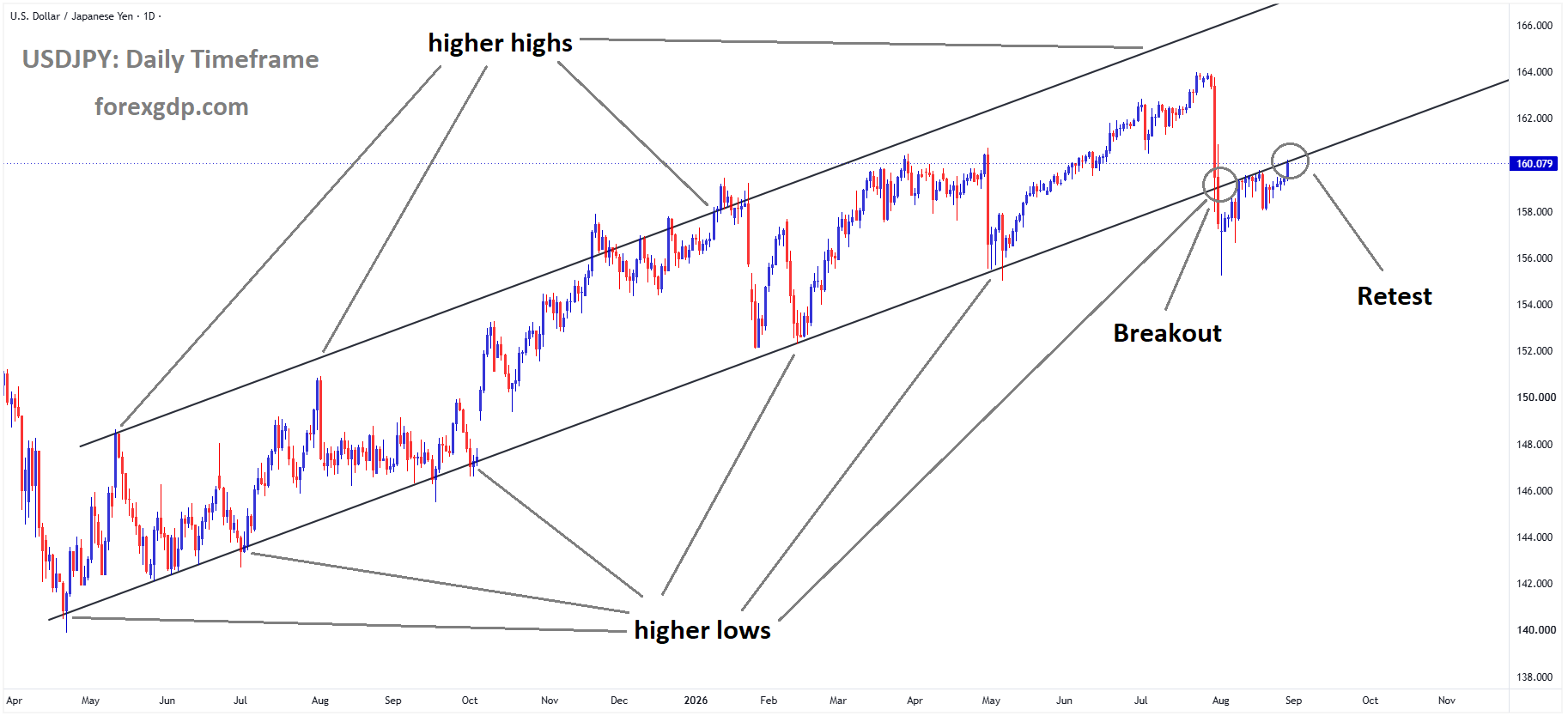
USDJPY reached the retest area of the broken ascending channel
Tokyo inflation showed renewed strength in August, while unemployment dropped to its lowest level in a year. These results suggest that price pressures are becoming more stable and that Japan’s labour market remains healthy. Both developments could give the Bank of Japan greater confidence to tighten monetary policy again.
However, the Yen failed to gain ground. The main reason is the continuing interest rate difference between Japan and the United States. Even if both central banks raise rates at their upcoming meetings, the gap between them may remain wide enough to keep the US Dollar more attractive.
Tokyo Inflation Gives the Bank of Japan Encouragement
Tokyo’s latest Consumer Price Index report showed that inflation remained firm during August. The measure excluding food and energy reached the Bank of Japan’s long-term inflation goal, rising from the previous month’s reading. Headline inflation also increased, showing that price growth is still present across the economy.
The Bank of Japan pays close attention to inflation excluding fresh food because this measure offers a clearer view of domestic price pressure. It increased for a third consecutive month and came in stronger than economists had expected. This trend may help policymakers argue that inflation is becoming more sustainable rather than being driven only by temporary global factors.
The rise in the measure excluding energy was particularly important. Government support for household electricity and gas costs may temporarily hold down the headline inflation figure. As a result, the underlying reading may provide a more accurate picture of current price conditions.
Energy subsidies were brought back after supply disruptions in the Gulf region increased concerns about fuel costs. While this support may reduce pressure on households, it can also make the headline inflation rate appear weaker than the actual domestic trend.
Japan’s Labour Market Remains Strong
Japan’s employment figures added another positive signal. The unemployment rate declined and reached its lowest level in about a year. A tight labour market can support wage growth because companies must compete more strongly to attract and retain workers.
Higher wages are important for the Bank of Japan’s strategy. The central bank wants inflation to be supported by lasting income growth and steady household demand. Inflation caused only by expensive imports is less reliable because it can weaken consumer spending instead of strengthening the economy.
A healthier labour market may encourage workers to spend more, helping businesses raise prices without losing too many customers. This cycle of stronger wages, spending and business activity is what Japanese policymakers have been trying to create after many years of weak inflation.
The latest figures therefore provide the Bank of Japan with meaningful evidence that economic conditions may be suitable for another policy adjustment. Yet good domestic data alone has not been enough to strengthen the Yen.
Investors Expect Another Bank of Japan Move

Reports throughout the month suggested that Bank of Japan officials were considering another interest rate increase at their September meeting. Policymakers may also be discussing whether to speed up the pace of tightening after following a cautious approach since beginning to withdraw long-running stimulus measures in 2024.
Japanese government bond yields have responded to this possibility, reflecting expectations that borrowing costs could continue to rise. The Bank of Japan’s previous decision had already taken its policy rate to its highest level in decades.
Despite these changes, the Japanese Yen has remained under pressure. This shows that currency markets are not judging Japan’s policy in isolation. Investors are comparing the expected direction of Japanese rates with the outlook for US rates, and the Federal Reserve currently has a much stronger influence on the pair.
Federal Reserve Expectations Support the US Dollar
The Federal Reserve Chair’s first Jackson Hole address had a major effect on market expectations. He warned that policymakers still had more work to do because they were not yet confident that underlying inflation was moving steadily back toward the central bank’s target.
Following those comments, investors increased their expectations of a September rate hike. Market expectations also suggested a strong possibility of at least one increase before the end of October, while the chance of another move later in the year remained under consideration.
This outlook helped the US Dollar because higher interest rates can make dollar-based assets more attractive to global investors. When US borrowing costs are expected to stay elevated or move higher, investors may continue favouring the Dollar over currencies connected to countries with lower rates.
Consumer inflation expectations for the coming year declined in a separate report, which could normally reduce pressure on the Federal Reserve to tighten policy. However, traders largely overlooked that result. The central bank’s cautious message about underlying inflation carried greater weight.
The Interest Rate Gap Remains the Main Issue
The central problem for the Japanese Yen is the difference between borrowing costs in Japan and the United States. Even if the Bank of Japan and the Federal Reserve both increase rates at their upcoming meetings, the gap between the two countries may remain almost unchanged.
This matters because many investors borrow in a low-interest-rate currency and use those funds to purchase assets offering higher returns elsewhere. This strategy, commonly known as a carry trade, has worked against the Yen for a long time.
A Bank of Japan rate increase could normally support the Japanese currency. However, if the Federal Reserve raises rates at nearly the same time, the advantage may disappear. Both countries would have higher borrowing costs, but the relative appeal of holding the US Dollar would remain.
The most favourable situation for the Yen would be a Bank of Japan increase combined with a Federal Reserve pause. That combination would narrow the interest rate gap and reduce some of the incentive behind carry trades. At present, however, investors are not convinced that the Federal Reserve will remain on hold.
Strong Japanese Data May Not Be Enough
Japan’s latest inflation and employment reports have strengthened the argument for tighter monetary policy. Price pressures are firming, the labour market is healthy, and officials may have enough evidence to consider another rate increase.
Nevertheless, the Japanese Yen continues to face a difficult environment. The Federal Reserve is also expected to maintain a firm policy stance, and that keeps the interest rate advantage firmly on the US side.
For the Yen to recover more convincingly, investors may need to see a meaningful change in the policy difference between the two countries. Strong Japanese data can improve the case for action, but its impact may remain limited if the Federal Reserve follows a similar path.
Summary
USDJPY extended its advance even after Japan reported stronger inflation and improving employment conditions. The figures could support another Bank of Japan rate increase, but expectations of further Federal Reserve tightening continued to favour the US Dollar.
If both central banks raise rates, the interest rate gap may remain largely unchanged. A more supportive outcome for the Yen would require the Bank of Japan to tighten while the Federal Reserve pauses. Until that possibility becomes more likely, encouraging Japanese economic data may struggle to produce a lasting Yen recovery.
USDCAD Gains as Impressive Canadian GDP Struggles to Support the Loonie
The Canadian economy delivered one of its strongest performances in recent years, yet the Canadian Dollar failed to benefit. Canada’s latest Gross Domestic Product report showed that economic activity expanded at its fastest pace since early 2023. The result also exceeded the Bank of Canada’s earlier forecast and removed concerns that the country had entered a technical recession.
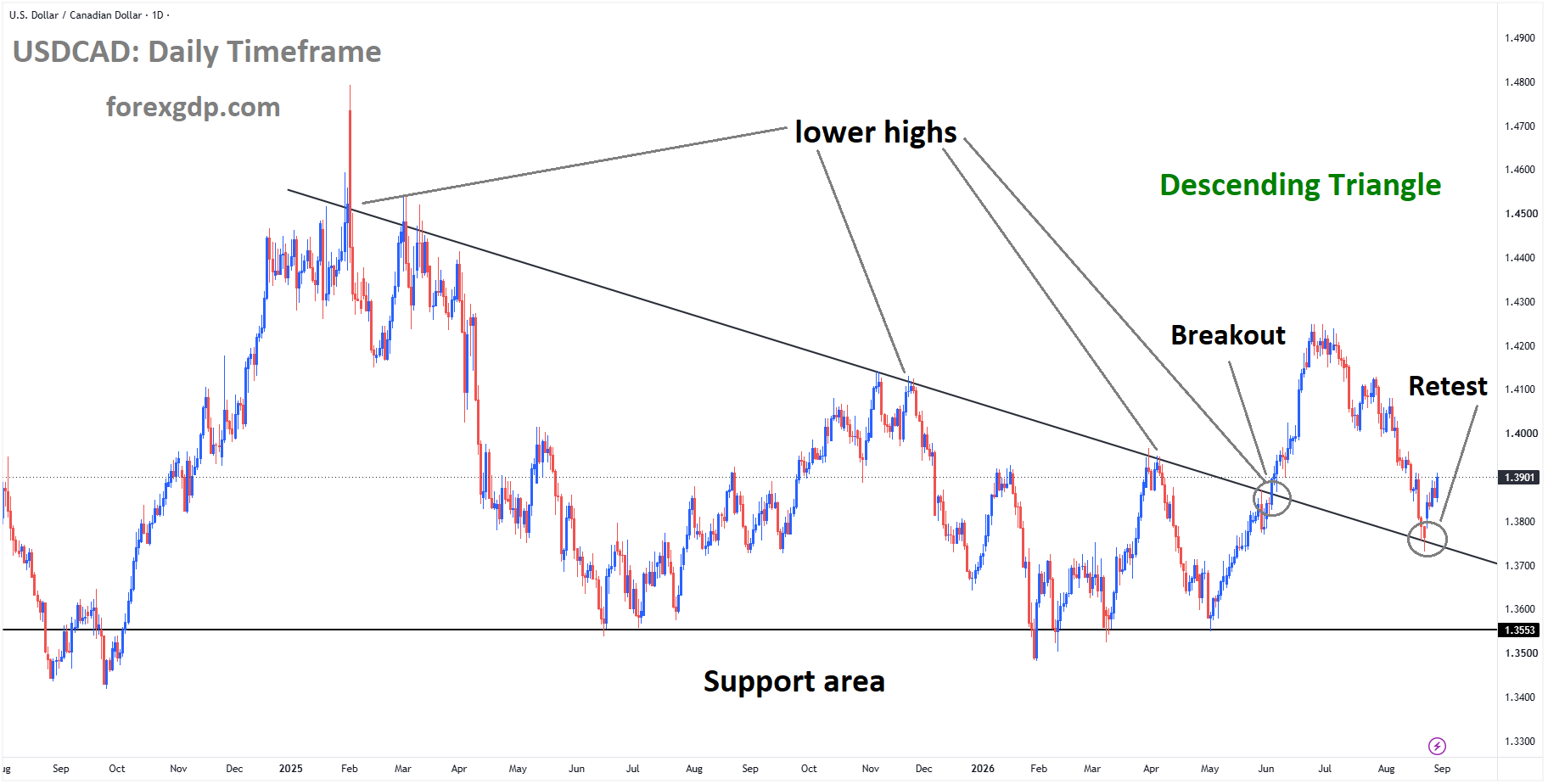
USDCAD is rebounding from the retest area of the descending triangle pattern
Under normal circumstances, such encouraging data could strengthen confidence in the Canadian Dollar. However, financial markets were more focused on the changing outlook for US monetary policy. Fresh comments from Federal Reserve Chair Kevin Warsh increased expectations that American interest rates may rise again.
As a result, USDCAD advanced even though Canada reported surprisingly healthy economic growth. The reaction highlighted an important reality in the currency market: expectations about future central bank decisions can sometimes carry more influence than current economic results.
Canada Records Its Fastest Growth Since Early 2023
Canada’s economy expanded at an annualized rate of 3.3% during the second quarter. This was comfortably stronger than the 2.5% growth forecast previously issued by the Bank of Canada.
The report also contained an important revision to the first-quarter data. Earlier figures had created the impression that Canada was experiencing a technical recession. The updated numbers removed that concern, changing the broader picture of the economy.
Instead of showing a country trapped in a prolonged slowdown, the revised data suggested that economic activity had remained more resilient than initially believed. This could give the Bank of Canada greater confidence that the economy can handle its current policy stance.
However, investors did not treat the report as a clear sign that stronger growth would continue. Much of the expansion came from areas facing significant uncertainty in the months ahead.
Exports and Automobile Shipments Drive the Recovery
Exports were one of the main engines behind Canada’s second-quarter expansion. Overseas shipments recorded their strongest increase in several years, supported heavily by the automobile industry.
Passenger car and light-truck shipments rose sharply as Canadian vehicle production recovered from two weak quarters. This rebound made the growth report look healthier and showed how important the automotive industry remains to Canada’s economy.
Business investment also improved. Capital spending ended a long period of decline, suggesting that some companies had become more willing to invest in equipment, facilities and future production. Economic activity at the end of the quarter was also better than expected, adding further strength to the report.
These details made the data more encouraging than the headline alone suggested. Growth was not limited to household spending or government activity. Exports, manufacturing recovery and business investment all contributed.
Still, investors questioned whether these improvements could survive the new trade environment.
Tariff Risks Cloud Canada’s Economic Outlook
The second quarter ended before recently announced US tariffs began affecting Canadian products. Therefore, the GDP report described economic conditions before businesses faced the full pressure of higher trade barriers.
New American duties cover billions of dollars in Canadian goods, while Canada has prepared its own retaliatory measures. These policies could raise costs, weaken demand and place pressure on companies that rely heavily on cross-border trade.
The automobile industry is particularly exposed. Vehicles, parts, trucks and steel move regularly between Canada and the United States through deeply connected supply chains. Higher tariffs could disrupt production, reduce export demand and force manufacturers to reconsider investment plans.
This matters because automobile shipments were one of the strongest parts of the second-quarter recovery. If that industry slows, Canada may struggle to repeat its recent growth performance.
Early estimates have already pointed toward weaker momentum after the quarter ended. Canadian economic output was expected to remain flat in July, while manufacturing activity appeared to lose some of its earlier strength. Investors therefore treated the GDP report as a picture of the recent past rather than reliable evidence of future conditions.
Federal Reserve Comments Strengthen the US Dollar
The main force behind the USDCAD move came from the United States rather than Canada. During his Jackson Hole speech, Federal Reserve Chair Kevin Warsh warned that policymakers still had more work to do in the fight against inflation.
He also indicated that the Federal Reserve lacked sufficient confidence that underlying inflation was returning sustainably to its target. His remarks encouraged investors to consider the possibility that US borrowing costs could rise again.
Market expectations quickly shifted toward a greater chance of a Federal Reserve increase at the September meeting. Traders also began assigning a strong probability to at least one increase later in the year, with the possibility of additional tightening remaining under consideration.
That change strengthened the US Dollar across the broader currency market. It also outweighed Canada’s positive GDP result, leaving the Canadian Dollar under pressure.
Different Central Bank Expectations Shape USDCAD
The Federal Reserve and the Bank of Canada are currently facing different policy expectations. Investors increasingly believe the Fed may need to tighten policy again, while the Bank of Canada is widely expected to leave borrowing costs unchanged at its next meeting.
This difference is more important for USDCAD than the current gap between the two central banks’ policy rates. Currency traders usually focus on where rates may move next rather than where they stand today.
If investors expect US rates to increase while Canadian rates remain unchanged, the US Dollar can become more attractive relative to the Canadian Dollar. This can happen even when Canada releases strong domestic economic data.
The latest market reaction demonstrated this imbalance clearly. Canada produced its strongest growth performance in years, but the Canadian Dollar weakened because the report did not meaningfully change expectations for the Bank of Canada.
At the same time, the Federal Reserve Chair’s remarks caused a major reassessment of the US policy outlook. Only the American side of the equation changed, and that was enough to support USDCAD.
Strong Data May Not Be Enough to Change Bank of Canada Policy
Canada’s GDP report reduces immediate fears of a deep economic slowdown. It may also make the Bank of Canada less willing to consider policy easing in the near term.
However, one strong quarter may not be enough to justify higher borrowing costs. Policymakers must consider whether the expansion can continue after new tariffs affect trade, manufacturing and business confidence.
The central bank will likely pay close attention to employment, consumer spending, inflation and business investment. It will also need to evaluate whether trade tensions create temporary disruption or a longer-lasting economic slowdown.
For now, investors appear to believe the Bank of Canada will remain patient. Unless upcoming data changes that view, Federal Reserve expectations may continue to play the larger role in directing USDCAD sentiment.
Final Summary
Canada’s economy delivered its fastest expansion since early 2023, supported by stronger exports, a recovery in automobile shipments and renewed business investment. Revised data also removed the earlier appearance of a technical recession.
Despite these positive developments, the Canadian Dollar weakened because investors were more concerned about future conditions. New tariffs threaten several important Canadian industries, while early signs suggest economic momentum may already be slowing.
At the same time, Federal Reserve Chair Kevin Warsh revived expectations of higher US interest rates by warning that inflation remains a concern. This created a wider difference between expected US and Canadian monetary policies.
The USDCAD reaction showed that currencies often respond more strongly to future central bank expectations than to backward-looking economic data. Canada’s growth report was impressive, but the shifting Federal Reserve outlook ultimately carried greater influence.
USDCHF Advances as Investors Shift Attention to Fed Leadership
USDCHF remained relatively stable on Friday as investors waited for an important speech from Federal Reserve Chairman Kevin Warsh at the Jackson Hole Symposium. The Swiss Franc weakened slightly against a firmer US Dollar, but overall market activity remained calm.
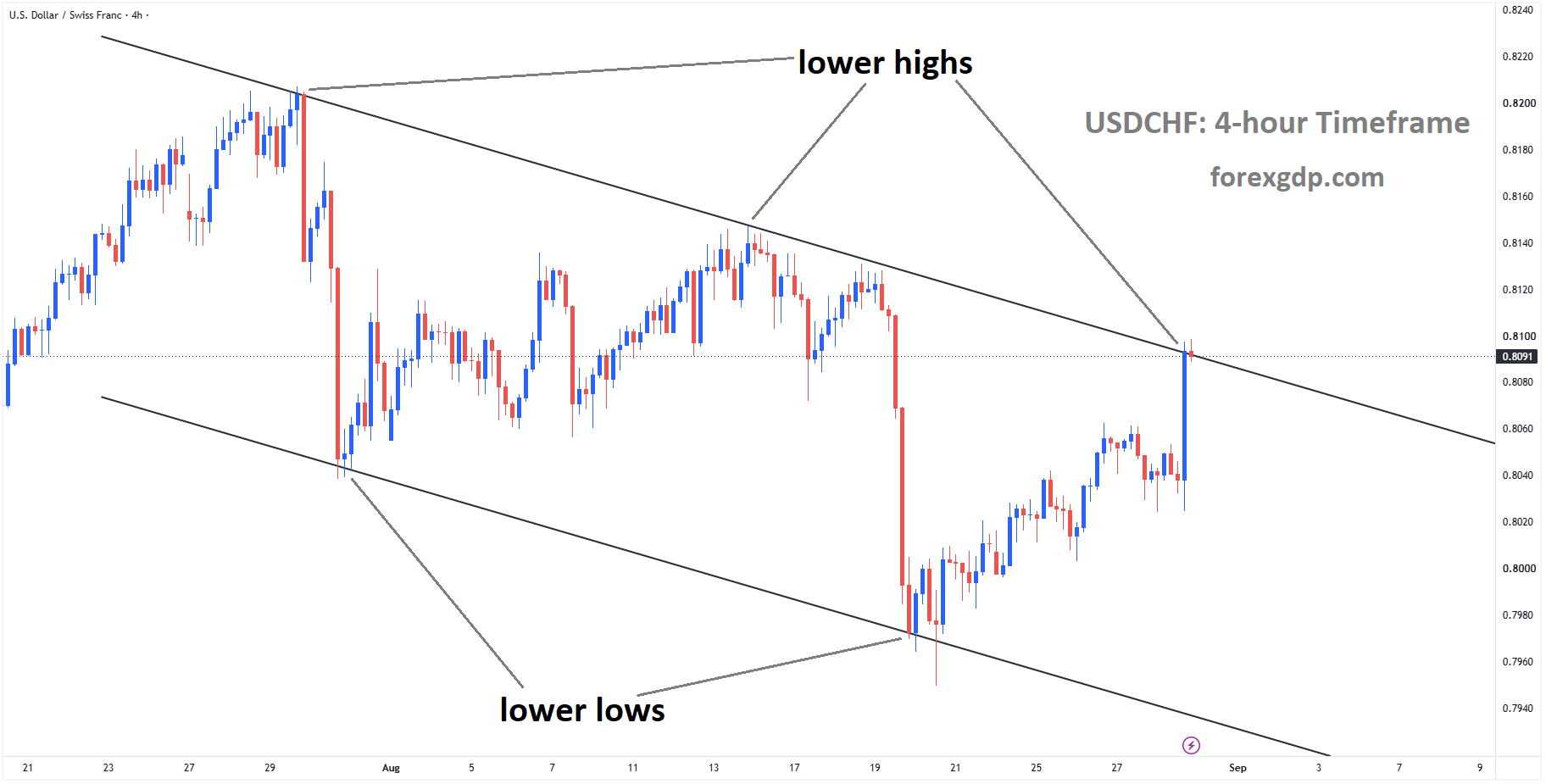
USDCHF reached the lower high area of the descending channel
The US Dollar gained some support after several Federal Reserve officials called for higher interest rates. Their comments strengthened expectations that the US central bank may need to take stronger action against persistent inflation.
At the same time, positive employment figures from Switzerland failed to provide meaningful support for the Swiss Franc. The data showed that the country’s labour market remains resilient despite uncertainty surrounding the Middle East and concerns about global energy supplies.
With both currencies influenced by different economic forces, investors remained cautious. The main focus was on whether Warsh would offer clear guidance about the future direction of US monetary policy.
Inflation Keeps Pressure on the Federal Reserve
Inflation remains one of the biggest challenges facing the Federal Reserve. Recent US economic reports have suggested that price pressures are still stronger than policymakers would like. This has encouraged some officials to support additional interest rate increases.
Higher interest rates are generally used to reduce inflation by making borrowing more expensive. When credit becomes costly, households and businesses often reduce spending. This can lower demand across the economy and gradually ease pressure on prices.
However, raising rates also creates risks. If the Federal Reserve acts too aggressively, economic growth could slow sharply. Companies may reduce investment, consumers may cut spending, and employment conditions could weaken.
The central bank must therefore find a careful balance. It needs to show that it is serious about controlling inflation without placing unnecessary pressure on the wider economy. This difficult balance explains why investors closely examine every speech and public comment from Federal Reserve officials.
Fed Officials Support Stronger Action
Kansas City Fed President Jeffrey Schmidt warned that inflation remains stubborn. His remarks suggested that the central bank has not yet completed its work and may need to consider further measures to bring price growth under control.
Cleveland Fed President Beth Hammack expressed a similar view. She indicated that the time had come for the Federal Reserve to act, referring to the possibility of higher interest rates.
These comments provided moderate support for the US Dollar because higher rates can make dollar-based assets more attractive to international investors. When investors expect US borrowing costs to rise, demand for the currency may increase.
Still, comments from individual policymakers do not always represent the final decision of the Federal Open Market Committee. The Federal Reserve considers a wide range of information, including inflation, employment, consumer activity, business investment, and financial conditions.
As a result, investors are looking for signs that the calls for tighter policy are gaining wider support within the central bank.
Warsh’s Jackson Hole Speech Takes Centre Stage
Kevin Warsh’s appearance at Jackson Hole has attracted considerable attention because investors want to understand how he plans to guide monetary policy. His earlier remarks were viewed as firm on inflation, but markets are waiting to see whether that position will lead to a clear policy plan.
The previous Federal Reserve meeting left many investors disappointed because it offered limited information about the next steps. Although policymakers recognised the inflation problem, they did not provide enough certainty about when or how they might respond.
Warsh now faces pressure to explain whether the Federal Reserve is prepared to increase interest rates. Investors also want to know which economic conditions would influence the timing of such a move.
A firm message could strengthen expectations of tighter monetary policy and provide further support for the US Dollar. A cautious speech, however, could leave markets uncertain and encourage investors to wait for additional economic reports.
Clear Policy Guidance May Remain Limited
Rabobank strategist Bas van Geffen has questioned whether Warsh will provide detailed guidance during his Jackson Hole address. He suggested that the Fed chairman may follow a prepared message instead of making stronger or more direct policy statements.
Part of this uncertainty is connected to recent comments from Treasury Secretary Scott Bessent about the rates market. Those interventions have added another layer to the debate over borrowing costs and the longer-term direction of US government bond yields.
The structure of this year’s Jackson Hole programme may also offer a clue. The absence of a dedicated monetary policy panel suggests that the event may not be designed to announce a major shift in the Federal Reserve’s approach.
If Warsh avoids giving specific guidance, investors may continue to rely heavily on upcoming inflation and employment data. This would keep uncertainty elevated and could lead to changing expectations as each new economic report is released.
Swiss Employment Data Shows Economic Resilience

Switzerland’s latest employment figures provided an encouraging picture of the domestic economy. The data indicated that the labour market remains stable despite uncertainty linked to the Middle East conflict and its effect on energy markets.
A resilient labour market is important because it supports household confidence and consumer spending. When employment conditions remain healthy, people are generally more willing to make purchases and meet financial commitments.
The figures also suggest that Swiss businesses have managed external pressures reasonably well. Global uncertainty, changes in energy costs, and weaker international demand can all affect a small, export-focused economy such as Switzerland.
Even so, the Swiss Franc received little support from the positive employment report. Investors appeared more interested in the outlook for US interest rates and the Federal Reserve’s inflation strategy.
Why the Swiss Franc Struggled to Benefit
Strong domestic data does not always lead to an immediate rise in a currency. Global monetary policy expectations can sometimes have a much greater influence than a single national report.
In this case, the possibility of higher US interest rates increased demand for the Dollar. That influence overshadowed the encouraging news from Switzerland’s labour market.
The Swiss Franc is also widely viewed as a safe-haven currency. It often attracts demand during periods of intense financial or geopolitical stress. However, market volatility was relatively subdued, reducing the need for investors to move heavily into defensive assets.
Uncertainty in the Middle East remains an important concern, particularly because it can affect energy supplies and global confidence. Yet investors appeared comfortable waiting for the Federal Reserve chairman’s speech before making larger decisions.
USDCHF Outlook Depends on Central Bank Expectations
The near-term direction of USDCHF is likely to depend heavily on how investors interpret Federal Reserve communication. If policymakers continue to argue that inflation requires stronger action, the US Dollar may remain supported.
However, markets will also examine whether the Fed chairman provides a clear timetable or simply repeats the central bank’s commitment to controlling inflation. General statements may not be enough to create lasting confidence about the future path of interest rates.
For the Swiss Franc, domestic economic resilience remains a positive factor. Stable employment conditions show that Switzerland is coping with external uncertainty better than some investors might have expected.
Nevertheless, the currency may struggle to gain momentum while attention remains centred on US monetary policy. Broader changes in risk sentiment and developments in the Middle East could also influence demand for the Franc.
Summary
USDCHF remained calm as investors waited for Kevin Warsh’s Jackson Hole speech. The US Dollar found support after Federal Reserve officials argued that persistent inflation may require higher interest rates.
Meanwhile, strong Swiss employment figures showed that the country’s labour market remains resilient despite geopolitical and energy-related uncertainty. However, the data was not enough to lift the Swiss Franc because investors were primarily focused on the Federal Reserve.
Warsh’s message will be closely examined for clues about future policy. If he supports stronger action against inflation, the Dollar could benefit. If he avoids specific guidance, uncertainty may continue as markets wait for the next round of US economic data.
AUDUSD Slides as Warsh’s Firm Fed Stance Revives Dollar Demand
The Australian Dollar weakened against the US Dollar on Friday after enjoying a strong rise earlier in the session. The currency pair had climbed to its strongest position since the middle of May, but it could not maintain that momentum as investors reacted to a more aggressive message from the Federal Reserve.
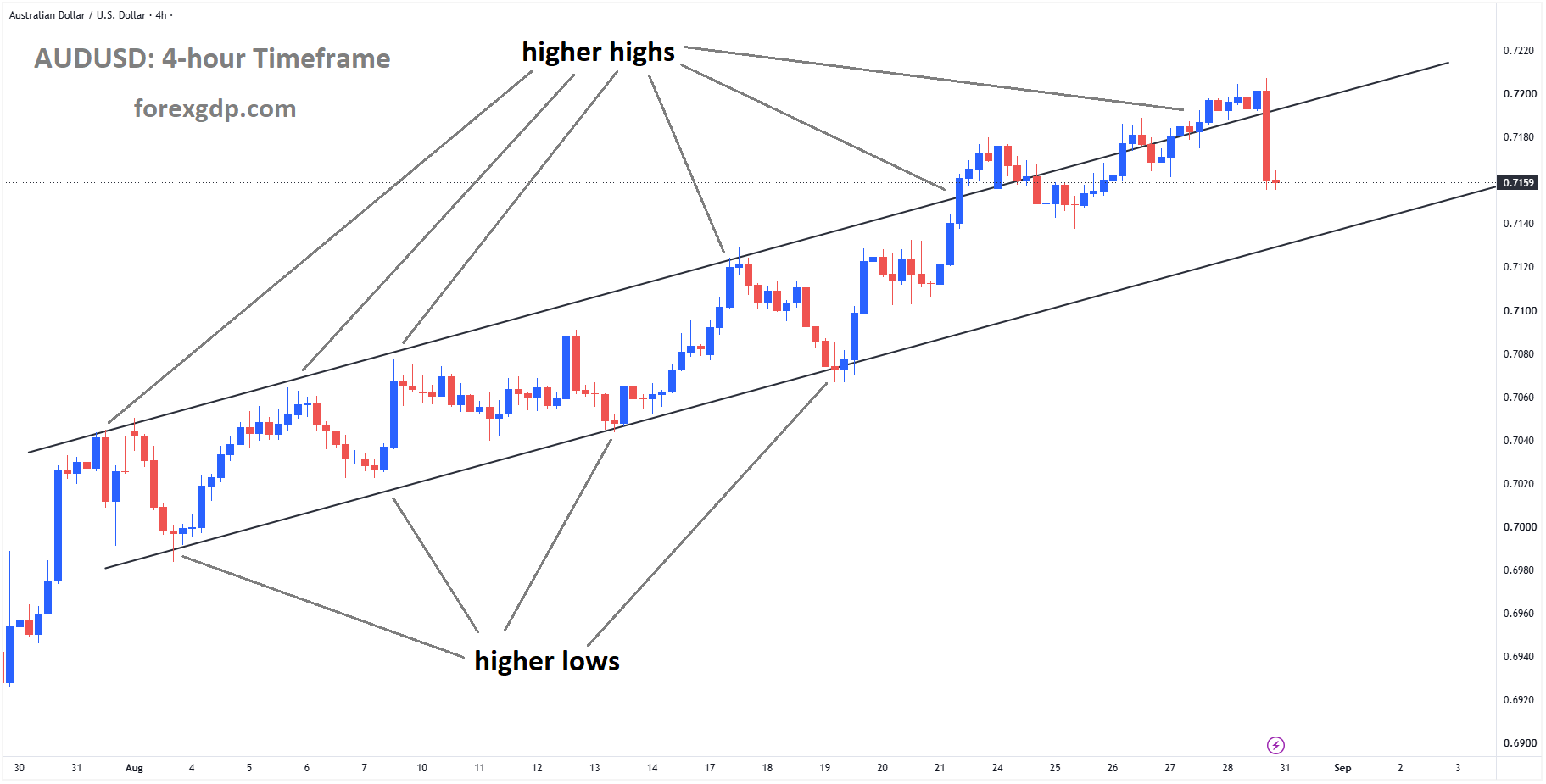
AUDUSD is moving in an ascending channel, and the market has fallen from the higher high area of the channel
Renewed demand for the US Dollar became the main force driving the market. Traders quickly adjusted their expectations after Federal Reserve Chair Kevin Warsh made it clear that inflation remains a serious concern for the US central bank.
His comments reminded investors that the battle against rising prices is not over. Although the US economy continues to show resilience, the Fed appears unwilling to relax its policy approach until there is stronger evidence that inflation is moving steadily toward its official goal.
This change in sentiment placed pressure on AUDUSD and encouraged some investors to reduce their exposure to the Australian Dollar.
Warsh Keeps the Focus on Price Stability
Kevin Warsh stressed that price stability must remain the Federal Reserve’s leading responsibility. His remarks suggested that economic strength alone would not persuade policymakers to overlook persistent inflation.
The Fed Chair explained that officials need greater confidence that underlying inflation is returning to the central bank’s target. If that progress does not become clear, policymakers may still need to take further action.
This message was important because recent economic reports had encouraged some investors to believe that inflation risks were beginning to ease. Warsh acknowledged that some data released during the summer had been more encouraging than expected. However, he warned that a few positive reports are not enough to confirm a lasting improvement.
Inflation can slow for a short period before rising again. Because of this risk, the Fed wants to see a broad and sustainable decline rather than temporary relief. Warsh’s comments showed that policymakers remain cautious and do not want to declare victory too early.
Fed’s Inflation Goal Remains Unchanged
Warsh also repeated that the Federal Reserve’s inflation objective remains firm. This statement helped remove doubts that the central bank might become more tolerant of inflation while the economy remains strong.
The Fed uses Personal Consumption Expenditures inflation as its preferred measure of price growth. Policymakers want this measure to return sustainably toward the central bank’s goal. Until that happens, borrowing costs could remain restrictive or move higher if inflation begins to strengthen again.
The Federal Reserve faces a difficult balancing act. Keeping policy tight for too long could weaken business activity, reduce investment and place pressure on employment. On the other hand, easing policy too early could allow inflation to become more deeply rooted in the economy.
Warsh’s speech suggested that the central bank currently sees persistent inflation as the greater danger. That view gave the US Dollar fresh support and weakened demand for currencies such as the Australian Dollar.
Investors Raise Expectations for Another US Rate Hike
The Fed Chair’s message led investors to sharply reconsider the likely direction of US monetary policy. Expectations for an interest-rate increase at the Fed’s September meeting rose noticeably following his remarks.
This shift matters because higher interest rates can make US assets more attractive to global investors. When demand for those assets increases, demand for the US Dollar often rises as well.
The repricing of Fed expectations happened quickly because Warsh’s comments were more hawkish than many market participants had anticipated. His focus on unfinished work against inflation suggested that policymakers are willing to tighten financial conditions further if necessary.
As the possibility of another rate increase gained attention, the US Dollar recovered and AUDUSD gave back part of its earlier advance. For the moment, the Federal Reserve’s firm message has become the strongest influence on the currency pair.
Australian Inflation Keeps the RBA Under Pressure

The Australian Dollar is not without support. Inflation in Australia remains above the Reserve Bank of Australia’s preferred range, keeping expectations of another interest-rate increase alive.
In its latest Bulletin, the RBA noted that consumer prices have remained uncomfortably high during much of the period following the pandemic. Despite earlier efforts to control inflation, price growth has not returned comfortably to the central bank’s target range.
This situation creates pressure on the RBA to maintain a firm policy approach. If inflation stays elevated, the central bank may decide that another rate hike is necessary before the end of the year.
Higher Australian interest rates would normally provide support to the Australian Dollar. However, that support was not strong enough on Friday to overcome the renewed demand for the US Dollar.
Latest Australian Data Shows Inflation Is Still Stubborn
Recent Australian inflation figures strengthened the argument for further action from the RBA. Headline consumer inflation slowed in July compared with the previous month, but the decline was smaller than economists had expected.
The data showed that inflation is moving in the right direction, but not quickly enough to give the RBA complete confidence. Price growth continues to remain above the central bank’s comfort zone, meaning officials cannot easily shift toward a softer policy stance.
Underlying inflation also remained firm. This measure removes some of the most volatile price movements and provides a clearer picture of broader inflation pressure. Its failure to slow as expected suggests that rising costs are still affecting many areas of the Australian economy.
Persistent inflation creates problems for households because it reduces purchasing power and keeps everyday expenses high. It also makes the RBA’s job more difficult, as the central bank must control prices without causing unnecessary harm to economic growth.
Fed and RBA Policies Pull AUDUSD in Opposite Directions
AUDUSD is being influenced by two central banks that are both concerned about inflation. The Federal Reserve is warning that more work may be required, while the Reserve Bank of Australia is also facing pressure to keep its policy restrictive.
This creates competing forces for the currency pair. Expectations of higher Australian interest rates can strengthen the Australian Dollar, while expectations of higher US rates can support the US Dollar.
The final direction often depends on which central bank is expected to act more aggressively. At present, the sudden rise in expectations for another Fed rate hike is having the greater impact.
Investors will continue to compare inflation reports, employment figures and comments from policymakers in both countries. Any evidence that US inflation is remaining stubborn could strengthen expectations for tighter Fed policy. Meanwhile, further signs of persistent Australian inflation could increase pressure on the RBA to act again.
Summary
The Australian Dollar pulled back against the US Dollar after reaching its strongest position since mid-May. Hawkish comments from Federal Reserve Chair Kevin Warsh renewed concerns that US interest rates may need to rise again.
Warsh made it clear that price stability remains the Fed’s main priority and that recent improvements in inflation data are not yet enough to confirm a lasting change. His remarks encouraged investors to raise their expectations for another US rate hike, helping the US Dollar regain strength.
Australia is also dealing with stubborn inflation, which keeps the possibility of further RBA tightening alive. However, the sharp change in US monetary policy expectations currently carries more influence. Until investors receive clearer inflation signals from both economies, AUDUSD is likely to remain sensitive to central bank guidance and changing interest-rate expectations.
NZDUSD Climbs as RBNZ Rate Hike Expectations Boost the Kiwi
The New Zealand Dollar gained strength against the US Dollar during Friday’s Asian trading session. Demand for the Kiwi improved as investors reacted to growing expectations that the Reserve Bank of New Zealand could raise interest rates at its next policy meeting.
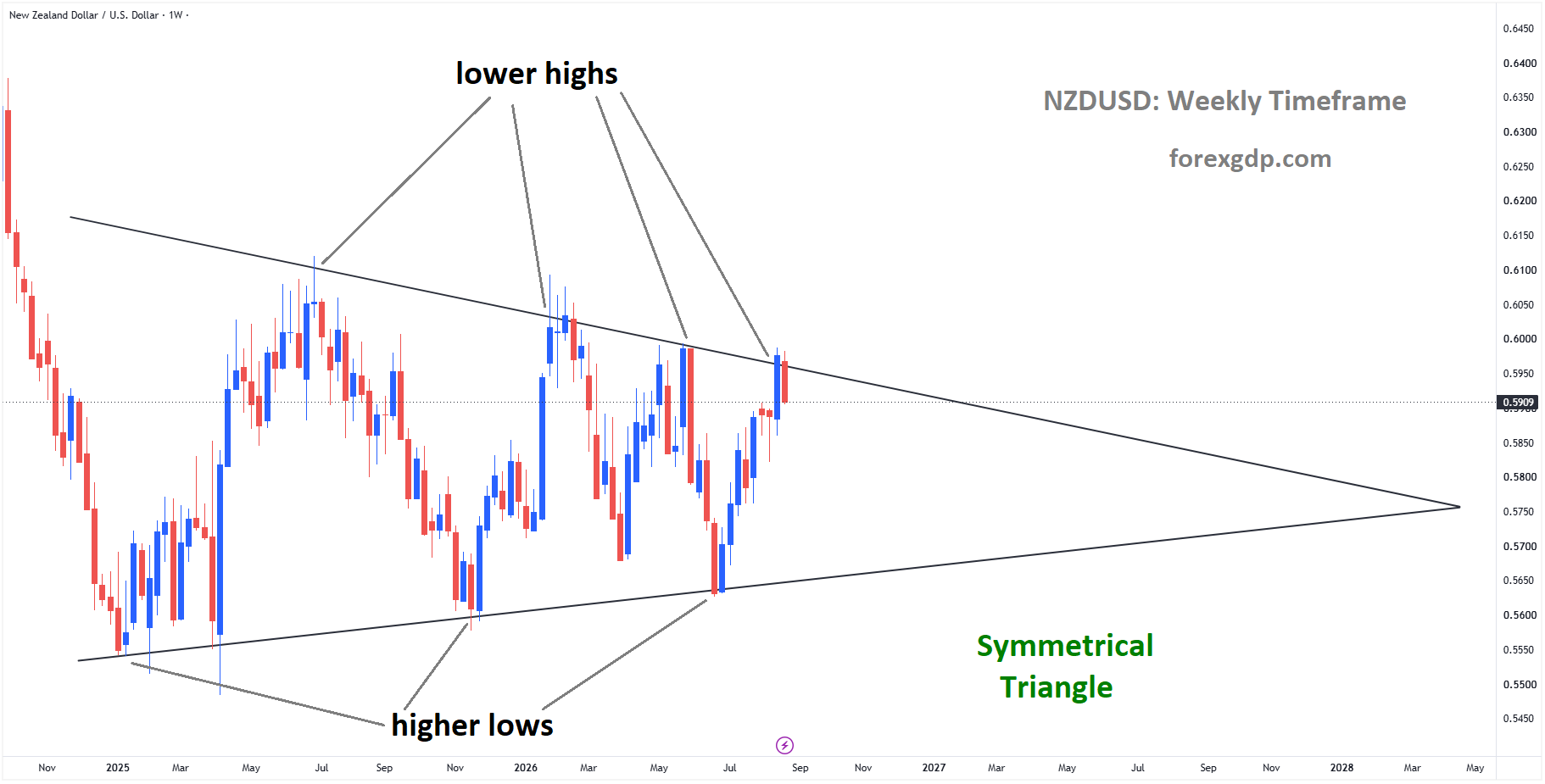
NZDUSD is falling from the lower high area of the symmetrical triangle pattern
Recent inflation figures from New Zealand have encouraged traders to believe that monetary policy may become tighter. Consumer prices increased more strongly than economists had expected during the second quarter. This result suggests that inflationary pressure remains a concern for the central bank.
Higher inflation often pushes a central bank to consider raising borrowing costs. When interest rates rise, a country’s currency can become more attractive to international investors. This is because investors may receive better returns from assets linked to that currency.
The possibility of an RBNZ rate increase has therefore provided support for the New Zealand Dollar. However, investors are also preparing for an important speech from the Federal Reserve, which could influence the direction of the US Dollar.
Inflation Raises the Chance of an RBNZ Rate Hike
New Zealand’s latest Consumer Price Index report was stronger than expected. The data showed that inflation remained persistent during the second quarter, increasing pressure on the RBNZ to respond.
BNZ analysts believe the central bank will increase the Official Cash Rate by 25 basis points at its September meeting. They expect the policy rate to reach 2.75%, describing the move as highly likely because financial markets have already priced in most of the expected increase.
A September rate hike would show that the RBNZ is becoming more concerned about inflation. Central banks normally raise interest rates when they want to reduce demand and control rising prices. Higher borrowing costs can discourage excessive spending and make loans more expensive for households and businesses.
The challenge for the RBNZ is to lower inflation without placing too much pressure on economic activity. Raising rates too quickly could weaken household spending, slow business investment and create difficulties for borrowers. Waiting too long, however, could allow inflation to become harder to control.
This difficult balance means every economic report will remain important. Employment figures, wage growth, consumer spending and business confidence could all shape the RBNZ’s future decisions.
Further Monetary Tightening May Follow
Investors are not only focused on the September meeting. The longer-term direction of New Zealand’s interest rates is also attracting attention.
The RBNZ could signal that additional policy tightening may be necessary after the expected September increase. Current expectations suggest that the central bank may guide interest rates toward a peak of around 3.5%.
BNZ holds an even more aggressive view. Its analysts believe the Official Cash Rate could eventually rise to 4.0% by May 2027. If this outlook proves correct, New Zealand could face an extended period of tighter monetary conditions.
Such a policy path may continue to support the Kiwi because higher interest rates can attract foreign capital. Nevertheless, the currency’s performance will depend on whether the economy can handle higher borrowing costs without experiencing a serious slowdown.
The RBNZ will also need to examine whether inflation is spreading across the wider economy. If price pressure remains limited to a few areas, policymakers may move carefully. If inflation becomes more widespread, the case for several rate increases could become stronger.
Jackson Hole Speech Takes Centre Stage
Although the RBNZ outlook has supported NZDUSD, attention is expected to shift toward the United States later on Friday. Federal Reserve Chair Kevin Warsh is scheduled to speak at the Jackson Hole Symposium, one of the most closely watched central banking events of the year.
Investors will listen carefully for comments about inflation, economic growth and the future direction of US interest rates. The speech could provide valuable clues about whether the Federal Reserve believes tighter monetary policy is still required.
A hawkish message would suggest that the Fed is prepared to keep interest rates elevated or consider additional increases. Such remarks could strengthen the US Dollar and reduce some of the New Zealand Dollar’s recent momentum.
On the other hand, a more cautious message could place pressure on the Greenback. If Warsh highlights economic risks or suggests that inflation is becoming less threatening, investors may reduce expectations of further US policy tightening.
The impact on NZDUSD will therefore depend on how the Federal Reserve’s outlook compares with expectations surrounding the RBNZ.
Central Bank Expectations Drive NZDUSD
The direction of NZDUSD is being shaped by two different central bank stories. In New Zealand, stronger inflation has increased confidence that the RBNZ will raise rates. In the United States, traders are waiting to learn whether the Fed will maintain a firm stance on inflation.
Currency markets often respond to differences between national interest-rate expectations. If investors believe New Zealand rates will rise faster than US rates, the Kiwi may receive additional support. If the Federal Reserve presents a more aggressive outlook, the US Dollar could regain strength.
This relationship can change quickly when new information becomes available. A single speech or economic report may alter expectations, especially when markets have already priced in a particular policy decision.
For this reason, the Jackson Hole event could produce cautious trading before Warsh delivers his remarks. Investors may avoid making large commitments until they have a clearer understanding of the Fed’s position.
New Zealand’s Economic Outlook Remains Important
Beyond central bank meetings, the strength of New Zealand’s economy will play an important role in the Kiwi’s longer-term direction. Higher interest rates may support the currency, but they can also create challenges for economic growth.
Households with mortgages could face greater repayment pressure, while companies may delay borrowing or expansion plans. If domestic demand weakens significantly, the RBNZ may have less room to continue raising rates.
Global conditions are also important because New Zealand depends heavily on international trade. Changes in commodity demand, trading-partner growth and worldwide risk sentiment can influence the country’s economic outlook.
The New Zealand Dollar is often sensitive to broader market confidence. It may perform well when investors are willing to take risks but struggle when uncertainty encourages demand for safer currencies such as the US Dollar.
Summary
NZDUSD received support as stronger New Zealand inflation increased expectations of an RBNZ interest-rate hike in September. BNZ analysts see a 25-basis-point increase as highly likely and expect further tightening over the coming months.
The focus now turns to Federal Reserve Chair Kevin Warsh’s Jackson Hole speech. A hawkish message could strengthen the US Dollar and limit the Kiwi’s progress, while a cautious outlook may allow the New Zealand Dollar to remain supported.
Future movement will depend on the changing policy expectations of both central banks, along with inflation, economic growth and global investor confidence.
AUDJPY Nears a Historic Peak as the Australian Dollar Surges
AUDJPY continued to attract buyers as the Australian Dollar benefited from its strong interest-rate advantage over the Japanese Yen. The pair approached a level not seen for many years, showing that demand for higher-yielding currencies remains powerful despite disappointing economic figures from Australia.
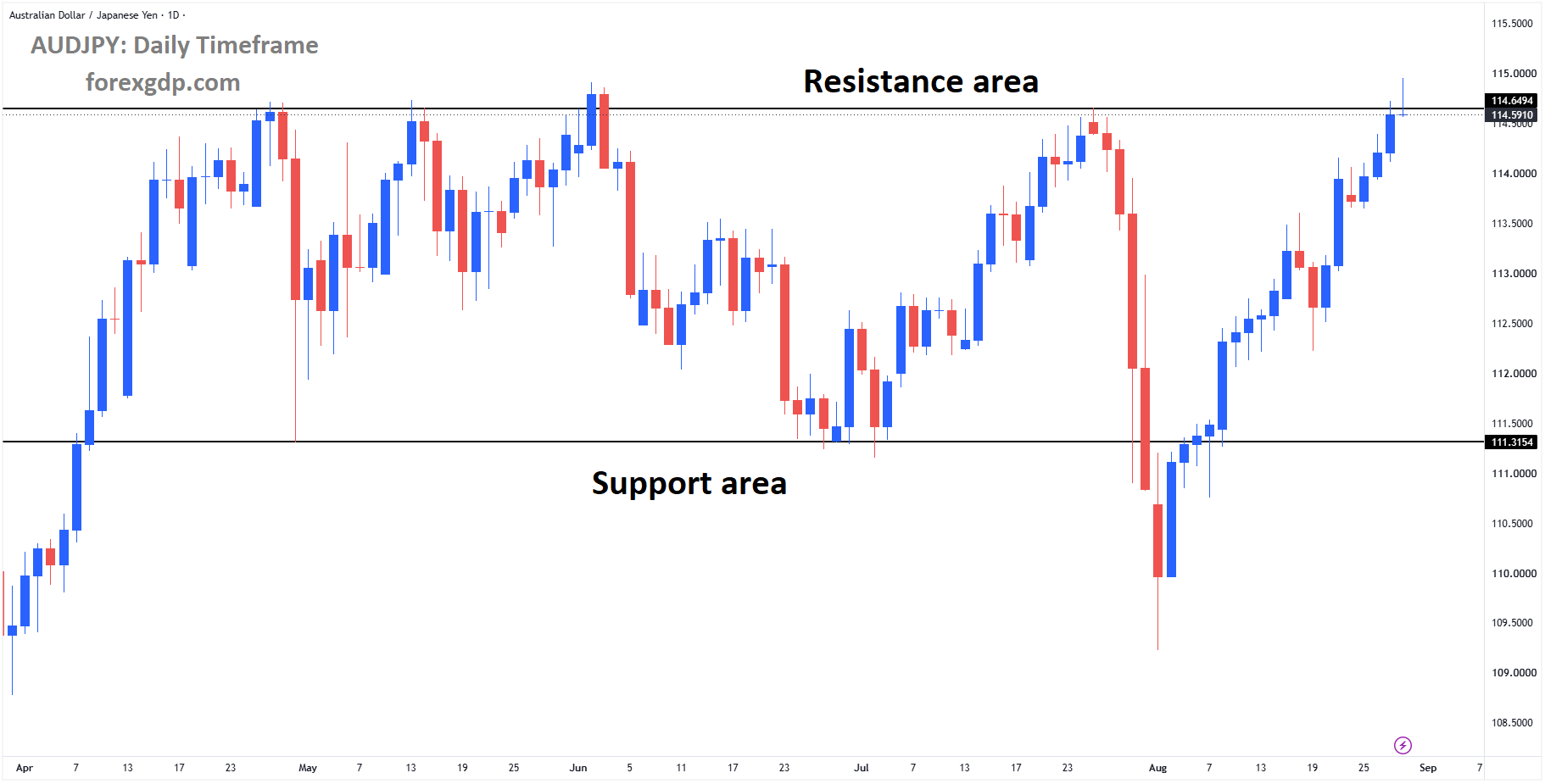
AUDJPY reached the resistance area of the box pattern
Australian business investment declined sharply during the second quarter. Markets had expected capital spending to remain unchanged, but the actual result showed a notable contraction. The previous quarter had recorded strong growth, making the latest decline even more striking.
However, the weak investment report failed to create lasting pressure on the Australian Dollar against the Yen. Investors remain focused on the wide difference between interest rates in Australia and Japan. That gap continues to make the Australian currency more attractive to traders seeking higher returns.
Meanwhile, attention is turning to Tokyo’s core inflation report. Economists expect inflation in the Japanese capital to slow compared with the previous month. A softer result could reduce expectations for aggressive action from the Bank of Japan and leave the Yen under renewed pressure.
Australian Capital Spending Falls Sharply
Australia’s latest capital expenditure report delivered an unwelcome surprise. Business investment fell during the second quarter, while economists had expected no change. The decline also followed a strong increase in the previous reporting period.
Capital expenditure is an important measure because it shows how much businesses are investing in equipment, buildings, technology, and future expansion. When companies increase spending, it often suggests that they feel confident about demand and economic growth. A decline can indicate that businesses are becoming more cautious.
The disappointing result may raise concerns about the strength of Australia’s economy. Higher borrowing costs can discourage companies from funding new projects, especially when operating expenses are already elevated. Businesses may also delay investment if they are uncertain about consumer demand or global trade conditions.
Even so, one weak report may not be enough to change the broader outlook for Australian interest rates. Inflation, employment, consumer activity, and wage growth will remain important factors in future decisions by the Reserve Bank of Australia.
Interest-Rate Advantage Supports the Australian Dollar
The main force supporting AUDJPY is the large difference between Australian and Japanese interest rates. Australia has maintained a much higher policy rate than Japan, creating an attractive environment for carry trades.
A carry trade involves borrowing in a currency with a relatively low interest rate and investing in one that offers a higher return. The Japanese Yen has traditionally been used as a funding currency because borrowing costs in Japan have remained low for a long time.
The Australian Dollar can benefit from this strategy because Australian assets offer stronger potential returns. As long as investors remain confident and market conditions are calm, demand for the Australian Dollar may continue.
Expectations that Australian policymakers could maintain a firm stance add to the currency’s appeal. Even if Japan raises rates again, the difference between the two countries’ borrowing costs would likely remain significant. This means the basic reason behind the carry trade would not disappear quickly.
Australia’s economic data may occasionally disappoint, but traders are likely to keep comparing the policy positions of the two central banks. If the Reserve Bank of Australia remains more concerned about inflation than economic weakness, the Australian Dollar could retain its interest-rate advantage.
Yen Intervention Delivered Only Temporary Relief
Japanese authorities previously stepped into the currency market after the Yen suffered heavy selling pressure. The intervention caused a sharp and immediate reaction, showing that officials were willing to act when exchange-rate movements became excessive.
However, the effect did not last long in AUDJPY. Within a few weeks, the pair recovered the entire decline caused by the intervention and returned to its earlier strength. This recovery highlights the limitations of direct currency intervention.
Authorities can influence exchange rates by buying or selling currencies, but intervention does not automatically change the economic reasons behind a market trend. The wide interest-rate gap between Australia and Japan remained in place after officials acted.
The results were also different across Yen currency pairs. The Yen managed to retain part of its recovery against the US Dollar, but its gains against the Australian Dollar faded more completely. This difference suggests that investors continue to see the Australian Dollar as a particularly attractive currency for carry trades.
Intervention can slow market movement, create uncertainty, and force traders to reduce risky positions. Yet its influence may fade if monetary policy remains unchanged. Sustainable Yen strength would likely require a lasting shift in Japanese interest rates or a broader reduction in global demand for high-yielding assets.
Tokyo Inflation Becomes the Next Key Focus

Traders are now watching Tokyo’s core inflation report for clues about Japan’s broader price outlook. Inflation in the capital is often viewed as an early guide to nationwide trends because it is released before the national data.
Economists expect Tokyo’s core inflation rate to ease from the previous month. If the report confirms that price pressures are weakening, the Bank of Japan may have less reason to tighten monetary policy quickly.
A softer inflation reading could reinforce the view that Japanese rates will remain relatively low. That would preserve much of Australia’s yield advantage and may encourage investors to continue using the Yen as a funding currency.
However, an unexpected increase in inflation could produce a different reaction. Stronger price growth might raise expectations that the Bank of Japan will take further action. Such a shift could make borrowing in Yen more expensive and reduce the appeal of carry trades.
The central bank must balance several risks. It wants to achieve stable inflation supported by healthy wage growth, but rapid rate increases could create problems for households, businesses, and financial markets. This cautious approach has made the policy gap with Australia difficult to close.
Carry Trades Can Reverse Without Warning
Although the interest-rate gap supports AUDJPY, carry trading is not without danger. These positions often generate returns gradually during stable periods, but they can unwind very quickly when investor confidence falls.
A sudden increase in global uncertainty may encourage traders to close risky positions and repay Yen-funded borrowing. This can create strong demand for the Japanese currency in a short period. The resulting move may be much faster than the steady gains produced by the carry trade.
Past market episodes have shown how severely Yen crosses can fall when investors rush to reduce risk. Changes in central-bank policy, financial stress, geopolitical developments, or concerns about global growth can all trigger a rapid reversal.
Currency intervention remains another risk. Even when its long-term effect is limited, official action can cause sharp short-term volatility. Traders may also become cautious if Japanese officials issue stronger warnings about one-sided or disorderly exchange-rate movements.
Final Summary
AUDJPY remains supported by the large interest-rate difference between Australia and Japan. Weak Australian capital spending has raised concerns about business confidence, but it has not been strong enough to outweigh the attraction of Australia’s higher returns.
The next important influence will be Tokyo’s core inflation report. Softer inflation could reduce pressure on the Bank of Japan to tighten policy quickly, while stronger data may increase expectations for further rate action.
Japanese intervention previously created a major but temporary recovery in the Yen. Without a lasting change in monetary policy, the forces supporting the carry trade remain active. Even so, investors should remember that carry trades can reverse suddenly when market sentiment changes.
Crude Oil Gains Strength as Russia-Ukraine Conflict Escalates
West Texas Intermediate oil remains caught between two powerful geopolitical forces. Escalating tensions between Russia and Ukraine are raising fears about energy supply disruptions, while diplomatic progress involving Iran and Oman is creating cautious hope for improved shipping conditions through the Strait of Hormuz.
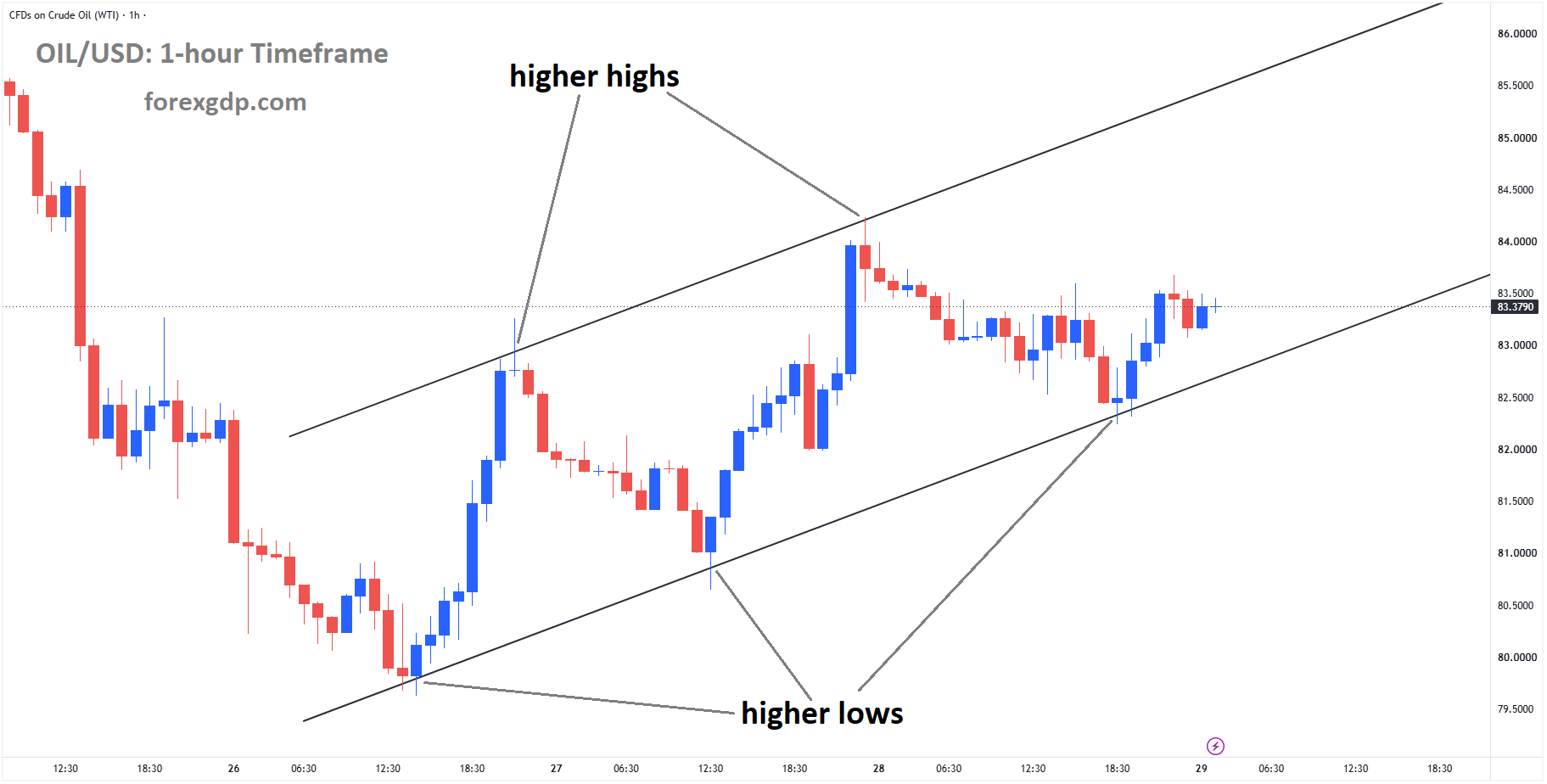
Crude Oil is moving in an ascending channel, and the market has rebounded from the higher low area of the channel
Oil has faced selling pressure after recording gains earlier in the week. However, the market could regain strength if attacks on Russian energy facilities continue. Damage to refineries, ports, and other important infrastructure may reduce Russia’s ability to supply crude oil and refined fuels to international buyers.
At the same time, developments in the Middle East have slightly reduced immediate supply fears. A new revenue-sharing agreement between Iran’s military and Oman has improved expectations surrounding the Strait of Hormuz. Still, Iranian officials have made it clear that the agreement does not guarantee the full or immediate reopening of this vital shipping route.
As a result, the global oil outlook remains uncertain. Traders are closely watching both Eastern Europe and the Middle East to understand which development will have the strongest influence on future energy supplies.
Russia-Ukraine Tensions Return to the Centre of the Oil Market
The Russia-Ukraine conflict is once again becoming a major concern for the global energy market. Recent comments from Russian President Vladimir Putin suggest that negotiations with Ukraine have made little progress. With talks appearing to stall, Russia may be preparing for a further escalation in military activity.
Any increase in fighting could create new risks for oil production, refining, transportation, and exports. Russia remains one of the world’s most important energy suppliers, so disruptions inside the country can affect buyers across Europe, Asia, and other regions.
The market is particularly concerned about the growing number of Ukrainian attacks on Russian energy infrastructure. Refineries and ports have repeatedly come under pressure, increasing the possibility of longer-term damage to the country’s energy system.
Even when crude production continues, damaged refineries can reduce Russia’s ability to convert oil into products such as diesel, petrol, and aviation fuel. Damage to ports can also delay shipments or force exporters to use more expensive and complicated transport routes.
These risks may encourage buyers to search for replacement supplies. If several countries compete for alternative energy sources at the same time, pressure on the wider oil market could increase.
Attacks on Russian Refineries Create Wider Supply Concerns
Russian refineries play an important role in regional and international fuel markets. They process large amounts of crude oil and supply refined products to a wide range of customers. Continued attacks on these facilities could therefore have consequences far beyond Russia.
A refinery cannot always return to normal operations quickly after suffering damage. Repairs may require specialised equipment, skilled workers, and replacement parts. Sanctions and trade restrictions can make this process more difficult by limiting access to foreign technology and industrial components.
Ports are equally important because they connect Russian energy production with international markets. Disruptions at export terminals can slow deliveries even when enough oil is available. Shipping companies may also become more cautious if security risks increase near important facilities or transport routes.
The combination of refinery damage and port disruption creates a double threat. Russia may struggle to process crude oil efficiently while also facing difficulties delivering energy products abroad. This could tighten the supply of certain fuels and increase uncertainty among importers.
The duration of any disruption will matter. Short interruptions may have a limited impact, but repeated attacks could gradually weaken Russia’s export capacity. If the conflict intensifies further, concerns about global crude and fuel availability are likely to remain strong.
Middle East Diplomacy Offers Cautious Hope
While Eastern Europe is adding pressure to the oil outlook, diplomatic developments in the Middle East are providing some relief. Reports of a revenue-sharing agreement between Iran’s military and Oman have improved expectations for energy transportation through the Strait of Hormuz.
The Strait of Hormuz is one of the most important shipping passages in the world. A significant share of globally traded oil and natural gas moves through this narrow route. Any restriction can delay deliveries, raise transport costs, and create concern among energy-importing countries.
The agreement appears to offer a possible path toward more stable operations in the area. Cooperation between Iran and Oman could reduce immediate tensions and create better conditions for vessels travelling through the passage.
However, the deal should not be treated as a complete solution. Iranian authorities have stressed that the compromise does not mean the strait will reopen fully or immediately. This warning shows that important political, military, and operational issues may still need to be addressed.
Immediate Supply Relief Is Not Guaranteed
The improved diplomatic tone has helped reduce some market anxiety, but uncertainty has not disappeared. Energy companies and shipping operators need clear evidence that vessels can travel safely and consistently before normal activity can fully resume.
Even after political agreements are reached, practical challenges may remain. Shipping schedules must be reorganised, insurers must assess the risks, and companies must decide whether the route is secure enough for regular operations. These decisions can take time.
There is also a possibility that the agreement could face delays or disagreements during implementation. Revenue-sharing arrangements often require clear rules, reliable monitoring, and cooperation between several authorities. If any part of the deal becomes disputed, confidence could weaken again.
For this reason, the Middle East outlook offers hope but not certainty. The market may continue reacting quickly to official statements, shipping updates, and any sign of renewed tension near the strategic waterway.
WTI Oil Faces Competing Geopolitical Pressures

WTI oil is being influenced by two contrasting narratives. The first is the risk of reduced Russian energy exports as the war in Ukraine intensifies. The second is the possibility of improved supply flows through the Strait of Hormuz following diplomatic progress between Iran and Oman.
Escalating attacks on Russian refineries and ports could support oil by raising fears of supply shortages. On the other hand, a safer and more accessible Strait of Hormuz could improve global energy flows and reduce concerns about disruptions from the Middle East.
The direction of the oil market may depend on which situation develops more rapidly. If Russian export capacity suffers serious damage, concerns about Eastern European supply could dominate. If the Strait of Hormuz returns to stable operation, improved Middle Eastern flows may ease some of that pressure.
Global demand conditions will also influence how strongly the market reacts. Supply disruptions usually have a greater impact when consumption is firm and available reserves are limited. If demand becomes weaker, the market may be better able to absorb temporary shortages.
Summary
WTI oil remains exposed to rapidly changing geopolitical developments. The worsening Russia-Ukraine conflict is creating fresh concerns about crude oil and refined fuel exports, especially as Ukrainian strikes continue to target Russian refineries and ports.
Meanwhile, the revenue-sharing agreement involving Iran and Oman has improved expectations for supply movement through the Strait of Hormuz. However, Iran’s warning that the passage will not reopen fully or immediately means the risk of disruption remains.
Oil may receive support if Russian energy infrastructure suffers further damage or export capacity declines. Yet improved conditions in the Middle East could limit those gains. Until clearer progress appears in either region, uncertainty surrounding global oil supply is likely to remain high.
BTCUSD Surges as Institutional ETF Demand Fuels Market Optimism
Bitcoin has continued to strengthen this week as renewed institutional interest improves confidence across the cryptocurrency market. The world’s largest digital asset has benefited from steady demand, stronger investment flows, and a modest improvement in global risk sentiment.
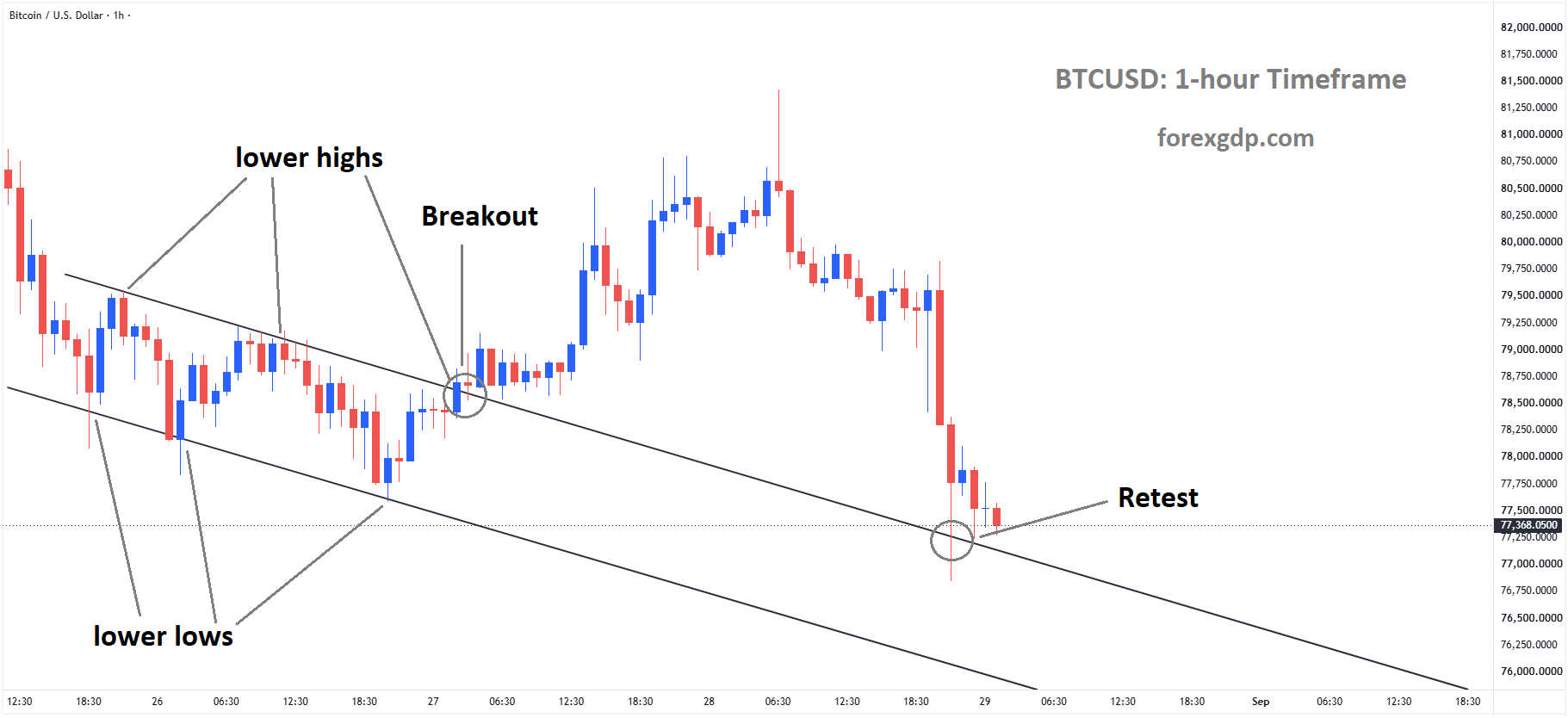
BTCUSD reached the retest area of the broken descending channel
One of the main drivers behind the latest recovery is the growing amount of money entering US-listed spot Bitcoin exchange-traded funds. These investment products allow investors to gain exposure to Bitcoin through traditional financial markets without directly buying or storing the cryptocurrency.
The latest fund activity suggests that large investors are becoming more comfortable with Bitcoin again. However, the wider economic environment remains uncertain. Inflation, Federal Reserve policy, interest-rate expectations, and geopolitical developments could all influence Bitcoin’s next move.
Institutional Investors Increase Their Bitcoin Exposure
Institutional demand has become an important source of support for Bitcoin. US-listed spot Bitcoin ETFs are heading toward a second consecutive week of inflows exceeding one billion dollars. Through Thursday, these funds attracted approximately $1.13 billion in fresh investment.
Two strong weeks of inflows show that demand is not coming from a single day of market excitement. Instead, investors appear to be gradually increasing their exposure. This creates a more encouraging backdrop because sustained investment often provides stronger support than short-lived speculative activity.
Spot Bitcoin ETFs have also made the cryptocurrency more accessible to pension funds, asset managers, financial advisers, and other professional investors. Many institutions prefer regulated investment products because they fit more easily into traditional portfolios and established risk-management systems.
Continued inflows can also improve overall market confidence. When investors see large amounts of capital entering Bitcoin-related funds, they may view it as a sign that institutional interest remains healthy. This can encourage additional participation from both professional and individual investors.
Still, ETF inflows should not be treated as a guarantee of uninterrupted growth. Institutional flows can change quickly when economic conditions become less favorable. If concerns about inflation or interest rates increase, some investors may reduce their exposure to assets considered more sensitive to risk.
Federal Reserve Policy Remains a Major Influence
Attention is now turning toward Federal Reserve Chair Kevin Warsh and his speech at the Jackson Hole Symposium. Investors hope his comments will offer more information about the central bank’s view of inflation, economic growth, and future monetary policy.
Warsh has provided limited guidance about upcoming policy decisions since becoming Fed Chair. As a result, markets may focus less on a direct promise about the next meeting and more on how he describes the broader economic environment.
A softer policy message could benefit Bitcoin. If Warsh suggests that inflation is becoming more manageable or that lower interest rates may eventually be appropriate, investors could become more willing to hold riskier assets.
Lower borrowing costs generally improve liquidity across financial markets. When returns on safer assets become less attractive, investors often explore alternatives with greater growth potential. Bitcoin can benefit from that shift because it is widely viewed as a high-risk asset with the possibility of strong long-term returns.
A firm message would create a different reaction. If Warsh focuses on persistent inflation and the need for tighter policy, expectations for higher interest rates could rise. That may strengthen demand for defensive assets while reducing interest in cryptocurrencies and other speculative investments.
Inflation Data Creates an Uncertain Economic Picture

Recent US inflation figures offered mixed signals. The core Personal Consumption Expenditures Price Index, which excludes more volatile food and energy costs, remained unchanged on an annual basis in July. The result matched economists’ expectations but showed that underlying inflation continues to run at an uncomfortable level.
Both headline and core inflation increased modestly during the month. Although the rise was not unexpected, it gave investors little reason to believe that inflation pressures had completely disappeared.
The Federal Reserve closely monitors the PCE Price Index when making monetary policy decisions. Persistent inflation may encourage officials to keep interest rates elevated or consider additional tightening if price pressures begin to accelerate.
Following the data release, financial markets increased expectations that the Fed could raise interest rates at its next policy meeting. The probability moved higher compared with the level recorded before the inflation figures were published.
This change matters for Bitcoin because interest-rate expectations affect investor behavior. Higher rates can make government bonds, savings products, and other lower-risk investments more attractive. At the same time, expensive borrowing can reduce liquidity and limit the amount of capital flowing into speculative markets.
However, the inflation report did not completely damage sentiment. The figures were broadly in line with expectations, which reduced the risk of an immediate market shock. Investors are now waiting for clearer guidance from the Fed before making larger decisions.
Strait of Hormuz Talks Offer Some Relief
Geopolitical developments are also shaping the outlook for Bitcoin. Diplomatic efforts involving Iran and Oman have raised hopes that the Strait of Hormuz could reopen under agreed conditions.
Iranian Security Chief Mohsen Rezaei stated that Tehran was preparing a list of requirements in response to a request from mediators. According to his comments, those requirements include an end to the conflict in the region.
The Strait of Hormuz is one of the world’s most important energy shipping routes. Any disruption in this area can affect global oil supplies, transportation costs, and inflation expectations. A prolonged closure could push energy expenses higher and create additional pressure on consumers and businesses.
Progress toward reopening the route may reduce fears of an extended supply disruption. Lower concern about energy-driven inflation could also reduce pressure on the Federal Reserve to maintain an aggressive monetary stance.
That possibility has helped support a mildly positive mood across risk-sensitive markets. Bitcoin has benefited because improving geopolitical conditions can encourage investors to move away from defensive positions and consider assets with greater growth potential.
Nevertheless, diplomatic discussions remain uncertain. Preparing conditions is not the same as reaching a final agreement. Investors will therefore watch for evidence that negotiations are making genuine progress.
Bitcoin’s Outlook Depends on Several Powerful Forces
Bitcoin currently sits between strong institutional support and an uncertain economic environment. ETF inflows show that professional investors remain interested, but future demand will depend partly on what happens with monetary policy.
A more supportive Federal Reserve could improve liquidity and strengthen appetite for cryptocurrency. In contrast, further monetary tightening could make investors more cautious and slow the flow of capital into risk assets.
Geopolitical developments add another layer of uncertainty. Progress in Middle East negotiations could reduce energy-related inflation concerns, while renewed tension could quickly reverse the improvement in sentiment.
Investors should also remember that Bitcoin can react sharply to headlines. Even when the broader outlook appears positive, sudden changes in economic expectations or international relations can create significant volatility.
Summary
Bitcoin’s weekly recovery is being supported by strong institutional demand, particularly through US-listed spot Bitcoin ETFs. A second consecutive week of major inflows suggests that professional investors are rebuilding exposure and maintaining confidence in the cryptocurrency market.
However, the next stage will depend heavily on Federal Reserve communication, inflation trends, and developments surrounding the Strait of Hormuz. A softer policy outlook and easing geopolitical tension could strengthen risk appetite. Higher interest-rate expectations or renewed conflict could create pressure.
For now, institutional buying provides an encouraging foundation, but the economic and political environment remains complex. Bitcoin’s broader direction will likely depend on whether investment demand can remain strong while markets adjust to changing monetary and geopolitical conditions.
Don’t trade all the time, trade forex only at the confirmed trade setups
Get more confirmed trade signals at premium or supreme – Click here to get more signals, 2200%, 800% growth in Real Live USD trading account of our users – click here to see , or If you want to get FREE Trial signals, You can Join FREE Signals Now!