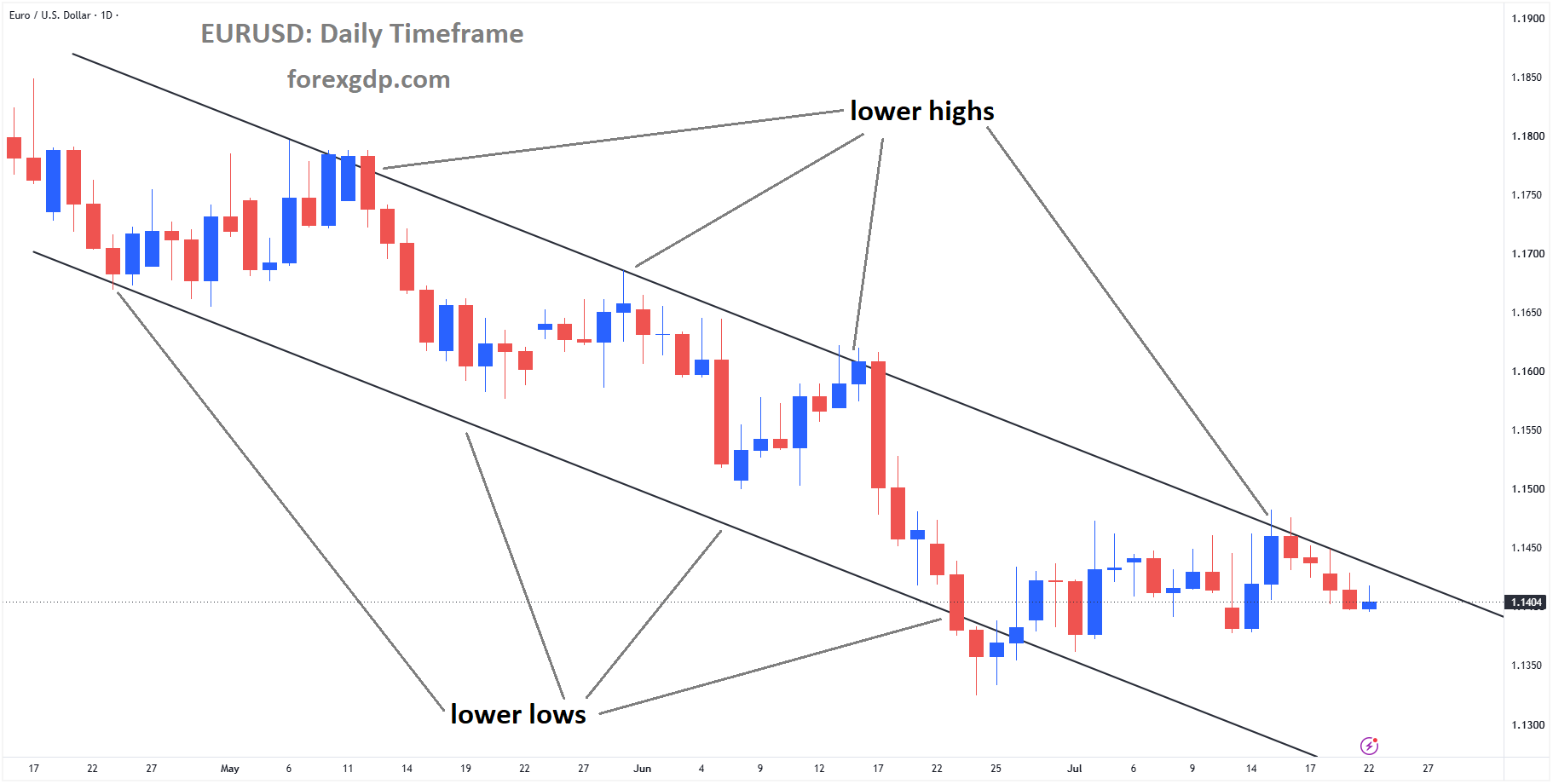
EURUSD is moving in a descending channel, and the market has reached the lower high area of the channel
EURUSD Stays Under Pressure as Oil Surge and Global Uncertainty Weigh on Euro
The EUR/USD currency pair continues to trade under pressure as investors remain cautious amid rising geopolitical tensions and growing uncertainty in global financial markets. Although the Euro has shown signs of resilience, its recovery has struggled to gain momentum, allowing the US Dollar to maintain its strength.
The market remains focused on developments in the Middle East, central bank decisions, and changing investor sentiment. These factors continue to shape the direction of both currencies, creating a cautious environment for traders.
Global Tensions Increase Demand for the US Dollar
The US Dollar has benefited from a wave of safe-haven demand as geopolitical tensions continue to escalate. Ongoing conflict involving Iran has raised concerns about regional stability, prompting investors to move their money into assets that are generally viewed as safer during uncertain times.
Whenever global uncertainty increases, the US Dollar often becomes one of the preferred choices for investors. This trend has once again helped support the Greenback, limiting the Euro’s ability to recover despite occasional buying interest.
Rising Oil Prices Add Pressure on the Euro
One of the biggest consequences of the current geopolitical situation has been the sharp rise in oil prices. Concerns about disruptions to global energy supplies have pushed energy costs higher, creating fresh challenges for economies that rely heavily on imported energy.
The Eurozone falls into this category, making the Euro more vulnerable whenever energy prices rise significantly. Higher energy costs can increase inflation, reduce consumer spending, and place additional pressure on economic growth. These concerns continue to weigh on investor confidence toward the common currency.
ECB Policy Expectations Continue to Support the Euro
Despite the challenges facing the Euro, expectations surrounding the European Central Bank (ECB) have helped prevent a much larger decline.
Many investors believe the ECB could continue maintaining a firm stance on inflation if price pressures remain elevated. This expectation has provided some support for the Euro, helping offset part of the pressure created by global uncertainty and rising energy costs.
However, market participants remain cautious ahead of the ECB’s upcoming policy announcement, as any change in the central bank’s outlook could quickly influence investor sentiment.
Analysts Believe ECB Support May Be Limited
According to analysts at ING, the Euro has remained relatively stable despite rising energy prices because markets have expected the ECB to respond more aggressively than the US Federal Reserve when dealing with inflation.
This belief has helped support the Euro over recent weeks. However, ING also suggests that there may be limited room for investors to expect even tighter ECB policy going forward.
If market expectations have already fully priced in future ECB actions, additional support for the Euro from monetary policy could gradually weaken. Investors will therefore pay close attention to the tone of the ECB’s latest communications.
The US Dollar Remains Firm Despite Fed Uncertainty
While expectations for the US Federal Reserve have shifted in recent weeks, the US Dollar has continued to attract buyers.
Recent inflation data reduced expectations that the Federal Reserve would move quickly toward additional policy tightening. Normally, this might weaken the Dollar, but strong demand for safe-haven assets has largely offset that effect.
As long as geopolitical uncertainty remains elevated, investors may continue favoring the US Dollar regardless of changing expectations surrounding future Federal Reserve decisions.
Market Sentiment Is Driving Currency Movements
At the moment, investor sentiment is playing a larger role than many traditional economic factors.
Periods of uncertainty often encourage traders to reduce exposure to riskier assets and move toward currencies considered more stable during times of global stress. This shift in sentiment has benefited the US Dollar while limiting the Euro’s upside potential.
Future headlines related to geopolitical developments could continue influencing market direction as much as economic reports or central bank statements.
Investors Watch Upcoming Central Bank Decisions

Attention is now turning toward the European Central Bank’s upcoming policy meeting. Investors will closely examine not only any policy decisions but also the language used by policymakers regarding inflation, economic growth, and future monetary policy.
Any signals suggesting a change in the ECB’s outlook could influence confidence in the Euro. At the same time, investors will continue monitoring comments from Federal Reserve officials for clues about the future direction of US monetary policy.
These central bank updates may help determine whether current market trends continue or begin to shift.
Energy Markets Remain an Important Factor
Energy prices are likely to remain a major influence on the Euro in the coming weeks. Continued uncertainty surrounding global oil supplies could maintain pressure on the Eurozone economy if energy costs remain elevated.
At the same time, any signs of easing geopolitical tensions could help stabilize energy markets, improving the overall outlook for the Euro and reducing demand for the US Dollar as a safe-haven asset.
Because of this connection, investors are watching developments in both financial markets and global politics very closely.
Final Summary
EUR/USD continues to face pressure as global uncertainty supports demand for the US Dollar. Rising geopolitical tensions and higher energy prices have created challenges for the Euro, particularly because of the Eurozone’s sensitivity to energy costs.
Even so, expectations surrounding the European Central Bank have helped prevent a sharper decline in the common currency. Investors now await fresh guidance from central banks while closely following geopolitical developments that could influence market sentiment. Until greater clarity emerges, caution is likely to remain the dominant theme for both the Euro and the US Dollar.
GBPUSD Under Pressure as Slowing UK Inflation Boosts US Dollar Demand
The British Pound remained under pressure against the US Dollar on Wednesday after fresh UK inflation data came in weaker than expected. The latest figures strengthened expectations that the Bank of England may not feel any urgency to adjust its monetary policy in the coming months. At the same time, growing concerns over the UK government’s spending plans and continued demand for the US Dollar added further pressure on the Pound.
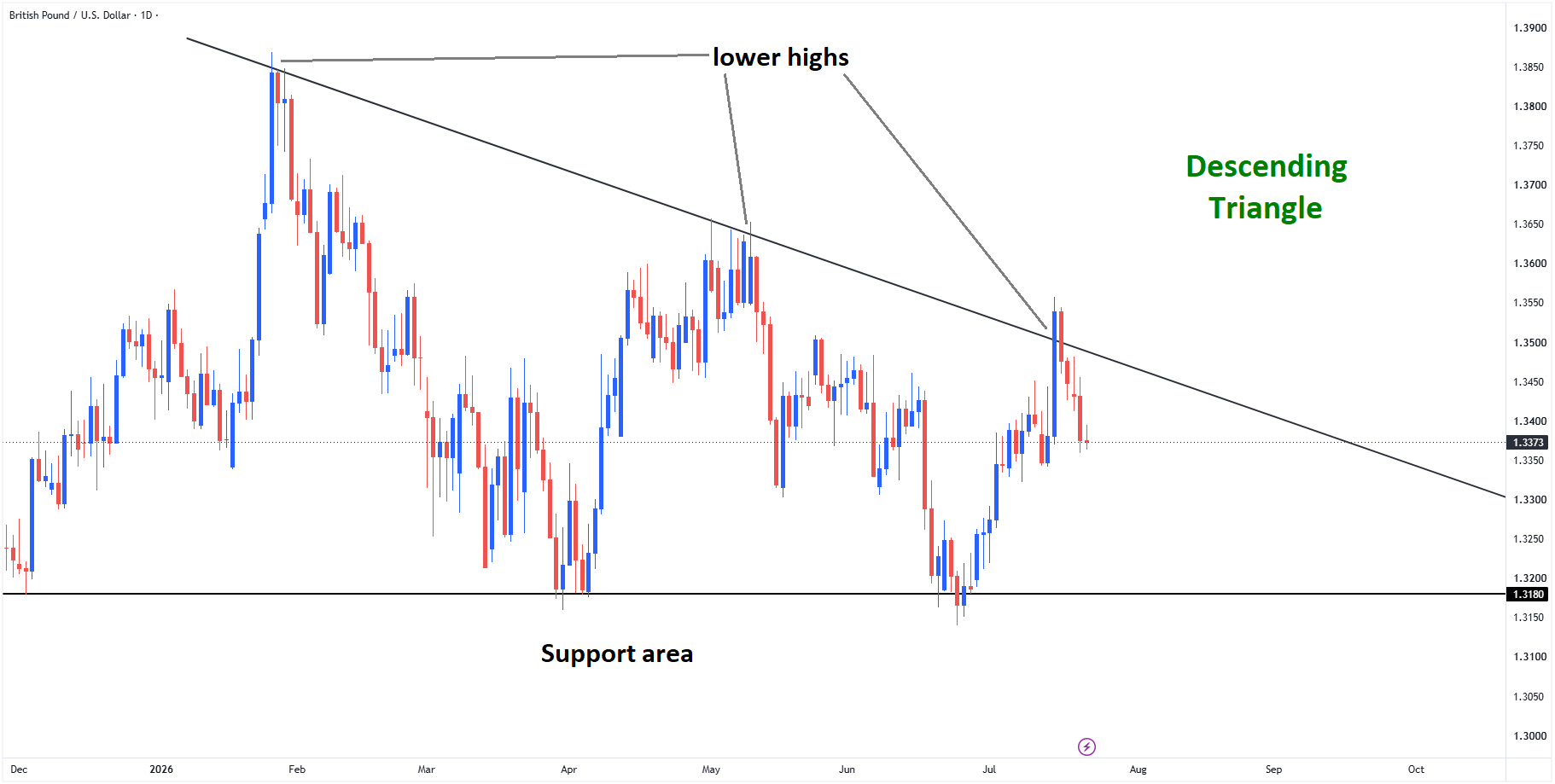
GBPUSD is moving in a descending triangle pattern, and the market has fallen from the lower high area of the pattern
The currency pair has now recorded several days of losses, reflecting a combination of domestic economic uncertainty in the UK and stronger demand for the US Dollar as global risks remain elevated.
UK Inflation Slows More Than Expected
Fresh data released by the UK’s Office for National Statistics showed that inflation continued to ease in June. Consumer prices rose at a slower annual pace than they did in May, coming in below economists’ expectations. This suggests that inflationary pressures are gradually cooling, giving policymakers more room to wait before making any significant changes to interest rates.
While the headline inflation figure softened, core inflation, which excludes more volatile items, remained largely unchanged. This indicates that although overall price growth is slowing, some underlying inflation pressures are still present within the economy.
The latest inflation figures reinforce the view that the Bank of England may continue monitoring incoming data rather than rushing into any immediate policy decisions.
Producer Prices Show Signs of Weak Business Demand
Alongside consumer inflation, producer price data also pointed to weaker pricing pressures across the UK economy.
Input prices, which measure the cost of raw materials purchased by manufacturers, recorded their sharpest monthly decline in more than six years. Output prices, reflecting the prices manufacturers charge for finished goods, remained unchanged despite expectations for an increase.
Annual producer price growth also slowed compared to the previous month. These figures suggest that businesses are experiencing lower cost pressures, which could eventually help keep consumer inflation under control.
However, softer producer prices may also reflect slowing business activity and weaker demand, raising questions about the strength of the UK’s economic recovery.
Bank of England Gains More Time
With inflation easing and producer prices cooling, financial markets believe the Bank of England has more flexibility to maintain its current policy approach.
Instead of acting quickly, policymakers may choose to wait for additional economic data before deciding on any future interest rate moves. A cautious approach allows the central bank to evaluate whether inflation continues to slow while monitoring overall economic growth.
For the British Pound, this outlook offers limited support because investors generally prefer currencies backed by stronger expectations of higher interest rates.
Political Uncertainty Adds Pressure on the Pound
Economic data was not the only factor affecting the British Pound. Investors also reacted cautiously to the early policy direction of Prime Minister Andy Burnham’s new government.
Although many members of the new cabinet are experienced politicians, markets remain uncertain about how the government’s spending plans will affect public finances.
Analysts noted that investors are paying close attention to the government’s upcoming fiscal announcements. Any increase in spending without a clear funding strategy could raise concerns about the UK’s long-term financial outlook.
This uncertainty has contributed to weaker investor confidence, making the Pound one of the weaker-performing major currencies in recent trading sessions.
Cost-of-Living Measures Raise Questions
One of the government’s first major announcements was a plan to reduce Value Added Tax (VAT) on household electricity bills beginning in October.
The move is designed to help families cope with the cost of living by lowering household energy expenses. While consumers may welcome this support, financial markets are focusing on a different question: how these measures will be financed.
Investors are now waiting for additional policy announcements to better understand the government’s overall fiscal strategy. The balance between supporting households and maintaining healthy public finances will likely remain an important issue in the months ahead.
US Dollar Continues to Benefit from Global Uncertainty

While the Pound struggled with domestic challenges, the US Dollar remained well supported.
There have been relatively few major economic reports from the United States this week, but the Dollar has continued attracting demand due to rising geopolitical tensions and stronger government bond yields.
Ongoing conflict in the Middle East has increased global uncertainty, encouraging investors to seek safer assets. Reports of continued military action involving Iran, along with warnings of possible further escalation from US President Donald Trump, have kept geopolitical risks elevated.
Periods of heightened uncertainty often increase demand for the US Dollar because it is widely viewed as one of the world’s safest currencies during times of global stress.
Global Events Continue to Shape Currency Markets
Currency movements are rarely driven by domestic data alone. International developments frequently influence investor decisions, and this week has been another example of that reality.
The combination of softer UK inflation, concerns over government spending, and ongoing geopolitical uncertainty has created a difficult environment for the British Pound.
Meanwhile, the US Dollar has continued benefiting from its traditional safe-haven status as investors remain cautious about global risks.
Until political uncertainty eases and economic confidence improves, these broader global themes are likely to remain important drivers of currency market sentiment.
What Investors Will Be Watching Next
Attention will now shift toward upcoming economic releases and government policy announcements from both the UK and the United States.
Investors will closely monitor whether UK inflation continues to ease, how the Bank of England responds in future meetings, and whether the government’s fiscal plans can reassure financial markets.
At the same time, developments in the Middle East and any changes in global risk sentiment will remain key factors supporting or weakening demand for the US Dollar.
With several major uncertainties still unresolved, market participants are expected to remain cautious while evaluating new economic and political developments.
Summary
The British Pound remained under pressure after weaker-than-expected UK inflation data strengthened expectations that the Bank of England may keep its cautious policy stance. Softer producer price figures also suggested easing inflation pressures across the economy.
Political uncertainty surrounding the new UK government’s spending plans has further reduced confidence in the Pound, while the US Dollar has continued to benefit from global geopolitical tensions and strong investor demand for safe-haven assets.
As markets await further economic data and government policy announcements, both domestic developments in the UK and international events are expected to play a major role in shaping the direction of the GBP/USD currency pair.