
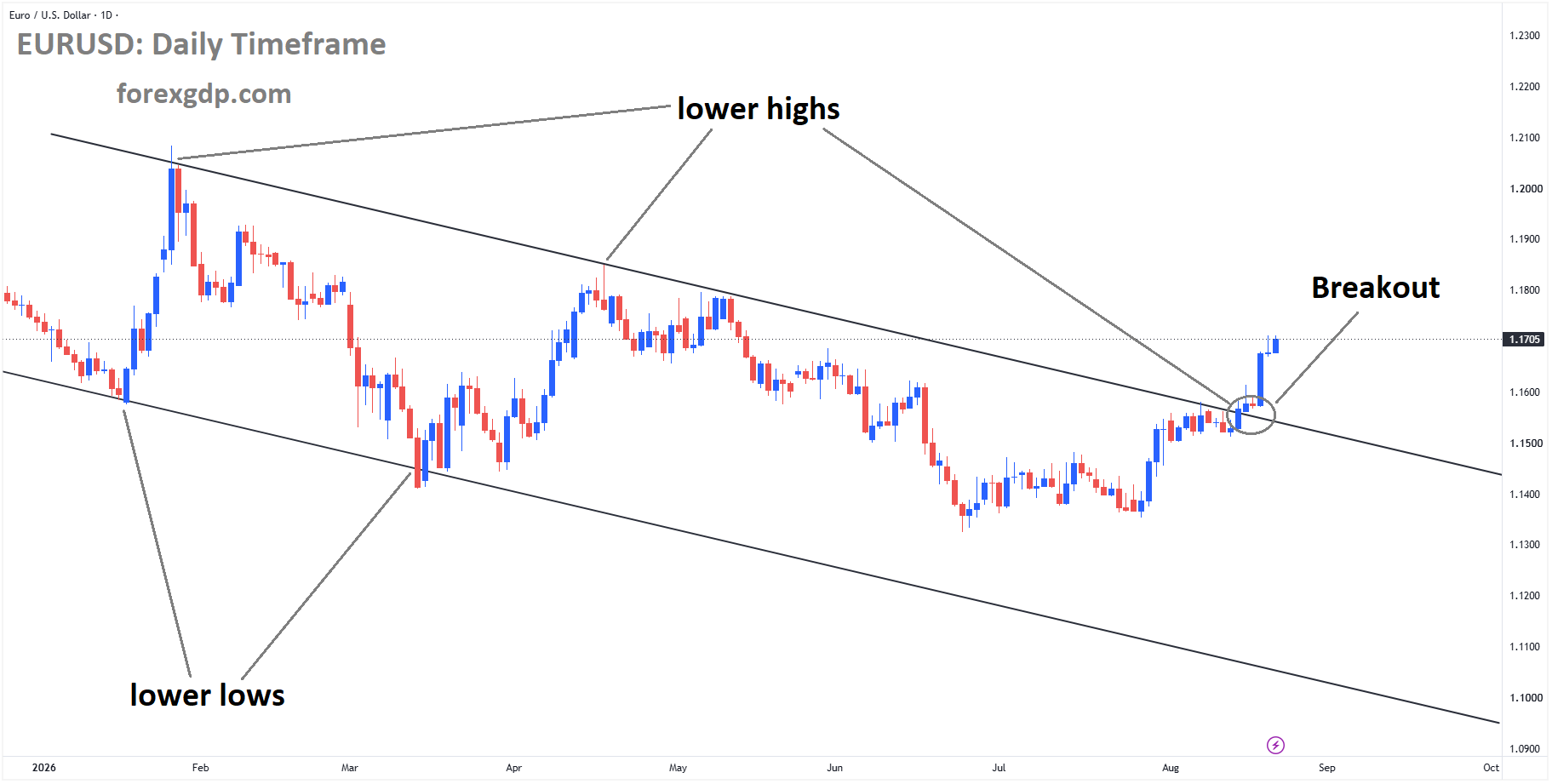
EURUSD has broken the descending channel to the upside
EURUSD Strengthens as ECB Policy Expectations Lift the Euro
The Euro continues to perform well against the US Dollar as investors respond to encouraging economic conditions across the Eurozone. The currency has maintained positive momentum for a third consecutive trading day, supported by persistent inflation and stronger economic figures from Germany.
Investors are now turning their attention to the upcoming HCOB Purchasing Managers’ Index reports from Germany and the wider Eurozone. These reports provide valuable information about activity in the manufacturing and services sectors. Strong readings could improve confidence in the regional economy and strengthen expectations that the European Central Bank will maintain a firm policy approach.
However, weaker business activity could raise concerns about whether the economy can handle further increases in borrowing costs. This makes the latest PMI reports especially important for the Euro’s near-term direction.
Rising Gas Prices Increase Eurozone Inflation Risks
A sharp rise in European natural gas prices is adding fresh inflation pressure across the region. Supply shortages linked to instability in the Middle East have created concerns about future energy availability, pushing gas costs higher.
Europe remains highly sensitive to changes in energy prices because businesses and households depend heavily on natural gas. When gas prices rise, production and transportation costs often increase. Companies may then pass these additional expenses on to consumers through higher prices for goods and services.
This situation creates another challenge for the European Central Bank. Policymakers want to control inflation without causing unnecessary harm to economic growth. Yet rising energy costs may prevent inflation from falling as quickly as expected.
If price pressures remain stubborn, the ECB could be forced to continue raising interest rates or keep them elevated for a longer period. Such expectations usually support the Euro because higher interest rates can make assets linked to the currency more attractive to global investors.
German Producer Prices Support a Firm ECB Stance
Recent economic figures from Germany have strengthened the argument for further action from the European Central Bank. German producer prices recorded a strong yearly increase in July, exceeding market expectations and reaching their fastest annual pace since April 2023.
Producer prices measure the costs businesses face when producing goods. They are closely watched because increases at the factory level can eventually reach consumers. When companies pay more for energy, raw materials, labour, or transportation, they may raise selling prices to protect their profit margins.
The monthly rebound in German producer prices also indicates that inflation pressure has not completely disappeared. This is important because Germany is the largest economy in the Eurozone and often has a strong influence on the region’s overall economic direction.
The latest figures suggest that the ECB may not have enough room to adopt a softer policy stance. Although economic growth remains a concern, policymakers cannot ignore signs that price pressures are becoming stronger again. If inflation continues to stay above the central bank’s comfort level, additional rate increases may remain on the table.
Upcoming Business Data Could Shape Euro Sentiment
The German and Eurozone PMI reports will help investors understand whether businesses are expanding or facing greater difficulties. These figures can also reveal changes in employment, new orders, production, and overall confidence.
A strong report would suggest that the regional economy remains resilient despite high borrowing costs and expensive energy. It could also give the ECB more confidence to maintain restrictive monetary policy because the economy may be able to absorb further tightening.
On the other hand, disappointing data could create a difficult situation. The central bank may face rising inflation while business activity weakens. This combination would make future policy decisions far more complicated.
For the Euro, the best outcome would be stable economic activity combined with controlled inflation. However, rising gas prices and strong producer price growth suggest that achieving this balance may not be easy.
Higher US Treasury Yields Support the Dollar
Although the Euro is benefiting from regional developments, its gains against the US Dollar may remain limited. US Treasury yields have started moving higher again, providing renewed support to the Greenback.
Higher Treasury yields can increase demand for US assets because they offer investors more attractive returns. International investors may need to purchase Dollars to invest in these securities, strengthening the currency.
The US Treasury has attempted to improve market conditions through a bond buyback programme focused on longer-term debt. The programme is designed to support liquidity and reduce pressure in parts of the Treasury market. However, these efforts have not fully prevented yields from rising.
Several factors may be keeping yields elevated, including persistent inflation concerns, government borrowing needs, and uncertainty about the Federal Reserve’s future policy decisions. As long as Treasury yields remain attractive, the Dollar may continue to limit the Euro’s progress.
Federal Reserve Remains Concerned About Inflation

Comments from St. Louis Federal Reserve President Alberto Musalem have also supported a cautious outlook for US monetary policy. He noted that financial conditions remain relatively accommodative, meaning borrowing, investing, and market activity may still be easier than the Federal Reserve would prefer.
When financial conditions are too loose, consumers and businesses may continue spending at a strong pace. This can make it more difficult for inflation to return to the central bank’s target.
Musalem also warned that underlying inflation remains too high. His estimate suggests that persistent price growth is still running well above the Federal Reserve’s preferred level. This means policymakers may hesitate to reduce interest rates quickly, even if certain inflation measures show improvement.
If the Fed keeps borrowing costs elevated for longer, US Treasury yields could remain firm and continue supporting the Dollar. This creates a major obstacle for the Euro, despite stronger inflation data and expectations of additional ECB action.
Different Central Bank Pressures Create Uncertainty
Both the European Central Bank and the Federal Reserve are facing stubborn inflation, but the source of the pressure is different. In Europe, rising energy costs and stronger producer prices are increasing concerns. In the United States, resilient demand and accommodative financial conditions may be preventing underlying inflation from cooling sufficiently.
These conditions suggest that neither central bank can confidently move toward easier policy. The ECB may need to respond to renewed energy-driven inflation, while the Fed may keep rates high to prevent demand from pushing prices upward again.
As a result, EUR/USD could be influenced by changing expectations surrounding both central banks. The Euro may benefit when markets expect stronger ECB action, but the Dollar can quickly regain strength when Treasury yields rise or Federal Reserve officials deliver firm inflation warnings.
Final Summary
The Euro remains supported by persistent Eurozone inflation, rising European gas prices, and stronger German producer price figures. These developments reinforce expectations that the European Central Bank may continue raising interest rates or maintain a restrictive stance for longer.
Upcoming German and Eurozone PMI reports could provide further insight into whether the regional economy remains strong enough to handle tighter monetary policy. Positive business activity would strengthen confidence, while weaker readings could raise fears about slowing growth.
At the same time, rising US Treasury yields and cautious comments from Federal Reserve officials are supporting the US Dollar. With inflation concerns affecting both regions, EUR/USD may remain caught between firm ECB expectations and continued demand for the Greenback.
GBPUSD Advances as US Dollar Pressure Supports the Pound
The British Pound remained strong against the US Dollar on Friday and was heading towards a positive weekly performance. Although the latest UK retail sales report showed weaker consumer spending, the data matched economists’ expectations and did not cause major concern among investors.
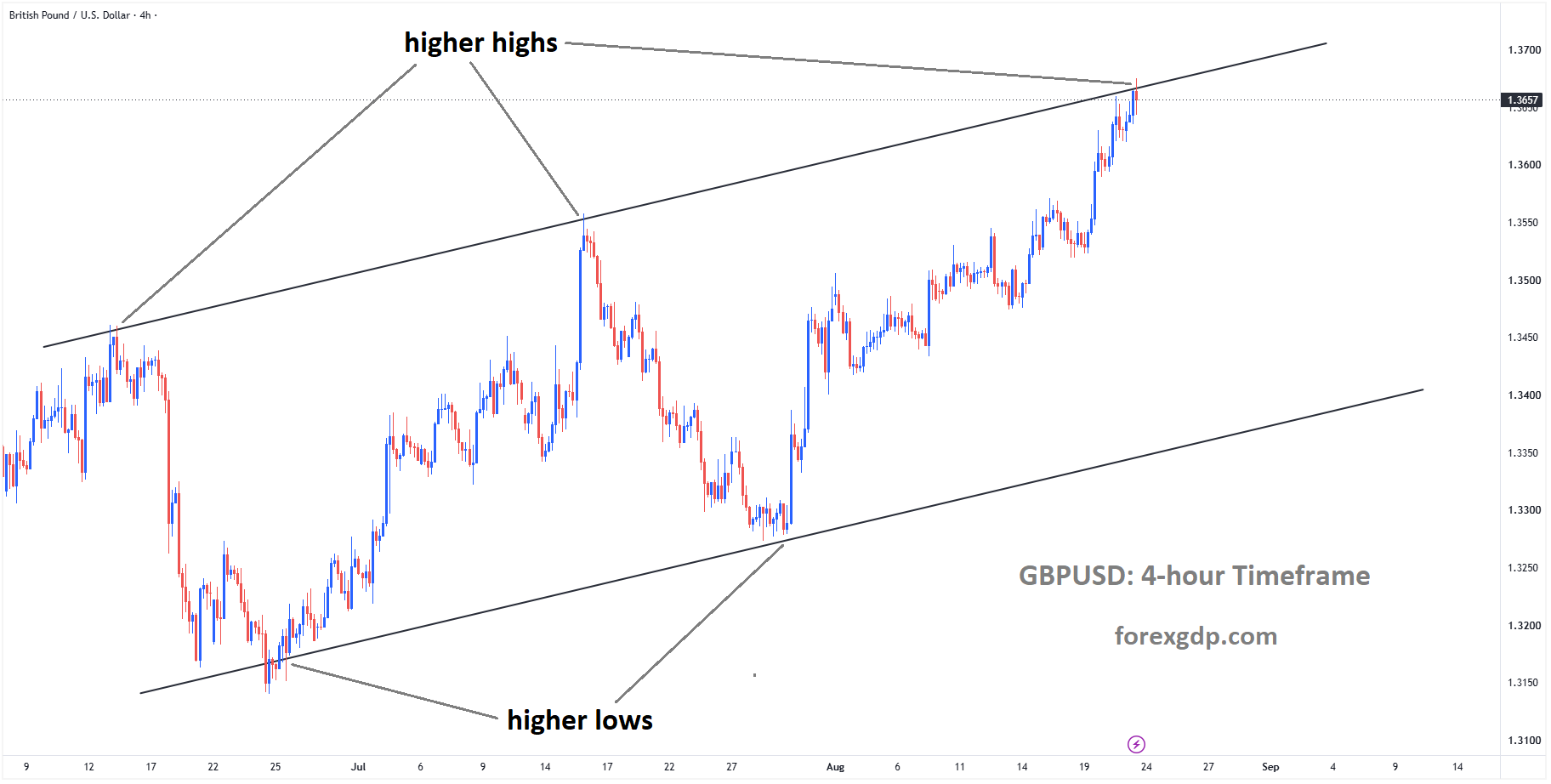
GBPUSD reached a higher high area of the ascending channel
The main driver behind the Pound’s strength was continued weakness in the US Dollar. The American currency faced selling pressure after the US Treasury revealed plans to expand its purchases of long-term government securities. The announcement raised fresh questions about US debt management, government borrowing and the long-term credibility of American fiscal policy.
As a result, GBPUSD continued to benefit from the difference in sentiment surrounding the two currencies. The UK economy still faces challenges, but concerns surrounding US government debt and Treasury policy have placed greater pressure on the Dollar.
UK Retail Sales Decline in July
Official data from the UK’s Office for National Statistics showed that retail sales contracted in July after recording growth in the previous month. The decline was widely expected, so the report did not deliver a major surprise to the market.
The figures suggest that British consumers became more careful with their spending during the month. Households continue to deal with high living costs, expensive borrowing and uncertainty about the wider economic outlook. Even when incomes improve, many people may choose to save more or focus only on essential purchases.
Annual retail sales growth also slowed compared with the previous month and fell short of economists’ forecasts. This shows that the pace of consumer activity is losing some strength, even though spending remains higher than it was during the same period last year.
Retail sales are closely watched because household consumption plays an important role in the UK economy. When shoppers spend more, businesses usually benefit from stronger demand. When spending falls, retailers may face lower revenue, tighter margins and greater pressure to reduce costs.
Weakness Spreads Beyond Fuel Purchases
The decline in UK retail sales was not limited to fuel. Sales excluding fuel also fell during July, reversing the improvement recorded in June. This broad weakness indicates that households reduced spending across several areas rather than cutting back on only one category.
Such a change may reflect growing caution among consumers. Many families are still reviewing their budgets carefully, especially when purchasing non-essential products. Higher household bills and borrowing costs can make people delay larger purchases or look for cheaper alternatives.
However, one weak month does not necessarily mean that the UK consumer sector is entering a long-term decline. Retail figures often change because of weather conditions, seasonal behaviour, holidays and temporary shifts in household confidence. Investors will therefore watch future reports to determine whether July’s decline was temporary or part of a wider slowdown.
The fact that the headline result matched expectations helped limit the negative effect on the Pound. Markets often respond more strongly when economic data differs sharply from forecasts. In this case, the decline had already been largely anticipated.
UK Government Borrowing Remains a Concern
Separate figures showed that UK public sector borrowing increased during July. Although the amount was much lower than the previous month, it still exceeded market expectations.
Higher borrowing can create difficulties for the government because it increases the amount of money needed to fund public spending. It can also limit the government’s ability to introduce tax cuts, increase investment or offer greater financial support to households and businesses.
The latest borrowing figures may therefore keep attention on the UK’s public finances. Investors want to see whether the government can balance spending priorities while maintaining confidence in its financial plans.
Despite these concerns, the British Pound remained supported because developments in the United States had a stronger influence on GBPUSD. Currency movements are often shaped by a comparison between two economies. Even when UK data is disappointing, the Pound can rise if concerns surrounding the US economy or the Dollar are more serious.
US Treasury Buyback Plans Pressure the Dollar
The US Dollar remained under pressure after Treasury Secretary Scott Bessent said that government bond buybacks could be expanded beyond the level announced earlier.
The Treasury’s plan involves purchasing older long-term government securities that may be harder to trade. The aim is to improve liquidity and make the government bond market function more smoothly.
Under this approach, the Treasury buys and retires older debt while continuing to issue newer and more actively traded securities through regular auctions. This can help improve trading conditions because investors usually prefer recently issued bonds that are easier to buy and sell.
On the surface, the plan is presented as a debt-management operation rather than an attempt to control borrowing costs. However, the timing has attracted attention because demand for long-term US government debt has weakened.
Growing US Debt Raises Investor Anxiety

Investors have become increasingly cautious about the rapid expansion of US government debt. Larger fiscal deficits mean the Treasury must issue more bonds to finance government spending. If supply continues to grow while demand weakens, concerns about America’s financial position may become more serious.
Long-term government securities have faced reduced investor interest as buyers question whether the returns are sufficient to compensate for inflation, fiscal risk and uncertainty about future borrowing. These worries can damage confidence in US assets and place pressure on the Dollar.
The Treasury’s expanded buyback plan may improve liquidity, but it does not solve the deeper issue of rising debt. Investors may continue to ask whether the US government has a clear and sustainable strategy for managing its financial obligations.
This distinction is important. A policy designed to improve market liquidity may be viewed positively. But if investors believe the Treasury is trying to influence borrowing costs or reduce pressure on long-term debt, confidence in US fiscal management could weaken.
Fiscal Credibility Becomes a Key Issue
Analysts at BBH described the Treasury plan as a debt-management swap involving the retirement of older, less liquid bonds in favour of newer securities. This process is a normal tool for improving the quality and efficiency of the bond market.
However, the firm also warned about a possible change in investor perception. If market participants begin to believe that the Treasury is managing yields rather than simply supporting liquidity, the policy could harm US fiscal credibility.
Trust is essential for the US Dollar because it is widely used in global trade, investment and financial reserves. Investors need confidence that US economic institutions will manage debt responsibly and maintain stable financial conditions.
Any doubt about that responsibility can reduce demand for the Dollar. This appears to be one reason why the currency remained defensive, allowing the British Pound to stay firm despite mixed economic reports from the United Kingdom.
What Could Shape the Next GBPUSD Move
The outlook for GBPUSD will depend on how investors assess economic conditions in both countries. In the UK, attention will remain on consumer spending, government borrowing, employment conditions and the wider pace of economic activity.
In the United States, fiscal policy and Treasury debt management are becoming increasingly important. Investors will closely follow further announcements about bond buybacks and government borrowing. Any sign that confidence in US debt is weakening could continue to weigh on the Dollar.
At the same time, stronger US economic data or improved demand for government securities could help restore support for the American currency. The balance of confidence between the UK and US economies will remain the central force guiding the pair.
Final Summary
The British Pound stayed firm against the US Dollar even after UK retail sales declined in July. The fall in consumer spending matched expectations, which limited its effect on the currency. Higher-than-expected public borrowing also highlighted ongoing challenges for the UK government.
The greater influence came from the United States, where plans to expand Treasury bond buybacks increased concerns about debt management and fiscal credibility. Although the programme is intended to improve liquidity, investors may question whether it is also designed to ease pressure in the long-term bond market. As long as these concerns continue, the US Dollar may struggle to regain confidence, leaving the Pound supported.
USDJPY Faces Pressure as BoJ Outlook Supports the Yen
USDJPY came under renewed selling pressure on Friday as several economic factors supported the Japanese Yen and weakened demand for the US Dollar. The currency pair struggled to continue its recovery from the previous session, showing that buyers remained cautious about pushing it higher.
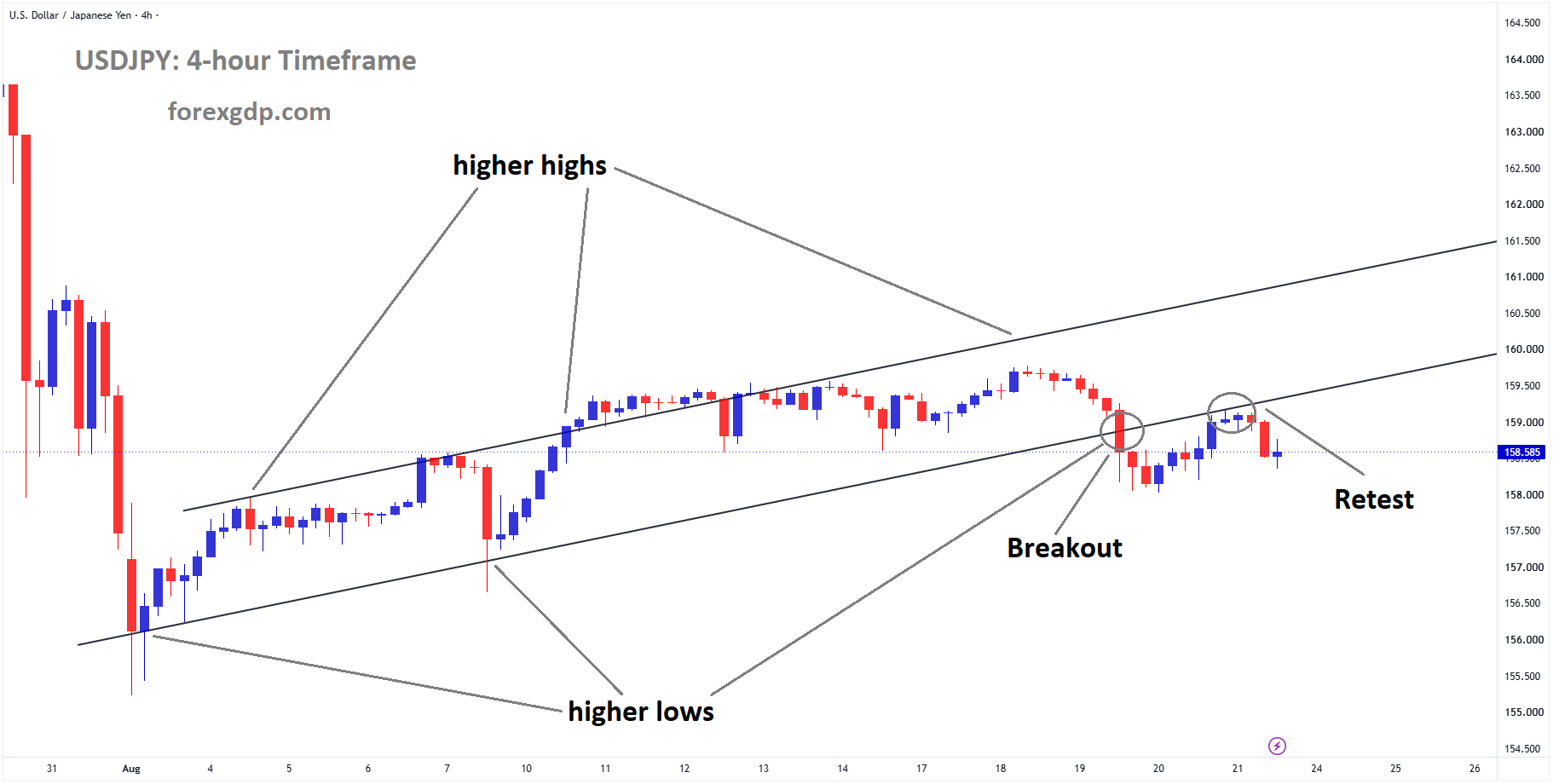
USDJPY is falling from the retest area of the broken ascending channel
The Japanese Yen gained modest support after the release of Japan’s latest inflation report. The data showed that consumer inflation strengthened during July, giving the Bank of Japan more reasons to consider raising interest rates. At the same time, falling expectations for another Federal Reserve rate hike placed additional pressure on the US Dollar.
These combined forces kept USDJPY under pressure during the first half of the European trading session. The pair was also heading towards its first weekly decline in three weeks, highlighting a possible change in short-term market sentiment.
Japan’s Inflation Data Strengthens the Yen
Japan’s National Consumer Price Index report attracted considerable attention because it provided fresh information about inflationary conditions in the country. The data showed that core consumer inflation accelerated in July, indicating that domestic price pressures may be becoming stronger.
Core inflation, which excludes fresh food because of its unstable pricing, increased by 1.8% compared with the same month a year earlier. This was higher than the 1.6% increase recorded in June and represented the fastest annual growth since January.
The rise suggests that inflation in Japan is not disappearing as quickly as some market participants had expected. Stronger inflation can encourage the Bank of Japan to continue moving away from its long-standing policy of keeping borrowing costs extremely low.
Another closely watched measure also showed stronger price growth. This index removes both fresh food and fuel costs, offering a clearer picture of underlying inflation across the Japanese economy. It rose by 1.9% from the previous year, following a 1.7% increase in June.
Because food and energy prices can change sharply, the Bank of Japan often pays close attention to measures that exclude these volatile categories. The latest increase suggests that inflation may be spreading more widely across goods and services rather than being driven only by temporary changes in fuel or food costs.
BoJ Rate Hike Expectations Return to Focus
The stronger inflation report reinforced expectations that the Bank of Japan could raise interest rates again. Although policymakers may not rush into a decision, the latest figures support the argument that borrowing costs cannot remain low forever.
For many years, Japan maintained one of the world’s most accommodative monetary policies. The central bank kept interest rates extremely low to encourage spending, investment, and economic growth. However, persistent inflation and improving wage conditions have created pressure for a gradual policy shift.
A possible rate hike would make Japanese assets more attractive to some investors. Higher borrowing costs may also reduce the appeal of using the Yen to finance investments in currencies that offer better returns. This change in expectations can strengthen the Japanese currency, particularly when other major central banks are considering softer policies.
However, the Bank of Japan must remain careful. Raising rates too quickly could weaken household spending, increase borrowing costs for businesses, and slow economic activity. Policymakers will therefore continue to examine inflation, wages, consumption, and overall growth before making their next move.
Even so, the July inflation report gives officials more confidence that price pressures are becoming established. This provided a modest lift to the Yen and contributed to the weakness seen in USDJPY.
US Dollar Demand Weakens as Fed Expectations Shift
Pressure on USDJPY also came from the US Dollar side. Investors have reduced their expectations that the Federal Reserve will raise interest rates again, limiting demand for the American currency.
Interest rate expectations play an important role in currency markets. When investors expect US borrowing costs to rise, the Dollar often becomes more attractive because American assets may offer stronger returns. When those expectations decline, the currency can lose some of its advantage.
Recent changes in market sentiment suggest that traders are becoming less confident about further Federal Reserve tightening. Attention is increasingly focused on whether US economic growth can remain stable and whether inflation will continue moving towards the central bank’s goal.
If the Federal Reserve keeps rates unchanged or begins considering a softer approach, the difference between US and Japanese monetary policies could gradually narrow. Such a development may help the Yen while limiting the Dollar’s ability to extend its gains.
The combination of stronger Japanese inflation and weaker expectations for higher US rates created an unfavourable environment for USDJPY. Traders are now watching upcoming comments from officials at both central banks for clearer guidance about future policy decisions.
Geopolitical Concerns May Limit Further Weakness

Despite the pressure on USDJPY, geopolitical risks may prevent the pair from falling too sharply. Periods of global uncertainty can create mixed reactions in currency markets because both the US Dollar and the Japanese Yen are widely viewed as safe-haven currencies.
When political tensions rise or investors become worried about the global economy, they often reduce exposure to riskier assets. Some move money into the Dollar because of its importance in international trade and finance. Others prefer the Yen because Japan has a large external asset position and the currency has historically performed well during periods of market stress.
The impact of geopolitical uncertainty will therefore depend on which safe-haven currency attracts stronger demand. If investors favour the Dollar, losses in USDJPY may remain limited. If the Yen becomes the preferred defensive currency, selling pressure on the pair could continue.
This uncertainty explains why the latest decline remained controlled. While economic factors supported the Yen, investors were reluctant to make aggressive moves while global risks remained present.
The Policy Difference Could Shape the Next Move
The future direction of USDJPY will largely depend on how monetary policy expectations develop in Japan and the United States. Japan’s stronger inflation data has increased confidence that the Bank of Japan may continue normalising its policy. Meanwhile, reduced expectations for another Federal Reserve rate hike have weakened support for the Dollar.
However, one inflation report is unlikely to determine the Bank of Japan’s entire policy direction. Officials will want to see whether stronger price growth continues and whether wages and household demand remain healthy. Similarly, the Federal Reserve will continue assessing US inflation, employment, and economic activity before deciding its next step.
The changing policy outlook has created a more balanced environment for the two currencies. The Dollar no longer enjoys the same level of support from rate hike expectations, while the Yen is receiving fresh attention as Japan moves towards a less accommodative policy stance.
Final Summary
USDJPY faced fresh selling pressure as stronger Japanese inflation supported expectations for another Bank of Japan rate hike. Both core inflation and the measure excluding fresh food and fuel accelerated in July, suggesting that underlying price pressures are becoming firmer.
At the same time, reduced expectations for additional Federal Reserve rate increases weakened demand for the US Dollar. These developments pushed USDJPY lower and placed the pair on course for its first weekly decline in three weeks.
However, ongoing geopolitical concerns could limit further losses because the Dollar and the Yen can both attract safe-haven demand. The next major direction will depend on upcoming economic data, central bank guidance, and changes in global risk sentiment.
USDCHF Slips as Growing US Debt Worries Weaken the Dollar
The Swiss Franc regained strength against the US Dollar after briefly losing momentum in the previous session. Demand for the Swiss currency improved as investors focused on growing concerns surrounding United States government debt and the country’s rising borrowing burden.
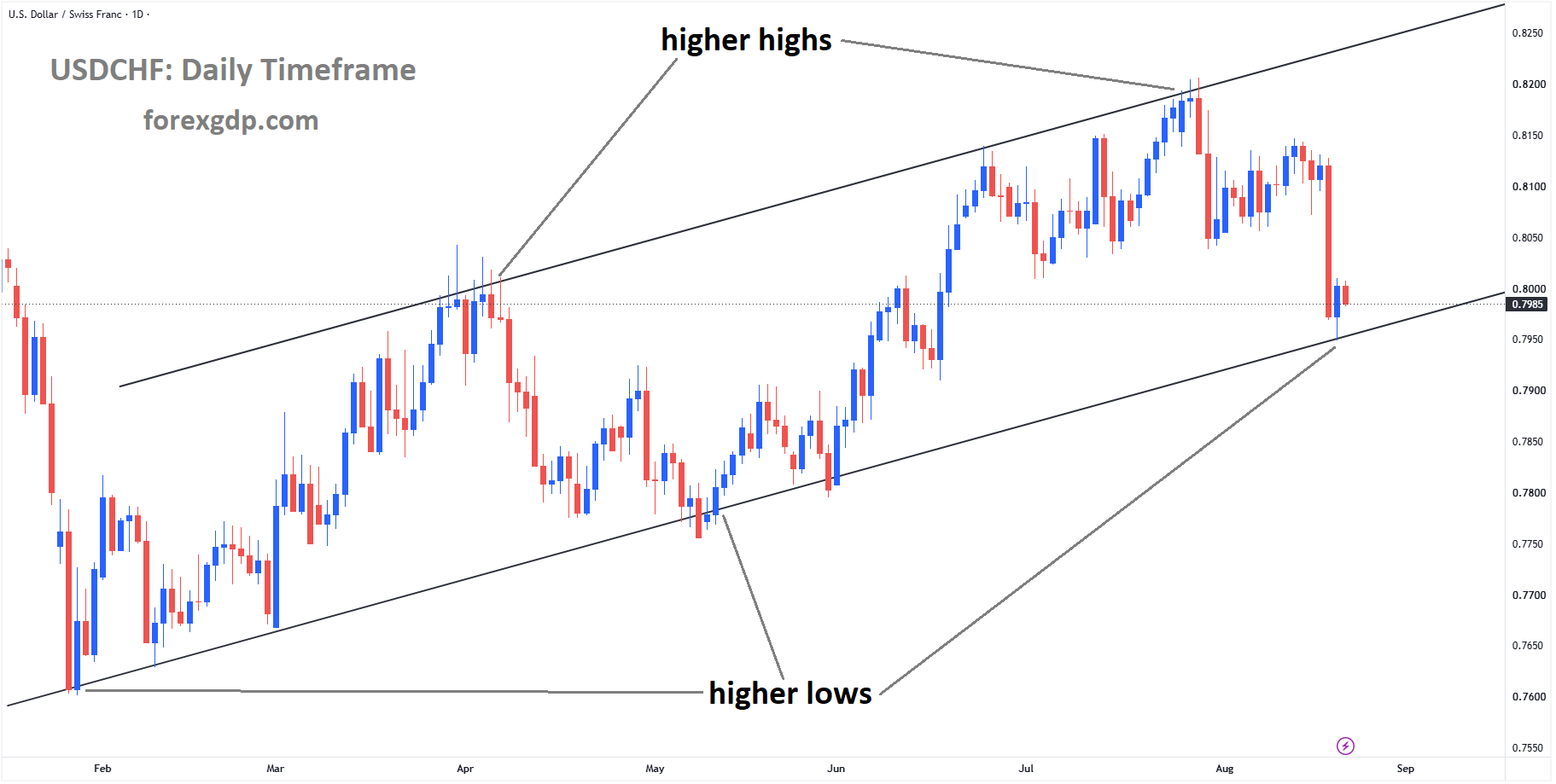
USDCHF reached the higher low area of the ascending channel
The US Dollar has struggled to attract lasting demand because confidence in the nation’s fiscal position is weakening. Although the American economy remains influential, the rapid expansion of government debt has raised difficult questions about future borrowing costs and financial stability.
At the same time, investors are preparing for the Federal Reserve’s September policy meeting. The central bank is widely expected to leave interest rates unchanged. While steady rates can sometimes support a currency, the current situation is more complicated because debt concerns and uncertainty about future policy are limiting the Dollar’s appeal.
Swiss Franc Recovers After a Brief Pullback
The Swiss Franc resumed its advance following a temporary correction. The earlier weakness appeared to be short-lived, with buyers returning as attention shifted back to the challenges facing the United States.
Switzerland’s currency often attracts interest when investors become uncomfortable with global financial conditions. Its reputation for stability can make it more appealing during periods of uncertainty. This does not mean the Franc will always rise when concerns increase, but it can benefit when confidence in larger economies begins to weaken.
The latest recovery reflects a broader preference for caution. Investors are not only thinking about immediate economic data. They are also examining the long-term health of government finances and asking whether current debt levels can be managed without creating additional pressure.
For the US Dollar, this change in focus is important. The currency has traditionally benefited from its central role in global finance. However, persistent fiscal concerns can reduce that advantage, particularly when investors believe the government may face higher borrowing costs for an extended period.
Growing US Debt Weakens Confidence in the Dollar
The size of US government debt has become a major concern for financial markets. When debt continues to grow, the government must issue more securities to finance its spending and repay existing obligations. A larger supply of debt can create pressure across the bond market and make investors demand better returns before lending money.
Higher borrowing costs can place additional strain on government finances. More public money may need to be directed toward interest payments, leaving fewer resources available for other priorities. This can create a difficult cycle in which rising debt leads to higher costs, which then make the debt burden even harder to control.
These concerns do not suggest that the US government is unable to meet its obligations. Instead, they reflect doubts about how sustainable the current fiscal path may be over the long term. Currency markets pay close attention to such doubts because trust and credibility are essential to the strength of any major currency.
The Dollar can remain widely used while still facing selling pressure. Investors may continue to hold American assets but become less willing to increase their exposure. Some may also look toward alternative currencies, including the Swiss Franc, when they want greater protection from fiscal uncertainty.
Treasury Buybacks Offer Only Temporary Relief
The US Treasury announced plans to increase the pace of its debt buyback operations. Through these transactions, the Treasury purchases older government bonds that are traded less frequently and replaces them with newer securities issued through regular auctions.
The aim is to improve the functioning of the government debt market. Older bonds can become harder to buy and sell, while newly issued securities usually attract greater investor interest. Replacing less liquid debt with more actively traded securities can therefore make the market operate more efficiently.
However, buybacks do not reduce the government’s total debt. They mainly change the type and structure of the securities that remain in circulation. This distinction matters because the operation can ease certain market pressures without solving the larger problem of rising government borrowing.
Initial relief faded when investors recognised that the plan had clear limits. The Treasury market is enormous, and the proposed operations represent only a small part of it. As a result, the programme may improve liquidity in selected areas, but it cannot remove broader concerns about the amount of debt being issued.
Questions Surround the Policy Signal

The timing of the announcement also attracted attention. Some observers believe the decision suggests that officials are becoming increasingly uncomfortable with rising long-term borrowing costs and weaker demand for certain government securities.
If investors view the buybacks as an attempt to influence borrowing costs rather than simply improve market liquidity, confidence in US fiscal management could decline. Such a perception may create further pressure on the Dollar because it raises concerns about whether financial authorities are responding to the symptoms instead of addressing the underlying problem.
Fiscal credibility is built through clear policies, responsible spending and confidence that debt can be managed over time. Temporary market operations may provide support, but they cannot replace a convincing long-term plan.
Federal Reserve Expectations Add Another Layer of Uncertainty
Attention is also turning toward the Federal Reserve’s September meeting. Investors largely expect policymakers to keep interest rates unchanged as they continue to evaluate inflation, employment and economic growth.
A decision to maintain current rates would show that the central bank is not ready to ease policy immediately. Under normal conditions, this could offer some support to the US Dollar because relatively firm interest rates can make American assets more attractive.
However, the effect may be limited because markets often react to future expectations rather than a decision that has already been widely anticipated. If unchanged rates are fully reflected in investor positioning, the announcement itself may provide little fresh support.
Traders will therefore focus closely on the Federal Reserve’s message about the coming months. Any sign that officials are becoming more open to future rate reductions could place additional pressure on the Dollar. On the other hand, a cautious approach toward easing may prevent a sharper decline.
The central bank must also operate against a challenging fiscal background. Monetary policy cannot directly solve the government debt problem, and keeping borrowing costs high for too long could make public interest expenses even heavier. This creates a difficult balance between controlling inflation, supporting economic activity and avoiding additional financial stress.
Final Summary
The Swiss Franc has regained support as investors turn their attention to growing US debt and concerns about the country’s fiscal direction. The Treasury’s expanded buyback programme may improve the operation of the bond market, but it does not reduce the overall debt burden.
Questions about rising borrowing costs and the purpose of the buybacks have weakened confidence in the US Dollar. Meanwhile, expectations that the Federal Reserve will leave interest rates unchanged may offer only limited support because that outcome is already widely anticipated.
Unless confidence in US fiscal management improves, the Swiss Franc may continue to benefit from cautious investor sentiment and demand for currencies associated with stability.
NZDUSD Advances for a Third Day as Kiwi Confidence Grows
The New Zealand Dollar continued to strengthen against the US Dollar, marking its third consecutive day of gains. The Kiwi also reached its strongest position since early June, reflecting improving demand for the currency and growing confidence in New Zealand’s monetary policy outlook.
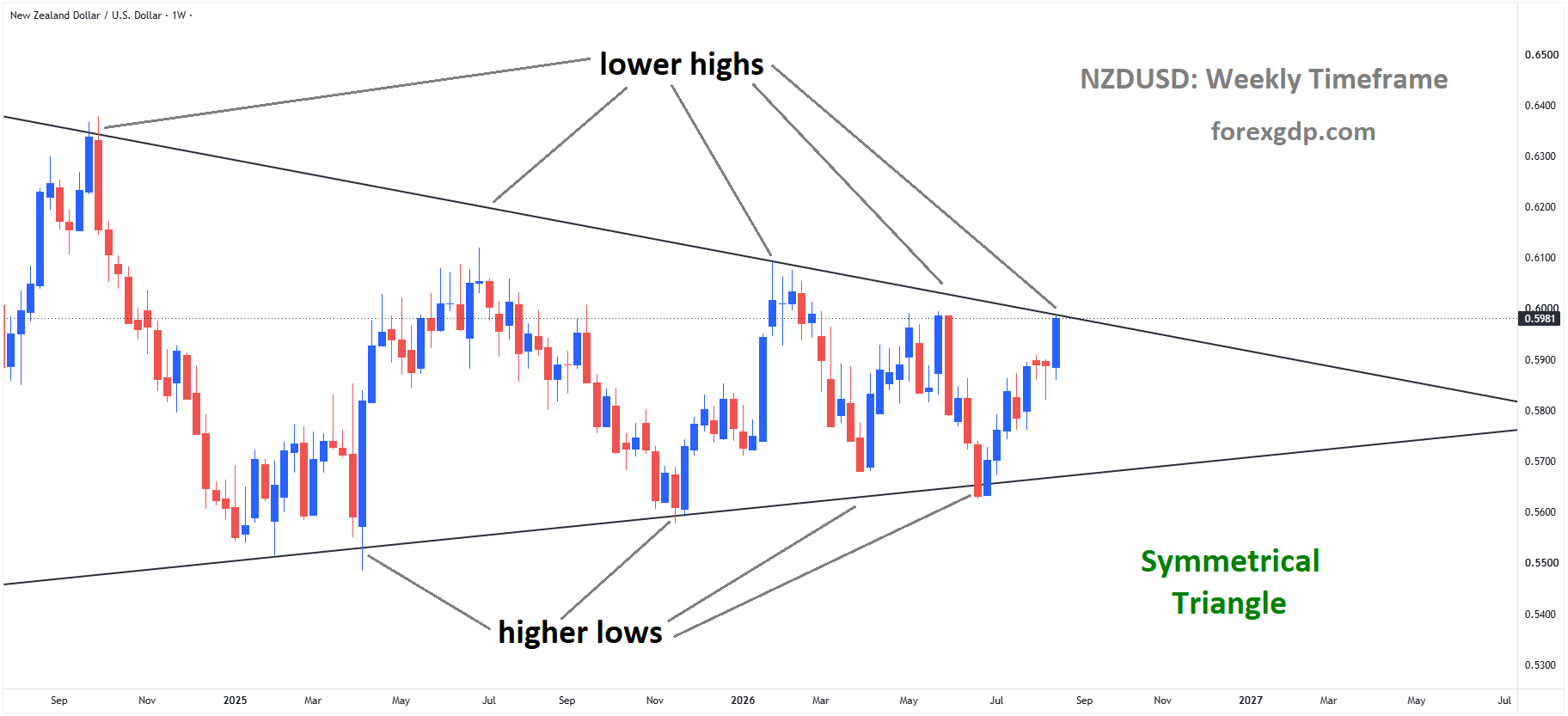
NZDUSD reached the lower high area of the symmetrical triangle pattern
Much of the recent movement has been driven by weakness in the US Dollar. Investors have reduced their expectations that the Federal Reserve will raise interest rates immediately. This change has made the Greenback less attractive, allowing currencies such as the New Zealand Dollar to gain ground.
The Kiwi is also heading toward a positive weekly performance. Although several global risks remain in the background, investors appear more focused on the difference between the interest rate expectations in the United States and New Zealand.
Federal Reserve Expectations Weaken the US Dollar
The US Dollar has remained under pressure as financial markets reconsider the likely direction of Federal Reserve policy. Earlier concerns that the central bank might quickly raise borrowing costs have started to fade.
However, the possibility of another increase has not completely disappeared. Minutes from the latest Federal Open Market Committee meeting showed that policymakers remain worried about inflation. Officials indicated that additional tightening could become necessary if inflation does not move closer to the central bank’s target.
This creates a mixed picture for the US Dollar. On one side, investors are less confident that the Fed will act immediately. On the other, the central bank has not ruled out another rate increase later in the year.
The timing of any future decision will depend heavily on upcoming economic figures. Inflation, employment, consumer spending, and business activity will all play an important role in shaping expectations. Until stronger evidence appears, the Greenback may struggle to build lasting demand.
RBNZ Policy Prospects Support the Kiwi
While expectations surrounding the Federal Reserve have softened, investors continue to consider the possibility of another interest rate increase from the Reserve Bank of New Zealand. This outlook has provided meaningful support for the Kiwi.
Higher interest rates can make a currency more attractive because investors may receive better returns from assets connected to that country. As a result, the prospect of further tightening in New Zealand has helped strengthen demand for the NZD.
The contrast between the two central banks is particularly important. Markets see a lower chance of immediate action from the Federal Reserve, while the RBNZ may still need to maintain a firm policy position. This difference has created a favourable environment for the New Zealand Dollar against its US counterpart.
Still, expectations can change quickly. The RBNZ will continue to watch domestic inflation, economic growth, employment conditions, and consumer activity before making its next decision. If New Zealand’s economy shows signs of weakening, expectations for higher borrowing costs could decline.
Trade Deficit Fails to Stop the Advance
New Zealand’s latest trade figures showed that the country recorded a monthly deficit in July. Normally, a larger trade gap could create some pressure on the national currency because it means the value of imports exceeded the value of exports.
Despite the disappointing result, the data did not stop the New Zealand Dollar from advancing. Investors appeared to treat the trade report as less important than the wider monetary policy outlook and the continuing weakness of the US Dollar.
This reaction highlights how currency markets often prioritise the issues considered most relevant at a particular time. Although trade performance remains important for New Zealand’s economy, interest rate expectations are currently having a stronger influence on the Kiwi.
Future trade reports may still attract attention, especially if weak results become part of a longer trend. New Zealand relies heavily on international trade, and changes in global demand can affect growth, business confidence, and employment.
Iran Tensions Create Inflation and Safe-Haven Risks
Geopolitical uncertainty remains a major risk for the currency outlook. Tensions involving the United States and Iran have increased concerns about the Strait of Hormuz, an important route for global energy shipments.
Any serious disruption in this region could push energy costs higher and add to inflationary pressure around the world. Rising oil expenses can increase transportation and production costs, making it more difficult for central banks to control inflation.
US President Donald Trump has also threatened stronger sanctions against Iran and countries accused of helping Tehran avoid American restrictions. If the disagreement becomes more severe, global investors may become increasingly cautious.
During periods of intense uncertainty, traders often seek currencies and assets viewed as relatively safe. The US Dollar may benefit from that behaviour even when domestic rate expectations are unfavourable. Therefore, worsening geopolitical conditions could limit the Greenback’s weakness and slow the New Zealand Dollar’s progress.
At the same time, higher energy costs could encourage the Federal Reserve to maintain a tighter policy stance for longer. That possibility would complicate current expectations and could renew support for the US currency.
US PMI Reports Move Into Focus
Investors are now preparing for the preliminary US Purchasing Managers’ Index reports for August. These figures will provide an early view of business activity in the manufacturing and services sectors.
Current expectations suggest that both areas may experience a modest slowdown. The services sector is especially important because it represents a large part of the American economy. A noticeable decline in activity could increase concerns about economic momentum and reduce the likelihood of an immediate Federal Reserve rate increase.
Weaker-than-expected PMI figures may place additional pressure on the US Dollar and strengthen the case for the Kiwi. However, stronger results could show that the American economy remains resilient, offering the Greenback an opportunity to recover.
The reports may also provide clues about employment, demand, business costs, and inflation. These details could influence how investors interpret the Federal Reserve’s next move.
Final Summary
The New Zealand Dollar has extended its gains as softer expectations for immediate Federal Reserve action weaken the US Dollar. At the same time, the possibility of further monetary tightening by the Reserve Bank of New Zealand continues to support the Kiwi.
New Zealand’s latest trade deficit has had limited influence because investors are concentrating on central bank policy and broader US Dollar movements. The upcoming US PMI reports may provide the next major direction by showing whether business activity is slowing or remaining resilient.
Geopolitical tensions involving Iran and the Strait of Hormuz remain an important risk. A further escalation could raise energy costs, increase inflation concerns, and restore safe-haven demand for the US Dollar. For now, the different policy expectations surrounding the Fed and RBNZ continue to favour the New Zealand currency.
Don’t trade all the time, trade forex only at the confirmed trade setups
Get more confirmed trade signals at premium or supreme – Click here to get more signals, 2200%, 800% growth in Real Live USD trading account of our users – click here to see , or If you want to get FREE Trial signals, You can Join FREE Signals Now!