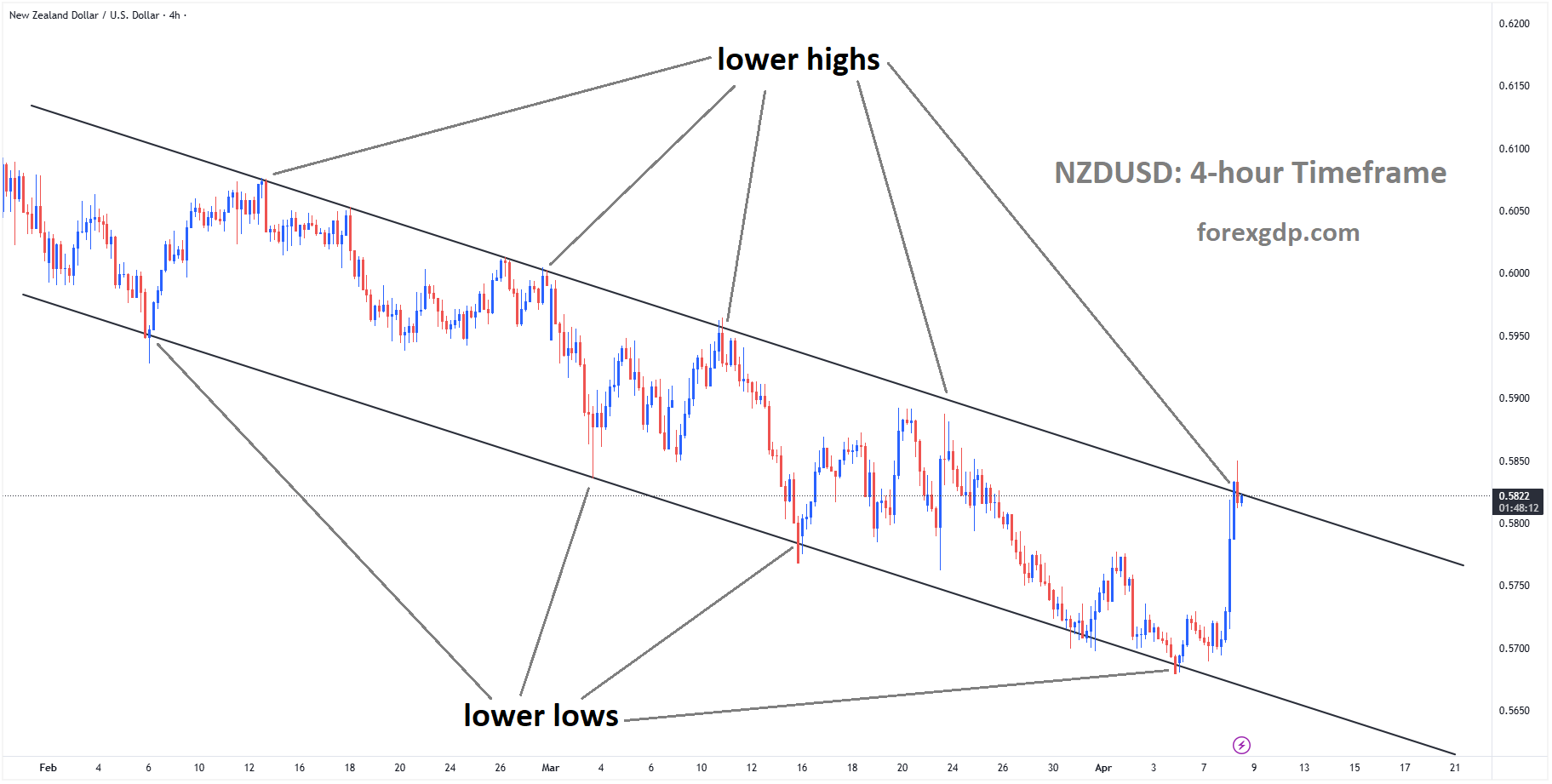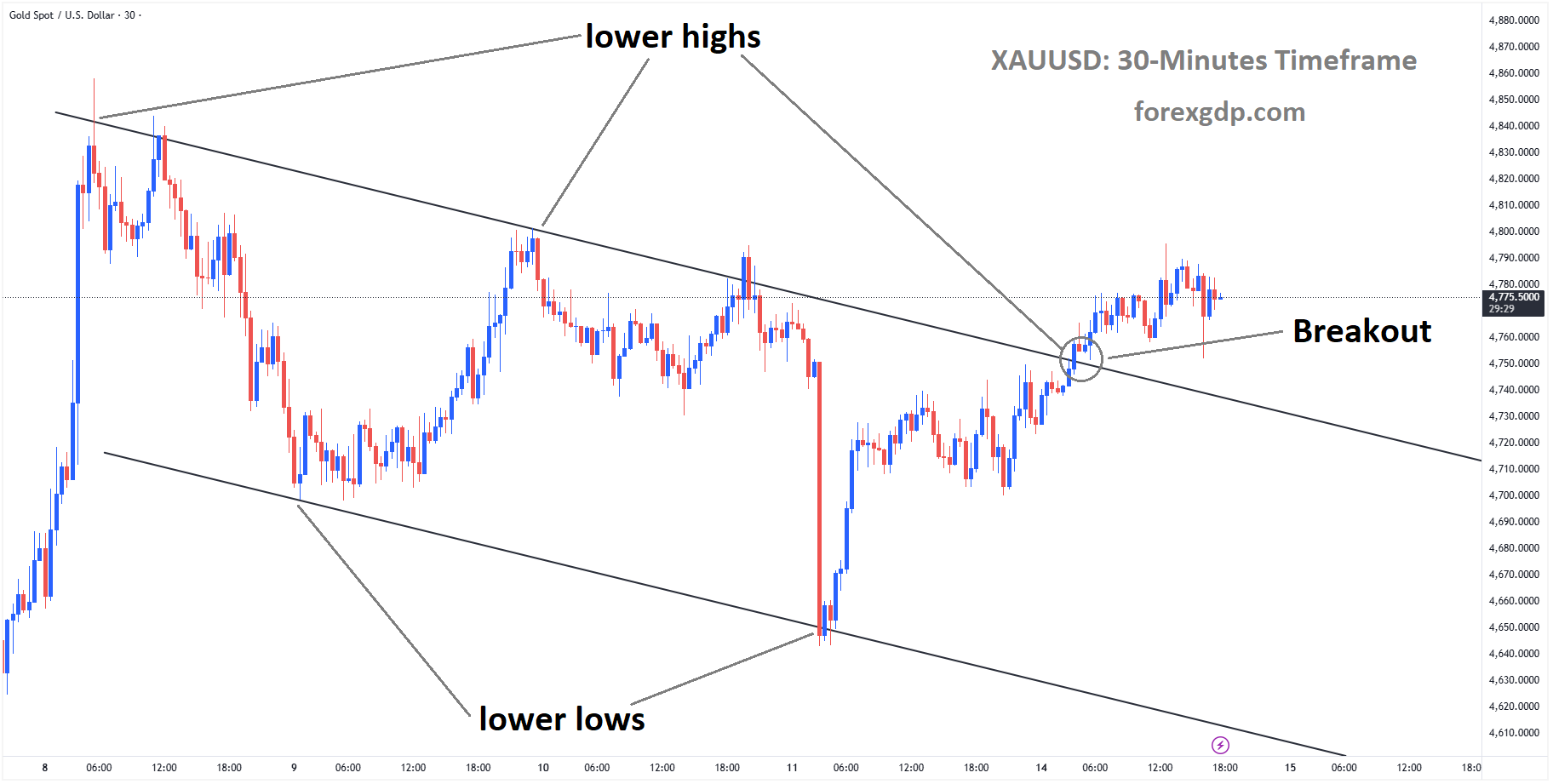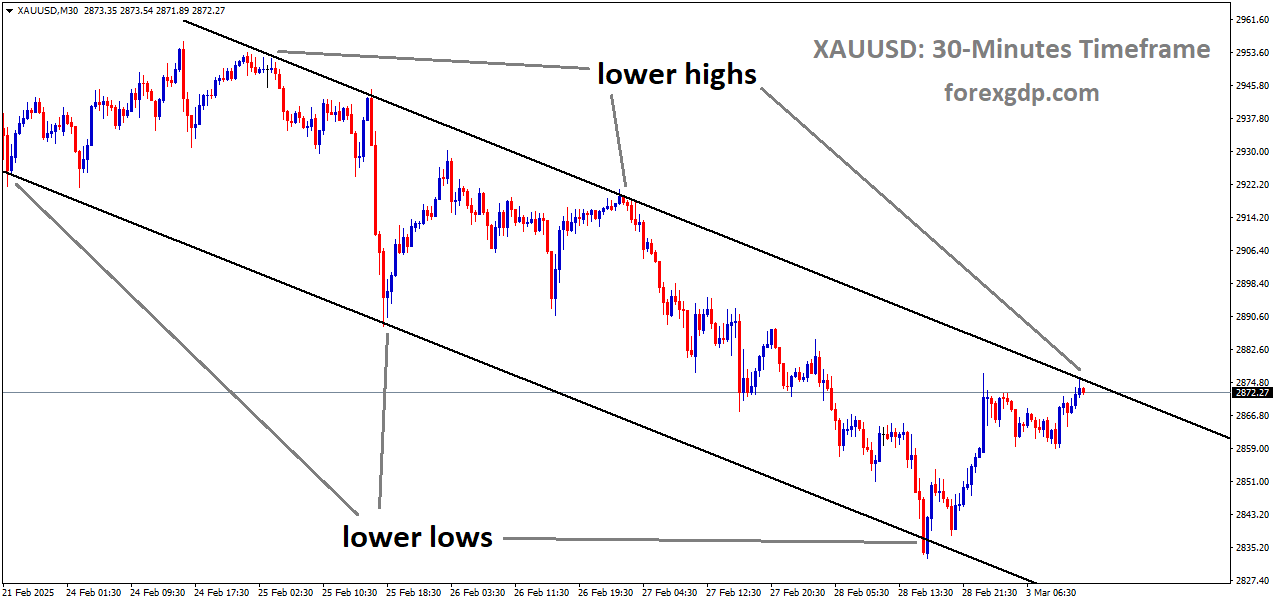

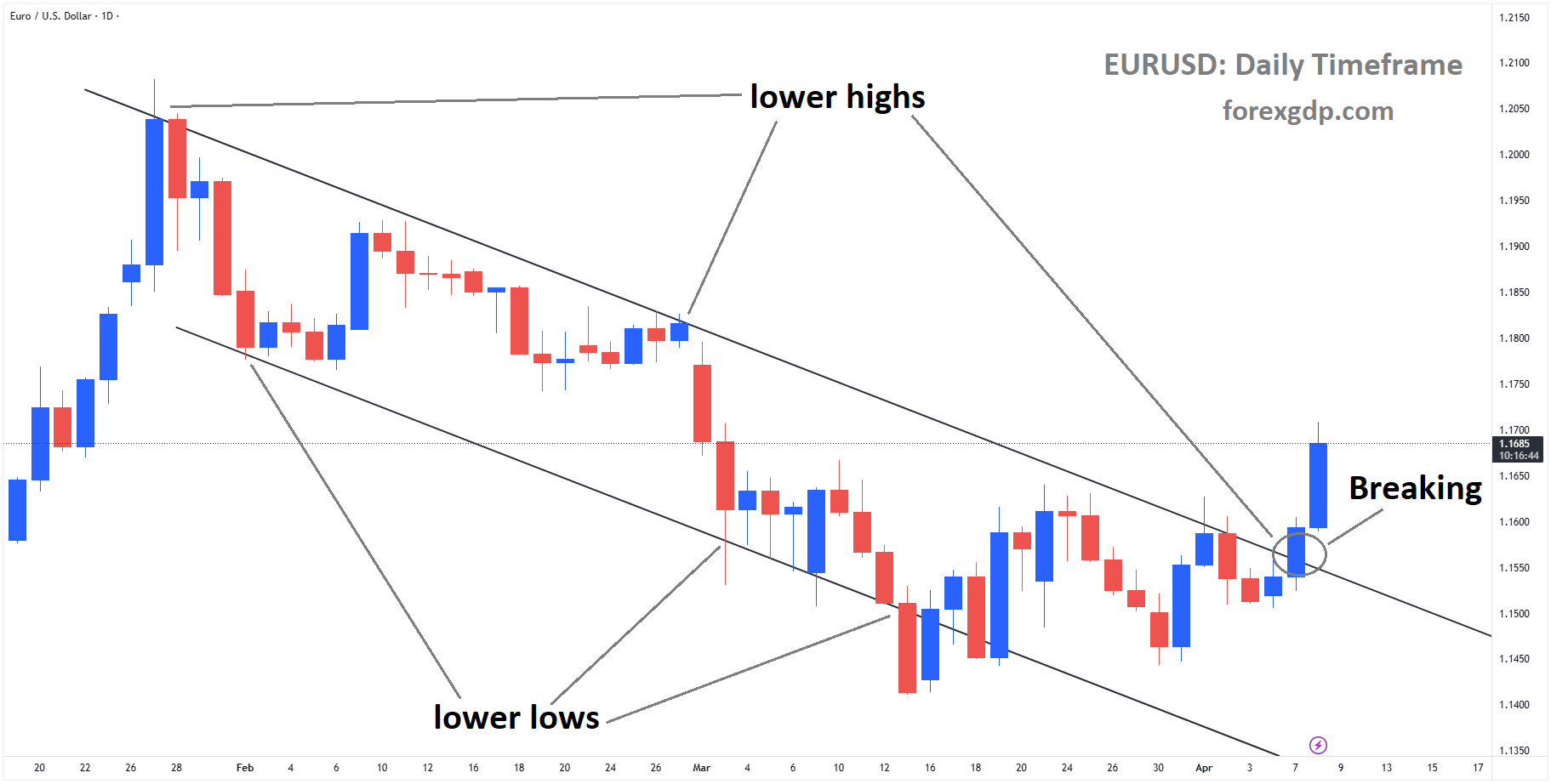
EURUSD is breaking the lower high area of the descending channel
EURUSD surges as Iran ceasefire deal lifts market mood and weakens dollar
The EUR/USD currency pair moved higher during early Wednesday trading in Asia, reaching levels close to 1.1670. This upward move reflects a shift in global sentiment, as investors react to a mix of political developments and upcoming economic updates. The strengthening of the Euro against the US Dollar comes at a time when markets are closely watching both geopolitical news and central bank signals.
The recent agreement on a temporary ceasefire between the United States and Iran has played a major role in shaping this movement. At the same time, traders are preparing for the release of important minutes from the Federal Reserve’s latest meeting, which could influence future expectations around monetary policy.
Ceasefire Agreement Brings Relief to Global Markets
A key factor behind the Euro’s recent strength is the announcement of a two-week ceasefire involving the United States and Iran. According to reports, former US President Donald Trump agreed to this temporary pause in tensions, provided that Iran reopens the Strait of Hormuz—a critical route for global oil shipments.
This agreement also involves Israel, which has reportedly accepted the ceasefire conditions. The development follows a proposal from Pakistan’s Prime Minister Shehbaz Sharif, who encouraged both sides to step back and allow room for diplomatic discussions.
Why the Strait of Hormuz Matters
The Strait of Hormuz is one of the most important shipping lanes in the world, especially for oil. A large portion of global energy supplies passes through this narrow waterway. Any disruption in this area can quickly affect oil prices and global economic stability.
By reopening this route, the risk of supply disruptions decreases. This helps calm fears in the market and encourages investors to move toward assets that are considered riskier, including currencies like the Euro.
Impact on Investor Sentiment
When geopolitical tensions ease, markets often respond with a sense of relief. Investors feel more confident about global growth and are more willing to take on risk. This shift usually weakens safe-haven currencies like the US Dollar while supporting others like the Euro.
In this case, the ceasefire has reduced immediate concerns about conflict in the Middle East. As a result, demand for the US Dollar has softened slightly, allowing the Euro to gain ground.
Euro Gains Strength Against the US Dollar

The Euro’s rise against the US Dollar reflects broader changes in market mood. With fewer immediate risks tied to geopolitical conflict, traders are adjusting their positions.
The US Dollar is often seen as a safe place to park money during uncertain times. However, when those uncertainties begin to fade, investors tend to look for better returns elsewhere. This shift benefits currencies like the Euro, especially when supported by positive sentiment.
Risk Appetite Returns to the Market
The concept of “risk appetite” plays a central role in currency movements. When investors are confident, they move toward assets that offer higher potential returns, even if they carry more risk. This includes equities, commodities, and certain currencies.
The recent ceasefire has helped improve this appetite. As a result, the Euro has gained strength, while the US Dollar has faced some pressure.
Short-Term Boost for the Euro
While the current move is driven largely by external events, it still provides a short-term boost for the Euro. Traders are watching closely to see if this trend continues or if new developments will shift the direction again.
Market movements like these often depend on a combination of political, economic, and psychological factors. Even small changes in sentiment can lead to noticeable shifts in currency values.
Focus Shifts to Federal Reserve Meeting Minutes
While geopolitical news has taken the spotlight, attention is now turning toward the United States Federal Reserve. Later on Wednesday, the minutes from the Federal Open Market Committee (FOMC) meeting will be released.
These minutes provide detailed insights into discussions held by policymakers during their most recent meeting. Traders and analysts study this information carefully to understand how the central bank views current economic conditions.
Why FOMC Minutes Are Important
The FOMC minutes offer a deeper look into the thinking behind interest rate decisions and future policy plans. They can reveal concerns about inflation, economic growth, and external risks.
In this case, one key topic is the recent energy shock linked to tensions in the Middle East. Rising energy costs can impact inflation and economic activity, making it an important issue for policymakers.
Potential Market Reactions
If the minutes suggest that officials are concerned about inflation or economic instability, it could influence expectations about future interest rate changes. This, in turn, may affect the strength of the US Dollar.
On the other hand, if the tone appears calm and confident, markets may interpret it as a sign of stability. This could limit any major movements in currency pairs like EUR/USD.
How Geopolitics and Policy Work Together
The current situation highlights how closely connected global politics and financial markets are. Events like ceasefires, diplomatic talks, and central bank decisions all play a role in shaping investor behavior.
Balancing Risk and Stability
Investors constantly balance risk and stability when making decisions. Geopolitical tensions increase uncertainty, pushing investors toward safer assets. When those tensions ease, confidence returns, and markets shift accordingly.
At the same time, central banks like the Federal Reserve influence this balance through their policies. Interest rates, inflation control, and economic outlook all affect how currencies perform.
A Dynamic Market Environment
The EUR/USD movement seen this week is a clear example of how quickly market conditions can change. A single announcement, such as a ceasefire, can alter sentiment and drive significant price movements.
This dynamic environment requires traders to stay informed and flexible. Both political developments and economic data must be considered when analyzing currency trends.
What Traders Are Watching Next
Looking ahead, market participants are focusing on several key factors:
- Updates on the US-Iran ceasefire and whether it holds
- Any new developments involving the Strait of Hormuz
- Insights from the FOMC minutes
- Broader global economic signals
Each of these elements can influence the direction of the EUR/USD pair in the coming days.
Traders are particularly interested in whether the current positive sentiment will continue or if new risks will emerge. Markets often shift quickly, especially when driven by geopolitical events.
Summary
The EUR/USD pair has moved higher as global tensions show signs of easing. The announcement of a temporary ceasefire between the United States and Iran has helped calm markets and improve investor confidence. This shift has supported the Euro while reducing demand for the US Dollar.
At the same time, attention is turning to the upcoming release of Federal Reserve meeting minutes. These details could provide important clues about how policymakers view recent economic challenges, including energy-related disruptions.
Together, these developments highlight the strong link between global politics and financial markets. As traders continue to monitor both geopolitical and economic signals, the EUR/USD pair remains sensitive to changes in sentiment and expectations.
GBPUSD gains momentum as geopolitical relief pressures US Dollar
The British Pound has been gaining strength against the US Dollar for the third straight day, with the GBP/USD pair moving higher during early Wednesday trading in Asia. This upward movement comes at a time when the US Dollar is losing its appeal as a safe-haven currency. The shift in sentiment follows a temporary easing of geopolitical tensions after the United States and Iran agreed to a short-term ceasefire.
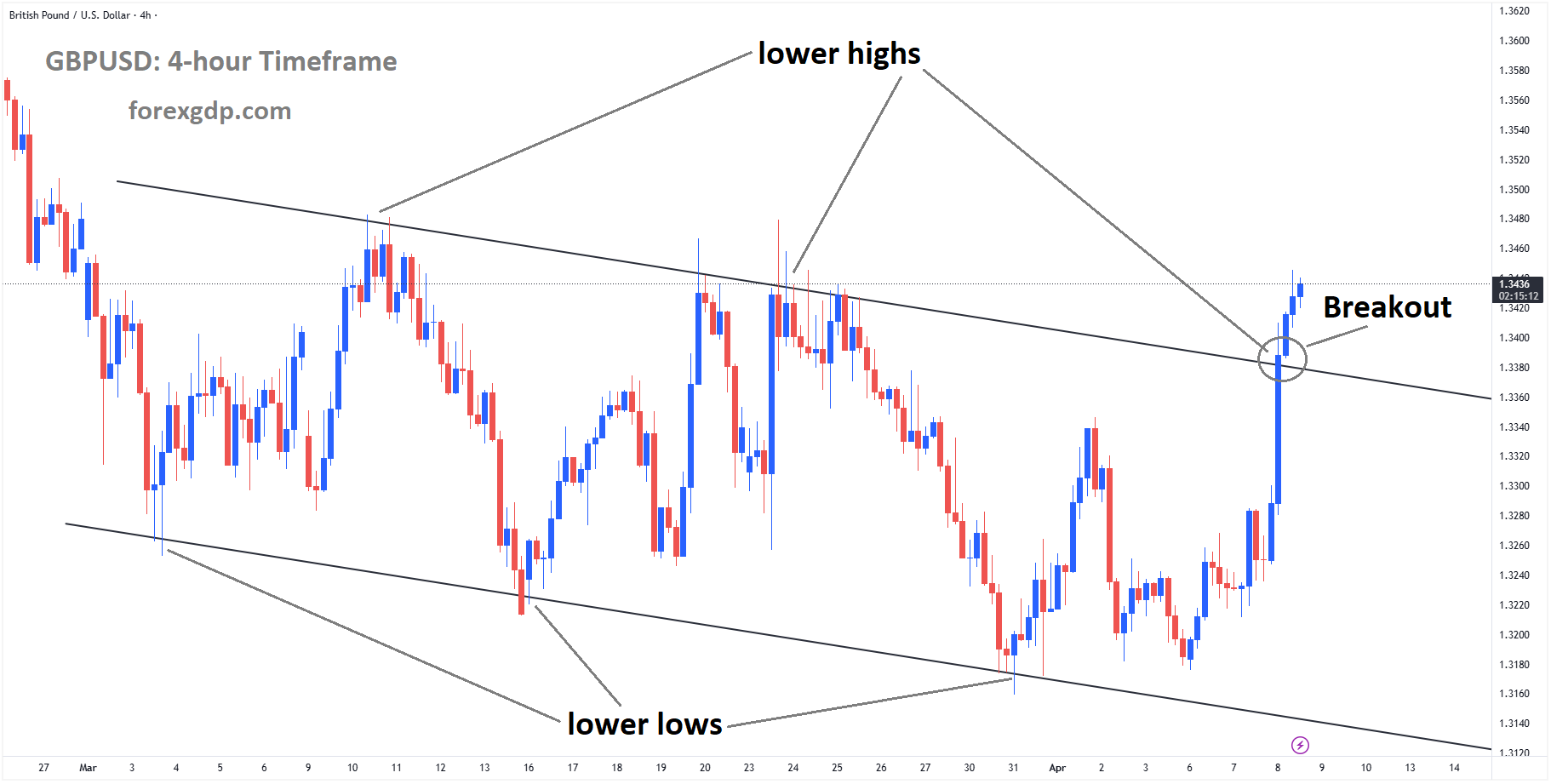
GBPUSD has broken the descending channel on the upside
This development has influenced not only currency markets but also oil prices and inflation expectations, creating a ripple effect across global financial systems.
What’s Driving the Pound’s Rise?
The recent rise in GBP/USD is closely linked to a drop in demand for the US Dollar. Typically, during periods of uncertainty or conflict, investors turn to the Dollar as a safe place to store value. However, with the announcement of a ceasefire between the US and Iran, some of that uncertainty has faded—at least for now.
As tensions ease, investors are more willing to move away from the Dollar and explore other currencies like the British Pound. This shift in demand has helped push the Pound higher.
Another factor supporting the Pound is improved market confidence. When global risks appear to decline, currencies that are seen as more growth-oriented tend to perform better. The Pound often benefits in such situations, especially when compared to the Dollar’s safe-haven role.
The Role of the US-Iran Ceasefire
The ceasefire agreement between the United States and Iran has become a key turning point in recent market movements. According to reports, US President Donald Trump agreed to a two-week pause in hostilities, but only if Iran commits to reopening the Strait of Hormuz—a critical route for global oil shipments.
Israel has also reportedly agreed to the ceasefire, adding another layer of stability to the situation. Meanwhile, discussions between the US and Iran are expected to take place in Islamabad, Pakistan. These talks aim to finalize the details of the agreement and potentially turn temporary peace into a more lasting arrangement.
Ongoing Tensions Still Present
Despite the ceasefire announcement, the situation remains fragile. Reports indicate that missile activity has not fully stopped, with alerts continuing in parts of the Middle East. Israeli defense forces have confirmed detecting missiles launched from Iran, while Qatar has also reported intercepting attacks aimed at its territory.
This ongoing tension suggests that while markets are reacting positively to the ceasefire, there is still a level of uncertainty that could influence future movements.
Oil Prices and Inflation: A Key Connection
One of the biggest impacts of the ceasefire has been seen in the oil market. With reduced fears of supply disruptions—especially through the Strait of Hormuz—oil prices have started to decline. This drop is significant because oil prices play a major role in shaping inflation.
When oil becomes cheaper, it reduces costs across many sectors, from transportation to manufacturing. As a result, inflation pressures tend to ease. This is exactly what markets are now anticipating following the ceasefire.
How This Affects the Bank of England
Lower inflation can have a direct impact on central bank decisions. In the United Kingdom, the Bank of England (BoE) closely monitors inflation when setting interest rates. If inflation slows down, the central bank may feel more comfortable lowering rates to support economic growth.
Before the recent geopolitical tensions, markets had already expected the BoE to cut interest rates two or three times in 2026. However, rising oil prices during the conflict had temporarily changed that outlook, as higher energy costs pushed inflation upward.

Now that oil prices are falling again, those earlier expectations of rate cuts may return. While this could support economic activity, it may also limit how much further the Pound can rise.
Why the Pound’s Gains May Be Limited
Even though the Pound is currently benefiting from a weaker Dollar, its upward movement may not continue indefinitely. The possibility of lower interest rates in the UK could reduce the attractiveness of the Pound for investors.
Interest rates are a key factor in currency value. Higher rates tend to attract more investment, strengthening a currency. On the other hand, lower rates can have the opposite effect.
So while the Pound is gaining ground now due to external factors like reduced global risk, internal factors such as monetary policy could eventually slow its progress.
Market Sentiment and Global Outlook
The broader market mood is currently leaning toward cautious optimism. The ceasefire has provided some relief, but investors remain aware that the situation could change quickly.
Global markets are highly sensitive to geopolitical developments, especially when they involve major players like the United States and Iran. Any signs of renewed conflict or breakdown in negotiations could quickly reverse current trends.
At the same time, upcoming talks in Pakistan will be closely watched. If both sides can reach a more permanent agreement, it could further stabilize markets and support continued risk-taking among investors.
Key Factors to Watch
Several elements will likely shape the next phase of market movement:
- Progress in US-Iran negotiations
- Stability in the Middle East
- Changes in oil prices
- Central bank decisions, especially from the Bank of England
- Overall global economic sentiment
Each of these factors can influence currency movements, sometimes in unexpected ways.
Summary
The recent rise in GBP/USD reflects a shift in global sentiment as geopolitical tensions temporarily ease. The US Dollar has weakened due to reduced demand for safe-haven assets, allowing the British Pound to gain strength. At the same time, falling oil prices have lowered inflation concerns, which could give the Bank of England room to consider interest rate cuts.
However, the situation remains uncertain. Ongoing tensions in the Middle East and the possibility of changing monetary policy in the UK may limit further gains for the Pound. Investors are likely to stay cautious, keeping a close eye on geopolitical developments and economic signals in the days ahead.
USDJPY slides as Japanese yen rallies on easing geopolitical tensions
The Japanese Yen has shown strong performance against the US Dollar, gaining momentum as global tensions begin to cool. A temporary ceasefire between the United States and Iran has played a key role in shifting market sentiment. This development has influenced currencies, oil prices, and investor behavior across global markets.
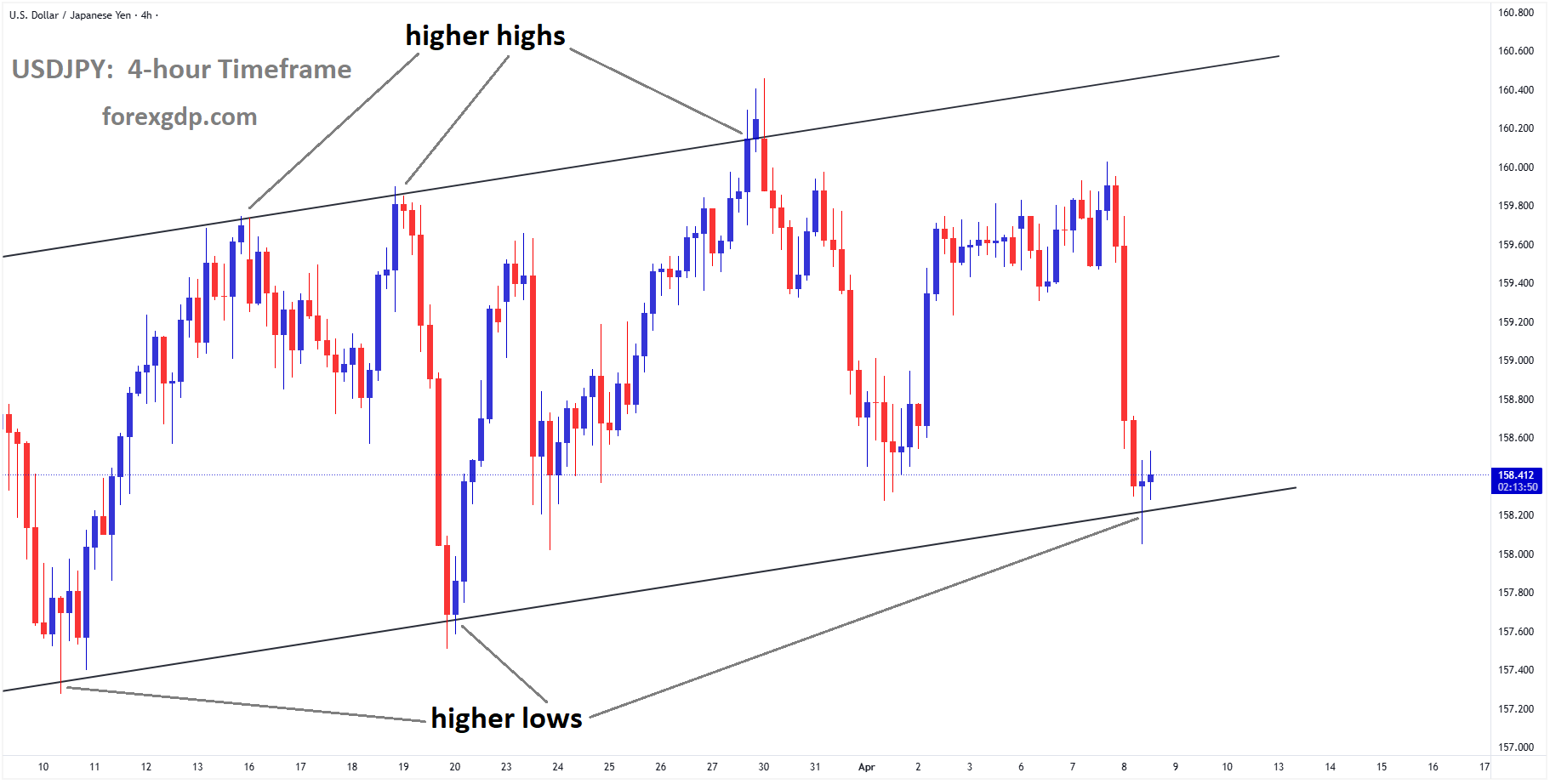
USDJPY is moving in an ascending channel, and the market has reached the higher low area of the channel
As the situation unfolds, the Yen has emerged as a notable beneficiary, supported by both economic factors and changes in risk perception among investors.
Ceasefire Between the US and Iran Brings Market Relief
A major reason behind the Yen’s recent strength is the announcement of a temporary ceasefire between the United States and Iran. The decision to pause military actions for two weeks has reduced immediate geopolitical risks. This has brought a sense of calm to global markets that were previously worried about escalating conflict.
The US government confirmed that planned attacks on Iranian civilian infrastructure would be suspended. At the same time, Iran agreed to reopen the Strait of Hormuz, a vital route for global oil transportation. This waterway is extremely important because a large portion of the world’s oil supply passes through it.
The reopening of the Strait has reassured markets, as any disruption there could have led to serious supply issues. With this key route now accessible again, fears of an oil crisis have eased significantly.
Diplomatic Talks Set to Begin Soon
Another important development is the start of formal negotiations between the US and Iran. Iran has confirmed that discussions on a proposed 10-point plan will begin on April 10 in Islamabad. This proposal is expected to address several major issues between the two countries.
Key Points in the Proposal
The proposal includes:
- Regulated passage through the Strait of Hormuz under Iranian supervision
- An end to military conflict involving Iran and its allied groups
- Withdrawal of US military forces from regional bases
These points indicate a possible shift toward diplomacy rather than conflict. If talks progress well, it could lead to longer-term stability in the region.
Investors are closely watching these developments, as successful negotiations could further reduce uncertainty in global markets.
Oil Prices Drop Sharply and Support the Yen
One of the most immediate effects of the ceasefire has been a sharp drop in oil prices. As tensions ease and supply concerns fade, oil prices have fallen significantly.
This decline has a direct impact on countries like Japan, which rely heavily on imported oil. Lower oil prices reduce the cost of energy imports, improving the country’s economic outlook.
Why Lower Oil Prices Help the Japanese Yen
Japan imports most of its energy needs, so when oil becomes cheaper:
- The country spends less on imports
- Trade balances can improve
- Economic pressure decreases
All of these factors support the strength of the Japanese Yen. As a result, the currency becomes more attractive to investors.
Changing Risk Sentiment in Global Markets
The ceasefire has also influenced how investors feel about risk. When geopolitical tensions are high, investors often move their money into safe assets. When tensions ease, they may shift back into riskier investments like stocks.
Interestingly, even though market sentiment has improved, the Yen has still strengthened. This shows that other factors, such as falling oil prices and currency dynamics, are playing a bigger role.
Meanwhile, US markets have reacted positively to the news. Stock futures have shown strong gains, reflecting renewed confidence among investors. This suggests that markets are welcoming the possibility of reduced conflict and improved diplomatic relations.
US Dollar Faces Pressure
While the Yen is gaining strength, the US Dollar is facing some downward pressure. The US Dollar Index, which measures the value of the Dollar against a group of major currencies, has declined.
This drop indicates that the Dollar is losing some of its appeal in the current environment. Several factors may be contributing to this trend:
- Improved global stability reducing demand for the Dollar as a safe option
- Stronger performance from other currencies like the Yen
- Market anticipation of future economic signals from the US
As the Dollar weakens, currency pairs involving the Yen are seeing noticeable movement.
Market Focus Shifts to Upcoming Economic Data
Looking ahead, investors are turning their attention to important economic updates from the United States. One key event is the release of the Federal Reserve’s meeting minutes from its March policy discussion.
These minutes can provide insights into:
- The central bank’s view on inflation
- Future interest rate plans
- Overall economic outlook
Such information can influence currency movements and investor decisions. If the Federal Reserve signals changes in its approach, it could affect the balance between the US Dollar and other currencies, including the Yen.
What This Means for Global Investors
The recent developments highlight how quickly global markets can respond to political and economic changes. A single announcement, like a ceasefire, can impact multiple areas:
- Currency markets
- Oil prices
- Stock market performance
For investors, this serves as a reminder of the importance of staying informed about global events. Political decisions, especially those involving major economies, can have far-reaching effects.
The Japanese Yen’s rise is a clear example of how interconnected these factors are. Lower oil prices, easing tensions, and shifting investor sentiment have all combined to support the currency.
Summary
The Japanese Yen has strengthened against the US Dollar as global tensions between the United States and Iran show signs of easing. A temporary ceasefire, along with the reopening of the Strait of Hormuz, has reduced concerns about oil supply disruptions. This has led to a sharp drop in oil prices, which benefits Japan due to its reliance on energy imports.
At the same time, planned diplomatic talks between the two nations offer hope for longer-term stability. While global market sentiment has improved, the Yen continues to gain support from economic factors and currency dynamics. Meanwhile, the US Dollar has weakened slightly as investors adjust their expectations.
With upcoming economic data from the United States, markets are likely to remain active. Investors will continue to watch both geopolitical developments and central bank signals to better understand the direction of global currencies.
USDCHF weakens past 0.7900 after ceasefire news, traders eye Fed insights
The USD/CHF currency pair has come under pressure during the early European trading session, reflecting a shift in global sentiment driven by geopolitical developments and expectations around central bank policy. A mix of easing tensions in the Middle East and anticipation of key economic insights from the United States is influencing how traders position themselves, leading to a softer US Dollar against the Swiss Franc.
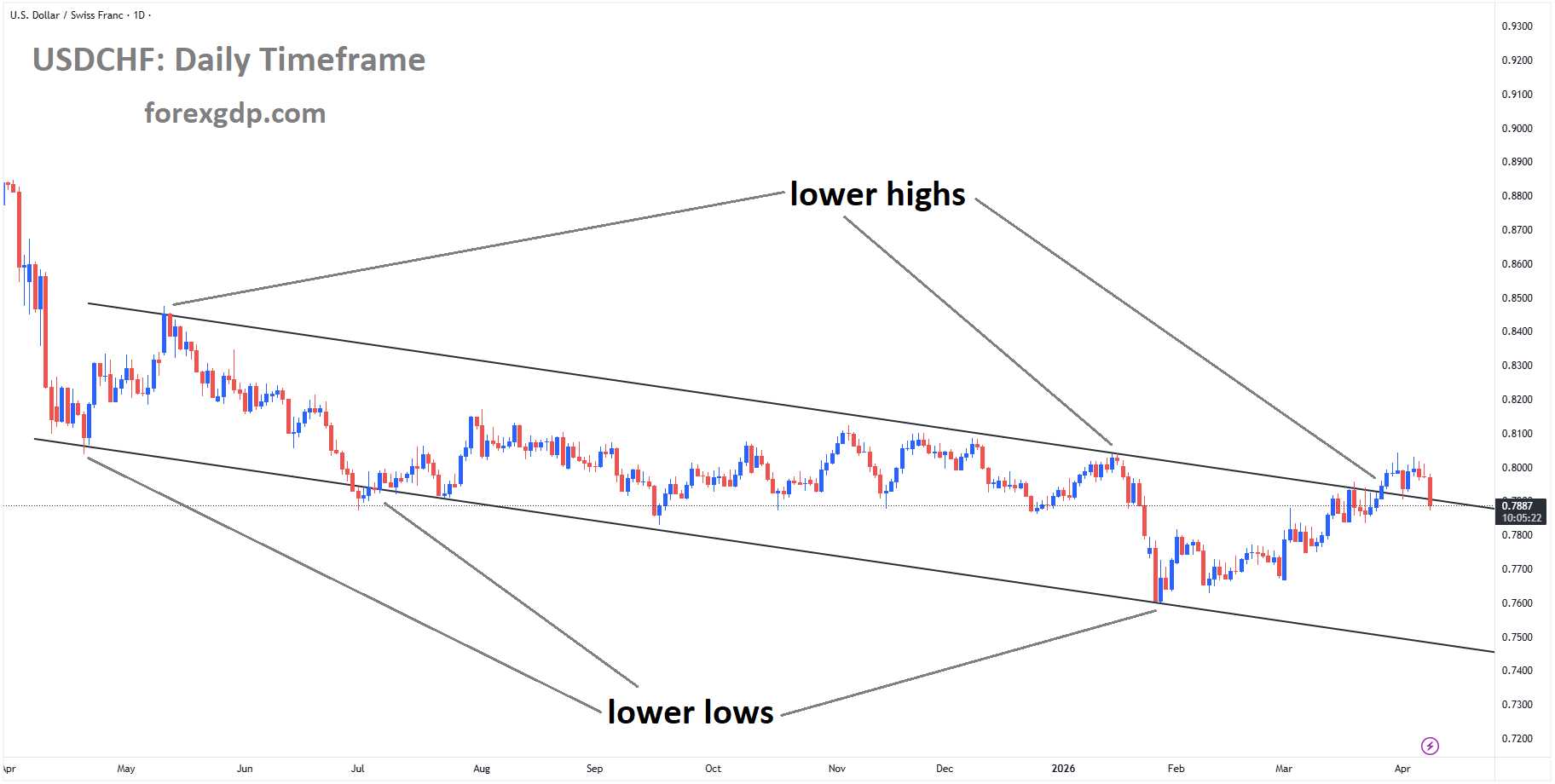
USDCHF is moving in a descending channel, and the market has reached the lower high area of the channel
Geopolitical Calm Reduces Demand for the US Dollar
One of the biggest drivers behind the recent movement in the USD/CHF pair is the sudden shift in geopolitical tone. Reports of a temporary ceasefire agreement between the United States and Iran have helped ease global concerns, at least for now. When tensions are high, the US Dollar often benefits as a safe-haven asset. However, when risks begin to fade, demand for the Dollar tends to weaken.
The announcement of a two-week ceasefire has played a key role in this change. The agreement reportedly includes steps to stabilize activity in the Strait of Hormuz, a critical global energy route. Any disruption in this region typically raises fears about energy supply and economic stability, pushing investors toward safer assets like the US Dollar.
With the situation now showing signs of improvement, investors are stepping away from defensive positions. This shift is allowing currencies like the Swiss Franc, which also holds safe-haven status but reacts differently to European and global conditions, to gain strength against the Dollar.
Political Messaging and Its Market Impact
Statements from US leadership have also added to the changing market mood. Public remarks emphasizing progress toward peace and economic recovery in the region have contributed to a more optimistic outlook. The idea that reconstruction efforts could follow the ceasefire has further supported expectations of stability.
Additionally, assurances regarding smoother passage through the Strait of Hormuz during the ceasefire period have helped calm fears of supply disruptions. This is particularly important because energy markets are closely tied to currency movements. When oil supply risks decline, it often reduces upward pressure on inflation and shifts central bank expectations.
Diplomatic efforts are continuing, with further discussions planned to finalize the terms of the ceasefire. These negotiations are being closely watched, as any setback could quickly reverse the current market sentiment.
Focus Shifts to Federal Reserve Signals
While geopolitical developments are currently influencing the Dollar, attention is also turning toward the Federal Reserve. The release of meeting minutes from the Fed’s previous policy discussion is expected to provide deeper insight into how officials view recent economic challenges.
What Traders Are Looking For

Market participants are particularly interested in how policymakers are assessing the impact of rising energy costs caused by earlier tensions in the Middle East. Energy price shocks can affect inflation, which in turn influences interest rate decisions.
If the minutes reveal that Fed officials are concerned about persistent inflation and are leaning toward tighter monetary policy, the US Dollar could regain some strength. On the other hand, if the tone suggests caution or concern about economic slowdown, it may keep the Dollar under pressure.
Balancing Growth and Inflation
The Federal Reserve faces a delicate balancing act. On one side, it must control inflation, especially if energy prices remain unpredictable. On the other, it must ensure that economic growth is not weakened by overly aggressive policy decisions.
This uncertainty is why the Fed’s communication is so important. Even subtle changes in tone can shift expectations and lead to noticeable movements in currency markets.
Swiss Franc Gains Support from Domestic Factors
While the US Dollar is facing downward pressure, the Swiss Franc is receiving support from developments within Switzerland itself. Recent data shows that inflation in the country has picked up at a faster pace than previously seen over the past year.
Rising Inflation Changes Policy Expectations
Higher inflation in Switzerland has important implications for the Swiss National Bank (SNB). For some time, there had been speculation that the SNB might return to negative interest rates to support the economy. However, rising price pressures reduce the need for such measures.
As inflation increases, the central bank is less likely to adopt ultra-loose monetary policies. This shift makes the Swiss Franc more attractive to investors, as it signals a more stable and potentially stronger economic environment.
Energy Costs Driving Price Increases
A major contributor to the rise in Swiss inflation has been the increase in energy costs. The earlier supply concerns linked to Middle East tensions led to higher prices for heating oil and other energy-related expenses.
Although the geopolitical situation is now improving, the effects of those earlier disruptions are still being felt. This lingering impact continues to influence economic data and, in turn, currency movements.
Safe-Haven Dynamics Between USD and CHF
Both the US Dollar and Swiss Franc are considered safe-haven currencies, but they do not always move in the same direction. Their performance often depends on the nature of the risk and how global investors interpret it.
When the Dollar Weakens
The US Dollar tends to gain when there is widespread uncertainty or financial stress. However, when tensions ease or when investors feel more confident about global stability, demand for the Dollar can decline.
Why the Franc Holds Firm
The Swiss Franc, while also a safe-haven currency, benefits from Switzerland’s stable political environment, strong financial system, and consistent economic policies. It often attracts investors looking for long-term safety rather than short-term protection.
In the current situation, the easing of geopolitical tensions has reduced the need for immediate safety, which affects the Dollar more than the Franc. At the same time, improving domestic conditions in Switzerland are providing additional support for its currency.
What Lies Ahead for USD/CHF
Looking forward, several factors will continue to influence the USD/CHF pair. The progress of diplomatic talks between the US and Iran remains a key variable. Any sign of renewed tension could quickly shift sentiment back in favor of the US Dollar.
At the same time, the Federal Reserve’s stance on inflation and interest rates will play a crucial role. Clear signals of tighter policy could strengthen the Dollar, while a more cautious approach may keep it under pressure.
On the Swiss side, inflation trends and central bank decisions will be closely monitored. If price pressures remain elevated, the Swiss Franc could continue to benefit from reduced expectations of negative interest rates.
Summary
The recent movement in the USD/CHF pair reflects a combination of geopolitical developments and evolving monetary policy expectations. A temporary easing of tensions in the Middle East has reduced demand for the US Dollar, while the Swiss Franc has gained strength from rising domestic inflation and shifting central bank outlook.
At the same time, attention is turning toward the Federal Reserve, as traders look for clues about future policy direction. The interplay between global risk sentiment and central bank decisions will continue to shape the path of this currency pair in the days ahead.
USDCAD under pressure as US pauses aggression, supporting Canadian Dollar
The USD/CAD currency pair showed a slight decline during early Wednesday trading in Asia, moving closer to the 1.3835 level. This shift reflects a mix of global political developments, energy market changes, and anticipation surrounding key economic updates from the United States.
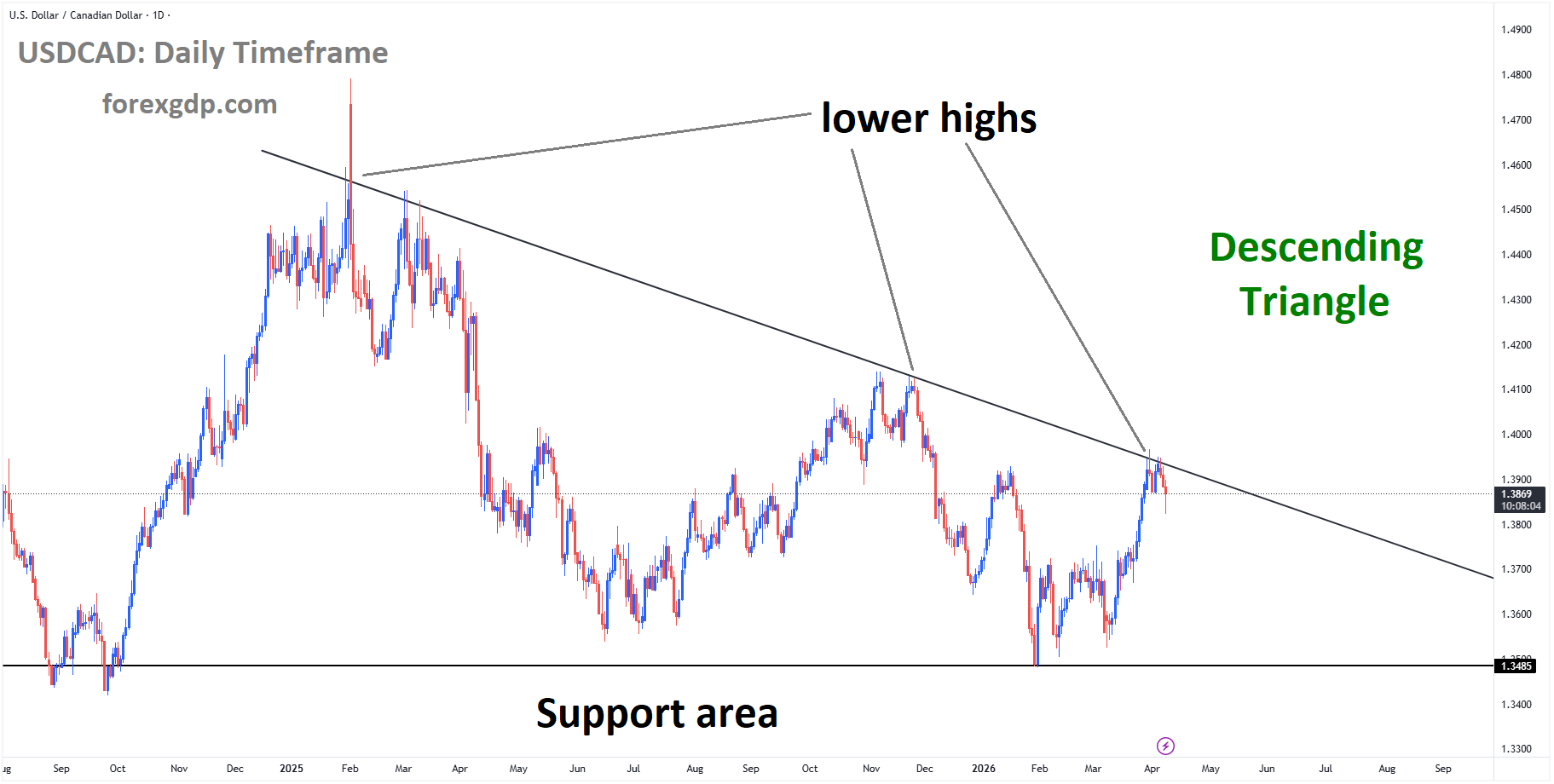
USDCAD is moving in a descending triangle, and the market has fallen from the lower high area of the pattern
At the center of this movement is a surprising geopolitical development involving the United States and Iran, along with fluctuations in oil prices and expectations tied to the Federal Reserve’s upcoming meeting notes. Together, these factors are influencing both the US Dollar and the Canadian Dollar in different ways.
Geopolitical Developments Ease Market Tension
One of the main drivers behind the recent movement in USD/CAD is a temporary easing of tensions between the United States and Iran. Reports indicate that Iran has agreed to a two-week ceasefire, creating a short-term pause in hostilities.
This decision came after US President Donald Trump signaled a willingness to suspend military actions, provided that Iran agreed to reopen the Strait of Hormuz. This strategic waterway is one of the most important routes for global oil transportation, and any disruption there can quickly impact markets worldwide.
Iran’s Foreign Minister confirmed that safe passage through the Strait would be allowed during the ceasefire period. Coordination with Iranian armed forces is expected to ensure that oil shipments can continue without interruption for at least two weeks.
This development has helped reduce immediate fears of supply disruptions in global energy markets. As a result, investors reacted quickly, adjusting their positions in currencies and commodities.
Impact on the US Dollar
The US Dollar faced some downward pressure following the announcement of the ceasefire. When geopolitical risks decrease, the demand for safe-haven assets like the US Dollar often weakens. Investors tend to move toward assets that offer better returns when the global environment appears more stable.
In this case, the easing of tensions reduced uncertainty, leading traders to sell the Greenback. This is one of the reasons why USD/CAD edged lower during the session.
However, the decline in the US Dollar may not be long-lasting. Market participants are now closely watching upcoming economic signals from the Federal Reserve, which could influence the direction of the currency in the near term.
Focus Shifts to Federal Reserve Signals
Another key factor influencing the USD/CAD pair is the upcoming release of the Federal Open Market Committee (FOMC) Minutes. These minutes provide a detailed summary of discussions held during the Federal Reserve’s latest meeting.
Traders and investors study these notes carefully to understand how policymakers view the current economic situation. In particular, there is strong interest in how officials are interpreting the recent energy-related disruptions caused by Middle East tensions.
If the minutes reveal that the Federal Reserve remains concerned about inflation or is leaning toward tighter monetary policy, it could support the US Dollar. Such signals are often described as “hawkish,” meaning the central bank may keep interest rates higher or raise them further.
On the other hand, if the tone appears cautious or suggests a pause in policy tightening, the US Dollar could remain under pressure.
Oil Prices Take a Hit
The ceasefire agreement has also had a noticeable impact on oil prices. With reduced risk of supply disruptions, crude oil prices dropped below the $100 mark.
This decline reflects improved confidence that oil shipments will continue without major interruptions, at least in the short term. When geopolitical risks ease, energy markets often respond quickly, adjusting prices based on expected supply stability.
Lower oil prices can have ripple effects across global markets, especially for countries that rely heavily on energy exports.
How Oil Prices Affect the Canadian Dollar

The Canadian Dollar, often referred to as the “Loonie,” is closely linked to oil prices because Canada is one of the world’s major oil exporters. When oil prices fall, Canada’s export revenues can decrease, which tends to weaken the national currency.
In this situation, the drop in crude oil prices is putting pressure on the Canadian Dollar. While the US Dollar is also facing some weakness, the decline in oil prices is limiting the strength of the Loonie.
This creates a balancing effect in the USD/CAD pair. On one side, a softer US Dollar pushes the pair lower. On the other side, a weaker Canadian Dollar due to falling oil prices helps prevent a sharper decline.
Market Sentiment Remains Mixed
The overall mood in the market remains cautious but slightly optimistic. The temporary ceasefire has provided some relief, but it is only a short-term arrangement. Investors are aware that geopolitical tensions could return once the two-week period ends.
At the same time, attention is shifting toward economic fundamentals, especially in the United States. The Federal Reserve’s stance on inflation and interest rates continues to play a major role in shaping currency movements.
Traders are trying to balance these factors—geopolitical developments, energy prices, and central bank signals—when making decisions.
Short-Term Outlook for USD/CAD
In the near term, the USD/CAD pair is likely to remain sensitive to both geopolitical news and economic data releases.
If the ceasefire holds and oil prices remain under pressure, the Canadian Dollar could continue to face challenges. However, any unexpected rise in oil prices could quickly strengthen the Loonie.
Meanwhile, the US Dollar’s direction will depend heavily on the tone of the Federal Reserve. Clear signals about future policy moves could either support the currency or lead to further weakness.
This combination of factors suggests that USD/CAD may continue to move within a narrow range as markets wait for clearer direction.
Final Summary
The recent dip in USD/CAD reflects a complex mix of global events and economic expectations. A temporary ceasefire between the United States and Iran has reduced immediate geopolitical risks, leading to a softer US Dollar and lower oil prices.
At the same time, falling crude oil prices are weighing on the Canadian Dollar, preventing a sharper decline in the currency pair. With traders now focusing on the Federal Reserve’s upcoming meeting notes, the next major move in USD/CAD will likely depend on how policymakers view inflation and future interest rates.
For now, the market remains in a state of cautious balance, shaped by both easing tensions and ongoing uncertainty.