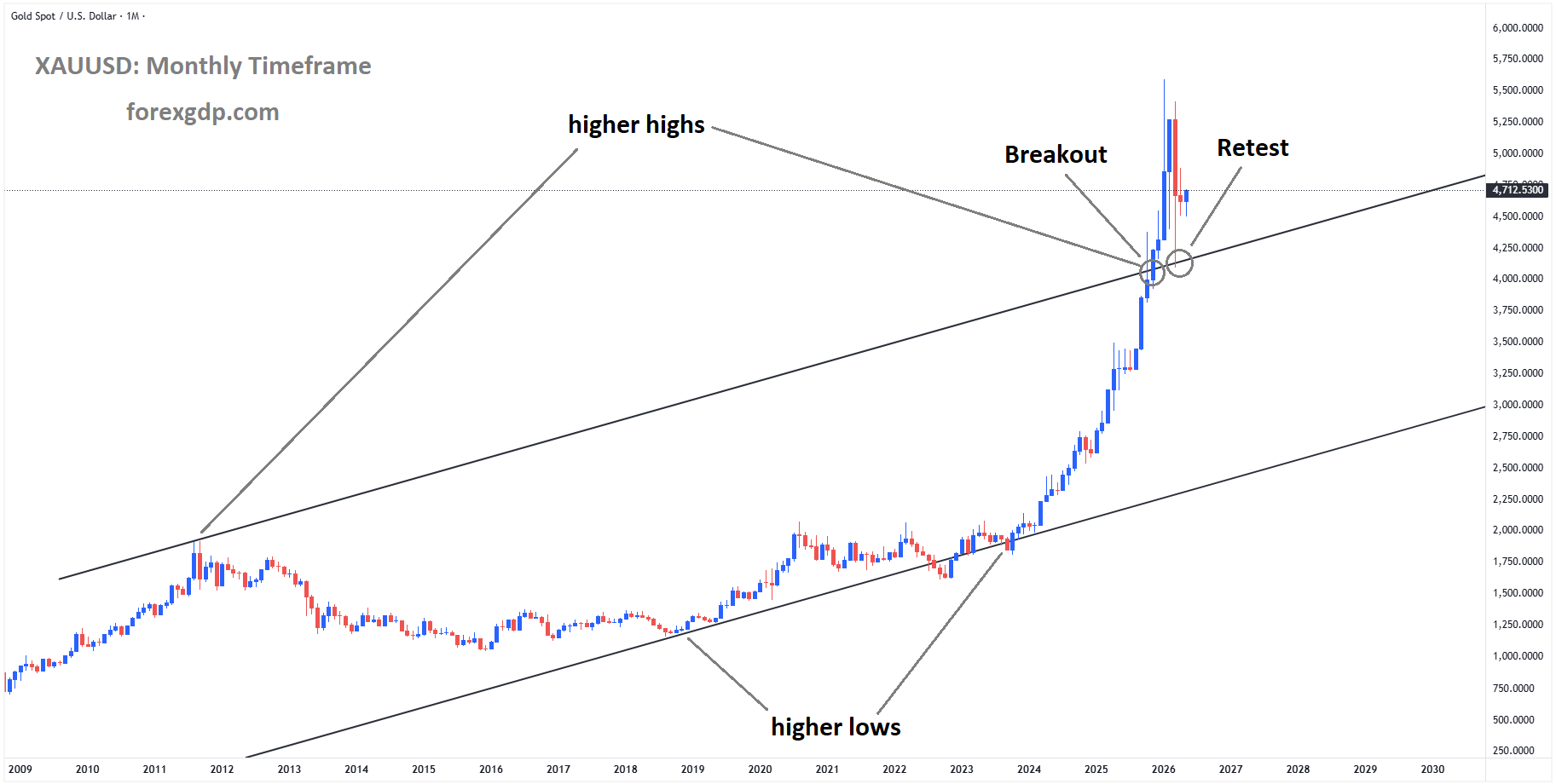


XAUUSD Struggles to Recover as Surging Bond Yields Pressure Gold
Gold ended the week under pressure as stronger US Treasury yields reduced the appeal of the precious metal, even though the US Dollar lost some of its recent strength. Investors closely watched comments from Federal Reserve officials, fresh economic data, and ongoing geopolitical tensions, all of which influenced market sentiment.
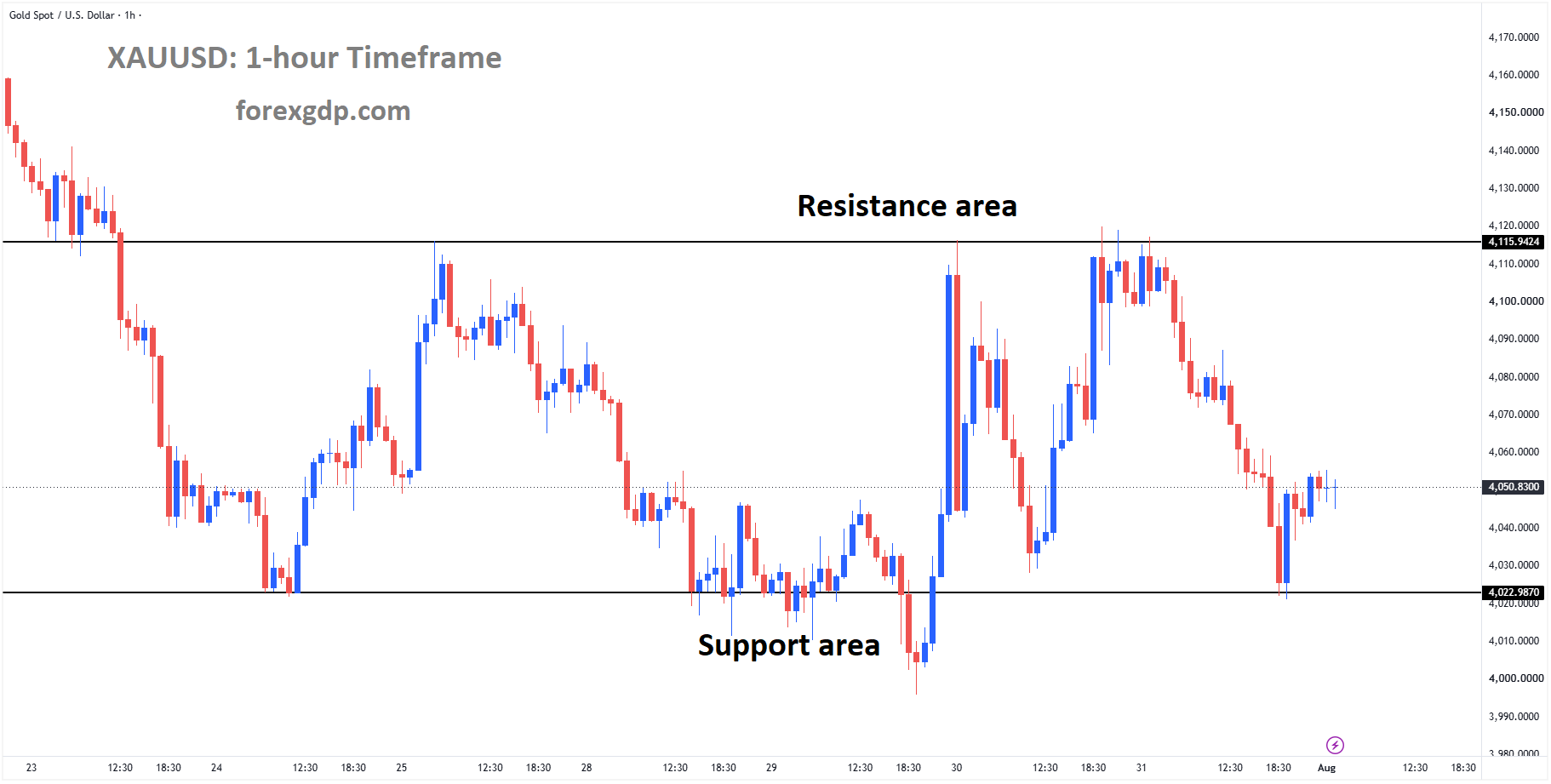
XAUUSD is moving in a box pattern, and the market has rebounded from the support area of the pattern
While softer economic growth and easing inflation initially supported hopes for a more flexible monetary policy, several Fed policymakers reminded markets that inflation remains a concern. At the same time, higher oil prices and rising government bond yields added new challenges for gold.
Treasury Yields Limit Gold’s Appeal
One of the biggest reasons behind gold’s weakness was the sharp rise in US Treasury yields. When bond yields move higher, investors often shift money toward interest-paying assets instead of gold, which does not generate regular income.
Even though the US Dollar failed to maintain its earlier strength, the jump in bond yields outweighed any benefit that a weaker currency might have provided. As a result, gold struggled to attract fresh buying interest throughout the trading session.
Federal Reserve Officials Keep Inflation Concerns Alive
Recent comments from several Federal Reserve officials showed that not everyone believes inflation is fully under control. Some policymakers argued that interest rates may still need to remain high, or even rise further, to make sure inflation continues moving toward the central bank’s target.
Dallas Fed President Lorie Logan explained that inflation risks are still leaning upward, making tighter monetary policy a reasonable option. Cleveland Fed President Beth Hammack also stressed that inflation has remained too high for an extended period, suggesting current policy may not be restrictive enough.
Meanwhile, Minneapolis Fed President Neel Kashkari supported a gradual approach, saying that smaller rate increases would be more effective than aggressive moves. Although their opinions differed slightly, all three officials emphasized the importance of keeping inflation under control.
Economic Growth Slows While Inflation Shows Improvement
Recent US economic data presented a mixed picture. Economic growth slowed during the second quarter compared with the first quarter, suggesting that higher borrowing costs are beginning to affect overall activity.
On the positive side, the Federal Reserve’s preferred inflation measure showed a small decline. This offered some reassurance that price pressures are gradually easing, supporting the central bank’s decision to leave interest rates unchanged at its latest meeting.
The combination of slower growth and improving inflation has created uncertainty. Investors are trying to determine whether the economy is cooling enough without falling into a deeper slowdown.
Rate Hike Expectations Ease
Following the latest Federal Reserve meeting, market expectations for another interest rate increase declined noticeably.
Many investors now believe the central bank may leave rates unchanged at its next meeting rather than tightening policy again. Although the possibility of another hike has not disappeared completely, confidence in that outcome has weakened compared with previous expectations.
This shift reflects growing uncertainty about the balance between controlling inflation and protecting economic growth.
Consumer Confidence Shows Signs of Recovery
Despite slower economic growth, American consumers appear slightly more optimistic about the future.
The latest University of Michigan Consumer Sentiment survey showed an improvement from its earlier estimate. The increase suggests households are becoming a little more confident about economic conditions.
According to the survey, optimism improved across different income levels, age groups, education backgrounds, and political affiliations. Inflation expectations also remained relatively stable, indicating that consumers are not expecting a major surge in prices over the coming years.
This steady outlook provides some reassurance that consumer spending could remain supportive for the broader economy.
Geopolitical Risks Continue to Influence Markets
Global political tensions remain another important factor affecting financial markets.
Ongoing conflict in the Gulf region has supported higher oil prices, increasing concerns that energy costs could keep inflation elevated. Rising energy prices often create additional pressure on central banks, making it more difficult for them to ease monetary policy.
For gold, this creates mixed conditions. While geopolitical uncertainty can increase demand for safe-haven assets, higher oil prices may also contribute to persistent inflation, encouraging central banks to maintain tighter policies that are generally less favorable for gold.
Investors Remain Focused on Policy Signals

Market participants are paying close attention to every new economic report and every statement from Federal Reserve officials.
Future decisions will largely depend on whether inflation continues to cool while economic growth remains stable. If inflation proves more stubborn than expected, policymakers could keep borrowing costs elevated for longer. On the other hand, further signs of slowing economic activity may encourage a more cautious approach.
Until clearer signals emerge, investors are likely to remain cautious as they assess changing expectations surrounding monetary policy.
Summary
Gold faced renewed selling pressure as rising US Treasury yields outweighed the support normally provided by a softer US Dollar. Although inflation has shown gradual improvement and economic growth has slowed, several Federal Reserve officials continue to express concern that inflation risks have not fully disappeared.
At the same time, stronger consumer confidence, easing expectations for another rate increase, and ongoing geopolitical tensions are creating a mixed outlook for financial markets. In the weeks ahead, investors will closely monitor economic data and central bank comments to better understand the direction of monetary policy and its potential impact on gold.
EURUSD Retreats as Dollar Rebound Pressures the Euro
The Euro moved lower against the US Dollar on Friday as the US currency regained strength after a sharp decline in the previous trading session. Investors shifted back toward the Greenback as expectations for higher US interest rates remained strong, while ongoing geopolitical tensions added to demand for the US Dollar.
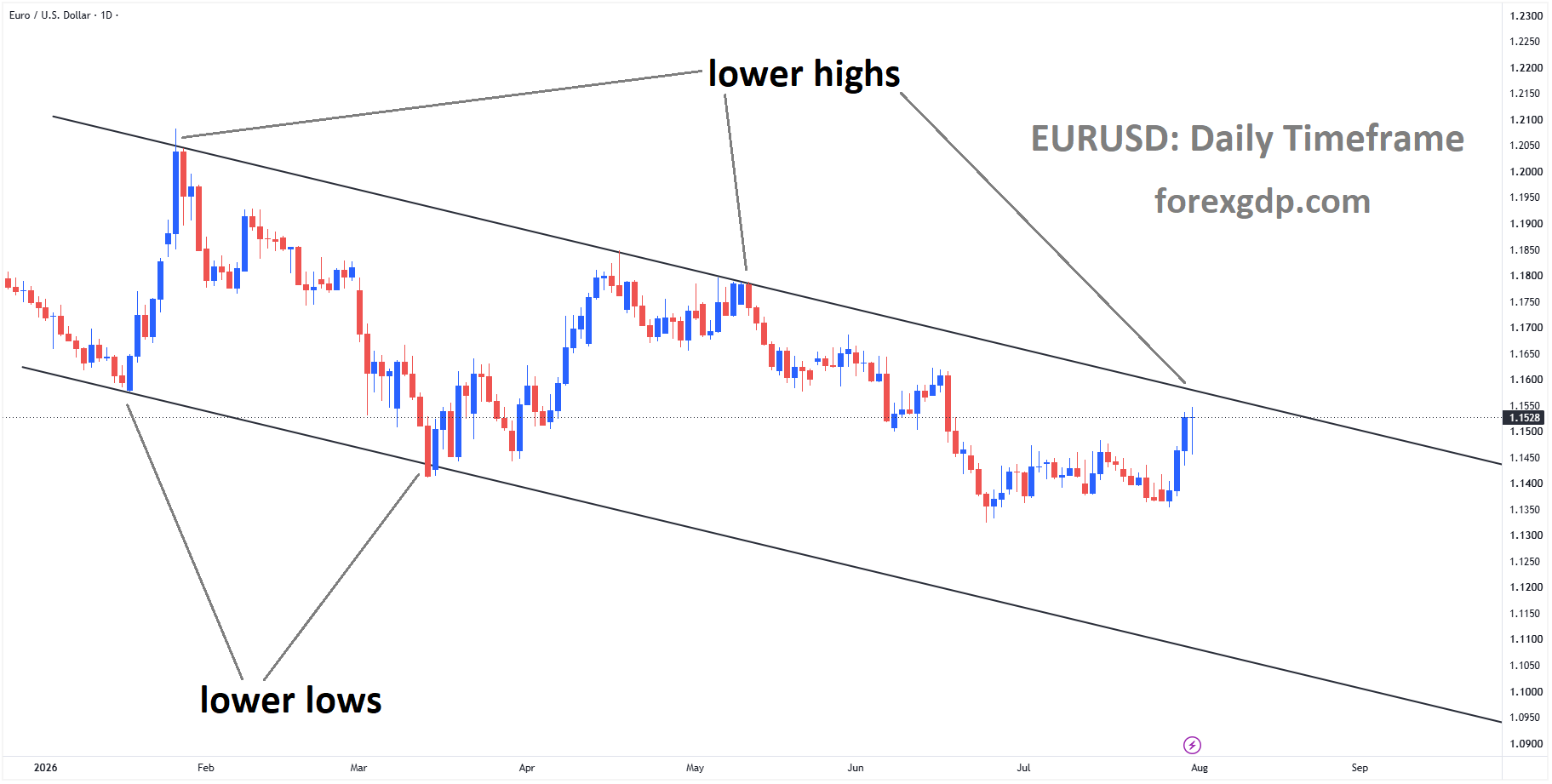
EURUSD is moving in a descending channel
Although fresh inflation data from the Eurozone supported the possibility of another European Central Bank (ECB) interest rate increase, the common currency struggled to maintain its recent gains. Market participants are now closely watching upcoming US economic data for fresh clues about the Federal Reserve’s next move.
US Dollar Recovers After Recent Weakness
The US Dollar bounced back after experiencing heavy selling earlier in the week. This recovery was mainly driven by investors adjusting their positions and renewed confidence that US interest rates could remain higher for longer.
The Greenback also benefited from cautious market sentiment as geopolitical tensions in the Middle East continued to encourage investors to seek safer assets. During times of uncertainty, the US Dollar often attracts stronger demand because it is widely viewed as a reliable safe-haven currency.
As a result, the Euro lost momentum after reaching its strongest level in several weeks, showing that the US Dollar remains well supported despite recent volatility.
Federal Reserve Officials Maintain a Hawkish Tone
One of the biggest reasons behind the Dollar’s recovery was the continued hawkish message from several Federal Reserve officials.
Although the latest Federal Reserve policy meeting ended without a change in interest rates, many policymakers made it clear that they remain concerned about inflation. Their comments suggested that additional rate increases are still possible if inflation does not slow enough in the coming months.
Several Fed officials stressed that controlling inflation remains their top priority, especially since the US labor market continues to show resilience. They believe it may be safer to make smaller interest rate adjustments gradually instead of delaying action and being forced to make larger changes later.
This cautious but firm approach has strengthened expectations that borrowing costs could rise again before the end of the year.
Investors Continue to Expect Another US Rate Hike
Financial markets continue to believe that the Federal Reserve has not finished tightening monetary policy.
While no immediate action was taken at the latest meeting, many traders still expect another interest rate increase in the months ahead. Rising energy costs have kept inflation concerns alive, making it harder for policymakers to confidently declare that price pressures are fully under control.
Because of this, investors are paying close attention to every economic report released in the United States. Consumer confidence surveys and inflation expectation data are especially important because they offer valuable insight into how households view future price growth.
Any signs that inflation remains stubborn could further support expectations for tighter monetary policy.
Middle East Tensions Continue to Support the Dollar
Global political developments also remain an important factor influencing currency markets.
The ongoing conflict in the Middle East has increased uncertainty across financial markets. During periods of geopolitical instability, investors often reduce exposure to riskier assets and move their money into safer investments.
The US Dollar usually benefits from this type of market behavior due to its role as the world’s leading reserve currency. Even when economic data is mixed, rising geopolitical risks can provide additional support for the Greenback.
This combination of economic and political factors has helped strengthen the Dollar against several major currencies, including the Euro.
Eurozone Inflation Keeps ECB Policy Expectations Alive
Across Europe, the latest inflation report showed that price pressures remain relatively steady.
Headline inflation increased in line with expectations, while core inflation, which excludes more volatile items, moved slightly higher compared to the previous month. Although these figures did not immediately boost the Euro, they reinforced the belief that inflation remains above the ECB’s long-term target.
This means the central bank may still need to tighten monetary policy further to ensure inflation gradually returns to desired levels.
Even though the market reaction was limited, the inflation data continues to support expectations that policymakers are preparing for another interest rate increase.
Economic Growth Adds Confidence to the ECB Outlook

Inflation is not the only factor supporting expectations for further ECB action.
Recent economic growth data from the Eurozone has also been stronger than many analysts expected. A stable economy gives central bankers greater confidence to continue fighting inflation without causing significant damage to overall economic activity.
Economists believe the combination of steady growth and persistent inflation provides enough justification for another policy adjustment if incoming data continues to support that view.
However, investors remain cautious because global uncertainties could still affect the region’s economic outlook in the months ahead.
Experts Warn Inflation Risks Have Not Fully Disappeared
Although inflation appears to be moving in the right direction, economists believe it is still too early to declare victory.
Analysts note that rising energy costs may eventually spread into other parts of the economy. Businesses often need time to pass higher production and transportation costs on to consumers, meaning the full impact of energy price increases may not yet be visible.
Because of this delayed effect, policymakers on both sides of the Atlantic are likely to remain cautious when making future interest rate decisions.
This uncertainty explains why central banks continue to emphasize the importance of monitoring incoming economic data before making any major policy changes.
Markets Shift Their Focus to Upcoming Economic Reports
With central bank meetings now behind them, investors are turning their attention toward fresh economic data that could influence future policy decisions.
Reports on consumer confidence, inflation expectations, employment, and spending will all play an important role in shaping market expectations over the coming weeks.
If US data continues to show resilient economic activity and persistent inflation, expectations for another Federal Reserve rate increase may strengthen further. On the other hand, softer figures could reduce pressure on policymakers.
Similarly, upcoming Eurozone inflation and growth reports will help determine whether the ECB remains on track for another interest rate hike.
Summary
The Euro weakened against the US Dollar as the Greenback recovered following the previous session’s losses. Continued support for the US Dollar came from hawkish comments by Federal Reserve officials, ongoing geopolitical tensions, and expectations that US interest rates could still move higher later this year.
Meanwhile, the latest Eurozone inflation figures reinforced expectations that the European Central Bank may continue tightening monetary policy. Even so, the Euro struggled to gain momentum as investors remained focused on the stronger outlook for the US Dollar.
Looking ahead, financial markets will closely monitor upcoming economic data from both the United States and the Eurozone, as these reports are expected to play a key role in shaping future central bank decisions and the direction of the EUR/USD currency pair.
GBPUSD Defies Dollar Comeback as Pound Maintains Stability
The GBP/USD currency pair remained relatively steady as the US Dollar regained some strength after a sharp decline earlier in the week. Although the Greenback managed to recover, the British Pound also found enough support to prevent any major losses. Investors continued to watch economic reports and central bank comments closely as they searched for clues about the future direction of monetary policy.
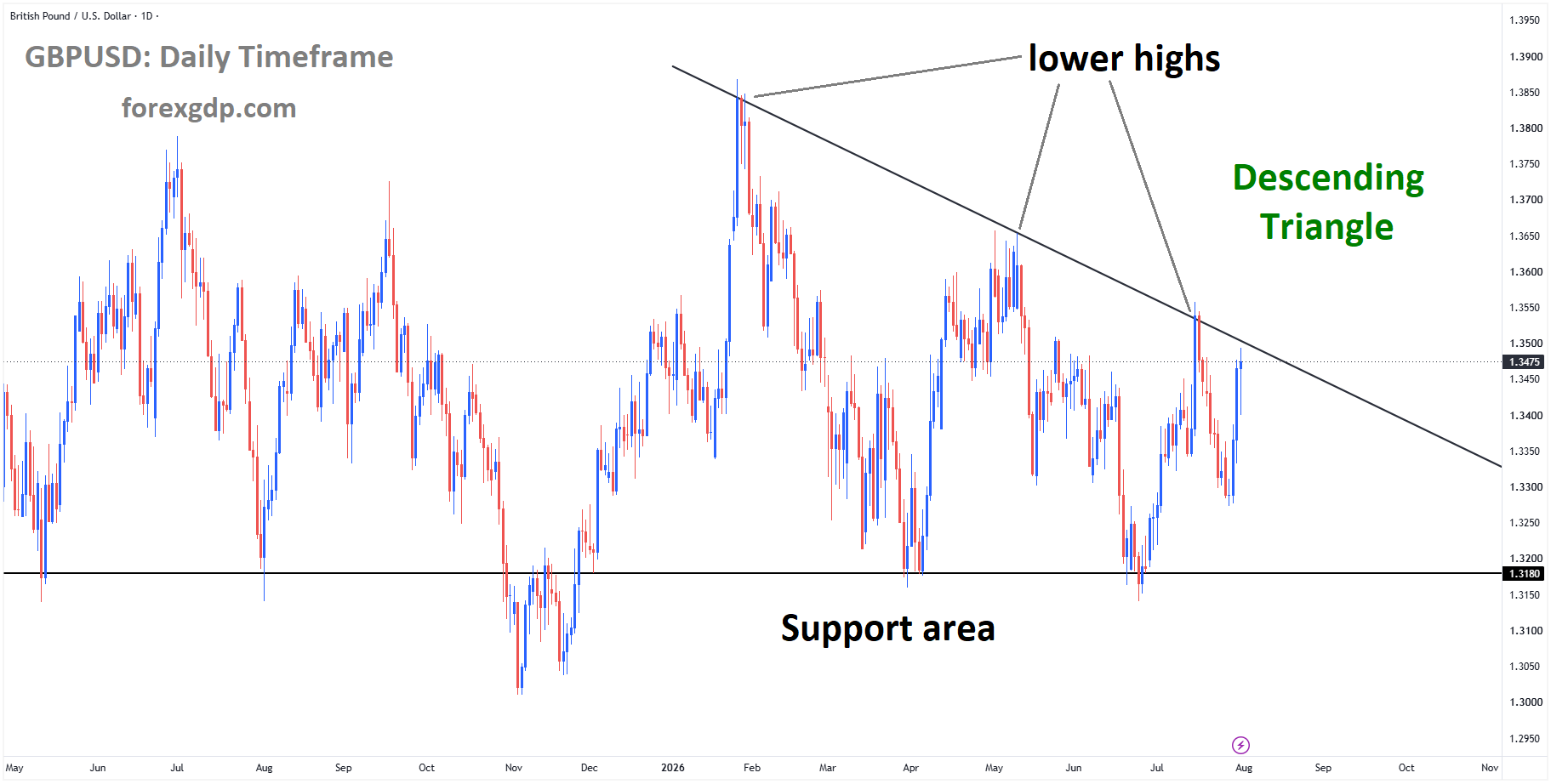
GBPUSD is moving in a descending triangle pattern
A combination of stronger consumer confidence in the United States, mixed inflation signals, and cautious comments from policymakers in both the US and the UK kept traders focused on the bigger economic picture rather than making aggressive moves.
US Dollar Finds Support After a Weak Week
The US Dollar experienced one of its weakest weeks in several months after coming under pressure following market intervention that pushed the US Dollar Index to its lowest level in about a month. However, by the end of the week, the currency showed signs of recovering as investors reassessed the latest economic data.
While the Dollar regained some lost ground, it still remained on track to finish the week with notable losses. This reflected ongoing uncertainty about the outlook for the US economy and the future path of interest rates.
Many investors preferred to stay cautious instead of making large positions, especially with several important economic developments unfolding at the same time.
Consumer Confidence Shows Signs of Improvement
One encouraging development for the US economy came from the latest University of Michigan Consumer Sentiment Survey. The report showed that consumer confidence improved slightly compared to the earlier estimate.
The increase suggested that households are feeling somewhat more optimistic about current economic conditions despite ongoing concerns about inflation and borrowing costs.
According to Joanne Hsu, Director of the Survey of Consumers, confidence improved across nearly every major demographic group. People from different income levels, education backgrounds, age groups, and political affiliations all reported better sentiment, indicating that optimism was becoming more widespread.
Although the improvement was modest, it suggested that consumers continue to adapt to the current economic environment.
Inflation Expectations Remain Elevated
Even with stronger consumer confidence, inflation continues to be a key concern for both households and policymakers.
The latest survey showed that inflation expectations remained unchanged over both the one-year and five-year outlooks. This suggests that many consumers still expect prices to remain relatively high for an extended period.
Stable inflation expectations are important because they influence spending habits, wage demands, and long-term business decisions. Central banks closely monitor these expectations since they can affect future inflation trends.
As long as inflation concerns remain elevated, policymakers are likely to remain cautious when considering future interest rate decisions.
Slower Economic Growth Shapes Expectations
Recent economic reports also pointed to slower growth in the US economy during the second quarter. The weaker pace of expansion reinforced concerns that higher borrowing costs may be weighing on overall economic activity.
At the same time, the Federal Reserve’s preferred inflation measure showed additional easing in price pressures during June. This combination of softer inflation and slower growth has led many investors to believe that the central bank may not need to tighten monetary policy as aggressively as previously expected.
Market participants have gradually reduced expectations for another interest rate increase in the near future, although they have not ruled out additional action later in the year if inflation proves difficult to control.
Federal Reserve Officials Continue to Debate Policy

Even though markets have become less confident about further rate increases, several Federal Reserve officials continue to argue that inflation risks remain significant.
Dallas Federal Reserve President Lorie Logan stated that she would have preferred another rate increase because she believes inflation risks continue to lean to the upside. In her view, acting sooner could help balance the risks facing the economy.
Cleveland Federal Reserve President Beth Hammack also supported tighter monetary policy, saying that current interest rates are not restrictive enough. She emphasized that inflation has remained above desired levels for too long and that additional action may still be necessary.
Meanwhile, Minneapolis Federal Reserve President Neel Kashkari favored a gradual increase in rates rather than waiting for larger policy adjustments later. His preference reflects a cautious strategy aimed at controlling inflation while limiting unnecessary economic disruption.
These differing opinions highlight that the debate within the Federal Reserve remains active, even if financial markets currently expect a slower pace of policy changes.
Bank of England Maintains a Cautious Approach
Across the Atlantic, the Bank of England decided to leave interest rates unchanged during its latest policy meeting. However, officials made it clear that further tightening has not been completely ruled out.
The central bank pointed to continued uncertainty surrounding global geopolitical developments, including tensions involving the United States and Iran, as one of the reasons for maintaining a cautious outlook.
Rather than committing to immediate policy changes, the Bank of England appears willing to wait for additional economic data before making its next move.
Even so, many market participants still believe another rate increase before the end of the year remains a realistic possibility.
Political Developments Add Another Layer of Uncertainty
Beyond economic reports and central bank decisions, political developments in the United Kingdom are also influencing confidence in the British Pound.
Investors are paying close attention to the policies of newly appointed Prime Minister Andy Burnham. His government’s approach to public finances and economic management could play an important role in shaping investor confidence over the coming months.
Questions surrounding the UK’s fiscal outlook remain an important factor for financial markets. A clear and credible economic strategy could help strengthen confidence, while uncertainty may continue to weigh on market sentiment.
Markets Continue to Watch Every New Development
The current market environment remains highly sensitive to incoming economic data and official comments from policymakers.
Every new report on inflation, employment, consumer spending, or economic growth has the potential to influence expectations regarding future interest rate decisions. Likewise, speeches from central bank officials continue to receive close attention as investors search for clues about future policy direction.
For now, neither the US Dollar nor the British Pound appears to have established a clear long-term advantage, leaving the currency pair largely driven by changing economic expectations.
Summary
The GBP/USD pair remained relatively stable as the US Dollar recovered some of its earlier losses, supported by improving consumer confidence in the United States. However, persistent inflation expectations, slower economic growth, and ongoing debates within the Federal Reserve continue to create uncertainty over future monetary policy.
Meanwhile, the Bank of England has chosen to keep interest rates unchanged while leaving the possibility of further tightening open if economic conditions require it. Political developments in the UK also remain an important factor for investors assessing the outlook for the British Pound.
With both central banks taking cautious approaches and economic data continuing to deliver mixed signals, market participants are expected to remain focused on upcoming reports and policy guidance that could shape expectations in the months ahead.
USDJPY Faces Fresh Selling Pressure as Bearish Momentum Builds
The USDJPY currency pair recovered some ground on Friday after facing heavy selling pressure in the previous trading session. Although the US Dollar gave back part of its early gains during European trading hours, it continued to trade higher against the Japanese Yen. The recovery came as investors reacted to renewed demand for the US Dollar while continuing to assess the outlook for both the Federal Reserve and the Bank of Japan.
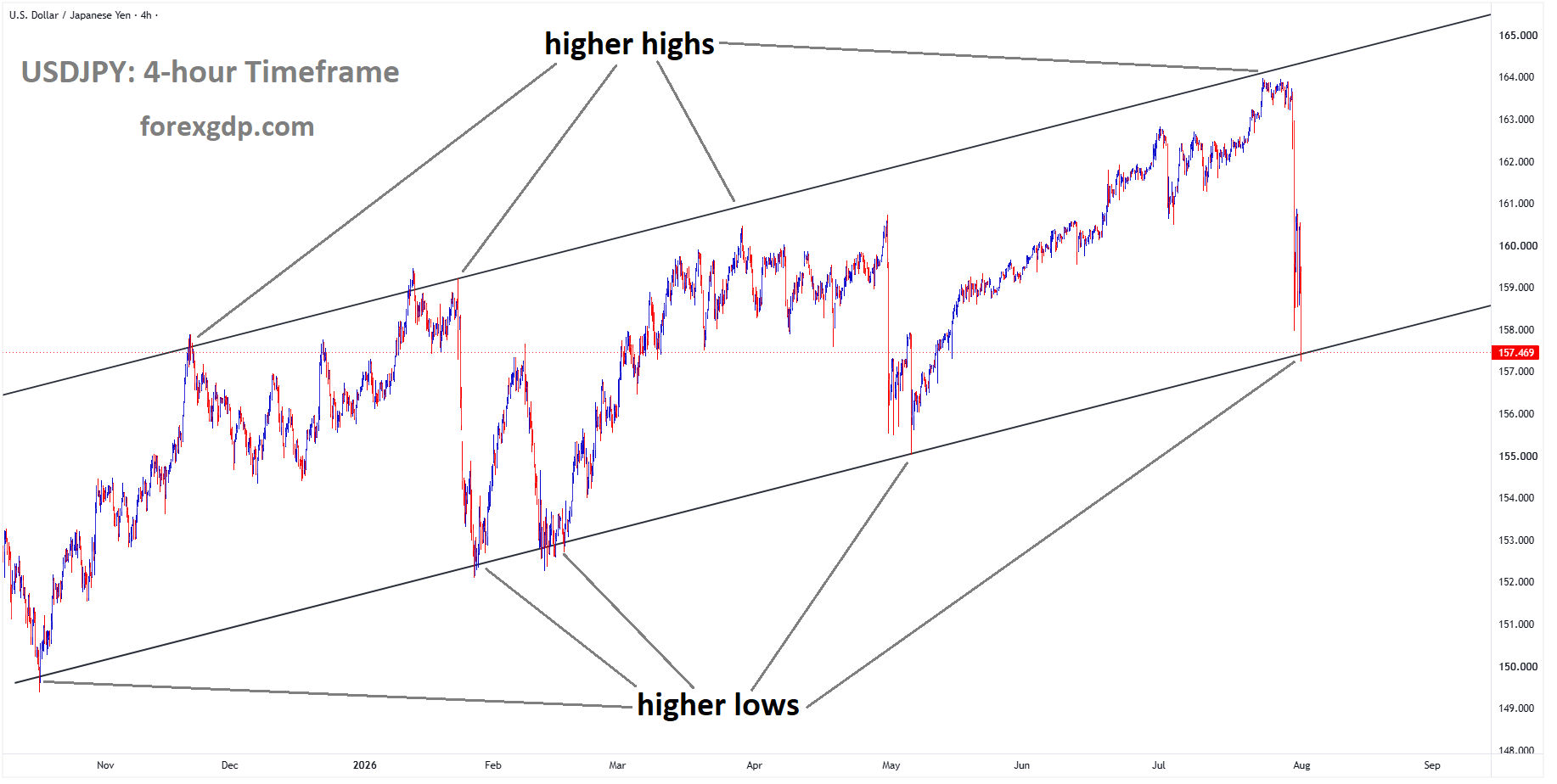
USDJPY reached the higher low area of the ascending channel
Even with the rebound, market sentiment remained cautious. Traders are still trying to understand the future direction of monetary policy in the United States, while Japan’s authorities continue to show growing concern about the weakness of the Yen.
US Dollar Finds Support but Faces Uncertainty
The US Dollar started the day on a stronger note after suffering a sharp decline a day earlier. Investors returned to the currency, helping it recover some of its recent losses. However, the rebound was limited because uncertainty surrounding the Federal Reserve’s next policy moves continues to weigh on overall confidence.
Markets are closely watching every signal from the US central bank. While policymakers have decided to leave interest rates unchanged for now, they have not provided a clear roadmap for future decisions. This has left investors uncertain about whether additional policy changes could come in the months ahead.
As a result, the US Dollar has struggled to build strong and lasting momentum, with traders remaining cautious before making larger positions.
Federal Reserve Keeps a Careful Approach
The latest Federal Reserve meeting delivered a message that was largely expected. Officials decided to leave borrowing costs unchanged while continuing to acknowledge that inflation risks remain.
At the same time, the central bank avoided giving clear forward guidance about its next steps. Instead of committing to future action, policymakers emphasized that upcoming economic data will continue to guide their decisions.
This balanced approach has created mixed reactions in financial markets. Some investors believe rates could remain steady for a longer period, while others expect future policy adjustments if inflation or economic conditions change significantly.
Because of this uncertainty, the US Dollar continues to experience periods of both strength and weakness as market expectations shift.
Japan Steps In to Support the Yen
One of the biggest developments affecting the Japanese Yen has been the intervention by Japan’s Ministry of Finance. Authorities entered the foreign exchange market in an effort to support the national currency after its prolonged weakness.
The move highlighted how seriously Japanese officials view the recent decline in the Yen. Government leaders have repeatedly expressed concerns that excessive currency weakness can create challenges for businesses, consumers, and the broader economy.
Analysts at Commerzbank noted that market conditions had already pointed toward possible official action. According to them, the intervention clearly demonstrated that Japanese authorities believed stronger measures were necessary to stabilize the currency.
The analysts also pointed out that the apparent support from the US Treasury added further confidence that Japan’s actions would receive a positive international response. Such cooperation between major economies can help strengthen market confidence during periods of heightened volatility.
Bank of Japan Maintains Hawkish Tone

Alongside the government’s intervention efforts, the Bank of Japan kept its monetary policy unchanged while maintaining a firm stance on inflation risks.
The central bank left its benchmark interest rate at its current level but continued to signal that inflation remains an important concern. Officials indicated that price pressures could remain stronger than previously expected, suggesting that they are prepared to respond if necessary.
This message reinforced the view that the Bank of Japan is carefully monitoring economic developments rather than becoming comfortable with current conditions.
Governor Kazuo Ueda also emphasized during his press conference that there is a possibility underlying inflation could move above the country’s long-term price stability objective. His comments suggested that policymakers remain alert and ready to act if inflation accelerates further.
Why Japan Is Watching the Currency So Closely
A weaker currency can have both advantages and disadvantages for an economy. While it may help exporters by making their products more competitive overseas, it can also increase the cost of imported goods, leading to higher expenses for businesses and households.
Japan has been paying close attention to these risks, especially as rising import costs can place additional pressure on consumers. By stepping into the market, officials are attempting to reduce excessive volatility rather than target a specific exchange rate.
Currency intervention is not used frequently, making each action significant. It often signals that policymakers believe market movements have become too rapid or disconnected from economic fundamentals.
Investors now understand that Japanese authorities are willing to take action again if necessary, adding another factor that traders must consider when evaluating the Yen.
Global Markets Continue to Watch Central Banks
The direction of USDJPY will continue to depend heavily on the decisions and communication from both the Federal Reserve and the Bank of Japan.
On the US side, investors remain focused on future inflation trends, employment data, and overall economic performance, all of which could influence the Federal Reserve’s next policy decisions.
Meanwhile, in Japan, market participants will closely monitor whether inflation continues to strengthen and whether policymakers see additional reasons to adjust their current approach.
Any new comments from central bank officials or unexpected government actions could quickly influence market sentiment and currency movements.
Summary
USDJPY recovered part of its recent losses as the US Dollar regained some strength, although uncertainty surrounding the Federal Reserve’s future policy path continued to limit the recovery. At the same time, Japan demonstrated its commitment to supporting the Yen through direct market intervention, highlighting official concerns about excessive currency weakness.
The Bank of Japan maintained its current interest rate while continuing to express concern over inflation risks, reinforcing its hawkish tone. With both the Federal Reserve and the Bank of Japan carefully balancing economic risks, investors are expected to remain highly focused on future policy signals and government actions that could shape the direction of the currency pair.
USDCHF Falls Back as Intervention Fears Weigh on the US Dollar
The USDCHF currency pair gave back part of its earlier gains on Friday as the US Dollar struggled to maintain its recovery. After showing signs of strength at the start of the session, the Greenback lost momentum once again as traders remained cautious about developments surrounding the Japanese Yen and the possibility of further government action in the currency market.
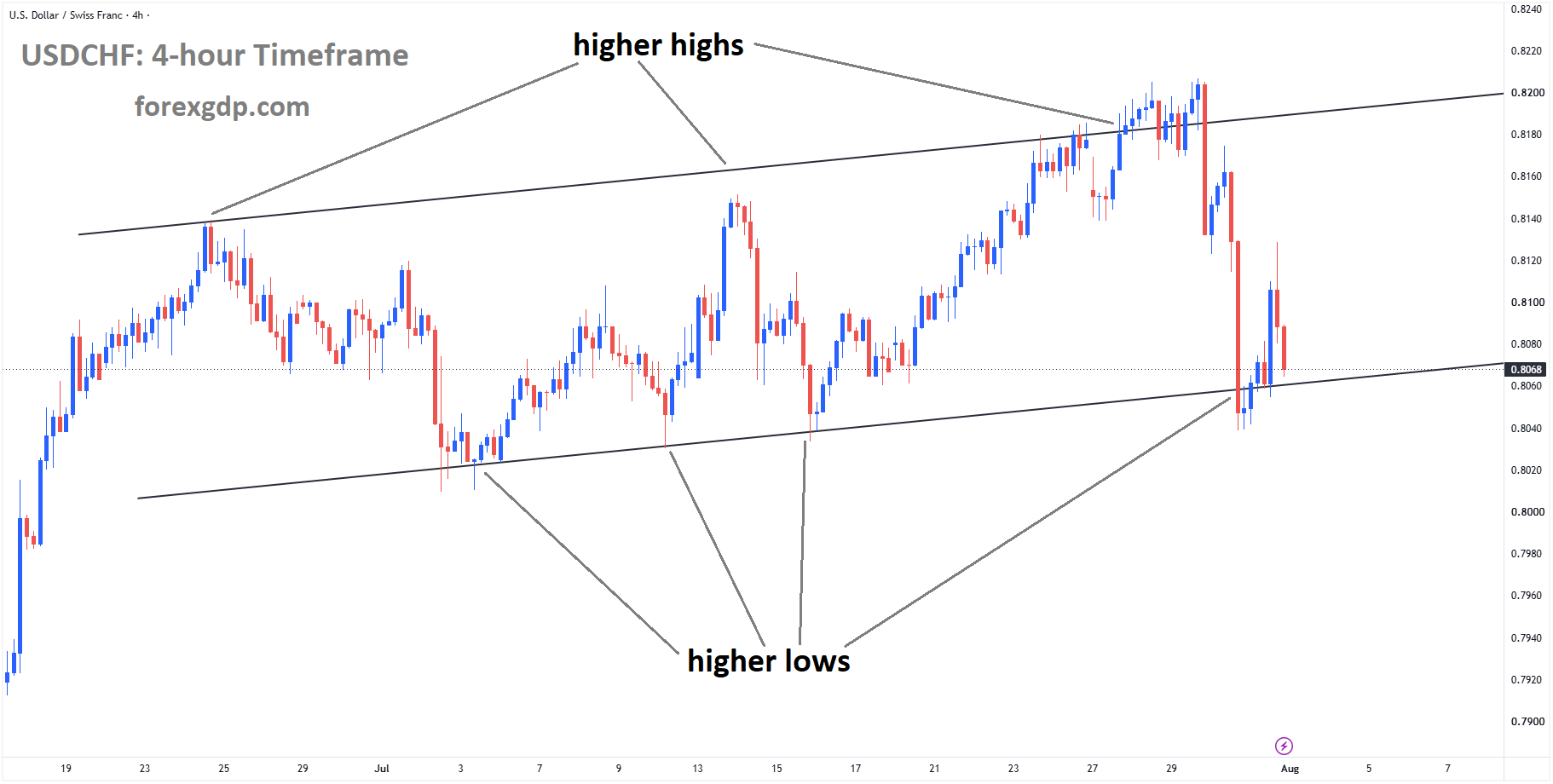
USDCHF reached the higher low area of the ascending channel
At the same time, investors shifted their attention toward important economic data from Switzerland, with the latest inflation report scheduled for release on Monday. The upcoming figures could provide fresh clues about the direction of Swiss monetary policy and influence the Swiss Franc in the days ahead.
US Dollar Recovery Loses Strength
The US Dollar entered Friday’s session attempting to recover after suffering heavy losses a day earlier. However, that rebound proved difficult to sustain as traders remained uncertain about the outlook for the currency.
Market sentiment weakened after reports suggested that Japanese authorities may have stepped into the foreign exchange market to support the Japanese Yen. Those reports increased speculation that governments could become more active in managing excessive currency movements, making investors more cautious about holding long US Dollar positions.
As a result, the Greenback struggled to build on its early recovery and gradually surrendered part of its gains during the trading session.
Intervention Concerns Continue to Pressure the Greenback
One of the biggest factors affecting the US Dollar has been speculation surrounding possible intervention in the currency market.
Reports indicated that the US Treasury had informed several financial institutions to remain prepared for possible future action related to the Japanese Yen. While no official intervention was confirmed, the news was enough to increase uncertainty across currency markets.
Whenever governments are believed to be considering intervention, traders often become more careful with their positions. The uncertainty can reduce confidence in the US Dollar and create additional volatility across major currency pairs, including USDCHF.
This cautious mood has limited the Greenback’s ability to recover despite its earlier attempts to regain lost ground.
Market Experts See a Softer Outlook for the Dollar
Several market analysts believe the US Dollar may face continued pressure in the coming months.
According to strategists at Brown Brothers Harriman, the strong rally that supported the US Dollar since May may now be losing momentum. They believe the positive impact from the resilience of the US economy is starting to fade as investors focus more on concerns surrounding future Federal Reserve policy.
Analysts also point to growing questions about whether the central bank is acting quickly enough to keep inflation under control. If inflation remains persistent while policy adjustments are delayed, investors may become less confident in the overall outlook for the US Dollar.
These concerns have contributed to a more cautious attitude toward the currency, even as economic conditions in the United States remain relatively stable.
Federal Reserve Officials Remain Divided
The latest Federal Reserve meeting highlighted ongoing differences among policymakers.
The central bank decided to leave interest rates unchanged for a fifth consecutive meeting. However, not everyone agreed with that decision. Several policymakers favored an immediate rate increase, showing that there is still significant debate within the Fed about the best approach to controlling inflation.
Dallas Federal Reserve President Lorie Logan was among those who preferred raising interest rates. She stated that taking modest action sooner could reduce the need for more aggressive policy moves later if inflation continues to remain elevated.
Her comments reinforced the view that some officials remain concerned about inflation risks despite the Fed’s decision to leave policy unchanged.
Markets Still Expect Further Fed Action
Although the Federal Reserve chose to keep interest rates unchanged, investors continue to believe another policy move remains possible later this year.
Market expectations suggest there is still a meaningful chance that the central bank could tighten monetary policy if inflation fails to ease or if economic data remains strong.
These expectations continue to influence currency markets, with every new economic report and speech from Federal Reserve officials receiving close attention from traders.
Future policy decisions will likely depend on incoming data, making each major economic release increasingly important for the direction of the US Dollar.
Swiss Inflation Data Becomes the Next Key Event

Attention is now turning toward Switzerland, where the latest Consumer Price Index (CPI) report is scheduled for release on Monday.
Inflation has remained relatively low in Switzerland in recent months, staying near the lower end of the Swiss National Bank’s target range. This has strengthened expectations that the central bank may continue maintaining its current interest rate policy.
If the upcoming inflation figures remain subdued, investors may see little reason for the Swiss National Bank to change its monetary policy in the near future.
However, any unexpected increase or decrease in inflation could quickly change market expectations and influence the performance of the Swiss Franc against major currencies.
What Traders Will Watch Next
The next few trading sessions could be driven by several important developments.
Investors will closely monitor any fresh comments from Federal Reserve officials for clues about future interest rate decisions. They will also remain alert for any new developments related to possible government intervention in currency markets, particularly involving the Japanese Yen.
At the same time, Switzerland’s inflation report will provide valuable insight into domestic price pressures and the likely path of Swiss monetary policy.
With multiple economic and policy-related factors influencing sentiment, traders are expected to remain cautious until greater clarity emerges.
Summary
USDCHF lost part of its earlier strength as the US Dollar struggled to extend its recovery following recent selling pressure. Concerns over possible intervention in the Japanese Yen market, along with uncertainty surrounding future Federal Reserve policy, continue to weigh on the Greenback.
Meanwhile, attention is shifting toward Switzerland’s upcoming inflation data, which could shape expectations for the Swiss National Bank’s next policy decisions. As investors evaluate central bank signals, government actions, and fresh economic data, USDCHF may continue to experience changing market sentiment in the sessions ahead.
USDCAD Advances as Fed Rate Outlook Lifts US Dollar Over Loonie
The USD/CAD currency pair moved higher on Friday after recovering from its lowest level in nearly two weeks. Even though Canada’s latest economic data showed another month of healthy growth, the Canadian Dollar was unable to hold on to its earlier gains. Instead, the US Dollar regained strength as investors continued to focus on expectations that the US Federal Reserve could maintain a tighter monetary policy for longer.
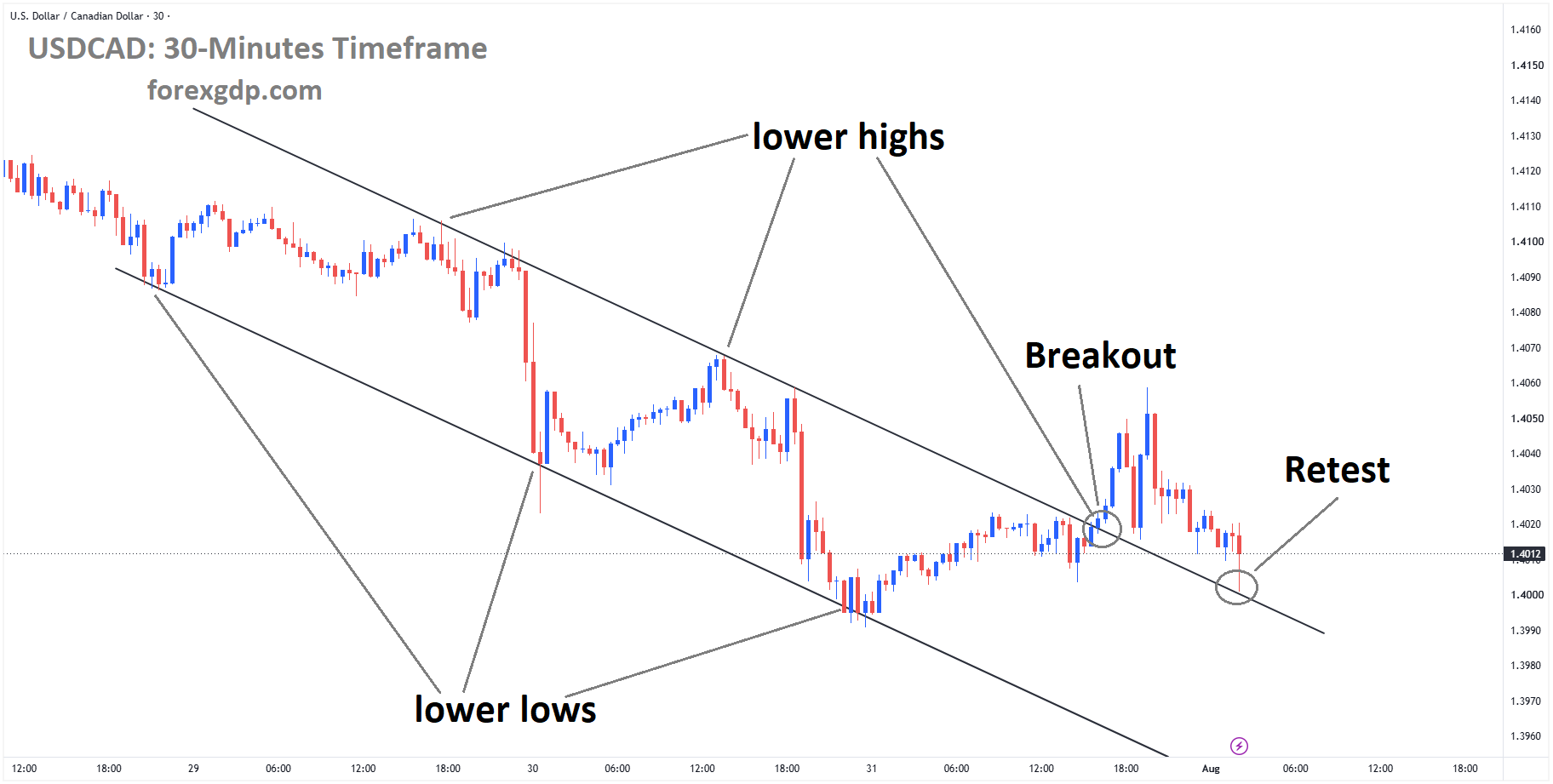
USDCAD reached the retest area of the broken descending channel
The latest movement highlights how currency markets often react not only to economic data but also to changing expectations about future interest rate decisions. While Canada’s economy continues to show resilience, concerns about inflation and the outlook for US monetary policy remain major drivers for the US Dollar.
Canada’s Economy Continues to Show Positive Momentum
Canada released encouraging economic data that pointed to another month of steady expansion. According to Statistics Canada, the country’s economy grew by 0.3% in May, matching market expectations and marking the second straight month of growth.
This followed an even stronger performance in April, which was revised higher from earlier estimates. The continued improvement suggests that the Canadian economy has been able to maintain a stable pace despite ongoing global economic challenges.
One of the most encouraging aspects of the report was that growth was spread across many parts of the economy rather than being driven by a single industry. Both goods-producing businesses and service-related sectors contributed to the expansion, showing that economic activity remained broad-based.
Out of 20 major industries, 13 recorded growth during the month. This balanced performance reflects healthy demand across different sectors and provides additional confidence in Canada’s overall economic outlook.
Strong Canadian Data Fails to Lift the Loonie for Long
Although the economic figures initially supported the Canadian Dollar, the positive impact did not last very long. Investors quickly shifted their attention back to developments in the United States, where expectations surrounding Federal Reserve policy continued to dominate market sentiment.
This shows that strong domestic economic reports do not always translate into lasting currency gains. When markets believe another country’s central bank could maintain higher interest rates for a longer period, those expectations often have a stronger influence on exchange rates.
As a result, the Canadian Dollar gave back its early gains, allowing the US Dollar to recover after its recent weakness.
Federal Reserve Expectations Continue to Support the US Dollar
One of the biggest reasons behind the renewed strength of the US Dollar is the growing belief that the Federal Reserve may not be finished with its efforts to control inflation.
Although the central bank recently decided to leave interest rates unchanged, policymakers have continued to emphasize that inflation remains a key concern. Their primary goal is to bring price growth under control while keeping the broader economy stable.
Federal Reserve Chair Kevin Warsh recently reaffirmed the bank’s commitment to restoring price stability. His comments reinforced the message that officials remain prepared to take additional action if inflation continues to stay above desired levels.
Adding to this outlook, several Federal Reserve policymakers supported raising interest rates immediately during the latest policy meeting, showing that opinions within the central bank remain divided but generally focused on fighting inflation.
Because of these signals, many investors believe the Federal Reserve could still introduce another rate increase in the coming months if economic conditions justify further tightening.
Global Risks Continue to Keep Inflation in Focus

Beyond central bank communication, several global developments are also influencing investor expectations.
Energy markets have experienced increased volatility in recent weeks, creating fresh uncertainty about future inflation trends. Sharp swings in energy costs can affect transportation, manufacturing, and consumer spending, making inflation more difficult to control.
At the same time, geopolitical tensions in the Middle East continue to add another layer of uncertainty to global markets. Whenever political conflicts threaten energy supplies or international trade, investors often become more cautious about future inflation risks.
These concerns have strengthened the belief that central banks, particularly the Federal Reserve, may need to keep monetary policy restrictive until inflation shows clearer signs of returning to target levels.
Markets Await More US Economic Signals
With Canada’s latest growth figures already released, investor attention is now shifting toward several important economic reports from the United States.
Among the most closely watched releases is the final University of Michigan Consumer Sentiment survey. This report provides valuable insight into how consumers feel about the economy, their personal finances, and future spending plans.
Markets will also closely monitor consumer expectations and both short-term and long-term inflation expectations. These indicators offer clues about whether households believe prices will continue rising, an important factor that central banks watch when making future policy decisions.
If upcoming reports suggest that inflation pressures remain persistent or that consumer confidence stays strong, expectations for continued restrictive monetary policy could remain in place. On the other hand, softer economic data could reduce expectations for additional policy tightening.
What Investors Are Watching Next
The coming days could play an important role in shaping market sentiment. While Canada’s economy has shown encouraging resilience, traders remain focused on whether the Federal Reserve will continue its inflation-fighting stance.
Future economic reports from both countries will likely determine whether the recent recovery in the US Dollar can continue or whether the Canadian Dollar finds renewed support from improving domestic conditions.
For now, investors are carefully balancing strong Canadian economic performance against the possibility of tighter US monetary policy, making upcoming data releases especially important for market direction.
Summary
USD/CAD recovered after briefly falling to its lowest level in two weeks, even as Canada’s economy posted another month of steady growth. Broad-based expansion across multiple industries highlighted the strength of the Canadian economy, but the Canadian Dollar struggled to maintain its gains.
The main driver behind the US Dollar’s recovery remains expectations that the Federal Reserve could keep monetary policy restrictive for longer as inflation concerns persist. Global energy uncertainty and geopolitical tensions have added further support to that outlook.
Attention now turns to upcoming US consumer confidence and inflation expectation reports, which could provide fresh insight into the Federal Reserve’s next policy decisions and influence the direction of the US Dollar in the days ahead.
AUDUSD Keeps Its Footing Despite Disappointing Economic Signals from China
The Australian Dollar remained under pressure against the US Dollar on Friday, giving back part of its recent gains after reaching its strongest level in several weeks. While stronger inflation-related data from Australia offered some support, disappointing economic reports from China and fresh comments from a US Federal Reserve official shifted market sentiment in favor of the US Dollar.
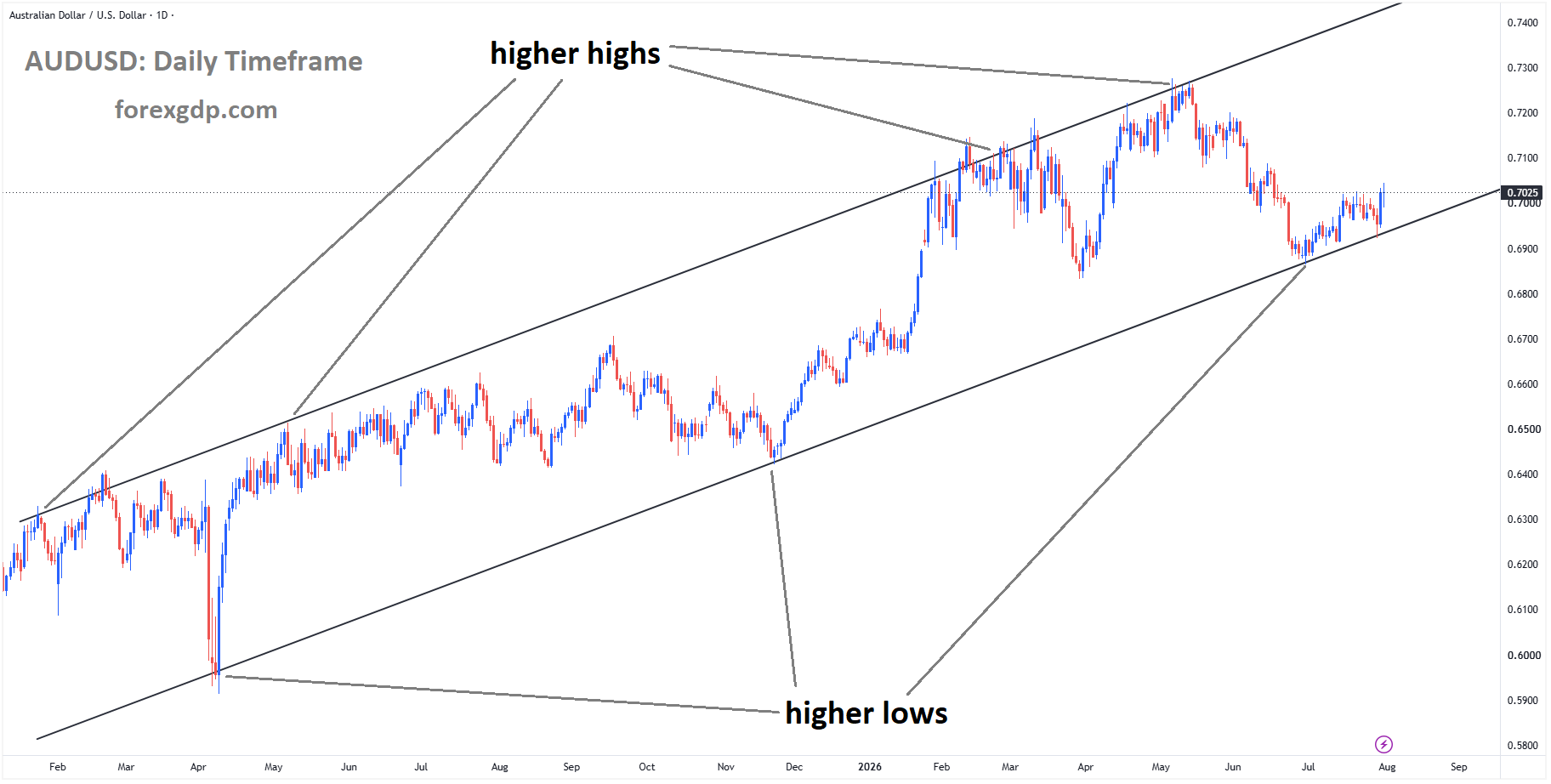
AUDUSD reached a higher low area of the ascending channel
China’s latest business activity figures raised concerns about slowing economic growth, which weighed on the Australian Dollar due to the close trade relationship between the two countries. At the same time, the US Dollar gained momentum after a senior Federal Reserve policymaker signaled that inflation remains a major concern and that tighter monetary policy could still be necessary.
Australian Dollar Loses Momentum After Recent Gains
The Australian Dollar started the session on a weaker note after failing to hold onto its recent upward momentum. Although the currency had climbed to a multi-week high earlier, selling pressure increased as investors reacted to weaker economic news from China.
Australia’s economy is closely linked to China’s demand for goods and raw materials. When China’s economic outlook weakens, investors often become more cautious about the Australian Dollar because reduced Chinese demand can affect Australia’s exports and overall economic performance.
As a result, even positive domestic developments were not enough to keep the Australian Dollar moving higher.
China’s Business Activity Slows More Than Expected
One of the biggest drivers behind the Australian Dollar’s decline was the release of China’s latest Purchasing Managers’ Index (PMI) reports.
According to China’s National Bureau of Statistics, both the Manufacturing and Non-Manufacturing PMI readings fell below market expectations. The manufacturing sector slipped back into contraction, while activity in the services and broader non-manufacturing sectors also weakened.
These figures suggest that business conditions across China’s economy have slowed, raising fresh concerns about future growth. Since China is Australia’s largest trading partner, any slowdown in Chinese economic activity can directly affect Australia’s export demand.
For investors, weaker Chinese data often translates into lower confidence in the Australian Dollar, making it more difficult for the currency to attract buying interest.
Australian Inflation Signals Remain Firm
Despite the pressure from overseas developments, Australia’s latest inflation-related data provided some encouraging signs for the domestic economy.

The country’s Producer Price Index (PPI), which measures changes in prices received by producers, increased at a faster annual pace during the second quarter. This indicates that price pressures remain present across parts of the economy.
Producer inflation is closely watched because it can eventually influence consumer prices. Higher production costs may be passed on to businesses and households over time, keeping inflation elevated.
The stronger PPI reading suggests inflation pressures have not disappeared completely. However, the positive data had only a limited impact because investors were more focused on the weaker outlook coming from China and the stronger performance of the US Dollar.
US Dollar Finds Fresh Support
The US Dollar strengthened during the session after comments from Dallas Federal Reserve President Lorie Logan reinforced expectations that inflation remains a top priority for US policymakers.
Logan stated that inflation is still running above the Federal Reserve’s long-term objective and argued that current monetary policy may not be restrictive enough to fully control price pressures.
Her remarks reminded investors that the fight against inflation is not over, increasing confidence in the US Dollar.
Whenever Federal Reserve officials express concern about persistent inflation, markets often expect interest rates to remain higher for longer. That expectation generally provides support for the US currency.
Federal Reserve Keeps Inflation in Focus
Lorie Logan also explained that inflation risks continue to lean to the upside, meaning she believes prices could remain stubbornly high unless further policy action is taken.
She said she would have preferred a modest interest rate increase, arguing that taking smaller steps early could reduce the need for larger policy moves in the future.
These comments highlight the Federal Reserve’s ongoing commitment to bringing inflation back toward its target. Even though policymakers continue to evaluate incoming economic data, Logan’s remarks suggest that caution remains necessary before declaring victory over inflation.
Her hawkish tone strengthened investor demand for the US Dollar, placing additional pressure on currencies such as the Australian Dollar.
Global Growth Concerns Influence Currency Markets
The latest developments demonstrate how global economic conditions continue to shape movements in major currencies.
The Australian Dollar is particularly sensitive to changes in global growth expectations because Australia’s economy depends heavily on international trade, especially with China.
When Chinese business activity weakens, investors often become more defensive, reducing exposure to growth-linked currencies. Meanwhile, the US Dollar frequently benefits during periods of uncertainty because it is viewed as a relatively stable currency.
This combination of weaker Chinese economic data and stronger US Dollar demand created a challenging environment for the Australian Dollar despite encouraging domestic inflation figures.
Investors Await More Economic Clues
Looking ahead, market participants will continue watching incoming economic reports from both Australia and China to assess whether recent weakness is temporary or part of a broader slowdown.
Investors will also pay close attention to future comments from Federal Reserve officials for any clues about the direction of US monetary policy. Inflation, employment, and overall economic performance will remain key factors influencing expectations.
If inflation remains persistent, policymakers could continue maintaining a cautious stance, which may keep supporting the US Dollar. At the same time, improvements in Chinese economic activity would likely be welcomed by Australian Dollar investors.
Summary
The Australian Dollar eased from its recent highs as disappointing Chinese business activity data overshadowed stronger inflation signals from Australia. Weak economic readings from China’s manufacturing and non-manufacturing sectors renewed concerns about slowing growth, reducing demand for the Australia-linked currency.
Meanwhile, the US Dollar received fresh support after Dallas Federal Reserve President Lorie Logan emphasized that inflation remains above target and that additional policy tightening could still be appropriate. With investors balancing global growth concerns against central bank expectations, both Chinese economic performance and future Federal Reserve guidance are likely to remain key influences on the AUDUSD pair.
NZDUSD Extends Losses as China’s Economic Slowdown Dampens Kiwi Demand
The New Zealand Dollar weakened against the US Dollar on Friday as investors reacted to disappointing economic data from China and renewed strength in the US Dollar. Since China is New Zealand’s biggest trading partner, any signs of slower growth in the Chinese economy often have a direct impact on the Kiwi.
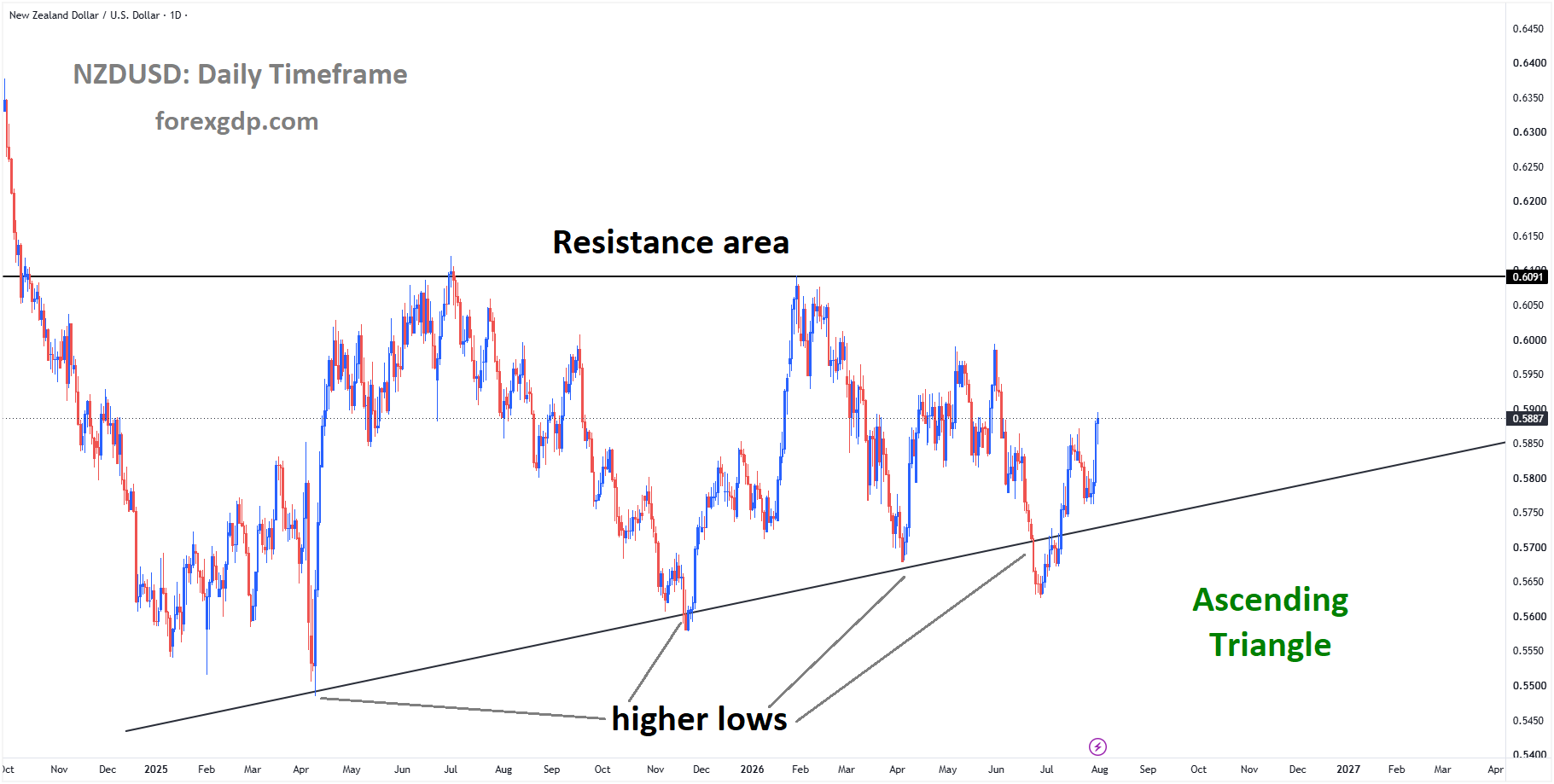
NZDUSD is moving in an ascending triangle pattern, and the market has rebounded from the higher low area of the pattern
Although New Zealand released encouraging consumer confidence figures, the positive domestic news was not enough to offset growing concerns about China’s economic slowdown. At the same time, investors continued to support the US Dollar as expectations remained that the Federal Reserve could keep interest rates higher for a longer period.
China’s Weak Business Activity Hurts the New Zealand Dollar
The biggest factor weighing on the New Zealand Dollar was the latest economic data from China. Fresh reports showed that business activity slowed more than expected during July, raising concerns about the strength of the world’s second-largest economy.
China’s official Manufacturing Purchasing Managers Index slipped below the level that separates expansion from contraction, suggesting factory activity weakened during the month. The Non-Manufacturing PMI also moved lower, showing that service industries and other business sectors faced slower growth as well.
These figures point to broader challenges across the Chinese economy. Slower manufacturing, weaker business confidence, and softer demand have increased worries that economic growth may remain under pressure in the coming months.
For New Zealand, this matters because China is its largest export destination. A slowdown in Chinese demand can reduce the need for New Zealand’s agricultural products and other exports, making the New Zealand Dollar less attractive to investors.
Improving Consumer Confidence Offers Some Support
Despite the pressure from overseas developments, New Zealand’s domestic economy delivered a more encouraging signal.
The latest ANZ-Roy Morgan Consumer Confidence Index climbed noticeably during July, reaching its highest level since February. The improvement suggests households are becoming more optimistic about the country’s economic outlook.
Consumers also reported stronger expectations for both the short-term and long-term economy. Confidence over the next year improved, while expectations for the next five years also moved higher.
Higher consumer confidence is often viewed as a positive sign because optimistic households are generally more willing to spend money, invest, and support economic growth. If confidence continues to improve, it could eventually strengthen business activity and support the broader economy.
However, global market sentiment had a much greater influence on trading during the session, leaving the positive local data largely ignored.
US Dollar Recovers as Fed Outlook Remains Firm
While the New Zealand Dollar faced pressure, the US Dollar gained strength as investors continued to evaluate the Federal Reserve’s next policy move.
Financial markets still believe the US central bank could maintain restrictive monetary policy for a longer period if inflation remains above its target. Although future decisions will depend on incoming economic data, expectations for another interest rate increase have not completely disappeared.
This outlook has continued to provide support for the US Dollar, as higher interest rates generally increase the appeal of US financial assets for global investors.
The belief that borrowing costs could stay elevated has helped the Greenback recover after recent periods of weakness.
US Consumer Sentiment Shows Further Improvement

Additional support for the US Dollar came from stronger consumer sentiment data.
The final reading of the University of Michigan Consumer Sentiment Index for July was revised higher compared with the preliminary estimate. This suggests American consumers were feeling slightly more optimistic about economic conditions than initially reported.
The Consumer Expectations Index also improved, indicating households held a better view of future economic conditions.
Meanwhile, inflation expectations remained unchanged over both the one-year and five-year outlooks. Stable inflation expectations are closely watched because they provide insight into how consumers view future price pressures.
The combination of stronger consumer confidence and stable inflation expectations reinforced the view that the US economy continues to show resilience despite higher borrowing costs.
Global Economic Outlook Remains a Key Driver
Currency markets remain highly sensitive to changes in global economic conditions, particularly developments in China and the United States.
China’s economy plays a major role in supporting demand for commodities and exports from countries such as New Zealand. Whenever Chinese economic data disappoints, currencies linked to global growth often come under pressure.
At the same time, the US Dollar continues to respond to expectations surrounding Federal Reserve policy. Investors closely monitor economic indicators that may influence future decisions on interest rates.
As these two major economies continue to shape global financial markets, currencies like the New Zealand Dollar are likely to remain influenced by both international trade developments and changing investor sentiment.
Investors Stay Focused on Upcoming Economic Signals
Looking ahead, traders will continue monitoring economic releases from both China and the United States for fresh clues about the global economy.
Any signs that China’s economic activity is stabilizing could improve confidence in export-driven economies such as New Zealand. On the other hand, continued weakness may keep pressure on the Kiwi.
Meanwhile, upcoming US economic reports will remain important as investors assess whether the Federal Reserve will maintain its firm policy stance. Strong economic data could continue supporting the US Dollar, while softer figures may lead markets to reconsider expectations.
Summary
The New Zealand Dollar weakened after disappointing Chinese business activity data raised fresh concerns about economic growth in New Zealand’s largest trading partner. Although consumer confidence in New Zealand improved to its highest level in several months, the positive domestic news was overshadowed by worries about China’s slowing economy.
At the same time, the US Dollar strengthened as investors continued to expect the Federal Reserve to maintain a restrictive monetary policy stance. Better US consumer sentiment data and steady inflation expectations further supported confidence in the American economy, keeping attention focused on future economic developments in both China and the United States.
EURGBP Falls as Sterling Gains Momentum After BoE Policy Signals
The EURGBP currency pair moved lower on Friday, giving back part of the gains recorded earlier in the week. The Euro weakened against the British Pound after the release of the latest inflation figures from the Eurozone, while the Pound continued to receive support from the Bank of England’s latest policy message.
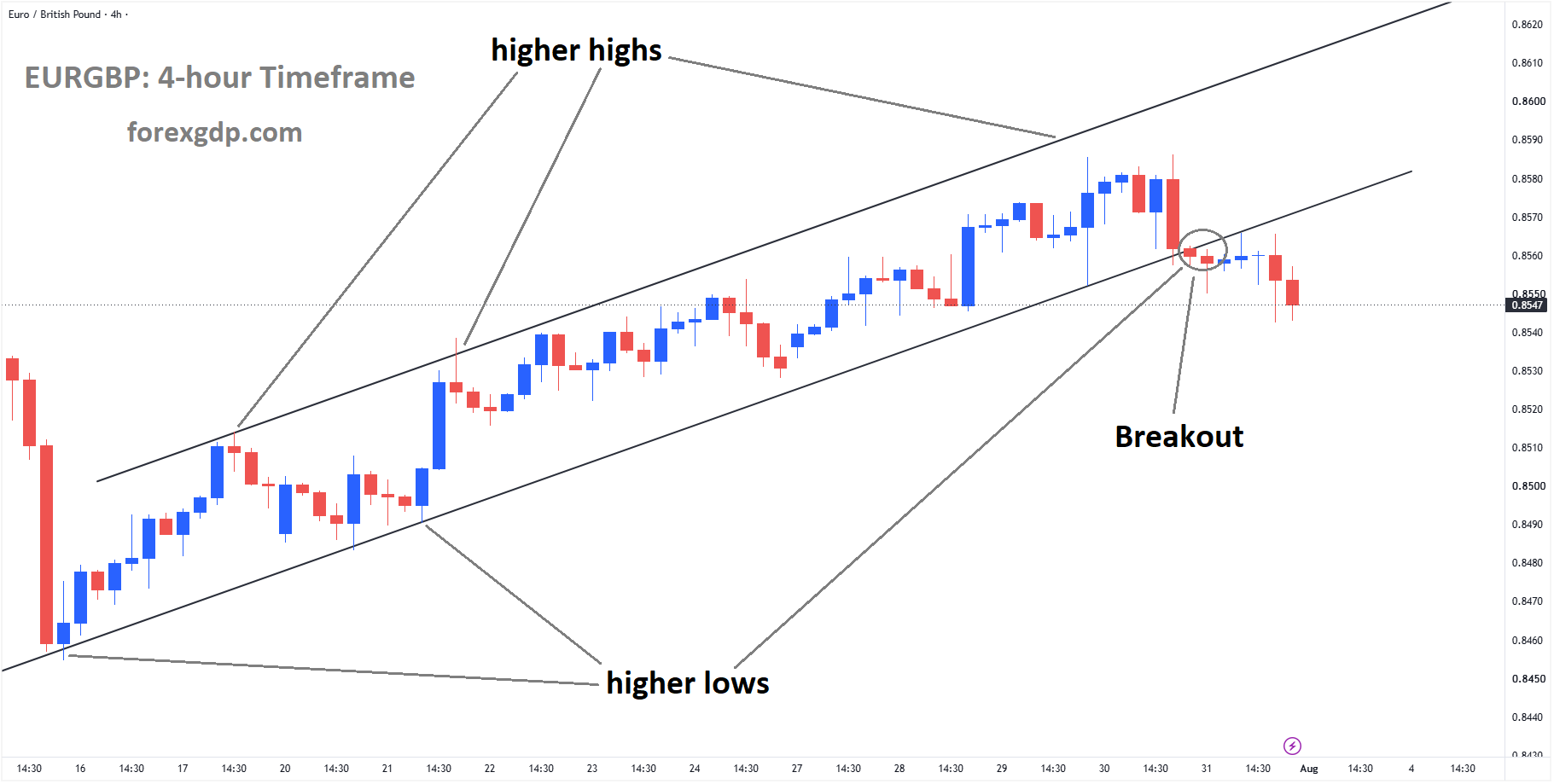
EURGBP has broken the ascending channel to the downside
Although the pair pulled back during the day, it still remained on track to end the week with a modest gain. Investors carefully assessed fresh economic reports from across Europe while also considering what central banks could do in the coming months.
Eurozone Inflation Moves Higher in July
The latest preliminary inflation report from the Eurozone showed that consumer prices continued to increase during July. Annual inflation rose slightly compared with the previous month, matching what economists had expected.
On a monthly basis, inflation also returned to positive territory after declining in June. This suggests that price pressures across the region remain persistent, even though the pace of inflation has eased significantly from the extremely high levels seen over the past few years.
Inflation remains one of the most important indicators for financial markets because it plays a major role in shaping central bank decisions. If price growth remains stronger than expected, policymakers may become more cautious about easing monetary policy too quickly.
Core Inflation Also Shows Strength
Another closely watched measure is core inflation, which excludes more volatile items such as food and energy. This measure is often viewed as a better reflection of underlying price trends within the economy.
The latest figures showed that core inflation increased slightly instead of remaining unchanged, as many analysts had predicted. This indicates that price pressures are still present across several sectors of the economy.
While the increase was not dramatic, it reinforces the view that inflation remains an issue the European Central Bank will continue to monitor carefully in the months ahead.
Mixed Economic Data Paints a Complicated Picture
Despite the stronger inflation numbers, other economic reports from the Eurozone presented a more mixed outlook.
France delivered an upside surprise, with annual inflation rising more than economists had expected. The stronger reading suggested that consumer prices remain elevated in one of the region’s largest economies.
However, Germany released less encouraging employment data. The country’s unemployment rate increased slightly, and the number of unemployed workers also rose after improving in the previous month.
Germany is the largest economy in the Eurozone, so any signs of weakness in its labor market often attract significant attention. A softer employment picture can raise concerns about economic growth and consumer spending in the region.
The combination of higher inflation and slowing labor market conditions creates a difficult balancing act for policymakers. On one hand, inflation remains above desired levels. On the other, weaker economic activity may argue against keeping monetary policy restrictive for too long.
Pound Gains Support from the Bank of England

While the Euro struggled to build momentum, the British Pound benefited from renewed optimism following the Bank of England’s latest monetary policy meeting.
As widely expected, the central bank decided to leave interest rates unchanged. The decision itself did not surprise investors, but several details from the meeting helped strengthen the Pound.
Some policymakers continued to argue in favor of a tighter monetary stance, showing that opinions within the committee remain divided. This suggested that the central bank is not yet ready to completely rule out additional policy tightening if inflation risks increase again.
These differing views encouraged investors to reassess expectations for future monetary policy, providing additional support for the British currency.
Governor Bailey Leaves the Door Open
Bank of England Governor Andrew Bailey also attracted attention with comments regarding future inflation risks.
He indicated that policymakers remain prepared to respond if external events lead to renewed price pressures. In particular, concerns surrounding tensions in the Middle East and their potential impact on global energy markets remain an important factor.
Higher energy costs could push inflation upward again, forcing central banks to maintain tighter policies for longer than previously expected.
These remarks signaled that the Bank of England remains alert and willing to act if necessary, helping improve confidence in the Pound.
Markets Focus on Future Central Bank Decisions
Financial markets are now shifting their attention toward what both the European Central Bank and the Bank of England may do over the coming months.
Although inflation has generally moved lower compared with previous years, policymakers continue to face uncertainty. Economic growth has slowed in several countries, yet inflation has not completely disappeared.
This creates a challenging environment where central banks must carefully balance supporting economic activity while ensuring inflation continues moving toward their long-term targets.
Every major economic report, including inflation, employment, and consumer spending, will likely play an important role in shaping expectations for future policy decisions.
Investors Remain Cautious
Currency markets continue to react quickly to new economic information as traders weigh the relative strength of different economies.
The Euro received some support from stronger inflation figures, but weaker labor market data from Germany limited enthusiasm. Meanwhile, the British Pound benefited from a more confident outlook surrounding the Bank of England after policymakers signaled they remain prepared to respond if inflation risks increase again.
With uncertainty surrounding global growth, inflation, and geopolitical developments, investors are likely to remain cautious while waiting for additional economic reports and central bank guidance.
Summary
The Euro lost ground against the British Pound after the latest Eurozone inflation report, despite consumer prices showing a modest increase during July. Stronger core inflation suggested that underlying price pressures remain present, but mixed economic data, including weaker German employment figures, limited support for the common currency.
At the same time, the British Pound found fresh strength following the Bank of England’s latest policy meeting. The central bank’s cautious stance, along with comments highlighting the possibility of future policy tightening if inflation risks return, helped improve confidence in the UK currency. Going forward, investors will closely monitor upcoming economic data and central bank signals for further clues about the direction of monetary policy in both Europe and the United Kingdom.