XAUUSD Springs Back as Falling Oil Softens Fed Pressure
Gold regained positive momentum at the end of the week, even after the Federal Reserve raised interest rates. The precious metal received support from softer Oil prices, cautious market sentiment, and growing geopolitical concerns in the Middle East.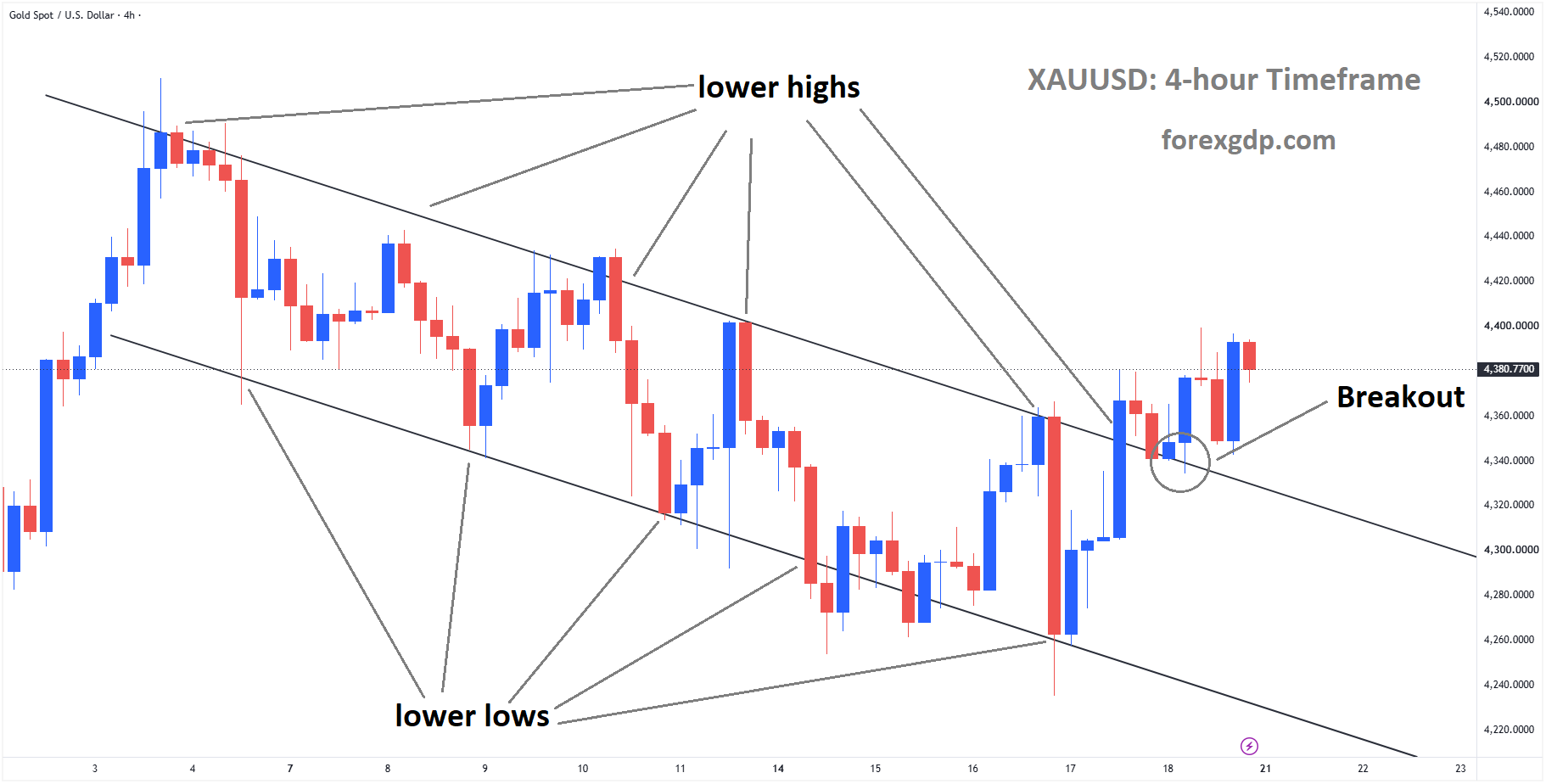
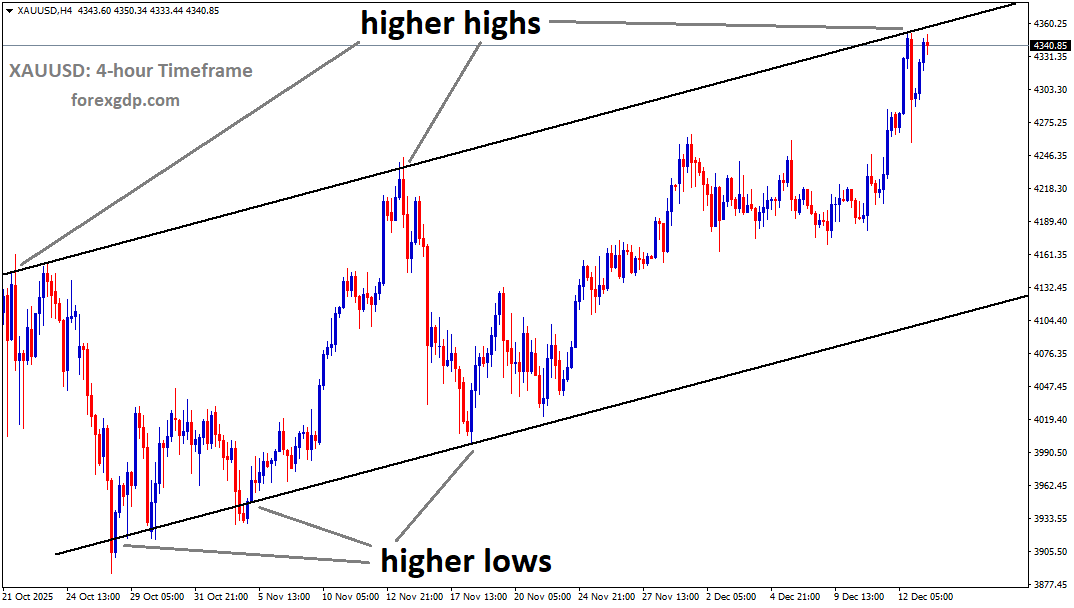
XAUUSD has broken the descending channel to the upside
However, Gold’s recovery remains partly limited by rising US Treasury yields. Investors are also watching the possibility of another Federal Reserve rate increase at its next meeting. Comments from Fed officials, upcoming employment figures, and fresh business activity data could play an important role in deciding Gold’s next direction.
Gold Finds Support Despite the Fed’s Rate Increase
Gold faced strong selling pressure earlier in the week after the Federal Reserve announced its first interest rate increase in three years. Higher interest rates usually create challenges for Gold because the metal does not provide regular interest income. When returns from government bonds rise, some investors may prefer those assets over precious metals.
Still, Gold managed to recover as the week progressed. This shows that investors are considering more than monetary policy alone. Concerns about global uncertainty, energy supplies, and economic growth are continuing to support demand for safe-haven assets.
The Federal Reserve approved the latest rate increase through a unanimous decision. This suggests that policymakers broadly agree that inflation remains a serious concern. The central bank continues to focus on returning inflation to its long-term target, even while the wider economy appears resilient.
Fed Chair Kevin Warsh said the strength of the US economy helped justify the decision. A healthy economy gives the central bank more room to keep borrowing costs elevated without creating immediate fears of a sharp slowdown.
Middle East Tensions Increase Safe-Haven Demand
Growing conflict in the Middle East has weakened investor confidence. The United States and Iran have reportedly exchanged attacks in the Persian Gulf, while fighting involving the Houthis and Saudi Arabia has affected conditions around the Red Sea.
These developments have raised fresh concerns about the security of important trade and energy routes. The Red Sea and Persian Gulf play a major role in global shipping. Any serious disruption in these areas can create uncertainty for businesses, energy markets, and international supply chains.
The Houthis, an Iran-backed group based in Yemen, reportedly attacked Saudi Arabia’s East-West Oil pipeline. Reports suggested that the incident forced the pipeline to stop operating temporarily and could delay some Oil deliveries to Europe. Saudi Aramco had not officially confirmed the report, leaving traders cautious about the true scale of the disruption.
Gold often benefits when geopolitical risks increase because investors view it as a store of value during uncertain periods. The metal can attract buyers when confidence in financial markets weakens or when conflict threatens global trade.
However, market reactions to geopolitical developments can change quickly. Investors will continue to monitor official statements, further military activity, and any disruption to energy exports.
Softer Oil Prices Keep the US Dollar Under Control

Despite concerns about possible supply shortages, Oil remained relatively weak. That weakness helped limit the strength of the US Dollar and created some breathing room for Gold.
Energy prices can influence inflation expectations. A major rise in Oil costs could increase pressure on consumers and businesses, potentially encouraging the Federal Reserve to maintain a stricter policy stance. Softer Oil prices reduce some of that immediate inflation concern.
The connection between Oil, the US Dollar, and Gold is not always straightforward. Still, a restrained Dollar generally makes Gold more attractive to international buyers who use other currencies. This relationship helped Gold recover from the pressure caused by the Fed’s latest decision.
The Dollar remained mostly stable against a group of major currencies. Traders appeared reluctant to push it strongly higher while assessing mixed economic data, developments in the energy market, and the possibility of another rate increase.
Rising Treasury Yields Restrict Gold’s Recovery
While weaker Oil provided support, rising US Treasury yields remained an important obstacle for Gold. Long-term government borrowing costs moved close to a significant psychological level after the Federal Reserve’s decision.
Higher bond yields increase the potential income available from government debt. This can reduce the appeal of holding Gold, which does not pay interest or dividends. As a result, bullion may struggle to maintain strong advances when Treasury returns rise sharply.
The recent rise in yields reflects expectations that US interest rates could remain elevated. The Federal Reserve’s updated projections suggested that many officials expect at least one more increase.
Markets are now assessing whether policymakers will act again at the October meeting. The possibility remains meaningful, but the decision will depend heavily on inflation, employment, consumer activity, and broader economic conditions.
Economic Data Sends a Mixed Message
Recent US industrial production figures offered a weaker signal about economic activity. Output remained unchanged over the measured period, missing expectations for growth and slowing from the previous month’s performance.
This result suggests that some parts of the economy may be losing momentum. If future data shows a broader slowdown, the Federal Reserve may become more cautious about raising rates again. That could reduce pressure on Gold.
However, one disappointing report is unlikely to change the policy outlook on its own. The Fed will examine a wide range of information before making its next decision. Inflation remains above the central bank’s preferred level, while the overall economy continues to show resilience.
Kansas City Fed President Jeffrey Schmid supported the latest rate increase. He noted that inflation remains elevated but said the economy continues to perform well after adjusting for price pressures. His comments reinforced the view that some officials remain comfortable with tighter monetary policy.
Global Central Banks Keep Markets Alert
The Federal Reserve was not the only major central bank influencing investor sentiment. The Bank of England kept interest rates unchanged, indicating a more cautious approach toward future policy changes.
Meanwhile, the Bank of Japan increased borrowing costs. The decision marked another important step in Japan’s move away from its long period of extremely loose monetary policy.
Different approaches from major central banks can influence global currency flows and investor demand for safe assets. If policy differences become wider, financial markets may experience greater volatility. Such an environment can support Gold, although the impact of a firm US Dollar and elevated bond yields may continue to limit its progress.
Fed Speakers and US Data Take Centre Stage
The coming week could provide greater clarity about the Federal Reserve’s next move. Several Fed officials are scheduled to speak, giving investors an opportunity to assess how strongly policymakers support another rate increase.
Employment data will also receive close attention. Strong job creation and stable wage growth could strengthen the case for further tightening. Weaker labour market figures could encourage officials to wait and examine more evidence.
Flash business activity reports and durable goods orders will offer additional information about demand, production, and corporate confidence. Together, these releases may influence expectations for economic growth and monetary policy.
Gold could remain sensitive to every major update. A softer Dollar, lower Treasury yields, or signs of slower economic activity may provide support. In contrast, strong data and firm comments from Fed officials could renew pressure on the metal.
Final Summary
Gold recovered despite the Federal Reserve’s rate increase as weaker Oil prices restrained the US Dollar and geopolitical tensions encouraged safe-haven demand. However, elevated Treasury yields and expectations of another possible rate increase continue to limit the metal’s strength.
The next major move may depend on comments from Federal Reserve officials and upcoming US economic reports. Employment figures, business activity, and durable goods orders will help investors judge whether the central bank is likely to tighten policy again. Until that outlook becomes clearer, Gold may remain caught between geopolitical support and pressure from high borrowing costs.
EURUSD Slides as Fed’s Firm Stance Lifts the Dollar
EURUSD remained under pressure at the end of the week as the US Dollar benefited from a firm Federal Reserve policy outlook. Expectations of further interest rate increases in the United States encouraged investors to hold the Greenback, making it difficult for the Euro to recover.
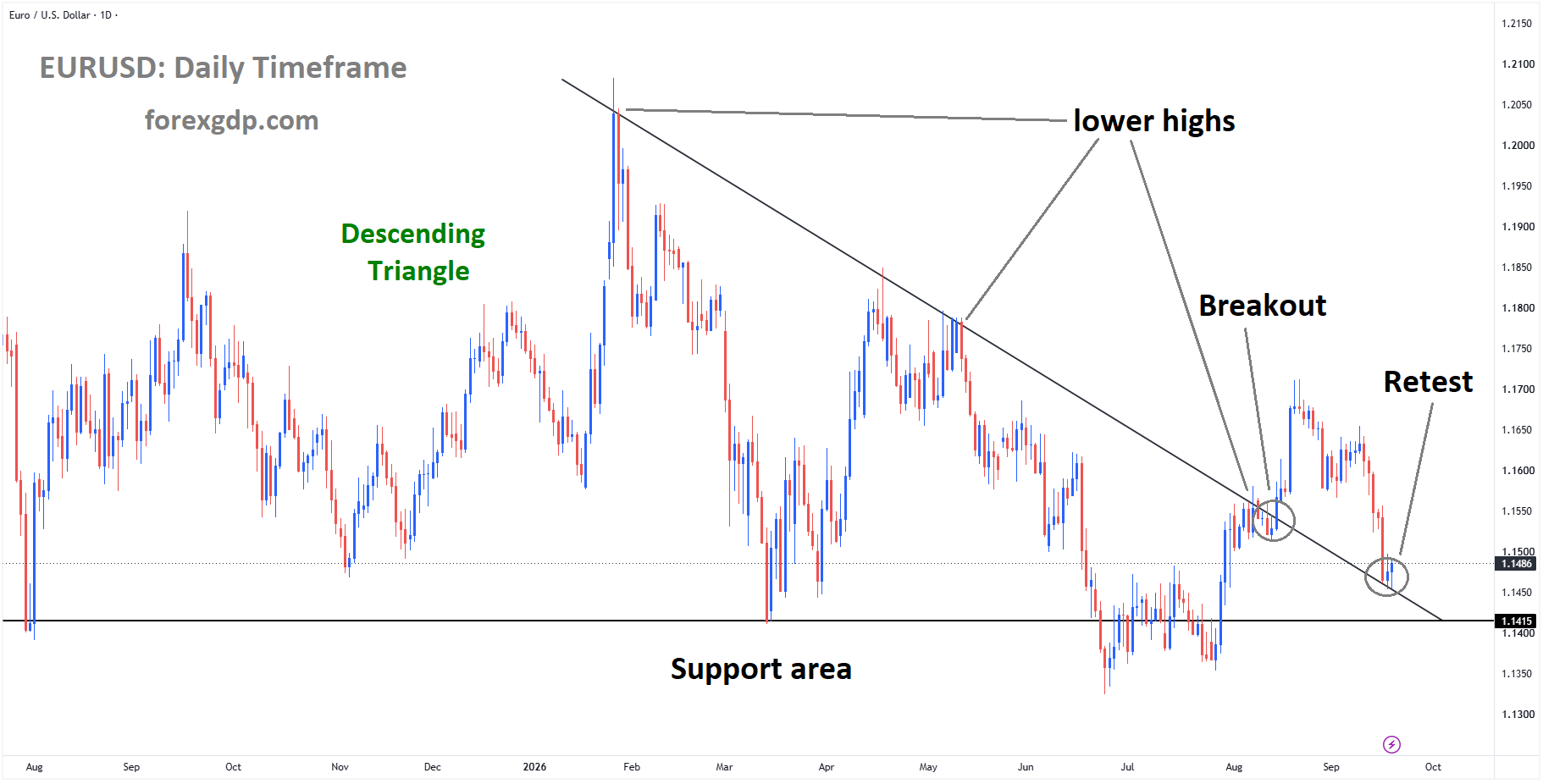
EURUSD reached the retest area of the broken descending triangle pattern
Energy-market uncertainty also played an important role. Oil prices initially declined after efforts were made to restore damaged supply routes. However, concerns surrounding Middle East supplies prevented a deeper fall. This renewed pressure on energy costs and kept global inflation risks elevated.
Both the Federal Reserve and the European Central Bank are watching these developments closely. While the Fed has adopted a more aggressive policy position, the ECB has also shown that it is prepared to respond if rising energy costs create another wave of inflation across the Eurozone.
Hawkish Federal Reserve Outlook Strengthens the US Dollar
The Federal Reserve delivered another interest rate increase during its latest policy meeting. It was the central bank’s first rate rise since 2023 and confirmed that officials remain concerned about inflation.
More importantly, the Fed’s updated projections suggested that most policymakers expect at least one additional increase before the end of the year. This signal changed the mood across financial markets because it indicated that borrowing costs could remain elevated for longer than previously anticipated.
Higher interest rates generally make a currency more attractive to investors. When US rates rise or are expected to remain high, investors can receive better returns from assets linked to the Dollar. This strengthens demand for the US currency and creates pressure on competing currencies such as the Euro.
The possibility of another rate increase at the Fed’s next meetings remains meaningful. Traders will therefore pay close attention to upcoming speeches from Federal Reserve officials. Their comments may reveal whether policymakers are firmly committed to further tightening or prefer to wait for more economic information.
The Fed’s decisions will depend heavily on inflation, employment, consumer spending, and energy costs. If these factors continue to show strength, the central bank may feel that another rate increase is necessary. However, signs of weaker economic activity could encourage policymakers to take a more cautious approach.
Oil Supply Concerns Keep Inflation Risks Elevated
Oil prices weakened earlier in the week after Saudi Arabia took action to redirect exports and restore an important pipeline damaged during a recent attack. These efforts helped calm immediate concerns about a major disruption to global supplies.
However, the situation in the Middle East remains uncertain. Investors are still concerned that further disruptions could reduce the amount of energy reaching international markets. As a result, the decline in Oil prices has remained limited.
Energy costs have a broad impact on the global economy. Higher Oil prices increase transportation, manufacturing, and distribution expenses. Businesses may pass those additional costs to consumers, creating renewed inflationary pressure.
This is particularly important for central banks because inflation linked to energy can spread through many areas of the economy. Even when domestic price growth begins to slow, a sudden rise in Oil and gas costs can delay progress toward inflation targets.
Rising energy prices can also affect government bonds. Investors may demand better returns when they expect inflation to remain high. This can push bond yields upward and strengthen expectations that central banks will maintain restrictive policies.
For the US Dollar, this environment can be supportive. Persistent inflation may encourage the Federal Reserve to keep rates high or introduce further increases. The combination of firm interest-rate expectations and strong demand for safer assets can help the Dollar remain attractive during uncertain periods.
The Euro Struggles Despite Expectations of ECB Action

The Euro has received some support from expectations that the European Central Bank may continue raising interest rates. The ECB has already tightened policy this year, showing that it remains committed to controlling inflation across the Eurozone.
ECB President Christine Lagarde recently offered a cautiously positive assessment of the European economy. She explained that growth appears slightly more encouraging than policymakers had previously expected. She also noted that the central bank has not yet identified clear evidence of widespread second-round inflation effects.
Second-round effects occur when an initial increase in prices leads to broader changes in wages, business costs, and consumer expectations. If these effects become established, inflation can become more difficult to control. The absence of strong second-round pressure may provide the ECB with some flexibility, although energy uncertainty remains a major risk.
Lagarde emphasized that energy is an important variable for the Eurozone. European countries depend heavily on global energy markets, which makes the region sensitive to supply disruptions and sudden cost increases.
She also said the ECB is well positioned to respond if energy-driven inflation becomes more serious. However, future policy decisions will be taken one meeting at a time. This means officials are not committing themselves to a fixed path and will continue studying fresh economic information before making each decision.
Markets Expect More Tightening From the ECB
Financial markets have quickly increased their expectations for further ECB rate increases. Rising energy prices have played a major role in this shift because they could slow the progress being made against inflation.
Some economists remain more cautious than traders. Analysts at Nordea believe market expectations have moved well beyond their central forecast, which includes two additional rate increases spread across future meetings.
This difference highlights the uncertainty facing the Euro. More ECB tightening could provide some support to the single currency, but higher rates may also create additional pressure on businesses, households, and economic growth.
The Eurozone economy must therefore balance two difficult risks. If the ECB moves too slowly, energy-related inflation could become more persistent. If it raises rates too aggressively, already vulnerable parts of the economy may weaken further.
Much will depend on developments in the Middle East. A prolonged period of supply uncertainty could keep energy costs elevated and force the ECB to maintain a firm policy position. A calmer environment, on the other hand, could reduce inflation pressure and allow policymakers to become more patient.
EURUSD Outlook Depends on Central Bank Expectations
The main force affecting EURUSD is the difference between Federal Reserve and ECB policy expectations. At present, the US Dollar has an advantage because the Fed has delivered a strong message and indicated that further action remains possible.
The ECB may also continue tightening, but its path appears less certain. European policymakers must consider weaker regional growth, energy dependence, and the uneven performance of member economies.
Upcoming comments from central bank officials will be important. Investors will study whether Fed policymakers continue supporting another rate increase and whether ECB officials share Lagarde’s confidence about managing energy-driven inflation.
Economic reports covering employment, consumer activity, business growth, and inflation will also help shape expectations. Any major change in Middle East supply conditions could quickly influence Oil prices, bond markets, and currency sentiment.
Final Summary
EURUSD is heading toward a weekly loss as a hawkish Federal Reserve outlook keeps the US Dollar well supported. The possibility of another US rate increase has strengthened demand for the Greenback and made it harder for the Euro to recover.
Oil supply concerns in the Middle East are adding another layer of uncertainty. Although efforts to restore export routes have reduced some immediate fears, the risk of further disruptions continues to keep energy-related inflation concerns alive.
The ECB remains prepared to respond if higher energy costs create broader inflation pressure. However, its future decisions will be made meeting by meeting. Until the balance between Fed and ECB policy expectations changes, the US Dollar may continue to hold the stronger position against the Euro.
GBPUSD Slips as Energy Concerns Overshadow Retail Strength
The Pound Sterling gave back its earlier gains against the US Dollar after financial markets turned their attention to renewed concerns about global oil supplies. Stronger-than-expected UK retail sales initially supported the British currency, but the positive reaction did not last long.
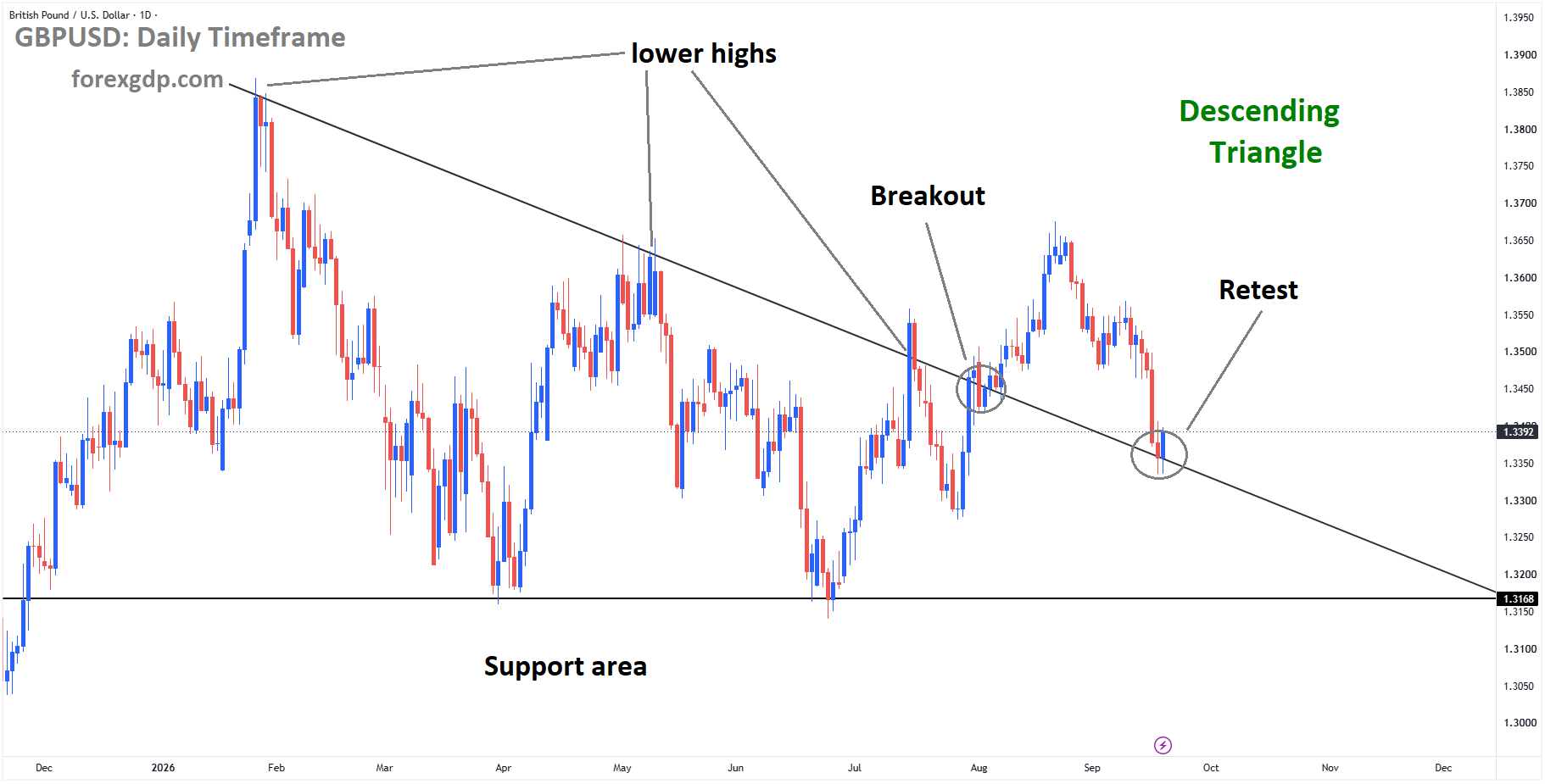
GBPUSD reached the retest area of the broken descending triangle pattern
Fresh reports about reduced Saudi oil supplies to European buyers raised fears that energy costs could remain elevated. This development quickly changed market sentiment because expensive energy can affect inflation, economic growth, business costs, and household spending.
The United Kingdom is particularly sensitive to changes in global energy markets because it imports a significant amount of its energy. When oil and gas costs rise, companies often face higher transportation and production expenses. Consumers may also pay more for fuel, heating, food, and other everyday products.
As a result, the encouraging retail sales report was not enough to keep Sterling firmly supported. Investors became more cautious as they considered how another energy shock could complicate the outlook for the UK economy.
UK Retail Sales Reveal Resilient Consumer Demand
British retail sales performed much better than economists had expected. Instead of falling, sales increased during the month, suggesting that consumers continued to spend despite pressure from living costs and economic uncertainty.
This resilience is important for the wider economy. Consumer spending plays a major role in UK economic activity, and stable demand can help businesses maintain revenue, retain employees, and continue investing.
The report also suggests that British households may be coping with financial pressure better than previously feared. Wage growth, careful household budgeting, and changing spending habits may have helped support demand across the retail sector.
However, one positive report does not remove every concern. Higher energy prices could gradually reduce disposable income by increasing household bills. If families need to spend more on fuel, electricity, transportation, and food, they may have less money available for non-essential purchases.
For the Bank of England, stronger consumer activity creates a difficult situation. Healthy spending can support economic growth, but it can also keep inflationary pressure alive. If demand remains firm while energy costs rise, the central bank may feel greater pressure to maintain a restrictive policy stance.
Saudi Oil Supply Concerns Revive Inflation Risks
Reports that Saudi Arabia may not provide European buyers with expected oil supplies for the following month renewed anxiety across global markets. Europe remains highly sensitive to energy availability, especially during periods of geopolitical uncertainty.
A reduction in supply can influence much more than fuel costs. Oil is used throughout the global economy, including in transportation, manufacturing, agriculture, shipping, and chemical production. When energy becomes more expensive, those higher costs can move through supply chains and eventually reach consumers.
This is why oil supply concerns often lead to wider inflation fears. Central banks have spent years trying to control price growth, and a fresh energy shock could slow that progress.
The situation is even more challenging when geopolitical tensions are involved. Conflict involving major energy-producing regions can disrupt shipping routes, reduce market confidence, and create uncertainty about future supplies. Even if actual production remains stable, fear of possible disruption can influence business decisions and investor behaviour.
For the UK, rising energy costs may place pressure on both households and companies. Businesses could face smaller profit margins, while consumers may become more careful with their spending. This combination creates a difficult balance between controlling inflation and protecting economic growth.
Bank of England Faces a Difficult Policy Choice
The latest retail sales figures may strengthen the argument for the Bank of England to consider further monetary tightening. Strong consumer demand, persistent inflation concerns, and higher energy costs could encourage policymakers to take a firmer approach.
Financial markets are already considering the possibility of another UK rate increase. Expectations for future policy action have grown as investors assess the risk that inflation may remain above the central bank’s comfort level.
However, raising interest rates also carries risks. Higher borrowing costs can place additional pressure on homeowners, renters, businesses, and consumers using credit. They may also discourage investment and weaken economic activity over time.
The Bank of England must therefore decide whether the greater danger comes from stubborn inflation or slower growth. If energy prices remain elevated while consumer spending stays strong, policymakers may see a need for tighter policy. If economic conditions begin to weaken, the central bank may prefer to move more cautiously.
This uncertainty can create mixed reactions in Sterling. Expectations of higher interest rates may support the currency, but concerns about energy dependence and weaker growth can limit that support.
Federal Reserve Policy Supports the US Dollar
The US Dollar remains supported by the Federal Reserve’s firm policy position. The American central bank raised interest rates after describing the economy as resilient enough to manage tighter financial conditions.
Federal Reserve Chair Kevin Warsh indicated that economic strength helped justify the latest decision. Although some areas of the economy have shown slower momentum, policymakers appear focused on ensuring that inflation remains under control.
US industrial production offered a less encouraging signal after activity remained unchanged during the latest reporting period. The result fell short of economists’ expectations and suggested that parts of the manufacturing economy may be losing strength.
Even so, financial markets continue to consider the possibility of another Federal Reserve rate increase. Expectations of tighter US policy can support the Dollar because higher interest rates often make Dollar-denominated assets more appealing to global investors.
The Federal Reserve’s willingness to keep rates elevated gives the Greenback an important advantage. As long as the US economy remains relatively resilient and inflation concerns continue, investors may expect the central bank to maintain its restrictive approach.
US-UK Rate Gap Keeps GBPUSD Under Pressure
The difference between US and UK interest rates remains a major influence on GBPUSD sentiment. Recent decisions from the Federal Reserve and the Bank of England have widened the policy gap in favour of the United States.
This difference can encourage investors to hold US assets because they may offer more attractive returns. As demand for these assets increases, the US Dollar can receive additional support.
Sterling still has some positive factors working in its favour. UK consumer spending remains resilient, and expectations of future Bank of England rate increases have strengthened. However, these factors must compete with the broader appeal of the Dollar and growing concerns about the economic effects of expensive energy.
The direction of the currency pair will depend heavily on how both central banks respond to inflation risks. The Federal Reserve appears prepared to maintain a firm stance, while the Bank of England must balance rising price pressure against the vulnerability of the UK economy.
Energy developments will also remain important. Any further reduction in global oil supplies could increase inflation fears and create new challenges for Britain as a net energy importer.
Final Summary
GBPUSD lost its earlier strength even after UK retail sales delivered a positive surprise. The data showed that British consumers remain active, giving the Pound some initial support and increasing expectations of future Bank of England action.
However, renewed fears about Saudi oil supplies quickly overshadowed the encouraging economic report. Higher energy costs could intensify inflation, squeeze household budgets, and raise operating expenses for British companies.
At the same time, the Federal Reserve’s firm policy position continues to support the US Dollar. The widening interest rate difference between the United States and the United Kingdom leaves the broader environment challenging for Sterling.
The Pound may benefit from resilient domestic demand and expectations of tighter Bank of England policy, but oil-related inflation risks and the Dollar’s rate advantage remain powerful opposing forces.
USDJPY Rallies as Yen Slides After BoJ Decision
USDJPY moved higher at the end of the week as the Japanese Yen faced strong selling pressure. The decline came even after the Bank of Japan raised interest rates to their highest level in more than three decades.
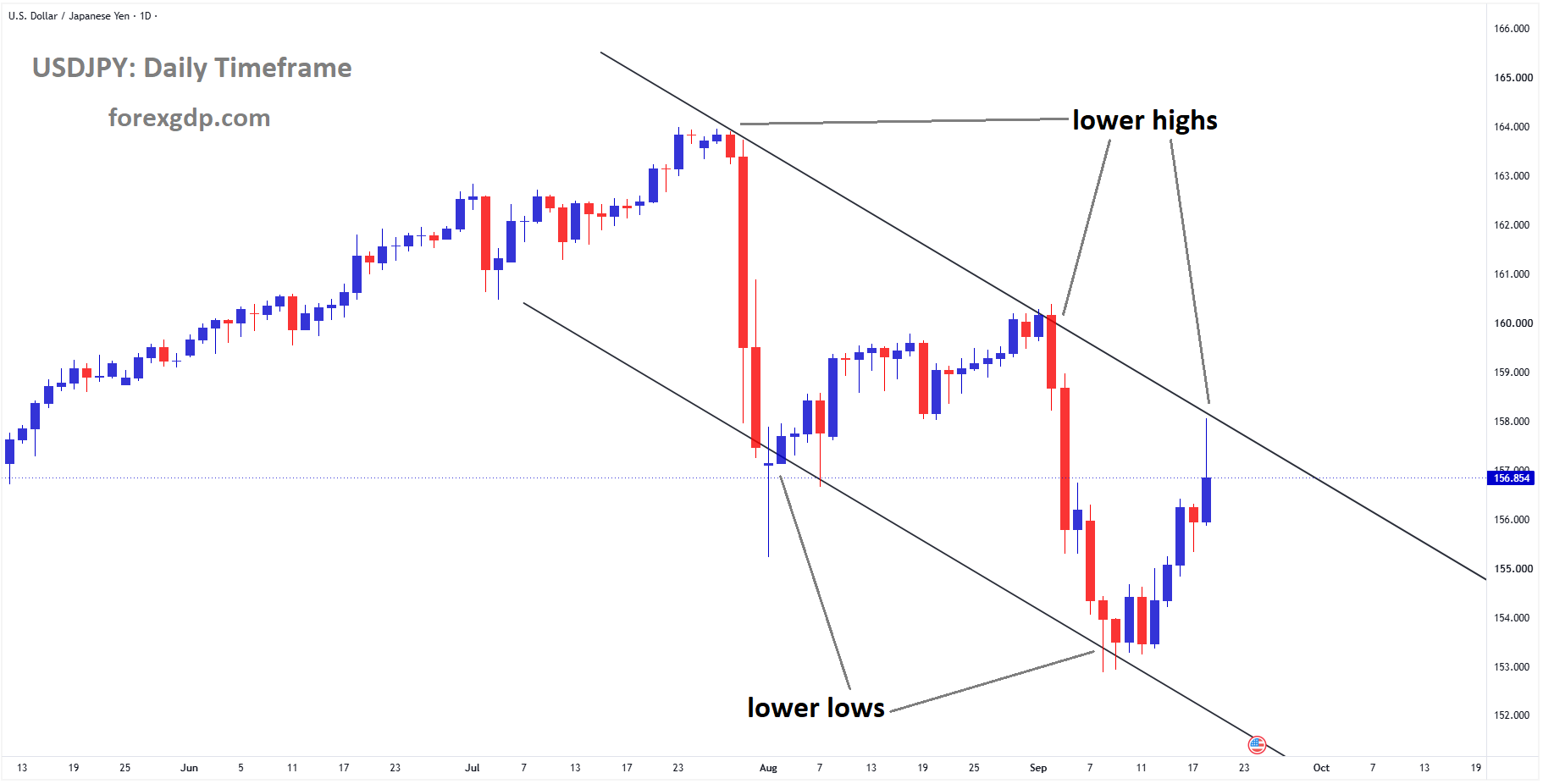
USDJPY is moving in a descending channel
At first glance, the Yen’s weakness may seem surprising. Higher interest rates often support a country’s currency because they can make local assets more attractive to global investors. However, currency markets usually react to future expectations rather than decisions that traders already expect.
The Bank of Japan’s move had been widely anticipated. As a result, investors paid more attention to the central bank’s guidance, inflation outlook, and willingness to continue raising borrowing costs. At the same time, expectations of further interest rate increases in the United States strengthened the US Dollar and increased its advantage over the Yen.
Bank of Japan Delivers Its Expected Rate Increase
The Bank of Japan raised its policy rate by 25 basis points, taking it from 1% to 1.25%. This marked the highest Japanese interest rate in 31 years and represented another important step away from the country’s long period of extremely loose monetary policy.
The decision received support from seven members of the policy board. Two members, Toichiro Asada and Ayano Sato, opposed the increase in borrowing costs.
Although the move was historically significant, it did not provide lasting support for the Japanese Yen. Investors had already prepared for the rate increase, meaning much of its potential impact had been reflected in market expectations before the official announcement.
This is a common situation in foreign exchange markets. A central bank can raise interest rates, but its currency may still weaken if the decision offers no fresh reason for investors to become more optimistic. Once the expected announcement is confirmed, attention quickly shifts toward what the central bank may do next.
Future Policy Guidance Disappoints Yen Buyers
Bank of Japan Governor Kazuo Ueda maintained the view that further interest rate increases remain possible. He explained that the central bank would continue adjusting policy if Japan’s economy and inflation developed in line with expectations.
However, the Bank of Japan did not provide a strong promise of rapid or continuous tightening. Instead, officials highlighted several risks that could affect future decisions.
These uncertainties include geopolitical tensions in the Middle East, changes in demand linked to artificial intelligence, and instability in foreign exchange markets. Each of these factors could influence global growth, energy costs, corporate confidence, and Japanese inflation.
The cautious tone encouraged investors to question how quickly the Bank of Japan could raise rates again. While additional action remains possible, the central bank appears likely to examine economic conditions carefully before making another move.
For Yen buyers, the lack of a clearly aggressive policy path was disappointing. The interest rate increase itself was not enough to overcome concerns that Japan’s future tightening cycle could remain gradual.
Japanese Inflation Limits Expectations for Faster Tightening

Japan’s latest inflation figures added to the uncertainty surrounding the Bank of Japan’s next steps. The National Consumer Price Index showed little change during August, while underlying inflation remained below the central bank’s annual target.
These figures suggest that inflationary pressure inside Japan may not be strong enough to justify an aggressive series of interest rate increases. The Bank of Japan has spent years trying to create stable inflation supported by wages, household spending, and domestic demand. Officials therefore need evidence that inflation can remain sustainable before tightening policy too quickly.
If inflation remains weak, raising borrowing costs rapidly could damage economic activity. Higher rates can make loans more expensive for households and businesses, potentially reducing spending and investment.
This creates a difficult balance for the Bank of Japan. It wants to normalize monetary policy after many years of exceptionally low rates, but it must avoid placing unnecessary pressure on the economy. That cautious approach reduces confidence in a fast tightening cycle and limits the Yen’s ability to benefit from the latest decision.
Federal Reserve Expectations Strengthen the US Dollar
While the Japanese policy outlook remains cautious, expectations surrounding the Federal Reserve have become more aggressive. The US central bank raised its benchmark interest rate by 25 basis points, delivering its first increase since 2023.
Rising energy costs have renewed concerns about inflation in the United States. Expensive oil and other energy products can increase transportation, production, and household costs. If companies pass these additional expenses to consumers, inflation may remain elevated for longer.
This risk has encouraged investors to consider the possibility of another Federal Reserve rate increase. Market expectations now show a stronger chance of additional tightening at the next policy meeting than they did before the latest Fed announcement.
The possibility of higher US interest rates gives investors another reason to hold the US Dollar. It also creates a clear contrast between the two central banks. The Federal Reserve is being viewed as more willing to take further action, while the Bank of Japan continues to communicate a gradual and data-dependent approach.
US Treasury Yields Reinforce the Dollar’s Advantage
Expectations of tighter Federal Reserve policy have also lifted US Treasury yields. When government bond yields rise, Dollar-based assets can become more attractive to international investors seeking stronger returns.
This development matters greatly for USDJPY because the pair is sensitive to the difference between American and Japanese interest rates. Even after the Bank of Japan’s latest increase, US rates remain considerably higher.
The wide yield gap encourages some investors to favour the US Dollar over the Yen. As long as US Treasury yields remain firm and expectations of further Federal Reserve tightening continue, the Dollar may retain an important advantage.
Japan’s rate increase reduced the policy difference slightly, but it did not remove it. Investors are therefore comparing not only the latest decisions but also the likely direction and speed of future changes in both countries.
Global Risks Add Another Layer of Uncertainty
Geopolitical developments remain an important part of the outlook. Tensions in the Middle East could continue to influence energy costs and global inflation. Japan depends heavily on imported energy, so higher oil prices can increase costs for businesses and consumers.
Artificial intelligence-related investment is another factor being watched by policymakers. Strong demand for technology, infrastructure, and advanced equipment may support certain parts of the global economy. However, sudden changes in investment could create volatility and affect export-focused countries such as Japan.
Foreign exchange instability is also a concern for Japanese officials. A weak Yen can support exporters by making their products more competitive overseas, but it can also raise the cost of imported fuel, food, and raw materials. That creates pressure on households and may complicate the Bank of Japan’s policy decisions.
Final Summary
USDJPY strengthened as the Japanese Yen weakened despite the Bank of Japan raising interest rates to their highest level in 31 years. The increase had already been widely expected, so investors focused on the central bank’s cautious guidance and the uncertain timing of future policy action.
Moderate Japanese inflation reduced expectations of rapid rate increases, while the prospect of further Federal Reserve tightening supported the US Dollar. Rising US Treasury yields also maintained the Dollar’s interest rate advantage over the Yen.
The broader direction of USDJPY will continue to depend on the contrast between the two central banks. Investors will closely follow Japanese inflation, Bank of Japan guidance, US energy-driven price pressures, Federal Reserve expectations, and global geopolitical developments.
USDCAD Pushes Higher as Canadian Dollar Faces Fed Pressure
USDCAD moved higher as the US Dollar continued to benefit from expectations of tighter monetary policy in the United States. The Federal Reserve’s latest interest rate increase strengthened the view that borrowing costs may remain elevated for an extended period.
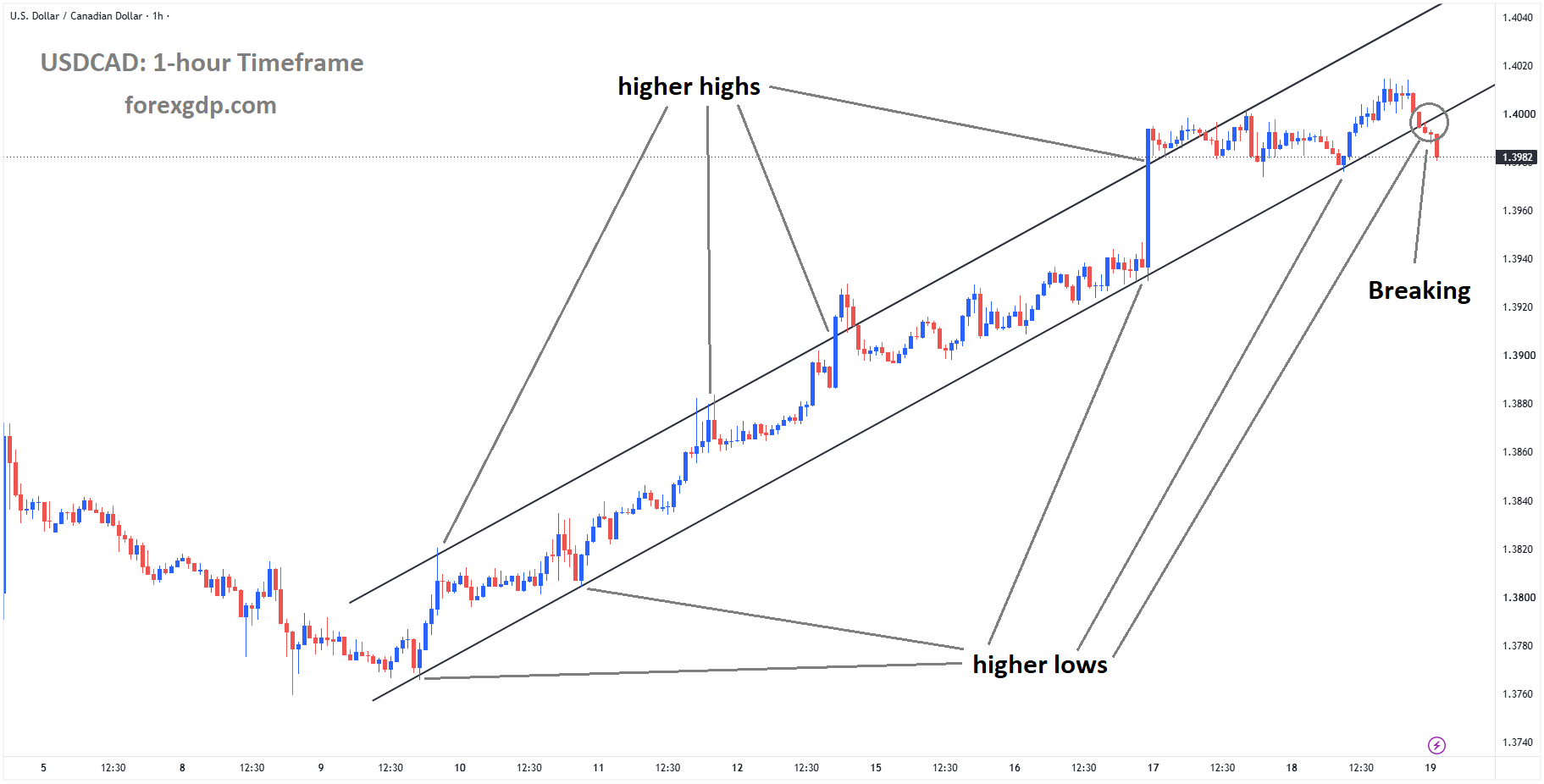
USDCAD is breaking the higher low area of the ascending channel
A stronger US Dollar usually places upward pressure on USDCAD because the pair measures the value of the Greenback against the Canadian Dollar. However, the movement remained controlled as recovering Oil prices provided support to the Canadian currency.
The Canadian Dollar often reacts to changes in the energy market because Canada is one of the world’s major Oil-producing nations. When Oil prices recover, expectations of stronger export income can improve demand for the Canadian currency. This relationship helped prevent USDCAD from making a larger advance.
As a result, traders are balancing two important forces. The US Dollar is receiving support from the Federal Reserve’s firm policy outlook, while the Canadian Dollar is benefiting from renewed strength in the Oil market.
Federal Reserve Maintains a Restrictive Policy Direction
The Federal Reserve raised its benchmark interest rate at its latest policy meeting. The decision marked an important shift after a long period without an increase and showed that officials remain concerned about inflation.
Rising energy costs have made the inflation outlook more complicated. Higher fuel and transportation expenses can spread through the wider economy, increasing costs for businesses and consumers. This makes it harder for the Federal Reserve to declare that inflation is fully under control.
Central bank officials have therefore maintained a restrictive policy position. Their message suggests that interest rates may need to remain high until there is stronger evidence that inflation is moving sustainably toward the desired level.
The Federal Reserve’s updated projections also indicate that most policymakers expect another increase before the end of the year. This has encouraged investors to reconsider earlier expectations that the tightening cycle was close to finishing.
The possibility of further action is important for the US Dollar. Higher interest rates can make US-based assets more attractive to global investors, especially when other central banks are moving more cautiously. This flow of capital can increase demand for the Greenback and strengthen its position against currencies such as the Canadian Dollar.
Inflation Risks Keep Further Rate Hikes in Focus
Inflation remains the central issue guiding expectations for US monetary policy. Although some areas of the economy may show signs of easing price pressure, energy costs continue to create uncertainty.
Oil plays a major role in the inflation picture because it affects transportation, manufacturing, logistics and household spending. When energy costs rise sharply, companies may pass those additional expenses to customers. This can slow the progress central banks are trying to make against inflation.
Federal Reserve officials are likely to examine upcoming economic data carefully before making another decision. Employment conditions, consumer spending, wage growth and inflation reports will all help determine whether another interest rate increase is necessary.
Investors currently see a meaningful possibility of further tightening at an upcoming meeting. This expectation may continue to support the US Dollar if economic data remains strong and inflation fails to cool as quickly as hoped.
However, the outlook can change quickly. Signs of weaker growth or softer inflation could reduce expectations for additional rate hikes. On the other hand, renewed inflation pressure could strengthen the case for keeping monetary policy restrictive for longer.
Rising Treasury Yields Strengthen the Greenback

US Treasury yields have climbed as investors adjust to the possibility of higher interest rates. Government bond yields often respond to changes in inflation expectations and the predicted direction of Federal Reserve policy.
When investors believe that interest rates will stay elevated, they may demand higher returns from longer-term government debt. This can push Treasury yields upward and increase the appeal of US assets.
Rising yields can provide direct support to the US Dollar because international investors may purchase the currency to invest in American bonds and other financial instruments. This helps explain why the Greenback has maintained a firm tone following the Federal Reserve’s latest decision.
Higher Treasury yields can also affect the wider global economy. They may increase borrowing expenses for companies, households and governments. They can also reduce demand for riskier assets by making safer investments more attractive.
For USDCAD, continued strength in Treasury yields could support further demand for the US Dollar. Still, the Canadian Dollar’s response to Oil prices may limit how strongly the pair reacts.
Oil Recovery Supports the Canadian Dollar
The Canadian Dollar found support as Oil recovered from its earlier decline. Canada exports a large amount of energy, particularly to the United States, making the country’s currency sensitive to developments in the Oil market.
When Oil prices rise, Canada may receive stronger export revenues. This can improve the country’s trade outlook and encourage demand for the Canadian Dollar. For this reason, the currency is often described as being linked to commodity market performance.
The latest Oil recovery has helped the Canadian Dollar resist some of the pressure created by the stronger Greenback. Without this support, USDCAD may have experienced a more noticeable advance.
However, Oil-driven support can be unstable because energy markets are influenced by economic growth, production decisions, inventories and geopolitical developments. A sudden change in any of these areas can quickly affect the Canadian Dollar.
Traders will therefore continue watching whether the Oil recovery can be sustained. A lasting improvement may provide the Canadian currency with stronger support, while renewed weakness could leave it more exposed to the Federal Reserve-backed US Dollar.
Middle East Tensions Add Uncertainty to Energy Markets
Geopolitical tensions in the Middle East continue to influence the Oil market. Investors remain concerned that a wider conflict could disrupt production or transportation in one of the world’s most important energy-producing regions.
Particular attention remains on the Strait of Hormuz, a vital route for global Oil shipments. Any threat to the movement of energy supplies through this area could create fears of shortages and increase uncertainty across international markets.
The possibility of renewed tension between the United States and Iran has added to these concerns. Even without a direct interruption to supply, the risk of escalation can keep a geopolitical premium in Oil prices.
This situation may offer temporary support to the Canadian Dollar because stronger energy prices can improve Canada’s export outlook. At the same time, serious geopolitical stress could strengthen the US Dollar through safe-haven demand.
This creates a complex environment for USDCAD. Both currencies may benefit from different parts of the same global event, making the pair’s direction dependent on which market force becomes stronger.
What Could Influence USDCAD Next
The next phase for USDCAD will likely depend on changing interest rate expectations, US economic data and developments in the Oil market.
Strong US data and persistent inflation could reinforce expectations of another Federal Reserve rate increase. That would likely keep Treasury yields elevated and maintain support for the US Dollar.
In contrast, weaker economic reports or easing inflation could reduce the need for additional tightening. Such a shift may weaken the Greenback and allow the Canadian Dollar to recover.
Oil prices will remain equally important. Continued strength in the energy market may support the Canadian currency, while a decline could remove one of its main sources of protection.
Final Summary
USDCAD remains supported by a firm US Dollar after the Federal Reserve raised interest rates and signaled that further tightening may be possible. Inflation concerns and rising Treasury yields have increased the appeal of the Greenback.
At the same time, recovering Oil prices are supporting the Canadian Dollar and limiting the pair’s upward movement. Ongoing tensions in the Middle East are keeping energy supply risks in focus, adding another layer of uncertainty.
The balance between Federal Reserve policy and Oil market performance is likely to remain the main influence on USDCAD. Traders will closely follow inflation data, central bank guidance, Treasury yields and geopolitical developments for clearer direction.
USDCHF Retreats as Swiss Franc Recovers Despite Policy Gap
USDCHF moved lower on Friday as traders secured profits following a strong weekly advance. The US Dollar lost some momentum before the weekend, encouraging market participants to reduce their positions after several days of steady strength.
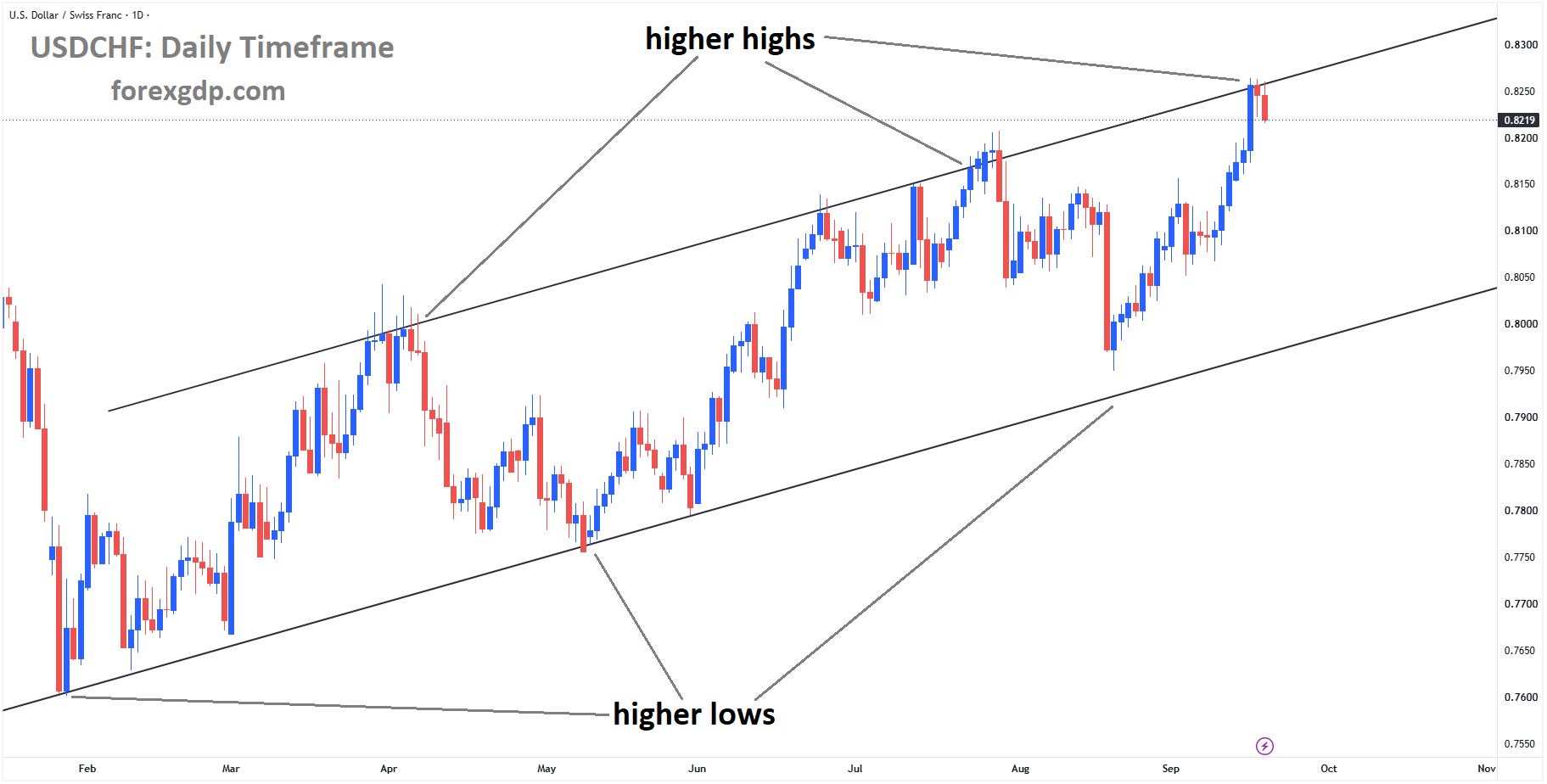
USDCHF reached the higher high area of the ascending channel
The decline appeared to reflect position adjustment rather than a major change in market sentiment. Traders often close part of their profitable positions before the weekend, especially after a currency pair has recorded a notable weekly move. This helps them protect their gains and reduce exposure to unexpected developments when markets are closed.
Despite Friday’s retreat, USDCHF remained on course to record its fourth consecutive weekly gain. The broader advance has been driven mainly by weakness in the Swiss Franc, supported by growing differences between the monetary policies of the Federal Reserve and the Swiss National Bank.
The US Dollar has also benefited from expectations that American interest rates could stay elevated for an extended period. Although short-term profit-taking may create temporary pressure, the fundamental outlook continues to favor the US currency over the Swiss Franc.
Federal Reserve Policy Supports the US Dollar
The Federal Reserve recently raised interest rates as officials continued their efforts to control inflation. The decision marked the central bank’s first increase since 2023 and delivered a clear message that policymakers remain concerned about persistent price pressures.
Updated projections from Fed officials suggested that another rate increase may be possible before the end of the year. Most policymakers indicated that further tightening could be required if inflation remains above the central bank’s preferred level.
This outlook is important for the US Dollar because higher interest rates can make Dollar-based investments more attractive. International investors often move capital toward currencies that offer stronger returns. When US rates rise or are expected to remain high, demand for American assets can increase.
Recent comments from Kansas City Fed President Jeffrey Schmid reinforced this view. He supported the latest rate increase because inflation continues to affect a wide range of goods and services. His remarks suggested that rising energy costs are not the only concern. Broader price pressures remain strong enough to keep the Fed cautious.
Schmid also described the US labor market as balanced and the economy as solid. A stable job market and healthy economic activity give the central bank more room to maintain a firm policy stance. If the economy continues to perform well, the Fed may feel less pressure to quickly reverse its recent tightening.
Treasury Yields Strengthen the Dollar’s Appeal
Higher US Treasury yields have provided additional support for the Dollar. Bond yields remain elevated as investors adjust to the possibility of tighter monetary policy and lasting inflation pressures.
When Treasury yields rise, US government debt can become more attractive to global investors. Foreign buyers may need to purchase Dollars before investing in these assets, helping support demand for the currency.
Energy market uncertainty is also influencing bond yields. Ongoing conflict in the Middle East has increased concerns about possible disruptions to global energy supplies. Firm oil costs can place additional pressure on inflation because energy affects transportation, manufacturing, food production, and household expenses.
If energy-related risks continue, the Federal Reserve may find it more difficult to bring inflation under control. That possibility could encourage policymakers to keep rates elevated or consider further action.
However, the Dollar’s weekly performance has not been equally strong against every major currency. In the case of USDCHF, much of the upward movement has come from the Swiss Franc’s weakness. This distinction matters because it shows that developments in Switzerland are playing an important role in the pair’s broader direction.
Swiss National Bank Policy Creates a Clear Rate Gap
The Swiss National Bank continues to maintain a much softer monetary policy than the Federal Reserve. With Switzerland’s policy rate at zero, the difference between US and Swiss borrowing costs has become increasingly noticeable.
This policy gap gives investors a financial reason to favor the US Dollar. Assets linked to the Dollar can offer better returns than similar Swiss investments. As long as this difference remains wide, the Franc may struggle to attract sustained demand.
The upcoming Swiss National Bank policy meeting will therefore receive close attention. Traders will look for any indication that officials are becoming concerned about the currency’s weakness or considering a change in policy.
If the SNB continues with its current approach, the Franc could remain under pressure. A cautious message from Swiss policymakers may strengthen expectations that the rate difference between the United States and Switzerland will continue.
On the other hand, any unexpected concern about inflation or currency depreciation could change the market’s expectations. For now, however, the Federal Reserve appears far more willing to use higher rates than the SNB.
Swiss Franc Gains Attention as a Carry-Trade Currency
The Swiss Franc is also becoming more popular as a funding currency for carry trades. This strategy usually involves borrowing or selling a low-yielding currency and using those funds to purchase a currency that offers a higher return.
For many years, the Japanese Yen was widely used for this purpose because Japan maintained extremely low interest rates. However, the Bank of Japan has started moving toward policy normalization. Rising Japanese rates have made the Yen less attractive as a cheap source of funding.
As a result, some investors are shifting their attention toward the Swiss Franc. Switzerland’s zero-rate environment makes the Franc an appealing alternative for financing investments in higher-yielding currencies.
This process can create additional selling pressure on the Franc. Investors participating in carry trades may sell the Swiss currency while buying currencies linked to economies with higher interest rates. The US Dollar is one of the currencies that can benefit from this demand.
Carry trades can remain popular while financial markets are stable and investors are willing to take risks. However, they can reverse quickly during periods of fear or uncertainty. The Swiss Franc has traditionally been viewed as a safe-haven currency, meaning demand can return when investors become more cautious.
Global Risks May Limit Franc Weakness

Although monetary policy favors the US Dollar, global uncertainty may prevent the Franc from weakening without interruption. The Swiss currency often attracts buyers during periods of geopolitical tension, financial instability, or falling investor confidence.
The ongoing Middle East conflict remains an important risk. Any major escalation could increase demand for traditional safe-haven assets, including the Swiss Franc. This could temporarily challenge the influence of rate differences and carry-trade activity.
At the same time, the US Dollar also benefits from safe-haven flows. The final impact on USDCHF would depend on which currency investors prefer during a specific period of uncertainty.
Economic data from the United States will also remain important. Strong inflation, employment, or growth figures could reinforce expectations of further Fed tightening. Weaker reports could reduce those expectations and limit the Dollar’s strength.
Final Summary
USDCHF moved lower as traders took profits before the weekend, but the broader weekly picture remained positive. The pair stayed on track for a fourth straight weekly gain, largely because the Swiss Franc continued to underperform.
The Federal Reserve’s firm policy stance, elevated Treasury yields, and expectations of another possible rate increase continue to support the US Dollar. Meanwhile, the Swiss National Bank’s zero-rate policy has created a wide interest-rate gap that makes Dollar-based investments more attractive.
Growing use of the Swiss Franc as a carry-trade funding currency may add further pressure. However, geopolitical uncertainty and the Franc’s safe-haven role could limit its weakness at times. The upcoming SNB decision will be important for determining whether the current policy difference is likely to continue.
AUDUSD Advances as Inflation Concerns Keep RBA Firm
The Australian Dollar moved higher against the US Dollar on Friday as investors reacted to firm comments from Reserve Bank of Australia officials. Policymakers expressed concern that inflation may remain stronger than expected, keeping the possibility of another interest rate increase on the table.
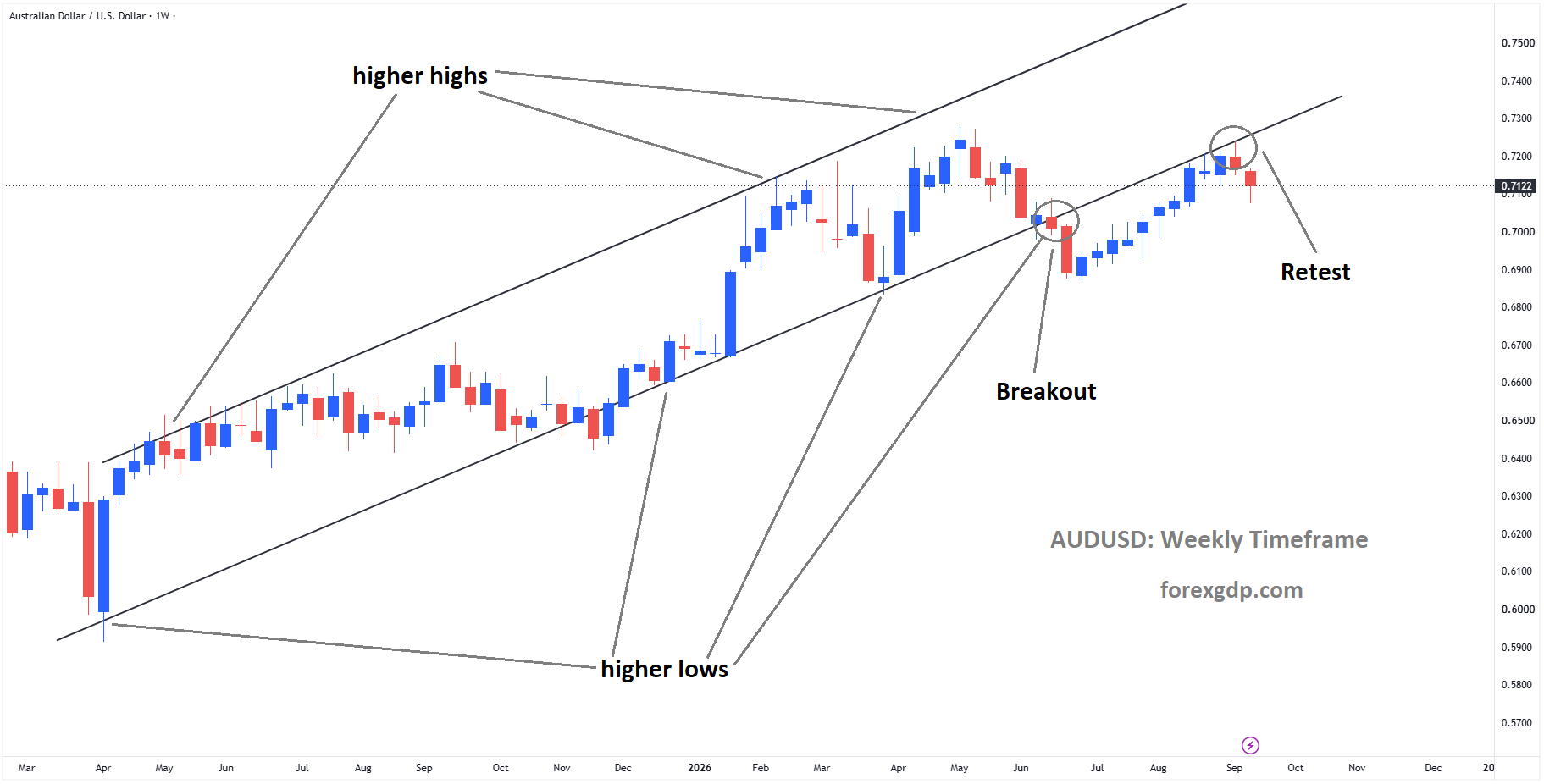
AUDUSD reached the retest area of the broken ascending channel
The latest remarks from RBA Governor Michele Bullock and Deputy Governor Andrew Hauser suggest that the Australian central bank is not ready to declare victory over inflation. Although previous interest rate increases are still affecting the economy, officials remain uncertain whether the current policy setting will be enough to bring inflation back to the desired level within a reasonable period.
At the same time, the US Dollar continues to receive support from expectations that the Federal Reserve may deliver another rate increase before the end of the year. This has created a difficult environment for AUDUSD, with both currencies benefiting from firm monetary policy expectations.
RBA Maintains a Firm Position on Inflation
The Reserve Bank of Australia remains highly focused on controlling inflation. Governor Michele Bullock told a parliamentary committee that inflation was still too high and warned that some risks were beginning to become more visible.
Her comments showed that the RBA is closely monitoring developments that could increase costs for households and businesses. Global uncertainty, especially tensions in the Middle East, may place additional pressure on energy, transportation, and production expenses. If those costs continue to rise, companies may pass them on to consumers through higher prices.
This creates a challenging situation for the Australian central bank. Policymakers want to reduce inflation without causing unnecessary damage to economic growth, employment, and household spending. However, leaving inflation elevated for too long could create even greater difficulties.
Persistent inflation can weaken consumer purchasing power and make everyday expenses harder to manage. It can also affect business confidence because companies may struggle to predict their future costs. For these reasons, the RBA continues to communicate that it is prepared to take further action if inflation does not move in the right direction.
Michele Bullock Highlights Growing Price Risks
Michele Bullock’s comments attracted attention because she suggested that some upside inflation risks may already be materializing. This means that the central bank is not only concerned about possible future pressures. It is also seeing signs that certain risks could already be influencing the economic environment.
Geopolitical tensions are one important factor. Australia is connected to the global economy through trade, energy markets, and international supply networks. Disruptions abroad can therefore increase domestic costs, even when the original problem is far away.
Higher transport or fuel expenses can affect a wide range of industries. Agriculture, manufacturing, construction, and retail businesses may all face additional pressure. These rising costs can eventually influence the prices paid by Australian consumers.
Bullock’s message indicates that the RBA cannot afford to become relaxed about inflation. The bank needs clear evidence that price growth is moving sustainably toward its target before it can consider adopting a softer policy position.
Andrew Hauser Keeps Further Tightening on the Table
RBA Deputy Governor Andrew Hauser also expressed caution about the inflation outlook. He said the main question was whether the tightening already delivered would be sufficient to return inflation to target within an acceptable period.
Interest rate changes usually take time to influence the broader economy. Higher borrowing costs may reduce household spending, weaken demand for loans, and encourage consumers to save more. Businesses may also delay investment when financing becomes more expensive.
Because these effects do not appear immediately, central banks must make decisions using incomplete information. If the RBA increases rates too aggressively, it could place excessive pressure on borrowers and economic activity. If it waits too long, inflation could remain above target and become more difficult to control.
Hauser’s comments leave the RBA with flexibility. Policymakers can continue observing economic data while remaining prepared to tighten monetary policy again if price pressures fail to ease. This cautious but firm approach has helped support the Australian Dollar.
Australian Dollar Receives Support From Rate Expectations

A currency can benefit when investors believe its central bank may increase interest rates. Higher rates may make assets connected to that currency more attractive to global investors seeking better returns.
The RBA has already delivered several increases this year and is currently keeping its policy rate unchanged. However, the central bank’s recent communication has encouraged expectations that another increase may still be necessary.
This possibility has improved demand for the Australian Dollar. Investors now have another reason to consider the currency, especially as Australian policymakers continue to stress their commitment to controlling inflation.
However, the outlook is not completely positive. Australia’s economy remains sensitive to household debt, consumer demand, and global trade conditions. Further tightening could slow economic activity and place more pressure on families with mortgages or other loans.
The RBA must therefore carefully balance the need to control inflation with the risk of placing too much strain on the economy.
Federal Reserve Expectations Keep the US Dollar Firm
Although the Australian Dollar has received support from the RBA’s firm position, the US Dollar remains a powerful competitor. The Federal Reserve recently raised its policy rate and delivered a message that encouraged expectations of another increase.
Fed Chair Kevin Warsh adopted a stronger tone than some investors expected. His comments suggested that the central bank may not be finished with its tightening campaign, particularly if inflation remains difficult to contain.
The possibility of another rate increase this year has helped maintain demand for the US Dollar. Investors often prefer the US currency when American borrowing costs are expected to remain elevated for an extended period.
Higher US rates can attract international capital toward American financial assets. They can also strengthen the appeal of holding cash in the US Dollar. This creates a barrier for AUDUSD because strength in the Australian Dollar may be offset by continued demand for the American currency.
AUDUSD Caught Between Two Determined Central Banks
The direction of AUDUSD is being shaped by two central banks that remain concerned about inflation. The RBA is warning that Australian price pressures could persist, while the Federal Reserve is signaling that additional action may still be required in the United States.
This creates a balanced policy struggle. The Australian Dollar benefits when expectations of further RBA tightening increase. However, the US Dollar receives similar support when investors anticipate another Federal Reserve rate increase.
Future sentiment will depend heavily on the messages delivered by both central banks. Inflation developments, economic growth, household spending, and global risks will all influence their decisions.
Geopolitical uncertainty will also remain important. Any event that raises energy or transportation costs could strengthen inflation concerns and encourage central banks to maintain restrictive policies for longer.
Final Summary
AUDUSD moved higher as firm comments from Australian policymakers increased expectations that the Reserve Bank of Australia could tighten monetary policy again. Governor Michele Bullock warned that inflation remains too high and that some risks to the outlook may already be developing. Deputy Governor Andrew Hauser also questioned whether the action taken so far would be enough to return inflation to target.
However, the pair’s advance remains limited by a resilient US Dollar. The Federal Reserve’s latest rate increase and its firm policy message have encouraged expectations of another move before the end of the year.
AUDUSD is therefore caught between two determined central banks. The RBA’s inflation concerns support the Australian Dollar, while expectations of prolonged monetary tightening in the United States continue to strengthen the US Dollar.
NZDUSD Weakens Under Renewed Federal Reserve Pressure
The New Zealand Dollar weakened against the US Dollar on Friday as investors reacted to changing interest rate expectations in the United States. A stronger Greenback placed fresh pressure on NZDUSD, while cautious global sentiment also reduced demand for risk-sensitive currencies.
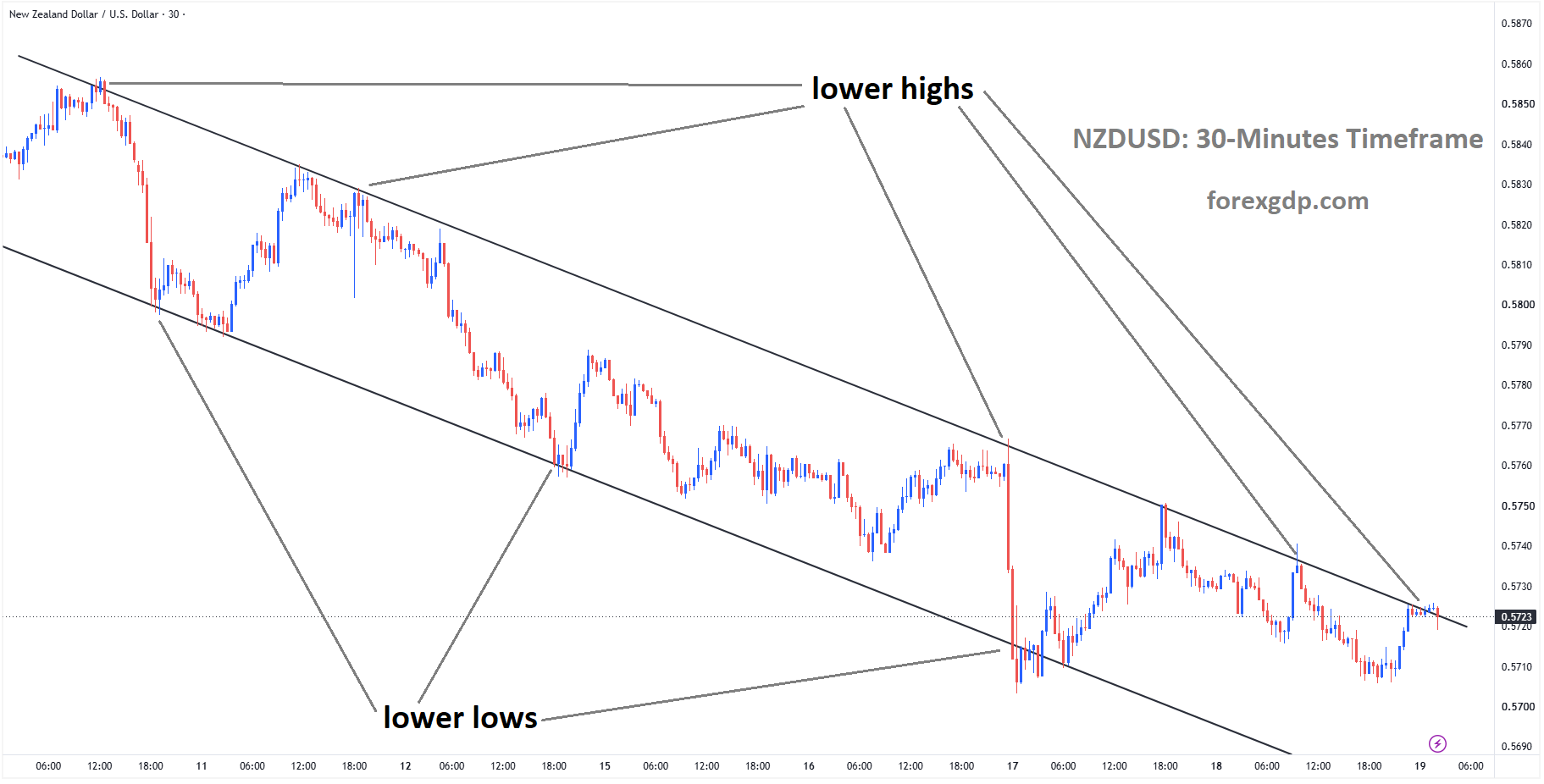
NZDUSD reached the lower high area of the descending channel
Comments from Federal Reserve Chair Kevin Warsh played an important role in the latest currency movement. His firm message on inflation encouraged investors to consider the possibility that US monetary policy could remain restrictive for longer than previously expected.
New Zealand’s economic data offered some positive signs, particularly through stronger exports and a smaller monthly trade deficit. However, the trade shortfall was still larger than economists had predicted. As a result, the domestic figures were not strong enough to overcome the wider influence of renewed US Dollar demand.
Hawkish Federal Reserve Message Supports the US Dollar
Kevin Warsh maintained a firm position on inflation and the future direction of US monetary policy. He explained that inflation remained too high and that recent economic figures had not shown enough lasting improvement.
This message matters because the Federal Reserve uses interest rates to manage inflation and economic activity. When inflation stays above the central bank’s comfort level, policymakers may keep borrowing costs elevated or consider further tightening.
Warsh’s remarks suggested that the Fed was not yet ready to declare victory over inflation. Although some data released during the summer showed signs of progress, he argued that the improvement was not convincing enough to prove that inflationary pressure had been brought under control.
Investors responded by adjusting their expectations for the Fed’s October meeting. The possibility of another interest rate increase gained more attention, supporting the US Dollar against several major currencies.
Higher US interest rates can make Dollar-based assets more attractive to global investors. This often increases demand for the Greenback, especially when other central banks have a less certain policy outlook. The shift in expectations therefore created a difficult environment for NZDUSD.
Interest Rate Expectations Drive Currency Demand
Central bank expectations remain one of the main forces influencing NZDUSD. The Federal Reserve and the Reserve Bank of New Zealand are both facing important decisions, but investors currently appear more focused on developments in the United States.
Markets increased their estimated probability of a Fed rate increase at the October meeting. The chance rose noticeably within a single day, showing how quickly sentiment changed after Warsh’s comments.
This repricing strengthened the belief that restrictive monetary conditions in the United States could continue for an extended period. Even if the Fed does not raise rates immediately, expectations of higher borrowing costs can still benefit the US Dollar.
The New Zealand Dollar also receives some support from expectations surrounding the RBNZ. Investors see a meaningful chance that New Zealand’s central bank could raise its policy rate at the upcoming October meeting.
Such a move could help the Kiwi by making New Zealand assets more attractive. However, expectations alone may not provide lasting support if the US Dollar continues to benefit from strong domestic data and a firm Federal Reserve stance.
The balance between these two policy outlooks will remain important. If the RBNZ sounds more confident about raising rates, the New Zealand Dollar could attract fresh interest. If the Fed continues to deliver a stronger message, however, the Greenback may remain the preferred currency.
New Zealand Trade Deficit Shows Partial Improvement

New Zealand’s latest trade figures delivered a mixed update on the country’s external economy. The monthly trade deficit became smaller in August compared with July, offering some encouragement.
A narrowing deficit means the gap between the value of imported and exported goods decreased. This can be positive because it suggests that trade activity is moving toward a healthier balance.
However, the deficit was still wider than economists had expected. That detail limited the positive impact of the report and raised questions about whether the improvement can continue during the coming months.
Exports recorded strong annual growth in August, improving from the pace seen in the previous month. This suggests that overseas demand for New Zealand products remained healthy.
New Zealand relies heavily on exports, particularly agricultural products, food, dairy goods and other commodities. Strong export performance can support economic activity by improving business income and bringing foreign currency into the country.
Imports also increased compared with the same period a year earlier, although their rate of growth slowed sharply from July. Rising imports can reflect healthy domestic demand, but they can also widen the trade gap when they grow faster than exports.
The overall report therefore contained both encouraging and disappointing elements. Export growth was a clear positive, while the larger-than-expected deficit prevented the data from delivering a stronger boost to the New Zealand Dollar.
Why the New Zealand Dollar Remains Vulnerable
The Kiwi is widely viewed as a risk-sensitive currency. It can perform well when investors feel confident about global economic growth, but it often faces pressure when uncertainty rises or traders move toward safer assets.
A firm US Dollar adds another challenge. When expectations for US interest rates move higher, investors may reduce exposure to currencies linked to smaller economies. This can weaken demand for the New Zealand Dollar even when local economic data show improvement.
New Zealand’s close trading relationship with China also remains important. Changes in Chinese demand can influence New Zealand’s exports and overall economic outlook. Any weakness in global trade or commodity demand may create additional pressure on the Kiwi.
Domestic monetary policy could offer some protection, particularly if the RBNZ indicates that further tightening is needed. Nevertheless, the central bank must carefully balance inflation risks against the possibility of slowing economic activity.
Higher interest rates can support a currency, but they can also increase pressure on households and businesses. This makes the RBNZ’s October decision especially important for the New Zealand Dollar’s broader direction.
Investors Await Further Economic Guidance
Attention will now remain focused on upcoming inflation, employment and growth data from both countries. These reports could help investors decide whether the Federal Reserve and the RBNZ are likely to tighten policy further.
In the United States, any evidence of persistent inflation or strong economic activity may reinforce expectations of higher rates. That outcome could keep the US Dollar well supported.
For New Zealand, stronger domestic figures and continued export growth may improve confidence in the economy. A clear hawkish signal from the RBNZ could also help the Kiwi recover some demand.
Until investors receive stronger evidence, the contrast between firm US monetary policy expectations and mixed New Zealand data may continue to influence NZDUSD sentiment.
Final Summary
NZDUSD came under pressure as the US Dollar strengthened following hawkish remarks from Federal Reserve Chair Kevin Warsh. His concerns about persistent inflation encouraged investors to increase expectations of tighter US monetary policy.
New Zealand’s trade deficit improved in August, supported by solid export growth and slower import expansion. However, the shortfall remained larger than economists had predicted, limiting the benefit for the Kiwi.
Expectations of possible RBNZ tightening provide some support to the New Zealand Dollar, but the Federal Reserve’s firm policy message currently carries greater influence. Future central bank guidance, inflation developments and trade performance will be central to the next phase of NZDUSD sentiment.
EURJPY Climbs as Ueda’s Firm Stance Fails to Lift Yen
The Euro continued to strengthen against the Japanese Yen after investors gave a cautious response to the Bank of Japan’s latest policy decision. Although the Japanese central bank raised interest rates and Governor Kazuo Ueda delivered firm comments about future policy, the Yen remained under pressure across the currency market.
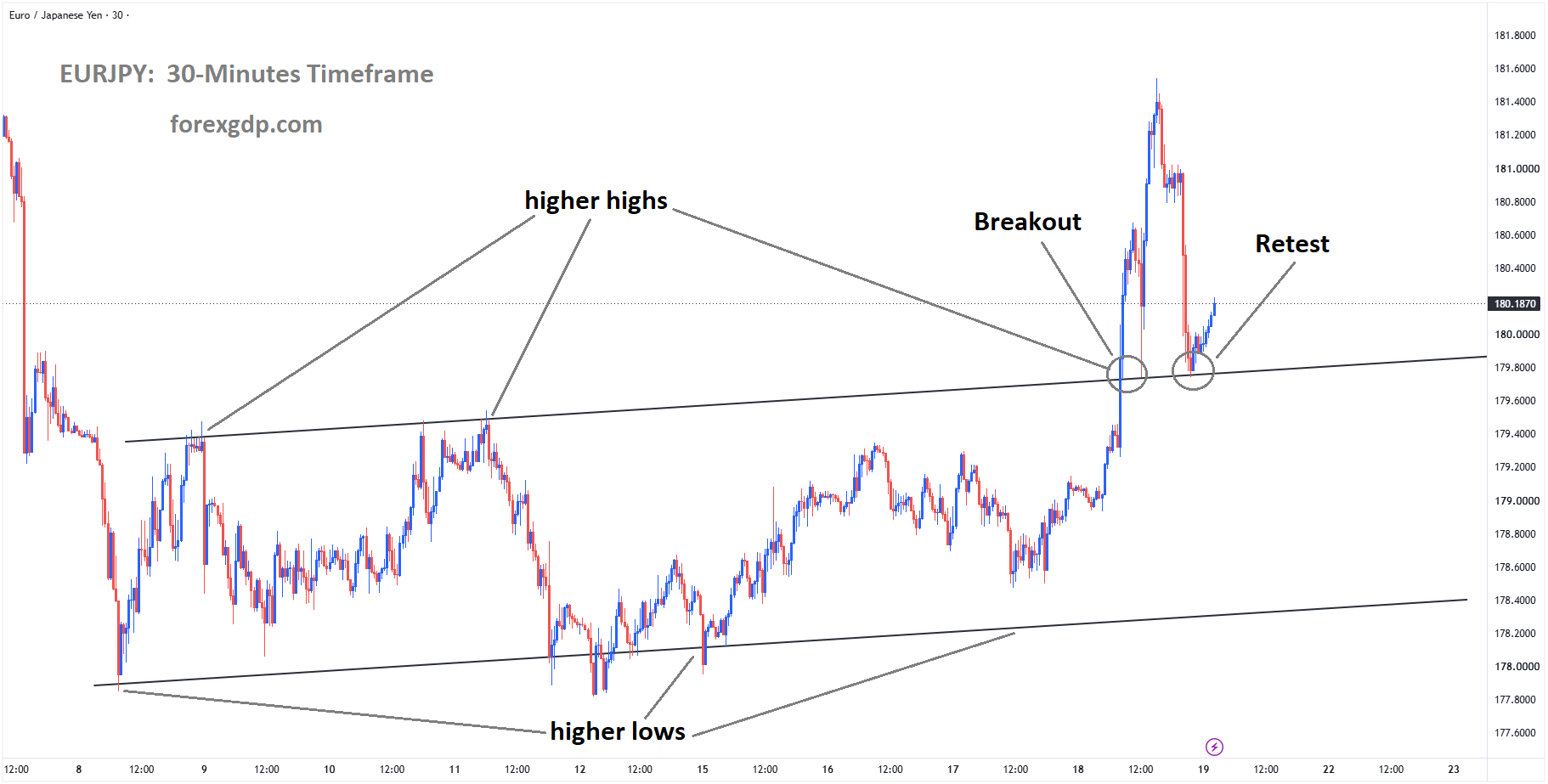
EURJPY is rebounding from the retest area of the broken ascending channel
The reaction suggests that traders were expecting a stronger signal from the Bank of Japan. The rate increase itself was widely anticipated, so attention quickly shifted toward the details of the decision, the level of support among policymakers, and the central bank’s willingness to continue tightening monetary policy.
Governor Ueda attempted to reassure markets by expressing confidence in Japan’s economic recovery. He also indicated that further rate increases could be introduced if economic growth and inflation continue to develop in line with the bank’s expectations. However, internal disagreement among committee members weakened the overall impact of his message.
As a result, EURJPY remained firm and headed toward a strong weekly performance. The currency pair benefited from broad Yen weakness as investors questioned whether the Bank of Japan could maintain a steady path of monetary tightening.
Bank of Japan Raises Rates but Leaves Investors Unconvinced
The Bank of Japan increased its key interest rate to its highest level in more than three decades. This represented another important step away from the extremely loose monetary policy that shaped Japan’s economy for many years.
The decision also showed that the central bank was willing to tighten policy sooner than its previous pattern suggested. Its earlier move took place several months ago, and the latest increase broke the slower pace that many market participants had expected.
Despite this important shift, the announcement failed to provide lasting support for the Yen. Investors had already prepared for a rate increase, which meant that the decision offered little surprise. Markets wanted clear evidence that the bank was ready to continue raising borrowing costs over the coming months.
Instead, the meeting revealed divisions within the policy committee. Three members opposed the decision, creating concerns about whether Governor Ueda could secure enough support for additional increases. The presence of several dissenting voices made the rate hike appear less forceful than the headline suggested.
This disagreement became one of the main reasons behind the Yen’s weakness. A central bank can influence a currency not only through its immediate policy action but also through expectations about what it may do next. When investors are unsure about the future direction of policy, the currency may struggle even after an interest-rate increase.
Governor Ueda Maintains Confidence in Japan’s Economy
During his post-meeting press conference, Governor Ueda offered a positive assessment of Japan’s economic conditions. He said the economy was recovering at a moderate pace and expressed confidence that growth could continue in the near term.
His comments reflected the Bank of Japan’s belief that the country may be entering a more stable economic period. Stronger wages, steady consumer activity, and ongoing inflation have allowed the central bank to gradually move away from its long-standing ultra-loose approach.
Ueda also explained that Japan’s financial environment remained supportive despite the recent increase in rates. His statement suggested that borrowing conditions were still favourable enough to support households and businesses.
More importantly, the governor indicated that the policy environment had entered a new stage. He promised that the central bank would consider further rate increases if economic activity and inflation developed as expected.
These remarks briefly helped the Yen because they confirmed that the latest move was not necessarily a one-time action. However, the support proved limited. Investors remained focused on the disagreement within the committee and the uncertainty surrounding Japan’s economic outlook.
Internal Opposition Weakens the BoJ’s Message

Three Bank of Japan committee members opposed the latest rate increase. Their resistance raised questions about the strength of support for continued monetary tightening.
Analysts described the decision as less aggressive than expected because some policymakers preferred to leave rates unchanged. They argued that uncertainty surrounding Japan’s economy made an immediate increase less appropriate.
Two of the dissenting members were appointed by Prime Minister Sanae Takaichi. This detail encouraged speculation that political support for higher interest rates might be weaker than previously believed. If political and economic concerns continue to influence the committee, the Bank of Japan may find it difficult to raise rates at a consistent pace.
The disagreement also created doubts about how the central bank would react if economic growth slowed. Japan’s economy remains exposed to changes in global demand, household spending, energy costs, and international trade. A weaker economic environment could give cautious policymakers more reasons to delay future action.
For currency markets, this uncertainty matters greatly. The Yen generally receives stronger support when investors expect the gap between Japanese interest rates and rates in other major economies to narrow. If the Bank of Japan proceeds slowly, that difference may remain wide enough to limit demand for the Japanese currency.
Inflation Gives Policymakers Room to Remain Patient
Recent inflation figures showed that price pressures remained broadly stable and close to the Bank of Japan’s target. This offered some reassurance that inflation was not accelerating beyond control.
Stable inflation can be viewed positively because it suggests that Japan’s economy is moving toward a healthier balance. However, it also reduces the urgency for rapid rate increases. Policymakers who opposed the latest decision may use the inflation data to argue that the bank has enough time to observe economic conditions before taking another step.
Governor Ueda also highlighted several risks that could affect future inflation. Rising wages may continue to support consumer demand and place upward pressure on prices. At the same time, conflict in the Middle East could influence energy costs, business confidence, and international trade.
Japan imports a significant amount of energy, making the country sensitive to disruptions in global oil and gas markets. Higher energy costs could lift inflation, but they could also hurt households and businesses. The central bank must therefore determine whether stronger price growth comes from healthy domestic demand or external pressures that may weaken the economy.
This difficult balance could encourage the Bank of Japan to move carefully, even if it remains committed to gradually raising rates.
Global Central Bank Decisions Reduce the Yen’s Advantage
The Yen’s reaction was also influenced by monetary policy decisions outside Japan. Recent announcements from the European Central Bank and the Federal Reserve changed the broader interest-rate outlook and reduced the competitive benefit of the Bank of Japan’s tightening move.
The Euro remained supported because investors continued to compare the policy direction of the ECB with that of the BoJ. While Japan raised rates, doubts about future increases prevented the Yen from fully benefiting.
The same issue applied to the US Dollar. A firm policy outlook from the Federal Reserve helped maintain demand for the American currency and placed additional pressure on the Yen.
These global developments increased the burden on the Bank of Japan. A single rate increase was not enough to produce a strong Yen recovery. Investors wanted clearer guidance, broader support among policymakers, and greater confidence that further tightening would follow.
Until those signals become stronger, the Yen may remain sensitive to decisions from other major central banks.
Final Summary
EURJPY continued its advance because the Bank of Japan’s rate increase failed to convince investors that a sustained tightening cycle was underway. Governor Ueda expressed confidence in Japan’s recovery and promised further action if growth and inflation remained supportive.
However, opposition from three committee members weakened the central bank’s message. Stable inflation, uncertainty about economic growth, political concerns, and global risks all supported a more cautious policy approach.
The Yen also received limited help from the broader global environment, as decisions from the European Central Bank and the Federal Reserve reduced Japan’s monetary policy advantage. The Bank of Japan has started an important transition, but investors still need stronger evidence that it can continue raising rates consistently.
AUDJPY Strengthens as RBA Outlook Supports the Australian Dollar
The Australian Dollar strengthened sharply against the Japanese Yen as investors compared the monetary policy outlooks of Australia and Japan. Although the Bank of Japan raised interest rates to their highest level in decades, the Yen weakened because the central bank did not deliver the strongly hawkish message some traders had expected.
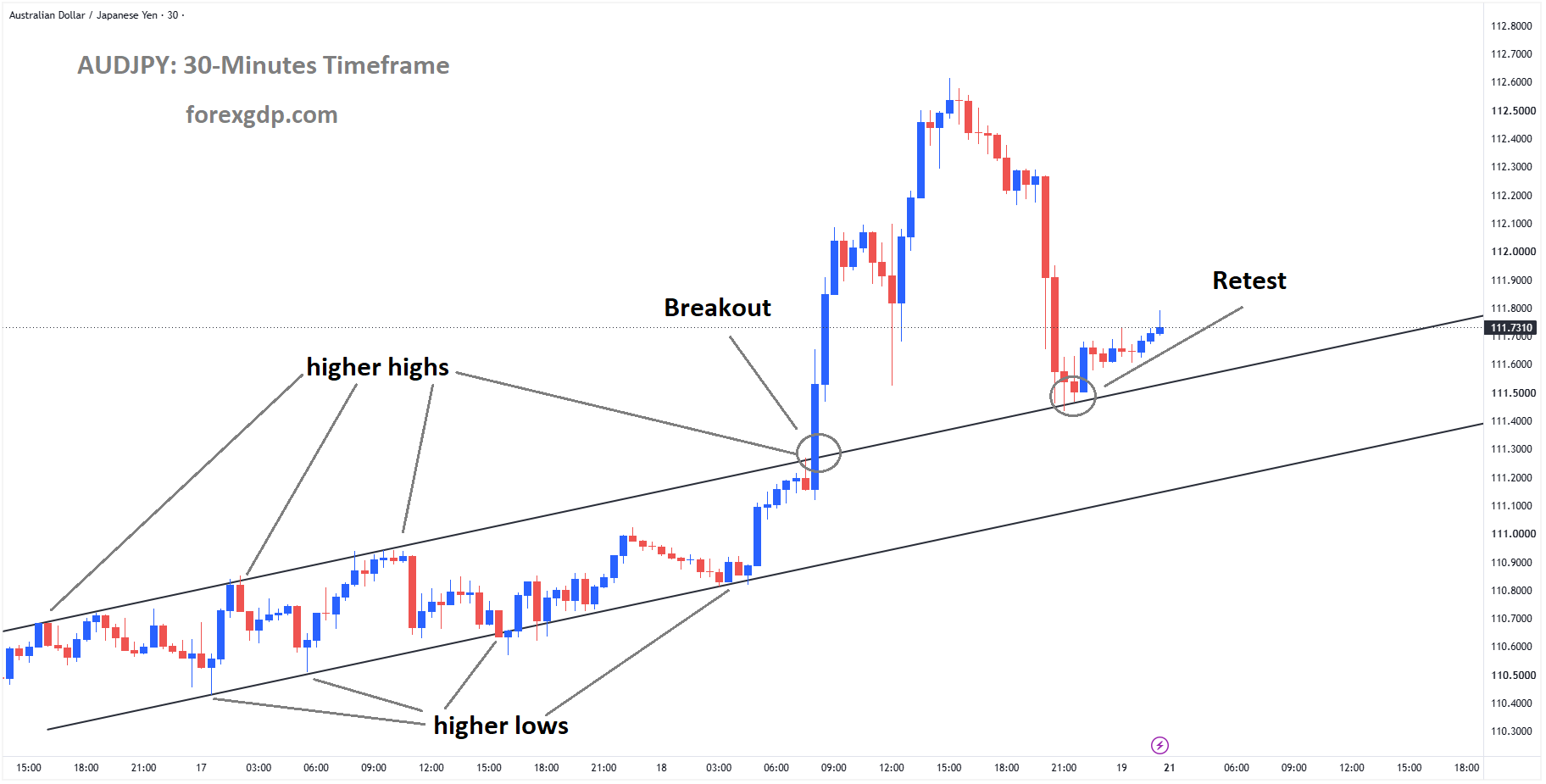
AUDJPY is rebounding from the retest area of the broken ascending channel
At the same time, the Australian Dollar received support from growing expectations that the Reserve Bank of Australia may continue raising borrowing costs. Persistent inflation, geopolitical uncertainty, and concerns about future price pressure have kept the possibility of another Australian rate increase firmly in focus.
The different market reactions to the two central banks created favorable conditions for AUDJPY. Japan delivered a rate hike that investors had already anticipated, while Australia continued to signal that further action may be needed to control inflation.
Bank of Japan Raises Interest Rates
The Bank of Japan increased its policy rate by 25 basis points, taking it to the highest level since 1995. The decision marked another important step in Japan’s gradual move away from the extremely loose monetary policy that shaped its economy for many years.
The rate increase was approved by a seven-to-two vote. Most policymakers supported higher borrowing costs, while Toichiro Asada and Ayano Sato opposed the decision.
Normally, an interest rate increase can support a country’s currency because higher rates may attract international capital. However, the Japanese Yen moved in the opposite direction. The market had already widely expected the decision, meaning the rate hike itself offered investors little fresh information.
Instead, attention quickly shifted to the Bank of Japan’s statement and its guidance about future policy. Investors were looking for a firm indication that additional rate increases could follow at a faster pace. That message did not arrive with enough strength to satisfy the most hawkish expectations.
Why the Japanese Yen Weakened After the Rate Hike
The Yen’s decline may appear surprising because the Bank of Japan increased borrowing costs. However, currency markets often react more strongly to future expectations than to decisions that have already been anticipated.
Investors had prepared for the rate hike before the meeting. As a result, the announcement was largely reflected in market expectations. Once the decision became official, traders focused on whether the central bank was ready to continue tightening policy aggressively.
The Bank of Japan maintained a cautious tone. It highlighted several risks that could affect the economy, inflation, and future policy decisions. These included tensions in the Middle East, changing demand linked to artificial intelligence, and instability in foreign exchange markets.
The central bank also recognised the possibility that underlying inflation could rise above its target. However, this concern was balanced by uncertainty surrounding economic growth and consumer prices. That careful approach reduced expectations of rapid or continuous rate increases.
BoJ Governor Kazuo Ueda repeated that the central bank remains prepared to raise interest rates when economic activity and price developments support further tightening. His comments kept the possibility of future action alive, but they did not offer a clear timetable.
Without stronger guidance, investors remained unsure about how soon another rate hike could arrive. This uncertainty limited the benefit of the latest decision for the Japanese Yen.
Japanese Inflation Encourages a Cautious Approach

Recent inflation figures have also weakened the case for faster monetary tightening in Japan. The country’s National Consumer Price Index showed little change, while underlying inflation remained below the Bank of Japan’s annual target.
These figures suggest that price pressure may not be strong enough to justify an aggressive series of rate increases. The central bank wants inflation to remain stable and sustainable, rather than being driven mainly by temporary external factors.
Japan also faces a delicate economic situation. Higher borrowing costs can support the Yen and control inflation, but they can also place pressure on households, companies, and government finances. The Bank of Japan therefore needs to normalise policy without damaging economic activity.
This balancing act explains why officials continue to use careful language. The central bank is moving toward tighter policy, but it does not want to create the impression that rapid increases are guaranteed.
For the Yen, that cautious stance is important. A single rate hike may not provide lasting support if investors believe that future moves will be slow, limited, or dependent on stronger economic evidence.
Australian Dollar Supported by Inflation Concerns
The Australian Dollar benefited from a very different policy environment. The Reserve Bank of Australia kept its policy rate unchanged after delivering three consecutive increases earlier in the year. However, the pause did not signal that its tightening campaign was necessarily complete.
Inflation in Australia remains a serious concern. RBA Governor Michele Bullock warned that price growth is still too high and that some inflation risks may be becoming more visible. Geopolitical tensions, particularly in the Middle East, could raise transportation, energy, and production costs.
These risks make the inflation outlook more uncertain. If businesses face higher costs, they may pass those expenses on to consumers. That could make it more difficult for inflation to return sustainably to the central bank’s preferred range.
Deputy Governor Andrew Hauser also indicated that additional rate increases may be required. His remarks reinforced the view that the RBA remains ready to act if inflation fails to ease at an acceptable pace.
The possibility of another increase gives the Australian Dollar a stronger policy advantage. Investors tend to favor currencies linked to central banks that may keep borrowing costs elevated or introduce further tightening.
Policy Expectations Favor the Australian Dollar
The contrast between Australia and Japan goes beyond their latest policy decisions. Japan raised rates but delivered cautious guidance, while Australia left rates unchanged but kept the door open to additional tightening.
This difference demonstrates why currency markets do not react only to the direction of the latest rate move. Expectations about future decisions can be even more influential.
The Bank of Japan is normalising policy after many years of exceptionally low borrowing costs. However, weak inflation signals and economic uncertainty may encourage officials to proceed gradually.
The Reserve Bank of Australia is dealing with inflation that remains uncomfortable. Policymakers are concerned that price pressure could continue for longer than expected, making another rate increase possible.
As long as investors believe the RBA may act more firmly than the Bank of Japan, the Australian Dollar could continue receiving relative support against the Yen. Future inflation reports, central bank speeches, and economic data from both countries will shape that outlook.
Final Summary
AUDJPY strengthened as investors responded to the contrasting monetary policy outlooks in Australia and Japan. The Bank of Japan raised interest rates to a multi-decade high, but the decision had already been expected and its cautious communication failed to provide strong support for the Yen.
Japanese inflation data also reduced expectations of faster tightening, encouraging investors to believe that future rate increases may arrive gradually.
Meanwhile, the Australian Dollar benefited from persistent inflation concerns and the possibility of further action from the Reserve Bank of Australia. Comments from senior RBA officials kept additional tightening firmly under consideration.
The different expectations surrounding the two central banks ultimately favored the Australian Dollar, as markets saw a stronger possibility of continued policy pressure in Australia than in Japan.
Crude Oil Slips as Saudi Supply Optimism Calms the Market
WTI Oil is moving toward its first weekly decline in three weeks as concerns about global supply disruptions begin to ease. The recent pullback follows a strong rally that lifted crude to its highest level in four months earlier in the week.
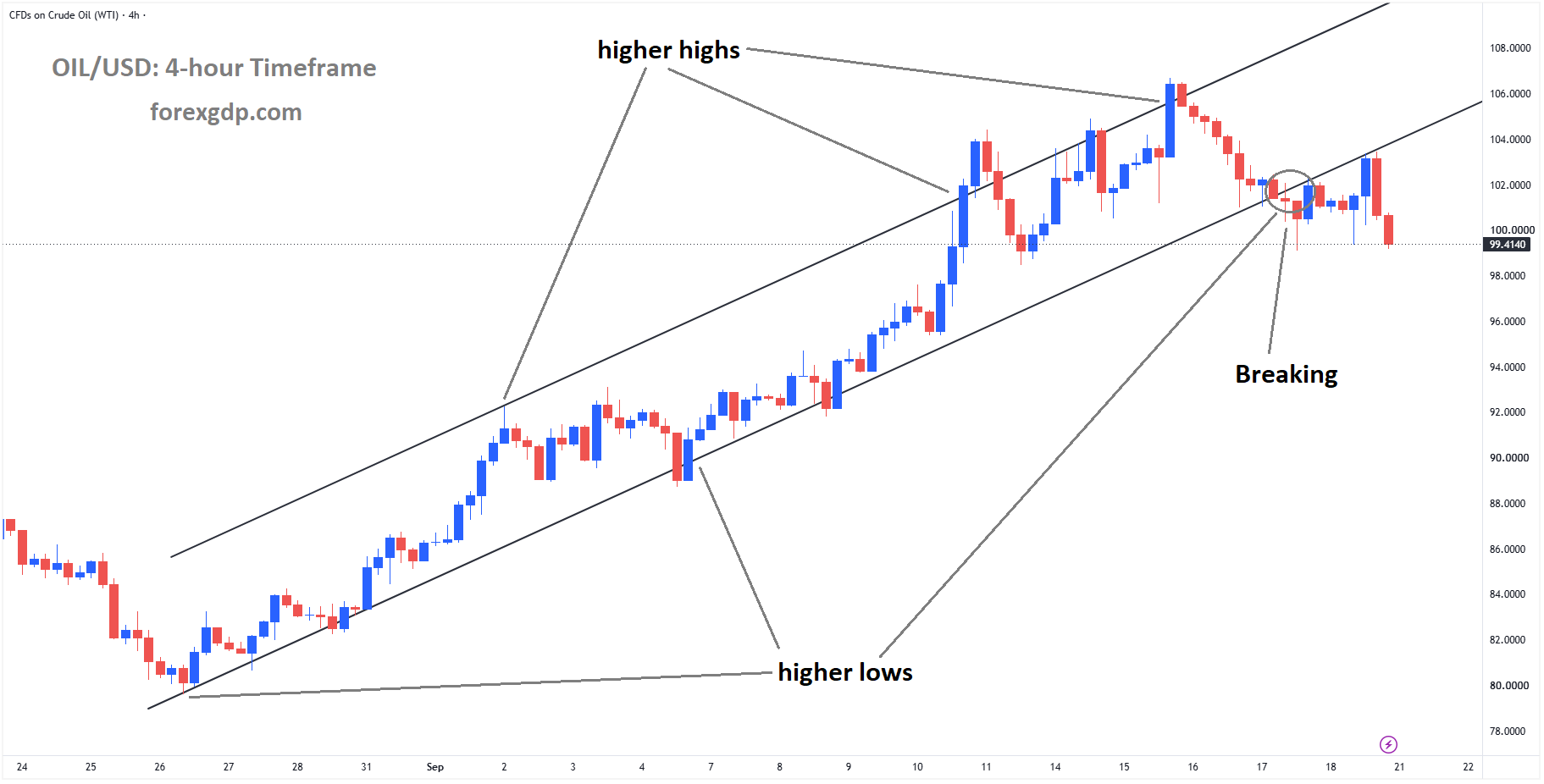
Crude Oil is breaking the higher low area of the ascending channel
Fresh reports about an alternative Saudi Arabian export route have offered some relief to the energy market. At the same time, China is reportedly increasing diplomatic pressure on Iran to limit the actions of Yemen’s Houthis around important shipping routes.
However, the wider situation remains highly uncertain. Continued attacks, regional tensions, and restrictions around key waterways are preventing Oil prices from falling sharply. Traders remain focused on whether diplomatic efforts can protect global energy flows or whether the conflict will create further disruption.
Saudi Arabia Finds Another Route for Oil Exports
Saudi Arabia has reportedly secured an alternative route through Oman to transport crude Oil to customers across Asia. The development has reduced some fears that Saudi exports could face serious delays following recent damage to an important pipeline.
A drone attack reportedly affected the West-East pipeline, which carries Saudi crude toward the Red Sea port of Yanbu. This pipeline had become increasingly important because it allowed the country to reduce its dependence on the Strait of Hormuz.
The alternative route through Oman could help Saudi Arabia maintain supplies to major Asian buyers even if traditional shipping paths remain restricted. This has improved confidence that some Oil deliveries can continue despite the difficult security environment.
Asia is one of the world’s largest energy-consuming regions, and many countries depend heavily on Middle Eastern crude. Any interruption to Saudi exports could create problems for refiners, manufacturers, transport companies, and national energy systems. News of another available route has therefore reduced some of the immediate pressure surrounding supply.
Still, an alternative route cannot completely remove the risk. Transporting Oil through different channels may require additional time, coordination, security, and cost. The market will closely monitor whether Saudi Arabia can use this route on a large and reliable scale.
China Calls for Restraint in the Red Sea
China has reportedly asked Iran to use its influence over Yemen’s Houthis after the group seized important coastal areas near the Red Sea. The Houthis have also threatened activity around the Bab el-Mandeb waterway, one of the most important passages for international trade.
The Bab el-Mandeb connects the Red Sea with the Gulf of Aden. Commercial vessels travelling between Europe, the Middle East, and Asia frequently use this route. Any blockade or major security threat could force ships to take longer journeys around Africa.
Such diversions would increase transport costs, extend delivery times, and place additional pressure on global supply chains. Energy shipments would be particularly vulnerable because large volumes of Oil and fuel products regularly pass through the region.
China has strong reasons to support stability. Its economy depends on reliable access to imported energy and smoothly functioning trade routes. Beijing’s appeal to Iran suggests that it is trying to prevent the conflict from causing wider economic damage.
Diplomatic pressure may calm some fears, but its effectiveness remains unclear. Iran has close ties with the Houthis, although the group also makes decisions based on its own regional goals. Investors are therefore waiting to see whether China’s involvement leads to meaningful restraint.
Middle East Tensions Continue to Support Crude Oil

Despite the recent decline in Oil prices, uncertainty across the Middle East remains significant. Reciprocal attacks involving Saudi Arabia and the Houthis have raised concerns that the conflict could spread further across Yemen and the Red Sea.
China’s foreign ministry has stated that it does not want regional tensions to expand into these areas. However, continued military action suggests that the risk of escalation has not disappeared.
The situation involving the United States and Iran adds another layer of uncertainty. Their conflict appears to be entering a less clearly defined stage, making it difficult to judge what could happen next. Markets often react strongly when there is no clear understanding of the political or military direction.
This uncertainty is helping keep crude Oil supported. Even when supply fears ease temporarily, traders remain cautious because a single attack or policy change could quickly affect transport routes, production facilities, or export operations.
Strait of Hormuz Remains a Major Concern
The Strait of Hormuz remains one of the most serious risks facing the global Oil market. The waterway is practically closed, creating major challenges for countries that rely on it to export crude and other energy products.
A large share of the world’s seaborne Oil normally moves through the Strait of Hormuz. Restrictions in this narrow passage can quickly affect global supply expectations, shipping insurance, freight costs, and delivery schedules.
Saudi Arabia’s alternative export route may reduce part of the pressure, but it cannot replace all the capacity that normally passes through Hormuz. Other regional producers may also have limited options for redirecting their shipments.
The UK Maritime Trade Operations has reported an attack on a vessel northeast of Oman’s Khasab. The location is especially important because it is close to the Strait of Hormuz. This incident has reinforced concerns about the safety of commercial shipping in the area.
Shipping companies may become increasingly cautious if attacks continue. Some operators could delay journeys, avoid certain routes, or demand stronger security arrangements. Insurance providers may also raise charges for vessels travelling through high-risk waters.
Supply Relief Remains Fragile
The recent easing in Oil prices reflects a combination of improved supply hopes and diplomatic activity. Saudi Arabia’s reported route through Oman has reduced fears of an immediate export disruption, while China’s efforts may help discourage further Houthi action.
However, neither development provides a complete solution. The region is still facing active conflict, damaged infrastructure, shipping threats, and uncertainty around several critical waterways.
Global Oil supply depends not only on production but also on the ability to transport crude safely. Even if producers maintain output, disruptions at ports, pipelines, or sea routes can create shortages elsewhere. This makes shipping security just as important as production capacity during periods of geopolitical tension.
The market is therefore balancing two competing forces. Alternative supply routes and diplomatic efforts are encouraging a modest retreat, while the continued danger of escalation is limiting that decline.
Final Summary
WTI Oil is heading toward its first weekly decline in three weeks as immediate supply fears begin to soften. Reports that Saudi Arabia can move crude through Oman have provided relief after damage to the West-East pipeline raised concerns about export disruptions.
China’s reported request for Iran to restrain the Houthis has also supported hopes for greater stability around the Red Sea and the Bab el-Mandeb waterway. However, ongoing attacks, uncertainty surrounding the US-Iran conflict, and restrictions in the Strait of Hormuz continue to threaten global energy flows.
The latest developments have reduced some pressure on the Oil market, but the relief remains fragile. As long as important shipping routes remain exposed to conflict, crude prices are likely to stay sensitive to every diplomatic statement, military event, and supply announcement from the region.