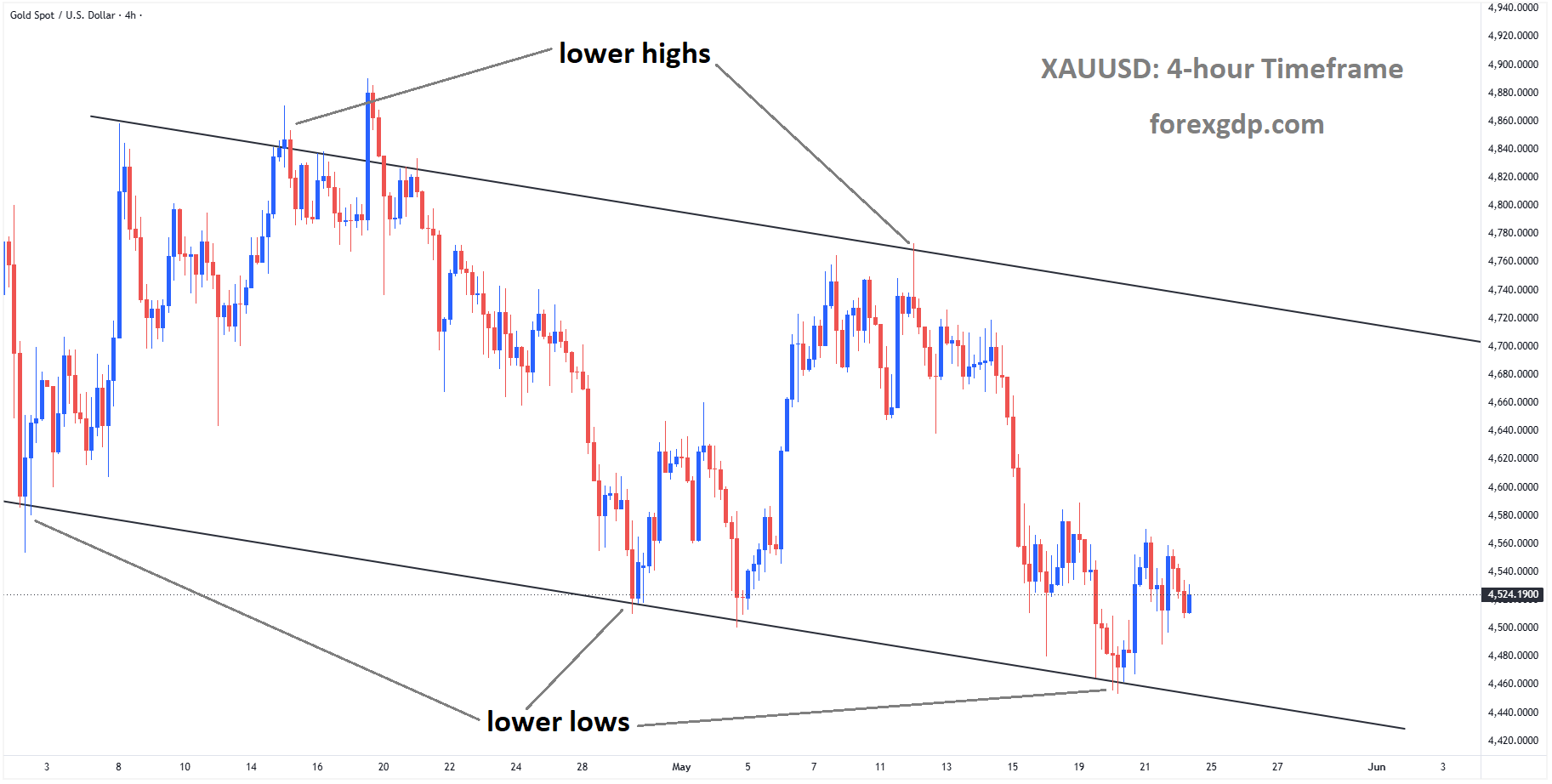
XAUUSD is moving in a descending channel, and the market has rebounded from the lower low area of the channel
Gold prices remained under pressure during Friday’s European trading session as investors continued to favor the US Dollar over safe-haven assets. Although Gold managed to stay above the important $4,500 level, the metal struggled to recover as global uncertainty and expectations of tighter US monetary policy strengthened the Dollar.
The recent movement in Gold prices reflects growing confidence in the US economy and increasing expectations that the Federal Reserve may keep interest rates high for a longer period. At the same time, tensions involving Iran and the United States are adding another layer of uncertainty to financial markets.
Strong US Dollar Continues to Limit Gold’s Recovery
One of the biggest reasons behind Gold’s weakness is the continued strength of the US Dollar. The Dollar recently climbed to its highest level in six weeks, supported by expectations that the Federal Reserve could maintain a strict stance on inflation.
Gold and the US Dollar often move in opposite directions. When the Dollar becomes stronger, Gold usually becomes more expensive for international buyers, reducing demand. This relationship has once again become visible in the current market environment.
Investors are now increasingly convinced that the Federal Reserve will avoid cutting interest rates in 2026. Instead, many traders believe there is even a possibility of another rate hike before the end of the year. Rising energy prices and concerns about inflation are playing a major role in shaping these expectations.
Higher interest rates generally reduce the appeal of Gold because the metal does not provide interest or yield. As a result, investors tend to shift their money toward assets that can generate returns, such as government bonds or interest-bearing investments.
Federal Reserve Maintains a Hawkish Tone
Recent comments and meeting records from Federal Reserve officials have further strengthened expectations of tighter monetary policy. The minutes from the Federal Open Market Committee meeting held on April 28–29 showed that policymakers remain worried about inflation staying above the central bank’s 2% target.
Several officials indicated that keeping interest rates elevated for a longer period may be necessary if inflation does not cool down. Some policymakers even discussed the possibility of raising rates again if price pressures continue.
This cautious approach from the Federal Reserve has pushed US Treasury bond yields higher in recent weeks. Rising yields often support the US Dollar because global investors seek better returns from US assets.
According to market expectations tracked by the CME Group FedWatch Tool, there is now more than a 60% chance that the Federal Reserve could raise rates by 25 basis points during the December meeting. This shift in expectations has become a major challenge for Gold prices.
Geopolitical Risks Remain in Focus
While the stronger Dollar has been hurting Gold, geopolitical tensions continue to keep investors cautious. The ongoing discussions between the United States and Iran remain uncertain, with several major disagreements still unresolved.
A senior Iranian official recently stated that no final agreement has been reached between the two countries, although both sides have reportedly narrowed their differences. However, major concerns still remain around Iran’s uranium enrichment activities and its control over the Strait of Hormuz.
The Strait of Hormuz is one of the world’s most important shipping routes for oil transportation. Any disruption in this region could affect global energy supplies and increase tensions across financial markets.
US Secretary of State Marco Rubio warned that Iran’s reported intention to charge tolls on ships moving through the Strait could act like a blockade and create additional obstacles for peace negotiations.
US President Donald Trump also addressed the issue, stating that the United States opposes any tolls on ships using the Strait of Hormuz. He further added that the US military would move to secure Iran’s stockpile of highly enriched uranium.
These developments have kept geopolitical risks alive in global markets. Normally, Gold benefits from uncertainty and political tensions because investors often turn to safe-haven assets during unstable periods. However, the strong performance of the US Dollar has so far overshadowed that support.
Investor Sentiment Shifts Toward the Dollar
Market sentiment currently appears to favor the US Dollar more than Gold. Investors are increasingly focusing on the Federal Reserve’s inflation concerns and the possibility of higher borrowing costs in the future.
The combination of rising Treasury yields, strong economic confidence, and expectations of tighter monetary policy has created strong support for the Dollar. This trend has reduced the appeal of non-yielding assets like Gold.
Even though geopolitical tensions remain elevated, traders seem more interested in assets linked to the strength of the US economy. As long as the Federal Reserve maintains its hawkish tone, Gold may continue facing difficulty in attracting strong buying interest.
What Could Influence Gold Moving Forward?
Several important factors could shape Gold’s direction in the coming weeks and months.
Inflation Trends in the United States
Inflation remains one of the most important issues for the Federal Reserve. If inflation stays high, the central bank could continue supporting higher interest rates, which may place additional pressure on Gold.
However, if inflation begins to slow meaningfully, expectations around future rate hikes could weaken, potentially helping Gold recover.
Developments in US-Iran Relations
Any major breakthrough or setback in negotiations between the United States and Iran could quickly impact market sentiment. Escalating tensions in the Middle East often increase uncertainty and may encourage investors to seek safe-haven assets like Gold.

XAUUSD is falling from the lower high area of the descending channel
At the same time, a peaceful resolution could reduce geopolitical fears and support riskier investments instead.
Strength of the US Dollar
The Dollar’s performance will likely remain one of the key drivers for Gold prices. If the Dollar continues climbing, Gold could remain under pressure. On the other hand, any weakening in the Dollar may provide some support for the precious metal.
Final Summary
Gold continues to struggle as a stronger US Dollar and expectations of tighter Federal Reserve policy reduce demand for the precious metal. Investors are increasingly betting that US interest rates will remain elevated for longer, with some even expecting another rate hike before the end of 2026.
Meanwhile, tensions involving Iran and the Strait of Hormuz continue to create uncertainty in global markets. Although geopolitical risks usually support Gold, the current strength of the US Dollar has become the dominant force influencing price movements.
As markets closely watch inflation data, Federal Reserve decisions, and developments in the Middle East, Gold is likely to remain sensitive to changes in investor sentiment and global economic conditions.