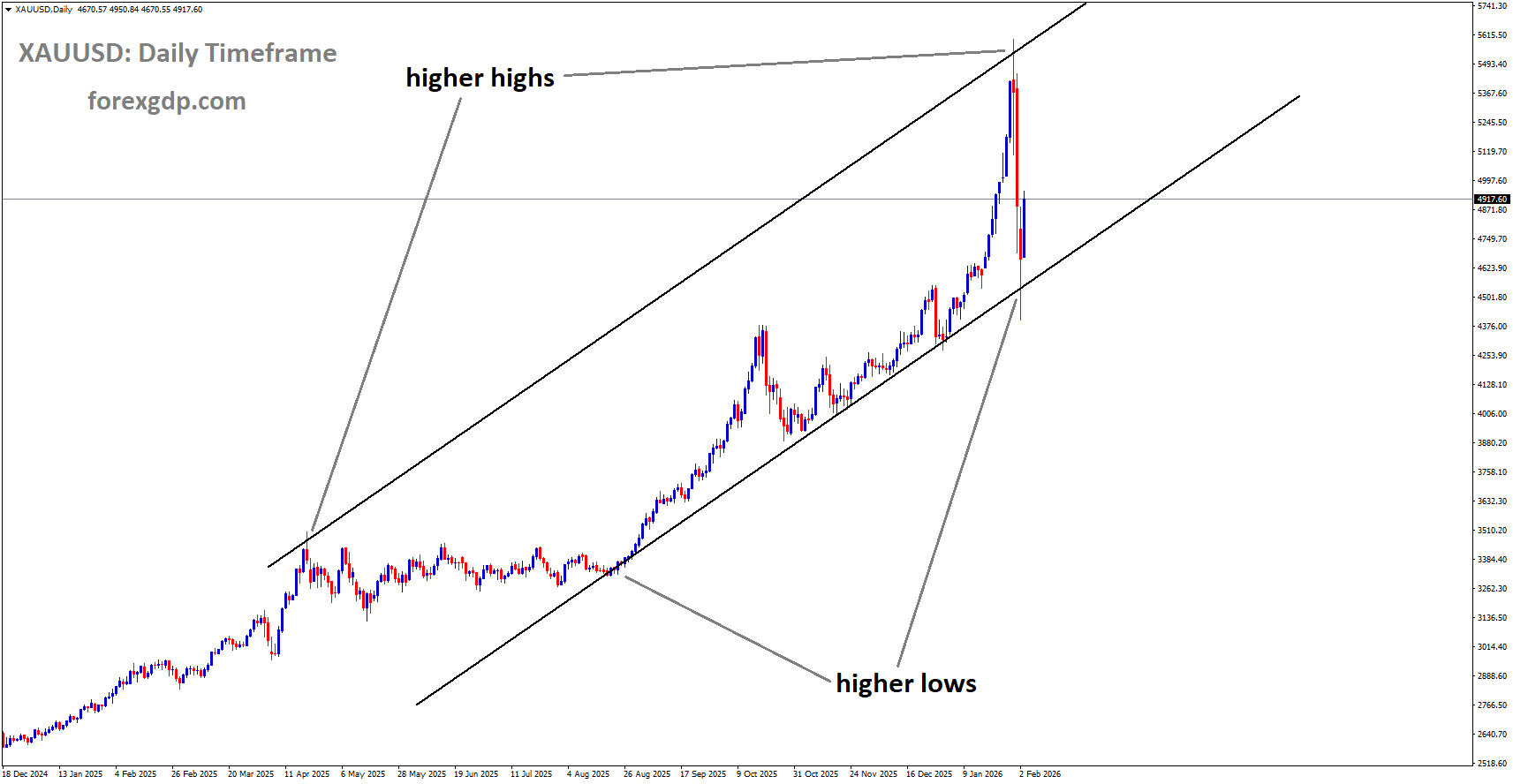
XAUUSD is moving in an uptrend channel, and the market has rebounded from the higher low area of the channel
Gold has staged a strong recovery after a sudden and aggressive sell-off shook the market last week. As buyers returned to take advantage of lower levels, confidence slowly rebuilt across the precious metals space. The rebound reflects renewed interest in gold’s long-term appeal, even as short-term pressures such as a stronger US dollar and easing geopolitical tensions continue to shape the outlook.
This latest move highlights how quickly sentiment can shift in the gold market. While uncertainty remains, the underlying demand for gold has not disappeared. Instead, recent price action suggests that many investors still see gold as a valuable part of their portfolios, especially during periods of heightened volatility.
What Drove the Sudden Gold Sell-Off
The sharp decline that hit gold last week caught many market participants off guard. However, the sell-off was not triggered by a major change in economic fundamentals. Instead, it was largely the result of technical factors and positioning dynamics.
As gold had been climbing steadily and reaching new highs, many traders were holding large positions. When prices began to fall, some of these positions were unwound rapidly. Margin-related selling also played a role, forcing traders to liquidate holdings to meet requirements. This created a fast-moving drop that fed on itself for a short period.
Importantly, this kind of move does not necessarily signal a long-term shift in direction. Once the selling pressure eased, buyers who had been waiting on the sidelines stepped back in. These buyers saw the pullback as an opportunity rather than a warning sign.
The rebound in gold was mirrored by strength in other precious metals as well. This broader recovery suggests that investor appetite for hard assets remains intact, even after a period of intense volatility.
The Role of the US Dollar and Global Developments

One of the key factors influencing gold’s near-term performance is the US dollar. A firmer dollar often makes gold less attractive to international buyers, as it becomes more expensive when priced in other currencies. Recently, the dollar has shown signs of recovery after a period of weakness, adding some pressure to gold’s upward momentum.
This dollar rebound has been supported by several developments in the United States. Markets reacted positively to the nomination of a new Federal Reserve chair who is seen as focused on controlling inflation. This eased concerns that interest rates could be cut too aggressively under political influence. As a result, confidence in the dollar improved.
At the same time, economic data from the US has been relatively encouraging. Stronger manufacturing activity has reinforced the idea that the economy is holding up better than some had feared. This has given policymakers more room to be patient, reducing expectations for rapid changes in monetary policy.
Geopolitical factors have also played a role. Recent signals pointing to easing tensions between the United States and Iran have slightly reduced demand for traditional safe-haven assets like gold. Statements from leaders on both sides suggest a willingness to engage in talks, lowering the immediate risk of escalation. While geopolitical risks have not vanished, even small improvements in the global outlook can affect short-term demand for gold.
Trade News and Its Impact on Market Sentiment
Another development shaping market sentiment is progress on international trade. A newly announced agreement between the United States and India has helped improve the overall mood in global markets. Under this deal, trade barriers are set to be reduced, and economic cooperation is expected to increase.
Trade agreements like this can influence gold indirectly. When investors feel more optimistic about global growth and stability, they may reduce exposure to safe-haven assets and shift toward riskier investments. This does not mean gold loses its value, but it can slow the pace of gains during periods of improving confidence.
That said, trade relationships remain complex and can change quickly. While one agreement may support optimism, unresolved disputes elsewhere continue to create uncertainty. This ongoing balance between positive and negative news helps explain why gold often moves in sharp bursts rather than smooth trends.
Why Volatility Remains a Key Feature
Recent price action has made one thing clear: volatility is still a defining feature of the gold market. Large swings in both directions reflect uncertainty about the global economy, monetary policy, and geopolitical risks.
For long-term investors, this volatility can be unsettling, but it is not unusual for gold. Historically, gold has gone through periods of sharp corrections followed by strong recoveries. These movements often shake out short-term traders while reinforcing the conviction of longer-term holders.
The latest rebound shows that buyers remain active and willing to step in when prices fall quickly. This behavior suggests that gold is still viewed as a strategic asset rather than a short-term trade alone.
At the same time, the absence of fresh major catalysts means that gold could enter a phase of consolidation. Without new economic surprises or geopolitical shocks, prices may move sideways as the market digests recent events. This kind of pause is common after dramatic moves and can set the stage for the next meaningful trend.
The Bigger Picture for Gold Investors
Looking beyond daily fluctuations, the broader environment continues to offer reasons for gold to remain relevant. Inflation concerns, shifting monetary policies, and geopolitical uncertainty are all factors that support long-term interest in the metal.
Even when some of these pressures ease temporarily, others tend to emerge. This constant interplay is why gold often serves as a hedge against a wide range of risks, rather than responding to a single narrative.

XAUUSD is moving in an uptrend line
Investors are also paying close attention to central bank behavior around the world. Continued interest in gold reserves by central banks adds another layer of demand that is less sensitive to short-term price movements.
While short-term headwinds such as a stronger dollar can limit immediate upside, they do not erase the underlying reasons many investors hold gold. Instead, they contribute to the ebb and flow that defines the market.
Final Summary
Gold’s recent recovery underscores the resilience of demand even after a sharp and unsettling sell-off. The pullback was driven more by technical and positioning factors than by a breakdown in fundamentals. As selling pressure faded, buyers returned, lifting prices and restoring some confidence.
Near-term gains may be moderated by a stronger US dollar and signs of easing geopolitical tensions. Positive developments in trade and solid US economic data have improved market sentiment, reducing the urgency for safe-haven assets. Still, volatility remains high, and sudden shifts in direction are likely to continue.
In the bigger picture, gold retains its appeal as a long-term store of value and a hedge against uncertainty. Periods of consolidation or correction do little to change that role. Instead, they remind investors that gold’s journey is rarely smooth, but its place in the global financial landscape remains firmly established.