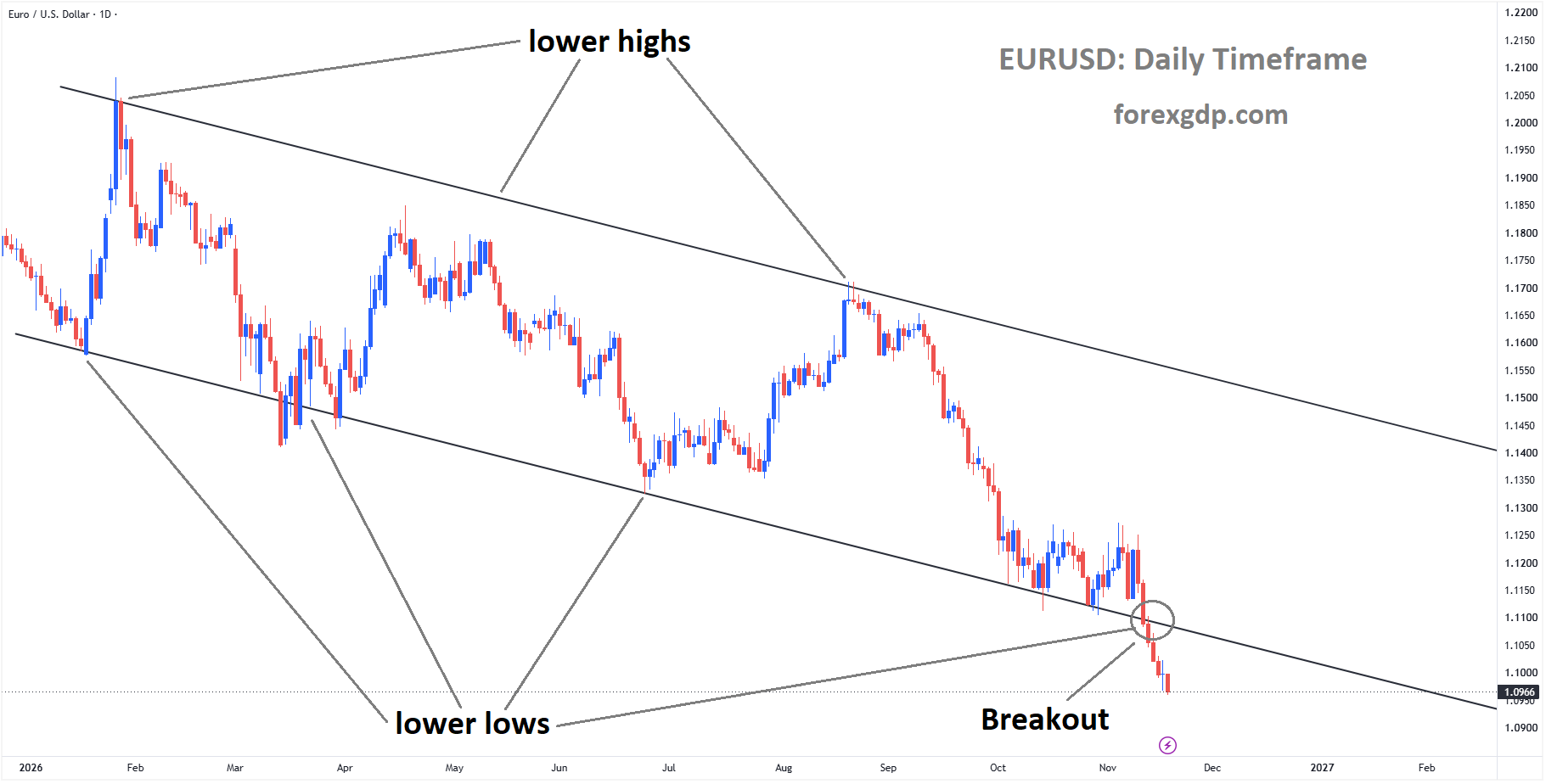
EURUSD has broken the descending channel to the downside
EURUSD Struggles for Stability as European Inflation Figures Fuel Economic Uncertainty
The Euro continues to face pressure against the US Dollar as strong economic data from the United States strengthens confidence in the American economy. At the same time, the latest Eurozone inflation figures have provided mixed signals, leaving investors uncertain about the European Central Bank’s next monetary policy decisions.
Although the Euro has shown some signs of recovery following a period of weakness, the broader economic environment remains challenging. Strong US economic performance, expectations of tighter Federal Reserve monetary policy, and changing inflation conditions across Europe are influencing investor confidence.
The latest inflation report from Eurostat highlights the challenges facing European policymakers. While overall inflation has shown signs of slowing, underlying inflation remains persistent, creating uncertainty about how quickly price pressures might ease.
Euro Faces Continued Pressure From a Stronger US Dollar
The Euro has struggled to regain momentum as the US Dollar continues to benefit from encouraging American economic data. Investors have responded positively to signs that the US economy remains resilient despite concerns about inflation and tighter financial conditions.
Strong economic performance in the United States often increases demand for the Dollar. When businesses continue expanding, employment conditions remain healthy, and consumer activity stays strong, investors may view the American economy as more attractive than other major economies.
This difference in economic performance can influence currency movements, particularly when the Eurozone faces slower growth and uncertainty about inflation.
Another important factor supporting the Dollar is the expectation that the Federal Reserve may maintain a restrictive monetary policy stance. When investors believe US interest rates could remain elevated or increase further, Dollar-denominated financial assets may become more appealing.
For the Euro, these developments create a difficult environment. Even when European economic reports contain encouraging information, the currency may struggle to strengthen if the US economic outlook remains comparatively favorable.
Eurozone Inflation Data Sends Mixed Signals
The latest inflation figures released by Eurostat provide a more detailed picture of price developments across the Eurozone.
According to the final October Harmonized Index of Consumer Prices (HICP) report, consumer prices increased by 0.5% compared with the previous month. This reading was higher than the initial estimate of 0.4%, suggesting that monthly inflation was slightly stronger than originally reported.
However, the figure remained below September’s 0.6% increase, indicating that the pace of monthly price growth had moderated.
On an annual basis, headline inflation remained unchanged at 4%, matching the earlier estimate.
These figures suggest that inflation pressures were still present across the European economy, even though some measures showed signs of improvement.
For households, persistent inflation can affect purchasing power and everyday spending decisions. Higher costs for goods and services may encourage consumers to reduce nonessential purchases, potentially weakening economic activity.
Businesses can also face difficulties when operating expenses remain elevated. Rising production costs, transportation expenses, and employee wages may affect profitability and influence future investment decisions.
As a result, inflation remains an important concern for both European policymakers and financial market participants.
Core Inflation Remains a Major Concern for the European Central Bank
One of the most significant developments in the October inflation report was the upward revision to annual core inflation.
Core HICP inflation increased to 2.6% year over year, compared with the preliminary estimate of 2.5%. Meanwhile, monthly core inflation remained unchanged at 0.3%.
Core inflation excludes food and energy prices, which can experience considerable short-term fluctuations. By removing these categories, economists and central banks can better understand the underlying direction of consumer prices.
The upward revision suggests that inflationary pressures remained stronger than initially expected in parts of the Eurozone economy.
This development is particularly important for the European Central Bank (ECB), which is responsible for maintaining price stability across countries that use the Euro.
The ECB aims to keep inflation at 2% over the medium term. When underlying inflation remains above that objective, policymakers may be cautious about easing monetary conditions too quickly.
Persistent core inflation can reflect several economic factors, including rising service costs, wage growth, and businesses passing higher expenses on to consumers.
Although the revision was relatively small, it highlights the difficulty of bringing inflation under control without placing unnecessary pressure on economic growth.
Why Inflation Figures Matter for ECB Monetary Policy

Inflation reports play an essential role in shaping expectations about future European Central Bank decisions.
When inflation remains elevated, central banks may maintain higher interest rates to reduce borrowing, moderate consumer spending, and encourage price stability.
Higher borrowing costs can discourage households from taking out loans and make businesses more cautious about financing expansion projects.
Over time, weaker demand can help reduce inflation. However, restrictive monetary policy can also slow economic activity and increase financial pressure on consumers and companies.
This creates a delicate balancing act for the ECB.
If policymakers focus too heavily on reducing inflation, they risk weakening an economy that may already be experiencing slower growth. On the other hand, easing monetary policy before inflation is sustainably controlled could allow price pressures to persist.
The latest Eurozone inflation figures illustrate this challenge.
Headline inflation has shown some moderation on a monthly basis, but the upward revision to annual core inflation suggests that underlying price pressures have not disappeared.
Consequently, investors are likely to pay close attention to upcoming ECB communications for clues about how officials interpret these developments.
Strong US Economic Data Supports Federal Reserve Tightening Expectations
While European policymakers evaluate mixed inflation signals, economic developments in the United States continue to support expectations of restrictive Federal Reserve policy.
Strong US economic indicators can suggest that businesses and consumers are handling higher borrowing costs better than anticipated.
When economic activity remains resilient, the Federal Reserve may have greater flexibility to keep interest rates elevated while working to control inflation.
This possibility can strengthen the US Dollar because relatively attractive interest rates may encourage international investors to hold American financial assets.
The relationship between interest rate expectations and currency demand is especially important when comparing the United States with the Eurozone.
If investors expect the Federal Reserve to maintain tighter monetary conditions than the ECB, the Dollar may continue to attract stronger demand.
However, expectations can change as new economic information becomes available.
A slowdown in US economic activity, weaker employment conditions, or further progress in reducing inflation could influence the Federal Reserve’s policy outlook.
Similarly, stronger European growth or persistent Eurozone inflation could change expectations about ECB decisions.
For this reason, the relative strength of the two economies remains a central factor influencing the Euro and US Dollar.
Economic Growth Differences Influence Investor Confidence
Beyond inflation and interest rates, broader economic conditions also affect confidence in the Euro.
The Eurozone includes several major economies with different industrial structures, consumer markets, and fiscal challenges. Changes in manufacturing activity, business investment, household spending, and international trade can influence the region’s overall performance.
When European economic growth appears weaker than US growth, investors may become more cautious about holding Euro-denominated assets.
Uncertainty surrounding energy costs, consumer demand, and business confidence can add to these concerns.
Meanwhile, continued resilience in the American economy may reinforce the perception that the United States offers comparatively stronger economic opportunities.
Nevertheless, currency sentiment is not determined by one economic report or a single central bank announcement.
Investors evaluate a wide range of developments, including inflation trends, employment conditions, government policies, and global economic risks.
A meaningful improvement in European economic conditions could gradually strengthen confidence in the Euro, particularly if the difference between US and Eurozone growth begins to narrow.
What Investors Will Watch in Upcoming Economic Reports
Future economic releases will help clarify whether the current differences between the US and Eurozone economies are likely to continue.
In Europe, attention will remain focused on inflation, consumer spending, employment, and business activity. These indicators can help determine whether price pressures are easing while economic growth remains stable.
Investors will also monitor statements from ECB officials to understand how the central bank balances inflation risks against concerns about weaker economic activity.
In the United States, employment reports, consumer inflation figures, and broader economic growth data will remain important for assessing the Federal Reserve’s policy direction.
Central bank communication may be especially influential when economic indicators provide conflicting signals.
Ultimately, changes in expectations about future monetary policy could play an important role in shaping confidence in both currencies.
Final Summary
The Euro remains under pressure as strong US economic data and expectations of restrictive Federal Reserve policy continue to support the US Dollar.
The latest Eurozone inflation report has introduced additional uncertainty. Although monthly headline inflation moderated compared with September, the upward revision to annual core inflation suggests that underlying price pressures remain persistent.
These mixed signals present a challenge for the European Central Bank as it seeks to restore price stability without placing excessive pressure on economic growth.
Looking ahead, the direction of the Euro will depend heavily on economic developments in both regions, particularly inflation trends, growth conditions, and the monetary policy decisions of the ECB and Federal Reserve.
Until there is greater clarity about these factors, uncertainty surrounding the Euro’s economic outlook is likely to remain an important influence on investor sentiment.
GBPUSD Remains Under Pressure as British Economic Signals Weigh on Sentiment
The British Pound (GBP) came under renewed selling pressure against the US Dollar (USD) on Wednesday after the latest UK inflation figures failed to meet market expectations. The disappointing inflation report raised fresh questions about the outlook for the British economy and the Bank of England’s future interest rate decisions.
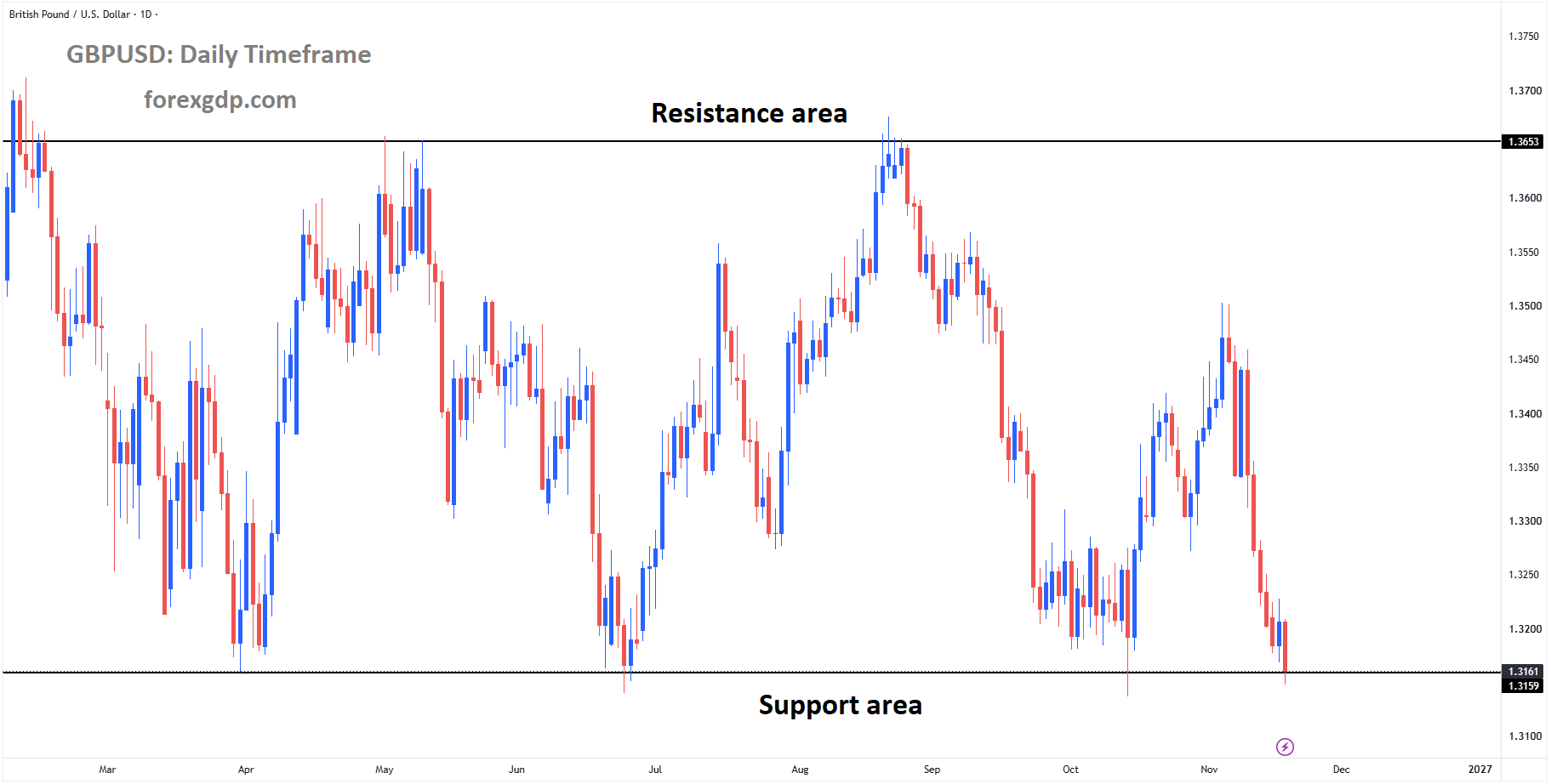
GBPUSD reached the support area of the box pattern
Meanwhile, the US Dollar continued to attract investor interest, supported by encouraging economic data and firm comments from Federal Reserve officials. The difference in economic conditions and monetary policy expectations between the United Kingdom and the United States has become an important factor influencing the GBP/USD currency pair.
Although inflation in the UK remains above the Bank of England’s target, the latest figures suggest that price pressures may not be developing as strongly as economists had predicted. At the same time, the US economy continues to demonstrate resilience despite ongoing efforts by the Federal Reserve to control inflation.
UK Inflation Data Disappoints Market Expectations
The latest UK Consumer Price Index (CPI) report showed that inflation increased in October, but the annual reading came in slightly below economists’ forecasts.
Consumer prices rose by 0.5% during October, compared with a 0.4% increase in September. On an annual basis, inflation reached 3.6%, up from 3.5% in the previous month. However, economists had expected annual inflation to rise to 3.7%.
While the difference between the actual reading and the forecast was relatively small, it was enough to influence investor sentiment toward the British Pound.
Inflation reports are closely followed by currency traders because they provide important information about the direction of monetary policy. When inflation rises faster than expected, central banks may feel greater pressure to maintain higher interest rates. Conversely, weaker-than-expected inflation can reduce expectations of further monetary tightening.
For the Bank of England, the latest figures present a complicated situation. Inflation remains considerably above its 2% target, meaning policymakers cannot ignore the continued increase in consumer prices.
However, the softer annual reading may encourage officials to examine whether existing monetary measures are beginning to limit inflationary pressure.
Core Inflation Remains Stable as Producer Prices Send Mixed Signals
Beyond the headline inflation figures, the latest report also provided important details about underlying price pressures across the UK economy.
Core inflation, which excludes certain volatile components such as food and energy, increased by 2.8% annually. This matched economists’ expectations and remained unchanged from the previous reading.
Core CPI is particularly important because it helps policymakers understand whether inflation is becoming more persistent across the economy.
A stable core inflation reading suggests that underlying price pressures have not accelerated significantly. Nevertheless, it does not necessarily mean inflation is fully under control.
Producer Price Index (PPI) figures presented a more complicated picture.
Input producer prices, which measure the costs businesses pay for materials and other production resources, increased by 2.2% in October. This was substantially higher than the expected 0.8% increase.
The stronger input reading suggests that some UK businesses continue to face rising production costs.
Meanwhile, output producer prices, which reflect the prices manufacturers charge for their products, increased by 0.4% during the month. This represented a slowdown from September’s 0.8% increase and was below the expected 0.6%.
The difference between input and output inflation could indicate that manufacturers are finding it difficult to pass rising costs directly to customers.
If this situation continues, businesses may face pressure on profit margins, potentially affecting investment decisions, hiring plans, and overall economic activity.
UK Employment Figures Add Uncertainty to the Economic Outlook

The inflation report followed a mixed UK employment update released on Tuesday, adding another layer of uncertainty to the outlook for the British economy.
According to the employment figures, the International Labour Organization (ILO) unemployment rate came in below expectations during the three months ending in September.
This development suggested that the labour market remained relatively resilient despite challenging economic conditions.
However, other parts of the report painted a less encouraging picture.
The number of people claiming unemployment-related benefits increased, while wage inflation showed signs of moderation.
Slower wage growth can be important for controlling inflation because rising labour costs often encourage businesses to increase the prices of goods and services.
When wage growth begins to ease, inflationary pressure may gradually weaken, particularly in service industries where employee costs represent a significant share of business expenses.
At the same time, slower wage increases can affect household purchasing power, especially when consumer prices continue to rise.
For the Bank of England, these mixed employment signals make interest rate decisions more challenging. Policymakers must balance the need to control inflation against the risk of weakening economic growth and employment conditions.
US Dollar Benefits From Resilient Economic Activity
While the British Pound faced pressure from domestic economic reports, the US Dollar remained supported by relatively strong economic fundamentals.
Recent US data suggested that consumer activity continued to expand, reinforcing confidence in the economy’s ability to withstand restrictive monetary conditions.
US Retail Sales increased by 0.2% in October, matching market expectations. On an annual basis, retail sales recorded growth of 6.8%.
Consumer spending is a major driver of US economic activity, making retail sales an important indicator of overall economic health.
Continued spending growth suggests that American households remain willing to purchase goods and services despite inflation concerns and higher borrowing costs.
This resilience can support the US Dollar because it reduces immediate concerns about a sharp economic slowdown.
The latest figures also showed that US import prices increased more quickly than economists had predicted.
Higher import costs can contribute to inflation by making goods purchased from overseas more expensive for businesses and consumers.
However, not every economic indicator delivered encouraging results.
US Industrial Production declined by 0.4% in October, disappointing expectations for a 0.1% increase.
The contraction highlighted ongoing challenges in the manufacturing sector. Nevertheless, the weaker industrial production figures did not significantly undermine broader confidence in the US economy.
Investors appeared to place greater emphasis on consumer spending and the Federal Reserve’s monetary policy outlook.
Federal Reserve Officials Maintain a Firm Policy Stance
Comments from Federal Reserve officials provided additional support for the US Dollar as policymakers continued to emphasize the importance of controlling inflation.
Several officials reiterated that restrictive monetary policy remained necessary to bring inflation under control and maintain long-term economic stability.
A firm monetary policy stance generally supports a currency because higher interest rates can make assets denominated in that currency more attractive to international investors.
However, expectations surrounding the pace of future Federal Reserve tightening appeared to be changing.
Although policymakers continued to support measures aimed at controlling inflation, investor expectations for particularly large interest rate increases showed signs of easing.
This distinction is important because the direction of monetary policy depends not only on whether interest rates rise, but also on how quickly and how far policymakers believe they need to move.
Attention therefore turned toward the minutes of the Federal Reserve’s October policy meeting.
The minutes were expected to provide additional insight into officials’ discussions about inflation, economic growth, financial conditions, and the appropriate pace of monetary tightening.
Any indication that policymakers intended to maintain restrictive conditions for an extended period could reinforce confidence in the US Dollar.
Bank of England and Federal Reserve Policy Expectations Shape GBP/USD Sentiment
The different economic signals emerging from the UK and the United States have placed central bank expectations at the centre of the GBP/USD outlook.
In the UK, inflation remains elevated, but weaker-than-expected readings and moderating wage growth could influence how aggressively the Bank of England approaches future policy decisions.
In the United States, resilient consumer spending and persistent inflation concerns have supported the Federal Reserve’s cautious approach toward easing monetary restrictions.
These differences matter because currency investors regularly compare interest rate expectations across major economies.
If investors believe US monetary policy will remain more restrictive than UK policy, the Dollar may continue to attract stronger demand relative to the Pound.
However, future economic releases could change those expectations.
UK employment trends, consumer inflation, business activity, and household spending will remain important indicators for assessing the British economy.
Similarly, US inflation reports, employment figures, consumer activity, and Federal Reserve communications will help determine whether the Dollar’s underlying support continues.
Summary
The British Pound weakened against the US Dollar as softer-than-expected UK inflation figures raised uncertainty about the Bank of England’s monetary policy outlook.
Although UK consumer inflation increased in October, the annual reading missed economists’ forecasts. Stable core inflation, mixed producer price data, and signs of moderating wage growth added to the uncertainty surrounding the economy.
Meanwhile, the US Dollar benefited from resilient retail sales and continued support from Federal Reserve officials advocating restrictive monetary policy.
The contrasting economic signals from both countries highlight the importance of central bank decisions in shaping currency market sentiment.
Looking ahead, investors will closely monitor upcoming inflation reports, employment developments, and statements from monetary policymakers. These factors will play an important role in determining confidence in the British Pound and US Dollar as both economies navigate ongoing inflation and growth challenges.
USDJPY Struggles to Maintain Strength as Investors Turn Cautious Ahead of BoJ Decision
The Japanese Yen (JPY) continues to strengthen against the US Dollar (USD) as investors become increasingly cautious about possible intervention by Japanese authorities. Although the US Dollar remains supported by encouraging economic data and expectations surrounding Federal Reserve monetary policy, concerns about Japan’s currency management are influencing investor sentiment.
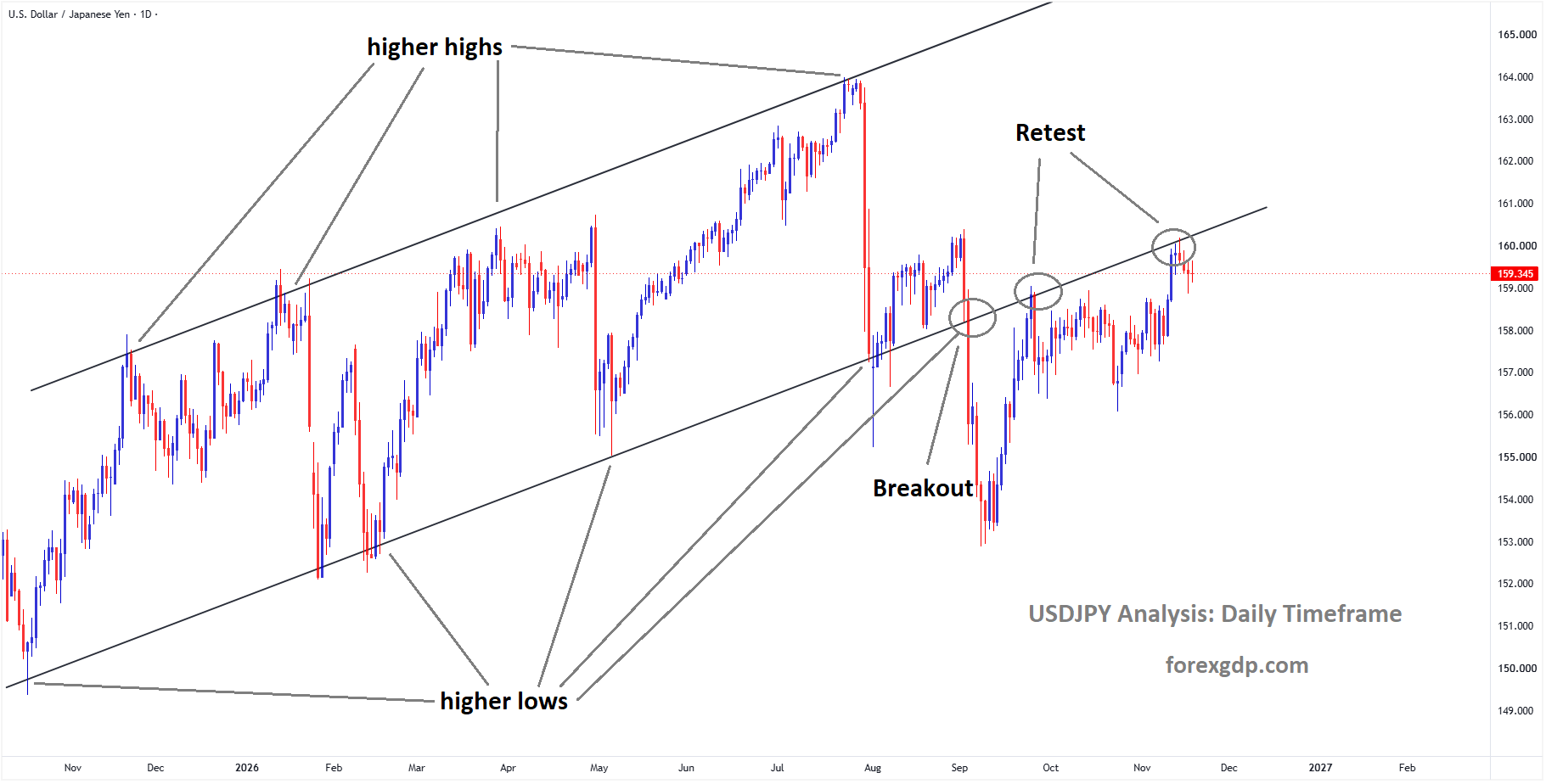
USDJPY reached the retest area of the broken ascending channel
The latest developments highlight the growing uncertainty surrounding the USD/JPY currency pair. Traders are closely monitoring statements from Japanese officials, economic conditions in both countries, and upcoming central bank decisions.
While the Japanese Yen has attracted renewed buying interest, its recovery remains limited. The contrasting monetary policy outlooks of the Bank of Japan (BoJ) and the US Federal Reserve (Fed) continue to shape the broader direction of the two currencies.
Japanese Yen Strengthens as Intervention Concerns Increase
The Japanese Yen has gained some ground against the US Dollar following renewed warnings from Japanese authorities about excessive currency movements. These warnings have encouraged investors to reconsider their exposure to positions that could suffer if the Yen strengthens suddenly.
Japan has a long history of closely monitoring currency fluctuations, particularly when rapid movements threaten economic stability. Officials have repeatedly emphasized that they are prepared to respond when foreign exchange activity becomes excessive or disconnected from economic fundamentals.
Such statements can influence market behavior even without direct government action.
Investors holding large positions against the Japanese Yen may become reluctant to maintain those positions when the possibility of official intervention increases. As a result, some traders choose to reduce their exposure, creating additional demand for the Japanese currency.
However, the Yen’s recovery has not developed into a broader shift in investor confidence. The US Dollar continues to benefit from relatively strong economic conditions, preventing the Japanese currency from establishing sustained momentum.
This situation reflects the delicate balance between intervention concerns and the economic forces supporting the US currency.
Bank of Japan Governor Kazuo Ueda Maintains Focus on Inflation
Bank of Japan Governor Kazuo Ueda has reiterated the central bank’s commitment to achieving sustainable inflation around its 2% target.
During a recent news conference, Ueda emphasized the importance of maintaining a monetary policy framework that supports stable economic growth while keeping inflation under control.
His comments reinforced the BoJ’s long-term objectives but offered limited clarity about the timing of future interest rate decisions.
Investors had been hoping for stronger guidance regarding the central bank’s upcoming December policy meeting. Instead, Ueda avoided making a firm commitment to additional monetary tightening.
The lack of a clear signal created uncertainty among market participants and temporarily weakened confidence in the Japanese Yen.
Why Ueda’s Comments Matter for the Japanese Yen
Central bank communication plays an important role in shaping currency expectations.
When policymakers indicate that borrowing costs could increase, investors may become more interested in holding that country’s currency. Higher interest rates can make domestic financial assets more attractive to international investors.
However, uncertainty about future policy decisions can have the opposite effect.
Ueda’s cautious approach suggests that the Bank of Japan is carefully evaluating economic conditions before making further changes. This strategy allows policymakers to respond to new information without committing to a specific course of action too early.
For currency investors, the absence of firm guidance means that upcoming economic reports and official statements will remain particularly important.
Japan’s Economic Contraction Raises Questions About Interest Rate Hikes
Recent Japanese economic data has complicated expectations surrounding the Bank of Japan’s next policy decision.
Figures released on Monday showed that Japan’s economy unexpectedly contracted during the third quarter. Weak private consumption was identified as an important factor behind the disappointing performance.
The contraction has raised concerns about the strength of domestic demand and the economy’s ability to withstand higher borrowing costs.
Consumer spending is a major contributor to economic activity. When households reduce their purchases, businesses may experience slower sales growth, potentially affecting investment, hiring, and wage increases.
These developments create challenges for policymakers who want to control inflation without damaging economic recovery.
Before the disappointing GDP report, some investors expected the Bank of Japan to raise interest rates by a quarter of a percentage point in December.
Those expectations have since weakened as market participants reassess the likelihood of further monetary tightening.
The central bank now faces the difficult task of balancing inflation objectives with the need to support economic activity.
Weak Consumer Spending Could Encourage a Cautious BoJ Approach
Japan’s subdued household consumption has become an important consideration in the monetary policy debate.
Although inflation remains a central concern, raising interest rates too quickly could place additional pressure on consumers and businesses.
Higher borrowing costs can discourage household spending, reduce demand for loans, and make business expansion more expensive.
These effects could be particularly challenging when economic growth is already showing signs of weakness.
Bank of Japan policymaker Taichiro Asada previously warned that moving too aggressively with interest rate increases could hurt consumer spending.
His comments reflect concerns that premature monetary tightening might undermine the recovery rather than strengthen the economy’s long-term stability.
Such views could become increasingly influential during discussions ahead of the December policy meeting.
Balancing Inflation Control With Economic Growth
The Bank of Japan must consider several economic factors before deciding whether additional tightening is appropriate.
Inflation needs to remain sustainable, but policymakers also want stronger wage growth, healthier household demand, and stable business investment.
If consumers continue to struggle, the central bank may prefer to wait for clearer signs of economic improvement before increasing borrowing costs again.
On the other hand, persistent inflation could encourage policymakers to maintain the possibility of future rate adjustments.
This uncertainty makes the upcoming policy meeting especially significant for investors following the Japanese Yen.
Strong US Economic Data Continues to Support the Dollar

While Japan faces concerns about economic growth, the United States continues to demonstrate relative economic resilience.
Encouraging US macroeconomic data has helped maintain confidence in the American economy and supported expectations that the Federal Reserve could keep monetary policy restrictive.
A resilient economy can give central bankers more flexibility to maintain higher borrowing costs when inflation remains a concern.
For the US Dollar, this creates an important source of underlying support.
Investors often consider differences between countries’ interest rate outlooks when making currency decisions. If US borrowing costs remain relatively attractive compared with those in Japan, demand for Dollar-denominated assets may remain firm.
This difference helps explain why the Japanese Yen’s recent improvement has faced limitations despite concerns about possible intervention.
The Federal Reserve’s future decisions will depend on incoming information about inflation, employment, consumer activity, and broader economic conditions.
Any meaningful change in those expectations could influence investor confidence in the US Dollar.
Federal Reserve and Bank of Japan Policies Remain Central to USD/JPY Sentiment
The contrasting approaches of the Federal Reserve and Bank of Japan remain among the most important influences on the USD/JPY currency pair.
The Federal Reserve is focused on ensuring that inflation remains under control while preserving economic stability. Strong US data may encourage policymakers to maintain a cautious stance toward monetary easing.
Meanwhile, the Bank of Japan is assessing whether domestic economic conditions can support further interest rate increases.
These different challenges create uncertainty about how the monetary policy gap between the two countries may evolve.
If Japan’s economic recovery improves, expectations for additional BoJ tightening could strengthen the Yen.
Alternatively, continued weakness in Japanese consumer spending could encourage policymakers to delay further action, limiting the currency’s appeal.
Similarly, changes in the US economic outlook could alter expectations surrounding Federal Reserve policy.
Investors will therefore continue to assess developments in both economies rather than relying on statements from either central bank alone.
Japanese Authorities Remain an Important Influence on Currency Sentiment
The possibility of Japanese government intervention adds another layer of uncertainty to the currency outlook.
Japanese authorities have made it clear that they are monitoring foreign exchange developments closely and remain concerned about excessive volatility.
Although verbal warnings do not guarantee direct intervention, they can influence investor behavior by increasing the perceived risks of holding positions against the Yen.
This may discourage aggressive speculation and encourage more cautious trading activity.
However, official intervention warnings alone may not produce lasting currency strength if broader economic conditions continue to favor the US Dollar.
A more sustainable improvement in the Japanese Yen would likely require stronger domestic economic performance, greater confidence in future BoJ policy tightening, or a change in the US monetary policy outlook.
Summary
The Japanese Yen has recovered some ground against the US Dollar as renewed intervention warnings encourage investors to exercise caution. Nevertheless, the currency continues to face challenges from Japan’s weaker economic performance and uncertainty surrounding the Bank of Japan’s next interest rate decision.
Governor Kazuo Ueda’s commitment to sustainable inflation has reinforced the central bank’s long-term priorities, but his limited guidance on December policy has left investors uncertain.
Japan’s unexpected economic contraction and weak consumer spending have also reduced confidence in an immediate rate increase.
At the same time, resilient US economic data and expectations of restrictive Federal Reserve policy continue to support the US Dollar.
Looking ahead, the direction of the USD/JPY currency pair will depend heavily on upcoming economic developments, central bank communication, and the possibility of action by Japanese authorities.
For now, investors remain focused on whether Japan’s economy can regain momentum and whether the Bank of Japan will have sufficient confidence to continue adjusting its monetary policy.
USDCAD Strengthens as Rising US Interest Rate Expectations Weigh on Canadian Currency
The USD/CAD currency pair is attracting renewed attention as expectations of further interest rate increases by the US Federal Reserve strengthen the US Dollar. Recent comments from Federal Reserve officials, encouraging US economic data, and growing uncertainty in the Middle East are shaping the outlook for both the US Dollar and the Canadian Dollar.
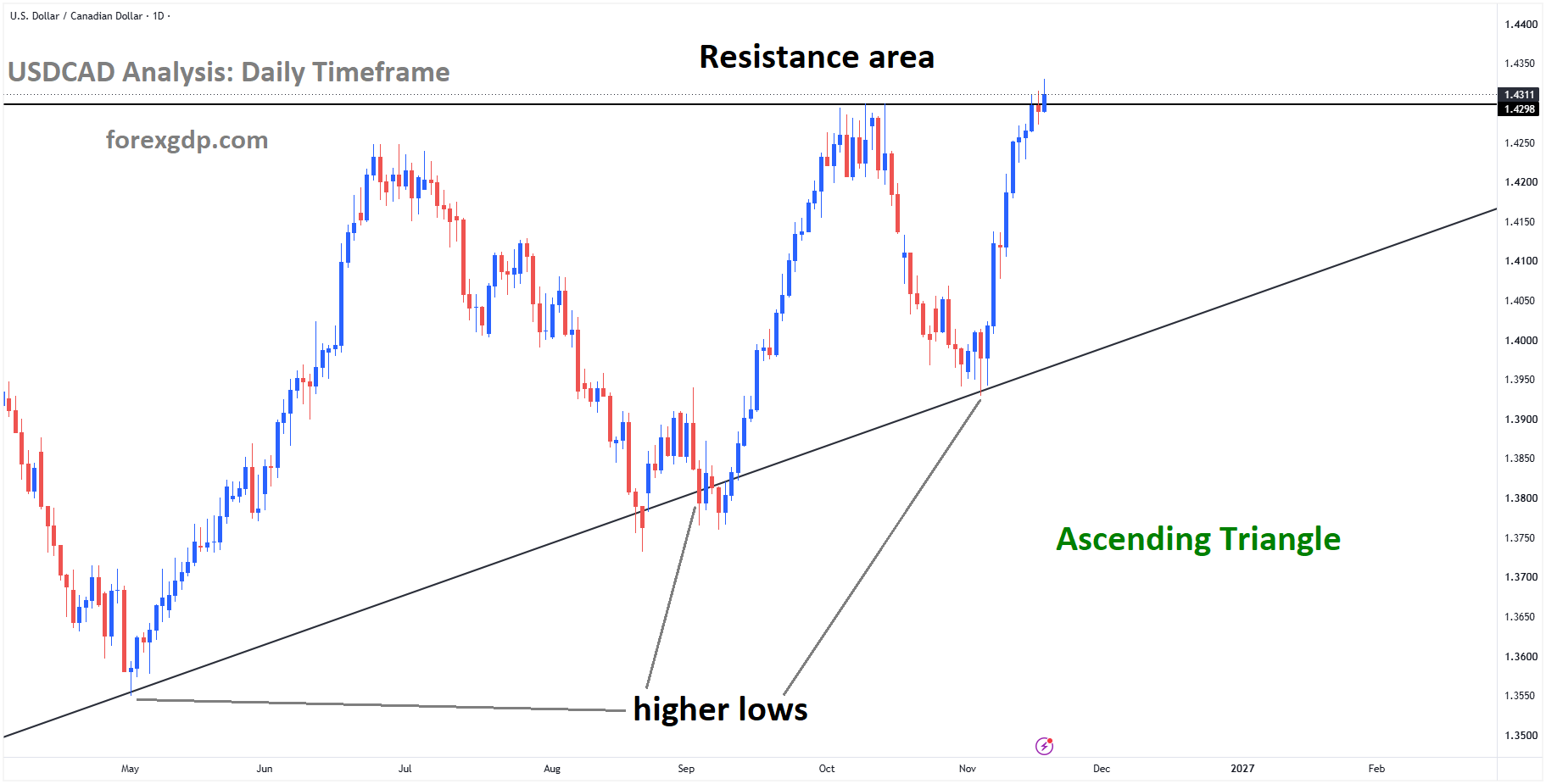
USDCAD reached the resistance area of the ascending triangle pattern
The US Dollar has found support from expectations that the Federal Reserve may need to maintain a restrictive monetary policy to bring inflation under control. Meanwhile, the Canadian Dollar could benefit from stronger demand for oil as geopolitical tensions raise concerns about global energy supplies.
These developments have created a mixed environment for USD/CAD, with monetary policy expectations supporting the US Dollar while energy market developments offer potential strength to the Canadian currency.
Federal Reserve Officials Signal the Possibility of Further Rate Hikes
The Federal Reserve remains focused on controlling inflation, and recent comments from policymakers suggest that additional interest rate increases could be necessary.
St. Louis Federal Reserve President Alberto Musalem indicated on Tuesday that the central bank might need to introduce several more rate hikes to address persistent inflationary pressures.
Musalem emphasized the importance of taking timely action rather than allowing inflation to become a more serious problem. His remarks reflect concerns that inflation could remain elevated without further monetary tightening.
Higher interest rates generally make the US Dollar more attractive to international investors. When US financial assets offer relatively stronger returns, demand for the American currency can increase.
This relationship helps explain why the US Dollar has strengthened following the latest comments from Federal Reserve officials.
However, future monetary policy decisions will depend heavily on economic conditions. Federal Reserve policymakers must consider inflation, employment, consumer spending, and broader economic growth before deciding whether additional tightening is appropriate.
The central bank also faces the challenge of controlling inflation without placing unnecessary pressure on economic activity.
Strong US Retail Sales Reinforce Expectations of Tighter Monetary Policy
Recent US retail sales figures have provided additional support for expectations that the Federal Reserve could continue raising interest rates.
According to the US Census Bureau, retail sales increased by 0.2% in October compared with the previous month. The result matched economists’ expectations and suggested that American consumers continued spending despite tighter financial conditions.
More importantly, the underlying retail sales figures showed greater strength.
Retail sales excluding automobiles increased by 0.6%, exceeding the expected 0.4% growth. This suggests that consumer demand remained healthy across several areas of the economy.
The retail sales control group also recorded a 0.6% increase, following a smaller 0.1% gain in the previous month.
This measure is particularly important because it contributes to calculations of consumer spending within US gross domestic product.
Why Consumer Spending Matters to the Federal Reserve
Consumer spending is one of the largest contributors to economic activity in the United States.
When households continue purchasing goods and services, businesses can experience stronger revenues, supporting employment and overall economic growth.
However, consistently strong consumer demand can also make inflation more difficult to control.
If consumers continue spending at a healthy pace, businesses may have less incentive to reduce prices. As a result, inflationary pressures could remain persistent.
For Federal Reserve policymakers, strong retail sales figures may indicate that the economy can withstand additional monetary tightening.
Following the economic data and hawkish policy comments, the CME FedWatch tool showed that traders assigned approximately a 95.7% probability to a quarter-percentage-point interest rate increase in December.
The remaining 4.3% probability reflected expectations of a larger half-percentage-point increase.
These expectations highlight how strongly investors were anticipating further action from the central bank at that time.
US Dollar Outlook Remains Supported by Economic Resilience
Although expectations of higher interest rates have strengthened the US Dollar, some market strategists believe its near-term gains could face limitations.
Elias Haddad, global head of markets strategy within the foreign exchange team at Brown Brothers Harriman, suggested that the recent US Dollar rally might have become somewhat extended.
One important factor is the monetary policy direction of other major central banks.
If central banks outside the United States also raise interest rates, the difference between US borrowing costs and those in other economies could narrow.
This could reduce some of the relative advantages that have supported demand for the US Dollar.
Nevertheless, Haddad highlighted several reasons why the American currency could maintain a favorable broader outlook.
These include resilient economic growth, relatively healthy labor market conditions, and inflation that continues to create challenges for policymakers.
Together, these factors suggest that the Federal Reserve may need to maintain a firm approach toward monetary policy.
Investors are also awaiting the release of the Federal Open Market Committee’s October meeting minutes.
The minutes could provide additional information about policymakers’ concerns regarding inflation and their views on the appropriate direction of interest rates.
Any indication that officials favor further monetary tightening could reinforce confidence in the US Dollar.
Canadian Dollar Could Benefit From Rising Oil Supply Concerns

While the US Dollar has received support from monetary policy expectations, the Canadian Dollar has its own potential source of strength.
Canada is a major energy producer and exporter, making its currency sensitive to developments in global oil markets.
When oil demand increases or supply concerns emerge, Canada’s energy sector can benefit from improved export conditions.
This relationship can provide support for the Canadian Dollar, particularly when energy market developments attract international attention.
Recent geopolitical tensions in the Middle East have raised concerns about possible disruptions to regional oil shipments.
The situation has become more uncertain following reports of additional US military activity involving Iranian targets.
US Military Strikes Increase Middle East Uncertainty
According to a Bloomberg report, a US military official stated that American fighter jets carried out additional strikes against an Iranian missile launch site on Qeshm Island.
The official described the operation as a self-defense measure involving precision weapons.
The targeted location was reportedly associated with Iran’s Islamic Revolutionary Guard Corps.
US officials stated that the operation followed Iranian aggression directed toward American personnel and assets in the region.
The official also emphasized that US Central Command remained highly alert and prepared to protect American interests throughout the Middle East.
These developments have increased concerns about regional security, particularly around important shipping routes.
The Middle East plays a major role in international energy transportation, and any disruption to shipping activity could affect global oil availability.
Even when physical supplies remain uninterrupted, uncertainty surrounding transportation routes can influence expectations about future energy supplies.
For Canada, stronger oil market conditions may improve sentiment toward its energy exports and provide additional support for the Canadian Dollar.
Competing Economic Forces Shape the USD/CAD Outlook
The direction of USD/CAD depends on the relative strength of the two currencies, and current developments are creating competing influences.
On one side, the US Dollar benefits from strong consumer spending, persistent inflation concerns, and expectations of additional Federal Reserve interest rate increases.
These factors encourage investors to consider the possibility that US monetary policy could remain restrictive.
On the other side, the Canadian Dollar may receive support from developments in the global energy sector.
If geopolitical tensions continue to threaten oil transportation, demand for Canadian energy exports could become an increasingly important consideration.
However, the Canadian Dollar’s response will also depend on domestic economic conditions, monetary policy expectations in Canada, and broader investor confidence.
A stronger energy sector does not automatically guarantee sustained Canadian Dollar appreciation, especially when the US Dollar is supported by significant economic and policy developments.
The balance between these influences will remain important in determining the currency pair’s broader direction.
Final Summary
The USD/CAD outlook is being shaped by two major developments: expectations of further Federal Reserve monetary tightening and growing uncertainty surrounding Middle Eastern energy supplies.
Federal Reserve official Alberto Musalem’s comments have reinforced concerns about persistent US inflation, while stronger underlying retail sales figures suggest that consumer demand remains resilient.
These developments have strengthened expectations of additional US interest rate increases and supported the US Dollar.
At the same time, renewed military tensions involving the United States and Iran have raised concerns about regional shipping security. Such uncertainty could support global oil demand for alternative supplies and improve sentiment toward the Canadian Dollar.
Looking ahead, the Federal Reserve’s meeting minutes, upcoming US economic reports, central bank policy signals, and developments in the Middle East will remain important influences on USD/CAD.
Ultimately, the currency pair’s direction will depend on whether US monetary policy expectations or Canada’s energy-related advantages exert the stronger influence on investor sentiment.
USDCHF Strengthens as US Rate Expectations Put Pressure on Swiss Currency
The US Dollar continues to gain strength against the Swiss Franc as investors focus on the growing differences between the monetary policies of the Federal Reserve (Fed) and the Swiss National Bank (SNB). Strong economic data from the United States, persistent inflation concerns, and expectations of further interest rate increases by the Fed have created a challenging environment for the Swiss currency.
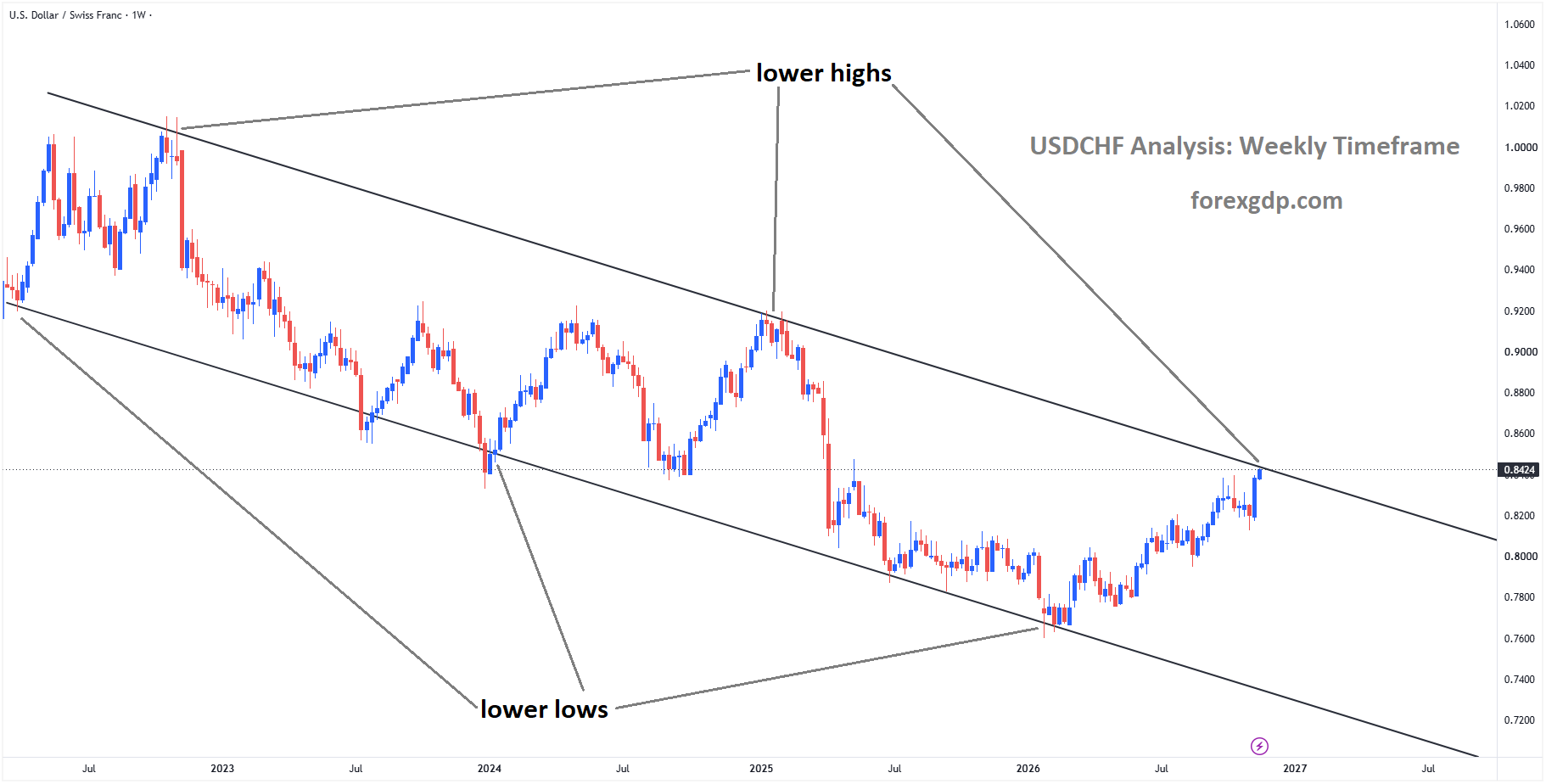
USDCHF reached the lower high area of the descending channel
The Swiss Franc has come under increasing pressure as the two central banks appear to be moving in different directions. While Federal Reserve officials continue to discuss the need for tighter monetary policy, the Swiss National Bank is expected to maintain a more cautious approach.
Market attention is now turning toward the release of the minutes from the Federal Reserve’s October policy meeting. These records could provide important information about the central bank’s future decisions and help investors understand how policymakers are responding to economic developments.
Federal Reserve and Swiss National Bank Follow Different Policy Paths
One of the main reasons behind the Swiss Franc’s recent weakness is the widening gap between US and Swiss monetary policy expectations.
The Federal Reserve remains concerned about inflation in the United States. Although economic conditions have shown signs of stability, policymakers believe that inflationary pressures still require careful attention. As a result, further interest rate increases remain a possibility.
Higher interest rates generally make a country’s currency more attractive to international investors. When borrowing costs rise, financial assets denominated in that currency may offer better returns, encouraging foreign investment and supporting demand for the currency.
The Swiss National Bank, meanwhile, faces a different economic environment. Unlike the Federal Reserve, the SNB is not widely expected to increase its benchmark interest rate in the near future.
This difference in policy expectations has reduced the relative appeal of the Swiss Franc.
Investors are increasingly considering the potential benefits of holding US Dollar-denominated assets, especially if American interest rates continue to move higher while Swiss borrowing costs remain unchanged.
The contrasting approaches of the two central banks are therefore playing an important role in shaping investor sentiment toward both currencies.
Strong US Retail Sales Highlight Economic Resilience
Recent US economic data has reinforced expectations that the Federal Reserve could maintain a restrictive monetary policy.
According to the latest retail sales figures, consumer spending increased by 0.2% in October, while annual growth reached 6.8%. Both results were consistent with market expectations and suggested that American consumers continued to support economic activity.
Consumer spending is particularly important because it accounts for approximately 70% of US gross domestic product.
When households continue purchasing goods and services, businesses benefit from steady demand. This can support employment, production, and overall economic growth.
However, strong consumer activity can also create challenges for the Federal Reserve.
If demand remains elevated, businesses may find it easier to pass higher costs on to customers. This can make inflation more difficult to control, particularly when price pressures are already persistent.
For this reason, resilient retail sales figures may strengthen the argument for keeping monetary policy tight.
The latest consumer spending data suggests that the US economy continues to demonstrate underlying strength despite concerns about borrowing costs and inflation.
This resilience gives Federal Reserve officials additional reasons to remain cautious about easing financial conditions too quickly.
Federal Reserve Officials Emphasize the Need to Control Inflation
Recent comments from Federal Reserve policymakers have further highlighted the central bank’s commitment to bringing inflation under control.
New York Federal Reserve President John Williams indicated that additional monetary tightening could be necessary. However, he also suggested that policymakers should avoid unusually aggressive action.
His comments point toward a measured approach in which interest rate decisions are guided by incoming economic information rather than sudden policy changes.
This position reflects the difficult balance facing the Federal Reserve.
On one hand, the central bank wants to prevent inflation from remaining elevated for an extended period. On the other, excessively rapid interest rate increases could place unnecessary pressure on businesses, households, and economic growth.
Cleveland Federal Reserve President Beth Hammack also expressed concern about the direction of inflation.
Hammack warned that inflation was moving in an unfavorable direction, reinforcing her preference for further monetary tightening.
Her remarks followed earlier comments supporting gradual interest rate increases.
Together, these statements suggest that some Federal Reserve officials believe additional action may be required to achieve lasting price stability.
Nevertheless, policymakers do not necessarily agree on how quickly borrowing costs should rise.
These differences make upcoming Federal Reserve communications especially important for understanding the central bank’s next steps.
October Federal Reserve Meeting Minutes Take Center Stage
Investors are closely watching the scheduled release of the minutes from the Federal Reserve’s October monetary policy meeting.
The central bank decided to leave interest rates unchanged during that meeting, although the decision was not supported by every policymaker.
Beth Hammack and Federal Reserve Governor Lisa Cook favored a quarter-percentage-point increase, demonstrating that some officials believed stronger action was necessary.
The meeting minutes are expected to provide a more detailed account of the discussions that took place before the decision.
They may reveal how policymakers assessed inflation risks, economic growth, employment conditions, and the potential consequences of further monetary tightening.
Why the Meeting Minutes Matter
Federal Reserve meeting minutes are important because they provide more context than the official policy announcement alone.
While an interest rate decision communicates the immediate outcome, the minutes explain the reasoning behind it and highlight areas of disagreement among policymakers.
Investors will be particularly interested in whether officials expressed growing concern about persistent inflation.
They will also look for signs that more policymakers are becoming supportive of additional interest rate increases.
Any indication of stronger support for tighter monetary policy could reinforce confidence in the US Dollar.
Alternatively, evidence that officials are increasingly worried about slowing economic activity could encourage a more cautious interpretation of the Fed’s future direction.
The minutes may therefore influence expectations surrounding the December policy meeting.
Swiss National Bank Expected to Maintain a Cautious Position

While the Federal Reserve remains focused on the possibility of additional tightening, the Swiss National Bank appears unlikely to make an immediate change to its monetary policy.
The SNB’s approach reflects Switzerland’s different economic conditions and inflation outlook.
Swiss policymakers must consider domestic price stability, economic growth, and the potential effects of currency movements when making interest rate decisions.
A stronger Swiss Franc can help reduce the cost of imported goods, but it may also create difficulties for Swiss exporters by making their products more expensive for overseas customers.
A weaker currency can have the opposite effect, potentially improving export competitiveness while increasing the cost of imports.
These considerations mean that the Swiss National Bank must carefully assess how exchange rate developments affect the broader economy.
For now, expectations of unchanged Swiss interest rates contrast with the possibility of further tightening in the United States.
This difference continues to influence international investment decisions and the relative attractiveness of the two currencies.
Swiss Trade Balance Data Remains on the Economic Calendar
Switzerland has a relatively quiet economic calendar this week, with October’s trade balance report scheduled for Thursday.
The report will provide information about the difference between the value of goods exported from Switzerland and the value of goods imported into the country.
Trade figures are useful for understanding international demand for Swiss products and the country’s overall external economic position.
Switzerland has a significant export sector, including pharmaceuticals, machinery, precision instruments, and luxury goods.
Changes in international trade activity can therefore provide valuable information about the health of the Swiss economy.
However, the upcoming trade balance release is not expected to have a major influence on the Swiss Franc.
Investors are likely to remain more focused on developments in US monetary policy, particularly the Federal Reserve’s assessment of inflation and the likelihood of additional interest rate increases.
Final Summary
The Swiss Franc remains under pressure against the US Dollar as the Federal Reserve and Swiss National Bank continue to follow different monetary policy paths.
Strong US retail sales figures have highlighted the resilience of American consumer spending, while comments from Federal Reserve officials have reinforced concerns about persistent inflation.
The possibility of additional US interest rate increases contrasts with expectations that the Swiss National Bank will maintain its current policy stance.
Attention is now centered on the minutes from the Federal Reserve’s October meeting, which could offer further insight into policymakers’ views on inflation and future borrowing costs.
Although Switzerland’s upcoming trade balance figures will provide additional economic information, US monetary policy developments are likely to remain the main influence on investor sentiment.
The direction of the US Dollar and Swiss Franc will continue to depend heavily on how both central banks respond to changing economic conditions and inflation risks.
AUDUSD Rebounds From Recent Weakness as Diverging Interest Rate Policies Fuel Uncertainty
The Australian Dollar (AUD) has shown signs of recovery against the US Dollar (USD), although uncertainty surrounding the Reserve Bank of Australia’s (RBA) future interest rate decisions continues to influence investor confidence. The Australian currency managed to recover some of its earlier losses during Wednesday’s European trading session, supported by renewed buying interest.
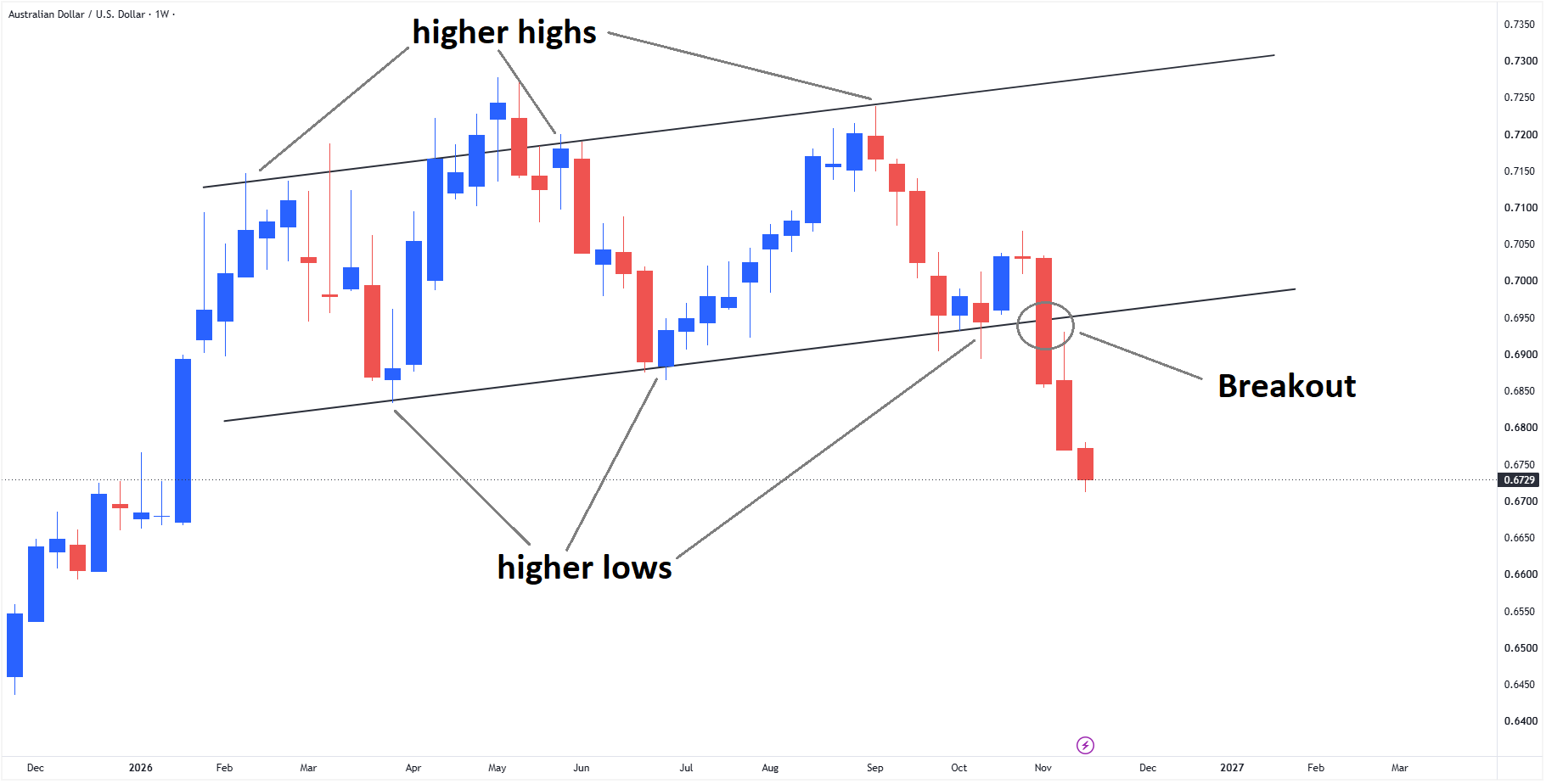
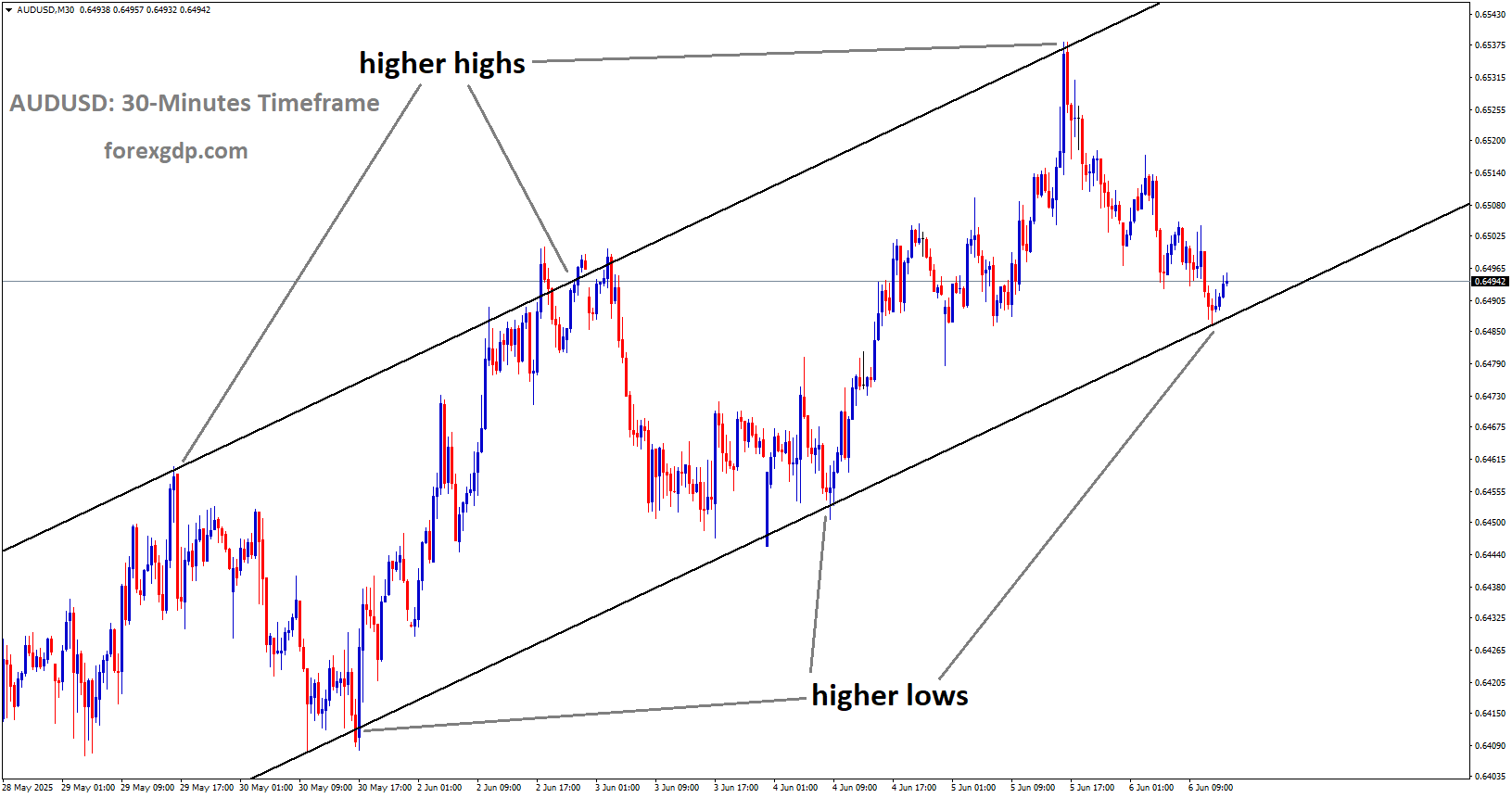
AUDUSD has broken the ascending channel on the downside
However, the broader outlook for the Australian Dollar remains uncertain as investors assess the possibility that the RBA has reached the end of its interest rate hiking cycle. At the same time, expectations of further monetary tightening by the US Federal Reserve (Fed) have strengthened demand for the US Dollar.
The different approaches taken by the two central banks could play an important role in shaping currency market sentiment in the coming weeks.
Australian Dollar Faces Uncertainty as RBA Adopts a Cautious Approach
The Australian Dollar has experienced mixed sentiment as investors consider the RBA’s latest monetary policy signals. Although the currency has managed to regain some lost ground, concerns about Australia’s economic outlook continue to limit confidence.
The RBA has already implemented several interest rate increases in an effort to control inflation. These measures are designed to reduce consumer spending, ease demand across the economy, and gradually bring inflation closer to the central bank’s target.
However, higher borrowing costs also create challenges for households and businesses. Mortgage repayments become more expensive, consumer spending may weaken, and companies can become less willing to invest in expansion.
These concerns have encouraged Australian policymakers to take a more careful approach toward additional interest rate increases.
Recent communication from the RBA suggests that another increase would require convincing evidence that inflation remains a serious concern. Policymakers appear increasingly aware that excessive monetary tightening could place unnecessary pressure on economic growth.
For the Australian Dollar, this cautious position creates uncertainty because interest rate expectations often influence international investment flows and demand for a country’s currency.
RBA Meeting Minutes Highlight Growing Economic Risks
The latest RBA meeting minutes have attracted attention because they reveal increasing concerns about the potential consequences of maintaining restrictive monetary policy.
Analysts at Commerzbank believe the central bank has established a high threshold for approving further interest rate increases. Their assessment suggests that Australian policymakers may prefer to evaluate the economic impact of previous decisions before introducing additional measures.
One important consideration is the relationship between the RBA’s policy rate and its estimated neutral interest rate.
The neutral rate represents a level of interest rates that neither encourages nor significantly restricts economic activity. When borrowing costs rise beyond this level, monetary policy generally places greater pressure on spending, lending, and investment.
According to the analysis highlighted by Commerzbank, the RBA’s policy settings have moved beyond its estimated neutral range. This suggests that existing borrowing conditions may already be restrictive enough to slow economic activity.
Another important detail from the meeting minutes was the disagreement among policymakers.
Three members who opposed the latest interest rate increase expressed concerns that the Australian economy could be approaching a more serious slowdown.
Their position reflects the difficult balance facing the central bank. While inflation must remain under control, policymakers also want to avoid damaging employment, household finances, and business confidence.
These differences suggest that future monetary policy decisions may depend heavily on incoming economic information rather than a predetermined path of additional rate increases.
Australian Labor Market Data Becomes a Key Focus
Australia’s upcoming employment report is expected to provide valuable information about the strength of the domestic economy.
Investors will closely examine the October labor market figures to determine whether employment conditions remain resilient despite higher borrowing costs.
Economists expect the unemployment rate to remain unchanged at 4.7%, suggesting that the labor market may be showing signs of stability.
Employment is also expected to recover after the previous month’s decline. Forecasts indicate that the economy could add approximately 25,200 jobs following a reduction of 39,300 positions in September.
A recovery in hiring would provide some reassurance that Australian businesses remain willing to employ workers despite challenging economic conditions.
However, employment growth alone may not be enough to convince the RBA that further interest rate increases are necessary.
Policymakers are also likely to consider wage growth, consumer spending, inflation developments, and broader economic activity before making their next decision.
A weaker employment report could reinforce concerns that higher interest rates are already affecting the economy. Such an outcome may strengthen expectations that the RBA will maintain its cautious approach.
On the other hand, stronger employment figures could suggest that the Australian economy remains capable of handling restrictive borrowing conditions.
The labor market report will therefore be important for understanding both Australia’s economic health and the possible direction of RBA monetary policy.
US Dollar Benefits From Expectations of Further Federal Reserve Tightening
While the RBA appears increasingly cautious, the US Federal Reserve has faced expectations of maintaining a more restrictive monetary policy stance.
This difference has helped support demand for the US Dollar.
Investors often favor currencies associated with relatively higher interest rates because they can offer more attractive returns on certain financial assets.
When markets expect the Federal Reserve to continue raising borrowing costs or maintain restrictive conditions for an extended period, demand for US Dollar-denominated investments can increase.
The resulting capital flows may strengthen the American currency against other major currencies, including the Australian Dollar.
Federal Reserve policymakers must also balance inflation control with the risks of slowing economic growth. However, expectations surrounding the Fed’s policy direction have remained an important source of support for the Greenback.
The strength of the US Dollar can create additional challenges for the Australian currency, particularly when investors believe the two central banks are moving toward different monetary policy decisions.
This divergence may continue to influence investor sentiment until clearer economic information becomes available.
Differences Between the RBA and Fed Shape Currency Sentiment
The contrasting monetary policy outlooks in Australia and the United States highlight an important factor affecting international currency movements.
Australia’s central bank appears concerned that previous interest rate increases could already be placing significant pressure on domestic economic activity.
Meanwhile, expectations of continued Federal Reserve tightening suggest that US monetary policy could remain restrictive for longer.
These differences matter because investors regularly compare economic conditions and potential returns across countries before deciding where to allocate their capital.
If the RBA maintains borrowing costs while the Federal Reserve continues tightening, the relative appeal of US financial assets could increase.
However, monetary policy expectations are not the only influence on the Australian Dollar.
Australia’s economic performance, global demand for commodities, international trade conditions, and broader investor confidence can also affect the currency.
As a major exporter of natural resources, Australia is particularly sensitive to changes in global economic activity and demand from important trading partners.
Improving international economic conditions could support confidence in the Australian economy, while weaker global demand may create additional uncertainty.
Consequently, investors will need to consider both domestic developments and international economic conditions when evaluating the Australian Dollar’s prospects.
Upcoming Economic Reports Could Clarify the Outlook
The next round of economic information will be important for determining whether current expectations surrounding the RBA and Federal Reserve remain justified.
In Australia, employment figures will offer an early indication of how businesses and workers are responding to restrictive monetary conditions.
Future inflation reports will also be important because they can reveal whether previous interest rate increases are successfully reducing price pressures.
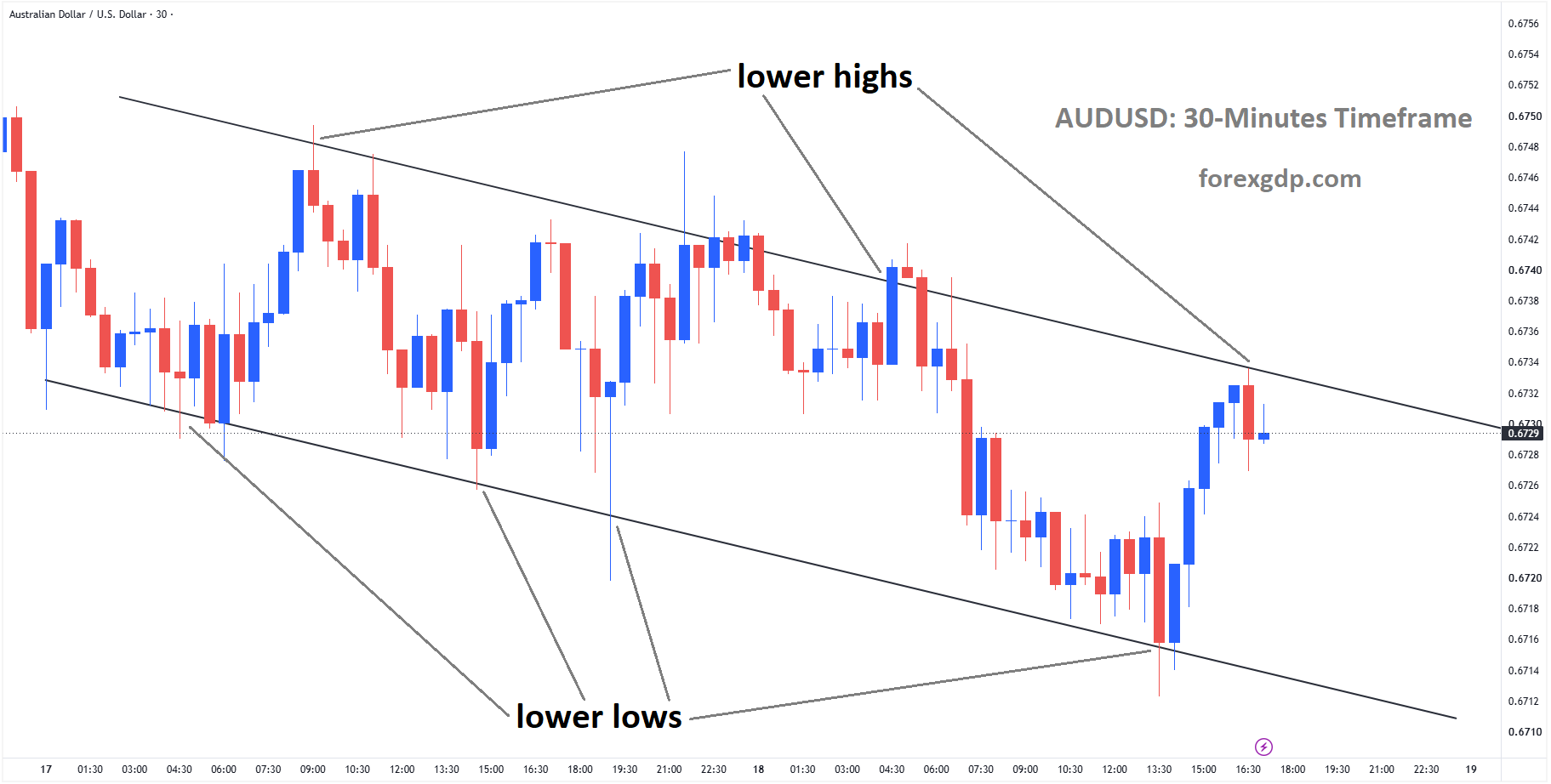
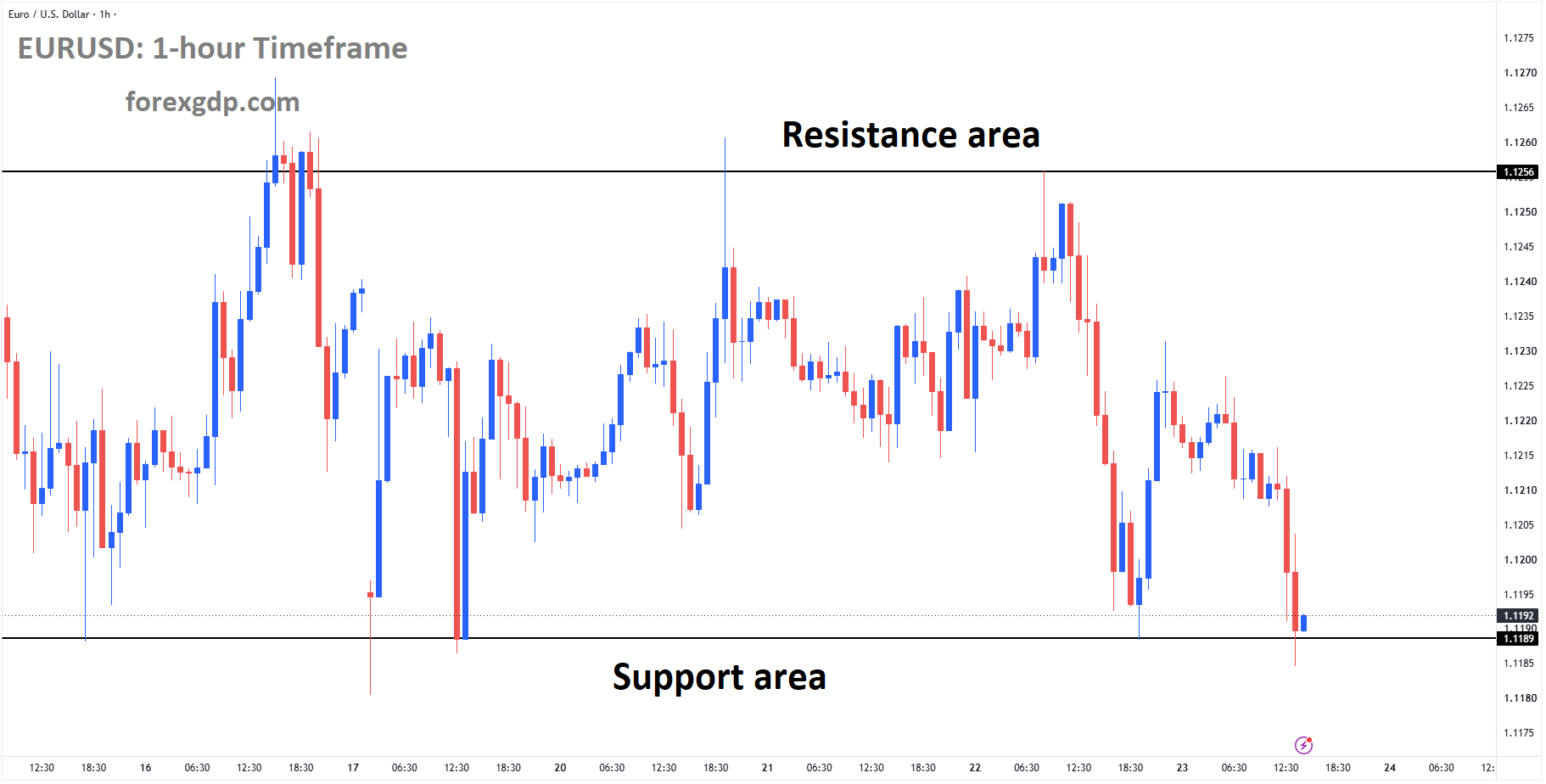
AUDUSD reached the lower high area of the descending channel
In the United States, inflation, employment, and consumer spending figures will help shape expectations about the Federal Reserve’s next steps.
Unexpected changes in these reports could influence investor confidence and alter assumptions about future monetary policy.
For now, uncertainty remains an important feature of the economic outlook in both countries.
Summary
The Australian Dollar has recovered some of its earlier losses against the US Dollar, but concerns about the Reserve Bank of Australia’s future monetary policy decisions continue to affect sentiment.
Recent RBA meeting minutes suggest that policymakers are becoming increasingly cautious about further interest rate increases because of growing risks to economic growth.
Commerzbank analysts have also highlighted the central bank’s restrictive policy position and the concerns expressed by members who opposed additional tightening.
Australia’s upcoming employment figures will provide further insight into the strength of the domestic economy and could influence expectations surrounding future RBA decisions.
Meanwhile, the US Dollar continues to benefit from expectations that the Federal Reserve may maintain a restrictive monetary policy approach.
The Australian Dollar’s broader outlook will depend on how these policy differences develop, alongside changes in employment, inflation, and global economic conditions.
NZDUSD Struggles to Recover as Investors Await Key Federal Reserve Insights
The New Zealand Dollar remains under pressure against the US Dollar as investors respond to a firm monetary policy outlook from the Federal Reserve and encouraging economic data from the United States. The NZD/USD currency pair has experienced seven consecutive days of weakness, reflecting growing confidence in the US Dollar and concerns about New Zealand’s economic performance.
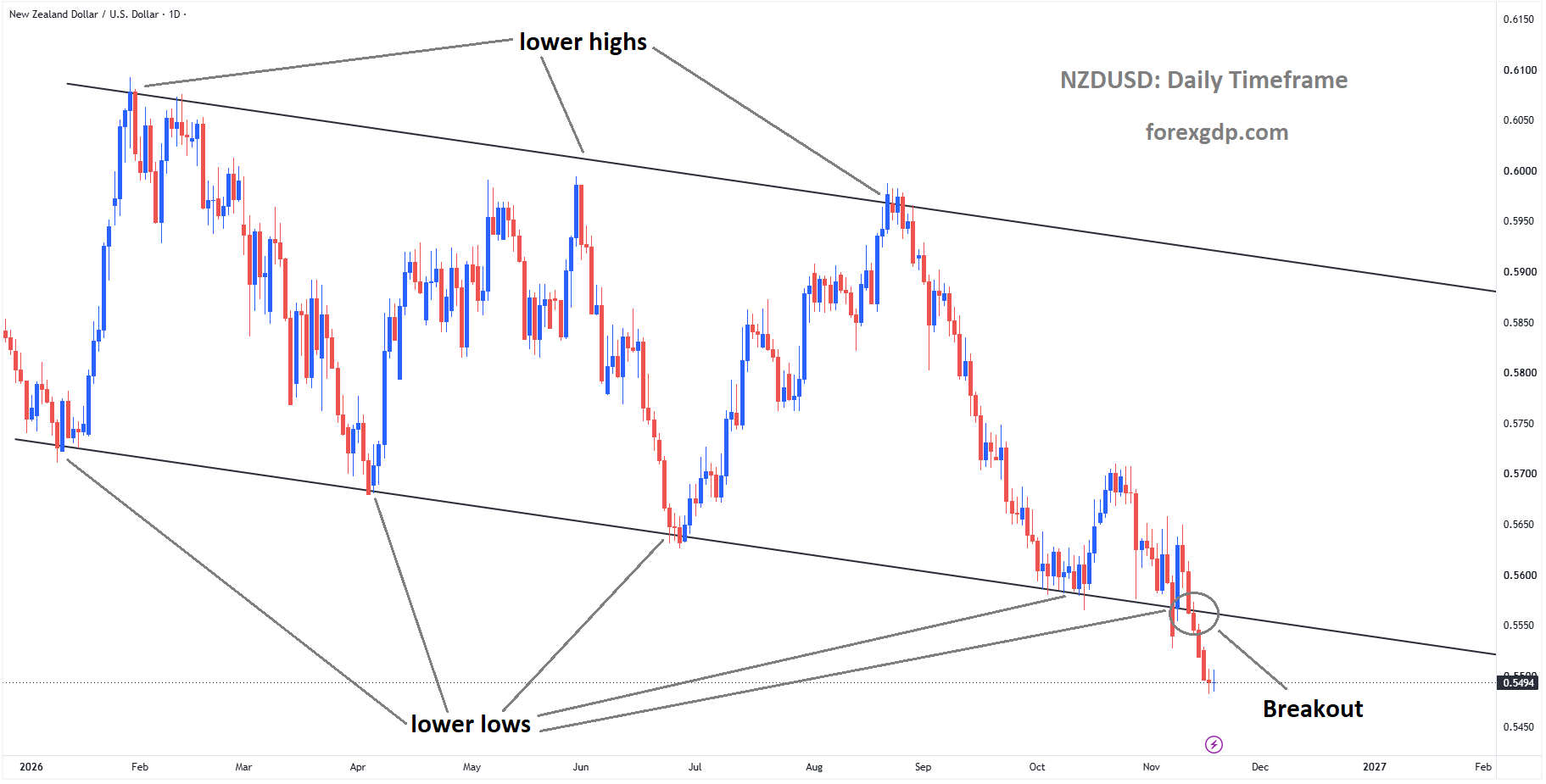
NZDUSD has broken the descending channel to the downside
Recent comments from Federal Reserve officials have strengthened expectations that US interest rates could remain elevated or increase further if inflation continues to pose a challenge. At the same time, stronger underlying US retail sales figures have reinforced confidence in American consumer spending.
Meanwhile, New Zealand’s latest Producer Price Index (PPI) figures show that business-related price pressures eased significantly during the third quarter of 2026. This development has added another layer of uncertainty to the outlook for the New Zealand Dollar.
Investors are now focusing on the Federal Open Market Committee (FOMC) October meeting minutes for further insight into the Federal Reserve’s thinking on inflation, interest rates, and the broader US economy.
NZD/USD Weakens as US Dollar Benefits From Federal Reserve Policy Expectations
The New Zealand Dollar has struggled to regain momentum against its American counterpart as the US Dollar continues to benefit from expectations of restrictive monetary policy.
During Wednesday’s European trading session, the currency pair remained under selling pressure, extending its losing streak to a seventh consecutive day. The sustained weakness highlights the growing difference between monetary policy expectations in the United States and economic conditions in New Zealand.
One of the main factors supporting the US Dollar is the Federal Reserve’s continued focus on controlling inflation. Although inflation has eased from earlier highs, policymakers remain concerned that price pressures could persist without sufficiently restrictive financial conditions.
Higher US interest rates can make Dollar-denominated assets more attractive to international investors. This increased demand can support the American currency, particularly when other economies are experiencing slower growth or softer inflation.
For the New Zealand Dollar, the situation is more challenging. The currency is sensitive to changes in global investor confidence, international trade conditions, and expectations surrounding domestic interest rates.
When investors become more cautious about global economic prospects, currencies such as the New Zealand Dollar can face additional pressure.
Federal Reserve Officials Maintain a Firm Position on Inflation
Recent remarks from Federal Reserve policymakers have played an important role in shaping market expectations.
St. Louis Federal Reserve President Alberto Musalem indicated that additional interest rate increases may be necessary to bring inflation under control. His comments reflected concern that delaying appropriate policy action could allow inflationary pressures to become more difficult to manage.
The message suggests that the central bank remains prepared to take further steps if economic conditions require them.
Why the Federal Reserve’s Hawkish Tone Matters
A hawkish monetary policy stance generally means that a central bank is more focused on reducing inflation, even when doing so could slow economic activity.
For the Federal Reserve, maintaining price stability remains a central priority. Policymakers must carefully balance inflation risks against employment conditions and economic growth.
If inflation stays above the central bank’s desired level, officials may consider keeping borrowing costs elevated for longer or introducing additional increases.
Such expectations can influence international capital flows because investors often compare interest rate conditions across major economies.
The possibility of tighter US monetary policy has therefore contributed to stronger demand for the US Dollar, placing additional pressure on the New Zealand currency.
However, comments from individual Federal Reserve officials do not necessarily represent a final decision by the entire committee. Future policy choices will continue to depend on economic developments and incoming data.
Strong US Retail Sales Highlight Consumer Spending Resilience

Recent US retail sales figures have provided further encouragement for the American currency.
According to the US Census Bureau, retail sales increased by 0.2% month over month in October, matching economists’ expectations.
Although the overall increase was moderate, several underlying components showed stronger consumer demand than anticipated.
Retail sales excluding automobiles increased by 0.6%, exceeding forecasts of 0.4%. This measure offers a clearer picture of spending across other retail categories by removing fluctuations associated with vehicle purchases.
Another important measure, the retail sales control group, also recorded a 0.6% increase. This followed a smaller 0.1% rise in the previous month.
The control group is closely watched because it contributes to calculations of consumer spending within US gross domestic product.
Consumer Demand Remains Important for the US Economy
Household consumption is a major driver of economic activity in the United States. When consumers continue purchasing goods and services, businesses may experience stronger revenue, supporting employment and overall economic growth.
The latest retail figures suggest that American households maintained spending activity despite elevated borrowing costs and continuing concerns about inflation.
This resilience creates an important consideration for Federal Reserve policymakers.
Strong consumer demand can help the economy avoid a sharp slowdown. However, persistent spending strength may also make inflation more difficult to reduce if businesses continue facing pressure from demand.
As a result, stronger economic figures can support expectations that the Federal Reserve will remain cautious about easing monetary conditions.
For the US Dollar, this combination of economic resilience and restrictive policy expectations has provided a supportive backdrop.
New Zealand Producer Price Inflation Slows Sharply in Third Quarter
While the United States has reported encouraging consumer spending figures, New Zealand’s latest producer inflation data points toward easing business cost pressures.
Statistics New Zealand reported that the Producer Price Index for output increased by 0.8% quarter over quarter during the third quarter of 2026.
This was below the expected 1.1% increase and represented a notable slowdown from the 1.7% rise recorded during the second quarter.
The input Producer Price Index also showed a significant reduction in growth.
Input prices increased by 0.7% during the third quarter, compared with a 2.9% rise in the preceding quarter. The figure was also below economists’ expectations of a 1.5% increase.
Together, these results indicate that price growth across New Zealand’s production sector slowed more quickly than anticipated.
Understanding Output and Input Producer Prices
Producer price data helps economists understand inflation pressures affecting businesses before those changes potentially reach consumers.
The output Producer Price Index measures changes in prices businesses receive for the goods and services they produce.
The input Producer Price Index measures changes in prices businesses pay for goods and services used in their production activities.
When input price growth slows, businesses may experience less pressure from rising operating costs. This can improve financial conditions for some companies, depending on demand and other expenses.
Similarly, slower output price growth suggests that businesses are increasing their selling prices at a more moderate pace.
These developments can eventually influence consumer inflation, although the relationship is not always immediate or consistent.
What Slower Producer Inflation Means for New Zealand’s Economy
The slowdown in producer price inflation presents both opportunities and challenges for New Zealand.
On the positive side, reduced business cost pressures may help limit future consumer price increases. More stable production expenses can also support businesses that have struggled with higher operating costs.
However, weaker producer price growth can sometimes reflect softer demand or reduced pricing power.
If businesses face slower sales growth, they may find it more difficult to increase prices, even when some operating expenses remain elevated.
The latest figures therefore provide useful information about the domestic economy, but they do not establish whether overall economic conditions are improving or weakening.
For the Reserve Bank of New Zealand (RBNZ), producer inflation is one of several indicators that can help assess broader price developments.
The central bank also considers consumer inflation, employment, economic activity, wage growth, and inflation expectations when evaluating monetary policy.
If inflation pressures continue easing, policymakers may have greater flexibility in their future decisions. Nevertheless, the direction of interest rates will depend on a broader assessment of economic conditions.
FOMC October Meeting Minutes Become the Next Major Focus
Attention is now turning toward the release of the Federal Reserve’s October meeting minutes.
These minutes provide a detailed account of discussions among policymakers during the meeting, including their assessments of inflation, employment, financial conditions, and economic risks.
Investors will be particularly interested in whether officials expressed concerns about persistent inflation and how they viewed the possibility of further monetary tightening.
The document may also reveal differences of opinion among committee members regarding the appropriate direction of interest rates.
A strong emphasis on inflation risks could reinforce expectations of restrictive US monetary policy.
Alternatively, greater concern about slowing economic activity or employment conditions could suggest a more balanced policy discussion.
Although meeting minutes describe earlier deliberations rather than announce new decisions, they can offer valuable insight into the Federal Reserve’s priorities.
For NZD/USD, the information could help clarify whether the current differences between US and New Zealand economic expectations are likely to persist.
Summary
The New Zealand Dollar continues to face a difficult environment as the US Dollar benefits from firm Federal Reserve rhetoric and resilient American consumer spending.
Comments from St. Louis Federal Reserve President Alberto Musalem have reinforced concerns that additional monetary tightening may be needed to control inflation. Meanwhile, stronger underlying US retail sales figures suggest that consumer demand remains an important source of economic strength.
In New Zealand, third-quarter producer price data revealed a sharper-than-expected slowdown in both input and output inflation. These developments suggest easing business price pressures while raising questions about the strength of domestic economic activity.
The upcoming FOMC October meeting minutes will provide further context about the Federal Reserve’s policy outlook.
Ultimately, the direction of the New Zealand Dollar against the US Dollar will remain closely connected to inflation developments, central bank decisions, and the relative strength of the two economies.
BTCUSD Faces Pressure as Weak Demand Adds to Fed Uncertainty
Bitcoin is facing another period of uncertainty as investors assess weakening institutional demand and changing expectations for US interest rates. The world’s largest cryptocurrency has struggled to maintain its recent recovery following a difficult week, with buyers showing limited confidence in the broader market outlook.
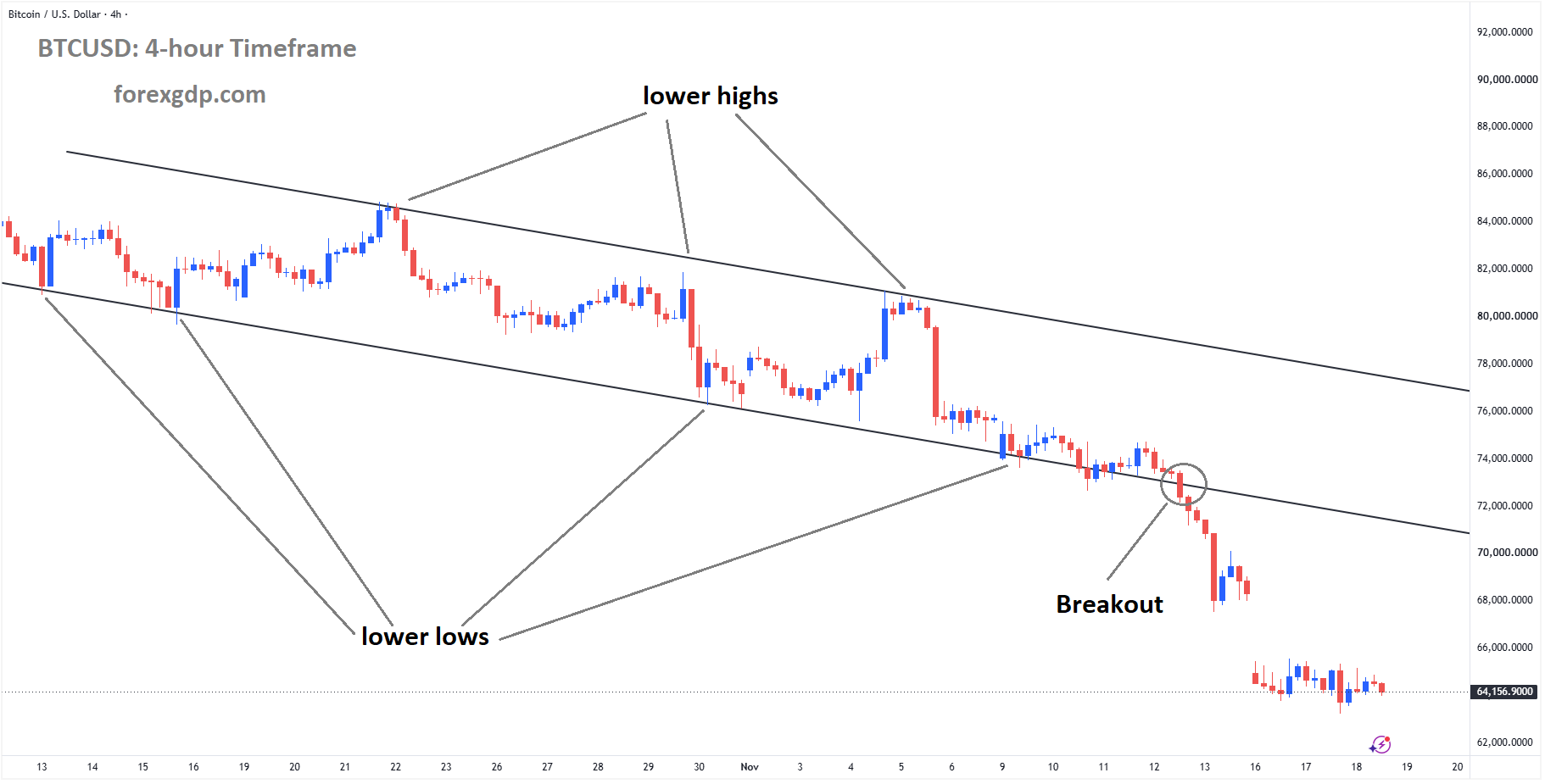
BTCUSD has broken the descending channel to the downside
Recent activity in US-listed spot Bitcoin exchange-traded funds (ETFs) suggests that institutional investors are becoming more cautious. At the same time, attention is shifting toward the Federal Reserve’s October meeting minutes, which could provide important information about the direction of US monetary policy.
The combination of reduced investment demand, persistent inflation concerns, and expectations of tighter financial conditions has created a challenging environment for Bitcoin. Investors are now looking for clearer economic signals before making major decisions.
Bitcoin Recovery Struggles as Investor Confidence Remains Weak
Bitcoin’s recent recovery has faced difficulties as investors remain uncertain about the cryptocurrency’s short-term outlook. Following last week’s decline, buying activity has shown signs of improvement, but the overall recovery has lacked strong support from institutional investors.
One of the main concerns is the absence of consistent demand from large investment firms. Institutional participation has become an important part of the Bitcoin market, especially since the introduction of spot Bitcoin ETFs in the United States.
These investment products allow traditional investors to gain exposure to Bitcoin without directly purchasing or storing the cryptocurrency. As a result, changes in ETF investment flows can offer useful information about institutional interest.
When investors increase their holdings in these funds, it often reflects greater confidence in Bitcoin’s long-term potential. However, when funds experience withdrawals, it may suggest that investors are reducing their exposure to risk.
The recent weakness in ETF activity has therefore added to concerns about the strength of Bitcoin’s recovery.
Bitcoin Spot ETF Outflows Highlight Cautious Institutional Sentiment
US-listed spot Bitcoin ETFs have experienced renewed selling pressure, raising questions about the willingness of institutional investors to increase their cryptocurrency exposure.
On Tuesday, these investment products recorded net withdrawals of approximately $239.94 million, following a modest inflow of $7.99 million on Monday.
The sharp change in investment activity suggests that demand remains unstable. Although a single day of withdrawals does not necessarily indicate a lasting change in investor sentiment, continued outflows could make it harder for Bitcoin to attract sustained buying interest.
Institutional investors often consider several factors before allocating capital to digital assets. These include economic growth expectations, inflation trends, interest rate policies, and overall financial market stability.
When uncertainty increases, large investors may choose to reduce exposure to volatile assets and move funds toward investments they consider more predictable.
Bitcoin ETFs have also created a stronger connection between cryptocurrency markets and traditional financial institutions. This means developments in the wider economy can influence Bitcoin investment decisions more directly than in the past.
For now, the recent ETF withdrawals suggest that some investors are taking a more defensive approach while waiting for greater clarity about economic conditions.
Federal Reserve Meeting Minutes Become a Major Focus for Bitcoin Investors

The Federal Reserve’s October monetary policy meeting minutes are attracting significant attention across financial markets.
These minutes provide a detailed account of discussions among Federal Reserve officials, including their views on inflation, economic growth, employment, and future interest rate decisions.
For Bitcoin investors, the document could offer valuable insight into how policymakers are thinking about the US economy.
Interest rates play an important role in shaping investment behavior. When borrowing costs rise, businesses and consumers generally face tighter financial conditions. Investors may also become less willing to hold assets that carry greater uncertainty.
Bitcoin is often affected by these changes because it is widely treated as a risk-sensitive investment.
If the meeting minutes suggest that Federal Reserve officials remain concerned about inflation, investors may expect restrictive monetary policy to continue.
On the other hand, any indication that policymakers are becoming more comfortable with inflation trends could improve confidence across financial markets.
However, the minutes reflect discussions from an earlier meeting rather than a new policy decision. Investors will therefore need to consider them alongside more recent economic reports and public comments from Federal Reserve officials.
Persistent US Inflation Raises Concerns About Future Interest Rates
Inflation remains one of the most important factors influencing expectations for Federal Reserve policy.
Recent US inflation data has reinforced concerns that consumer price pressures may remain difficult to control. At the same time, firm comments from central bank officials have strengthened expectations that monetary policy could become more restrictive.
The Federal Reserve uses interest rates as one of its main tools to manage inflation. Higher borrowing costs can reduce spending and slow economic activity, helping to ease pressure on consumer prices over time.
However, tighter monetary policy can also create difficulties for financial markets.
When interest rates increase, investors may find traditional interest-bearing investments more attractive. This can reduce the amount of capital flowing into assets such as cryptocurrencies.
According to expectations reflected in the CME Group’s FedWatch Tool, traders have been anticipating an additional interest rate increase in December, with growing attention on the possibility of further tightening in January.
These expectations highlight the market’s concern that the Federal Reserve may need to maintain a firm policy stance for longer than previously anticipated.
For Bitcoin, this environment creates uncertainty because stronger institutional participation often depends on investors feeling comfortable with broader financial conditions.
Strong US Dollar Adds Pressure to Cryptocurrency Market Sentiment
The US dollar has also benefited from expectations of tighter Federal Reserve policy.
When investors believe US interest rates will remain elevated or increase further, dollar-denominated assets can become more attractive to international investors.
This additional demand can strengthen the dollar and influence investment decisions across global financial markets.
Bitcoin and the US dollar do not always move in opposite directions, but a stronger dollar can sometimes create challenges for cryptocurrency demand.
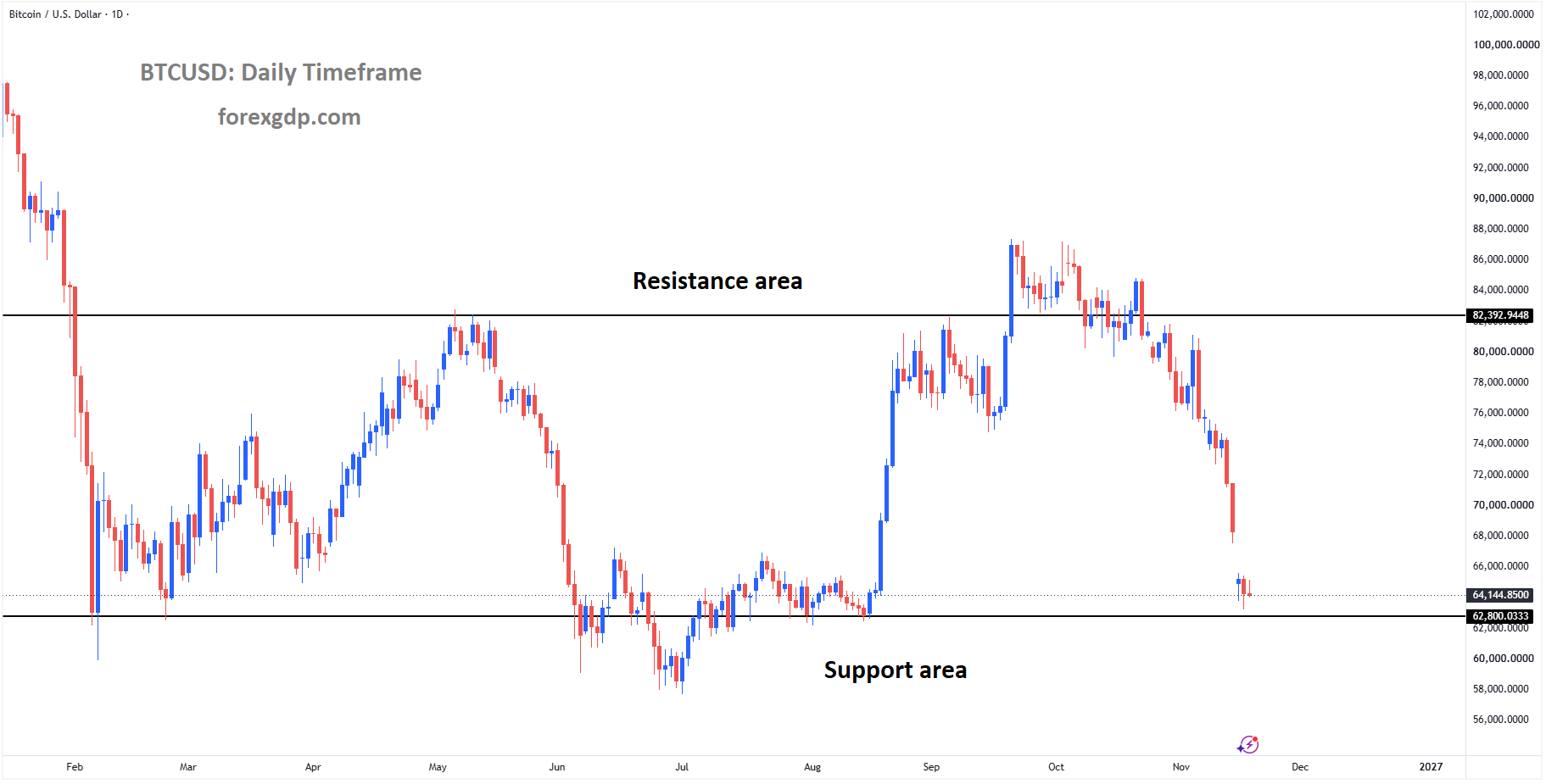
BTCUSD is moving in a box pattern
Investors who hold other currencies may become more cautious about allocating funds to dollar-based investments, including Bitcoin. Meanwhile, international capital may move toward traditional US financial assets when their expected returns become more appealing.
Elevated US Treasury yields can reinforce this behavior by offering investors an alternative to assets that do not provide regular interest payments.
Bitcoin does not generate a fixed income simply through ownership, meaning investors generally depend on changes in its value or other investment arrangements to earn returns.
As a result, an environment of attractive traditional yields can make it more difficult for cryptocurrencies to compete for investment capital.
What Could Influence Bitcoin Sentiment in the Coming Weeks?
Several developments could shape Bitcoin investor confidence as the market moves through the remainder of the year.
The Federal Reserve’s communication will remain particularly important. Investors will closely examine whether policymakers continue emphasizing inflation risks or begin expressing greater confidence in economic stability.
Upcoming US economic reports could also influence expectations. Employment figures, consumer spending data, and inflation releases may help determine whether additional monetary tightening becomes necessary.
Institutional demand represents another important factor.
A return to consistent inflows into spot Bitcoin ETFs could indicate that large investors are becoming more comfortable with cryptocurrency exposure. In contrast, continued withdrawals may reflect ongoing concerns about financial conditions.
Broader market sentiment will matter as well. Bitcoin increasingly attracts participation from traditional financial institutions, making it sensitive to developments affecting equities, bonds, and global investment flows.
Nevertheless, cryptocurrency markets are influenced by more than monetary policy alone. Regulatory developments, adoption by businesses, technological progress, and changing investor preferences can also affect long-term demand.
Because these factors can interact in unpredictable ways, investors may remain cautious until a clearer economic outlook emerges.
Summary
Bitcoin continues to face an uncertain investment environment as institutional demand weakens and expectations for tighter US monetary policy influence market sentiment.
Recent withdrawals from US-listed spot Bitcoin ETFs suggest that some investors are reducing their exposure while waiting for stronger signs of economic stability.
Meanwhile, the Federal Reserve’s October meeting minutes could provide further insight into policymakers’ concerns about inflation and the future direction of interest rates.
A firm US dollar, elevated Treasury yields, and expectations of additional monetary tightening are adding to the challenges facing risk-sensitive assets.
Looking ahead, Bitcoin’s broader investment outlook will likely depend on the interaction between Federal Reserve policy, institutional participation, and confidence across global financial markets. Although uncertainty remains, these developments will help investors better understand the economic conditions shaping cryptocurrency demand.
Don’t trade all the time, trade forex only at the confirmed trade setups
Get more confirmed trade signals at premium or supreme – Click here to get more signals, 2200%, 800% growth in Real Live USD trading account of our users – click here to see , or If you want to get FREE Trial signals, You can Join FREE Signals Now!