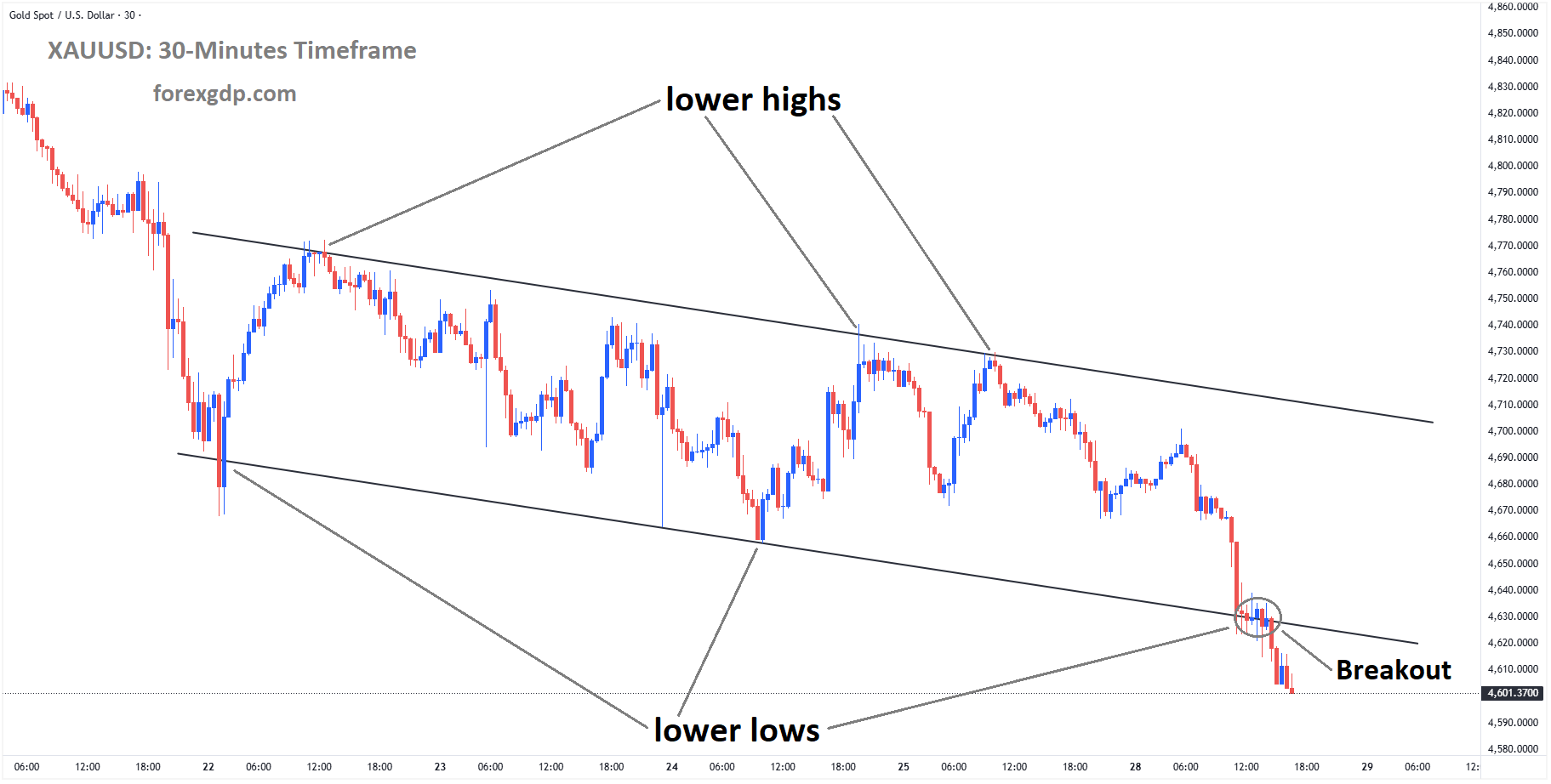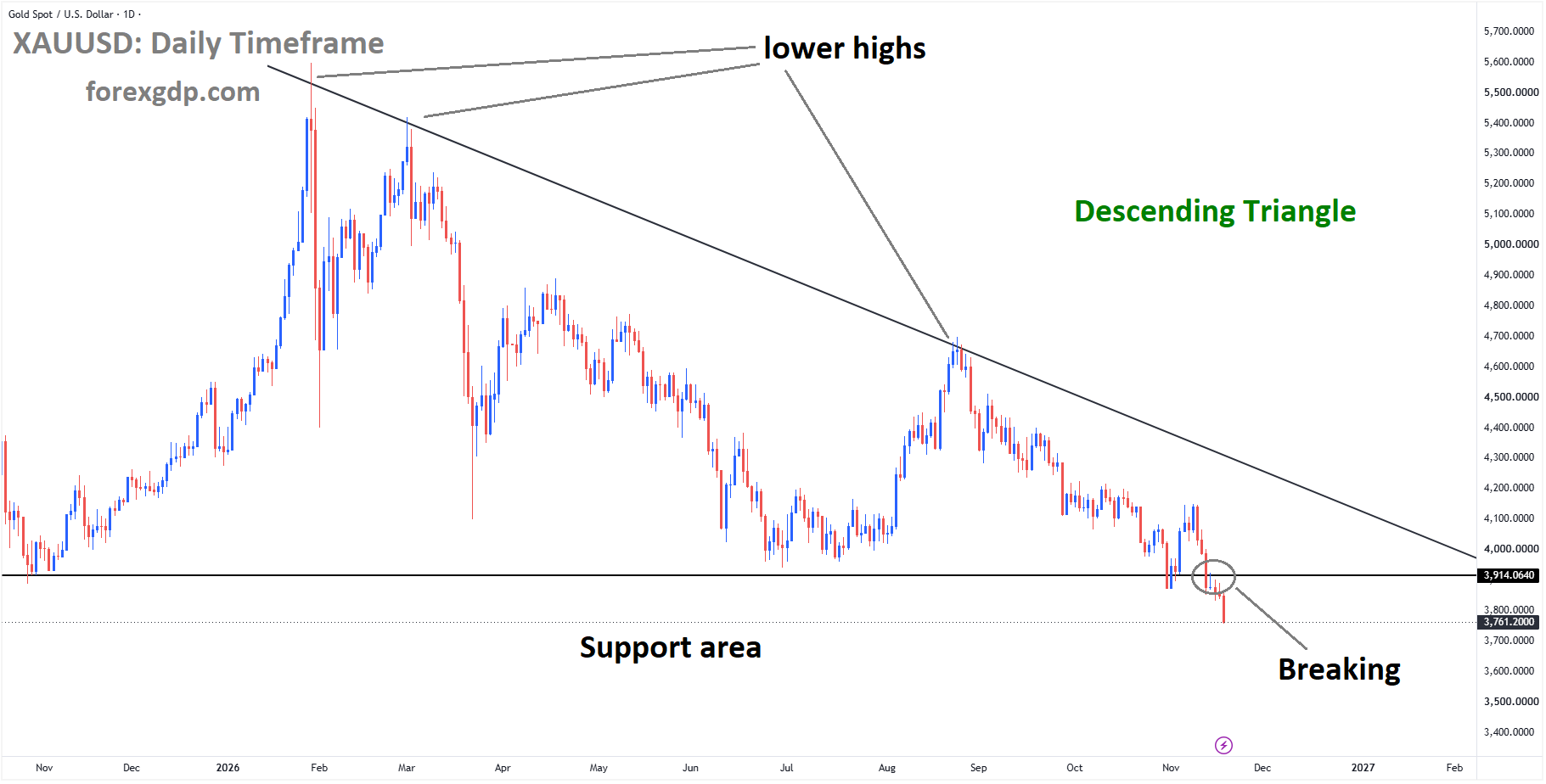
XAUUSD is breaking the support area of the descending triangle pattern
Gold came under heavy selling pressure on Wednesday as growing expectations of further interest rate increases by the US Federal Reserve weighed on investor confidence. The precious metal recorded a decline of more than 2%, extending its recent weakness as traders adjusted their expectations for US monetary policy.
The latest decline reflects a major change in market sentiment. Investors increasingly believe the Federal Reserve will maintain a restrictive monetary policy for longer than previously expected. Strong US economic data, firm comments from central bank officials, and ongoing inflation concerns have reinforced this outlook.
Meanwhile, traders are closely watching the upcoming release of the Federal Reserve’s October meeting minutes. The report could provide important information about the central bank’s next steps and help investors understand whether additional interest rate increases are likely in the coming months.
Strong US Economic Data Adds Pressure on Gold
One of the main reasons behind gold’s recent weakness is the continued strength of the US economy. Despite tighter financial conditions, consumer spending and manufacturing activity have remained relatively resilient.
Recent economic reports suggest that American households are still spending, while industrial production continues to expand. This combination has raised concerns that inflation could remain stubbornly high, making it harder for the Federal Reserve to ease monetary policy.
According to strategists at OCBC, economic activity maintained solid momentum during October, providing a strong foundation for the final quarter of 2026.
US retail sales increased by 0.2% during the month, while the closely watched retail sales control group grew by 0.6%. Manufacturing output also expanded by 0.3%, indicating that factory activity remained relatively healthy.
These figures suggest that higher borrowing costs have not significantly weakened economic demand.
For gold investors, this creates a challenging environment. When the economy remains strong, the Federal Reserve has more room to keep interest rates elevated or introduce additional increases to control inflation.
As expectations of tighter monetary policy grow, investors often become less interested in holding assets such as gold that do not generate regular interest income.
Federal Reserve Officials Signal More Interest Rate Increases
Recent statements from Federal Reserve policymakers have strengthened expectations that further monetary tightening may be necessary.
Several officials have expressed concern that inflation remains a significant challenge, even as the US economy continues to demonstrate resilience.
Federal Reserve official Alberto Musalem suggested that multiple interest rate increases could be required before spring 2027. His comments indicate that some policymakers believe inflation risks may demand a stronger response from the central bank.
John Williams also addressed the possibility of additional tightening. Although he pushed back against the idea of an unusually large interest rate increase in December, he acknowledged that strong investment in artificial intelligence and continued economic demand could create a need for further action.
These comments have encouraged traders to prepare for a longer period of restrictive monetary policy.
Market expectations now strongly favor another Federal Reserve rate increase in December. Investors also see a significant possibility of an additional move in January, with further tightening potentially extending into 2027.
However, these expectations are not guaranteed outcomes. Future decisions will depend on incoming economic reports, inflation developments, employment conditions, and the Federal Reserve’s assessment of financial stability.
For gold, the uncertainty surrounding the timing and scale of future interest rate increases remains an important source of pressure.
Stronger US Dollar Reduces Demand for Gold
The US Dollar has benefited from expectations that American interest rates will remain elevated.
When interest rates rise, assets that offer interest income can become more attractive to international investors. This often increases demand for the US currency, particularly when monetary policy in other major economies is less restrictive.
A stronger Dollar can create difficulties for the global gold market.
Gold is generally traded in US Dollars, meaning that changes in the currency’s value affect buyers around the world.
When the Dollar strengthens, gold becomes more expensive for investors using other currencies. This can reduce international demand, particularly in countries where consumers and businesses are sensitive to currency movements.
Higher US Treasury yields also influence investment decisions.
Government bonds provide interest payments, while physical gold does not generate income simply by being held. As bond yields increase, some investors may prefer interest-bearing assets over precious metals.
This relationship does not mean that gold always declines when interest rates rise. The metal can still attract demand during periods of economic uncertainty, financial instability, or geopolitical stress.
Nevertheless, the current combination of a stronger Dollar and expectations of further Federal Reserve tightening has made the environment less favorable for gold.
Federal Reserve Meeting Minutes Become the Next Major Focus
Investors are now turning their attention to the minutes of the Federal Reserve’s October policy meeting.
The document is expected to provide a more detailed account of discussions among central bank officials, including their views on inflation, economic growth, and future interest rate decisions.
While the Federal Reserve announces its policy decisions immediately after each meeting, the minutes offer additional insight into the reasoning behind those decisions.
Traders will be particularly interested in whether policymakers expressed broad support for further tightening or whether opinions were divided.
Signs of strong agreement on additional interest rate increases could reinforce expectations that borrowing costs will remain elevated.
On the other hand, evidence that some officials are becoming more concerned about economic risks could encourage investors to reconsider the outlook.
The minutes may also reveal how policymakers are interpreting recent developments in consumer spending, manufacturing, employment, and inflation.
For the gold market, the importance of the report lies in its potential to change expectations about future monetary policy.
Even small shifts in the Federal Reserve’s outlook can influence demand for the US Dollar, government bonds, and precious metals.
Middle East Conflict Continues to Influence Inflation Concerns
Geopolitical developments have also played an important role in shaping the economic environment surrounding gold.
The US-Iran conflict created significant uncertainty in global energy markets, contributing to higher oil costs and renewed concerns about inflation.
Rising energy expenses can affect businesses and households across the economy.
Transportation, manufacturing, agriculture, and many other industries depend heavily on fuel and electricity. When energy costs increase, companies may face higher operating expenses and pass some of those costs on to consumers.
This can make inflation more difficult for central banks to control.
Although gold is traditionally viewed as a safe-haven asset during geopolitical conflicts, its performance also depends on how those events affect monetary policy.
In this case, inflation concerns linked to the conflict have strengthened expectations of tighter Federal Reserve policy, creating an additional challenge for the precious metal.
More recently, recovering Middle Eastern oil exports and stronger global supply have helped ease some pressure in energy markets.
However, lower oil costs have not been enough to significantly improve sentiment toward gold.
The Federal Reserve remains focused on returning inflation to its 2% target, and policymakers may require more convincing evidence of sustained progress before reconsidering their approach.
What Could Influence Gold Demand in the Coming Months?
The outlook for gold will depend on several closely connected economic developments.
Inflation remains one of the most important factors. If consumer price pressures continue to persist, the Federal Reserve may feel compelled to maintain higher interest rates for an extended period.
Economic growth will also matter. Continued strength in household spending and business investment could support the case for additional tightening.
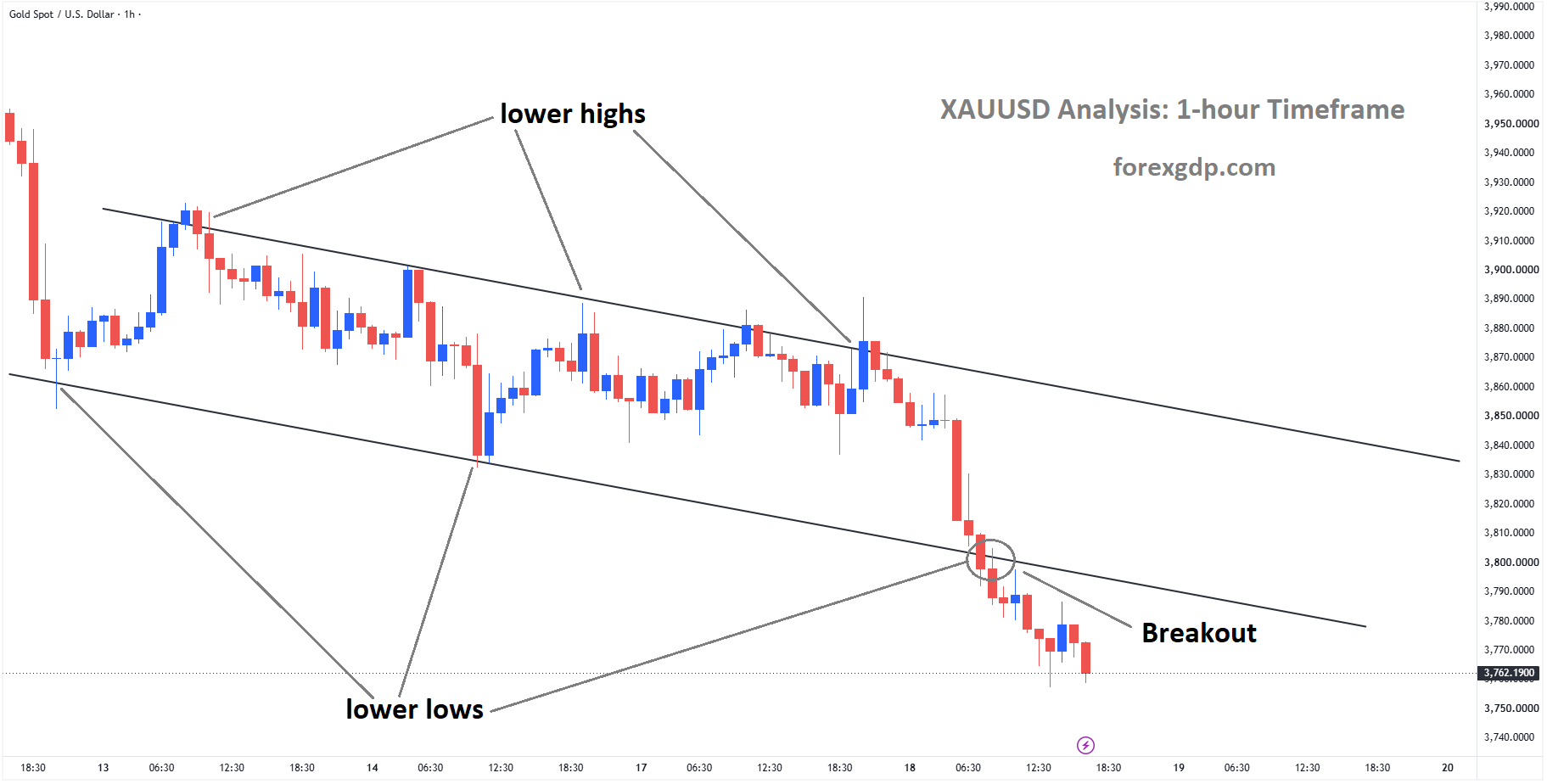
XAUUSD has broken the descending channel to the downside
However, a meaningful slowdown in economic activity could change the central bank’s priorities, especially if employment conditions begin to weaken.
The direction of the US Dollar will remain another important influence on international gold demand.
Geopolitical uncertainty could also affect investor behavior. Although higher inflation expectations have recently weighed on gold through monetary policy concerns, renewed fears about global stability may increase interest in traditional safe-haven assets.
These competing forces mean that gold’s future direction will depend on how investors balance economic resilience, inflation risks, central bank decisions, and international developments.
Final Summary
Gold remains under pressure as strong US economic data and firm Federal Reserve commentary increase expectations of further interest rate hikes.
Resilient consumer spending, improving manufacturing activity, and persistent inflation concerns have strengthened the argument for maintaining restrictive monetary policy. At the same time, a stronger US Dollar and elevated Treasury yields have reduced the appeal of holding non-interest-bearing assets.
The upcoming Federal Reserve meeting minutes could provide further clarity about policymakers’ intentions and the likelihood of additional tightening.
Although geopolitical uncertainty and changing energy market conditions remain important influences, the Federal Reserve’s commitment to controlling inflation continues to dominate market sentiment.
For now, investors are likely to remain focused on US economic developments and central bank communication as they assess the outlook for gold.