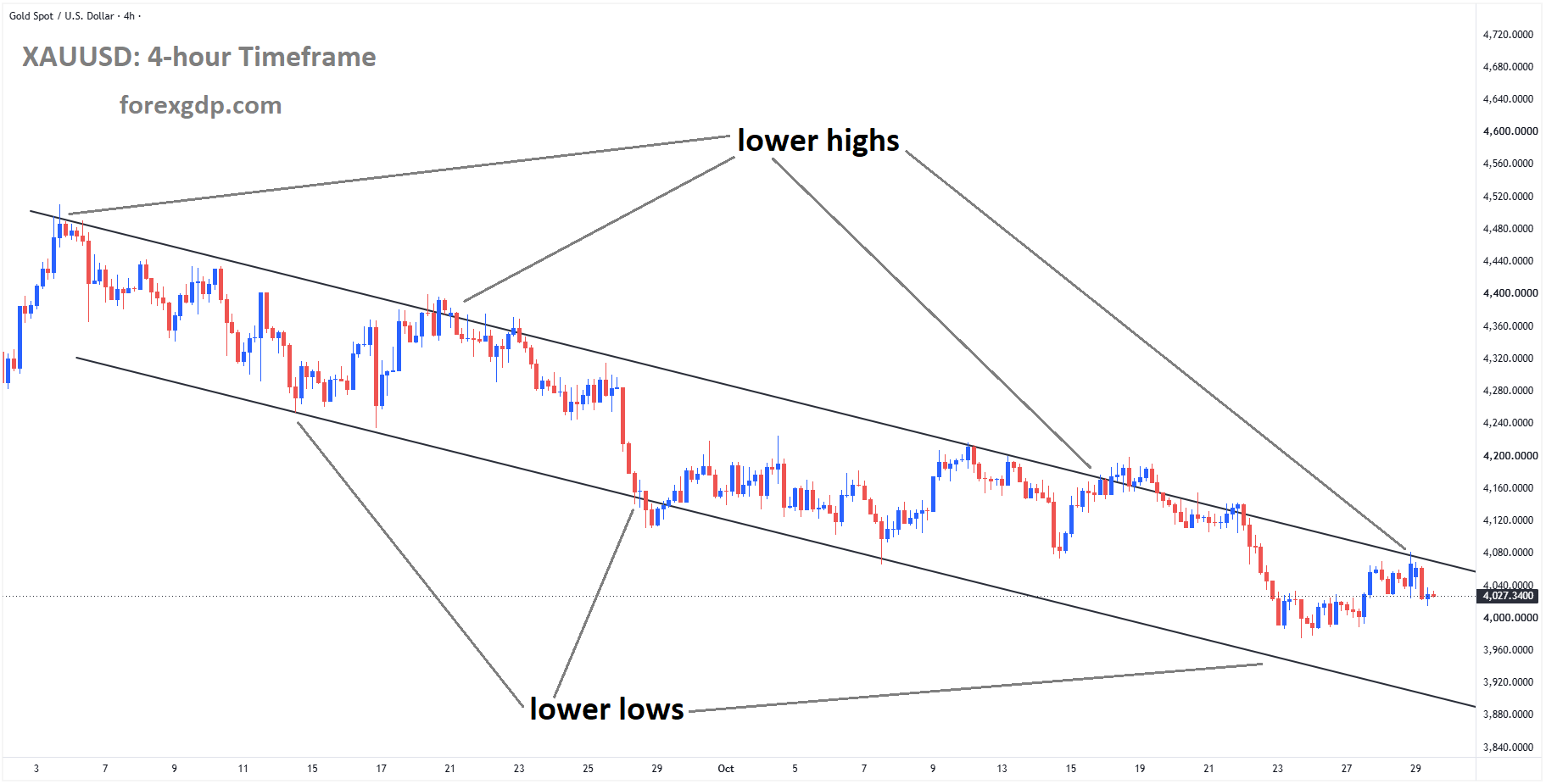
XAUUSD is moving in a descending channel, and the market has fallen from the lower high area of the channel
Gold remains under pressure on Thursday as renewed demand for the US Dollar and expectations of tighter monetary policy from the Federal Reserve influence investor sentiment. Although growing geopolitical tensions in the Middle East continue to create uncertainty across global financial markets, the precious metal is struggling to attract strong buying interest.
Investors are closely watching developments surrounding US interest rates, inflation, and international conflicts. The Federal Reserve’s cautious approach toward inflation has strengthened expectations that borrowing costs could rise further, making the US Dollar more attractive.
Meanwhile, attention is shifting toward upcoming US economic reports, including third-quarter Gross Domestic Product (GDP) figures and the Personal Consumption Expenditures (PCE) Price Index. These reports could provide important clues about the Federal Reserve’s next policy decisions and the broader outlook for gold.
Gold Struggles as US Dollar Regains Strength
Gold experienced renewed selling pressure during Thursday’s European trading session as the US Dollar recovered from its previous decline. The American currency attracted fresh buying interest following a temporary pullback after the Federal Reserve’s latest monetary policy announcement.
A stronger US Dollar often creates challenges for gold because the precious metal is generally traded in dollars worldwide. When the dollar strengthens, gold becomes more expensive for buyers using other currencies, potentially reducing international demand.
Another important factor affecting gold is the outlook for US interest rates.
Unlike bonds and certain savings instruments, gold does not provide regular interest payments. When borrowing costs rise, investors may prefer assets that offer income rather than holding a non-yielding precious metal.
This relationship has become particularly important as financial markets assess the possibility of additional monetary tightening by the Federal Reserve.
Despite gold’s traditional reputation as a safe-haven asset, investors are currently giving considerable attention to the strength of the dollar and the direction of US monetary policy.
Federal Reserve’s Hawkish Outlook Supports Dollar Demand
The Federal Reserve’s latest policy meeting has played a major role in shaping market expectations.
As widely anticipated, the US central bank decided to leave its benchmark interest rate unchanged at the end of its October meeting. However, the decision did not eliminate concerns about the possibility of higher borrowing costs in the coming months.
The policy announcement highlighted continued worries about inflation and the economic risks associated with global geopolitical developments.
Federal Reserve Chair Kevin Warsh emphasized that policymakers remain alert to persistent inflationary pressures. He also acknowledged that international uncertainty and rising energy costs could complicate efforts to maintain economic stability.
These concerns have encouraged investors to consider the possibility that the central bank may need to maintain a restrictive monetary policy for longer than previously expected.
Expectations of Another Interest Rate Increase
Financial markets have increasingly focused on the possibility of another Federal Reserve interest rate increase at the December policy meeting.
According to expectations reflected in the CME Group’s FedWatch Tool in the source account, traders were assigning a substantial probability to additional monetary tightening.
Such expectations tend to support the US Dollar because higher interest rates can make dollar-denominated investments more attractive to global investors.
For gold, the situation presents a challenge.
When investors expect higher returns from interest-bearing assets, demand for gold may weaken. This does not mean the precious metal loses its long-term appeal, but it can influence investment decisions in the near term.
The Federal Reserve’s future actions will largely depend on incoming economic information, particularly inflation trends, employment conditions, and overall economic activity.
Middle East Geopolitical Tensions Increase Market Uncertainty
Alongside monetary policy developments, escalating tensions in the Middle East are adding another layer of uncertainty to global financial markets.
Concerns surrounding relations between the United States and Iran have intensified following reports suggesting the possibility of further military confrontation.
According to the reported developments, US officials warned several Gulf Arab countries about the potential for a limited military campaign against Iran.
Such reports have raised concerns about regional security, international trade, and the stability of energy supplies.
Iranian Foreign Minister Abbas Araghchi stated that the country’s armed forces remain prepared to defend national interests. At the same time, he indicated that Tehran would continue communicating with diplomatic intermediaries in an effort to preserve opportunities for negotiations.
These statements reflect the difficult balance between military preparedness and diplomatic engagement.
Diplomatic Efforts Continue Despite Rising Risks

Regional governments are attempting to prevent tensions from developing into a broader conflict.
Qatar and other mediators have reportedly been working to restart discussions between Washington and Tehran. Their efforts are aimed at reducing the risk of renewed hostilities and creating conditions for a peaceful settlement.
Reports also suggested that US Vice President JD Vance had reached out to Iranian officials in an attempt to encourage further dialogue.
Although these diplomatic initiatives offer some hope, uncertainty remains high.
For investors, geopolitical instability often increases interest in assets considered relatively secure during periods of international conflict.
Both gold and the US Dollar can benefit from safe-haven demand. However, their performance depends on several factors, including interest rate expectations, investor confidence, and the nature of the geopolitical threat.
In the current environment, stronger demand for the dollar appears to be limiting gold’s ability to benefit from heightened uncertainty.
Yemen Conflict Raises Concerns About Global Energy Supplies
The continuing conflict in Yemen has created additional concerns about regional stability and the security of important energy infrastructure.
Fighting between the Iran-backed Houthi movement and forces supported by Saudi Arabia remains a significant source of tension.
According to the reported developments, Houthi forces claimed responsibility for a ballistic missile attack targeting Saudi Arabia’s Ras Tanura oil refinery, one of the country’s most important energy facilities.
Separate attacks involving pumping stations along Saudi Arabia’s East-West oil pipeline have also raised concerns about possible disruptions to energy transportation.
These incidents highlight the vulnerability of critical infrastructure during regional conflicts.
Any major interruption to energy production or distribution could have consequences beyond the Middle East, particularly for countries that depend heavily on imported fuel.
Energy Supply Risks Could Complicate Inflation Control
Energy supply disruptions can create additional inflationary pressure by increasing transportation, manufacturing, and operating costs.
For the Federal Reserve, this presents a difficult challenge.
If energy-related inflation remains persistent, policymakers may find it harder to justify reducing borrowing costs. They could instead maintain tighter monetary conditions to prevent inflation from becoming more widespread.
Such an outcome could continue supporting the US Dollar while creating obstacles for gold demand.
Nevertheless, geopolitical developments remain unpredictable. A significant escalation could also encourage investors to increase their exposure to gold as protection against financial and political uncertainty.
US GDP and PCE Inflation Reports Become Key Focus
With several major economic and geopolitical factors influencing investor sentiment, attention is now turning toward upcoming US economic data.
Two reports are especially important: the advance estimate of third-quarter Gross Domestic Product and the Personal Consumption Expenditures Price Index.
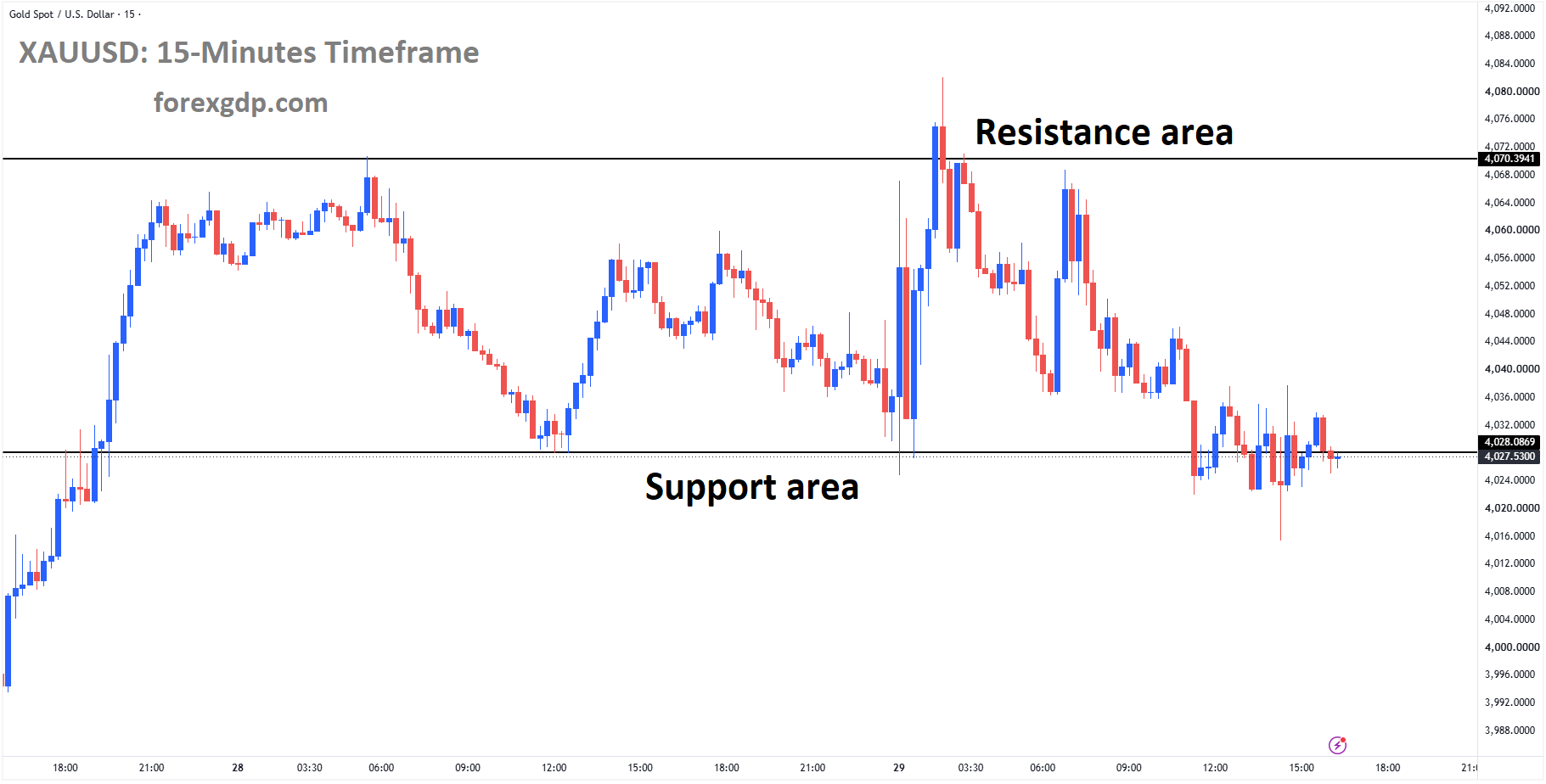
XAUUSD reached the support area of the box pattern
The GDP report will provide insight into the overall strength of the American economy.
Stronger economic growth could reinforce expectations that the Federal Reserve has room to maintain restrictive monetary conditions. Weaker growth, however, could encourage investors to reconsider the likelihood of additional interest rate increases.
The PCE Price Index is equally important because it is one of the Federal Reserve’s preferred measures of inflation.
A higher-than-expected inflation reading could strengthen arguments for tighter monetary policy, while signs of easing inflation could reduce pressure on policymakers to raise borrowing costs.
Both reports may therefore influence demand for the US Dollar and gold.
Investors are likely to approach these releases cautiously, as unexpected economic results could quickly change expectations about the direction of US monetary policy.
Summary
Gold continues to face a challenging environment as renewed US Dollar strength and expectations of further Federal Reserve monetary tightening influence investor demand.
At the same time, geopolitical tensions involving Iran, Yemen, and Saudi Arabia are creating uncertainty about regional security and global energy supplies.
Although these developments could support gold’s traditional safe-haven appeal, concerns about persistent inflation and higher US interest rates are currently playing an important role in market sentiment.
The upcoming US GDP and PCE inflation reports will be crucial in shaping expectations for the Federal Reserve’s next decisions.
For now, investors remain focused on the interaction between monetary policy, economic growth, inflation, and geopolitical risks. How these factors develop will help determine the broader direction of gold demand in the coming weeks.