

The Problem With “More Trades = More Money”
There’s a loud idea floating around trading circles: if you want more profit, you need more trades. More charts, more alerts, more entries, more exits—like pressing your foot harder on the gas automatically gets you to the destination faster. Sounds exciting, right? It also sounds like a shortcut. And shortcuts in trading have a nasty habit of turning into cliff edges.
Because here’s what “more trades” often means in real life: more fees bleeding you slowly, more spread costs nibbling at every entry, more moments where you’re slightly late, slightly unsure, slightly emotional. It’s not dramatic in the moment—it’s a thousand tiny paper cuts. You might not notice them today. But check your account after a month of frantic clicking, and suddenly you’re staring at a number that feels like it got mugged.
When trading becomes a slot machine with charts
Let’s be honest—overtrading doesn’t always look like a problem. Sometimes it looks like confidence. You’re “active.” You’re “in the market.” You’re “taking opportunities.” But there’s a thin line between being engaged and being addicted to action.
At some point, the chart stops being information and starts being entertainment. Every candle becomes a mini cliffhanger. You start hunting the next move the way people refresh social media—hoping for a hit of excitement. And that’s where things get ugly, because markets don’t reward excitement. They punish it. They punish impatience, impulsiveness, and that itchy feeling of “I have to do something.”
The hidden costs nobody brags about
Every trade has a price tag, even if you don’t see it printed neatly on your screen. Spread, slippage, commissions, swaps—sure. But the bigger cost is mental. Decision fatigue is real. The more decisions you force yourself to make, the worse your decisions become.
Trading more doesn’t just multiply opportunities. It multiplies mistakes. And mistakes don’t politely stay small because you “meant well.” They compound with the same enthusiasm profits do.
Why busy traders often feel broke
It’s a weird contradiction: the busiest traders often feel the poorest mentally and financially. They spend hours “working,” but the account barely moves—or worse, it moves backward like it’s got a personal grudge.
That’s not laziness on the market’s part. It’s the market reflecting a messy process. If your approach depends on constant activity, then your results depend on your mood, your energy, and your ability to stay sharp across hundreds of micro-decisions. Spoiler: humans aren’t built for that.
The emotional hangover of constant entries
Each trade carries a little emotional charge: hope when you enter, fear when it pulls back, relief when it goes your way, panic when it doesn’t. Now stack that ten times a day. Twenty. Thirty.
Eventually, you’re not trading the market—you’re trading your hormones. And when cortisol becomes your co-pilot, your strategy starts making “creative” decisions you never wrote down.
Less trading isn’t laziness—it’s strategy


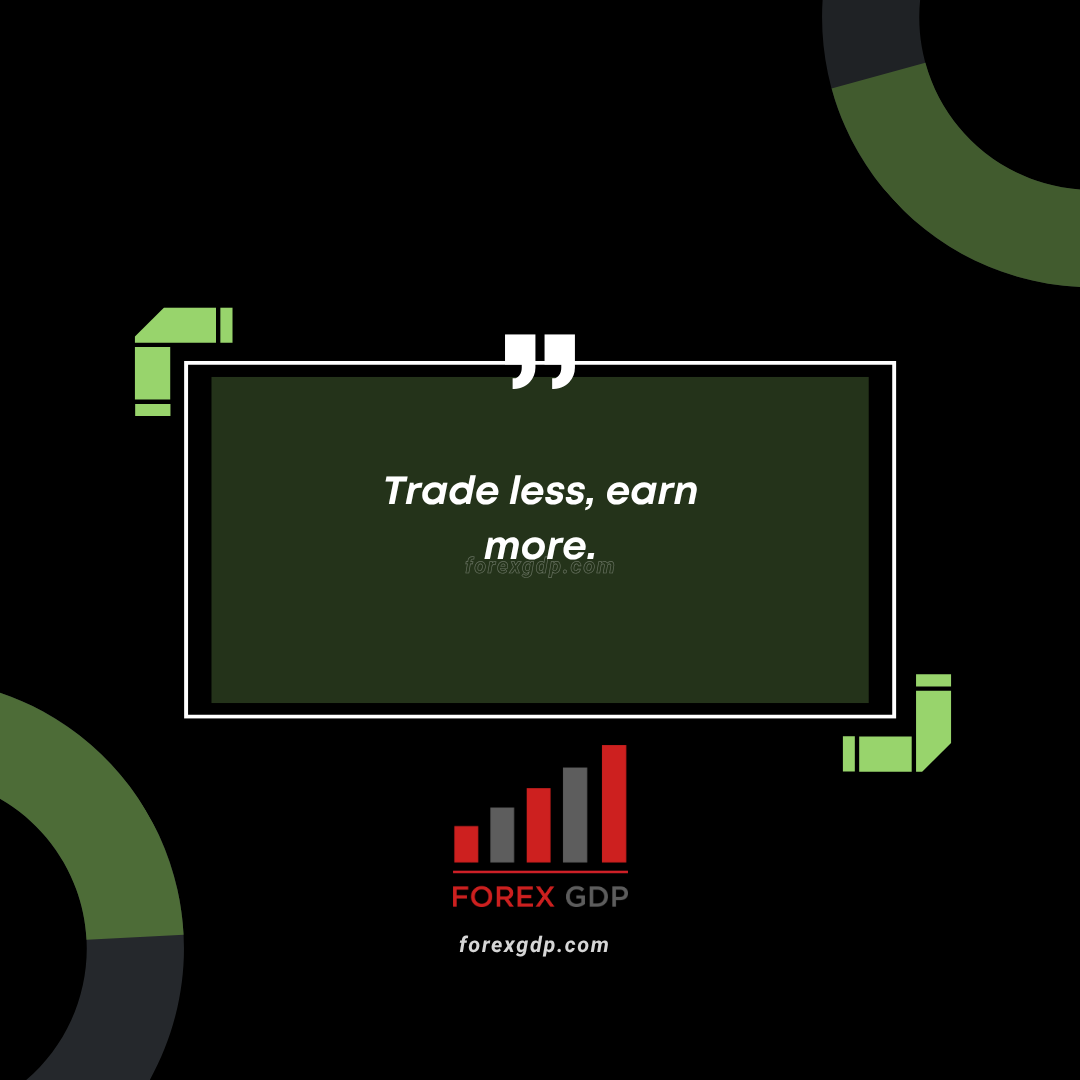
“Trade less, earn more” sounds like a bold line on a graphic. But it hits because it’s the opposite of what most people do. It’s a permission slip to stop chasing every twitch in price and start treating trading like what it is: a game of selection.
The best traders aren’t the ones with the most trades. They’re the ones who say “no” the most. No to noisy setups. No to mediocre conditions. No to that itchy impulse to be involved just because the market exists today. And weirdly, that quiet discipline is where the money starts showing up.
Filtering beats forcing
If you had a gold pan and a river, you wouldn’t scoop and keep every single pebble. You’d filter. You’d wash. You’d focus on the parts that actually glitter.
Trading is the same. The goal isn’t to participate in everything. The goal is to filter down to the moments where probability, structure, and timing line up—then act with intent instead of desperation.
Quality setups have a different “feel”
A clean setup doesn’t usually scream at you. It doesn’t beg for attention. It sits there like a door that’s already open. You don’t need to push it. You just walk through.
Overtrading setups feel different. They feel like persuasion. Like you’re trying to convince yourself. Like you’re creating reasons. And if you have to sell yourself on a trade, you probably shouldn’t buy it.
What “Trade Less, Earn More” Really Means
Less noise, more signal
There’s a reason the message lands: trading has become noisy. Charts covered in indicators. Ten timeframes open. Five Telegram channels yelling different opinions. It’s like trying to hear a whisper inside a nightclub.
Trading less is a way to turn the volume down. When you’re not constantly hunting, you become selective. When you become selective, you start noticing signal again—real shifts in momentum, real structural breaks, real zones that actually matter.
This isn’t about doing nothing. It’s about refusing to let randomness rent space in your head.
The power of patience (and why it’s so unpopular)
Patience is the one trading skill nobody wants to practice because it doesn’t feel like progress. Waiting feels like you’re missing out. Waiting feels boring. Waiting feels like being the only person at the party not dancing.
But patience is what stops you from buying tops, selling bottoms, and donating money to the market out of impatience. The market loves impatient traders. They’re predictable. They chase. They panic. They overreact. They provide liquidity—meaning they become the fuel for someone else’s better-timed decision.
If that stings a little, good. Sometimes trading needs a little sting to wake you up.
Patience isn’t passive—it’s active restraint


Waiting isn’t “doing nothing.” Waiting is choosing not to do the wrong thing. And that takes more strength than clicking a button.
It’s like holding your tongue in an argument when you know a sharp comment would feel good for five seconds and haunt you for five hours. Restraint is underrated. In trading, it’s priceless.
Boredom is a skill
This is the part people don’t like hearing: boredom is often the correct state. If you need constant stimulation to feel productive, trading will chew you up.
When you can sit through quiet sessions without forcing trades, you’ve leveled up. When you can watch price wander and feel nothing, you’re dangerous—in a good way.
Earning more by losing less
Profit isn’t only about finding winners. It’s about avoiding dumb losses. And many losses aren’t “the market being unfair”—they’re the result of low-quality trades taken out of impatience, ego, or the need to feel busy.
When you trade less, you naturally reduce exposure to nonsense. Fewer entries mean fewer chances to make a rushed decision. Fewer decisions mean more clarity. More clarity means better execution. And better execution is the quiet engine behind long-term profitability.
The quiet math of fewer mistakes
Think about it: if half your trades are mediocre, then half your activity is basically self-sabotage. You don’t need a new indicator. You need fewer bad decisions.
Cut the mediocre trades and your win rate can improve without your strategy changing at all. Your drawdowns shrink. Your confidence stabilizes. Your account stops feeling like a heart monitor.
Consistency beats adrenaline
Adrenaline makes you feel alive. It also makes you do stupid things. Consistency feels plain. It feels almost underwhelming. And yet, consistency is the thing that actually builds accounts.
If your trading day feels like a rollercoaster, your process probably has more gambling DNA than you want to admit. And yes, that’s harsh—but sometimes truth is supposed to be a little uncomfortable.
Where Forex GDP Fits Into This Mindset

A brand message that hits a nerve for a reason
The image says it cleanly: “Trade less, earn more.” Underneath, you’ve got the name Forex GDP and the site forexgdp.com. It’s minimal, bold, and kind of blunt—like it’s not interested in entertaining your overtrading habits.
And that’s the point. The message is a nudge away from chaos and toward selectivity. It appeals to the trader who’s tired. The one who’s done with chasing. The one who has tried the “more, more, more” approach and realized it mostly creates stress with occasional lucky spikes.
If you’ve ever felt exhausted after a trading session and wondered, “Why does this feel like I ran a marathon?”—yeah, this message is speaking your language.
Trading less is also a lifestyle upgrade
There’s a life outside the charts. Wild, I know. But a strategy built on constant trading steals time in sneaky ways. It steals your attention at dinner. It steals your focus at work. It steals your ability to sleep without checking your phone at 2 a.m. like you’re waiting for an emergency call.
A trade-less approach gives time back. It gives your brain room to breathe. And if trading is supposed to improve your life, not consume it, then “less” starts sounding like wisdom instead of weakness.
When trading stops hijacking your mood
Overtrading doesn’t just hurt your account. It messes with your personality. You get irritable. You get obsessive. You swing between “genius” and “idiot” depending on the last candle.
Trading less helps you stop wearing the market’s mood like it’s your own. You’re no longer emotionally leased to every tiny price movement. You become less reactive—more grounded. And that’s not just good trading. That’s good living.
Space creates perspective
When you step back, you see patterns. When you zoom out, you spot structure. When you’re not glued to every tick, you notice what actually matters.
It’s like reading a book: if you stare at a single word for hours, you’ll go crazy. But when you read sentences and paragraphs, the meaning appears. Trading is the same—too much zoom makes you blind.
Why simplicity feels scary at first
Here’s the strange part: when traders first hear “trade less,” it can feel like standing still. Like letting opportunities pass. Like surrendering control.
But control was never yours. The market will do what it does. The only control you actually have is what you choose to participate in.

Simplicity feels scary because it removes the illusion that effort equals profit. Sometimes your best trading decision is no trade at all. And that’s insulting to the part of us that wants hard work to be automatically rewarded.
The ego wants action
Ego loves activity. It loves feeling involved. It loves being able to say, “I was in that move.” Even if the move slapped you.
A calmer, more selective approach bruises the ego a little. It forces you to admit that you don’t need to be in everything. That you won’t catch every move. That missing trades is normal. Healthy, even.
Confidence grows in the quiet
Confidence built on frequent trading is fragile. It depends on streaks. It collapses after a bad run.
Confidence built on good selection and restraint is sturdier. It’s not dependent on constant wins. It’s based on knowing you’re playing a smarter game—one where you’re not bleeding out from a thousand unnecessary cuts.
Final summary
The phrase “Trade less, earn more” isn’t just a catchy line—it’s a antidote to the noisy, trigger-happy trading culture that burns people out. Trading more often can secretly magnify costs, mistakes, and emotional stress, until your account starts feeling like it’s leaking from places you can’t even see. Trading less, on the other hand, pushes you toward selectivity: fewer decisions, cleaner focus, better execution, and more consistent outcomes.
Forex GDP’s message—paired with that simple, bold visual—leans into this calmer philosophy. It suggests a mindset where patience isn’t weakness, boredom is a skill, and profitability is less about chasing every move and more about refusing the bad ones. If trading has been feeling like chaos lately, maybe the “more” you need isn’t more trades at all. Maybe it’s more restraint.
FAQs
1.Is trading less actually better for beginners?
Often, yes. Beginners tend to overtrade because they confuse activity with learning. Fewer, higher-quality trades can reduce damage while you build skill and discipline.
2.Won’t I miss opportunities if I trade less?
You will miss some, and that’s normal. The goal isn’t to catch everything—it’s to catch what’s most worth your attention without blowing up your consistency.
3.How do I know if I’m overtrading?
If you feel compelled to be in the market daily, take trades you can’t clearly explain, or feel emotionally exhausted after sessions, those are common red flags.
4.Does “trade less” mean holding trades longer?
Not necessarily. It’s more about being selective with entries. You can trade short-term or long-term and still trade less if you stop forcing mediocre setups.
5.What’s the biggest benefit of trading less besides money?
Peace of mind. Fewer trades usually means less stress, fewer emotional swings, and more time to live your life without the market living in your head.