

The financial market has a way of humbling people. It doesn’t care about opinions, hopes, predictions, or emotions. It moves according to forces far greater than any individual trader’s expectations. Yet every day, countless traders enter the market carrying invisible baggage—beliefs about what should happen, what they want to happen, and what they desperately hope will save a losing position.
The quote, “See the market for what it is, not what you want,” captures one of the most important lessons in trading and investing. It sounds simple on the surface, but it represents a mindset that often takes years to develop. Many traders spend countless hours learning technical indicators, chart patterns, and economic news, yet continue losing money because they fail to master this fundamental principle.
The market is like a mirror. It reflects reality, not desires. The sooner a trader accepts this truth, the sooner they can begin making decisions based on evidence instead of emotion.
Why Traders Often See What They Want to See
Human beings are naturally wired to seek confirmation. We prefer information that supports our existing beliefs and often ignore evidence that challenges them. In everyday life, this tendency can be harmless. In trading, it can become expensive.
When money enters the equation, emotions become stronger. Fear and greed begin influencing decisions, often without the trader even realizing it. Instead of objectively reading the market, many people start searching for signs that validate their preferred outcome.
The Trap of Confirmation Bias
Confirmation bias is one of the most dangerous psychological obstacles in trading. Once a trader decides that a currency pair should move higher, they begin focusing on bullish signals while overlooking bearish warnings.
A trader may scroll through news articles, social media posts, and market analyses until they find someone who agrees with their view. Suddenly, every positive signal seems important while every negative sign appears insignificant.
How Bias Distorts Market Reality
The market provides information continuously. Price action, volume, momentum, and economic data all tell a story. Confirmation bias acts like a filter that removes parts of that story.
Instead of seeing the complete picture, traders only see selected pieces. This partial view often leads to poor decisions because the market reality becomes distorted.
The danger grows when traders become emotionally attached to their analysis. They stop observing and start defending their opinion.
The Cost of Ignoring Contradictory Evidence
Markets constantly change direction. A setup that looked strong yesterday may become weak today. Successful traders understand this and adapt.
Those trapped by confirmation bias often refuse to acknowledge changing conditions. They hold losing trades longer than necessary because accepting reality feels uncomfortable.
Unfortunately, the market rarely rewards stubbornness. It rewards adaptability.
The Emotional Attachment to Predictions
Many traders fall in love with their forecasts. They spend hours analyzing charts and naturally become invested in their conclusions.
The problem arises when they begin treating their analysis as a certainty rather than a possibility.
Why Being Right Becomes Dangerous

Trading is not about being right all the time. It is about managing risk and responding effectively to changing conditions.
When traders become obsessed with proving themselves correct, they often ignore warning signs. They continue holding positions simply because admitting a mistake feels like a personal failure.
Ironically, the desire to be right often leads to larger losses.
The Market Doesn’t Care About Opinions
The market functions independently of individual beliefs. It does not adjust its direction because a trader feels confident.
Imagine standing on a beach and demanding that the tide reverse because your analysis predicts it should. The ocean won’t listen. Markets behave similarly.
Accepting this reality is one of the first steps toward trading maturity.
Learning to Read the Market Objectively
Objectivity is the foundation of professional trading. It allows traders to respond to facts rather than emotions.
Seeing the market clearly requires discipline, patience, and a willingness to challenge personal assumptions.
Understanding Price as the Ultimate Truth
Price action represents the collective decisions of millions of market participants. Regardless of news, rumors, or predictions, price reveals what buyers and sellers are actually doing.
This is why experienced traders often prioritize price over opinions.
Price Reveals Real Intentions
People can say anything. Analysts can make predictions. Influencers can share bold forecasts.
Price, however, reflects actual money being committed. It shows where participants are placing real risk.
Watching price behavior helps traders stay connected to reality rather than speculation.
Following Evidence Instead of Narratives
Market narratives can be persuasive. A convincing story often sounds more attractive than a simple chart.
Yet stories frequently fail when confronted by actual market movement.
Successful traders learn to trust evidence over narratives. They focus on what is happening rather than what should happen according to popular opinion.
Accepting Uncertainty as Part of Trading
Many people enter trading hoping to find certainty. They search for perfect indicators, foolproof systems, and guaranteed predictions.
The truth is less comfortable but far more useful.
No One Knows the Future
Even the most successful traders experience losses. The reason is simple: nobody can predict every market movement.
Markets are influenced by countless variables, many of which are impossible to anticipate.
Accepting uncertainty reduces emotional pressure and encourages more balanced decision-making.
Probability Beats Prediction
Professional traders think in probabilities rather than certainties.
Instead of saying, “The market will definitely rise,” they think, “The odds currently favor a bullish move.”
This subtle shift creates flexibility. It allows traders to change their view when new information emerges.
The Psychological Battle Between Hope and Reality

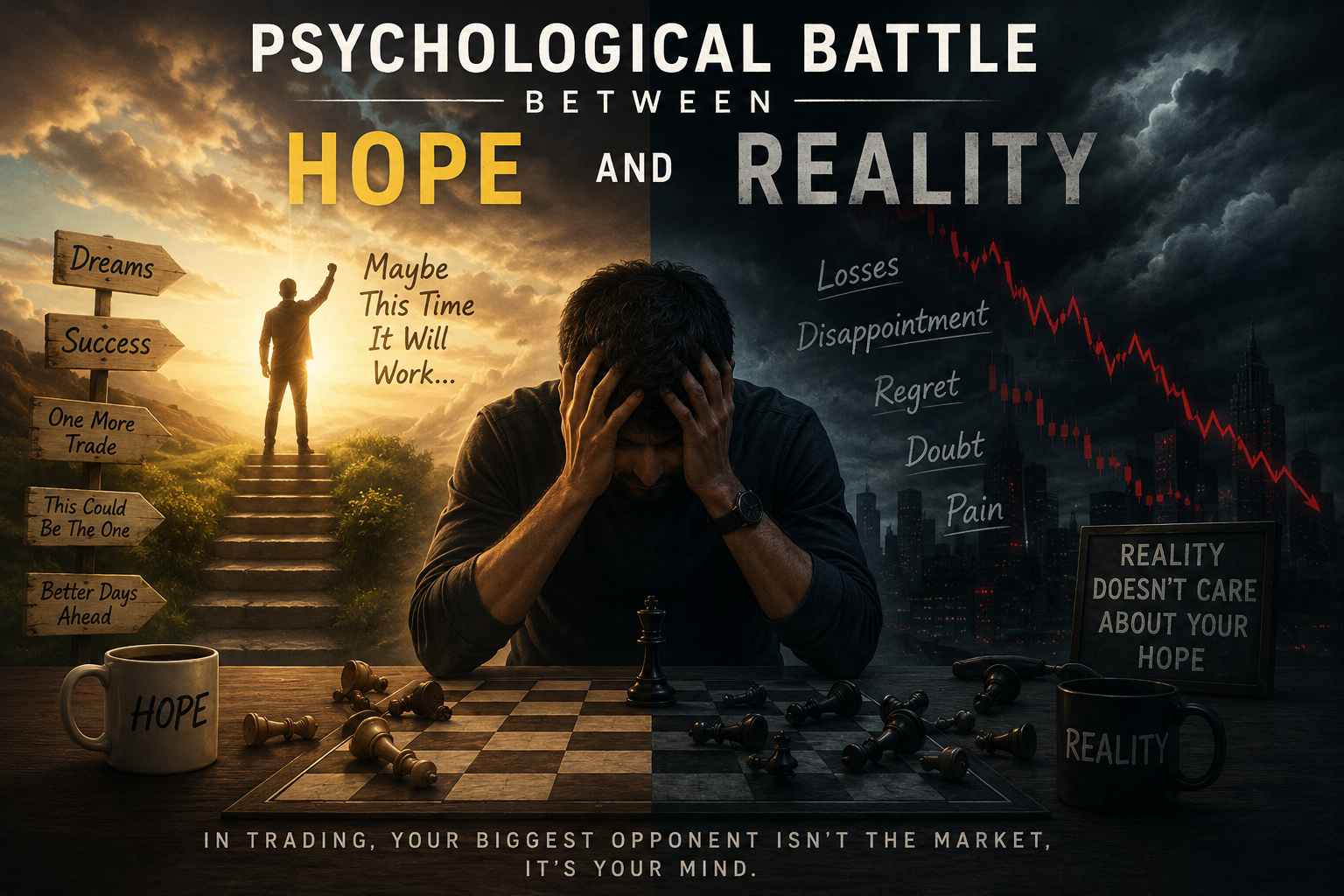
The greatest challenges in trading often occur internally rather than externally. Charts do not create emotional pain. Our reactions to them do.
Hope can be valuable in life, but in trading it sometimes becomes a dangerous distraction.
When Hope Replaces Strategy
A solid trading plan is built on rules and evidence. Hope enters the picture when those rules begin to break down.
Many traders start with a strategy but abandon it once emotions take control.
Holding Losing Trades Too Long
One of the most common mistakes occurs when traders refuse to close losing positions.
They tell themselves the market will eventually return in their favor. They wait for a miracle reversal rather than accepting a manageable loss.
Small losses often become large losses because hope replaces discipline.
The False Comfort of Waiting
Waiting can feel productive. It creates the illusion that a solution is coming.
In reality, waiting without evidence often delays necessary decisions. Markets can remain irrational longer than traders expect.
Accepting a loss is painful, but endless waiting can be even more costly.
Fear and Its Impact on Market Perception
While hope can distort reality, fear can do the same.
Fear causes traders to see threats everywhere. It can make healthy market pullbacks appear catastrophic.
Missing Opportunities Through Fear
Many traders exit winning trades too early because they fear losing profits.
The market may still be showing strong bullish momentum, yet fear convinces them danger is around every corner.
This habit limits growth and prevents traders from maximizing favorable conditions.
Overreacting to Market Noise
Financial markets generate constant fluctuations. Not every movement carries significance.
Fearful traders often react to every small price change. They confuse noise with meaningful information.
Learning to distinguish between temporary fluctuations and genuine trend changes is essential for long-term success.
Building the Discipline to Accept Reality


Seeing the market for what it truly is requires consistent mental training. Discipline does not appear overnight. It develops through repetition and self-awareness.
Like strengthening a muscle, traders build discipline one decision at a time.
Creating Rules That Override Emotion
Rules act as guardrails during emotional moments. They help traders stay aligned with reality even when emotions become intense.
Without rules, decision-making becomes inconsistent and unpredictable.
The Power of Predefined Risk Management
Risk management removes much of the emotional burden from trading.
When exit levels and position sizes are determined beforehand, traders are less likely to make impulsive decisions.
This structure encourages objective thinking and protects capital during difficult periods.
Consistency Creates Clarity
Consistent behavior produces reliable feedback. Traders can evaluate what works and what doesn’t.
Random decisions create confusion because outcomes become impossible to analyze accurately.
The more consistent a trader becomes, the easier it is to recognize genuine market signals.
Developing Emotional Awareness
Emotional awareness does not mean eliminating feelings. That would be impossible.
Instead, it involves recognizing emotions before they influence decisions.
Identifying Emotional Triggers
Every trader has emotional triggers. Some struggle with greed after winning streaks. Others become fearful following losses.
Recognizing these patterns allows traders to respond consciously rather than react automatically.
Awareness creates a gap between emotion and action, and that gap is often where better decisions emerge.
Separating Feelings from Facts
Feelings are temporary. Facts are observable.
A trader may feel certain that a market will rise, but feelings alone do not constitute evidence.
Successful traders learn to separate emotional reactions from objective market conditions. This distinction keeps them grounded in reality.
The Difference Between Amateur and Professional Thinking

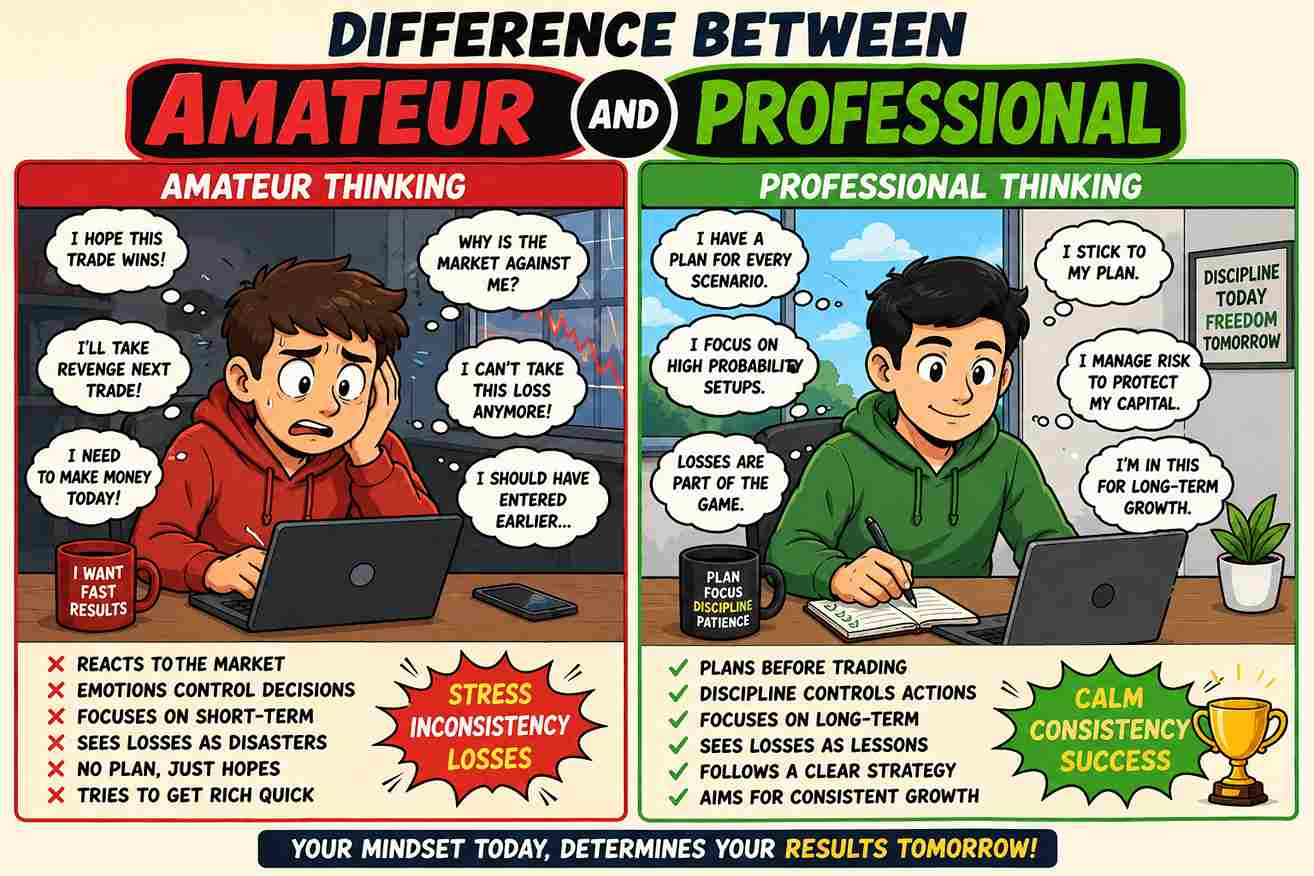
The gap between amateur and professional traders often has little to do with intelligence. It usually comes down to mindset.
Professionals approach markets differently because they understand that survival matters more than ego.
Professionals React, Amateurs Predict
Many amateurs spend enormous energy trying to forecast every market movement.
Professionals focus more on responding to what the market actually does.
Flexibility Creates Opportunity
A flexible trader can adapt when conditions change.
If a bullish setup becomes bearish, they adjust accordingly. They are not emotionally tied to a single outcome.
This adaptability allows them to remain aligned with reality rather than outdated assumptions.
Rigidity Leads to Losses
Rigid thinking creates vulnerability. Markets evolve constantly, and strategies must evolve alongside them.
Traders who refuse to adapt often find themselves fighting trends rather than benefiting from them.
The market usually wins that battle.
Professionals Respect the Market
Respect does not mean fear. It means recognizing the market’s complexity and unpredictability.
Experienced traders understand that confidence should never become arrogance.
Humility Preserves Capital
Humility encourages caution. It reminds traders that losses are always possible.
This mindset supports responsible risk management and prevents reckless behavior.
The market has a way of teaching humility to anyone who ignores it.
Continuous Learning Matters

Markets evolve as economic conditions, technology, and participant behavior change.
Professional traders remain students of the market. They continue learning, adapting, and refining their approach.
This commitment to growth helps them maintain an objective perspective over time.
A Final Reflection
The message behind the quote, “See the market for what it is, not what you want,” extends far beyond trading. It is a lesson about accepting reality instead of resisting it.
Markets reward those who observe carefully, think objectively, and adapt quickly. They punish those who cling to wishes, defend opinions, and ignore evidence. Every chart tells a story, but only if we are willing to read it honestly.
Success in trading does not come from predicting every move correctly. It comes from understanding what the market is communicating in the present moment. When traders stop arguing with reality and start working with it, their decision-making becomes clearer, their emotions become more manageable, and their performance often improves dramatically.
The market is neither friend nor enemy. It is simply a reflection of collective human behavior. The challenge is learning to view that reflection without distortion. Once that happens, traders gain something far more valuable than a perfect prediction—they gain perspective.
FAQs
1.Why is objectivity important in trading?
Objectivity helps traders make decisions based on facts and market behavior rather than emotions, assumptions, or personal opinions.
2.What does it mean to see the market for what it is?
It means observing actual market conditions, price movements, and evidence instead of focusing on what you hope or expect will happen.
3.How does confirmation bias affect traders?
Confirmation bias causes traders to seek information that supports their existing beliefs while ignoring evidence that contradicts them, often leading to poor decisions.
4.Why do traders hold losing positions for too long?
Many traders become emotionally attached to their trades and rely on hope rather than objective analysis, causing them to delay necessary exits.
5.Can anyone completely remove emotions from trading?
No. Emotions are a natural part of being human. The goal is not to eliminate them but to recognize and manage them so they do not control trading decisions.