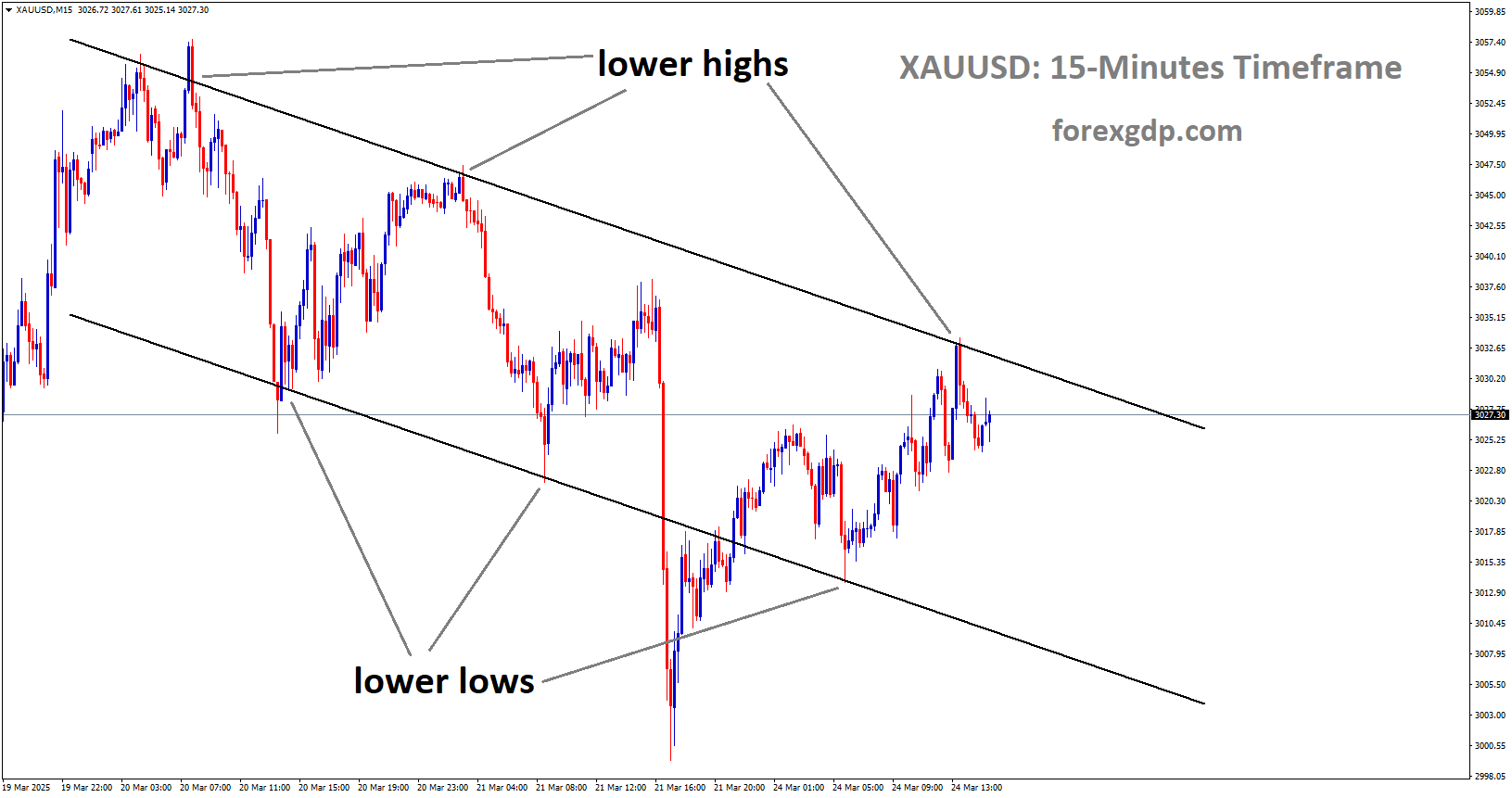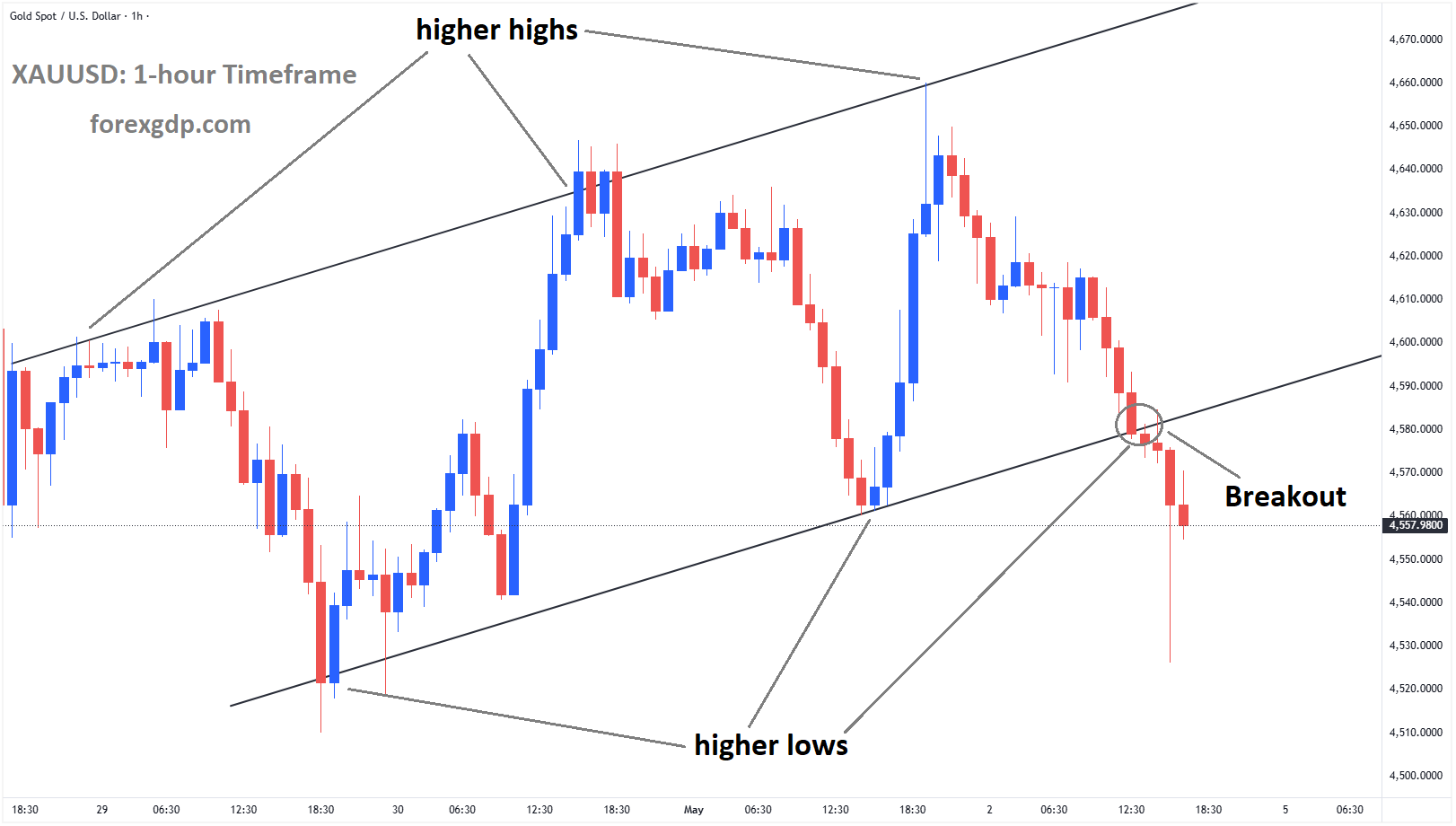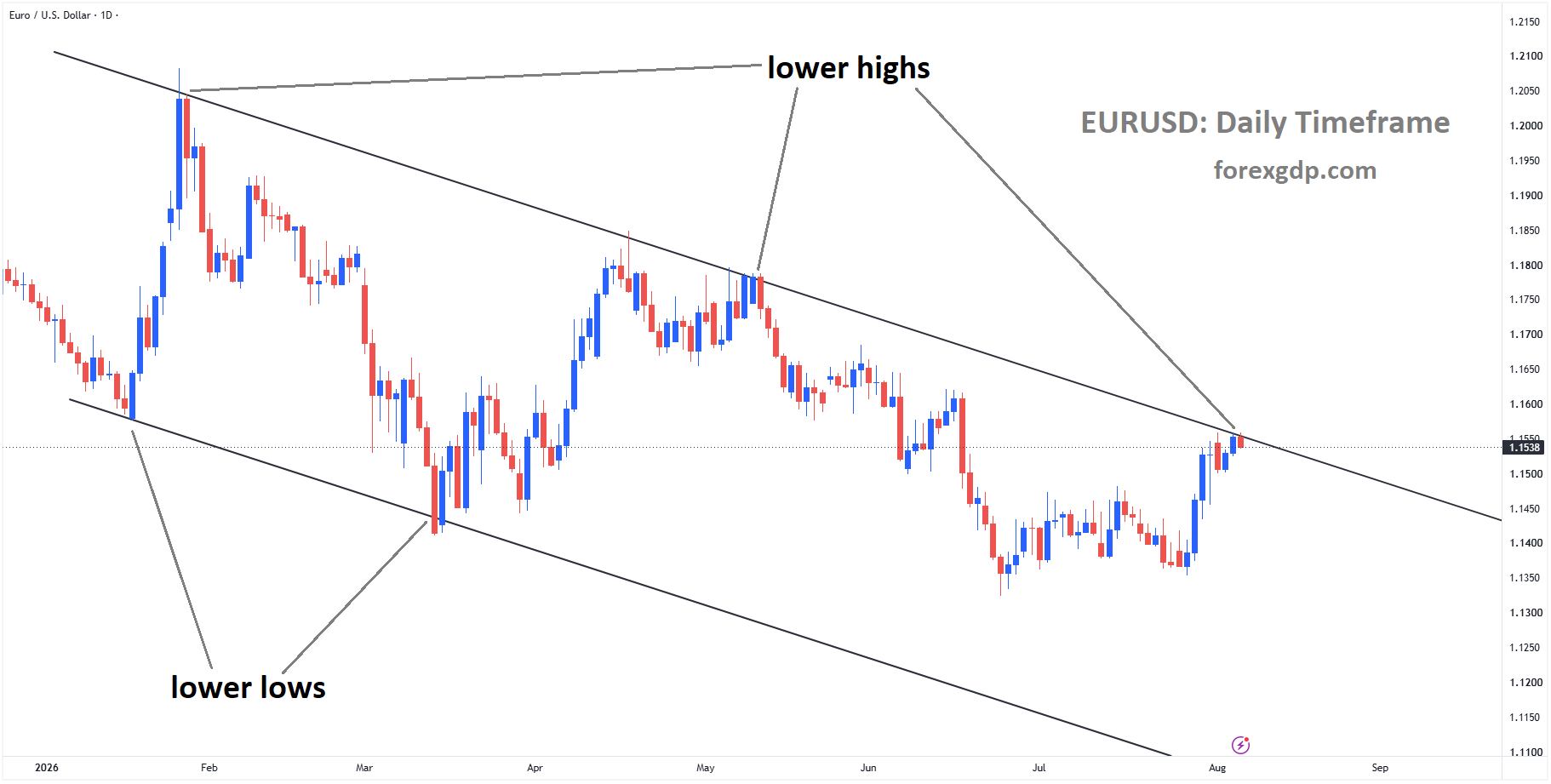
EURUSD reached the lower high area of the descending channel
EURUSD Stays Resilient with Upbeat Eurozone Signals Supporting the Euro
The Euro remained steady against the US Dollar during early European trading on Thursday. Support for the common currency came from encouraging economic reports in the Eurozone, lower oil costs, and growing uncertainty about the strength of the US labour market.
Recent German data offered investors a more positive view of Europe’s largest economy. Factory orders rose strongly in June and easily exceeded forecasts. The improvement followed an encouraging update to the region’s services sector figures, helping to strengthen expectations that the European Central Bank could raise interest rates at its September meeting.
Meanwhile, the US Dollar struggled to gain momentum after private employment figures failed to meet expectations. The disappointing report increased attention on the upcoming US Nonfarm Payrolls release, which is expected to provide a broader picture of hiring conditions across the country.
German Factory Orders Deliver a Positive Surprise
German Factory Orders increased by 3.1% in June, significantly stronger than the modest 0.3% growth expected by economists. The previous month’s result was also revised lower to show a 0.3% increase.
The June reading offered a welcome sign for Germany’s industrial sector. Factory orders measure demand received by manufacturers and can provide an early indication of future production activity. A strong increase suggests that businesses may have more work in the coming months, although one monthly report does not necessarily confirm a lasting recovery.
Germany plays a central role in the Eurozone economy because of its large manufacturing base. Its industrial companies are closely connected to supply chains across Europe and the rest of the world. For that reason, unexpected strength in German orders can improve confidence in the wider regional outlook.
The positive report was especially important because the German economy has faced pressure from weak external demand, high energy costs, and uncertain global trade conditions. A better-than-expected result does not remove those challenges, but it may reduce concerns that industrial activity is deteriorating rapidly.
Eurozone Services Data Adds to the Optimism
The factory orders report followed an upward revision to the HCOB Services Purchasing Managers’ Index. Released on Wednesday, the revised survey suggested that activity among service-sector businesses was somewhat stronger than initially reported.
Services make up a large part of the Eurozone economy, covering industries such as transport, finance, hospitality, communications, and professional support. When activity in this area improves alongside industrial demand, policymakers may become more confident about the region’s ability to manage tighter financial conditions.
Taken together, the German and Eurozone reports encouraged expectations that the European Central Bank may consider another interest-rate increase in September. The central bank must balance the need to control inflation against the risk of placing too much pressure on households and businesses.
Stronger economic data can give the ECB more room to continue fighting inflation. However, officials will still need to study wage growth, consumer demand, lending conditions, and future inflation reports before making a final decision.
Lower Oil Costs Offer Additional Help to Europe
Lower oil costs have also supported the outlook for the Eurozone. Many European countries depend heavily on imported energy, meaning a decline in oil costs can reduce pressure on businesses, transport companies, and consumers.
Cheaper energy may help manufacturers control operating expenses and allow households to spend more money in other parts of the economy. It can also ease some inflationary pressure, although the effect depends on how long lower energy costs last and how quickly they reach consumers.
The relationship is not entirely straightforward for the ECB. Lower energy costs may reduce inflation, potentially limiting the need for aggressive rate increases. At the same time, relief from high energy expenses could support economic activity and make the region more resilient.
For the Euro, the immediate impact has been broadly supportive because lower energy costs can improve Europe’s trade position and reduce concerns about the economic damage caused by expensive imports.
US Employment Report Raises Fresh Concerns
Economic news from the United States was less encouraging. ADP reported that private employers added 44,000 jobs, falling well short of the 70,000 increase expected by economists. Hiring also slowed sharply compared with the previous month, when the economy recorded a revised gain of 98,000 private-sector positions.
The ADP report is closely watched because it arrives shortly before the government’s Nonfarm Payrolls data. However, the two reports are produced using different methods and do not always move in the same direction. A weak ADP result therefore does not guarantee that the official employment report will also disappoint.
Even so, the figures added to concerns that demand for workers may be losing strength. A slower labour market could affect household income, consumer spending, and the wider economic outlook. It could also influence the Federal Reserve’s future policy decisions if officials believe employment conditions are weakening more quickly than expected.
Investors are now likely to give particular attention to job creation, unemployment, wages, and revisions to earlier employment estimates in Friday’s report.
US Services Activity Shows Mixed Conditions
The ISM Services Purchasing Managers’ Index increased slightly in July, rising to 54.1 from 54 in the previous month. A reading above 50 generally signals that business activity is expanding. However, the result was weaker than the 54.5 figure expected by economists.
Details within the survey presented a mixed picture. Price pressures increased, while the employment component declined. This combination may be uncomfortable for the Federal Reserve because it suggests that inflation risks remain even as hiring conditions lose momentum.
Persistent price pressure could encourage policymakers to keep borrowing costs elevated. On the other hand, weaker employment may create pressure for a more cautious approach. The Federal Reserve will need to consider both sides of that picture when assessing future policy.
Strait of Hormuz Proposal Adds Geopolitical Uncertainty
Developments involving Iran and Oman introduced another source of uncertainty. Reuters reported that the two countries had proposed an agreement to reopen the Strait of Hormuz, with Iran receiving control over traffic passing through the strategically important waterway.
The Strait of Hormuz is one of the world’s most important routes for energy shipments. Any change affecting access, security, or control of the passage can have major consequences for global oil supplies and international relations.
The US government had not formally responded to the reported proposal. President Donald Trump, however, has strongly opposed the possibility of Iran controlling the strait.
The situation remains important for Europe because disruptions to global energy transport could affect import costs, inflation, and business confidence. Even without an immediate interruption, uncertainty surrounding the waterway may influence decisions by governments, shipping companies, and energy producers.
Summary
The Euro received support from stronger German Factory Orders, an improved Eurozone services reading, and lower oil costs. These developments encouraged expectations that the European Central Bank may consider raising interest rates in September.
In contrast, disappointing US private employment growth and mixed services data raised questions about the condition of the American economy. Attention is now focused on the Nonfarm Payrolls report for clearer evidence about hiring and wage growth.
At the same time, the proposed arrangement involving Iran, Oman, and the Strait of Hormuz has added geopolitical uncertainty. Economic reports, central-bank expectations, and energy-security developments are likely to remain the main influences on the Euro and US Dollar outlook.
GBPUSD Comes Under Pressure While US-Iran Negotiations Take Center Stage
The British Pound weakened against the US Dollar during Thursday’s early European session as investors reacted cautiously to mixed messages surrounding negotiations involving the United States and Iran. Uncertainty over diplomatic progress reduced demand for risk-sensitive currencies, allowing the US Dollar to benefit from its traditional safe-haven status.
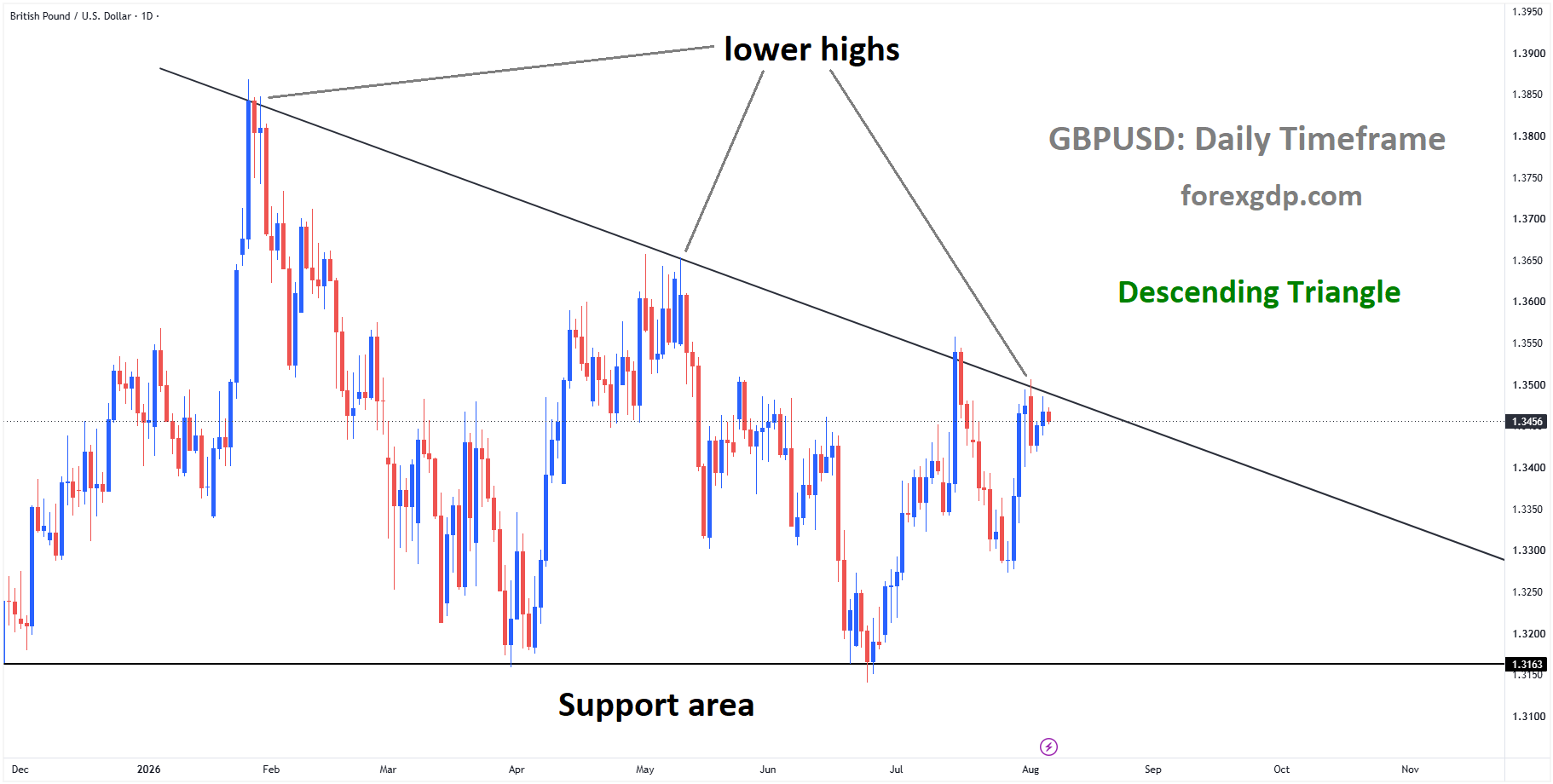
GBPUSD reached the lower high area of the descending triangle pattern
Geopolitical developments remain an important influence on global financial markets. Although American officials have described recent discussions in positive terms, they have also warned that reaching a meaningful agreement could be difficult and time-consuming. Iranian officials have added to the confusion by offering different accounts of the talks.
At the same time, weaker US employment figures have raised questions about the strength of the American labor market. This could limit further gains for the Dollar if upcoming reports provide additional evidence that hiring conditions are losing momentum.
Conflicting US Statements Create Diplomatic Uncertainty
US President Donald Trump said on Wednesday that discussions with Iran had been highly productive. His comments suggested that diplomatic efforts were moving forward and raised hopes that both countries could eventually find common ground.
However, Vice President JD Vance offered a more cautious assessment. He warned that the negotiating process would likely be complicated and could take considerable time. Vance also pointed to difficulties within Iran’s political structure, suggesting that its divided decision-making system may make it harder to reach or implement an agreement.
These contrasting statements have left investors unsure about the true condition of the negotiations. Positive remarks from the president offered some reassurance, but the vice president’s warning highlighted the obstacles that remain.
Financial markets generally respond poorly to uncertainty, especially when negotiations involve security, energy transportation, and important international trade routes. When the outlook becomes less predictable, investors often reduce exposure to currencies viewed as more sensitive to global risk. The Pound can come under pressure during such periods, while the Dollar may attract defensive demand.
Strait of Hormuz Talks Add Another Layer of Confusion
Developments involving the Strait of Hormuz have also drawn close attention. The waterway is one of the world’s most important routes for international energy shipments, making any political or military tension in the area a major concern for governments, shipping companies, and investors.
Iranian Deputy Foreign Minister Kazem Gharibabadi said Iran and Oman had been holding negotiations for more than three weeks about reopening the strait. According to him, the discussions had produced broad agreement on proposed shipping routes for vessels entering and leaving the area.
Those comments appeared to indicate that diplomatic work was taking place behind the scenes. Oman has often played a useful role as a mediator in regional disputes, and its involvement could provide a channel for practical discussions.
However, another Iranian official denied that Tehran was currently negotiating with Washington over the waterway. This denial created fresh doubt about who was involved in the talks and how much progress had actually been made.
The lack of a consistent message makes it difficult for markets to judge whether tensions are easing. Even if Iran and Oman are discussing shipping arrangements, the absence of confirmed direct talks between Tehran and Washington may mean that broader political disagreements remain unresolved.
Until clearer information emerges, geopolitical caution may continue to influence GBP/USD. The effect is not only about the relationship between the two currencies. It also reflects wider concerns about global trade, energy supplies, inflation, and economic confidence.
Weak US Private Employment Growth Limits Dollar Strength

Although political uncertainty has supported demand for the Dollar, recent US economic data has been less encouraging. Figures from Automatic Data Processing showed that private-sector employment increased by 44,000 positions in July.
This was a sharp slowdown from the revised or previously reported increase of 98,000 jobs in June. It also fell below the market expectation of 70,000, indicating that private employers added fewer workers than economists had predicted.
The ADP report does not always move in the same direction as the government’s official employment data. Still, it can offer a useful early look at hiring activity across private businesses. A weaker reading may suggest that employers are becoming more careful because of uncertain demand, high borrowing costs, or concerns about the wider economy.
Slower job creation can affect consumer spending because employment and income are closely connected. If households become worried about job security, they may delay major purchases and reduce discretionary spending. That can eventually weigh on economic growth.
For the currency market, softer employment data creates a possible obstacle for the Dollar. If the US economy shows clear signs of slowing, investors may become less confident that the Federal Reserve will maintain a more restrictive policy approach.
Jobless Claims and Official Employment Data Move Into Focus
Investors are now turning their attention to the US Initial Jobless Claims report. This weekly release tracks the number of people filing for unemployment benefits for the first time and can provide a timely view of labor market conditions.
A noticeable increase in claims could reinforce concerns that employment demand is weakening. On the other hand, a stable or lower figure may suggest that businesses are still holding on to workers despite slower private-sector hiring.
The official US employment report for July will receive even greater attention on Friday. It will provide broader information about job creation, unemployment, and wage growth. Together, these figures can shape expectations for the Federal Reserve’s next policy decisions.
If the report shows that the labor market is losing strength, investors may reconsider expectations for future interest-rate increases. That could reduce some of the support currently enjoyed by the Dollar and offer relief to GBP/USD.
However, a resilient employment report could have the opposite effect. Strong hiring and wage figures may encourage the view that the American economy can withstand tighter financial conditions, keeping the Dollar supported.
UK Economic Calendar Remains Quiet Ahead of GDP Report
The British Pound has few major domestic economic releases to guide it in the immediate future. Strategists at Scotiabank noted that the UK calendar remains limited, with no major reports scheduled before the preliminary second-quarter gross domestic product release on August 13.
This quiet period means that GBP/USD may be driven mainly by developments outside the United Kingdom. US employment figures, Federal Reserve expectations, and news involving Iran are likely to attract more attention than British data in the near term.
The upcoming UK GDP report will therefore be especially important. It will show whether the British economy expanded during the second quarter and provide insight into the health of household spending, business activity, and overall demand.
A stronger growth result could improve confidence in the UK outlook and support the Pound. A disappointing report, however, may increase concerns about weak economic momentum and influence expectations for future Bank of England policy.
Summary
GBP/USD has moved lower as uncertain US-Iran negotiations encouraged caution across financial markets. Conflicting statements about diplomatic progress and the Strait of Hormuz have made it difficult for investors to determine whether tensions are genuinely easing.
Meanwhile, weaker US private-sector employment growth has introduced doubts about the strength of the American labor market. Upcoming jobless claims and official employment figures will be closely watched for evidence of a broader slowdown.
With the UK data calendar remaining quiet, the Pound is likely to remain sensitive to international events and US economic reports. Attention will later shift to Britain’s preliminary second-quarter GDP release, which could provide the next major domestic signal for the currency pair.
USDJPY Pushes Higher Despite Recent Efforts to Support the Yen
The Japanese yen weakened against the US dollar on Thursday, surrendering part of the sharp advance that followed a rare coordinated currency intervention by Japan and the United States.
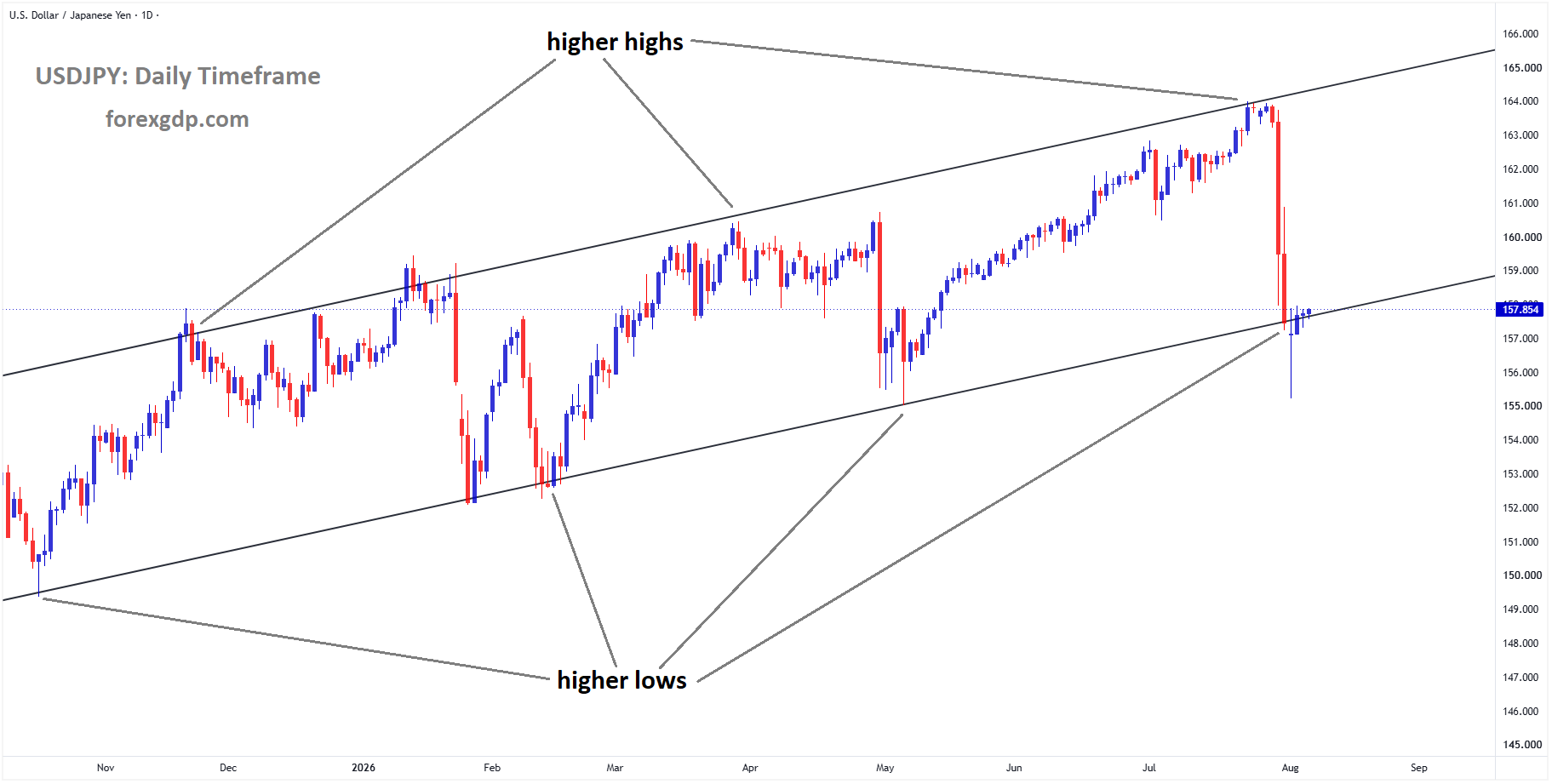
USDJPY reached the higher low area of the ascending channel
The intervention had delivered a powerful short-term boost to the Japanese currency late last week. However, that momentum has started to fade as investors turn their attention to Japan’s fiscal plans and the possible impact of new government spending measures.
Although weakness in the US dollar continues to offer some support to the yen, concerns about Japan’s proposed tax cuts and financial assistance for households are making traders more cautious. The result is a mixed environment in which neither currency has been able to build strong and lasting momentum.
Coordinated Intervention Delivered a Strong Initial Impact
Japan’s Ministry of Finance and the US Treasury recently stepped into the foreign exchange market to support the yen. The coordinated action was notable because direct intervention involving both countries is relatively uncommon and sends a stronger political message than action taken by Japan alone.
The immediate response was significant. The yen strengthened rapidly as market participants reacted to the intervention and reduced positions that had benefited from its earlier weakness.
Such action can influence markets in two ways. First, the actual buying and selling of currencies can create a sudden change in demand. Second, intervention warns investors that government authorities are uncomfortable with excessive currency movements and may act again if necessary.
However, intervention does not always create a lasting shift. Its longer-term success often depends on whether government policy, economic conditions, and central bank decisions support the same direction. If those factors remain unchanged, the effect can begin to disappear once the initial surprise passes.
That challenge is becoming visible as attention moves from the intervention itself to Japan’s broader economic strategy.
Japan’s Tax-Cutting Plans Raise Fiscal Concerns
Shortly after authorities acted to support the yen, the Japanese cabinet approved a plan to reduce the sales tax on food for two years. The government is also considering payments to lower-income households as part of its response to the rising cost of living.
These policies are designed to provide relief to families facing pressure from expensive food, energy, and other essential goods. They may also help Prime Minister Takaichi’s government address declining public support linked to household financial difficulties.
While the measures could offer immediate help to consumers, their financing has become an important concern. Critics say the tax reduction has not been supported by a clear plan showing how the lost government revenue will be replaced.
Questions have come from opposition parties, financial market participants, and some members of the governing Liberal Democratic Party. Their concern is that tax cuts and household payments could increase pressure on Japan’s public finances if they are introduced without spending reductions or new sources of revenue.
Japan already carries a very large public debt burden. For that reason, investors closely watch any policy that could lead to heavier government borrowing. Measures intended to help households may be politically attractive, but they can also create doubts about fiscal discipline.
A recent sale of long-term Japanese government debt did not show serious signs of weak demand. That suggests investors have not yet become broadly alarmed about the government’s funding position. Still, a single bond auction may not provide a complete picture of market confidence.
Rabobank analysts believe the yen could become a more important test of how investors view Japan’s policy mix. If the currency continues to struggle after official intervention, it may suggest that concerns about government spending and fiscal credibility are outweighing the authorities’ efforts to support it.
Weak US Data Limits the Dollar’s Recovery

The yen is not facing pressure from Japan’s domestic policies alone. Developments in the United States are also playing a major role.
Recent US economic reports have been weaker than expected, preventing the dollar from making a stronger advance. Investors are particularly concerned about the condition of the American labour market, which has shown signs of losing momentum.
The ADP private-sector employment report showed that businesses added fewer workers than economists had expected in July. Job creation also slowed noticeably compared with the previous month. Although the ADP report does not always match the government’s official employment figures, it is often used as an early signal of hiring conditions.
The latest survey of the US services sector offered another reason for caution. Business activity continued to expand, but the overall result fell short of expectations. More importantly, the employment component showed a decline, suggesting that service companies were becoming more careful about staffing.
The services industry represents a major share of the US economy and employs millions of people. Weakness in employment within this sector can therefore have wider consequences for consumer spending and economic growth.
Nonfarm Payrolls Become the Main Market Focus
Investors are now waiting for the US Nonfarm Payrolls report, which will provide a broader view of hiring across the American economy.
Economists expect employment growth to improve from the previous month. However, the recent private payrolls and services data have created uncertainty around that forecast. A disappointing report could strengthen concerns that businesses are reducing hiring as economic conditions become less predictable.
The employment report will also influence expectations for Federal Reserve policy. The central bank closely follows job creation, unemployment, wage growth, and inflation when deciding whether interest rates should change.
A healthy labour market could give policymakers more confidence that the economy can handle restrictive monetary conditions. On the other hand, clear signs of weakness could encourage the Federal Reserve to take a more cautious approach.
Traders have already reduced expectations that the Fed will raise interest rates soon. This shift has limited demand for the dollar and prevented it from fully benefiting from the yen’s renewed weakness.
Central Bank Expectations Keep Both Currencies Under Pressure
The outlook for the dollar and yen remains closely connected to the policy paths of the Federal Reserve and the Bank of Japan.
For the US dollar, weaker employment figures would make another near-term rate increase less likely. That could reduce the currency’s appeal, particularly if investors begin expecting the Fed to focus more heavily on supporting economic growth.
For the yen, the situation is more complicated. Japan’s government wants to ease the financial burden on households while also preventing excessive currency weakness. Yet generous fiscal measures without clear funding could damage confidence and work against the impact of intervention.
The Bank of Japan’s policy decisions will also remain important. Any change in its stance could affect borrowing costs, government finances, and demand for the yen. Investors will therefore continue to examine whether monetary and fiscal policies are moving in a consistent direction.
Summary
The Japanese yen has lost part of the strong gain created by coordinated US-Japan currency intervention. Concerns about a temporary food tax reduction and financial support for lower-income households are raising questions about Japan’s fiscal discipline.
At the same time, disappointing US employment and services data are limiting the dollar’s ability to strengthen. Investors are now focused on the upcoming Nonfarm Payrolls report for clearer evidence about the condition of the US labour market and the Federal Reserve’s next policy move.
The yen’s performance may ultimately reveal whether investors believe Japan’s intervention and economic policies can work together effectively.
USDCAD Loses Momentum While Crude Rebound Lifts the CAD
The Canadian Dollar gained strength against the US Dollar as recovering crude oil markets improved demand for Canada’s commodity-linked currency. USD/CAD moved lower for a second consecutive session, with energy supply concerns and mixed US economic figures shaping investor sentiment.
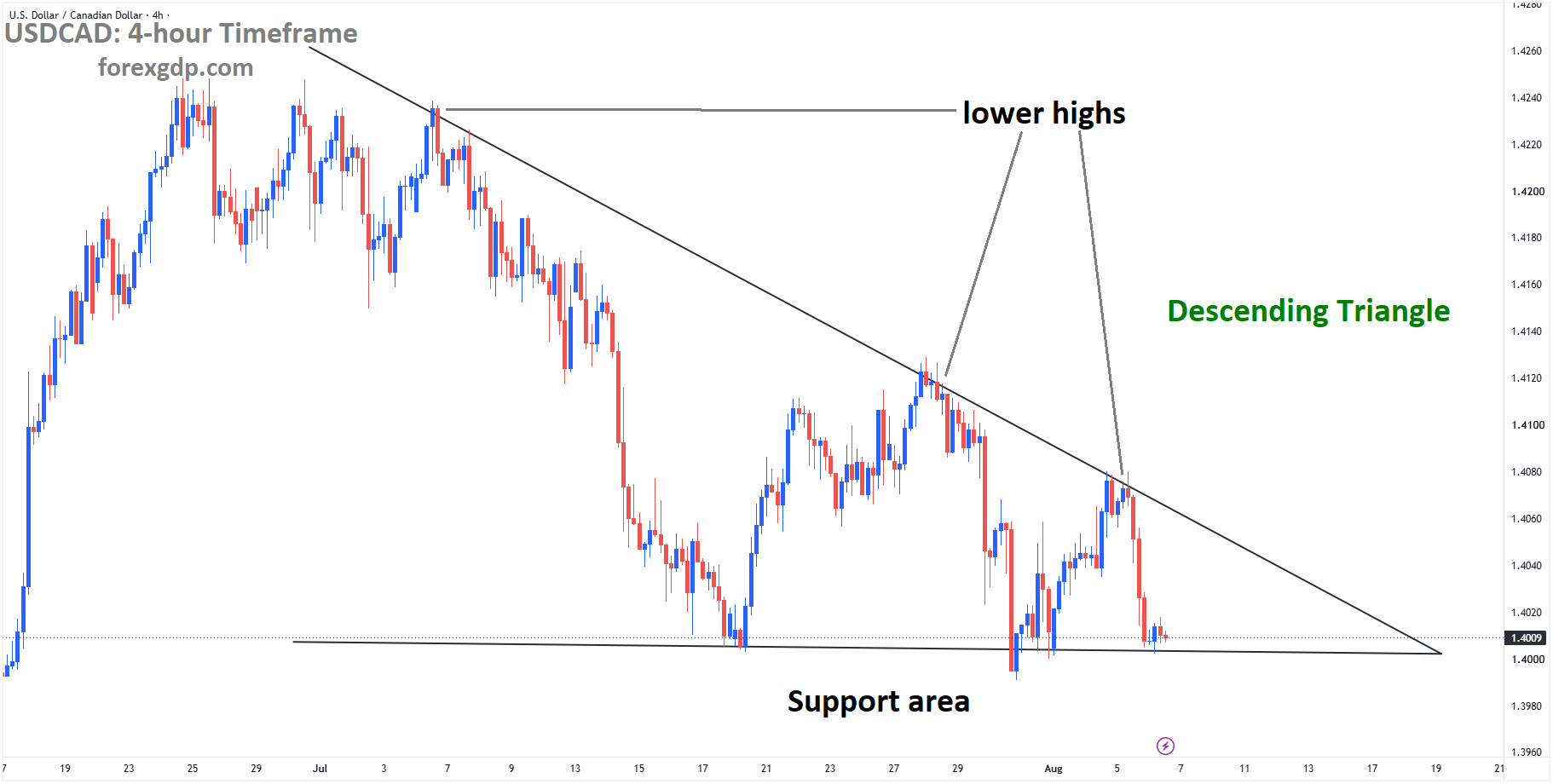
USDCAD reached the support area of the descending triangle pattern
Canada is one of the world’s leading oil exporters, which means movements in crude oil often influence the value of its currency. When energy markets strengthen, expectations of higher Canadian export revenue can make the Canadian Dollar more attractive. That relationship was visible again as crude rebounded following several days of weakness.
At the same time, investors remained cautious about the US Dollar after private employment growth came in below expectations. Although the American services sector continued to expand, details within the report raised fresh concerns about the health of the labour market.
Attention has now turned to upcoming US employment data, particularly weekly jobless claims and the closely watched Nonfarm Payrolls report.
Rising Crude Oil Supports the Canadian Dollar
The Canadian Dollar received an important lift from the recovery in crude oil. Energy markets had previously recorded several consecutive sessions of losses, but renewed concerns about supply disruptions helped reverse some of that weakness.
Oil plays a central role in Canada’s economy. The country exports large amounts of crude, especially to the United States, and energy production supports jobs, business investment and government revenue. As a result, the Canadian Dollar often benefits when the outlook for oil demand or export earnings improves.
The latest rebound gave investors another reason to reduce their exposure to USD/CAD. The pair had already been under pressure, and the stronger energy market added momentum to the move.
However, the connection between crude oil and the Canadian Dollar is not always straightforward. Currency traders must also consider interest-rate expectations, economic growth, inflation and developments in the United States. Since the US is Canada’s largest trading partner, changes in the American economy can have a major effect on Canadian financial conditions.
For now, the oil recovery has provided enough support to keep the Canadian currency on firmer ground.
Middle East Tensions Renew Supply Concerns
Geopolitical developments in the Middle East returned to the centre of attention after a deadly Israeli airstrike in southern Lebanon. The operation reportedly targeted Hezbollah infrastructure and followed accusations of ceasefire violations.
Any rise in regional tensions can quickly affect energy markets because the Middle East is a crucial source of global oil production and exports. Even when physical supplies remain available, the possibility of military escalation can lead traders to prepare for disruptions.
Shipping routes are especially important in this calculation. A large share of the region’s energy exports must travel through narrow and strategically sensitive waterways. Conflict near these routes can delay shipments, increase insurance expenses and create uncertainty for refiners and importers.
The latest developments therefore encouraged renewed buying in crude oil. Investors appeared concerned that a wider confrontation could threaten production facilities or interfere with the movement of energy supplies.
These fears helped strengthen the Canadian Dollar because higher crude oil demand generally improves the outlook for Canada’s export sector. Still, the situation remains complicated due to separate diplomatic and maritime developments involving Iran and Oman.
Iran and Oman Discuss Temporary Hormuz Shipping Route

Iran and Oman are reportedly preparing a joint statement on a temporary shipping arrangement through the Strait of Hormuz. The proposed route could remain in place for a period of two to four months.
The Strait of Hormuz is one of the most important waterways for the international energy trade. Any limitation on shipping through the area can create serious concerns about the availability of oil and gas.
The possible agreement could allow additional Middle Eastern energy shipments to reach global buyers. That prospect has reduced some of the strongest fears surrounding an immediate and severe supply shortage.
However, Iranian officials have stressed that the temporary measure should not be interpreted as a complete reopening of the strategic waterway. This distinction is important because it suggests that shipping conditions may remain restricted or uncertain even if the arrangement moves forward.
Energy traders are therefore balancing two competing forces. On one side, renewed military tension has increased the risk of interruptions. On the other, the Iran-Oman plan could support a limited improvement in regional energy flows.
This uncertainty may continue to influence both crude oil and the Canadian Dollar. A smooth expansion of shipping activity could ease supply concerns, while further political or military escalation could strengthen them again.
Weak ADP Payroll Growth Raises US Labour Concerns
US economic releases offered an uneven picture. Private-sector employers added only 44,000 jobs in July, according to ADP data. That result was much weaker than anticipated and also represented a clear slowdown from the revised increase of 95,000 recorded in June.
The ADP report does not always predict the government’s official employment figures accurately. Even so, it provides an early look at hiring conditions and can influence expectations before the Nonfarm Payrolls announcement.
The softer result suggested that American businesses may be becoming more cautious about recruitment. Companies can slow hiring when they face uncertain demand, higher operating expenses or concerns about future economic activity.
Signs of weaker employment growth can place pressure on the US Dollar because they may affect expectations for monetary policy. If the labour market loses momentum, policymakers could have more reason to consider supporting the economy. However, one report alone is unlikely to settle the debate, especially when other areas of the economy remain relatively resilient.
Services Activity Remains Firm but Employment Weakens
The ISM Services Purchasing Managers’ Index offered a more positive signal by showing that the sector continued to expand. The headline reading improved slightly from the previous month, although it remained below economists’ expectations.
Services make up a large part of the US economy, covering industries such as finance, healthcare, transportation, hospitality and professional support. Continued expansion in these areas suggests that overall economic activity has not experienced a sudden decline.
The employment component of the survey told a less encouraging story. It fell into contraction territory, indicating that service-sector businesses may have reduced hiring or cut staffing levels during the month.
ING analysts noted that the weaker ADP figure and the sharp fall in the ISM services employment measure created mild downside risks for the official payroll report. Their assessment supports a cautious approach because the headline services number appears stable while the underlying labour signal looks less secure.
Nonfarm Payrolls Become the Main Market Focus
Investors are now waiting for Initial Jobless Claims and the Nonfarm Payrolls report. Weekly claims will offer a more recent view of layoffs, while the payroll release will provide broader information on hiring across the economy.
The official jobs report will be particularly important because it can influence expectations for US growth and monetary policy. Traders will examine not only the number of jobs created but also unemployment, wage growth and revisions to earlier data.
A softer labour report could reinforce concerns raised by ADP and the ISM employment component. More resilient figures, however, could show that private surveys presented an overly cautious picture.
For USD/CAD, the outcome will be considered alongside crude oil developments. The exchange rate is currently being influenced by two major themes: support for the Canadian Dollar from stronger energy markets and uncertainty surrounding the US labour outlook.
Summary
USD/CAD remained under pressure as recovering crude oil strengthened the Canadian Dollar. Renewed Middle East tensions increased concerns about energy supplies, although a temporary shipping arrangement between Iran and Oman offered some hope of improved flows through the Strait of Hormuz.
Meanwhile, weak US private payroll growth and a decline in the ISM services employment component raised questions about the strength of the American labour market. With weekly jobless claims and Nonfarm Payrolls still ahead, investors are likely to remain cautious as they assess whether hiring conditions are experiencing a temporary slowdown or a broader loss of momentum.
AUDUSD Slips as Strong Australian Trade Data Loses Influence
The Australian Dollar recorded a modest pullback against the US Dollar on Thursday after reaching its strongest position in roughly three weeks during the previous session. Despite the retreat, the broader mood around the Australian currency remained positive.
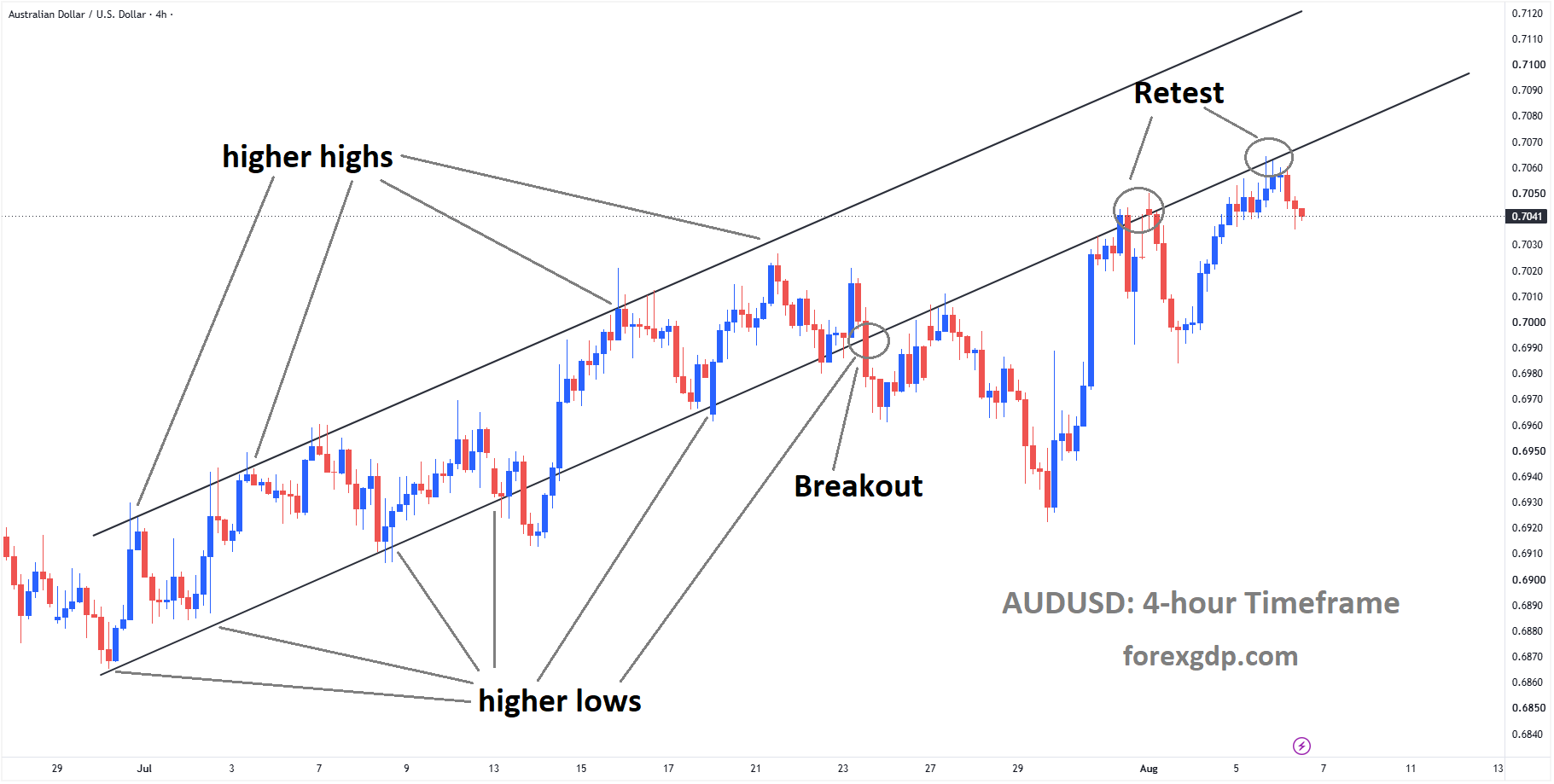
AUDUSD is falling from the retest area of the broken ascending channel
Investors appeared unwilling to make large moves before the release of the closely watched US Nonfarm Payrolls report on Friday. Markets were also waiting for fresh information about negotiations involving the United States and Iran, which could influence global risk sentiment and demand for major currencies.
Positive trade figures from Australia provided support for the Australian Dollar. At the same time, recent economic data from the United States failed to give the US Dollar a clear advantage. This combination helped the Australian currency retain much of its recent strength, even as some traders reduced their positions ahead of important events.
Australian Trade Balance Delivers a Positive Surprise
Australia’s latest trade figures were stronger than economists had expected. The country reported a trade surplus for June, while forecasts had pointed to another deficit.
The result marked a significant improvement from May, when Australia recorded a larger shortfall than previously reported. The turnaround was mainly driven by a sharp rise in commodity exports, which reached their highest level in four years.
Australia is one of the world’s major exporters of raw materials, including iron ore, coal, natural gas and agricultural products. Strong overseas demand for these goods can improve the country’s trade position and bring more foreign income into the economy.
The unexpected surplus therefore offered a welcome sign for Australian policymakers and investors. It suggested that the export sector remained capable of supporting the economy, even as uncertainty continued across international markets.
The data also helped limit pressure on the Australian Dollar. Although the currency weakened slightly during Thursday’s session, the trade report gave investors a reason to remain confident about its near-term outlook.
Commodity Exports Strengthen Australia’s External Position
The jump in commodity shipments was one of the most important details in the June report. Export growth can have a broad effect on the Australian economy because the mining and resources industries contribute heavily to national income.
Higher export volumes may benefit Australian producers, transport companies and regional economies connected to mining activity. They can also improve government revenue through taxes and royalties.
A stronger trade balance does not remove every challenge facing the economy. Australia is still exposed to changes in global demand, especially from its largest trading partners. Slower industrial activity abroad could eventually reduce demand for Australian raw materials.
Even so, the June figures showed that the country’s export sector entered the second half of the year with better momentum. For currency markets, the surprise surplus created a stronger domestic backdrop and helped the Australian Dollar remain resilient.
US Employment Data Falls Short of Expectations
Economic releases from the United States offered less encouragement for the US Dollar.
The latest ADP employment report showed that private employers added fewer workers in July than economists had predicted. Job creation was also considerably weaker than in June, suggesting that hiring activity may be losing momentum.
The ADP report does not always match the government’s official employment figures. However, traders still follow it because it can provide an early view of conditions in the US labour market.
Weak private-sector hiring raised fresh questions about the strength of the American economy. If businesses become more cautious about recruitment, it may signal concern about future demand, borrowing costs or operating conditions.
The disappointing result prevented the US Dollar from gaining strong support from the week’s economic data. Investors instead turned their attention to Friday’s official Nonfarm Payrolls report, which is expected to provide a more complete picture of employment conditions.
Services Sector Shows Mixed Economic Signals
The US services sector continued to grow, according to the latest survey from the Institute for Supply Management. However, the overall result was weaker than markets had expected.
Details within the report also created a mixed picture. Prices increased, pointing to continued cost pressures across service industries. Meanwhile, the employment component declined, adding to concerns raised by the ADP report.
These developments may place policymakers in a difficult position. Persistent price pressures could make it harder to ease monetary policy, while weaker hiring may increase concerns about economic growth.
For currency traders, the report did not provide a clear reason to buy the US Dollar. Growth remained present, but the softer headline reading and weaker employment conditions reduced the positive impact.
The combination of disappointing private payroll figures and mixed services data left the Dollar without strong economic support ahead of the official jobs report.
Markets Wait for the US Nonfarm Payrolls Report
Friday’s Nonfarm Payrolls release remains the main economic event for global currency markets. The report will offer detailed information on job creation, unemployment and wage growth in the United States.
Because employment figures can change expectations for Federal Reserve policy, the report often creates significant market movement. A strong result may ease concerns about the economy, while a weak reading could strengthen fears that the labour market is slowing.
Forecasting the monthly employment report is difficult, which explains why many investors are avoiding large positions before its publication. Even when private payroll data appears weak, the official numbers can deliver a different outcome.
This uncertainty has encouraged a cautious atmosphere. The Australian Dollar has benefited from supportive domestic data, but investors remain aware that the US jobs report could quickly change expectations surrounding the Dollar.
US-Iran Talks Shape Global Risk Sentiment
Geopolitical developments are also influencing currency markets. Reports of an agreement involving Iran and Oman to establish a safe shipping route through the Strait of Hormuz helped improve investor confidence.
The Strait of Hormuz is one of the world’s most important energy shipping routes. Any threat to traffic through the area can raise concerns about global trade and energy supplies. Signs of safer passage may therefore reduce uncertainty and encourage demand for currencies linked to global growth.
ING currency strategists noted that the improved mood had supported a move away from the US Dollar and toward currencies that generally perform better when investors are more comfortable taking risks.
However, movements among major currencies remained limited. The approaching US employment report made traders reluctant to respond aggressively to geopolitical headlines.
Markets were also waiting for further developments in negotiations between Washington and Tehran. Positive news could support confidence, although its impact on the US Dollar may be limited because investors already appear less worried about the talks.
Australian Dollar Outlook Remains Supported by Cautious Trading

The Australian Dollar’s modest retreat did not erase the support created by the stronger trade report. Australia’s unexpected surplus, rising commodity exports and improving external position helped maintain a constructive mood around the currency.
At the same time, weak US private hiring and a mixed services-sector report limited demand for the US Dollar. Neither currency received enough fresh momentum to produce a decisive shift, leaving investors focused on upcoming economic and political developments.
Until the US payrolls report is released, trading may remain cautious. New headlines involving US-Iran negotiations could influence sentiment, but many market participants are likely to avoid major decisions before receiving clearer evidence about the American labour market.
Summary
The Australian Dollar eased after reaching a three-week high, but its broader near-term outlook remained supported. Australia’s June trade balance delivered an unexpected surplus as commodity exports climbed to a four-year high.
US economic data was less convincing. Private employment growth disappointed, while the services sector expanded more slowly than expected and reported weaker hiring conditions.
Investors are now waiting for the US Nonfarm Payrolls report and further news about US-Iran negotiations. Until those developments provide clearer direction, cautious trading and limited currency movement are likely to continue.
Don’t trade all the time, trade forex only at the confirmed trade setups
Get more confirmed trade signals at premium or supreme – Click here to get more signals, 2200%, 800% growth in Real Live USD trading account of our users – click here to see , or If you want to get FREE Trial signals, You can Join FREE Signals Now!