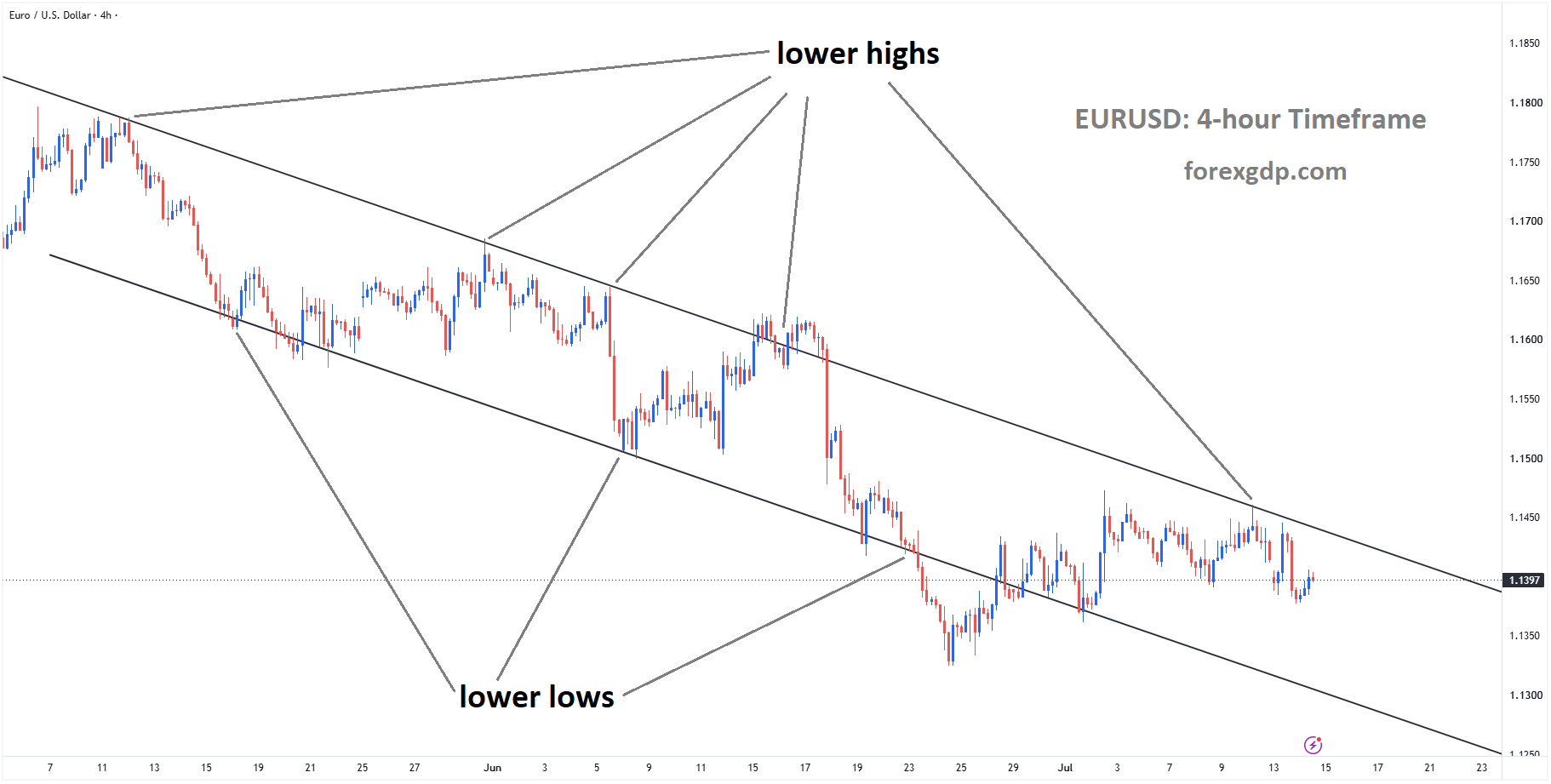
EURUSD is moving in a descending channel
EURUSD Climbs as US Dollar Softens Before Key US Inflation Report
The Euro strengthened against the US Dollar during Tuesday’s European trading session as investors shifted their attention to the upcoming United States inflation report. The release of the June Consumer Price Index (CPI) has become one of the most anticipated economic events of the week because it could influence the next steps from the US Federal Reserve.
At the same time, comments from Federal Reserve officials and expectations surrounding the European Central Bank (ECB) are shaping investor sentiment. While traders remain cautious ahead of key economic data, both the Euro and the US Dollar are responding to changing expectations about future interest rate decisions.
US Inflation Report Takes Center Stage
The biggest focus for financial markets is the June US inflation report. Inflation remains one of the most important factors guiding the Federal Reserve’s policy decisions. Even though inflation has eased from the extremely high levels seen over the past few years, policymakers continue to believe that price pressures have not completely disappeared.
Investors are watching the report closely because it may provide fresh evidence on whether inflation is continuing to cool or showing signs of becoming stubborn again. The outcome could affect expectations for future interest rate decisions and influence market sentiment across currencies, stocks, and bonds.
If inflation continues to slow, markets may become more confident that the Federal Reserve can eventually move toward a less restrictive policy. However, stronger-than-expected inflation could force policymakers to maintain tighter financial conditions for longer.
Federal Reserve Keeps Inflation in Focus
Recent comments from Federal Reserve officials show that inflation remains their primary concern. Minutes from the Federal Open Market Committee (FOMC) meeting revealed that policymakers continue to view inflation as one of the biggest risks facing the US economy.
Federal Reserve Governor Christopher Waller recently reinforced this message by warning that another stronger inflation reading could require the central bank to consider additional monetary tightening.
His comments highlighted that the fight against inflation is not yet over. While economic conditions have improved in several areas, policymakers remain determined to prevent inflation from becoming deeply rooted in the economy again.
This cautious approach explains why every major inflation release attracts significant attention from investors around the world.
Why Inflation Matters So Much
Inflation directly affects consumer spending, business investment, borrowing costs, and overall economic growth. Central banks use interest rates as their main tool to control inflation.
When inflation rises too quickly, higher interest rates can slow demand and reduce price pressures. On the other hand, when inflation moves closer to target levels, central banks may eventually have room to reduce policy restrictions.
Because of this relationship, every inflation report can quickly change market expectations about future policy decisions.
Investors understand that one single report may not determine the entire policy path, but it can provide valuable evidence about the broader direction of the economy.
Expectations for the June CPI Report
Economists expect the June inflation report to show that overall inflation continued to moderate compared to previous months. Monthly inflation is also expected to remain relatively stable, suggesting that price pressures may be easing gradually.
However, policymakers are paying close attention to core inflation, which excludes food and energy prices because these categories often experience greater short-term volatility.
Core inflation is viewed as a better indicator of underlying price trends. If it remains elevated, the Federal Reserve may decide that inflation is still too persistent to relax its policy stance.
This explains why investors often pay just as much attention to the core figures as they do to the headline numbers.
Investors Await More Guidance from Federal Reserve Leadership
Later in the day, market participants will also monitor testimony from Federal Reserve Chair Kevin Warsh before Congress.
Although investors always pay close attention to comments from the Fed Chair, expectations for major policy signals remain limited. During previous communications, Warsh indicated that providing detailed forward guidance is difficult under current economic conditions because incoming data continues to shape policy decisions.
Instead of making firm commitments, Federal Reserve officials have repeatedly emphasized that every economic report will be evaluated carefully before future decisions are made.
This flexible, data-driven approach has become a defining feature of the current policy environment.
ECB Policy Expectations Support the Euro

While attention remains focused on the United States, developments in Europe are also helping support the Euro.
Investors continue to assess whether the European Central Bank will deliver another interest rate increase later this year. The ECB has repeatedly stressed that future policy decisions will depend on incoming economic data rather than following a fixed schedule.
This approach allows policymakers to respond to changing inflation and growth conditions without committing to a predetermined path.
The possibility of additional policy tightening has helped maintain confidence in the Euro, especially as inflation remains an important issue across the Eurozone.
MUFG Expects Another ECB Rate Increase
Analysts at MUFG believe the European Central Bank could introduce another interest rate increase during its September meeting.
Their expectation follows the ECB’s previous policy decision, where officials continued efforts to keep inflation under control while making it clear that future moves would depend on fresh economic information.
If inflation in the Eurozone remains above the central bank’s target, policymakers may decide that further tightening is necessary to ensure long-term price stability.
This outlook has provided additional support for the Euro as investors compare the policy paths of both the ECB and the Federal Reserve.
Markets Remain Highly Data Dependent
One common theme shared by both major central banks is their commitment to making decisions based on economic data.
Rather than promising future actions months in advance, policymakers prefer to evaluate inflation, employment, consumer spending, and other economic indicators before making adjustments.
This means that every important economic release has the potential to influence market expectations.
For investors, staying informed about these reports has become more important than ever, as even small surprises can quickly change sentiment across global financial markets.
Summary
The Euro strengthened modestly against the US Dollar as investors prepared for the release of the June US inflation report. Inflation remains the primary focus for the Federal Reserve, with officials continuing to warn that persistent price pressures could require tighter monetary policy if necessary.
Meanwhile, attention is also turning toward the European Central Bank, where expectations for another possible interest rate increase continue to support the Euro. With both central banks relying heavily on incoming economic data, future market direction will depend largely on how inflation evolves in the United States and the Eurozone over the coming months.
GBPUSD Climbs as Traders Await Crucial US Inflation Report
The GBPUSD pair moved slightly higher during Tuesday’s early European session as investors weighed expectations for future interest rate decisions in the United Kingdom while also keeping a close watch on major developments in the Middle East. Traders remained cautious ahead of the release of the latest US inflation report, which could shape market sentiment and influence the direction of the US Dollar.
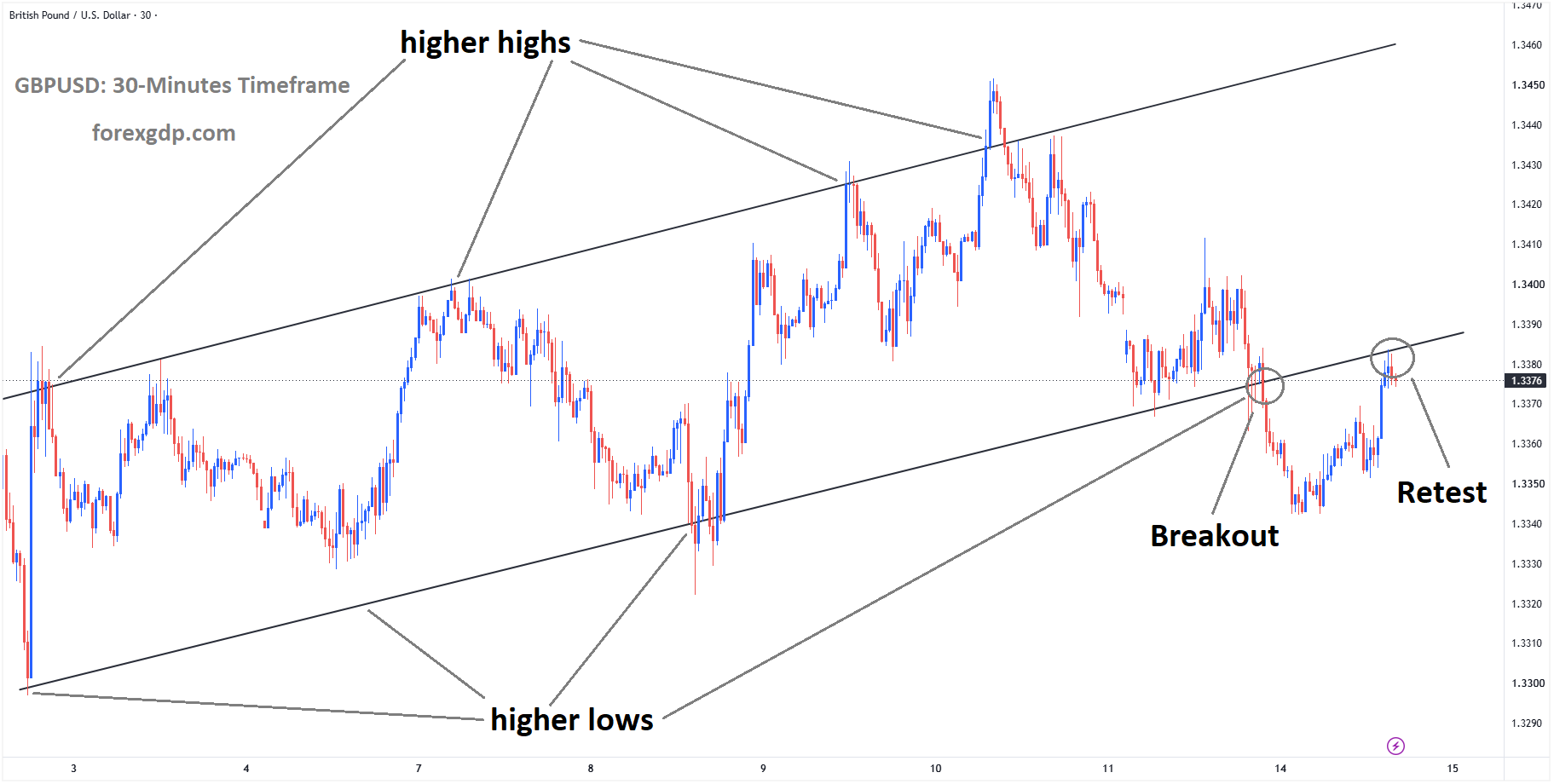
GBPUSD reached the retest area of the broken ascending channel
The British Pound found support after investors increased their expectations that the Bank of England (BoE) may need to tighten monetary policy further this year to keep inflation under control. At the same time, growing geopolitical tensions and upcoming US economic data continued to create uncertainty across global financial markets.
Bank of England Rate Expectations Support the British Pound
One of the biggest drivers behind the Pound’s recent strength is the growing belief that the Bank of England could raise interest rates again before the end of the year. Inflation in the UK has remained a key concern, and policymakers continue to focus on preventing long-term price pressures from becoming deeply rooted in the economy.
Market participants have increased their expectations for additional policy tightening after comments from Bank of England Chief Economist Huw Pill. He suggested that further interest rate increases may be needed to stop inflation from remaining above the central bank’s target for an extended period.
These comments encouraged investors to adjust their outlook for future monetary policy. Financial markets now expect more tightening from the Bank of England than they anticipated just a day earlier, reflecting growing confidence that policymakers are prepared to act if inflation remains stubborn.
The expectation of higher interest rates generally supports a country’s currency because it can attract investors looking for stronger returns. This has helped the British Pound remain resilient despite rising global uncertainty.
Middle East Conflict Keeps Investors on Edge
While expectations for UK interest rates supported the Pound, geopolitical tensions continued to create uncertainty in the broader market.
The United States launched additional military strikes on Iran, further increasing concerns about instability in the Middle East. Reports from Iranian media described explosions in several locations, while Iran claimed it had responded by targeting US military sites in Kuwait, Bahrain, and Jordan. Iranian officials also reported attacks involving oil tankers moving through the Strait of Hormuz.
These developments have once again placed the region at the center of global attention. Investors remain concerned that further escalation could disrupt energy supplies and increase uncertainty across international markets.
The Strait of Hormuz is one of the world’s most important oil shipping routes. Any threat to its operations has the potential to influence global energy markets and increase concerns about economic stability. Rising tensions have already pushed oil prices higher after they had previously returned to more stable levels.
Safe-Haven Demand May Support the US Dollar
Whenever geopolitical risks increase, investors often shift their money toward assets considered safer during uncertain times. The US Dollar frequently benefits from this type of demand because it is widely viewed as one of the world’s leading safe-haven currencies.
Although the British Pound has gained support from stronger expectations for Bank of England policy, continued geopolitical uncertainty could limit further gains if investors increasingly move toward the US Dollar for protection.
This creates a delicate balance in the currency market. On one hand, expectations for higher UK interest rates strengthen the Pound. On the other hand, global risk aversion has the potential to boost demand for the US Dollar.
As long as tensions in the Middle East remain elevated, currency markets may continue to react quickly to new political and military developments.
Attention Turns to the US Inflation Report
Another major focus for investors is the release of the US Consumer Price Index (CPI) report for June.
Inflation remains one of the most important factors influencing monetary policy decisions in the United States. Every CPI report provides fresh insight into whether inflation is slowing, remaining stable, or accelerating.
If inflation shows signs of easing, investors may believe there is less urgency for tighter monetary policy in the future. That could reduce support for the US Dollar, making it easier for other major currencies, including the British Pound, to strengthen.
However, if inflation remains stronger than expected, expectations for tighter monetary policy could continue to support the Greenback.
Because inflation plays such an important role in shaping central bank decisions, traders often react quickly when new inflation figures are released.
Federal Reserve Commentary Also in Focus
Alongside the inflation report, investors will closely monitor remarks from Federal Reserve official Kevin Warsh during his congressional testimony.
Comments from Federal Reserve policymakers are carefully examined because they often provide clues about how officials view the economy, inflation, and future policy decisions.
If policymakers express concern that inflation remains persistent, markets may interpret those remarks as supportive of a tighter monetary policy stance. On the other hand, signs that inflation risks are easing could reduce expectations for further action.
Although official decisions depend on a wide range of economic data, speeches from central bank officials often influence short-term market sentiment.
Global Uncertainty Continues to Shape Currency Markets
Financial markets are currently balancing several major themes at once. Investors are monitoring central bank expectations, inflation trends, geopolitical developments, and economic growth prospects across major economies.
The British Pound has benefited from growing confidence that the Bank of England remains committed to controlling inflation. At the same time, uncertainty surrounding the Middle East continues to support demand for safer assets, creating competing forces within the currency market.
With several important events taking place over a short period, traders are likely to remain cautious until clearer signals emerge from both economic data and geopolitical developments.
Summary
The British Pound strengthened against the US Dollar as investors increased expectations for additional Bank of England interest rate increases aimed at controlling inflation. Comments from BoE Chief Economist Huw Pill reinforced the view that policymakers remain focused on keeping inflation under control.
Meanwhile, renewed military conflict between the United States and Iran has increased global uncertainty, encouraging demand for safe-haven assets such as the US Dollar. Investors are also awaiting the latest US inflation report and comments from Federal Reserve official Kevin Warsh, both of which could provide fresh direction for market sentiment in the coming sessions.
USDJPY Stays Elevated Ahead of Key US CPI Report and Fed Policy Signals
The USDJPY currency pair remained steady during Tuesday’s Asian trading session after posting a strong rally in the previous session. While buying momentum slowed, the pair continued to trade close to its highest level in several decades, reflecting the ongoing strength of the US Dollar against the Japanese Yen.
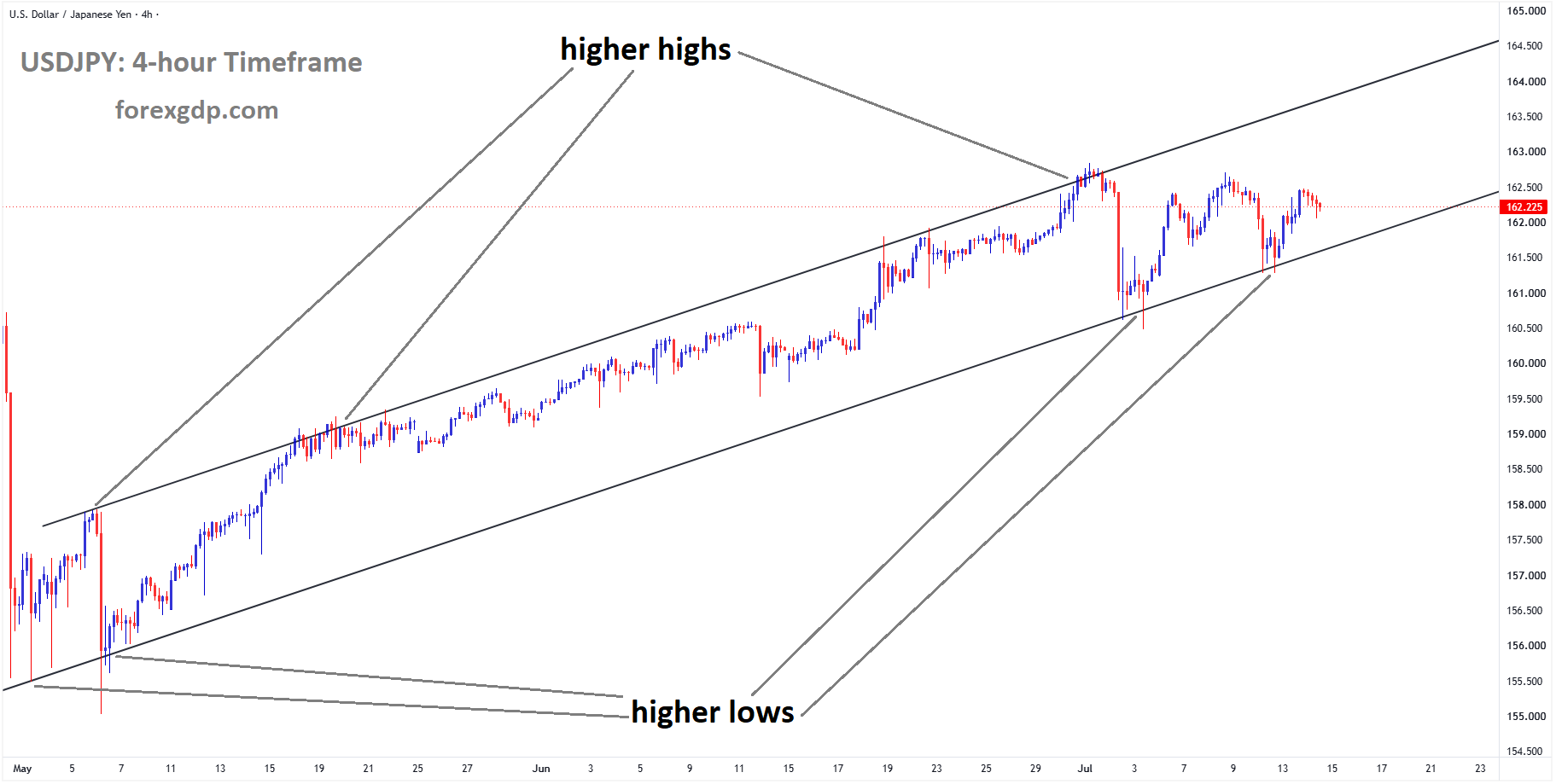
USDJPY is moving in an ascending channel
Investors are taking a cautious approach ahead of important economic events, including the latest US Consumer Price Index (CPI) report and testimony from Federal Reserve Chair Kevin Warsh. These events are expected to provide fresh clues about the direction of US monetary policy and could shape the next move for the US Dollar.
Although the Japanese Yen has found some temporary support from comments by Japanese officials, several broader economic factors continue to limit its recovery.
Investors Wait for Key US Economic Events
One of the main reasons for the market’s cautious mood is the upcoming release of US inflation data. Inflation remains one of the biggest factors influencing the Federal Reserve’s interest rate decisions.
If inflation continues to stay above the central bank’s target, policymakers may be more willing to keep interest rates elevated for longer or even consider additional tightening measures. Higher interest rates generally increase the appeal of the US Dollar because they offer stronger returns for investors holding dollar-based assets.
Alongside the inflation report, market participants are also paying close attention to Federal Reserve Chair Kevin Warsh’s congressional testimony. His comments could offer valuable insights into how the central bank views inflation, economic growth, and future policy decisions.
As a result, many traders are choosing to wait for these important announcements before making larger investment decisions.
Japanese Yen Receives Limited Support from Government Comments
The Japanese Yen managed to gain some support after Japan’s Finance Minister, Satsuki Katayama, suggested that changes to the Government Pension Investment Fund’s asset allocation could be considered if investment conditions change significantly.
The Government Pension Investment Fund, commonly known as GPIF, is one of the world’s largest pension funds. Any adjustments to how it invests its massive portfolio can influence financial markets and affect demand for the Japanese Yen.
While these comments provided some short-term support, they were not enough to significantly strengthen the currency because larger global economic concerns continue to weigh on Japan’s outlook.
Middle East Tensions Increase Economic Uncertainty
Growing geopolitical tensions remain one of the biggest drivers in the currency market. The conflict involving the United States and Iran has continued to escalate, raising concerns about global stability and energy supplies.
Recent developments include renewed US military actions against Iran and increased restrictions affecting Iranian ports. In response, Iranian forces reportedly targeted US facilities in the region, while attacks involving oil tankers in the Strait of Hormuz further increased uncertainty.
These developments have attracted investors toward traditional safe-haven assets, with the US Dollar benefiting from increased demand.
Global markets often react quickly to geopolitical risks because such events can disrupt trade, slow economic activity, and create uncertainty across financial markets.
Japan Faces Additional Pressure from Energy Dependence
Japan’s heavy reliance on imported energy places additional pressure on its economy whenever tensions rise in the Middle East.
A significant portion of Japan’s oil imports comes from this region. Any disruption to shipping routes or energy production can increase costs for Japanese businesses and consumers.
Higher energy prices can also create inflationary pressure while reducing economic growth, making it more difficult for policymakers to balance economic stability with inflation control.
Because of these concerns, the Japanese Yen often struggles to attract sustained buying during periods of rising energy market uncertainty, even though it has traditionally been viewed as a safe-haven currency.
Interest Rate Gap Continues to Favor the US Dollar

One of the strongest long-term factors supporting USDJPY remains the difference between interest rates in the United States and Japan.
Although the Bank of Japan recently increased its policy rate to 1%, marking its highest level since 1995, the gap between Japanese and US borrowing costs remains substantial.
This difference encourages global investors to seek higher returns in US financial markets rather than holding lower-yielding Japanese assets.
The larger the interest rate gap becomes, the more attractive the US Dollar generally appears compared to the Japanese Yen.
As long as investors expect US interest rates to remain relatively high, this advantage is likely to continue supporting the US Dollar.
Carry Trade Activity Remains Strong
The wide interest rate difference also keeps the popular carry trade strategy active.
A carry trade involves borrowing money in a currency with relatively low interest rates, such as the Japanese Yen, and investing it in assets that offer higher returns in another currency, often the US Dollar.
As long as this interest rate advantage remains significant, many investors continue using this strategy, creating ongoing selling pressure on the Yen and additional demand for the US Dollar.
Even after Japan’s recent rate increase, the overall yield difference still supports this investment approach.
Japanese Authorities Remain in Focus
With USDJPY trading close to levels not seen in decades, investors are also watching Japanese officials for any signs of potential market intervention.
In the past, Japanese authorities have stepped into currency markets when they believed rapid Yen weakness threatened financial stability or increased economic risks.
Although there has been no direct action recently, the possibility of intervention remains an important factor that keeps traders cautious whenever the pair approaches extreme levels.
Any official comments or policy actions could quickly influence market sentiment and lead to increased volatility.
Market Focus Shifts Toward Inflation and Central Bank Signals
For now, the direction of USDJPY will likely depend on how upcoming economic data and central bank communication shape investor expectations.
The US inflation report and remarks from Federal Reserve Chair Kevin Warsh could significantly influence views on future interest rate policy. At the same time, ongoing geopolitical tensions and developments in the Middle East remain important drivers of global market sentiment.
Meanwhile, Japan continues to face challenges from higher energy costs, its dependence on imported oil, and a still-wide interest rate gap with the United States.
Summary
USDJPY remains close to multi-decade highs as investors balance several powerful market forces. Expectations surrounding US inflation, Federal Reserve policy, and continuing geopolitical tensions continue to provide support for the US Dollar. Although comments from Japanese officials have offered some temporary strength to the Yen, broader economic challenges and the persistent interest rate gap continue to favor the US currency. With major economic events approaching and global risks remaining elevated, traders are likely to remain cautious while closely monitoring fresh developments that could determine the pair’s next direction.