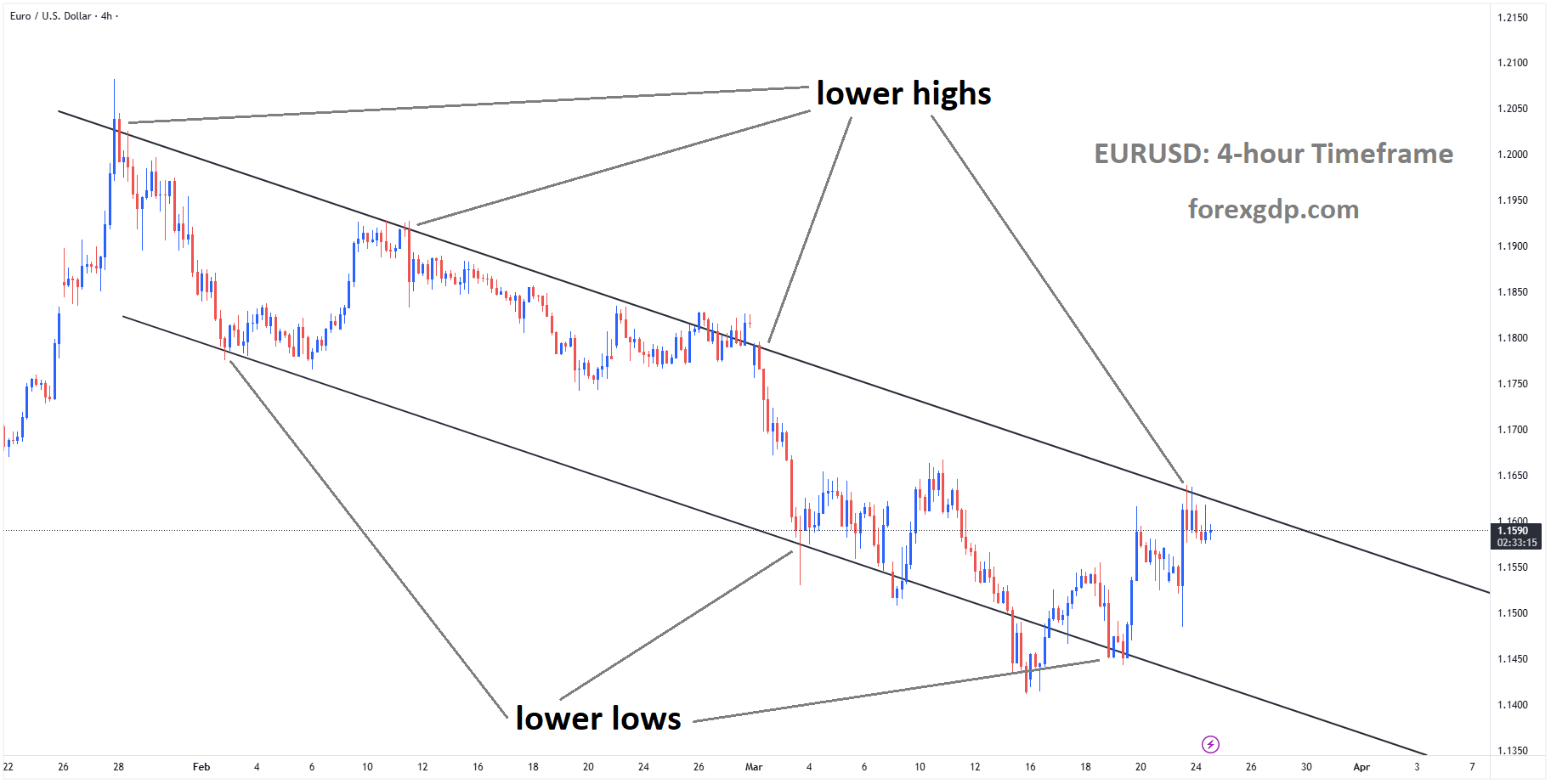
EURUSD is moving in a descending channel, and the market has reached the lower high area of the channel
EURUSD Under Pressure as Market Uncertainty Fuels Dollar Buying
The EUR/USD currency pair has recently shown signs of weakness, drifting lower during early European trading hours. While movements in this major currency pair are often influenced by economic data and central bank decisions, current developments highlight the growing role of geopolitical uncertainty and shifting monetary policy expectations.
Understanding what is driving the Euro lower against the US Dollar requires a closer look at global tensions, investor behavior, and central bank outlooks.
Safe-Haven Demand Strengthens the US Dollar
One of the primary reasons behind the recent dip in EUR/USD is the rising demand for the US Dollar as a safe-haven asset. When uncertainty increases on the global stage, investors tend to move their funds into assets that are perceived as stable and reliable. The US Dollar has long held this status.
Why Investors Turn to the Dollar
During periods of geopolitical tension, such as conflicts or diplomatic uncertainty, investors often seek to protect their capital. This leads to increased demand for safe-haven currencies like the US Dollar, Swiss Franc, and Japanese Yen. Among these, the Dollar remains the most widely used and trusted.
The latest developments in the Middle East have played a key role in this shift. Concerns about escalating tensions have pushed traders to reduce exposure to riskier assets, including the Euro, and increase holdings in the Dollar.
Impact on EUR/USD
As demand for the US Dollar rises, it naturally strengthens against other currencies. At the same time, the Euro faces downward pressure, causing the EUR/USD pair to move lower. This dynamic reflects a broader market reaction rather than a weakness tied solely to European economic conditions.
Geopolitical Uncertainty Adds to Market Volatility
Recent headlines surrounding potential negotiations between the United States and Iran have added another layer of uncertainty to global markets. While there were indications of possible talks, conflicting statements from both sides have left investors unsure about the direction of the situation.
Mixed Signals from Global Leaders
Reports suggested that the US administration was considering a short window for renewed discussions with Iran, potentially offering a path toward easing tensions. However, Iranian officials have denied the existence of any such negotiations, creating confusion in the market.
This lack of clarity is significant. Markets react not only to confirmed events but also to expectations and perceived risks. When messages from key players are inconsistent, uncertainty grows—and that often leads to increased volatility.
How Uncertainty Influences Currency Markets
Currency markets are highly sensitive to global developments. Even the possibility of prolonged conflict or failed negotiations can shift investor sentiment. In this case, uncertainty has encouraged a defensive approach, with traders favoring the US Dollar over the Euro.
As one market analyst noted, the key issue is whether investors see these developments as a step toward resolution or simply a delay that extends instability. Until there is a clear answer, cautious positioning is likely to continue.
ECB Policy Outlook Supports the Euro—But Not Enough
While geopolitical factors are currently dominating market movements, monetary policy expectations in the Eurozone are also playing an important role.
ECB Holds Rates Amid Uncertainty
The European Central Bank (ECB) recently decided to keep its interest rates unchanged. This decision reflects the complex environment policymakers are facing, particularly due to global tensions and uncertain economic conditions.

The ECB acknowledged that ongoing geopolitical issues have made the economic outlook less predictable. In such situations, central banks often prefer to wait for clearer signals before making significant policy changes.
Expectations for Future Rate Hikes
Despite the pause, financial institutions and analysts are increasingly expecting the ECB to raise interest rates in the future. Some forecasts suggest that multiple rate increases could occur in the coming year.
This outlook would normally support the Euro, as higher interest rates tend to attract foreign investment. However, in the current environment, these expectations are being overshadowed by stronger safe-haven demand for the US Dollar.
Upcoming Economic Data and Central Bank Signals
Looking ahead, traders are closely watching key economic indicators and central bank communications for further direction.
Importance of PMI Data
Preliminary Purchasing Managers’ Index (PMI) data from the United States, Eurozone, and Germany are set to be released soon. These reports provide valuable insights into the health of the manufacturing and services sectors.
Strong data from the US could reinforce the strength of the Dollar, while positive figures from Europe might offer some support to the Euro. However, the impact of these releases will depend on how they compare to market expectations.
Focus on Federal Reserve Commentary
Another key factor for the EUR/USD pair is the outlook for US interest rates. Comments from Federal Reserve officials, often referred to as “Fedspeak,” can significantly influence market sentiment.
If policymakers signal a firm stance on controlling inflation or maintaining higher interest rates, it could further strengthen the US Dollar. On the other hand, a more cautious tone might ease some of the pressure on the Euro.
Balancing Economic and Political Forces
The current movement in EUR/USD highlights how currency markets are shaped by a combination of economic fundamentals and geopolitical developments.
On one side, expectations of future interest rate increases in the Eurozone provide underlying support for the Euro. On the other, rising global tensions and uncertainty are driving investors toward the safety of the US Dollar.
This balance between risk and opportunity is what defines currency trading in times of uncertainty.
Summary
The recent decline in EUR/USD reflects a broader shift in market sentiment driven by geopolitical concerns and safe-haven demand. Rising tensions in the Middle East have increased uncertainty, leading investors to favor the US Dollar over the Euro.
At the same time, expectations of future interest rate hikes by the European Central Bank offer some support to the Euro, but not enough to counterbalance the current risk-averse environment.
With important economic data releases and central bank signals on the horizon, the direction of EUR/USD will likely depend on how these factors evolve. For now, global uncertainty remains the dominant force shaping the pair’s movement.
USDJPY climbs back as stronger investor confidence weakens dollar demand
The Japanese Yen has made a strong comeback after facing early losses against the US Dollar. As global market sentiment shifts toward optimism, investors are moving away from safe-haven assets like the Dollar. This change has helped the Yen regain strength, showing how closely currency movements are tied to global confidence and economic signals.
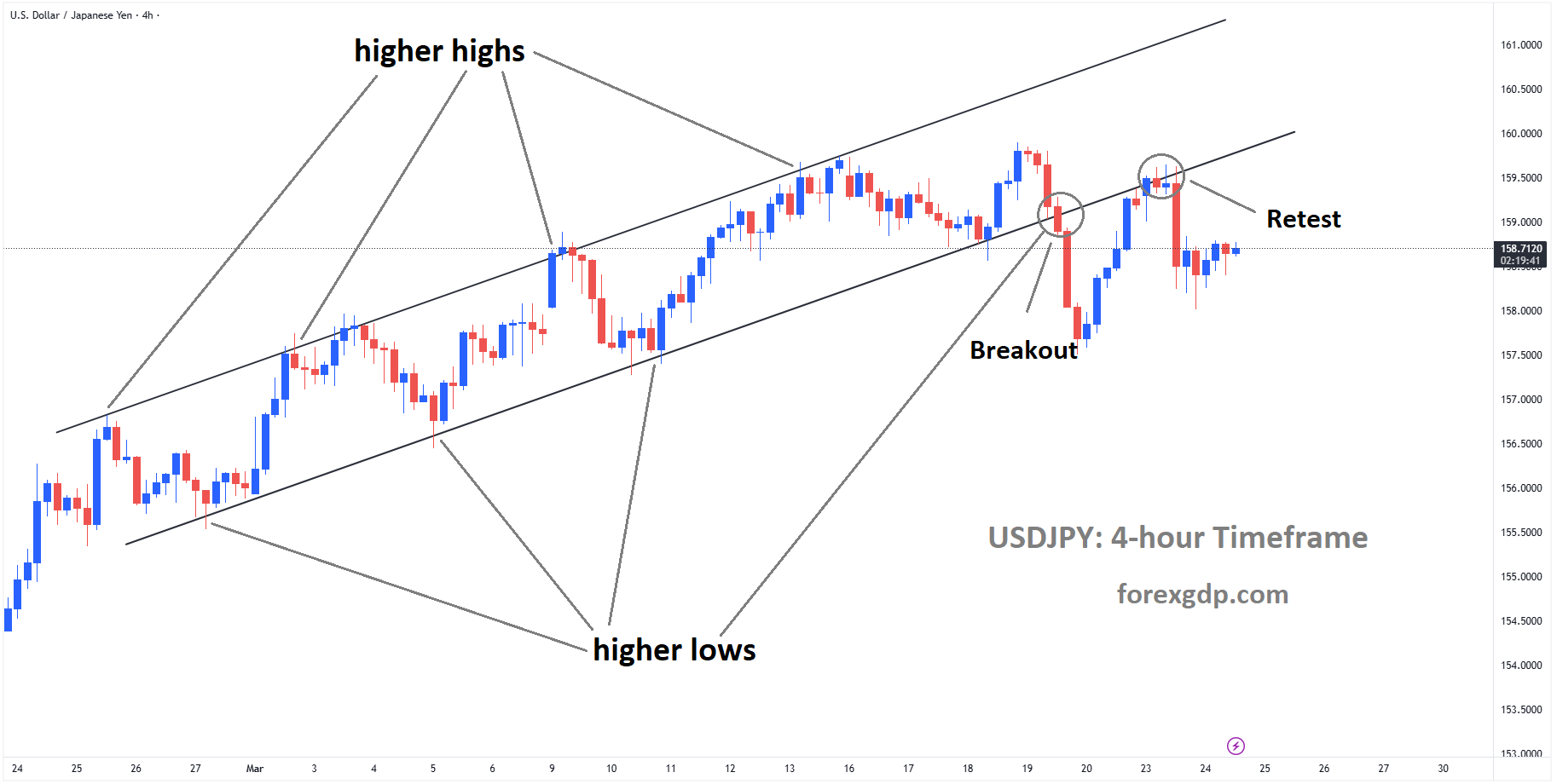
USDJPY is falling from the retest area of the broken uptrend channel
During Tuesday’s European trading session, the Yen managed to recover nearly all its earlier declines. The USD/JPY pair, which reflects the value of the US Dollar against the Japanese Yen, moved back toward a stable level around 158.50. This shift highlights how quickly financial markets can react to changing moods and expectations.
Improving Risk Appetite Weakens the US Dollar
One of the main reasons behind the Yen’s recovery is the growing appetite for risk among investors. When traders feel more confident about the global economy, they tend to move their money into assets that offer higher returns. This reduces the demand for safer options like the US Dollar.
This trend was clearly visible in the performance of US stock futures. The S&P 500 futures, which had initially declined earlier in the day, rebounded and turned positive. This signals that investors are willing to take on more risk, expecting better returns from equities and other growth-focused investments.
At the same time, the US Dollar Index (DXY), which measures the Dollar’s strength against a group of major currencies, lost some of its earlier gains. After reaching a higher level during the day, the index slipped back and stabilized, reflecting reduced demand for the Dollar.
This combination of rising stock markets and a softer Dollar creates a favorable environment for currencies like the Japanese Yen to recover.
Geopolitical Developments Boost Market Confidence
Global political events also played a major role in shaping market sentiment. Recent developments in the Middle East have eased fears of further escalation, which has encouraged investors to take on more risk.
The United States government announced a temporary pause in military actions targeting Iran’s power infrastructure. This move has given markets hope that tensions in the region might not worsen in the near term.
Although Iran has denied reports of direct talks with the US regarding conflict resolution, the overall tone of recent statements has been more positive. Even small signs of possible de-escalation can have a big impact on financial markets, as uncertainty tends to push investors toward safer assets.
With the perceived risk of a broader conflict decreasing, traders are feeling more comfortable investing in higher-risk assets. This shift has reduced the demand for the US Dollar and supported the recovery of other currencies, including the Yen.
Bank of Japan Signals Confidence in Inflation Growth
Another important factor supporting the Japanese Yen is the outlook from the Bank of Japan (BoJ). The central bank has expressed confidence that inflation in Japan will continue to rise at a moderate pace.
BoJ Governor Kazuo Ueda stated that underlying inflation is expected to gradually increase. He highlighted that Japan’s tight labor market and active wage growth are contributing to this trend. As companies raise wages and adjust prices, a cycle is created where both wages and prices continue to rise together.
This kind of economic environment is important because it suggests that Japan may be moving closer to achieving stable and sustainable inflation. For many years, Japan struggled with low inflation, so this shift is seen as a positive development.
When a country shows signs of improving inflation and economic strength, its currency often benefits. Investors see this as a signal that the central bank may eventually adjust its policies, which can support the value of the currency.
Mixed Economic Data from Japan

Despite the positive outlook from the central bank, recent economic data from Japan has been slightly weaker than expected. The National Consumer Price Index (CPI), excluding fresh food, showed a slower rate of growth.
The inflation rate came in at 1.6% year-on-year for February. This was slightly below both the market expectation of 1.7% and the previous reading of 2%. While this indicates that inflation is still present, the slower pace suggests that the recovery may not be entirely smooth.
Even so, markets appear to be focusing more on the broader trend and the central bank’s confidence rather than short-term fluctuations in data. The expectation of moderate and steady inflation growth continues to support the Yen.
How Market Sentiment Shapes Currency Movements
The recent movement in the USD/JPY pair is a clear example of how global sentiment influences currency markets. When investors feel uncertain or worried about global events, they often move their money into safe-haven currencies like the US Dollar and the Japanese Yen.
However, when confidence returns and risks appear to decrease, the opposite happens. Investors shift toward assets that offer higher returns, such as stocks and emerging market investments. This reduces demand for safe-haven currencies.
In this case, the improved outlook for global stability, combined with positive signals from Japan’s central bank, has helped the Yen regain strength while the Dollar has weakened.
The Role of Central Banks and Investor Expectations
Central banks play a crucial role in shaping currency values. Their statements and policies influence how investors view the future of an economy.
The Bank of Japan’s confidence in rising inflation has given the market a reason to believe that Japan’s economy is on a stable path. Even though actual inflation data came in slightly lower than expected, the overall message from the central bank remains positive.
On the other hand, the US Dollar’s movement reflects changing investor expectations about global risks rather than domestic economic changes. As fears of geopolitical conflict ease, the need for a safe-haven currency decreases.
What This Means for the Near Term
The recent recovery of the Japanese Yen shows that currency markets are highly sensitive to both global events and economic signals. A combination of improving risk appetite, easing geopolitical tensions, and supportive central bank comments has created a favorable environment for the Yen.
However, markets remain dynamic. Any sudden change in geopolitical conditions or economic data could quickly shift sentiment again. Investors will continue to watch developments closely, especially updates related to global conflicts and central bank policies.
Final Summary
The Japanese Yen’s recovery highlights the strong connection between global sentiment and currency movements. As investor confidence improves, the demand for safe-haven assets like the US Dollar decreases, allowing currencies like the Yen to gain ground.
Support from the Bank of Japan, particularly its positive outlook on inflation and wage growth, has also strengthened the Yen’s position. While some economic data has been slightly weaker, the broader trend remains encouraging.
At the same time, easing geopolitical tensions have reduced uncertainty, encouraging investors to take on more risk. This shift has played a key role in weakening the Dollar and supporting the Yen.
Overall, the balance between global confidence, economic signals, and central bank guidance continues to shape the direction of major currencies in the market.
USDCAD Rises While Geopolitical Risks Pressure the Loonie
The USD/CAD currency pair showed a steady upward move during Tuesday’s Asian trading session, reaching close to the 1.3750 level. This shift reflects a mix of geopolitical tensions, economic expectations, and commodity price movements that continue to influence both the US Dollar and the Canadian Dollar.

USDCAD is moving in an uptrend channel, and the market has fallen from the higher high area of the channel
Global markets are currently navigating a complex environment shaped by political uncertainty and economic signals. As a result, traders are closely watching developments that could impact currency values in the short term.
Geopolitical Tensions Support the US Dollar
One of the key drivers behind the recent strength in the US Dollar is the ongoing tension in the Middle East. Reports surrounding the conflict involving the United States, Israel, and Iran have created uncertainty in global markets. In such situations, investors often turn to the US Dollar, which is widely seen as a safe-haven currency.
Although there were initial reports suggesting progress in discussions between the US and Iran, the situation remains unclear. Statements from US leadership indicated that there were several points of agreement following recent talks. However, Iranian officials quickly denied that any such discussions had taken place.
Conflicting Messages Add to Market Uncertainty
The difference in statements from both sides has added confusion and concern among investors. When communication is inconsistent, markets tend to react cautiously. This often results in increased demand for safer assets like the US Dollar.
Further adding to the tension, senior Iranian officials have emphasized that the conflict will continue until certain conditions are met, including compensation for damages. This signals that a quick resolution may not be on the horizon.
As long as uncertainty persists, the US Dollar is likely to remain supported due to its role as a global reserve currency.
Oil Prices Rise and Impact the Canadian Dollar
While the US Dollar is gaining strength from geopolitical concerns, the Canadian Dollar is receiving support from another important factor: rising oil prices.
Canada is one of the world’s leading oil exporters, and its currency often moves in line with changes in crude oil prices. When oil prices increase, Canada’s export revenues tend to improve, which can strengthen the Canadian Dollar.
Why Oil Prices Are Increasing

Crude oil prices have surged recently as traders react to developments in the Middle East. The lack of progress in diplomatic talks has raised concerns about potential disruptions to global oil supply. Any threat to supply can push prices higher, as markets anticipate tighter availability.
This rise in oil prices provides a natural boost to the Canadian economy, which depends heavily on energy exports. As a result, the Canadian Dollar has some level of support, even as the US Dollar strengthens.
Central Bank Policies Add Another Layer of Influence
Monetary policy decisions from central banks also play a crucial role in shaping currency movements. Both the US Federal Reserve and the Bank of Canada have recently taken cautious approaches, reflecting the uncertain global environment.
Federal Reserve Maintains Interest Rates
The US Federal Reserve decided to keep its interest rates unchanged in its latest meeting. While holding rates steady, the Fed expressed concerns about rising oil prices and their potential impact on inflation.
Higher oil prices can lead to increased costs for transportation and goods, which may push overall inflation higher. The Fed is closely monitoring this situation, as controlling inflation remains one of its primary goals.
Bank of Canada Signals Economic Uncertainty
Similarly, the Bank of Canada chose to leave its key interest rate unchanged. However, it highlighted the growing uncertainty in the global economy, particularly due to geopolitical risks.
The central bank noted that the ongoing conflict involving Iran could have broader economic consequences. These include potential disruptions in trade, rising energy costs, and slower global growth.
By maintaining a cautious stance, the Bank of Canada is signaling that it is prepared to respond if conditions worsen.
Upcoming Economic Data in Focus
Market participants are also paying attention to upcoming economic data releases, which can influence currency movements. One key report expected is the preliminary reading of the US S&P Global Purchasing Managers Index (PMI) for March.
The PMI provides insight into business activity in the manufacturing and services sectors. Strong data could further support the US Dollar, while weaker figures might limit its gains.
Traders often use such data to assess the overall health of the economy and adjust their positions accordingly.
Balancing Forces in the USD/CAD Pair
The current movement in the USD/CAD pair reflects a balance between competing forces:
- The US Dollar is gaining support from geopolitical uncertainty and safe-haven demand.
- The Canadian Dollar is benefiting from rising oil prices and its role as a commodity-linked currency.
This creates a situation where both currencies have underlying strengths, making the pair sensitive to new developments.
Short-Term Market Drivers
In the near term, several factors could influence the direction of USD/CAD:
- Updates on the Middle East conflict
- Changes in crude oil prices
- Economic data releases from the US
- Central bank signals and policy updates
Even small changes in these areas can lead to noticeable shifts in the currency pair.
Final Summary
The USD/CAD pair’s move toward the 1.3750 level highlights how global events and economic factors are shaping currency markets. Ongoing geopolitical tensions are supporting the US Dollar, while rising oil prices are providing strength to the Canadian Dollar.
At the same time, cautious approaches from both the Federal Reserve and the Bank of Canada reflect the uncertainty surrounding the global economy. With key economic data on the horizon and geopolitical developments still unfolding, the USD/CAD pair is likely to remain influenced by a mix of risk sentiment and commodity trends.
Understanding these dynamics can help in following how the pair may evolve in the coming sessions, especially as new information continues to shape market expectations.