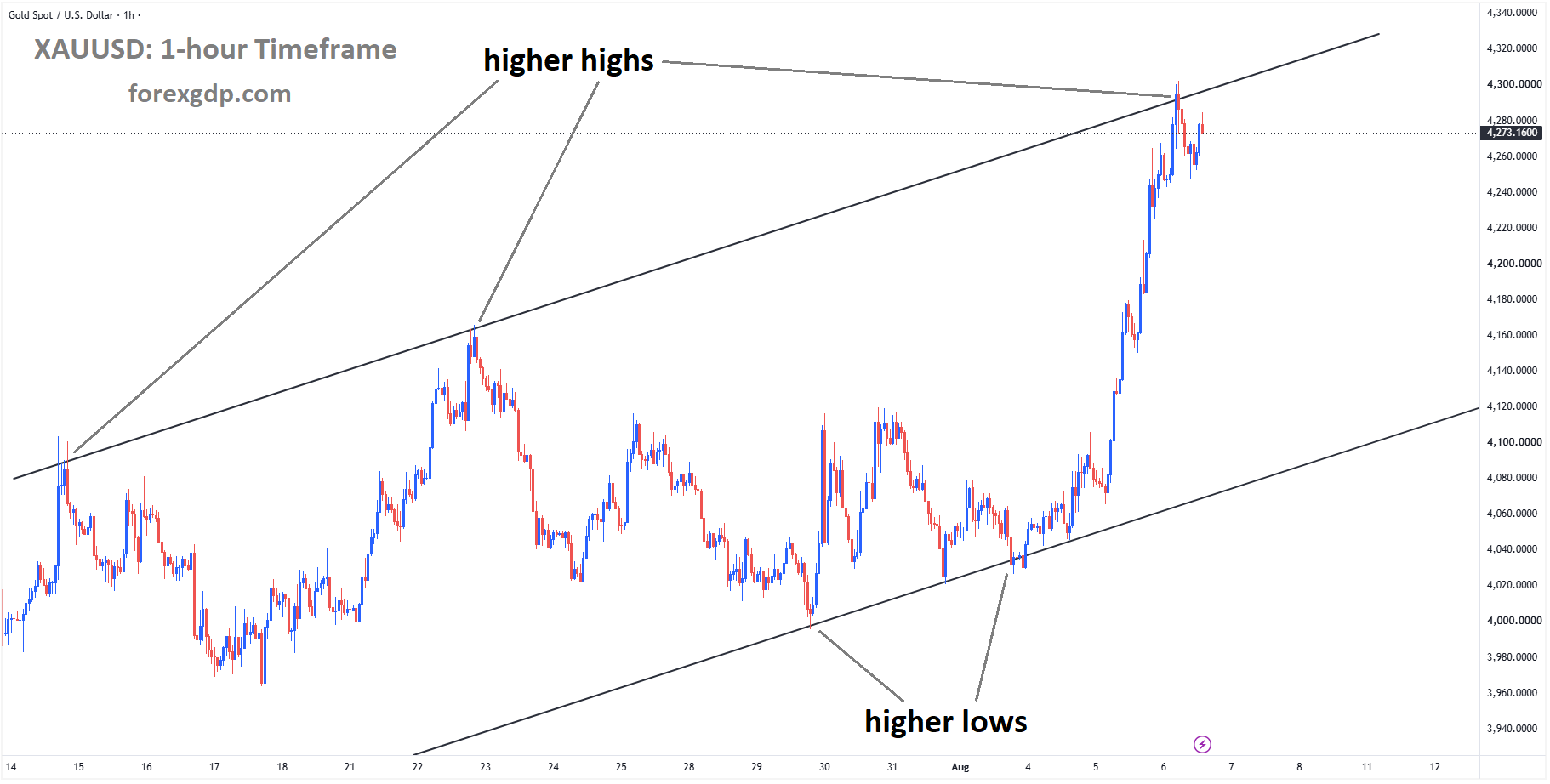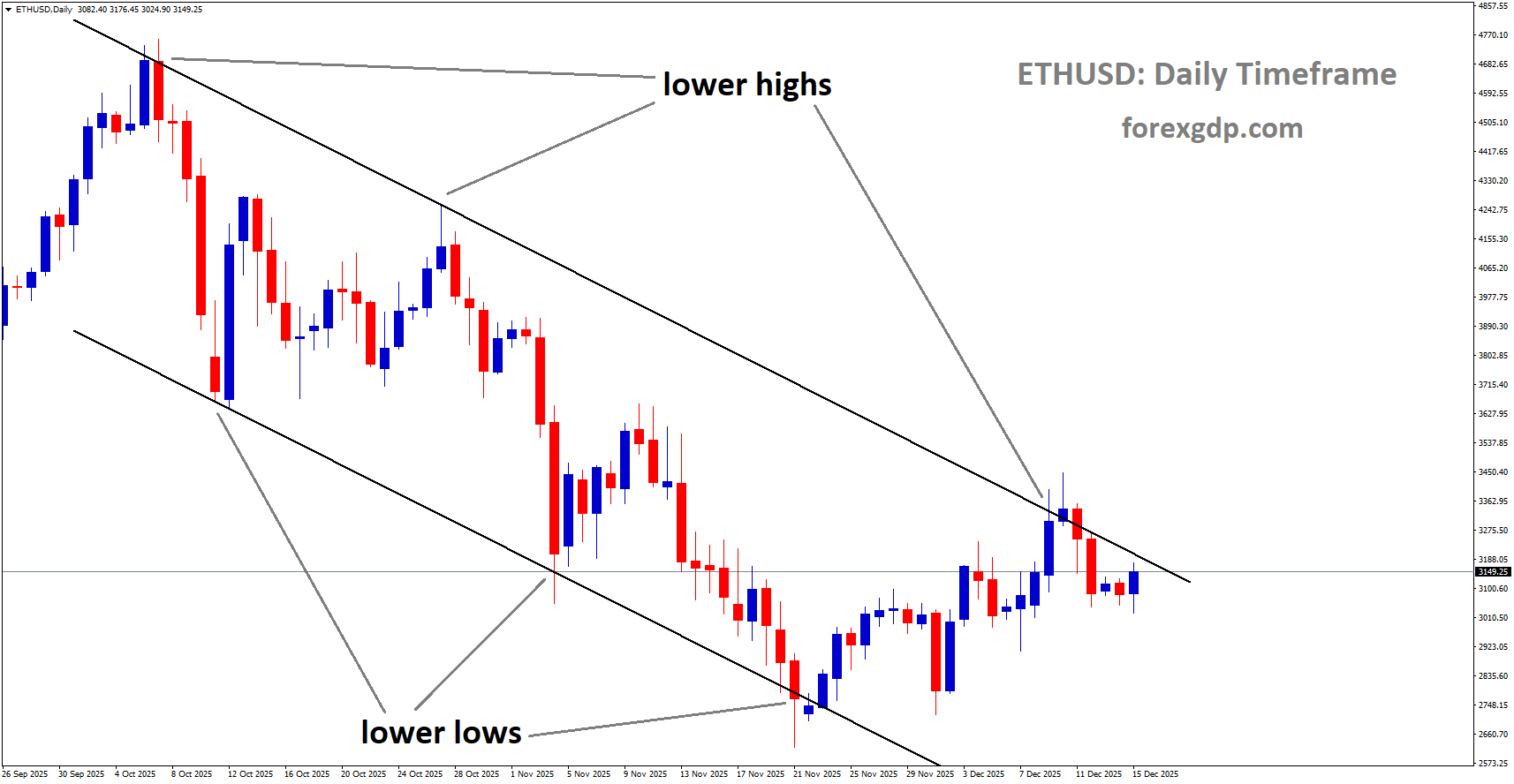
ETHUSD is moving in a descending channel, and the market has reached the lower high area of the channel
ETHUSD Ether Outshines as Bitcoin Fails to Break Higher
Crypto markets have started to climb again, and that’s a welcome change after weeks of choppy trading. But if you’re expecting a full-blown breakout, the mood is still more “careful optimism” than “all systems go.” While stocks have continued to push higher, crypto has mostly lagged behind, creating a noticeable gap between the two markets.
Bitcoin has managed to stay above its November lows, which matters because it shows buyers are willing to step in when prices dip. Still, the rebound has felt more like a cautious bounce than a confident surge. Twice within a month, bitcoin has approached the $94,000 area and then backed off. That kind of repeat hesitation often signals that traders want stronger reasons to keep pushing higher.
Ether, on the other hand, has looked a bit healthier. Its recovery has been steadier and more convincing compared to bitcoin’s stop-start rhythm. Even so, the bigger question remains: can ether move beyond its November highs and hold there? Until that happens, any rally can still be questioned, because short-lived climbs are common in crypto—especially when the wider financial world is sending mixed signals.
Crypto and Stocks Are Moving in Different Directions
For much of the past few years, crypto has often traded like a high-energy cousin of tech stocks. When tech rallied, crypto usually followed. When tech sold off, crypto often fell harder. That’s why the current divergence stands out.
Equity markets have kept rallying, yet crypto has not matched that pace. This doesn’t mean crypto is “broken,” but it does suggest that traders are being selective. Some investors may be waiting for clearer signals on interest rates, regulation, and liquidity before committing fully. Others may simply be taking profits after earlier gains and choosing to rotate into areas of the stock market that feel less risky.
The result is a crypto market that’s rising, but without the kind of excitement that usually defines a true bull run. Volume and momentum matter in this space, and when price climbs without much enthusiasm behind it, it can leave the market vulnerable to sudden pullbacks.
Bitcoin’s Slow Grind Versus Ether’s Stronger Recovery
Bitcoin remains the headline asset for crypto, but lately it has struggled to show strong follow-through. Holding above November lows is a positive sign, and it suggests the market has found a level where demand shows up. Still, the repeated failure to push beyond a key barrier tells a story: buyers are present, but they are not rushing in.
Ether has shown a more encouraging bounce. Its recovery has looked more stable, which often attracts traders who want signs of improving confidence. But ether still needs to prove that it can break into a stronger uptrend by moving beyond its November highs. Without that step, the market could still be stuck in a cycle where short rallies fade and traders remain hesitant.
Why This Matters for Everyday Crypto Investors

If you’re a long-term holder, this “slow improvement” phase can actually be useful. It often shakes out overly leveraged speculation and lets the market rebuild on firmer ground. For shorter-term traders, however, a low-energy climb can be tricky because it may not offer clean, sustained moves. In that environment, patience and risk control tend to matter more than bold bets.
The UK Moves Toward Clearer Crypto Rules
While prices grab attention, regulation can quietly reshape the market in deeper ways. In the UK, the Treasury is planning to bring cryptocurrencies under the oversight of the Financial Conduct Authority (FCA) from 2027. The goal is to align crypto more closely with the rules that already apply to traditional financial products.
This shift is being driven by real concerns, especially the rise in crypto-related scams and the need for stronger consumer protection. For many people, unclear rules create confusion: they don’t know which companies are trustworthy, what protections exist, or what happens when things go wrong. A clearer regulatory framework can help reduce that uncertainty.
Of course, tighter regulation doesn’t come free. Compliance costs will likely rise. Smaller or riskier operators may struggle to keep up, while larger, better-capitalized firms could gain an advantage. In the short term, tougher rules can slow down innovation on the fringes of the market. But over time, clearer oversight can make it easier for established financial institutions to participate with more confidence.
What Regulation Could Mean for the Crypto Industry
-
More clarity for consumers: People may feel safer using platforms that meet stricter standards.
-
Pressure on smaller firms: Some businesses may exit the market if compliance becomes too expensive.
-
A boost for major players: Well-funded companies often benefit when rules raise the bar.
-
Longer-term institutional growth: Traditional finance tends to move more comfortably when rules are well defined.
In simple terms, crypto markets may become more structured and less “wild west.” That could reduce some of the chaotic energy that attracts speculators, but it may also create a healthier market that is easier to trust and easier to integrate into mainstream finance.
A Packed Week: Central Banks and Major Economic Data
Crypto doesn’t trade in isolation. Even if digital assets have their own headlines, the wider financial environment still matters—especially decisions from central banks and key economic reports.
This part of December is shaping up to be busy. Even after recent major moves in the US, traders are still watching what comes next. There’s more on the calendar, including expectations around a possible rate cut in the UK and a potential rate hike in Japan. At the same time, the US is set to release major reports on jobs, inflation, and retail sales.
These events can affect crypto indirectly by shifting market mood. If investors feel confident about growth and liquidity, they may be more willing to take on risk, which can support crypto. If they feel uncertain—especially about inflation or policy tightening—riskier assets can lose momentum quickly.
Why Macro News Can Move Crypto Fast
Crypto is often treated as a “risk-on” asset, meaning it tends to do better when investors are comfortable taking chances. Central bank decisions can influence:
-
Borrowing conditions and liquidity
-
Investor appetite for risk
-
The strength of major currencies
-
How capital flows between markets
When the macro backdrop is unclear, crypto can become more reactive, with sharper swings as traders adjust positions quickly.
Stock Market Rotation Could Be Holding Crypto Back
Another factor in the current setup is the rotation happening in stocks. Investors have recently shown signs of moving away from tech after high-profile company updates, and that shift matters for crypto more than many people realize.
Crypto has often moved in step with big tech sentiment. When the market loves tech, it tends to be more open to growth stories, innovation themes, and higher-risk bets. When money rotates into other sectors, tech enthusiasm can cool—and crypto can lose some of the tailwind it normally enjoys.
If this rotation continues, it could keep crypto’s rebound in check, even if the overall stock market stays strong. That doesn’t mean crypto can’t rise, but it may rise more slowly, with more pauses and setbacks along the way.
Summary
Crypto prices are rising again, but the market still lacks the energy that usually comes with a clear breakout. Bitcoin has held above its November lows but has struggled to push past a key level after multiple attempts. Ether looks stronger, yet still needs to move beyond its November highs to fully convince traders that a durable rally is underway. Meanwhile, the UK is pushing toward clearer crypto regulation under FCA oversight from 2027, which could raise compliance standards and reshape the industry in favor of stronger, better-capitalized firms. On top of that, a heavy schedule of central bank decisions and major economic data could influence risk appetite, while stock market rotation away from tech may continue to limit crypto’s upside in the near term.
BTCUSD slips below key ground as sellers keep control
Bitcoin started Monday on steady ground, holding above $89,000 after a frustrating week for bullish traders. The big breakout many were watching didn’t happen, as the price failed to push above a descending trendline. At the same time, US-listed spot Bitcoin ETFs posted a small weekly inflow, hinting that institutional interest may be slowly picking up again.
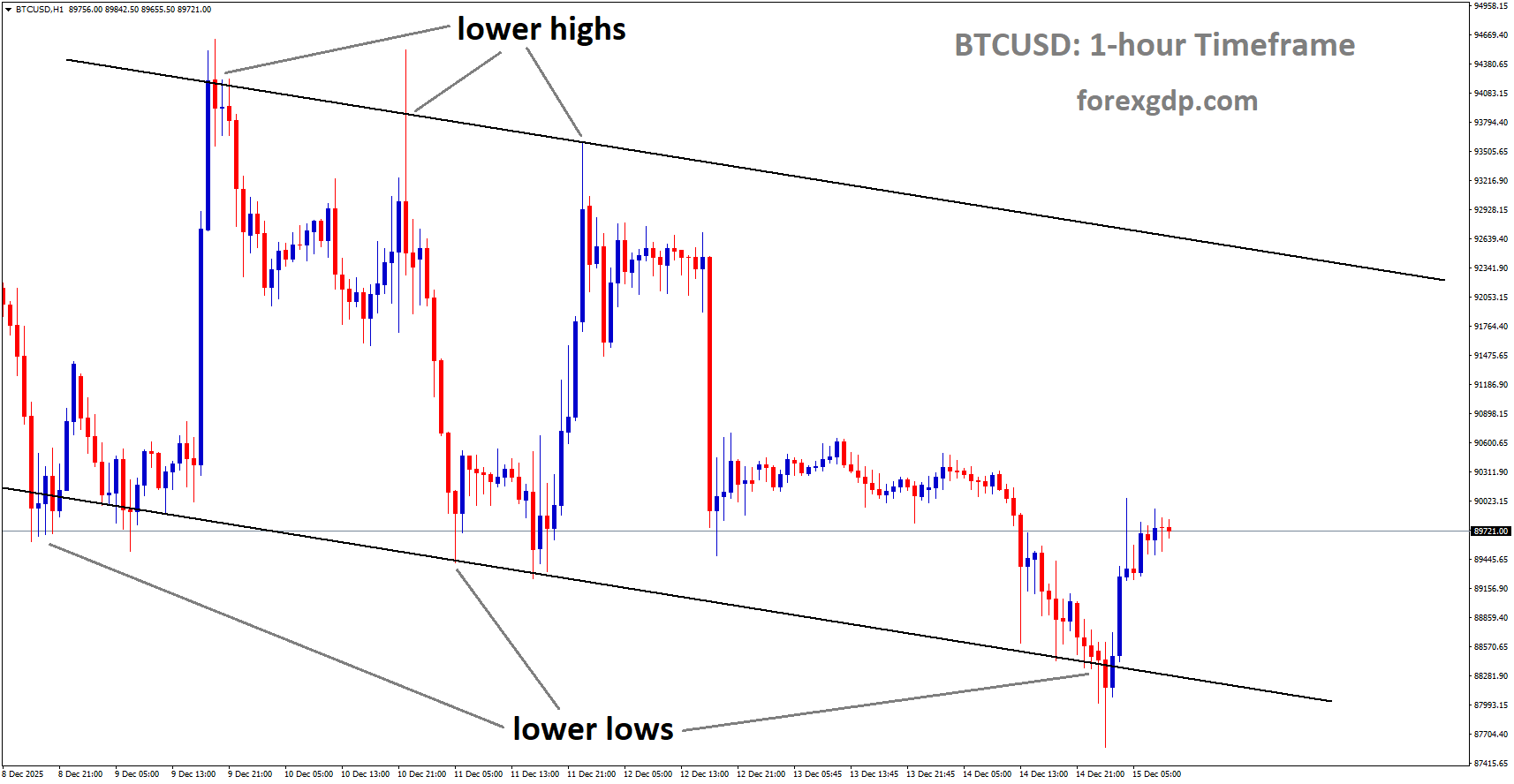
BTCUSD is moving in a downtrend channel, and the market has rebounded lower low area of the channel
Still, this is not a “relax and forget it” moment. A well-known market veteran is warning about a much deeper pullback, and a major central bank decision later this week could add more pressure. Here’s what’s shaping the conversation around Bitcoin right now, and why traders and long-term holders are paying attention.
Bitcoin holds above $89,000, but momentum feels cautious
Bitcoin’s ability to stay above $89,000 is meaningful because it shows buyers are still willing to step in. But the tone is mixed. Last week’s attempt to break higher was rejected near a descending trendline, and that failure matters because it can signal hesitation rather than strength.
When Bitcoin stalls at a key area, it often creates a “wait and see” mood. Some traders step back, some take profit, and others hold off on new buys until the market proves it can move up with conviction. That’s the kind of environment where short-term stability can quickly turn into sharper moves—either up or down—depending on what news, liquidity, or sentiment arrives next.
This cautious feeling is also why more people are watching outside factors, not just Bitcoin itself. Two things are getting most of the attention: a bearish warning from a respected trader and the Bank of Japan’s upcoming rate decision.
Why Peter Brandt thinks Bitcoin could drop toward $25,240
Veteran commodity trader Peter Brandt shared a bearish view that caught a lot of eyes: he said Bitcoin could fall toward $25,240. That’s a dramatic move from current levels, and it’s not a casual prediction. His view is based on how Bitcoin bull cycles have behaved in the past.
Brandt’s core idea is that Bitcoin’s big bull runs have shown what he calls exponential decay over time. In simple terms, he believes each major cycle still grows, but the “explosive” portion of that growth becomes less extreme as the market matures. That’s a common way experienced traders describe an asset that is growing up: still powerful, but less wild than in its early years.
The historical warning sign he’s focused on
Brandt pointed to a recurring pattern from previous cycles: Bitcoin often goes into a steep, parabolic-style rise during major bull phases. In earlier cycles, when Bitcoin broke below a parabolic support line, the decline that followed was severe—often at least 80% from highs.
His concern is that Bitcoin’s latest price action suggests that this parabolic structure has been violated again. From that perspective, a move down toward $25,240 becomes a possible downside target based on how previous cycle breakdowns played out.
It’s important to understand what makes this warning influential. Traders don’t follow Brandt because he’s always bearish or always bullish—they follow him because he’s consistent about using long-term market behavior and sticking to patterns he believes repeat over time. That doesn’t mean the market must do what he expects, but it does mean people take the risk seriously, especially when the price is already struggling to push higher.
A key macro event: the Bank of Japan rate decision
While trader commentary can move sentiment, central bank policy can move entire markets. One major event coming up is the Bank of Japan (BoJ) interest rate decision on Friday, where expectations are for a 25 basis point increase.
Why does that matter for Bitcoin? Because global liquidity and borrowing costs influence risk appetite. When borrowing becomes more expensive, markets often get more selective. Assets seen as higher-risk can face selling pressure as investors shift toward safety or reduce leverage.
A pattern traders are watching from past BoJ moves
Some analysts are looking at how Bitcoin reacted after recent Bank of Japan rate hikes. In the examples being discussed, Bitcoin saw notable pullbacks after previous tightening steps:
-
Around 27% after the March 2024 decision
-
Around 30% after the July 2024 hike
-
Around 30% after January 2025
The point isn’t that the same percentage must repeat, but that there’s a history of sharp post-decision declines during periods of BoJ tightening. If Bitcoin were to see a similar drop again—roughly around 30%—that would pull the price down toward the $63,000 area.
Of course, markets don’t move on a single factor. Sometimes the expected decision is already priced in. Sometimes the wording of a central bank statement matters more than the headline rate change. But because Bitcoin is sitting at an important level and sentiment is already cautious, this decision is being treated as a real risk event.
Spot Bitcoin ETF inflows show mild institutional improvement

While the risks are getting attention, there is also a positive detail that shouldn’t be ignored: US-listed spot Bitcoin ETFs recorded a weekly inflow of $286.60 million. That followed a weekly outflow of $87.77 million the week before, suggesting a modest shift back toward net buying.
For many observers, ETF flows are one of the clearest windows into institutional participation. They don’t tell the whole story, but they do provide a visible signal of whether large pools of capital are adding exposure or stepping away.
Why “mild” is the right word right now
An inflow of $286.60 million is supportive, but it’s not a flood. It suggests interest is improving slightly, not surging. The comparison many people make is to stronger periods in the past, when weekly inflows were much larger. In other words, institutions may be leaning in again, but they are not rushing.
This matters because sustained Bitcoin recoveries are often easier when there is strong, steady demand from bigger players. If the market is going to push higher with confidence, many traders want to see ETF inflows build over multiple weeks, not just bounce from a negative week to a positive one.
What this mix of signals means for Bitcoin sentiment
Right now, Bitcoin is sitting in a zone where the market can tell two different stories at the same time:
-
A stable price above $89,000 suggests buyers are still present and defending the area.
-
Failure to break higher suggests momentum is not strong enough to spark the next leg up yet.
-
A major bearish warning keeps downside risk in the conversation, especially for traders watching long-term cycle behavior.
-
The BoJ decision introduces a near-term macro catalyst that could quickly change the mood.
-
ETF inflows offer a small but real sign that institutional participation may be improving.
In practical terms, this is the kind of environment where investors often split into two camps. Some treat the stability as a sign of strength and a chance to accumulate. Others see the warning signs and prefer to protect capital until the market shows clearer direction.
Final summary
Bitcoin is steady above $89,000 after failing to push past a descending trendline last week, keeping the market cautious rather than confident. Veteran trader Peter Brandt is warning that a breakdown pattern seen in prior bull cycles could open the door to a drop toward $25,240, a scenario that has traders watching downside risk more closely. Meanwhile, Friday’s Bank of Japan rate decision is another potential pressure point, with past tightening moves linked to sharp Bitcoin pullbacks that, if repeated, could drag the price toward $63,000. On the brighter side, spot Bitcoin ETFs posted a modest $286.60 million weekly inflow, hinting at a small improvement in institutional demand—though not yet strong enough to signal a major wave of new buying.
EURUSD moves up as Eurozone industry report sparks fresh demand for the euro
EUR/USD started Monday in a steady mood, keeping most of its recent gains and trading close to the 1.1750 area during the European session. After moving higher over the past few weeks, the pair is now taking a breather rather than charging ahead. Buyers have managed to keep the Euro supported above the 1.1720 zone, and the market’s tone has been helped by a positive economic update from the Eurozone.
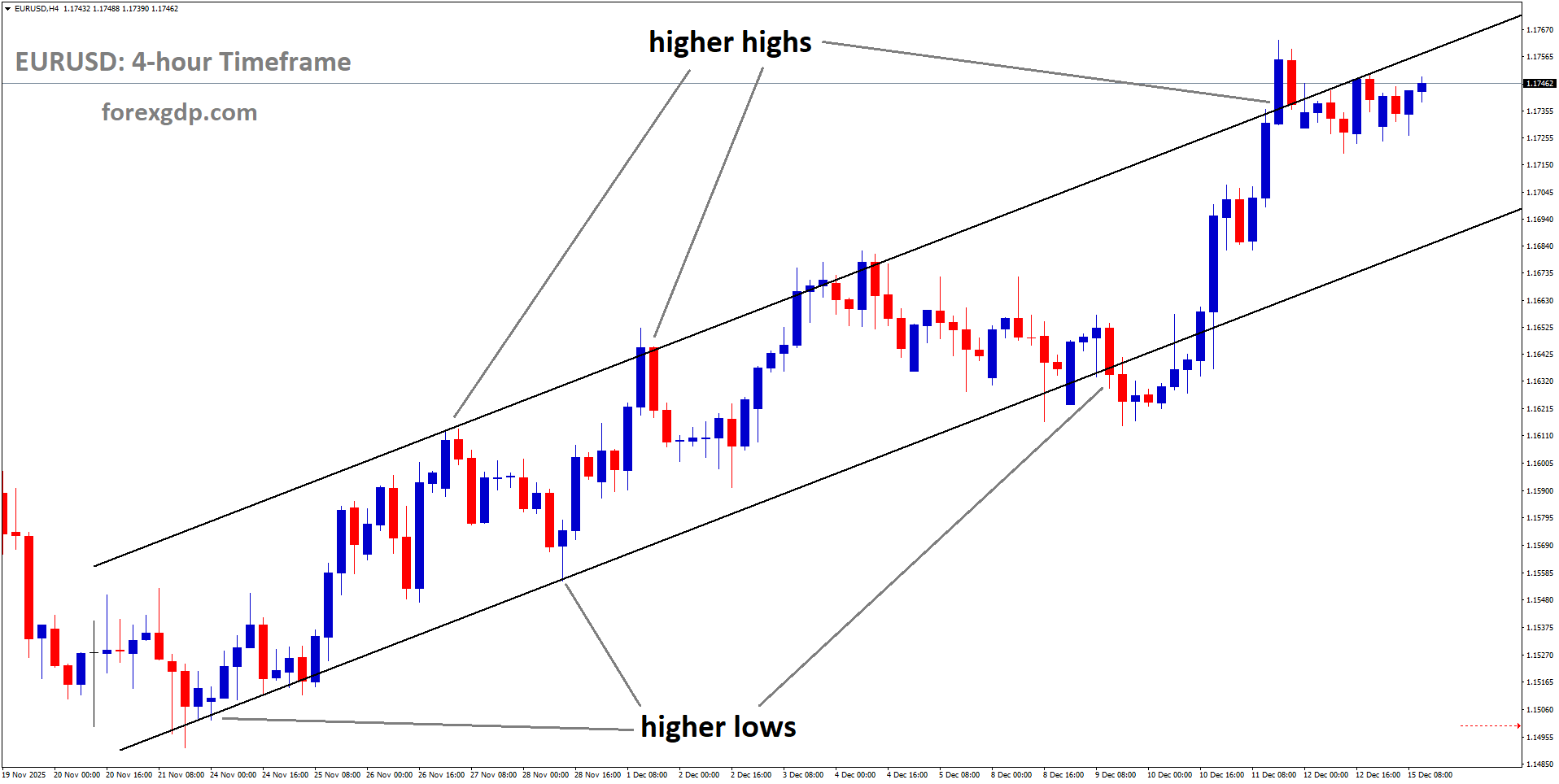
EURUSD is moving in an uptrend channel, and the market has reached a higher high area of the channel
At the same time, many traders are choosing patience over bold moves. A packed calendar of important data and central bank headlines is just around the corner, and that tends to slow things down. When major reports are due, it’s common to see markets pause, reassess, and trade in a tighter range until the next big piece of information arrives.
Strong Eurozone Factory Output Lifts Confidence
One reason the Euro is staying supported is the latest Eurozone Industrial Production report. Data published by Eurostat showed that factory output improved more than expected in November. Month-over-month growth came in at 0.8%, up from 0.2% in October and far above what many economists had predicted. On a yearly basis, industrial production rose 2%, also stronger than the previous month’s 1.2% increase.
This kind of surprise matters because it changes the story traders tell themselves about the Eurozone economy. Industrial production is closely watched since it reflects how active the region’s factories are and can hint at the direction of broader growth. When the numbers beat expectations, it often improves the mood around the currency, especially if markets were worried about slowing demand or weak output.
It doesn’t mean the Eurozone is suddenly out of the woods, but it does add a supportive data point at a time when investors are very sensitive to signs of strength or weakness.
The Bigger Picture: A Rally Takes a Pause
Zooming out, EUR/USD has already done a lot of work. Over the last three weeks, the pair climbed nearly 2%, reversing earlier losses and pushing toward last week’s peak near 1.1762. Moves like that rarely continue in a straight line. Even strong trends usually pause, pull back a little, or move sideways as traders lock in profits and wait for fresh reasons to buy.
That’s the feeling in the market right now: the Euro has momentum behind it, but it also needs new fuel to push higher in a sustainable way. Some traders are treating Monday as a “wait and see” day—strong enough to hold the line, but not yet strong enough to break out with confidence.
Why the Euro Still Has Supportive Themes
Beyond the industrial data, there’s a broader theme helping EUR/USD: the policy outlook between the European Central Bank (ECB) and the US Federal Reserve is not moving in the same direction, and that difference matters for currency markets.
In simple terms, when investors believe one central bank will keep policy tighter than another, it can influence where money flows. Right now, traders see the Fed as more likely to cut rates in the future, while the ECB has signaled that its next move could eventually be in the opposite direction. When markets sense that gap, it can give the Euro a tailwind and keep the US Dollar from gaining too much ground.
US Politics and the Fed: Another Layer of Uncertainty
Another storyline hovering over the US Dollar is political chatter about the future leadership of the Federal Reserve. Comments from President Trump have drawn attention to possible candidates to replace Fed Chair Jerome Powell when his term ends in May. Names mentioned include former Fed Governor Kevin Warsh and White House economist Kevin Hassett. Trump also suggested that the next Fed Chair should consider his opinions on interest rate decisions.
Markets pay attention to this because leadership expectations can shape beliefs about future policy. If traders think the next chair could be more willing to lower rates, that perception can weigh on the Dollar, even before any official change happens. Of course, it’s still early, and speculation is not the same as a confirmed outcome—but currency markets often respond to expectations long before the facts are final.
Global Risk Mood Takes a Hit After China Updates
While Europe got a helpful data surprise, news out of China added some caution to the overall market mood. Reports showed China’s industrial output growth slowed more than expected in November, while retail spending grew at its weakest pace in almost two years. That combination can raise concerns about demand and momentum in the world’s second-largest economy.
On top of that, headlines about the state-backed property developer China Vanke struggling to avoid bankruptcy revived worries about China’s property sector—an area that has repeatedly shaken confidence in recent years.
When investors feel uneasy about global growth or financial stability, markets can become more defensive. That doesn’t always translate the same way across currencies, but it often reduces risk-taking and encourages traders to stay cautious. In sessions like these, currency pairs can move less, react more sharply to headlines, and hesitate near important areas until there’s clearer direction.
A High-Stakes Week Ahead for EUR/USD
The main reason traders are holding back is simple: the next few days are loaded with events that can quickly change expectations.
Here’s what markets are watching most closely:
US Jobs Data: Nonfarm Payrolls Reports
The US Nonfarm Payrolls (NFP) reports for October and November are scheduled for Tuesday after being delayed. Jobs data is one of the most influential releases for the Dollar because it shapes how investors think about US growth, inflation pressures, and the Fed’s next steps.
If the reports show strong job creation and firm wage growth, it could support the Dollar by reducing rate-cut expectations. If the numbers disappoint, the opposite could happen—especially if traders interpret weaker hiring as a sign the economy is cooling faster than expected.
US Inflation Data: CPI on Thursday
Thursday brings the US Consumer Prices Index (CPI) for November. Inflation remains one of the biggest drivers of interest rate thinking. Markets will be watching not just the headline number, but also whether price pressures appear to be easing or staying stubborn.
A softer inflation read can reinforce the idea that the Fed has room to lower rates down the road. A hotter print can force traders to rethink that view.
The ECB Decision Also Lands on Thursday
As if that weren’t enough, the ECB will also announce its monetary policy decision on Thursday. Even if the bank does not change policy immediately, the language in the statement and comments from ECB officials can shift expectations quickly. Traders will listen closely for any hints about the direction of rates, the bank’s level of confidence in the economy, and how policymakers see inflation risks evolving.
When the Fed and ECB are both in focus, EUR/USD often becomes especially sensitive, with sharper moves possible in either direction depending on how the messaging compares.
What Traders Are Thinking Right Now
At the moment, the market seems to be balancing two ideas:
-
The Euro has support from better Eurozone data and a policy narrative that still leans in its favor.
-
The rally has already been strong, and the next major moves may depend on this week’s US and European headlines.
That mix explains why EUR/USD is holding its gains but not racing higher. Many participants would rather wait for confirmation from jobs data, inflation figures, and central bank guidance than commit heavily based on a single data release.
Final Summary
EUR/USD began the week steady, holding above the 1.1720 area and trading near 1.1750 as the Euro benefited from stronger-than-expected Eurozone Industrial Production. The pair is consolidating after a solid multi-week climb, while traders remain cautious ahead of major releases. With delayed US jobs reports on Tuesday, US CPI and the ECB policy decision on Thursday, and ongoing uncertainty tied to US politics and global risk sentiment from China-related concerns, the next clear direction for the pair may depend on how this busy week unfolds.
USDJPY Wobbles Around 155.00 While the Yen Holds Firm in Early Trade
The Japanese Yen opened the new week on a firmer footing, helped by a mix of changing central bank expectations and a slightly more cautious mood in global markets. Traders are paying close attention to signs that the Bank of Japan (BoJ) could move closer to raising interest rates, while the US Dollar remains under pressure as investors lean toward a more rate-cut-friendly outlook for the Federal Reserve (Fed).
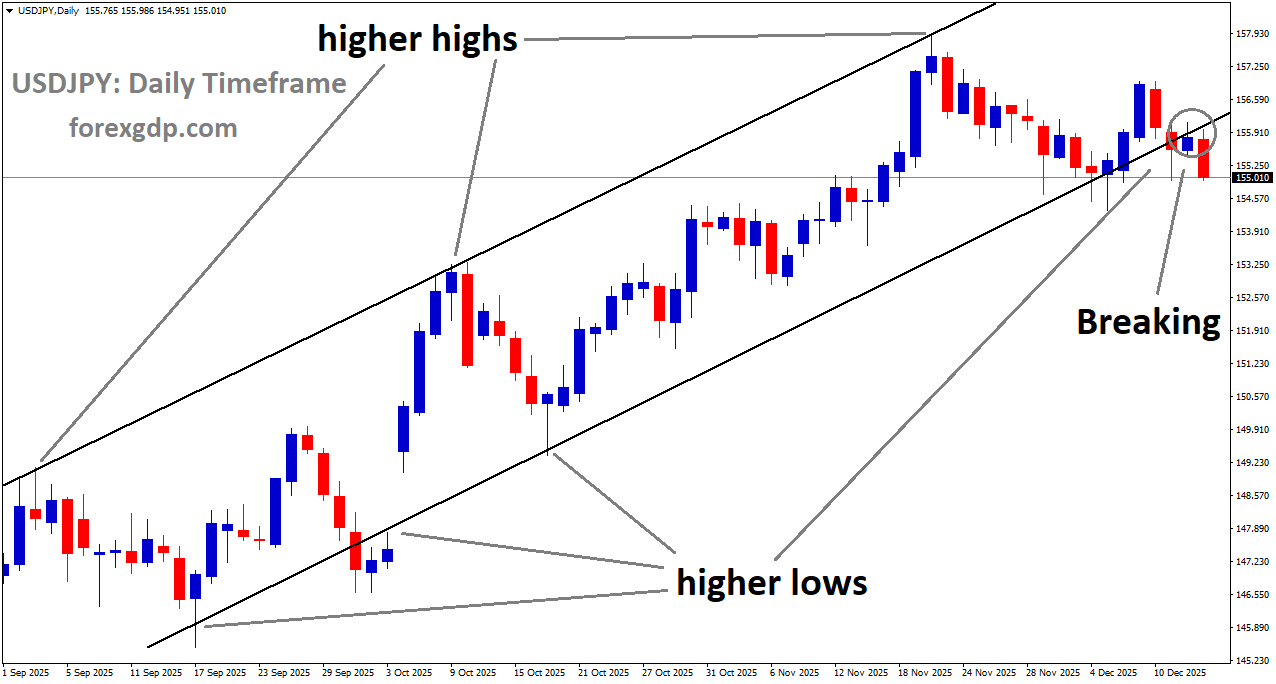
USDJPY is breaking the higher low area of the uptrend channel
This combination matters because currencies often react to the “gap” between where investors think interest rates are heading in two countries. Right now, the story is simple: more people believe Japan may be heading toward tighter policy, while the United States may be heading toward easier policy. That contrast has supported the Yen and kept the Dollar from finding steady demand.
Why the Yen Is Getting Support Right Now
A big driver behind the Yen’s strength is growing confidence that the BoJ may be preparing to take another step away from its long-standing ultra-easy policy stance. Market attention has sharpened after a shift in tone from BoJ Governor Kazuo Ueda, whose recent comments have been interpreted as more open to action as Japan approaches its inflation goals.
When a central bank is seen as more likely to raise rates, its currency often benefits. The logic is straightforward: higher rates can make holding that currency more attractive compared with lower-yielding alternatives. Even if the Yen is still considered “lower-yielding” by global standards, the key is the direction of travel and the change in expectations.
At the same time, a softer global risk tone has also played a role. The Yen is widely viewed as a “safe-haven” currency, meaning it tends to get support when investors feel uncertain and reduce risk exposure. When traders move away from riskier assets, demand can shift toward perceived safer places, and the Yen often gains from that shift.
The Tankan Survey Adds Fuel to BoJ Rate Hike Bets
Another important piece of the puzzle came from the BoJ’s quarterly Tankan survey, a closely watched snapshot of business sentiment in Japan. The latest release showed that confidence among large manufacturers improved in the fourth quarter of 2025, and the outlook measure also strengthened. For many investors, that kind of steady business mood supports the idea that Japan’s economy may be stable enough to handle slightly higher borrowing costs.
What business leaders are saying
A senior BoJ official noted that companies pointed to easing uncertainty around US trade policy and steady demand in high-tech areas as reasons behind improved sentiment. Firms also highlighted better cost pass-through—meaning businesses feel more able to raise prices to reflect higher costs—along with resilient demand supporting a brighter outlook.
These details matter because the BoJ has spent years trying to create the kind of environment where price growth is supported by real demand and wages, not just temporary shocks. When business confidence holds up and companies report stronger pricing power, it strengthens the case for the BoJ to keep moving toward normal policy.
The BoJ Meeting Is Now the Main Event
The calendar is doing a lot of the talking this week. Traders are focused on the BoJ policy meeting scheduled for December 18–19, with many expecting clearer direction about where policy goes next. The market will be watching not only the decision itself but also what comes afterward.
That’s why Governor Ueda’s post-meeting press conference is set to be a key moment. Investors want to hear how the BoJ views inflation progress, wage trends, and the broader outlook for 2026. Even small changes in language can shift expectations quickly, and the Yen tends to react sharply when the market senses a meaningful turn in policy thinking.
Political background also matters
Reports suggesting that top officials in Prime Minister Sanae Takaichi’s cabinet are unlikely to oppose a BoJ rate hike have added to the sense that policy tightening may face fewer obstacles. Still, many traders prefer to wait for official guidance before placing large bets, especially after periods when the BoJ has surprised markets with careful, gradual changes rather than dramatic moves.
Fiscal Worries in Japan Could Limit Yen Gains
While the short-term mood has helped the Yen, it isn’t all one-way traffic. Concerns about Japan’s fiscal direction remain a lingering headwind. Investors are watching the country’s public finances closely, particularly as discussion grows around large-scale government spending plans.
Prime Minister Sanae Takaichi’s reported massive spending plan has raised questions about how Japan will balance growth support with long-term debt sustainability, especially in an environment where economic expansion is still seen as relatively modest. If fiscal concerns intensify, they can weigh on investor confidence—even if central bank expectations are supportive.
In other words, the Yen currently has a strong tailwind from shifting rate expectations, but fiscal headlines can still complicate the picture and slow down momentum if markets begin to worry about the bigger long-term trade-offs.
The US Dollar Is Soft as Fed Cut Expectations Build
On the other side of the equation, the US Dollar has struggled to attract consistent buying interest and remains close to recent lows. One major reason is that traders are increasingly pricing in the possibility of two additional Fed rate cuts next year.
The Fed has signaled caution about moving too quickly, but markets often react not just to what policymakers say today, but to what they might do later if growth cools or inflation continues to ease. That forward-looking thinking has helped keep the Dollar on the defensive, especially when compared with the more hawkish shift investors are sensing in Japan.
Fed leadership speculation adds another layer
Adding to the uncertainty, US President Donald Trump said he had narrowed the list of contenders to replace Jerome Powell as the next Fed chair, and he expects his nominee to deliver interest-rate cuts. Markets tend to pay attention to leadership signals like this because the Fed chair can influence communication style, priorities, and the tone of future policy discussions. Even without any formal change yet, the possibility of a more politically aligned, rate-cut-friendly future leadership profile can weigh on the Dollar’s appeal.
Big US Data Releases Could Set the Next Move
This week’s US economic calendar is loaded, and that means traders may stay cautious until major numbers are out. Two releases stand out because they can shift rate expectations quickly.
Key events markets are watching
-
The delayed Nonfarm Payrolls (NFP) report for October, due Tuesday
-
The latest US inflation figures, due Thursday
If jobs data shows stronger hiring and wage growth, it could challenge the market’s confidence in multiple Fed cuts next year. On the other hand, softer employment data could reinforce the idea that the Fed will need to ease policy further. Inflation numbers can have an equally strong impact—especially if they move meaningfully away from expectations.
Because these reports can reshape Fed expectations in a hurry, the Dollar’s direction may stay sensitive and reactive, which in turn can influence how far the Yen’s strength extends.
What This All Means for the Yen This Week
Right now, the Yen is being supported by two forces working together: stronger belief in a BoJ rate hike and a mildly cautious global mood that encourages safe-haven demand. Meanwhile, the Dollar is weighed down by a market that leans toward more Fed rate cuts ahead, plus added uncertainty around future Fed leadership.
Even so, the next big push will likely come from clarity—first from Japan’s central bank meeting and then from the major US data releases. If the BoJ sounds confident and the US data leans softer, the Yen could remain well supported. If the BoJ is more careful than expected or US numbers come in hot, the market may quickly reassess.
Summary
The Japanese Yen began the week stronger as expectations grew that the Bank of Japan could raise rates soon, supported by improved business confidence in Japan and a slightly more cautious global risk tone. At the same time, the US Dollar stayed weak as traders leaned toward additional Federal Reserve rate cuts next year and watched developing headlines around future Fed leadership. Attention now shifts to the BoJ policy meeting on December 18–19 and major US releases this week, including the delayed October jobs report and fresh inflation data, which could shape the next move in both currencies.
USDCHF Keeps Calm While Traders Wait on Key US Hiring Updates
The USD/CHF pair is trading almost unchanged around 0.7960 during Monday’s early European session. At first glance, it looks like a quiet start to the week. But underneath that calm price action, traders are clearly holding back. The market is in “wait-and-see” mode as a busy run of US economic updates is about to arrive, starting with delayed employment figures on Tuesday and followed by inflation data later in the week.
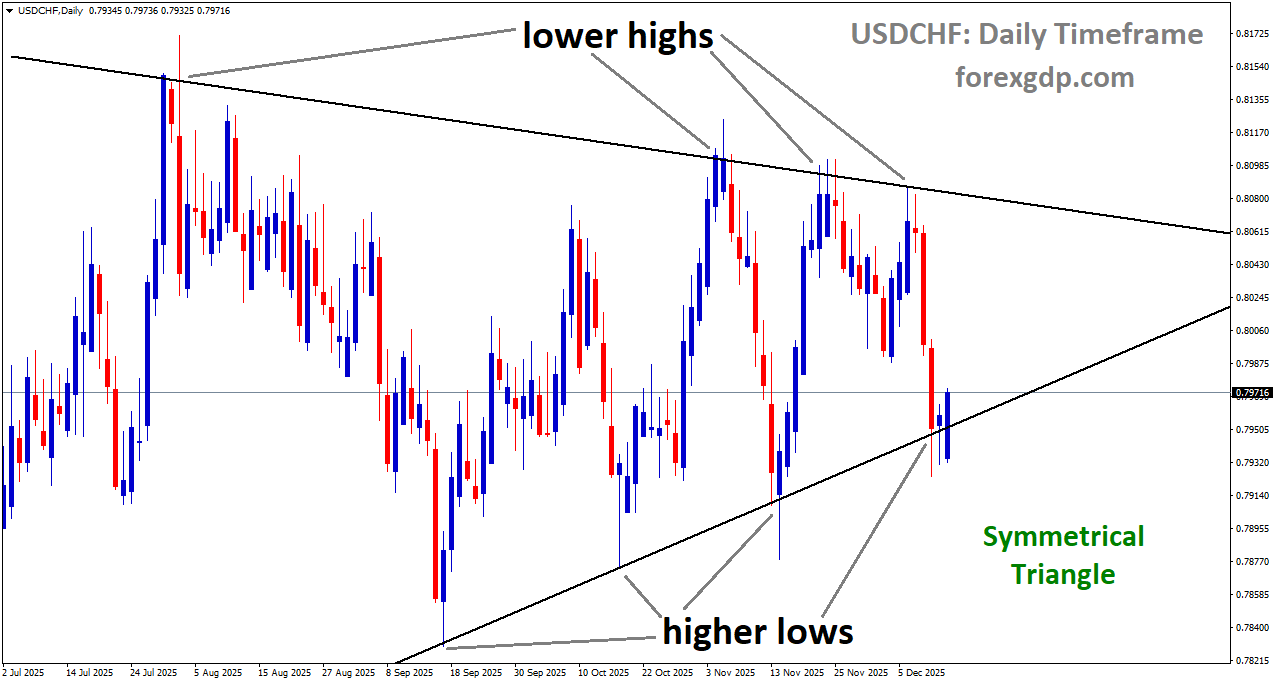
USDCHF is moving in a symmetrical Triangle pattern, and the market has reached the higher low area of the pattern
When traders expect big, market-moving news, they often reduce risk, cut down on big positions, and avoid bold bets. That’s exactly the mood right now. In this kind of environment, the US Dollar can struggle to gain traction, while the Swiss Franc often finds support because many investors see it as a safer place to park money when uncertainty rises.
A Quiet Price Doesn’t Mean a Quiet Market
Even though USD/CHF is flat for now, it doesn’t mean traders think nothing will happen. In fact, the lack of movement can signal the opposite: markets are tense, and participants are waiting for fresh information before committing.
This week’s key question is simple: what will the US data say about jobs and inflation, and what will that mean for future interest rate decisions? Because interest rates heavily influence currency values, the answers matter not only to economists, but also to anyone trading the Dollar or the Franc.
Why This Week’s US Employment Reports Matter So Much
The main focus is on the US employment reports for October and November, scheduled for release on Tuesday. These numbers have drawn extra attention because they were delayed by a US government shutdown. When reports arrive late, markets don’t just look at the headline figure—they also try to figure out whether the delay changes how the data should be interpreted.
Jobs data is important because it offers a clear snapshot of economic strength. If hiring is strong and unemployment stays low, it often suggests consumers can keep spending and the economy can keep moving. If hiring slows, it can signal that growth is cooling.
Delayed Data Creates Extra Uncertainty
Because these reports cover two separate months and were released later than usual, traders may be more cautious about jumping to conclusions from a single result. One well-known currency strategist, Sim Moh Siong of Bank of Singapore, noted that policymakers may read these numbers more carefully than usual, focusing on what they reveal about the broader trend in the labor market rather than treating them as a simple one-time signal.
That idea matters for markets too. Traders will likely look beyond the top number and ask: is the US labor market holding up, gradually slowing, or weakening faster than expected?
What a Surprise Could Mean for USD/CHF
The reaction in USD/CHF may depend on whether the jobs figures come in above or below expectations:
-
If the data is stronger than expected: the US Dollar could get a short-term boost, since stronger employment can reduce pressure for easier policy.
-
If the data is weaker than expected: the Dollar may soften, especially if traders believe it strengthens the case for more rate cuts ahead.
Either way, Tuesday’s release has the potential to break USD/CHF out of its current slow pace.
Inflation Is Next: CPI Data Keeps Traders on Edge

After Tuesday’s jobs numbers, attention will quickly shift to US inflation data on Thursday, with the release of the Consumer Price Index (CPI). CPI is one of the most closely watched inflation measures because it affects how central banks think about price stability.
Inflation is not just a cost-of-living issue—it’s a key driver of interest rate decisions. If inflation remains stubborn, central banks may hesitate to ease policy. If inflation cools, they may feel more comfortable cutting rates.
For currency markets, this matters because differences in interest rate expectations between countries can drive demand for one currency over another.
Why CPI Can Move Currencies Quickly
Even small surprises in inflation data can trigger fast market reactions. Traders will compare the CPI result to expectations and immediately reassess what the Federal Reserve might do next. That reassessment often shows up quickly in the US Dollar’s performance.
If CPI comes in hotter than expected, the Dollar can gain as traders rethink the pace of future easing. If CPI is softer, the Dollar can weaken as expectations tilt toward more supportive policy.
Federal Reserve Expectations Are Weighing on the US Dollar
A big theme shaping USD/CHF right now is the market’s view of where US interest rates are headed over the longer term. Expectations that the Federal Reserve may deliver additional interest rate cuts in 2026 have been a drag on the US Dollar. When traders think rates may fall, it can reduce the appeal of holding Dollar-based assets compared with currencies where the outlook is steadier.
The Fed’s Summary of Economic Projections—often discussed through the “dot plot”—has played a role in shaping these expectations. The median projection suggested one additional rate cut next year, which has added to the sense that the policy path may gradually become more supportive rather than restrictive.
Why Rate Expectations Matter for USD/CHF
Currencies often move based on what markets think will happen next, not only what is happening today. If traders become more convinced that US rates will trend lower over time, the Dollar may struggle to build momentum, especially against currencies that benefit from safety demand like the Swiss Franc.
That doesn’t mean the Dollar can’t bounce. It can, especially if upcoming data suggests the economy is stronger than feared. But it helps explain why the upside in USD/CHF could feel limited unless the US data clearly shifts expectations.
Swiss Franc Support: Risk-Off Mood Keeps CHF in Demand
The Swiss Franc has a long-standing reputation as a safe-haven currency. When global markets feel uneasy—whether due to economic uncertainty, political concerns, or unexpected shocks—investors often increase exposure to assets they consider more stable. Switzerland’s financial reputation and history of stability are part of why CHF tends to benefit during risk-off periods.
That’s relevant right now because the broader market mood has turned cautious ahead of this week’s US releases. In uncertain moments, traders may prefer caution over risk, and that can naturally support CHF.
SNB Policy Adds Another Layer
On the Swiss side, the Swiss National Bank (SNB) has kept its policy rate at 0% and is widely expected to maintain that stance for an extended period, aiming to manage inflation conditions over time. While a 0% rate might not sound like a reason to buy a currency, safe-haven demand doesn’t always depend on yield. Sometimes it’s driven by confidence, stability, and capital preservation.
So even if the interest rate story doesn’t strongly favor CHF on its own, the safe-haven role can still make the Franc resilient—especially when markets get nervous.
Final Summary
USD/CHF is holding near 0.7960 as traders remain cautious at the start of the week. The pair’s next meaningful move may depend on a packed US data calendar, beginning with delayed October and November employment reports on Tuesday and followed by US CPI inflation data on Thursday. Expectations of additional Fed rate cuts in 2026 have weighed on the US Dollar, while a risk-off mood could increase demand for the safe-haven Swiss Franc. If US jobs and inflation data surprise to the upside, the Dollar could rebound in the near term—but if the results point to a cooling economy, CHF support may remain firm.
NZDUSD drops under 0.5800 following downbeat China economic updates
The NZD/USD pair started Monday on the back foot, drifting down toward the 0.5780 area during Asian trading. While day-to-day moves in currency markets can look small on the surface, they often reflect a bigger story underneath. In this case, the New Zealand Dollar is feeling pressure after softer economic numbers from China, while traders also keep one eye on the United States, where a closely watched jobs report is due on Tuesday.
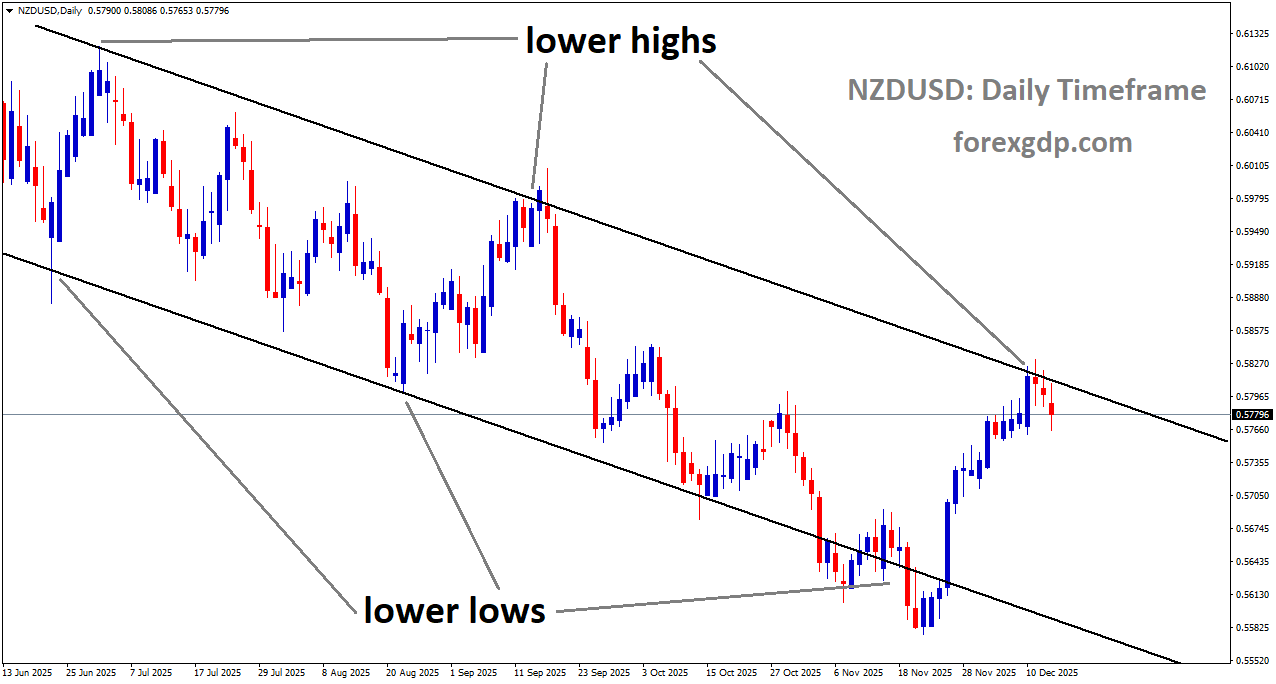
NZDUSD is moving in a descending channel, and the market has reached the lower high area of the channel
This mix of global growth worries and US policy expectations has created a cautious mood. And when traders feel cautious, they tend to lean toward the US Dollar, especially when key US data is just around the corner.
China’s Retail Sales Miss and the Kiwi Feels It
One of the biggest drivers behind the early-week dip is fresh data out of China. China’s National Bureau of Statistics reported that Retail Sales rose 1.3% year-over-year in November. That was not only slower than October’s 2.9% reading, but also far below what markets were expecting.
Industrial Production, another important measure of activity, increased 4.8% year-over-year. While that number is not a collapse by any means, it was still a touch weaker than forecasts and slightly below the previous month’s pace.
So why does this matter so much for NZD/USD?
New Zealand’s economy is tightly linked to China through trade. China is one of New Zealand’s most important partners, and when Chinese consumer demand looks weaker than expected, it can raise concerns about future demand for New Zealand exports. Even if the New Zealand economy itself has not changed overnight, sentiment can shift quickly when a major partner shows signs of slowing.
Why markets react fast to China headlines
Currency traders don’t wait for long-term proof. They often react immediately because weaker Chinese data can suggest:
-
softer demand for imports,
-
slower global growth momentum,
-
more uncertainty for economies tied to Asia-Pacific trade.
That’s why the New Zealand Dollar is sometimes treated as a “China-sensitive” currency. When China disappoints, the Kiwi often takes a hit.
RBNZ Signals Stability, Which Could Limit the Downside
Even with the Kiwi under pressure, the Reserve Bank of New Zealand has offered a slightly steadier backdrop.
Early Monday, RBNZ Governor Anna Breman noted that the economic outlook is broadly tracking the central bank’s expectations. She also pointed to continued signs that growth is recovering. That’s important because it suggests policymakers are not currently panicking or signaling an urgent need for more support.
At the same time, she did not completely rule anything out. There is still a small chance of another rate cut, but if conditions develop as expected, the Official Cash Rate is likely to stay at 2.25% for a while.
This “steady but cautious” tone matters for NZD/USD because it can help limit how far the New Zealand Dollar falls, even when offshore news is negative. When a central bank appears comfortable holding policy steady, it can give the currency a bit of support by reducing fears of near-term easing.
What traders may take from the RBNZ message
-
The bank sees recovery signs, not a sharp downturn.
-
Policy looks stable for now, even if risks remain.
-
The door is not fully closed on changes, but it’s only slightly open.
In other words, the RBNZ is not rushing to act, and that can calm the market—at least a little.
Fed Watch: Officials Speak as Markets Reassess the Next Move
Across the Pacific, the US Dollar is being shaped by expectations around the Federal Reserve. Several Fed officials are scheduled to speak, including Fed Governor Stephen Miran and New York Fed President John Williams. Comments from central bank officials often matter most when markets are unsure about what comes next.
Last week, the Fed delivered its third and final quarter-point interest rate cut of the year, lowering rates by 25 basis points to a target range of 3.50% to 3.75%. Fed Chair Jerome Powell emphasized that policymakers want time to see how this year’s cuts filter through the economy.
That message is a big deal because it signals patience. The Fed is not promising more cuts quickly, and it is not committing to a fixed path. Instead, it is watching the data.
For NZD/USD, this matters because the US Dollar tends to strengthen when traders believe the Fed will stay cautious about easing. A more patient Fed can keep US yields attractive relative to other markets, making the Greenback harder to bet against.
The key question markets are asking
Is the Fed done cutting for now, or will it need to act again soon?
Speeches can shape the mood, but traders usually wait for the hard numbers to settle that debate.
All Eyes on Tuesday’s US Nonfarm Payrolls Report
The main event is the delayed US Nonfarm Payrolls (NFP) report for October, due Tuesday. NFP is one of the most watched reports on the economic calendar because it offers a clear snapshot of labor market strength.
This release matters for two reasons:
-
It influences Fed expectations.
If job growth looks strong and unemployment stays steady, the Fed may feel less pressure to cut further. If the labor market shows real weakness, traders may increase bets on more easing. -
It drives immediate US Dollar moves.
NFP often triggers quick reactions because it changes the outlook for growth, inflation pressure, and policy decisions all at once.
For NZD/USD, the direction often comes down to the “surprise factor.” If the report points to a weakening labor market, the US Dollar could lose ground and give the pair some breathing room. If it shows resilience, the Greenback could stay supported, and NZD/USD may struggle to rebound.
What a weaker jobs report could signal
-
hiring demand is cooling,
-
the economy may be losing momentum,
-
policy may need to become more supportive.
Any of those outcomes can shift expectations for the Fed’s January meeting, which is why the market is treating Tuesday as a major checkpoint.
How These Forces Come Together for NZD/USD This Week
Right now, NZD/USD is caught between two powerful themes.
On one side, China’s softer numbers are pulling down risk-sensitive currencies, including the New Zealand Dollar. On the other side, New Zealand’s own central bank is signaling relative stability, which can soften the blow.

Meanwhile, the US Dollar is being driven by Fed messaging and the upcoming NFP report. Until Tuesday’s data arrives, traders may be reluctant to make big commitments, which can keep market moves choppy and headline-driven.
In practical terms, that means NZD/USD could remain sensitive to:
-
additional news from China that changes the growth narrative,
-
remarks from Fed officials that hint at policy direction,
-
any shift in market expectations ahead of the US jobs report.
Final Summary
NZD/USD slipped toward 0.5780 in early Monday trading as disappointing Chinese Retail Sales data weakened sentiment toward China-linked currencies like the New Zealand Dollar. New Zealand’s central bank offered a steadier tone, suggesting growth is recovering and policy may stay on hold for some time, which could help limit deeper losses. Attention now shifts to the United States, where Fed speakers and Tuesday’s October Nonfarm Payrolls report could reshape expectations for the Fed’s next decision and drive the next meaningful move in the pair.
Don’t trade all the time, trade forex only at the confirmed trade setups
Get more confirmed trade signals at premium or supreme – Click here to get more signals, 2200%, 800% growth in Real Live USD trading account of our users – click here to see , or If you want to get FREE Trial signals, You can Join FREE Signals Now!