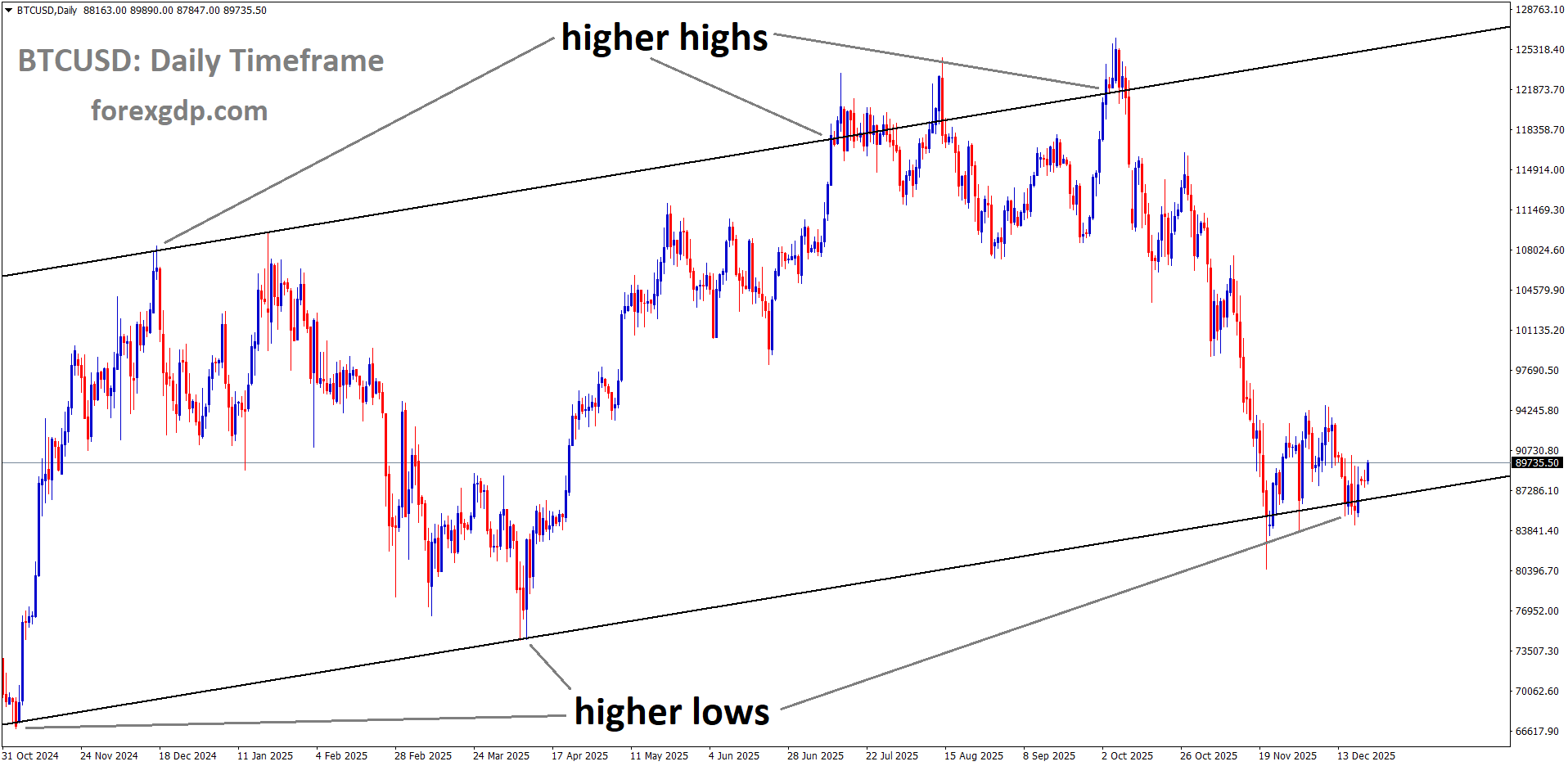
BTCUSD is moving in an uptrend channel, and the market has reached a higher low area of the channel
BTCUSD hovers close to 90K as optimism fades under heavy fund selling
Bitcoin has been climbing toward an important area that many traders and long-term holders have been watching closely. When Bitcoin moves up to a widely followed level, it often brings a mix of excitement and caution. Some people see it as a chance for a fresh push higher. Others see it as a place where the market may stall, especially if buying strength is not strong enough to keep the move going.
Right now, that tug-of-war is easy to feel. On one side, Bitcoin’s recent bounce has sparked hopes of a short-term recovery. On the other side, signs of softer institutional demand are raising questions about how much fuel this recovery really has.
Bitcoin Nears a Major Test for Momentum
When Bitcoin approaches a key “line in the sand,” the market usually becomes more emotional and more reactive. A strong move above that level can change sentiment quickly, bringing in new buyers and forcing some sellers to step aside. But if Bitcoin struggles to break through, it can create frustration and lead to profit-taking.
This is why daily closes matter to many market watchers. A quick spike during the day can be driven by short-term trading. A firm close, however, can suggest the market is accepting higher levels, at least for now. That kind of confirmation often improves confidence—especially among participants who do not trade minute-to-minute.
Still, price action alone doesn’t tell the full story. What happens behind the scenes—especially with big-money flows—can heavily influence whether a move has staying power.
Spot Bitcoin ETF Outflows Hint at Weaker Institutional Appetite
One of the clearest signals of institutional interest in recent times has been the behavior of US-listed spot Bitcoin ETFs. These products made it easier for traditional investors to gain exposure to Bitcoin without handling wallets, private keys, or crypto exchanges. Because of that, ETF flows have become a popular “check the temperature” tool for broader demand.

Last week, the data showed a sharp shift. Instead of steady inflows, spot Bitcoin ETFs saw a sizable net outflow—one of the largest weekly pullbacks in quite some time—breaking the positive streak from the week before. In everyday terms, that means more money left these ETF products than entered them.
Why does that matter?
Because when institutions are consistently buying through ETFs, it can provide steady support to the market. It’s not the only driver, but it can reduce the impact of short-term selling and help keep dips from turning into deeper drops. When the opposite happens—when outflows accelerate—it can signal that big investors are stepping back, taking profits, or reducing risk.
Why ETF Flows Can Change Quickly
ETF flows can swing for several reasons, and not all of them are “bearish” on their own:
-
Portfolio rebalancing: Large investors may reduce exposure after a strong run.
-
Risk-off mood: If broader markets look uncertain, institutions may prefer safer positions.
-
Short-term profit-taking: Some buyers may have entered earlier and now want to lock in gains.
-
Changing expectations: If investors feel the upside is limited in the near term, they may pause new allocations.
Even so, continued outflows can create a tougher environment for Bitcoin to keep rising. Without strong institutional support, the market may rely more on retail demand and shorter-term trading, which can be more volatile.
A CryptoQuant Report Warns the Cycle May Be Turning
Alongside ETF flow concerns, a weekly report from CryptoQuant added another layer of caution. The report suggested Bitcoin’s broader cycle may be shifting toward a more bearish phase, pointing to demand exhaustion and early signs that a wider downtrend could be forming.
The key idea here is simple: markets tend to move in cycles, and strong uptrends usually need expanding demand to continue. When demand growth slows sharply, it can signal that the market is losing the energy needed to keep pushing higher.
CryptoQuant’s analyst noted that demand growth has fallen below its trend since early October 2025, after several major demand waves since 2023. Those demand bursts were linked to big narratives and events that brought fresh attention and new money into Bitcoin.
While the exact triggers can be debated, the larger point is straightforward: when the big waves of new demand fade, the market often becomes more fragile. Without fresh buyers stepping in at increasing levels, rallies can lose strength and pullbacks can deepen.
The Big Risk: Losing a Key Pillar of Support
A healthy bull phase usually has multiple “pillars” holding it up—strong sentiment, strong inflows, rising network activity, and steady participation from both retail and larger investors. If one pillar weakens, the market can still do fine. But if several weaken at the same time, the risk of a longer downturn grows.
This is what makes the current mix of signals uncomfortable for many investors: Bitcoin is testing an important level while signs of institutional cooling and slowing demand growth appear in the background.
What Large Bitcoin Holders Are Doing Matters
Another point raised in the report focuses on large holders—often called “whales”—and how their balances are changing. CryptoQuant highlighted that addresses holding a large amount of Bitcoin (in the range typically associated with bigger investors) have been growing more slowly than the longer-term trend. In plain terms, this suggests that some large players are not accumulating as aggressively as they did earlier in the cycle.
Why does that matter?
Large holders can influence market direction simply because of their size. When they accumulate, it can reduce available supply and support prices during dips. When they slow down or reduce exposure, the market may feel “lighter” on real demand.
The report also compared the current shift to a previous period where demand weakness showed up before a major bear market. Historical comparisons don’t guarantee the same outcome, but they can help investors recognize patterns that have appeared before.
What This Could Mean for Investors and Traders
Bitcoin can still move higher in the short term even when warning signs are present. Markets are rarely perfectly aligned. Sometimes bearish signals take time to show up fully, and sometimes negative sentiment clears out weak hands before the market resumes a healthier trend.
But it’s also true that when demand cools, rallies often become harder to sustain. That can lead to choppier moves, quicker reversals, and a market that punishes overconfidence.
Here are a few practical ways to think about the current situation:
-
Watch for confirmation, not excitement. Strong follow-through matters more than a single green day.
-
Pay attention to demand signals. ETF flows and on-chain demand indicators can help explain whether moves are supported by real buying.
-
Expect more noise. When the market is uncertain, it often swings between hope and fear more dramatically.
-
Have a plan. Whether you’re investing long term or trading short term, clear risk rules matter more in shaky conditions.
Summary
Bitcoin is pushing toward a widely watched level that could shape near-term sentiment, but the backdrop has become more complicated. Spot Bitcoin ETFs in the US recently saw a major weekly outflow, suggesting institutional appetite may be cooling. At the same time, CryptoQuant’s latest commentary points to slowing demand growth and early signs that the broader cycle could be turning more bearish. Large-holder behavior also appears softer than the longer-term trend, adding to concerns that the market may not have the same demand strength that powered earlier advances.
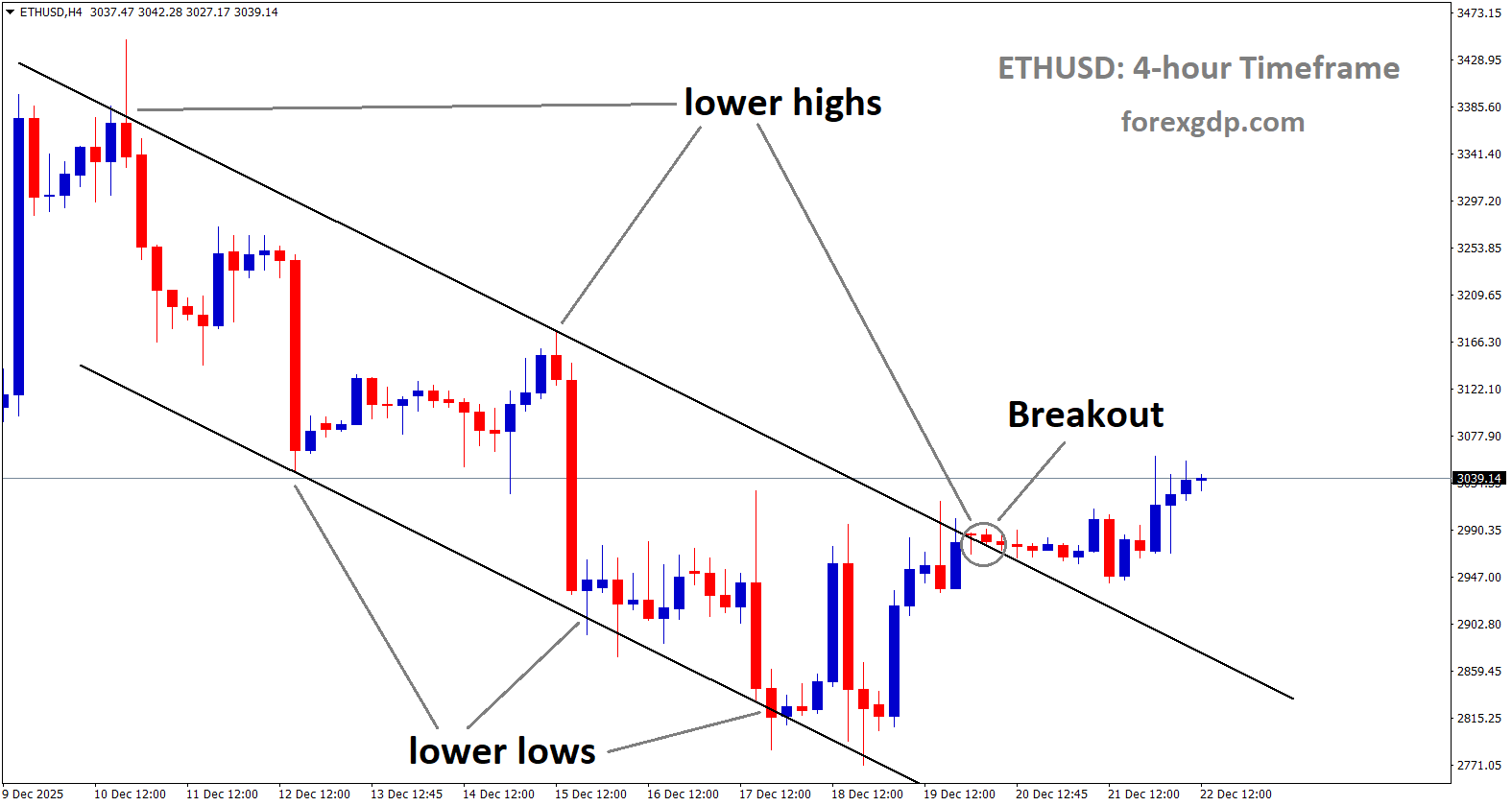
ETHUSD Awakens After a Dip: Could the Next Target Be Closer Than Expected?

EURUSD pushes above 1.1700 as ECB shifts to a wait-and-watch stance
EUR/USD started the new week with gentle upward momentum, trading near 1.1710 during early Asian hours on Monday. The move may look small on the chart, but the reasons behind it matter. The Euro is getting a bit of extra support after the European Central Bank (ECB) chose to keep interest rates steady and sounded more comfortable with how the Eurozone economy is handling global pressure. At the same time, the US Dollar is struggling to find fresh energy as the Federal Reserve (Fed) continues to lower rates and signals it is not in a rush to change direction.
With a long holiday period approaching, market activity can also slow down. Many traders prefer to reduce risk, lock in profits, and avoid big positions when trading desks are thin. That calmer backdrop often leads to smaller price swings, even when the news itself is important.
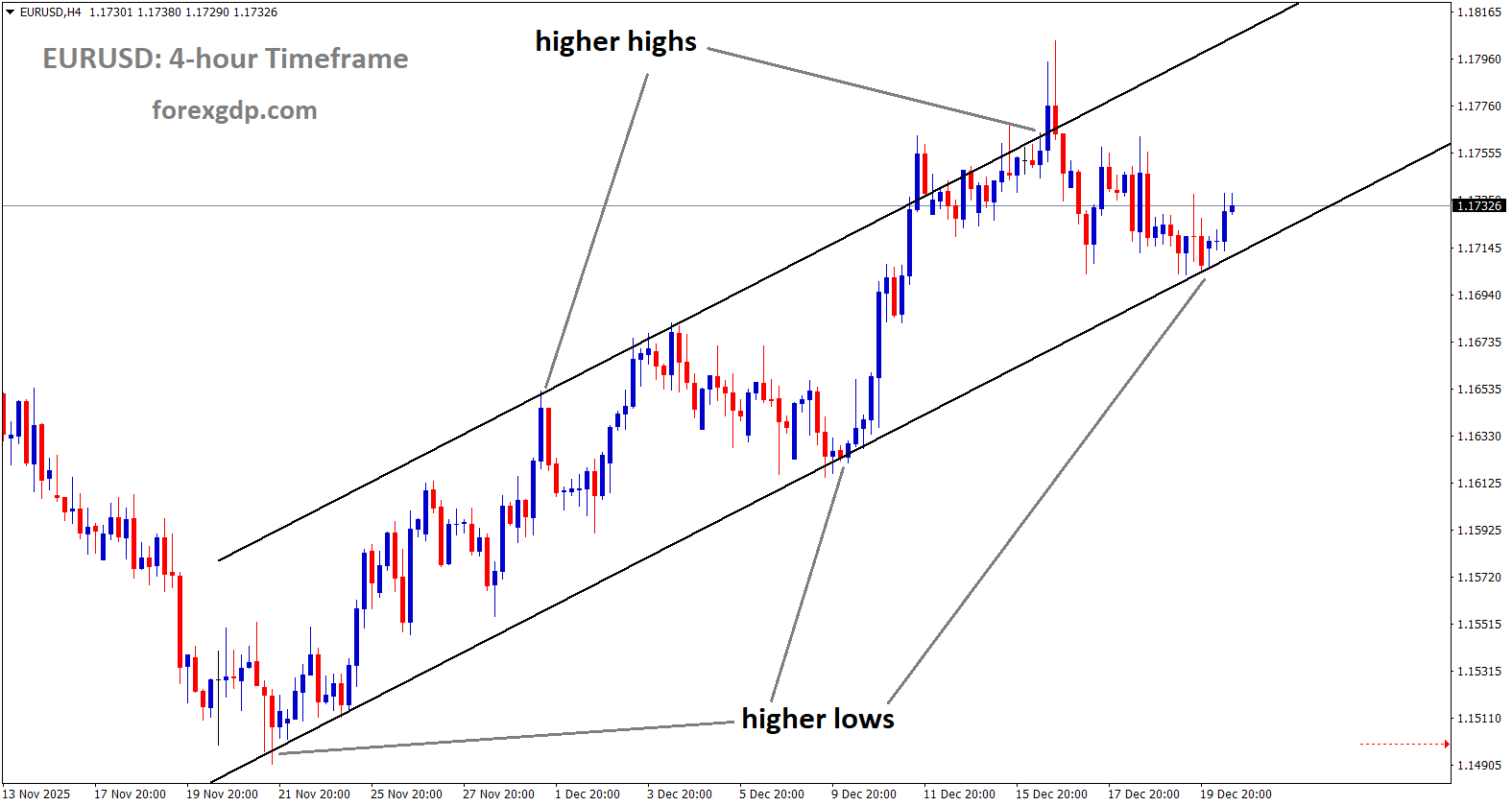
EURUSD is moving in an uptrend channel, andthe market has reached a higher low area of the channel
Why EUR/USD Is Moving at the Start of the Week
Currency markets often react less to the headlines and more to what central banks imply about the future. In this case, both the ECB and the Fed delivered messages that investors quickly translated into expectations about what comes next.
The ECB’s choice to keep rates unchanged, combined with a more upbeat tone on growth and inflation, can be read as a sign that the bank feels less pressure to keep easing policy. When a central bank appears to be reaching the end of its rate-cut cycle, its currency can benefit because investors may see fewer reasons for that currency to weaken.
On the US side, the Fed’s latest rate reduction has kept the focus on when cuts might stop—and how long rates might stay lower. When markets believe rates will continue to fall or remain low, the Dollar can lose some of its appeal, especially against major peers like the Euro.
All of this creates a simple setup: the Euro is finding support from a “steady and more confident” ECB, while the Dollar faces headwinds from a Fed that is easing and then pausing to evaluate incoming data.
ECB Signals a Shift: Less Easing, More Patience
The ECB kept its key policy rate unchanged at 2.0%, where it has remained since June. What stood out to market watchers was not just the pause itself, but the broader message that came with it.
Recent ECB communications suggested a more positive view of the Eurozone’s ability to cope with outside challenges, including trade-related uncertainty. When policymakers upgrade growth and inflation projections, they are essentially saying the economy is performing better than expected, or at least not weakening enough to demand further immediate support.
What the ECB’s tone means for the Euro
When the ECB avoids strong hints about future moves, it can create two reactions at once:
-
It reduces expectations of near-term rate cuts, which can support the Euro.
-
It highlights uncertainty, which can limit how far the Euro climbs.
ECB President Christine Lagarde also noted that uncertainty remains elevated and did not offer firm guidance about the next steps. That lack of commitment may be intentional. Central banks often prefer flexibility when economic conditions are shifting, especially when global risks—like trade tensions—can change quickly.
Still, traders are increasingly leaning toward the idea that the ECB may stay on hold for a long stretch, potentially until at least mid-year. If that view continues to grow, it can act as a steady tailwind for the Euro, especially if the US outlook stays tilted toward lower rates.
The Fed Cut Rates Again and Now Wants More Data

In the United States, the Fed delivered a widely expected 25-basis-point rate cut at its December meeting. This was the third straight reduction, bringing the federal funds rate to 3.50%–3.75%. For currency markets, a rate cut is often a clear negative for the currency involved, because lower rates can reduce the return investors earn on assets in that currency.
But what matters even more is what comes after the cut.
Fed Chair Jerome Powell indicated the central bank is entering a wait-and-see phase, meaning officials want to review upcoming economic data before deciding on additional moves. He also suggested that a rate hike is not likely in the near term, which reinforces the idea that policy will stay supportive rather than restrictive.
Why “wait-and-see” still affects the Dollar
Even when the Fed pauses, the Dollar does not automatically strengthen. The market asks a different question: What is the next likely direction? If investors believe future moves lean toward more cuts rather than hikes, the Dollar can remain under pressure.
That’s especially true when other central banks—like the ECB—look more comfortable holding rates steady. The difference between expected paths can matter as much as the current rate levels themselves.
The Dot Plot vs Market Expectations: A Key Point for Traders
Another reason the Dollar may be losing some traction is the gap between what the Fed’s projections suggest and what markets are currently expecting.
The Fed’s Summary of Economic Projections—often called the dot plot—showed a median view that points to only one additional rate cut in 2026. That is a cautious outlook, implying the Fed may not need to keep cutting aggressively.
However, market expectations are not fully aligned with that message. Many traders are pricing in the possibility of two or more cuts next year, based on shifting views of growth, inflation, and overall economic momentum. When markets expect a more dovish Fed than the Fed itself is projecting, the Dollar can weaken because investors position for lower future yields.
This difference in expectations is important for EUR/USD because it can create a situation where the Euro doesn’t have to do much to rise—sometimes the Dollar simply does the heavy lifting by softening.
Holiday Trading Can Keep Moves Limited
Even with central bank headlines in play, trading conditions around the holiday season often shape how the market behaves. Liquidity can thin out as institutions reduce activity and many traders step away from their desks.
In that environment:
-
Moves can be slower and more gradual if there is no major shock.
-
Short-term rallies can fade quickly if traders focus on booking profits.
-
Unexpected headlines can cause sharp jumps because fewer orders are available to absorb them.
That is why EUR/USD can show mild gains without turning it into a big trend move right away. Many participants are simply managing exposure, not placing bold new bets.
What to Watch Next for EUR/USD
EUR/USD will likely stay sensitive to how investors interpret the next round of Eurozone and US economic updates. If the Eurozone continues to show resilience and the ECB keeps signaling comfort with its current stance, the Euro may hold firm. On the other hand, if US data comes in weaker and strengthens the case for more Fed cuts, the Dollar could remain on the defensive.
Key themes that often guide sentiment include:
-
Whether inflation is cooling at a pace that allows continued easing
-
Whether growth is slowing enough to change central bank priorities
-
Whether global trade uncertainty increases or fades
-
Whether market expectations shift closer to, or further from, central bank projections
For now, the bigger story is not dramatic price action. It is the changing mood around central banks—and what that implies for the months ahead.
Final Summary
EUR/USD is holding mild gains near 1.1710 as the Euro draws support from an ECB that has paused rate cuts and sounded more confident about the Eurozone’s resilience. Meanwhile, the US Dollar faces pressure after the Fed’s third consecutive rate cut and a shift into a wait-and-see stance. A mismatch between the Fed’s own projections and market expectations for future rate cuts is also weighing on the Dollar. With the holiday period approaching, thinner trading conditions may keep price moves more restrained, even as central bank signals continue to shape the broader direction.
GBPUSD surges as updated UK Q3 growth numbers lift the Pound
The British Pound found renewed strength at the start of the week as fresh economic data from the United Kingdom offered reassurance about growth. At the same time, comments from US central bank officials and caution ahead of key American data shaped global currency sentiment. Together, these factors helped the Pound perform better against several major currencies, including the US Dollar.
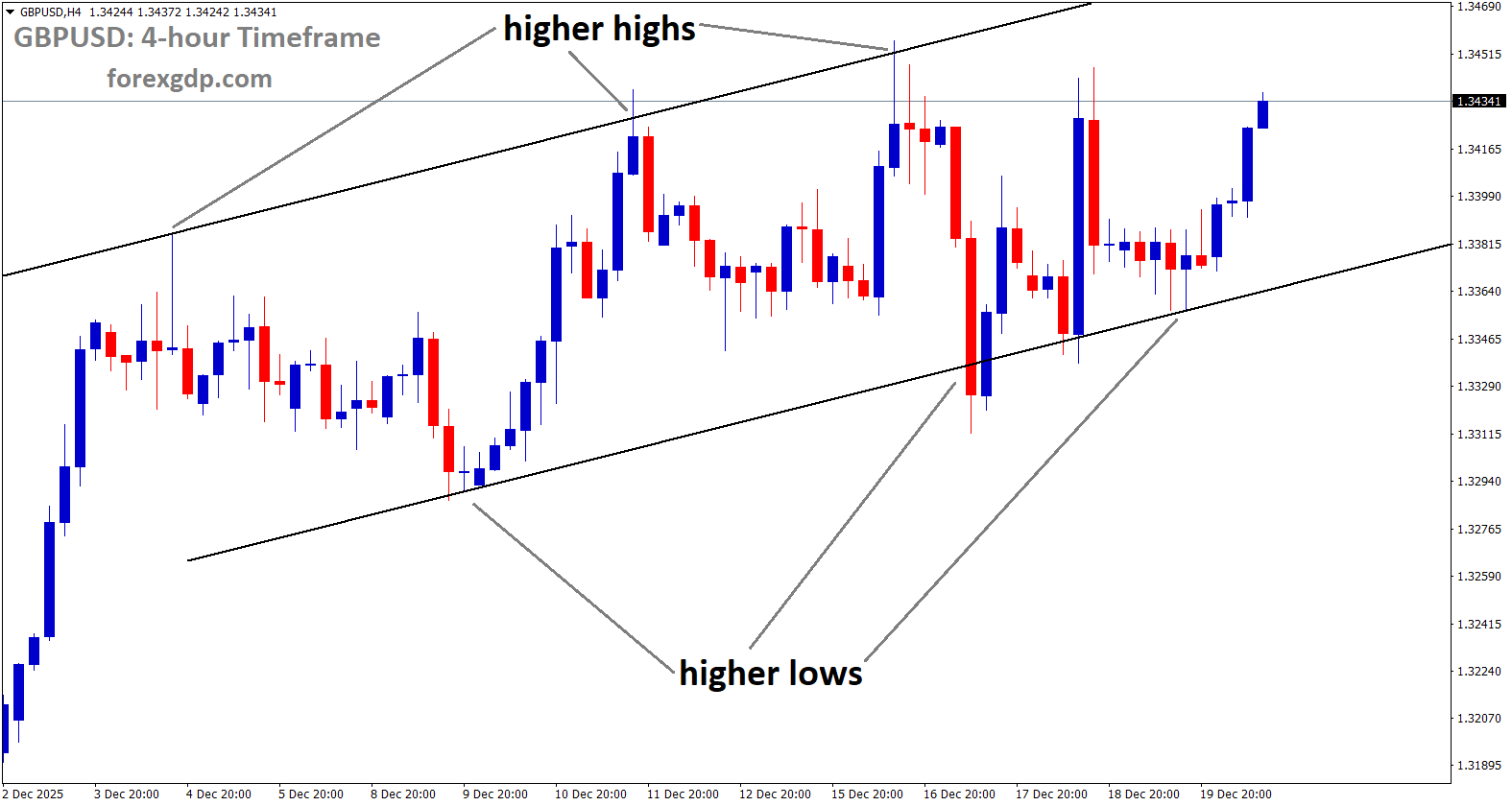
GBPUSD is moving in an uptrend channel
This move reflects more than just one data release. It highlights how investors are weighing economic growth, inflation trends, and future interest rate decisions on both sides of the Atlantic.
UK Economic Growth Offers Short-Term Relief
New figures from the UK’s Office for National Statistics confirmed that the economy grew modestly in the third quarter of the year. The updated data matched earlier estimates, showing that output expanded slightly compared with the previous quarter. On a yearly basis, the economy also continued to grow at a steady pace.
For the Pound, this confirmation mattered. It removed uncertainty around whether earlier growth readings might be revised lower. Investors often react positively when data confirms stability, especially during periods when economic momentum feels fragile.
That said, the relief may not last long. Many market participants are already looking beyond the third quarter and focusing on how the economy is performing right now. Growth earlier in the year does not automatically guarantee strength in the months ahead, especially as households and businesses continue to feel pressure from higher borrowing costs and tight financial conditions.
Concerns About the Final Quarter of the Year
Despite the positive tone from the latest GDP update, concerns remain about the UK’s economic outlook in the final quarter. Recent monthly figures showed an unexpected contraction in output, raising questions about whether the economy is losing momentum again.
The Bank of England has also acknowledged these risks. In its latest policy communication, the central bank suggested that economic growth could stall in the current quarter. This cautious assessment came alongside a narrow decision to reduce interest rates slightly, reflecting a balance between supporting growth and keeping inflation under control.
For currency markets, this creates a mixed picture. On one hand, confirmed growth earlier in the year supports confidence in the UK economy. On the other hand, expectations of weak or flat growth ahead may limit how far the Pound can rise without stronger evidence of improvement.
Bank of England Policy Remains the Key Driver
Looking ahead, expectations around the Bank of England’s next moves are likely to play a central role in shaping the Pound’s direction. With few major UK data releases scheduled in the near term, investors are focusing on signals from policymakers.
The central bank has made it clear that it expects interest rates to trend lower gradually rather than fall sharply. This approach suggests caution and a desire to avoid reigniting inflation while still providing some support to the economy over time.
For the Pound, a slow and measured path of rate cuts can be supportive compared with more aggressive easing elsewhere. Currency values often respond not just to the level of rates, but to how quickly they are expected to change relative to other countries.
Pound Performs Better as Dollar Faces Uncertainty
The Pound also benefited from a softer tone in the US Dollar ahead of important economic data from the United States. Investors turned more cautious as they waited for updated growth figures, which are expected to show a slowdown compared with earlier in the year.
When traders sense that US growth may be losing pace, they often reassess expectations around future policy decisions by the Federal Reserve. This can reduce demand for the Dollar, especially if other economies appear relatively stable by comparison.
In this environment, the Pound found some breathing room, supported by the combination of confirmed UK growth and a pause in Dollar strength.
US Growth Data Under the Spotlight
The upcoming US growth report is seen as an important checkpoint for the world’s largest economy. While growth remains solid by historical standards, expectations point to a moderation from the strong pace seen earlier in the year.
Any clear sign of slowing could influence how investors think about interest rates in the months ahead. Slower growth may reduce pressure on the Federal Reserve to keep policy tight for longer, even if inflation has not fully returned to target levels.
However, expectations for near-term rate cuts in the US remain limited. Market participants appear cautious about betting on aggressive easing until there is clearer evidence that inflation risks have faded and growth is cooling in a sustainable way.
Inflation Trends and Federal Reserve Signals
Recent US inflation data showed that price pressures eased slightly, offering some comfort to policymakers. Both headline and underlying measures pointed to a gradual slowdown rather than a sharp drop, suggesting that inflation is moving in the right direction but is not yet fully under control.
Against this backdrop, comments from Federal Reserve officials have taken on added importance. Over the weekend, a senior regional central bank president argued against cutting interest rates too soon. She suggested that rates should remain unchanged for now, at least until there is more clarity in the data.
She also noted that recent inflation figures may have been affected by temporary factors, making it harder to draw firm conclusions. Such remarks reinforce the idea that the Federal Reserve is in no rush to ease policy, even if inflation shows signs of cooling.
What This Means for the Pound Going Forward
For the Pound, the balance of risks remains finely tuned. Short-term support has come from confirmed economic growth and relative calm around UK policy expectations. At the same time, uncertainty about the final months of the year and the broader global outlook could limit upside momentum.
Much will depend on how incoming data shapes expectations on both sides of the Atlantic. If UK growth stabilizes and inflation continues to ease without a sharp downturn, the Pound could remain relatively resilient. Conversely, signs of renewed weakness may bring pressure back into focus.
Global factors also matter. Shifts in US growth, inflation, and Federal Reserve communication can quickly change the tone in currency markets, influencing how investors view alternatives like the Pound.
Final Summary
The Pound has found support following confirmation that the UK economy grew modestly in the third quarter, easing immediate fears of a downturn. However, concerns about weak growth toward the end of the year remain, keeping investors cautious.
At the same time, uncertainty around US economic data and firm messages from Federal Reserve officials have weighed on the Dollar, allowing the Pound to perform better in comparison. With few major UK data releases ahead, attention is likely to stay focused on central bank signals and global economic trends.
In the weeks ahead, the Pound’s direction will depend on whether growth can hold steady and how policymakers respond to evolving inflation and economic conditions at home and abroad.
USDJPY slips as investors seek safety and Japan hints at action to defend the yen
The Japanese Yen (JPY) opened the new week with a firmer tone, supported by a mix of global and domestic factors that tend to pull money toward safer assets. Early Monday, the Yen stayed on the front foot in European trading, helped by rising geopolitical tension and fresh talk that Japan could step in if the currency weakens too quickly.
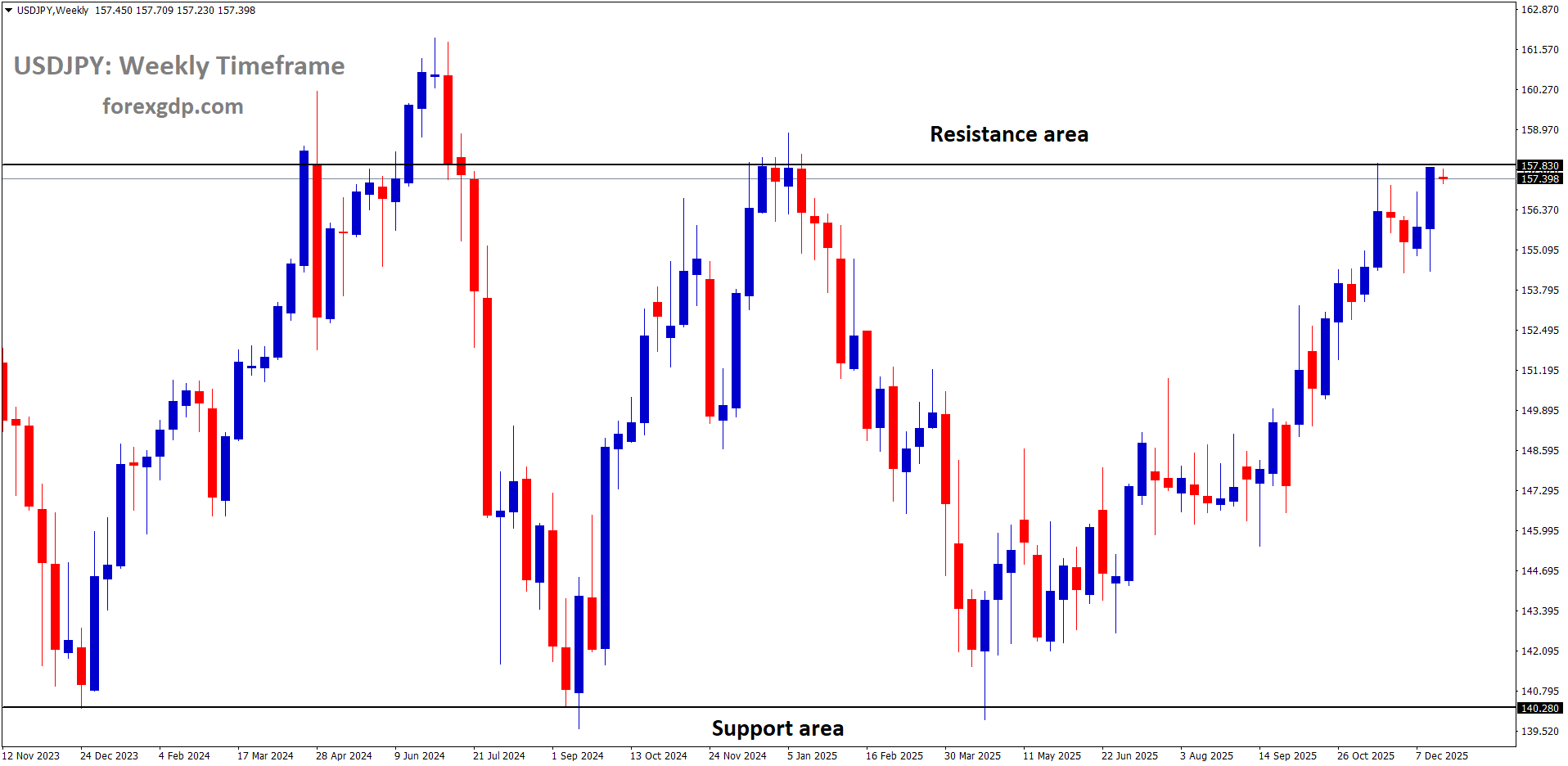
USDJPY is moving in a box pattern, and the market has reached the resistance area of the pattern
At the same time, the move is not a straight line. Japan’s own financial worries are acting like a brake, while the US Dollar (USD) is also shifting as traders weigh what the Federal Reserve might do next. Put together, it explains why the Yen is gaining, but not racing higher.
Safe-haven demand returns and supports the Yen
When investors feel nervous, they often look for “safe-haven” assets—places to park money when the world feels uncertain. The Yen is one of the currencies that can benefit from that kind of mood, and several headlines are feeding that demand right now.
Tensions have risen between the United States and Venezuela after the US intercepted a Venezuelan oil tanker over the weekend and reportedly pursued another, following an order from President Donald Trump aimed at blocking sanctioned tankers moving in and out of Venezuela. That kind of action can unsettle energy markets and raise broader risk concerns.
Elsewhere, worries in the Middle East are also back in focus. Reports said Israel’s leadership is concerned Iran may be rebuilding nuclear enrichment sites and is preparing to brief Trump on possible options related to Iran’s missile program. Even the hint of escalating conflict in the region is often enough to lift demand for defensive assets, including the Yen.
Meanwhile, the long-running Russia-Ukraine war continues to add uncertainty. A top foreign policy aide to Russian President Vladimir Putin reportedly said changes proposed by European parties and Ukraine did not improve the outlook for peace. When hopes for a near-term breakthrough fade, markets tend to stay cautious—another reason the Yen can hold support.
Intervention talk adds another layer of strength
Beyond global tensions, the Yen also drew attention because of renewed intervention chatter in Japan.
Japan’s Vice Finance Minister for International Affairs and top foreign exchange official, Atsushi Mimura, said he is concerned about one-way moves in the currency and warned that “appropriate action” could be taken against an excessive decline in the Yen. Comments like this matter because Japan has a history of stepping in when currency moves become too fast or too one-sided.
Why intervention warnings matter
When investors think authorities might intervene, it can change behavior quickly. Traders become less willing to push the Yen weaker if there is a risk of sudden official action. Even if nothing happens immediately, the warning alone can slow momentum and create a supportive backdrop for the currency.
The Bank of Japan keeps tightening on the table

Japan’s central bank is also part of the story. The Bank of Japan (BoJ) raised its policy rate to 0.75% at the end of its December meeting, a level not seen in roughly 30 years. The BoJ also repeated that it is prepared to keep raising rates if the economy and prices develop as expected.
That matters because, for years, Japan stood out as the major economy with ultra-low rates. As the BoJ moves away from that stance, the Yen can become more attractive, especially if investors believe the rate path could continue upward.
In his press conference, BoJ Governor Kazuo Ueda emphasized that policymakers will closely watch the impact of the latest rate change. He also suggested the pace of future adjustments will depend on how the economy, inflation, and financial conditions evolve. However, Ueda did not give a clear timeline for the next move, which is one reason the Yen’s gains have looked steady rather than explosive.
What the market is listening for next
Investors are trying to judge whether the BoJ is committed to a slow, cautious path—or whether it could tighten faster if inflation stays firm. Without clear signals on timing, the Yen can strengthen on the general direction of policy, but still lack the strong conviction that comes from more specific guidance.
Japan’s fiscal concerns could limit how far the Yen climbs
Even with safe-haven demand and a central bank that is no longer fully “easy,” the Yen has its own headwinds.
One major issue is Japan’s fiscal outlook. Rising Japanese government bond (JGB) yields have drawn attention to the country’s debt and funding pressures. On top of that, concerns have grown around plans that involve more government spending, adding to the debate about how sustainable Japan’s financial position is over the long run.
When bond yields rise sharply, it can send mixed signals. On one hand, higher yields can support a currency. On the other, if yields jump because investors are worried about fiscal health, it can undermine confidence and cap gains. This balancing act is one reason the Yen may struggle to extend rallies too far without a clear shift in the domestic narrative.
Why USD/JPY is softer, but not collapsing
The US Dollar has edged lower, and that is helping keep USD/JPY under pressure. A softer Dollar makes it easier for the Yen to rise in the pair, especially when combined with risk-off headlines and intervention talk.
Still, the downside for USD/JPY may be limited in the near term because the Dollar has its own support from Federal Reserve messaging. Influential Fed officials have recently sounded cautious about moving too quickly. For example, Cleveland Fed President Beth Hammack said policy is in a good place to pause and assess the impact of previous rate cuts on the economy during the first quarter.
This kind of commentary can steady the Dollar because it suggests the Fed may not be in a rush to cut again. At the same time, traders are still pricing in a chance of additional US rate cuts in 2026, which can prevent the Dollar from building too much momentum.
Key data can shift the balance
Market attention is also turning to upcoming US economic data, including delayed third-quarter GDP figures expected later in the week. If the numbers surprise in either direction, expectations around Fed policy could change—and the Dollar can react quickly.
What this mix of forces means for the Yen this week
Right now, the Yen is being pulled by two strong themes:
-
Supportive forces: global uncertainty, safe-haven demand, and the risk that Japanese officials intervene if the Yen weakens too sharply.
-
Limiting forces: worries about Japan’s fiscal condition and a US Dollar that still has support from cautious Fed voices.
That combination can keep the Yen bid while also encouraging traders to stay careful. In other words, the Yen can remain firm, but headlines—especially geopolitical ones—are likely to play an outsized role in day-to-day moves.
Final summary
The Japanese Yen is starting the week stronger as investors respond to rising geopolitical tensions and renewed demand for safer assets. Comments from Japan’s top foreign exchange official have also increased speculation that authorities may act against excessive Yen weakness, adding support. Meanwhile, the Bank of Japan’s recent rate hike and its willingness to tighten further provide a helpful backdrop, even if the timing of future moves remains unclear. On the other side, concerns about Japan’s fiscal health and a US Dollar supported by cautious Federal Reserve messaging may limit how far the Yen can run in the near term.