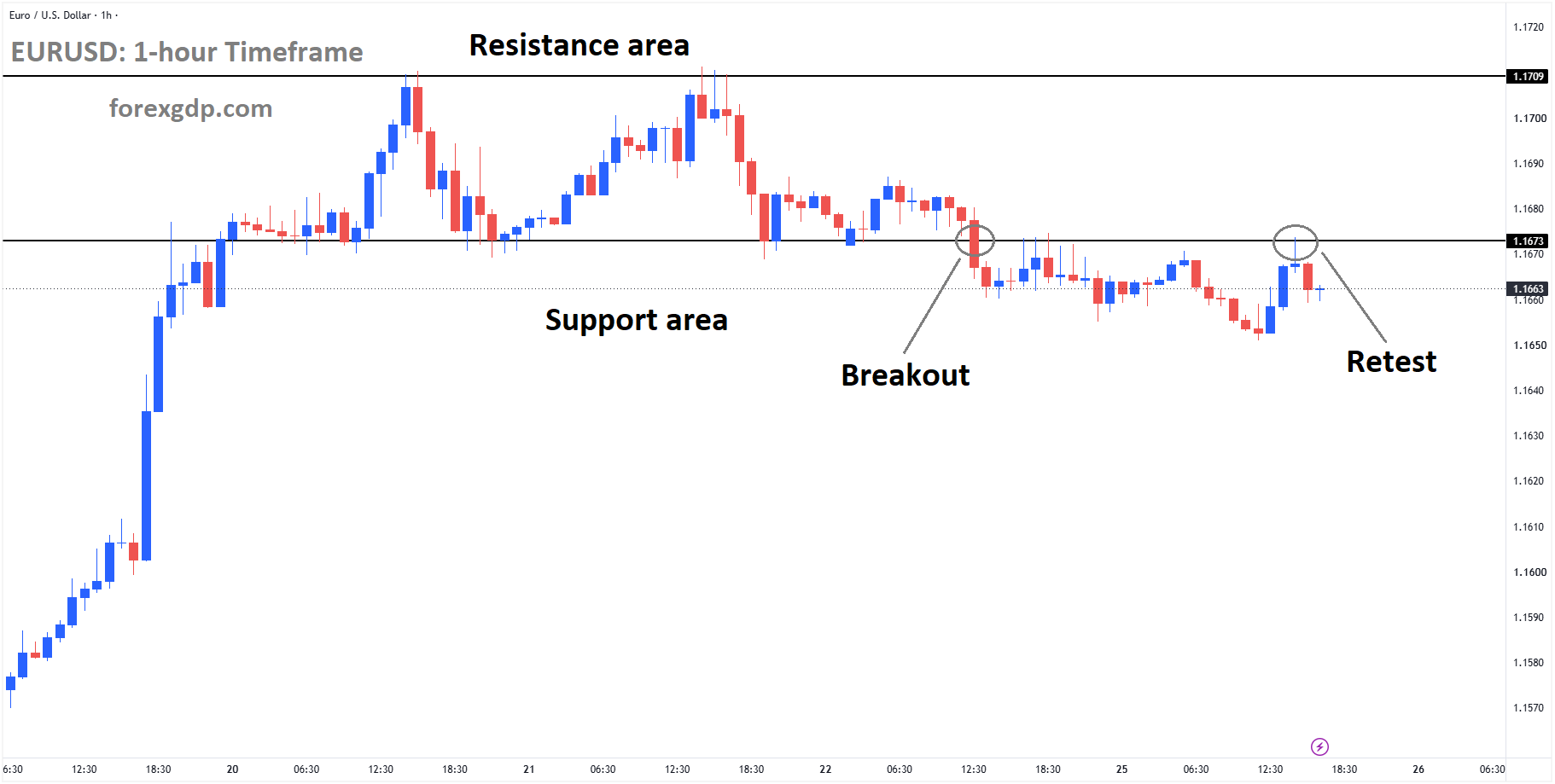
EURUSD reached the retest area of the broken box pattern
EURUSD Stays Resilient Following Positive German Growth Updates
The Euro remained largely stable against the US Dollar on Tuesday as traders responded to encouraging economic figures from Germany. Although the latest data offered some support to the European currency, investors showed little interest in making aggressive moves before several important events in the United States.
German business confidence improved more than expected, while the country’s economic growth figures were revised higher. These developments helped reduce some concerns about the health of Europe’s largest economy. However, the overall market mood remained cautious because traders were waiting for fresh US inflation data and comments from Federal Reserve Chairman Kevin Warsh at the Jackson Hole Symposium.
The US Dollar also struggled to attract strong demand. Questions surrounding the Federal Reserve’s independence and uncertainty connected to the US Treasury’s bond buyback plans continued to influence investor confidence. With several major events approaching, neither Euro buyers nor Dollar buyers appeared ready to take firm control.
EURUSD Traders Remain Cautious Before Major US Events
EURUSD showed limited movement as investors avoided placing large directional bets. This kind of hesitation is common when markets are waiting for information that could reshape expectations about interest rates and economic policy.
The upcoming US Personal Consumption Expenditures Price Index is one of the main events attracting attention. The PCE Price Index is closely watched because the Federal Reserve uses it as an important measure of inflation. A stronger-than-expected reading could reduce hopes for easier monetary policy, while a softer result might strengthen expectations that the central bank will take a more supportive approach.
Until the inflation report is released, many traders may prefer to remain on the sidelines. Opening large positions before such an important announcement can carry additional risk because the market may react quickly once the data becomes available.
The Jackson Hole Symposium is another major focus. Central bankers, economists, and policymakers often use this annual gathering to discuss the economic outlook and future policy direction. Comments made during the event can influence currencies, bonds, and global investor sentiment.
German Business Confidence Shows Encouraging Progress
The latest German IFO Business Climate Index delivered a welcome improvement in August. Business confidence climbed to its strongest level in about a year and exceeded economists’ expectations.
This improvement suggests that German companies are becoming less negative about the economy. That does not mean every problem has disappeared, but it offers some hope after a long period of weak growth and uncertainty.
Companies also reported a better view of their current business conditions. This part of the survey helps investors understand how firms are performing now rather than how they expect to perform in the future. A stronger reading may indicate that businesses are facing fewer immediate difficulties than they experienced during the previous month.
Expectations for the coming months also improved noticeably. This is important because business decisions are often influenced by confidence. When companies feel more positive about future demand, they may become more willing to invest, hire employees, or expand their operations.
However, confidence surveys can change quickly. Businesses still face challenges such as uncertain global demand, high operating costs, and changing financial conditions. The latest figures are encouraging, but they do not guarantee a smooth economic recovery.
German Economic Growth Receives an Upward Revision
Germany’s Gross Domestic Product data provided another positive development for the Euro. Official figures showed that the economy expanded more strongly during the second quarter than initially estimated.
The updated result also matched the growth recorded during the first quarter. This suggests that the German economy maintained some momentum rather than losing strength as the year progressed.
Annual growth was also revised higher. Compared with the same period a year earlier, the economy performed better than preliminary calculations had suggested. The annual improvement was considerably stronger than the expansion recorded in the first quarter.
For the Eurozone, better German growth matters because Germany remains its largest economy. Changes in German manufacturing, household spending, exports, and business investment can affect the wider region. When Germany performs better, it can improve confidence across the currency bloc.
Still, one stronger revision cannot erase all economic concerns. Germany has struggled with weak industrial activity, changing energy conditions, and softer international demand. The latest numbers offer relief, but investors will need more consistent evidence before believing that a lasting recovery has begun.
A Softer US Dollar Offers Support to the Euro
The Euro also benefited from weakness in the US Dollar. The American currency remained under pressure as investors continued to assess questions surrounding the Federal Reserve and the US Treasury’s recent decisions.
Concerns about the Federal Reserve’s independence can create uncertainty because markets value clear and credible monetary policy. Investors generally want confidence that interest-rate decisions will be based on inflation, employment, and broader economic conditions rather than outside pressure.
The US Treasury’s bond buyback plans have added another layer of uncertainty. Bond market developments can affect government borrowing conditions, investor demand, and expectations for the Dollar. When policy announcements create unanswered questions, traders may become more cautious about holding the currency.
Even so, Dollar weakness may not continue without interruption. The upcoming inflation report and the Federal Reserve chairman’s remarks could quickly change market expectations. If the new information supports a tighter policy outlook, demand for the Dollar could recover. If it points toward softer policy, the Euro may receive further support.
Low Volatility Reflects a Market Waiting for Direction
The quiet movement in EURUSD does not mean that traders have lost interest. Instead, it shows that the market is waiting for stronger information before choosing a direction.
Low volatility often develops ahead of major economic releases and central bank speeches. Investors may reduce their positions, protect existing trades, or delay new decisions until the uncertainty becomes clearer. As a result, currency movement can become limited even when several important themes remain active.
The current balance is shaped by two competing forces. Positive German data is helping the Euro, while uncertainty surrounding US policy is weighing on the Dollar. At the same time, the possibility of new guidance from the Federal Reserve is preventing traders from becoming too confident.
This cautious environment may continue until the US inflation figures and Jackson Hole remarks provide a clearer view of future monetary policy.
What Investors May Watch Next
Investors will pay close attention to whether the latest improvement in German data continues in future reports. Stronger business confidence is helpful, but it must eventually lead to better investment, production, employment, and consumer activity.
The US inflation outlook will be equally important. Persistent inflation could encourage the Federal Reserve to maintain a firm policy stance, while weaker inflation may create more room for policy support.
Traders will also listen carefully to Kevin Warsh’s comments for any guidance about inflation risks, economic growth, and the direction of interest rates. Even small changes in language could influence expectations and increase activity in EURUSD.
Final Summary
EURUSD remained steady as encouraging German business confidence and stronger economic growth figures supported the Euro. The softer US Dollar also helped, with uncertainty surrounding Federal Reserve independence and Treasury policy affecting sentiment.
Despite these factors, investors avoided making large commitments. The upcoming US PCE inflation report and Kevin Warsh’s Jackson Hole speech may provide the market with clearer direction. Until then, cautious trading and limited movement are likely to remain the dominant themes.
GBPUSD Stays Strong While Markets Await Crucial US Updates
The British Pound remained largely unchanged against the US Dollar as investors avoided making major decisions ahead of important economic events in the United States. Currency market activity stayed unusually quiet, reflecting a cautious mood among traders who are waiting for clearer information about inflation and future interest-rate policy.
GBPUSD reached the resistance area of the box pattern
GBPUSD has shown resilience in recent sessions, supported by improving demand for the British currency and a softer outlook for the US Dollar. However, the pair has struggled to build strong momentum because many investors prefer to remain on the sidelines before the release of the US Personal Consumption Expenditures Price Index and the Jackson Hole central banking summit.
Both events could shape expectations for Federal Reserve policy. Until investors receive fresh guidance, the Pound and the Dollar may continue to move within a limited range.
GBPUSD Trading Activity Remains Quiet
The British Pound traded almost flat against the US Dollar for a second consecutive session. This lack of movement does not necessarily suggest weakness in Sterling. Instead, it reflects the broader hesitation seen across the foreign exchange market.
Investors rarely take large positions before important economic announcements. Unexpected inflation figures or changes in central bank language can quickly alter the direction of currency markets. As a result, many traders are reducing their exposure and waiting for stronger confirmation before making new decisions.
The absence of major economic releases has also contributed to subdued market activity. Without fresh information from the United Kingdom or the United States, there has been little reason for investors to push GBPUSD decisively in either direction.
US Inflation Data Takes Centre Stage
The upcoming US Personal Consumption Expenditures Price Index is one of the most closely watched events of the week. The Federal Reserve pays particular attention to this report when evaluating inflation trends and deciding whether monetary policy needs to remain restrictive.
Economists expect US inflation to remain persistent. If the data shows that price pressures are still strong, policymakers who favour tighter monetary conditions may gain further support. Such an outcome could strengthen expectations that interest rates will stay elevated for longer.
Higher interest rates usually make a currency more attractive because investors can seek better returns from assets issued in that country. Therefore, stronger inflation data could offer temporary support to the US Dollar. However, the market reaction would also depend on how much of that outcome investors have already anticipated.
On the other hand, softer inflation figures could reduce concerns about continued monetary tightening. That may weaken demand for the Dollar and improve the outlook for currencies such as the British Pound.
Jackson Hole Could Shape Market Expectations
Although the inflation report is important, the Jackson Hole Symposium may become the week’s main event. The annual gathering brings together central bankers, economists, financial experts, and policymakers to discuss the global economy and the challenges facing monetary authorities.
Investors will closely follow the Federal Reserve Chair’s speech for guidance about the central bank’s next steps. Markets want to know whether policymakers remain focused on controlling inflation or are becoming more concerned about economic growth and employment.
Even a small change in tone could influence the Dollar. A firm message about inflation could encourage expectations of tighter policy, while a more cautious approach could raise hopes for easier financial conditions.
Questions surrounding the Federal Reserve’s independence may also attract attention. Investors generally want central banks to make policy decisions based on economic evidence rather than political pressure. Any uncertainty about that independence could affect confidence in US assets and create additional volatility for the Dollar.
US Dollar Positioning Has Changed
Analysts at TD Securities have highlighted an important change in market sentiment toward the US Dollar. According to their assessment, investor positioning has moved from favouring the Dollar to betting against it.
This shift suggests that more traders now expect the US currency to weaken. It also indicates that the recent decline in Dollar demand is not limited to one or two currency pairs. Instead, it appears to be part of a broader change in investor expectations.
Several factors may be contributing to this development. Concerns about the US economic outlook, expectations surrounding future Federal Reserve decisions, and renewed questions about central bank independence have all influenced sentiment.
However, short positioning can also create sudden market movements. If US economic data surprises positively or the Federal Reserve delivers a more restrictive message than expected, traders holding negative Dollar positions may rush to close them. This could lead to a rapid but possibly temporary recovery in the currency.
The British Pound Maintains a Positive Outlook
The Pound has remained relatively firm despite the quiet trading environment. Its recent performance suggests that investors are not rushing to sell the British currency, even as uncertainty continues to limit fresh buying activity.
UOB Group strategists have maintained a positive outlook for Sterling over the coming weeks. Their view reflects expectations that the British Pound may continue to benefit if the US Dollar remains under broad selling pressure.
Confidence in Sterling also depends on developments within the UK economy. Inflation, wage growth, consumer spending, and Bank of England policy expectations can all influence demand for the currency. If British economic data remains stable while US economic uncertainty grows, GBPUSD may continue to attract investor interest.
Still, the Pound is not protected from risk. Weak UK data or a more cautious message from the Bank of England could quickly reduce its appeal. Global risk sentiment may also play a role, especially if financial markets become nervous about economic growth or geopolitical developments.
Why Investors Are Taking a Wait-and-See Approach
The current market mood is shaped by uncertainty rather than a lack of interest. Traders know that inflation figures and central bank comments can produce sudden changes in expectations, so many are choosing patience over aggressive positioning.
This cautious behaviour explains why currency volatility has remained low. Investors are waiting for answers to several important questions. Is US inflation still too high? Will the Federal Reserve keep monetary conditions tight? Can the British Pound maintain its recent strength? The upcoming events may provide greater clarity.
Until then, GBPUSD could remain calm as traders balance Sterling’s positive tone against the possibility of renewed Dollar demand.
Final Summary
GBPUSD remains steady as investors wait for major US inflation data and the Jackson Hole central banking summit. Quiet market conditions reflect caution, with traders reluctant to take large positions before receiving clearer guidance on Federal Reserve policy.
The US Dollar has faced broader selling interest, and market positioning has shifted toward a more negative outlook for the currency. Meanwhile, the British Pound continues to show resilience, supported by expectations that it could strengthen further if Dollar weakness continues.
The next direction for GBPUSD will largely depend on the US inflation report and the Federal Reserve’s message at Jackson Hole. These developments could determine whether investors continue reducing their Dollar exposure or return to the US currency.
USDJPY Moves Higher as Global Conflict Concerns Weaken the Yen
The Japanese Yen continues to face selling pressure as investors become increasingly concerned about Japan’s financial condition. The country already carries a substantial public debt burden, and the cost of managing that debt may rise as long-term borrowing costs increase. This situation makes it harder for policymakers to support economic growth without creating fresh financial risks.
Calls for greater government spending have added another layer of uncertainty. Expansionary fiscal policies may help households and businesses in the short term, but they can also increase public borrowing. Investors are therefore questioning whether Japan can continue stimulating its economy while keeping its debt under control.
These concerns have weakened the Yen’s traditional role as a safe-haven currency. During uncertain periods, traders often turn to the Japanese currency for protection. However, doubts about Japan’s fiscal outlook are making that response less reliable. Even when global risk sentiment worsens, the Yen may struggle to attract lasting demand.
Interest-Rate Differences Encourage Carry Trades
The wide interest-rate gap between Japan and other major economies remains one of the biggest challenges facing the Yen. Japanese borrowing costs are still relatively low, while rates in several other countries remain considerably higher. This difference encourages investors to borrow money in Yen and use it to purchase assets that may provide better returns elsewhere.
This strategy is commonly known as a carry trade. It can remain attractive while global markets are stable and investors feel comfortable taking risks. As more traders use the Yen to fund these positions, selling pressure on the Japanese currency can increase.
The Bank of Japan faces a difficult decision. Raising rates more quickly could support the Yen, but aggressive tightening could also harm economic activity and increase the government’s debt-servicing costs. Keeping policy loose may protect growth, yet it also allows the interest-rate gap to remain wide.
Unless the difference between Japanese rates and overseas rates narrows meaningfully, carry-trade demand may continue to limit the Yen’s recovery. This creates a long-term obstacle even when short-term events temporarily improve demand for the currency.
Energy Dependence Creates Another Risk for Japan
Japan relies heavily on imported energy, making the economy vulnerable to disruptions in global oil and gas supplies. Rising tensions in the Middle East have increased worries about transport routes, production and the reliable movement of energy supplies.
The Strait of Hormuz is particularly important because a significant amount of the world’s oil passes through this route. Any interruption could push import costs higher and place additional pressure on countries that depend on foreign energy. Japan is among the economies most exposed to this risk.
More expensive energy imports could weaken Japan’s trade balance because the country would need to spend more on essential supplies. Businesses may also face higher operating costs, while households could experience increased utility and transport expenses. These pressures could reduce consumer spending and slow economic growth.
Higher import costs may also complicate the Bank of Japan’s policy decisions. Inflation caused by expensive energy is different from inflation driven by strong domestic demand. Raising interest rates may not resolve supply-related pressures, but ignoring rising costs could damage public confidence.
Currency Intervention Has Offered Limited Relief
The United States and Japan previously coordinated action in the foreign exchange market to address excessive currency movements. Such intervention can slow rapid Yen weakness by demonstrating that officials are prepared to act when trading becomes disorderly.
However, direct intervention may have only a temporary impact if the economic forces behind the currency’s weakness remain unchanged. Japan’s low interest rates, fiscal concerns and reliance on imported energy continue to influence investor behaviour. Without improvement in these areas, official action alone may struggle to produce a lasting Yen recovery.
Still, the possibility of another intervention cannot be ignored. Japanese authorities have shown that they are willing to respond when currency movements become too sharp. This risk may discourage traders from building overly aggressive positions against the Yen, especially when government warnings become stronger.
As a result, USDJPY is being pulled in two directions. Fundamental pressures continue to hurt the Yen, but intervention concerns prevent traders from selling it without caution.
Iran Tensions Increase Demand for the US Dollar
Geopolitical uncertainty is providing some support to the US Dollar. The United States has announced a fresh campaign intended to isolate Iran from the global economy. Countries that continue conducting business with Tehran may face American sanctions, raising the risk of wider economic disruption.
Iranian officials have responded with warnings about possible restrictions on oil exports through the Strait of Hormuz and other parts of the Persian Gulf. Such statements have increased fears about global energy supplies and the possibility of a broader regional confrontation.
During periods of political and economic uncertainty, investors often seek currencies associated with deep and liquid financial markets. The US Dollar frequently benefits from this behaviour. As long as tensions remain elevated, safe-haven demand may continue to offer the currency some support.
However, geopolitical developments can change quickly. Diplomatic progress could reduce demand for defensive assets, while further escalation could strengthen it. Traders must therefore remain alert to official statements and developments across the region.
Federal Reserve Uncertainty Limits Dollar Strength
Although global tensions are supporting the US Dollar, uncertainty surrounding Federal Reserve policy is preventing stronger and more consistent demand. Volatile oil costs could increase inflation, keeping the possibility of additional monetary tightening alive. Even so, investors are becoming less confident that policymakers will raise interest rates immediately.
The Federal Reserve must balance inflation risks against the health of the wider economy. Higher borrowing costs can slow demand, reduce business investment and place greater pressure on consumers. If economic activity begins to weaken, policymakers may hesitate to tighten monetary policy further.
Concerns about US public finances are also affecting confidence in the Dollar. Large government borrowing requirements can raise questions about long-term debt sustainability. The Dollar still benefits from its central role in global finance, but fiscal worries may prevent investors from becoming overly optimistic.
This mixed policy outlook is one reason USDJPY lacks a decisive direction. The Yen remains vulnerable, yet the Dollar is not receiving enough support to advance without interruption.
US Inflation Data and Federal Reserve Guidance Take Focus
Investors are now watching the US Personal Consumption Expenditures Price Index, an inflation measure closely followed by the Federal Reserve. The report may help markets understand whether inflationary pressure is easing or becoming more persistent.
Attention will then turn to Federal Reserve Chair Kevin Warsh’s speech at the Jackson Hole Symposium. Traders will listen carefully for comments about inflation, economic growth and the future direction of interest rates.
A firm stance on inflation could strengthen expectations that US borrowing costs will remain elevated. A more cautious message, however, may reduce demand for the Dollar. Together, the inflation report and central bank guidance could shape the next major move in USDJPY.
Final Summary
USDJPY remains supported by Japan’s fiscal challenges, its low interest rates and the continued popularity of Yen-funded carry trades. Japan’s dependence on imported energy also makes the economy vulnerable to Middle East supply disruptions and rising costs.
Geopolitical tensions involving Iran are helping the US Dollar, but uncertainty about Federal Reserve policy and concerns over American public finances are limiting its strength. Meanwhile, the risk of further currency intervention discourages excessive Yen selling.
Upcoming US inflation data and Federal Reserve guidance may provide greater clarity. Until then, USDJPY is likely to remain influenced by the struggle between long-term Yen weakness, cautious Dollar demand and the possibility of official action.
USDCAD Climbs as Trade Disputes Weaken the Canadian Dollar
The USDCAD currency pair continues to attract buying interest for a second consecutive day. However, the upward momentum remains limited because several economic and political forces are pulling the pair in different directions.
USDCAD has broken the descending channel to the upside
The US Dollar is benefiting from expectations that the Federal Reserve may keep interest rates higher for longer. Rising energy costs have renewed concerns about inflation, while growing geopolitical uncertainty has increased demand for safe-haven assets. These conditions are helping the Greenback recover after a period of weakness.
At the same time, higher crude oil prices would normally support the Canadian Dollar because Canada is a major energy exporter. However, concerns about a worsening trade dispute between the United States and Canada are limiting the Loonie’s ability to benefit from stronger oil demand. As a result, the market remains cautious despite the positive tone surrounding USDCAD.
Inflation Concerns Keep Federal Reserve Expectations Alive
Volatile energy prices have brought inflation risks back into focus. When oil and other energy costs rise sharply, transportation, manufacturing, and household expenses often increase as well. Businesses may pass these higher costs on to consumers, making it harder for inflation to return to comfortable levels.
This situation has encouraged investors to keep the possibility of another Federal Reserve interest rate increase on the table. Even if the central bank does not act immediately, the expectation of tighter monetary policy can strengthen the US Dollar. Higher interest rates generally make US-based assets more attractive to international investors.
However, traders are not showing complete confidence in this outlook. The Federal Reserve will still need to examine upcoming inflation, employment, and consumer spending data before deciding its next move. Policymakers must balance the need to control inflation against the risk of slowing economic activity too much.
This uncertainty explains why the US Dollar is receiving support without experiencing a powerful rise. Investors appear willing to hold the currency during uncertain conditions, but many are waiting for clearer guidance before making larger commitments.
Geopolitical Risks Increase Safe-Haven Demand
Escalating tensions between the United States and Iran have added another layer of uncertainty to global markets. The US government has announced a campaign intended to isolate Iran from the international economy. It has also warned that countries continuing to conduct business with Iran could face American sanctions.
Iranian officials have responded with warnings related to oil exports through the Strait of Hormuz. This waterway is one of the most important routes for global energy transportation. Any disruption to shipping in the area could reduce oil supplies and create serious challenges for energy markets.
The possibility of supply interruptions has helped crude oil prices remain supported. It has also increased demand for the US Dollar, which investors often view as a safer place to hold money during periods of political or economic stress.
This creates an unusual situation for USDCAD. Higher oil prices can benefit the Canadian economy and strengthen the Canadian Dollar. Yet the same geopolitical tension driving oil higher is also increasing demand for the Greenback. These competing effects are preventing either currency from gaining a decisive advantage.
US-Canada Trade Dispute Weighs on the Canadian Dollar
While stronger oil prices offer some assistance to the Canadian Dollar, growing trade tensions with the United States are creating a much larger concern. Trade negotiations between the two countries collapsed shortly before an expected agreement, damaging the positive mood that had recently supported the Loonie.
The United States then introduced heavy tariffs on billions of dollars’ worth of Canadian products. Canada responded by announcing plans to impose retaliatory duties on American goods. The Canadian government has indicated that its measures will match the value of the US tariffs.
A prolonged tariff dispute could hurt businesses on both sides of the border. Canada may be especially vulnerable because the United States is its largest trading partner. Many Canadian industries rely heavily on access to American customers, suppliers, and transportation networks.
Tariffs raise the cost of imported goods and can make exported products less competitive. Companies facing higher expenses may delay investment, reduce hiring, or increase consumer prices. This could weaken business confidence and slow economic growth.
Canadian authorities have also suggested that additional domestic financial support may be introduced. Although such assistance could help affected companies and workers, the need for government aid highlights the seriousness of the situation. It also raises questions about public spending and the long-term impact of the trade conflict.
Oil Strength Offers Only Limited Help to the Loonie
The Canadian Dollar is closely connected to developments in the energy market because oil is one of Canada’s leading exports. Stronger crude oil demand can increase export revenue, improve Canada’s trade position, and encourage foreign investment in the country’s energy sector.
Under normal conditions, this would provide meaningful support for the Loonie. The present environment, however, is far from normal. Trade uncertainty is overshadowing the benefits created by higher oil prices.
Businesses cannot easily make long-term plans when tariff policies may change without warning. Energy companies may receive more revenue from stronger oil demand, but manufacturers, agricultural producers, and exporters could face serious difficulties if access to the US market becomes more expensive.
Therefore, oil strength is helping prevent deeper weakness in the Canadian Dollar, but it is not strong enough to remove the pressure created by the trade dispute.
Investors Await Fresh Signals From the Federal Reserve
The broader economic environment currently favors modest USDCAD strength, but traders remain reluctant to make aggressive decisions. Much will depend on upcoming information about inflation and the Federal Reserve’s future policy direction.
The Personal Consumption Expenditures Price Index will receive close attention because it is the Federal Reserve’s preferred measure of inflation. The report may show whether price pressures are becoming more persistent or beginning to ease.
Investors will also listen carefully to the Federal Reserve Chair’s address at the annual Jackson Hole Symposium. Any comments about inflation, economic growth, employment, or interest rates could influence expectations for future monetary policy.
A firm message against inflation may support the US Dollar, while a more cautious tone could reduce expectations of tighter policy. Until these events provide greater clarity, investors may continue to avoid taking large positions.
Final Summary
USDCAD remains supported by a stronger US Dollar, renewed Federal Reserve rate expectations, and rising demand for safe-haven assets. Geopolitical tension involving the United States and Iran has increased uncertainty while also supporting both crude oil and the Greenback.
Higher energy prices offer some relief to the Canadian Dollar, but the worsening US-Canada trade conflict is limiting that benefit. New tariffs, planned retaliation, and the possibility of further government assistance have created fresh concerns for Canadian companies and the wider economy.
The current environment therefore gives USDCAD a positive tone without producing strong confidence among buyers. Investors are likely to remain careful until upcoming US inflation data and Federal Reserve communication provide a clearer view of the central bank’s next policy steps.
USDCHF Rebounds as Greenback Recovers From Recent Weakness
USDCHF moved modestly higher at the beginning of the week as the US Dollar regained some stability following its recent decline. Investors are balancing several major themes, including renewed tensions between the United States and Iran, concerns about growing US government debt, and uncertainty surrounding the Federal Reserve’s next policy decision.
USDCHF reached the retest area of the broken descending triangle pattern
The Swiss Franc remains supported by its traditional safe-haven reputation, but the US Dollar is also attracting defensive demand as geopolitical risks return to the headlines. This has created a cautious market environment in which neither currency holds a clear fundamental advantage.
US Dollar Finds Support After Recent Weakness
The US Dollar began the week on firmer ground after suffering a broad sell-off during the previous period. That decline followed the US Treasury’s decision to increase buybacks of longer-dated government bonds. Although bond buybacks can improve market liquidity, the announcement also renewed uncomfortable questions about the country’s fiscal health.
Investors remain concerned about the rising level of US government debt and the cost of managing it. When borrowing continues to expand, confidence in the long-term strength of the currency can weaken. The issue does not necessarily create an immediate crisis, but it adds another cloud to an already uncertain economic outlook.
Despite those concerns, the Greenback received some support as global political tensions increased. In nervous markets, investors often seek currencies with deep liquidity and broad international use. The US Dollar continues to benefit from that role, even when domestic economic conditions are less encouraging.
Fresh US Sanctions Put Iran Back in Focus
Relations between Washington and Tehran have once again become an important issue for global markets. US Treasury Secretary Scott Bessent announced a new sanctions campaign called “Operation Economic Outcast,” designed to strengthen financial pressure on Iran.
The campaign expands secondary sanctions against individuals, businesses, vessels, and countries involved in transactions with Iran. The measures target a wide range of Iran-linked activities, including the country’s nuclear programme, missile development, cyber operations, and energy networks.
Washington’s latest action suggests that the United States wants to isolate Iran more aggressively from international trade and financial systems. Secondary sanctions are especially powerful because they can affect foreign companies and governments that continue doing business with sanctioned Iranian organisations.
This creates difficult choices for international businesses. Companies may need to decide whether commercial ties with Iran are worth the risk of losing access to the much larger US financial system. As a result, the sanctions could place additional strain on Iran’s economy while also increasing uncertainty across the Middle East.
Iran’s Warning Raises Wider Energy Concerns
Iran has responded strongly to the latest US pressure. A senior Iranian official warned that tougher sanctions could trigger a broader confrontation and threatened possible disruption to oil exports through the Strait of Hormuz and other areas of the Persian Gulf.
The Strait of Hormuz is one of the world’s most important energy routes. Any interruption in shipping through this region could affect global oil supplies, transportation costs, inflation expectations, and business confidence. Even without an actual disruption, threatening language can be enough to make investors more cautious.
That caution may offer short-term support to the US Dollar. However, the Swiss Franc is also widely viewed as a defensive currency during periods of political stress. Therefore, rising geopolitical tension does not automatically create a one-sided move in USDCHF. Investors must judge which safe-haven currency appears more attractive under the broader economic conditions.
US Fiscal Worries Limit Dollar Strength
Although political uncertainty has helped the Greenback recover, its upside may remain limited by concerns about America’s fiscal position. The US government continues to face pressure from large budget deficits, rising debt-servicing costs, and heavy borrowing requirements.
The Treasury’s plan to increase longer-term bond buybacks has drawn attention to these problems. The programme may help improve trading conditions in the bond market, but it cannot remove the larger issue of government debt. For currency investors, the key concern is whether borrowing will continue growing faster than the economy can comfortably support.
This creates an awkward situation for the US Dollar. It may benefit when global tensions rise, but it can struggle when investors focus on domestic debt and economic weakness. The currency is effectively being pulled in opposite directions.
Softer US Data Changes the Federal Reserve Outlook
Recent US employment and inflation figures have also reduced expectations that the Federal Reserve will raise interest rates soon. A softer labour market suggests that economic demand may be losing momentum, while weaker inflation pressure gives policymakers more freedom to keep borrowing costs unchanged.
Higher interest rates usually make a currency more attractive because investors can potentially earn better returns from assets linked to that currency. When expectations of a rate increase fade, some of that appeal disappears. This explains why recent economic reports have acted as a headwind for the Greenback.
The Federal Reserve must now balance two risks. Keeping policy too tight could weaken employment and economic activity. Easing too quickly, however, could allow inflation to return. That difficult balancing act is likely to keep investors highly sensitive to every major US economic release.
PCE Inflation Report Takes Centre Stage
The upcoming US Personal Consumption Expenditures Price Index will be one of the week’s most closely watched reports. The PCE index is important because it is the Federal Reserve’s preferred measure of inflation.
A softer reading could strengthen expectations that the central bank will leave interest rates unchanged or consider a more supportive policy approach later. Such an outcome may limit demand for the US Dollar. On the other hand, evidence of persistent inflation could encourage policymakers to maintain tighter financial conditions for longer.
Investors will pay attention not only to the main inflation figure but also to underlying price pressures. The report may help show whether recent weakness is part of a lasting cooling trend or merely a temporary pause.
Jackson Hole Speech Could Guide Expectations
Attention will later turn to Fed Chair Kevin Warsh’s scheduled speech at the Jackson Hole gathering. Central bankers often use this annual event to discuss major economic challenges and signal possible changes in policy direction.
Markets will listen carefully for comments about inflation, employment, economic growth, and the future path of interest rates. A firm message about controlling inflation could support the US Dollar, while a cautious tone focused on weaker growth may reduce its strength.
Clear guidance will be important because investors are currently dealing with mixed economic evidence. Any unexpected change in tone could quickly reshape expectations surrounding future Federal Reserve decisions.
Quiet Swiss Calendar Keeps Focus on the SNB
The Swiss economic calendar is relatively quiet, leaving broader global events and central-bank expectations to guide the Franc. Inflation in Switzerland remains subdued and sits close to the lower end of the Swiss National Bank’s price-stability range.
Low inflation creates a challenge for the SNB because falling price pressure can weaken spending and economic activity. Governing Board member Petra Tschudin recently stated that negative interest rates could be considered again if necessary to keep inflation within the bank’s preferred range.
The possibility of negative rates may reduce some of the Franc’s appeal because investors generally receive lower returns from Swiss assets. However, the currency’s safe-haven status can still attract demand whenever political or financial anxiety increases.
Final Summary
USDCHF is being shaped by a complicated mix of geopolitical tension, fiscal concerns, inflation expectations, and central-bank policy. Fresh US sanctions against Iran have increased demand for defensive assets, offering some support to the US Dollar. At the same time, concerns about US debt and softer economic data are limiting its strength.
The upcoming PCE inflation report and the Federal Reserve Chair’s Jackson Hole speech may provide clearer direction. With few major Swiss releases scheduled, attention will remain focused on global risk sentiment, the Federal Reserve’s policy outlook, and the possibility of future action from the Swiss National Bank.
Don’t trade all the time, trade forex only at the confirmed trade setups
USDJPY is moving in a box pattern #USDJPY Analysis Video [embed]https://youtube.com/shorts/HddrktUIT0E[/embed] The Japanese Yen has been stirring up some curiosity…