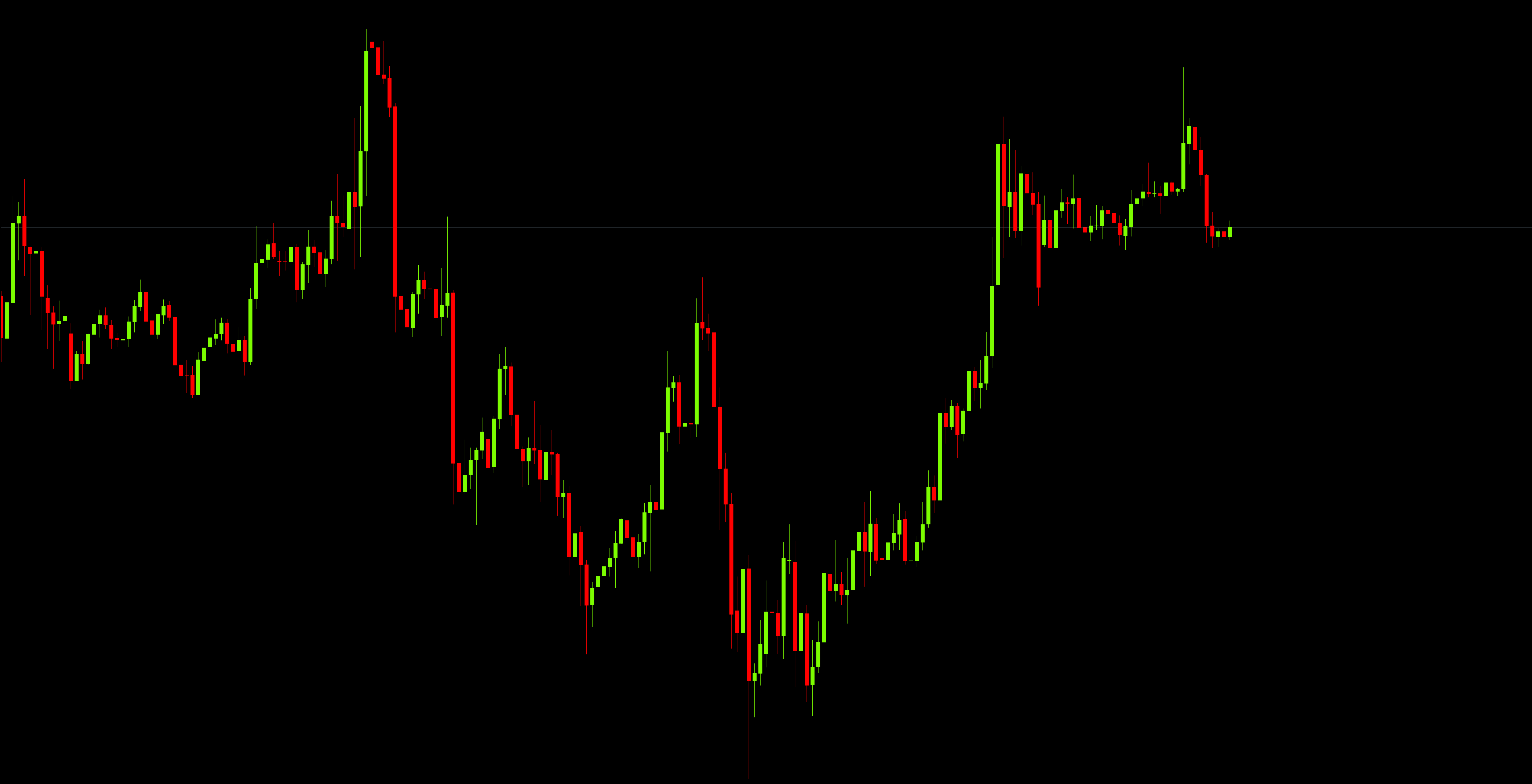
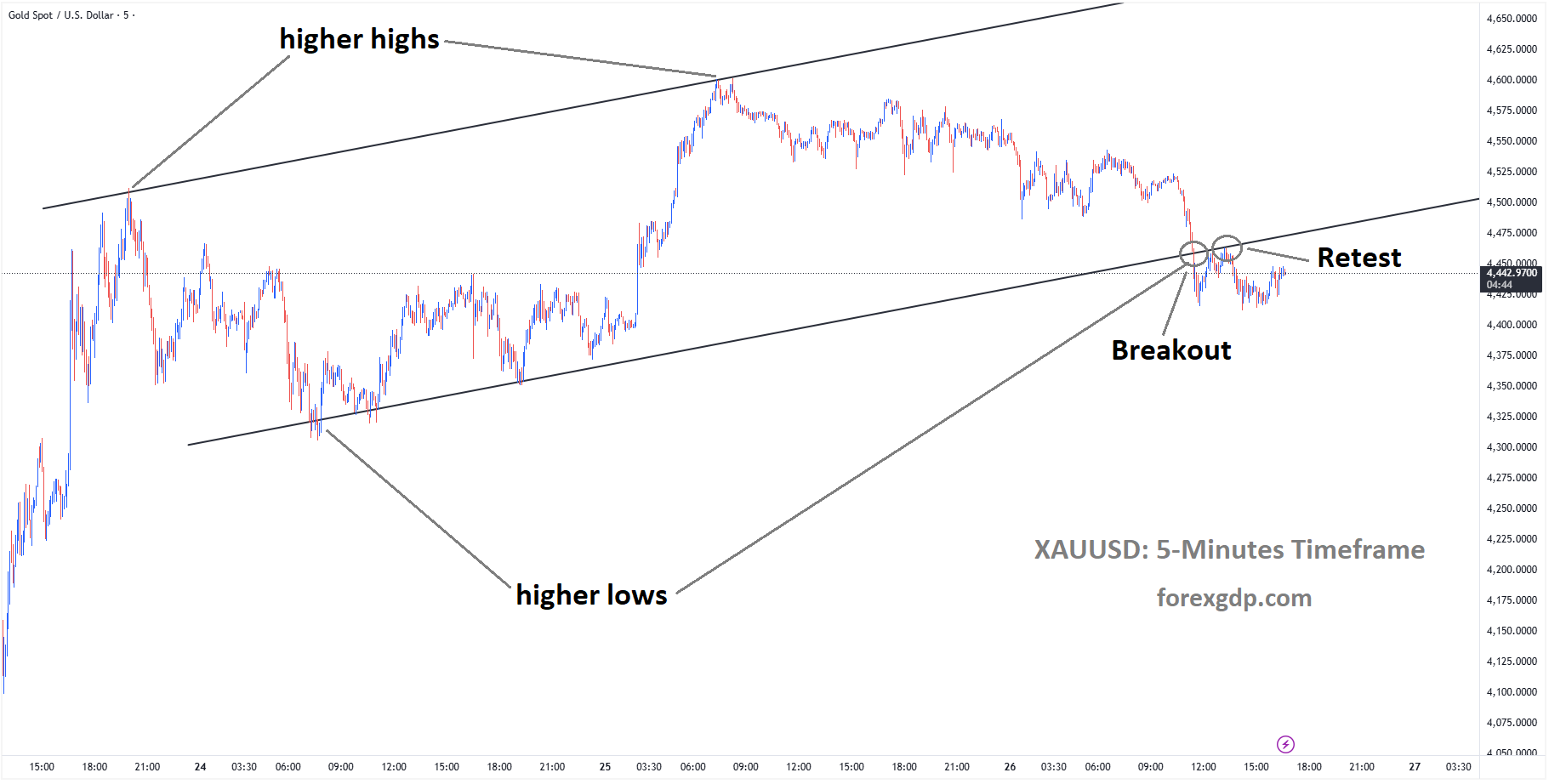
EURUSD is moving in a descending channel, andthe market has reached the lower high area of the channel
EURUSD Stays Supported as Softer Euro Inflation Fails to Shake Bulls
The EUR/USD pair started the week on a steady note, holding on to its gains after an early dip. After touching a seven-week low near 1.1585, the pair bounced back and was trading around 1.1620 at the time of writing. Buyers have stayed active, although upward momentum has been limited, with the pair struggling to push beyond the 1.1640 area.
What’s interesting is that the Euro has managed to remain supported even after inflation data from the Eurozone came in softer than expected. Normally, weaker inflation could weigh on a currency because it reduces the pressure on a central bank to keep interest rates high. But this time, the Euro is holding up, mainly because the US Dollar has come under pressure due to renewed political and trade-related uncertainty.
At the center of the market mood is a new wave of tension sparked by President Donald Trump’s latest tariff threats against European countries. These developments are keeping investors cautious and are setting the tone for what could be a volatile week in global markets.
Eurozone Inflation Slips Below a Key ECB Target
One of the major updates for the Euro on Monday came from the final reading of the Eurozone Harmonised Index of Consumer Prices (HICP) for December. The numbers showed inflation easing below the European Central Bank’s long-term target.
The final report confirmed that headline inflation slowed to 1.9% year-on-year, down from the earlier estimate of 2.0% and also lower than November’s 2.1%. This is an important shift because the ECB has long focused on keeping inflation close to 2% over time.
However, the “core” inflation measure, which strips out more volatile items and is often seen as a better signal of long-term price trends, remained unchanged at 2.3% year-on-year. That detail matters because it suggests that while overall price pressure is easing, underlying inflation has not fully cooled.

For the Euro, this creates a mixed picture. Softer inflation can reduce expectations for tighter policy from the ECB. At the same time, stable core inflation keeps the central bank cautious, since it may not want to relax its stance too quickly if price pressures remain sticky in key sectors.
Why the Euro Didn’t Fall After the Data
Despite the headline inflation easing, the Euro didn’t lose ground in a meaningful way. That’s largely because the US Dollar weakened at the same time, giving EUR/USD room to stay supported.
Currency markets often move based on relative strength. Even if Europe delivers softer data, the Euro can still rise if the US side of the equation looks worse or more uncertain.
In this case, the biggest driver has been growing concern over US trade policy and the possible economic impact of sudden tariffs. Investors tend to dislike unclear policy direction because it makes future growth and inflation harder to predict. That uncertainty can reduce confidence in the Dollar, especially when global risk appetite is already fragile.
Trump’s Tariff Threats Shake Investor Confidence
Over the weekend, President Trump surprised markets by threatening new tariffs on European countries. According to reports, he warned of an additional 10% tariff on EU nations that oppose the US annexation of Greenland.
The reaction across Europe has been serious. European leaders have already discussed the possibility of retaliatory steps if these measures are introduced. With all 27 EU member states expected to meet in the coming days, investors are preparing for more headlines and possible shifts in tone.
This type of political tension can have a direct impact on currency markets because it changes expectations around trade, economic growth, and global cooperation. When relations between major allies become strained, investors often move toward safer positions and reduce exposure to risk-sensitive assets.
That shift in sentiment can sometimes support the US Dollar, but not always. In this situation, the Dollar has been the one losing ground, as markets worry that unpredictable tariff decisions could create economic damage at home as well.
Growing NATO Tensions Add Another Layer of Uncertainty
Beyond trade, the political fallout has raised bigger questions. Europe’s response has hinted at a deeper divide among long-standing allies, and some analysts believe the situation could create a major challenge for NATO.
While currency traders don’t directly trade NATO headlines, they do react to the broader message behind them: global stability may be weakening. And when stability is questioned, markets can become more sensitive and quick to react.
Even small updates or statements from officials could lead to sudden shifts in EUR/USD and other major currency pairs throughout the week.
A Risk-Off Mood Takes Over Ahead of Davos
With tariff fears rising, markets have slipped into a “risk-off” mood. That simply means investors are behaving more cautiously. Instead of taking bold positions, many prefer to wait for clarity.
This cautious tone is especially important because global leaders and top executives are heading into the Davos Economic Forum, a major event where economic and political direction is often discussed openly.
President Trump and his team are expected to meet representatives from many of the countries affected by the latest tariff threats. His speech on Wednesday is likely to be one of the biggest market-moving moments of the week, as investors listen closely for any changes in tone, new warnings, or hints of negotiation.
Even if no official policy changes are announced, the way leaders communicate at Davos can influence expectations. In markets, expectations often matter just as much as actual decisions.
The US Dollar Starts the Week on the Back Foot
One of the clearest trends on Monday was the broad weakness in the US Dollar. Among major currencies, the Dollar has been the weakest performer, with investors selling it across the board.
This drop reflects growing concerns about how tariff threats could affect the US economy. While tariffs are often promoted as a way to protect domestic industries, they can also raise costs for businesses and consumers, disrupt supply chains, and trigger retaliation from trading partners.
When markets start pricing in those risks, the Dollar can lose appeal, especially if traders believe the uncertainty could slow down growth or create instability in the months ahead.
For EUR/USD, this has been a key reason the pair has remained supported, even without strong bullish momentum.
What Traders Are Watching Next This Week
The economic calendar is relatively light early in the week, but attention will build quickly as major US data releases approach.
A Quiet Monday in the US
Monday’s US calendar is empty, partly due to a bank holiday in observance of Martin Luther King Jr. Day. With fewer US-based traders active, price action can sometimes be choppy, especially when markets are already reacting to political headlines.
Key US Data Later in the Week
Later in the week, investors will be focused on two major US releases:
-
Third-quarter Gross Domestic Product (GDP)
-
Personal Consumption Expenditures (PCE) Price Index
Both are scheduled for Thursday and could shape expectations for the US economy and the future path of monetary policy.
GDP offers a broad look at growth trends, while the PCE index is one of the inflation measures most closely watched by the Federal Reserve. If the numbers come in stronger or weaker than expected, the Dollar could see sharp moves in either direction.
What This Means for EUR/USD in the Bigger Picture
Right now, EUR/USD is being pulled in two directions.
On one side, Eurozone inflation easing below the ECB’s target could reduce pressure on the central bank to stay aggressive. That would normally be a headwind for the Euro.
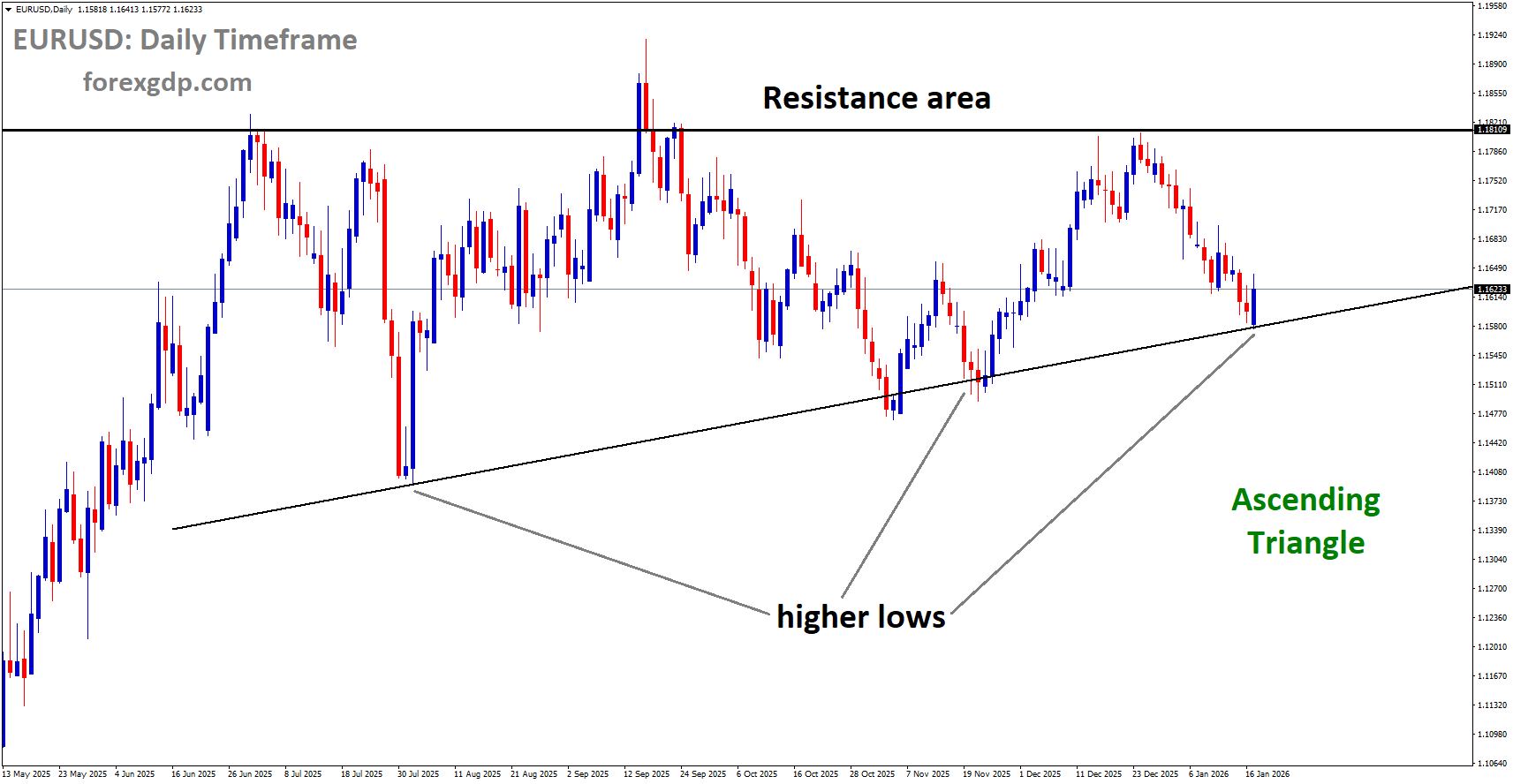
EURUSD is moving in an Ascending Triangle pattern, andthe market has reached the higher low area of the pattern
On the other side, the US Dollar is struggling with a confidence problem. Renewed tariff threats, political uncertainty, and rising global tension are pushing investors to rethink their exposure to the Greenback.
As a result, the pair is holding up, but not breaking higher with conviction. Traders are waiting for clearer signals—either from political developments, upcoming US data, or fresh messaging from global leaders at Davos.
Final Summary
EUR/USD is holding firm near 1.1620 after rebounding from recent lows, supported mainly by a weaker US Dollar. Eurozone inflation cooled to 1.9% in December, slipping below the ECB’s 2% target, though core inflation stayed steady at 2.3%. Meanwhile, markets are on edge after President Trump threatened additional tariffs on European countries, raising fears of retaliation and deeper political tension among allies. With Davos meetings approaching and key US economic reports due later this week, investors are preparing for more headline-driven swings in the days ahead.
USDCAD drops below 1.3900 after broad US Dollar selling returns
The USD/CAD pair has started the week on a softer note, continuing a pullback from recent highs and slipping to levels just under 1.3900 during the European session on Monday. After reaching a peak near 1.3928 late last week, the pair has turned lower as the US Dollar loses momentum across global markets.
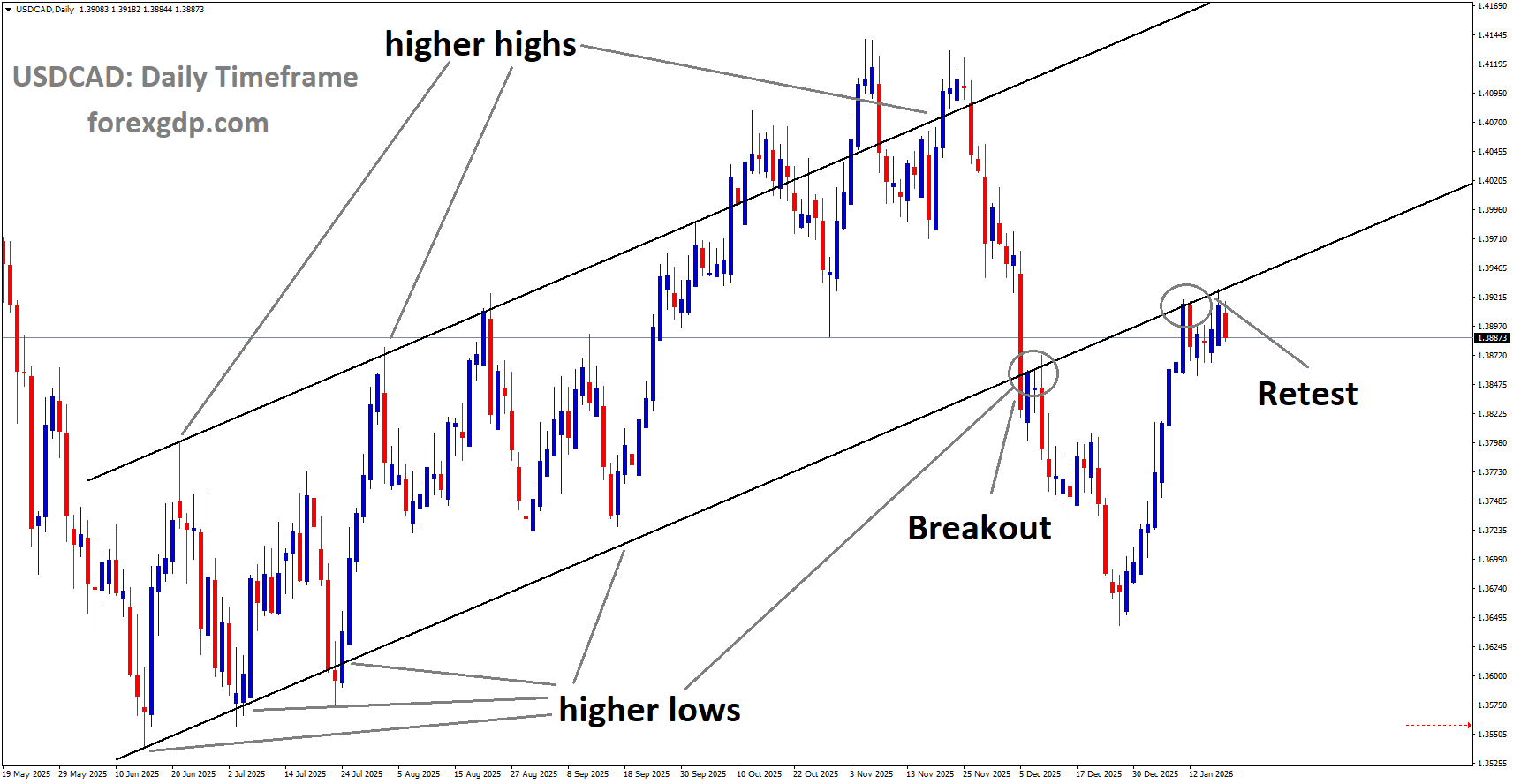
USDCAD reached the retest area of the broken uptrend channel
This move is not happening in isolation. A mix of political headlines, shifting investor sentiment, and upcoming Canadian inflation data is shaping the direction of both currencies. With the US market closed for Martin Luther King Jr. Day, trading conditions are also slightly thinner than usual, which can make currency moves feel sharper even when volumes are lighter.
At the center of the current market mood is renewed concern about trade tensions, following fresh tariff threats from US President Donald Trump. Meanwhile, the Canadian Dollar is balancing its usual connection to oil prices with the impact of domestic economic data that could soon set the tone for the rest of the week.
Why the US Dollar Is Losing Ground
The US Dollar has weakened broadly after President Trump announced a new round of trade tariffs aimed at European countries. This news surprised markets over the weekend and quickly became a major driver of sentiment as the new week began.
The tariffs are reportedly linked to political tensions involving Greenland. European leaders have pushed back against US plans connected to the territory, and that disagreement has now spilled into trade policy threats. In response, European officials have also hinted at possible retaliatory steps.
For currency markets, this kind of headline creates uncertainty fast. Even without immediate action, the idea of new trade barriers is enough to make investors nervous. It raises concerns about global economic growth, cross-border business activity, and overall stability in trade relationships.
When traders feel unsure about the future, they often reassess their positions in major currencies. In this case, the US Dollar has come under pressure because investors are increasingly worried about the economic impact of unpredictable trade decisions.
The bigger issue: uncertainty, not just tariffs
It’s not only the tariffs themselves that matter. Markets tend to react strongly when policies appear inconsistent or hard to forecast. When investors don’t know what might come next, they may reduce exposure to risk and shift away from currencies that could be affected by policy changes.
That’s part of what is weighing on the Greenback now. The US Dollar is reacting not only to the trade news but also to the broader fear that global growth could be disrupted again if trade disputes escalate.
USD/CAD Drops Even as Oil Prices Cool Off
Normally, the Canadian Dollar is closely tied to oil because Canada is a major energy exporter. When oil prices rise, the Canadian Dollar often benefits. When oil prices fall, the Canadian Dollar can weaken.
This week, oil has moved lower. US benchmark crude oil, known as WTI, has pulled back from earlier gains and is trading near its lowest level in about a week. That drop in crude prices would usually give the US Dollar an advantage over the Canadian Dollar.
But this time, the weaker US Dollar is playing a bigger role. The decline in the Greenback is offsetting the pressure that falling oil prices might have placed on the Canadian Dollar. As a result, USD/CAD is still moving lower even though the commodity backdrop is not especially supportive for Canada.
In simple market terms, the US Dollar is currently acting like the weaker currency in this pair, and that is dominating the price action.
Why oil matters so much to Canada
Canada’s economy benefits when energy exports perform well. Oil strength can support government revenues, improve trade balances, and lift confidence in Canada’s economic outlook. That’s why traders often treat the Canadian Dollar as a “commodity-linked” currency.
Still, the relationship is not perfect. There are times when politics, economic reports, or central bank expectations matter more than oil. This week looks like one of those moments.
Global Focus Shifts Away From Iran Toward Greenland
Another reason oil prices have eased is that tensions involving Iran appear to have calmed down compared to earlier concerns. With fewer headlines driving fear of supply disruptions, oil has lost some of its recent upward pressure.
At the same time, attention has shifted to Greenland-related political tension and trade risks. That shift matters because it changes what markets are worried about.
When geopolitical risks rise in the Middle East, oil often gains support because traders worry about disruptions in supply routes. But when those risks fade, crude prices can cool down, especially if the demand outlook is uncertain.
This calmer tone around Iran, combined with the new trade concerns involving Europe and the US, is creating a different kind of market stress. Instead of focusing on energy supply threats, investors are now focused on the potential impact of trade conflict on global growth.
For the Canadian Dollar, that’s a tricky mix. Lower oil prices can reduce support, while global trade uncertainty can also weaken demand expectations. Still, for now, the bigger driver in USD/CAD is the broad pullback in the US Dollar.
Canadian Inflation Data Could Decide the Next Move
Later on Monday, Canada is expected to release its Consumer Price Index (CPI) report, and this data could be the key event for the Canadian Dollar in the short term.

Inflation figures matter because they influence what the Bank of Canada might do next. If inflation is rising too quickly, central banks may keep interest rates higher for longer. If inflation is cooling, it can increase expectations for rate cuts or a more cautious policy approach.
Markets are currently watching two key parts of the report:
Monthly inflation
The monthly CPI reading is expected to show a small decline in December, following a modest rise in November. A weaker monthly number may suggest that price pressures are easing, at least in the short term.
Yearly inflation
The year-on-year CPI rate is expected to remain steady, holding around the same pace as the previous month. If that number stays firm, it could signal that inflation is not falling as quickly as some might hope.
For traders, the real question is how this data shifts expectations. If inflation comes in higher than expected, it could support the Canadian Dollar by increasing confidence in Canada’s economic resilience. If inflation comes in weaker, it may pressure the Canadian Dollar, especially since oil is already moving lower.
A Quiet US Market Day Can Still Bring Big Moves
With US markets closed for Martin Luther King Jr. Day, some traders may assume the day will be calm. But reduced participation can sometimes have the opposite effect.
When fewer major players are active, markets can become more sensitive to headlines and data surprises. Even modest buying or selling can create noticeable movement, especially in widely traded pairs like USD/CAD.
That means the Canadian CPI release could have an even stronger impact than usual, simply because there is less competing flow from US market activity.
This type of environment often leads to short, sharp moves that may not always last. Still, it can set the tone for the rest of the week, especially if the inflation data changes how traders think about interest rate decisions in Canada.
What Traders Are Watching Next for USD/CAD
The direction of USD/CAD in the coming sessions will likely depend on a few clear themes:
-
Whether trade tensions between the US and Europe continue to escalate
-
How strongly the US Dollar reacts to ongoing tariff uncertainty
-
Whether oil stabilizes or continues to slide
-
How Canadian inflation data reshapes expectations for the Bank of Canada
Even though USD/CAD has pulled back from recent highs, the next move will depend on which side gets the stronger fundamental support. Right now, the US Dollar is under pressure due to trade worries, but the Canadian Dollar still faces challenges if oil stays weak and inflation shows signs of cooling.
Final Summary
USD/CAD has turned lower after topping out near recent highs, moving below 1.3900 as the US Dollar weakens across the market. The drop in the Greenback is largely tied to renewed trade tariff threats from President Trump, which have raised fresh concerns about economic uncertainty and global growth. At the same time, oil prices have slipped, limiting support for the Canadian Dollar, but not enough to stop USD/CAD from falling. With US markets closed for the holiday, Canada’s inflation report is now the main event, and it could play a major role in shaping the Canadian Dollar’s next direction.
USDCHF drops below 0.8000 with the US Dollar losing momentum globally
The USD/CHF currency pair has moved lower in the latest trading session, reflecting a softer US Dollar and a stronger Swiss Franc. This shift comes at a time when global investors are closely watching rising political tension between the United States and European countries, along with fresh uncertainty around trade policy and international diplomacy.
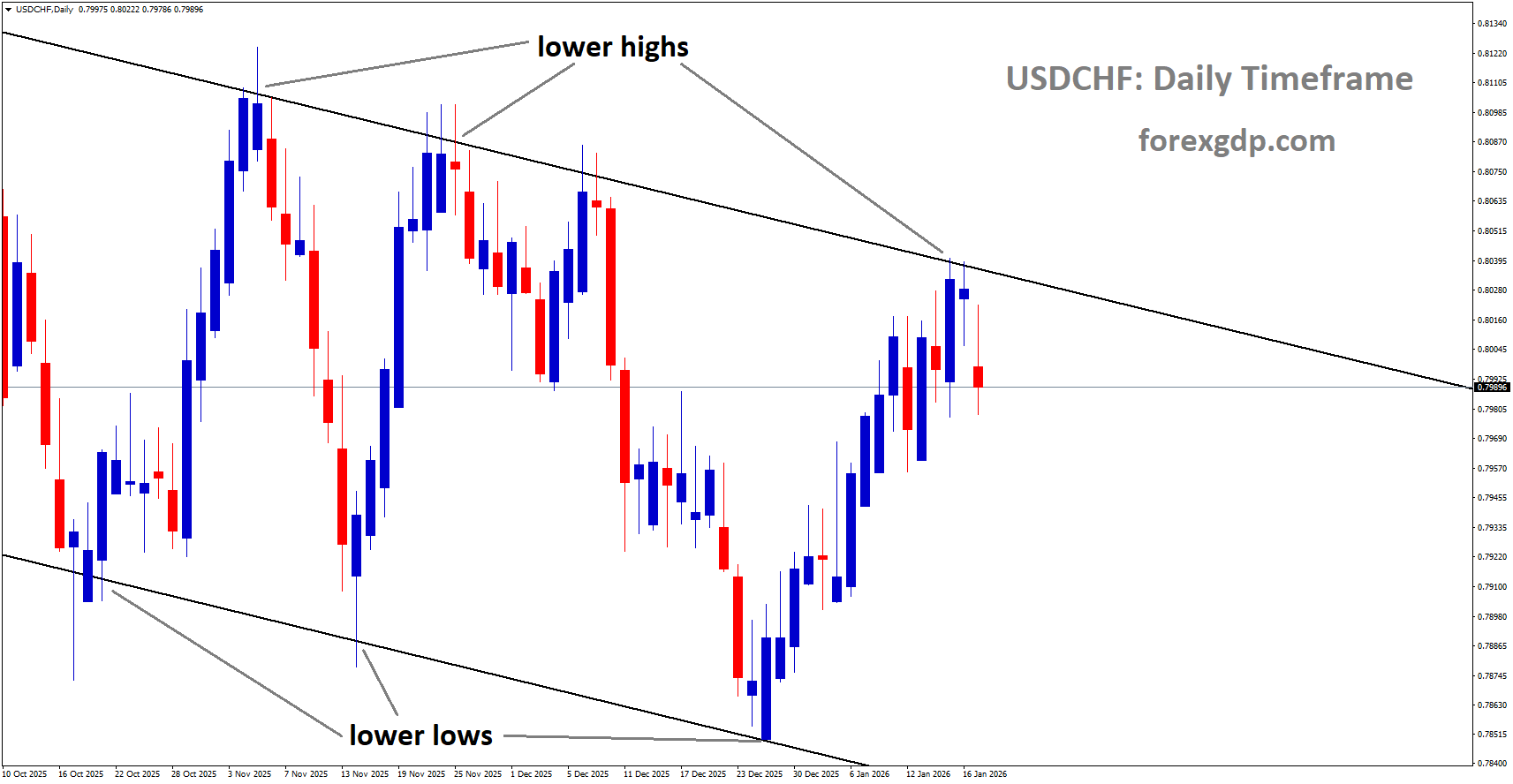
USDCHF is moving in a descending channel, andthe market has fallen from the lower high area of the channel
The mood in the currency market has turned cautious, and that has helped boost demand for traditional safe-haven assets like the Swiss Franc. At the same time, traders are preparing for important comments from Swiss National Bank (SNB) Chairman Martin Schlegel, who is expected to speak during the World Economic Forum (WEF) in Davos this week.
Why USD/CHF Is Falling Right Now
A major reason USD/CHF has dropped is the growing weakness in the US Dollar. When confidence in the US economy or political stability gets shaky, investors often reduce exposure to the Dollar and look for alternatives that feel more stable.
The Swiss Franc is one of the most popular choices in those moments. Switzerland is widely seen as politically neutral, financially strong, and reliable during periods of global uncertainty. So when risk levels rise, CHF demand often rises too.
This time, the pressure on the US Dollar has been linked to two key themes:
-
Increased tension between the US and Europe
-
A renewed push toward tariffs and trade conflict
Both issues can influence investor sentiment quickly, especially when they involve major economies and long-term alliances.
The Greenland Sovereignty Dispute Adds to Market Stress
One of the biggest political stories weighing on the US Dollar is the growing disagreement between Washington and European leaders over Greenland’s sovereignty.
The situation has escalated after US President Donald Trump renewed his interest in purchasing Greenland, a proposal that has triggered strong reactions from European countries, particularly Denmark, which has authority over Greenland’s foreign affairs and defense.
While the idea itself may sound unusual to some, markets tend to focus on the bigger message behind it: rising geopolitical friction between long-time allies. Even small shifts in international relationships can create uncertainty, and uncertainty is exactly what currency traders dislike.
As tensions increased, investors became more cautious and started leaning toward safer currencies—especially the Swiss Franc, which has performed strongly during similar global disputes in the past.
Tariff Threats Shake Confidence in US-EU Trade Relations
Adding to the pressure, President Trump has threatened new import tariffs on multiple European countries. According to reports, the proposed tariffs would apply to goods imported from several European Union members, including Denmark, Sweden, France, Germany, the Netherlands, and Finland. The plan also reportedly includes Britain and Norway.
The tariff measures are expected to take effect on February 1.
Whenever tariffs enter the conversation, financial markets usually respond quickly. That’s because tariffs don’t just affect trade numbers—they can also impact inflation, business investment, consumer confidence, and international partnerships.
For currency markets, the biggest concern is the risk of escalation. If one side responds with countermeasures, the situation can grow into a broader trade dispute. That kind of uncertainty tends to reduce appetite for risk and pushes investors toward stable currencies and defensive positions.
Europe Pushes Back, Warning of Wider Consequences
European leaders have responded cautiously but firmly to the tariff threats and the Greenland dispute. They have signaled that they will not ignore actions that challenge sovereignty or disrupt trade relationships.
European Commission President Ursula von der Leyen posted a warning emphasizing that sovereignty and territorial integrity are central principles under international law. She also noted that tariffs could harm transatlantic cooperation and potentially lead to a damaging cycle of retaliation.
That message matters for markets because it suggests Europe may respond with its own measures if tensions continue. Even if no immediate action is taken, the possibility of further conflict is enough to influence trading decisions.
When investors see political disagreements turning into economic threats, they often assume volatility could rise. And when volatility rises, safe-haven currencies like CHF often benefit.
Why the Swiss Franc Gains When Global Risk Increases
The Swiss Franc has a long history of strengthening during uncertain times. It’s considered a safe haven for several reasons:
-
Switzerland has a reputation for political stability
-
The country is known for a strong financial system
-
Swiss assets are often seen as reliable in global crises
-
Investors trust Switzerland’s long-term economic management
This week’s geopolitical tension has encouraged more investors to hold CHF, which is why the Swiss Franc has been outperforming many other currencies.
In simple terms, the market is behaving in a familiar way: when headlines get tense and trade risks rise, traders move toward safety.
The US Dollar Struggles as Confidence Slips
On the other side of the pair, the US Dollar has been under pressure. While the Dollar is also sometimes treated as a safe haven, it can weaken when political risk is tied directly to US policy decisions.
The market reaction suggests traders are concerned that escalating trade threats could create uncertainty for the US economy and strain international relationships.
A weaker US Dollar can also reflect shifting expectations about how the Federal Reserve may respond in the future. While no immediate policy changes have been confirmed, traders often start repositioning early when they sense the economic environment could become more unpredictable.
All Eyes on Central Bank Leaders at Davos
Beyond politics, investors are also focusing on global central bank signals this week. The World Economic Forum in Davos is set to begin Tuesday, and it often becomes a major event for market-moving speeches.
Central bank leaders use these meetings to discuss the economy, inflation, growth risks, and financial stability. Even when they don’t announce new policies, the tone of their comments can shape market expectations.
That’s why currency traders will be listening carefully, especially as global economies continue adjusting to shifting inflation trends and changing interest rate outlooks.
SNB Chairman Martin Schlegel’s Speech Could Move the Swiss Franc
One of the most closely watched events for CHF traders will be the speech from Swiss National Bank Chairman Martin Schlegel, scheduled for Tuesday at the World Economic Forum.
The SNB plays a major role in shaping the Swiss Franc’s direction. Investors are eager for any hints about how the central bank views the current economic situation and what it might do next.
What investors want to hear
Traders will pay attention to whether Schlegel discusses:
-
Inflation trends in Switzerland
-
Economic growth expectations
-
Currency strength and its impact on exports
-
The broader global outlook
-
Any clues on the future path of Swiss interest rates
Even small comments can matter because markets are always trying to anticipate what central banks will do next. If investors believe Swiss rates could stay higher for longer—or that the SNB will remain cautious—CHF strength may continue.
Why this matters for USD/CHF
USD/CHF is heavily influenced by the difference between US and Swiss policy expectations. If the Swiss central bank sounds confident and firm, CHF could gain further support. If the tone is more cautious, the Franc may lose some momentum.
But for now, safe-haven demand appears to be a major driver, and that can sometimes overpower normal interest rate expectations.
What to Watch Next in USD/CHF

The USD/CHF story this week is likely to remain tied to a mix of politics and central bank messaging. Traders are watching two big questions:
Will US-EU tensions escalate or cool down?
If both sides continue trading sharp statements or take real action, market caution may grow. If the situation softens, the Dollar could stabilize.
Will Schlegel offer a clear policy signal?
If the SNB chairman hints at a firm stance on inflation or rates, the Swiss Franc may stay strong. If he avoids details, markets may turn back to geopolitical headlines as the main driver.
Investors will also continue tracking broader global sentiment. When uncertainty is high, CHF often stays supported. When markets calm down, some of that demand can fade.
Summary: A Weak Dollar and Strong Franc Drive the Move
USD/CHF has moved lower as the US Dollar weakens and the Swiss Franc gains support from rising safe-haven demand. The decline is closely linked to renewed political tension between the United States and European countries, especially surrounding Greenland’s sovereignty and new tariff threats. Meanwhile, investors are preparing for key speeches at the World Economic Forum in Davos, with SNB Chairman Martin Schlegel’s comments expected to offer fresh insight into Switzerland’s interest rate outlook.
USDJPY slides under 158 as the Dollar stumbles and Japan signals a surprise vote
The USD/JPY currency pair moved slightly lower on Monday, drifting down to around 157.85 during the European trading session. While the drop was not dramatic, it reflected a clear shift in market mood: the US Dollar softened broadly, and traders leaned a bit more toward the Japanese Yen.
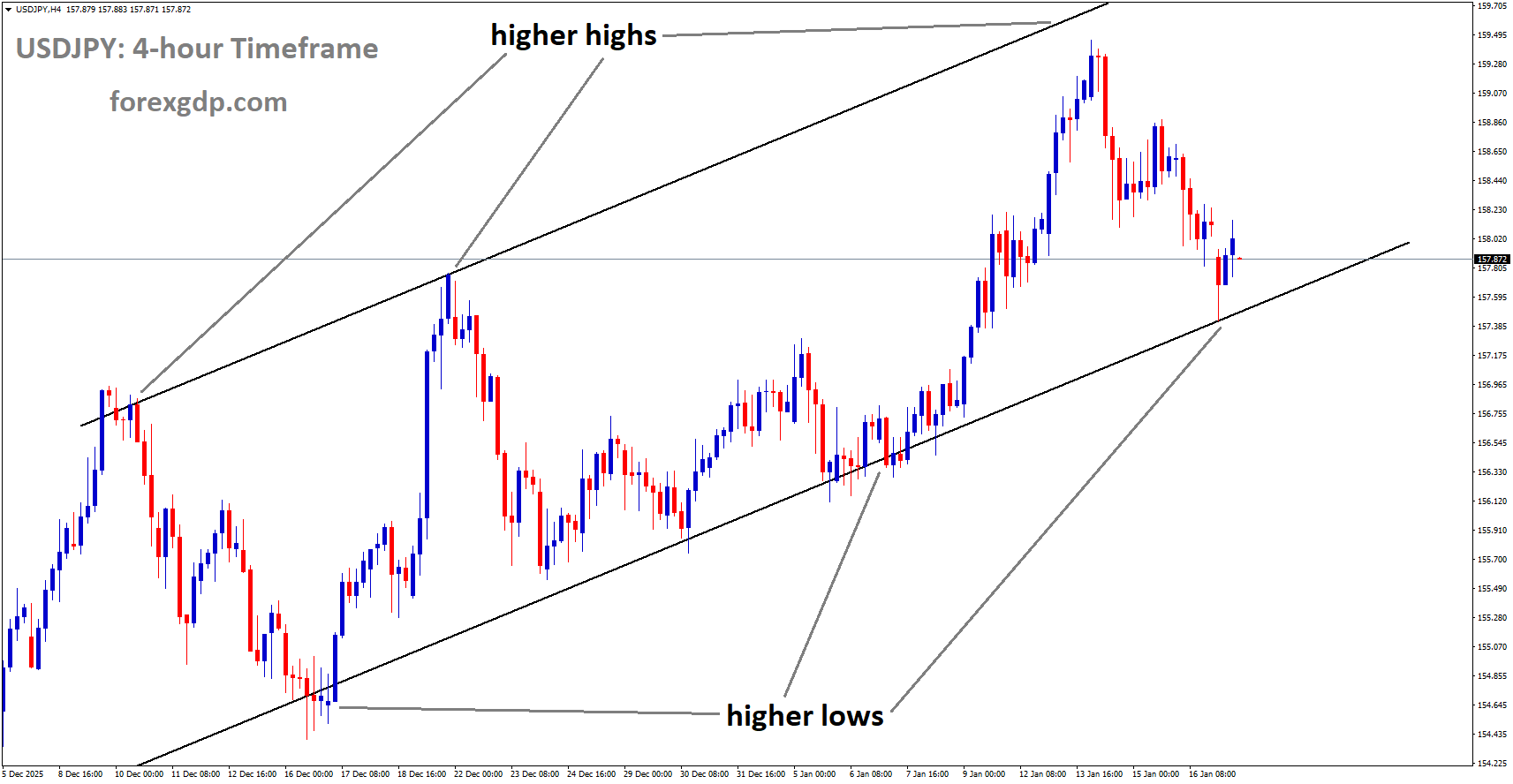
USDJPY is moving in an uptrend channel, and the market has reached the higher low area of the channel
At the center of this move is a growing political and trade dispute between the United States and the European Union, along with fresh political developments in Japan. Together, these stories helped shape how investors viewed risk, stability, and where to place their money at the start of the week.
A Softer US Dollar Pulls USD/JPY Lower
One of the main reasons USD/JPY slipped was simple: the US Dollar lost strength against multiple major currencies. When the Dollar weakens overall, it often puts downward pressure on currency pairs where the Dollar is the base currency, including USD/JPY.
This broader Dollar softness came after new tariff news involving the United States, several EU member countries, and the United Kingdom. Trade disputes tend to make investors cautious because they can affect economic growth, business confidence, and international relations.
Even when currency markets move only a little, traders often react quickly to headlines that could shape policy or create long-term uncertainty.
Tariff Announcement Sparks Market Unease
Over the weekend, US President Donald Trump announced 10% tariffs on certain EU members. The move was presented as retaliation tied to political disagreements connected to Washington’s interest in purchasing Greenland.
The announcement immediately drew strong reactions across Europe. EU leaders described the tariff threats as “blackmail”, and several member states signaled that they would respond with equal countermeasures if needed.
For investors, this kind of back-and-forth is important because it raises the possibility of a larger dispute that could expand over time. Even if tariffs begin with a limited scope, markets tend to price in the risk that the situation could grow into something more disruptive.
EU Leaders Warn of a “Dangerous Downward Spiral”
European Commission President Ursula von der Leyen issued a warning that added weight to the story. She emphasized that territorial integrity and sovereignty are core principles of international law and suggested that tariff pressure could damage broader cooperation between the United States and Europe.
She also warned that these actions could harm transatlantic relations and create the risk of a “dangerous downward spiral.”
That phrase matters because it hints at more than a simple trade disagreement. It suggests a chain reaction where one side responds to the other again and again, potentially turning a political clash into a long-lasting economic problem.
Currency markets pay attention to these signals because strained relations between major economies can affect everything from trade flows to investment decisions, and even central bank expectations.
Why Global Trade Conflicts Can Move Currency Markets
Trade disputes don’t just affect exporters and importers. They can influence the entire global financial system, including currencies like the Dollar and the Yen.
Here’s why:
-
Uncertainty increases, and investors often reduce risk exposure
-
Companies may delay investments or hiring decisions
-
Global growth expectations can soften
-
Investors may shift money into currencies seen as more stable
In many cases, the Japanese Yen tends to benefit when markets become more cautious. That’s because the Yen is often treated as a safer option during uncertain periods, especially when global headlines turn negative.
A Quiet US Trading Day Adds to the Mood
Another detail shaping Monday’s market environment was that US markets were closed due to the Martin L. King Birthday holiday.
When major US markets are closed, trading activity can be lighter, and price moves may become more sensitive to news from other regions. In quieter sessions, even modest headlines can have an outsized impact because fewer traders are actively taking positions.
This doesn’t always mean major moves will happen, but it can create a different kind of market rhythm—one where cautious sentiment builds more easily.
Japan’s Political Shift Supports the Yen
While the US Dollar was weakening, the Japanese Yen found some support from domestic political news.
Japan’s Prime Minister Sanae Takaichi announced plans to dissolve the lower house of parliament on January 23. Political events like this can influence the Yen because they may affect future government spending, taxation, and overall economic direction.
In her statement, Takaichi also said her administration plans to end excessively tight fiscal policy.
What “less tight fiscal policy” could mean
A shift away from strict fiscal policy can suggest that the government may be more open to:
-
Increased public spending
-
New stimulus measures
-
Stronger support for households and businesses
-
A more growth-focused economic strategy
These possibilities can change how investors think about Japan’s future economic performance and the direction of policy in the months ahead.
The Bank of Japan Meeting Is the Big Event This Week
Even with political headlines in the spotlight, the most important upcoming driver for the Japanese Yen is expected to be the Bank of Japan’s monetary policy decision on Friday.
The BoJ is widely expected to keep interest rates steady, holding them at 0.75%.
Markets will be watching closely not just for the rate decision itself, but also for any hints about what comes next. Central bank messaging can be just as important as the actual policy move, especially when investors are trying to judge whether a change could be coming later in the year.
Why the BoJ decision matters for USD/JPY

USD/JPY is strongly influenced by the difference between interest rate expectations in the United States and Japan.
If Japan appears likely to keep policy stable for longer, that can sometimes limit how far the Yen rises. But if the BoJ signals that it is becoming more confident about the economy, traders may begin adjusting their expectations for the future—even if rates stay unchanged for now.
How These Headlines Come Together for USD/JPY
Monday’s move in USD/JPY was shaped by several forces happening at the same time:
-
The US Dollar weakened broadly, pressuring the pair lower
-
New tariff tensions between the US and EU increased uncertainty
-
EU leaders warned of worsening relations and a potential spiral of retaliation
-
Japan’s political announcement added a fresh domestic factor supporting the Yen
-
Traders looked ahead to the Bank of Japan policy decision, which could guide the Yen’s next move
What’s notable here is that the Yen didn’t need a major economic surprise to gain ground. Instead, it benefited from a mix of global caution and local political developments, while the Dollar struggled under the weight of trade-related headlines.
What Traders Will Watch Next
As the week continues, market focus will likely shift between politics, trade developments, and central bank messaging.
Key themes likely to influence USD/JPY
-
Any follow-up statements from the US, EU, or UK on tariffs
-
Signs of retaliation or negotiation between major economies
-
Updates from Japanese leaders ahead of the lower house dissolution
-
The tone of the Bank of Japan’s policy communication
Even without major economic data, markets can move quickly when political and trade news creates uncertainty. For USD/JPY, that means the pair may remain sensitive to headlines until investors feel more confident about where the situation is heading.
Final Summary
USD/JPY edged lower toward 157.85 as the US Dollar weakened and investors reacted to rising tension between the United States and the European Union following new tariff announcements. EU officials strongly criticized the tariff threats and warned of a possible escalation that could damage long-standing international relationships. Meanwhile, Japan’s Prime Minister Sanae Takaichi announced plans to dissolve the lower house of parliament on January 23, adding another layer of market interest in the Yen. The next major focus for traders is Friday’s Bank of Japan policy decision, where rates are expected to remain unchanged, but forward guidance could shape the Yen’s direction in the days ahead.
BTCUSD dips again as trade-war headlines push traders toward safer assets
Bitcoin started the week under pressure, slipping below $93,000 on Monday and extending a recent run of losses. For many traders, this move feels less like a crypto-only event and more like part of a wider shift happening across global markets.
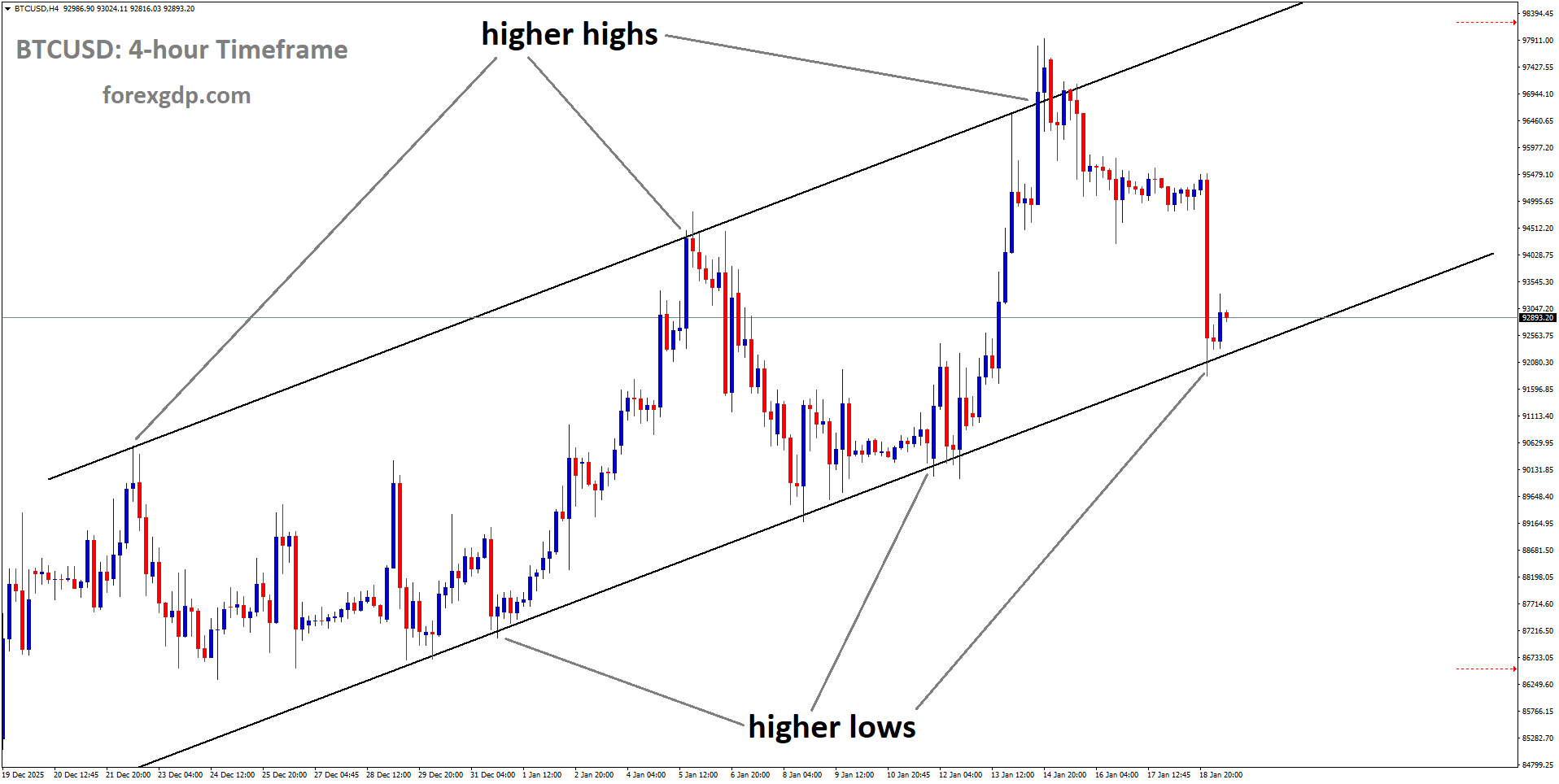
BTCUSD is moving in an uptrend channel, and the market has reached the higher low area of the channel
When big economic headlines hit, investors often change their behavior quickly. Right now, growing tension between the European Union (EU) and the United States (US) is pushing people into a more cautious mindset. Instead of chasing higher-risk assets like Bitcoin, many are choosing safer places to park their money.
At the same time, one important part of the Bitcoin story remains surprisingly strong: institutional demand. Even as the price pulls back, US-listed spot Bitcoin ETFs brought in $1.42 billion in inflows last week—the biggest weekly total since early October. That’s a major signal that large investors are still interested, even when short-term price action looks shaky.
Why Bitcoin Fell Below $93,000 This Week
Bitcoin’s drop under $93,000 didn’t happen in a vacuum. It came during a moment when global markets are paying close attention to politics and trade risks.
A major reason behind Monday’s weakness is rising concern about a possible EU–US trade conflict. When trade relationships between large economies become unstable, markets often react fast. Traders tend to reduce exposure to anything seen as “risky,” and Bitcoin is still treated as a risk asset by many investors—especially in the short term.
Bitcoin also recorded its fifth straight day of losses, adding to the negative mood. When the market sees several red days in a row, confidence can weaken, and some traders may choose to step back until things feel calmer.
Even long-term Bitcoin supporters can admit that short-term moves often follow emotion and headlines more than fundamentals. That’s exactly the kind of environment markets are dealing with right now.
Trade-War Tension Between the EU and US Raises Investor Anxiety
The latest wave of uncertainty comes from reports that EU capitals are considering a strong response to US pressure, including the possibility of placing €93 billion (about $101 billion) in tariffs on American goods. Another option reportedly being discussed is limiting access for US companies to parts of the European market.
This news follows tariff threats from US President Donald Trump, who has reportedly pushed for new tariffs on several European nations. The situation became even more intense due to a dispute connected to Greenland, after some countries opposed Trump’s plan related to acquiring it.
According to the report, Trump announced a 10% tariff on goods from countries such as:
-
Denmark
-
Sweden
-
France
-
Germany
-
The Netherlands
-
Finland
-
The United Kingdom
-
Norway
The proposed start date mentioned was February 1, with the tariffs expected to remain in place until the US is allowed to buy Greenland.
Whether these plans move forward exactly as stated or not, markets tend to react to the risk of disruption. Trade fights can lead to higher costs for companies, slower growth, and less confidence overall. When investors sense that uncertainty is rising, many of them reduce risk quickly.
Investors Shift Toward Safe-Haven Assets Like Gold and Silver
When fear grows in financial markets, money often flows into traditional “safe-haven” assets. This week, that trend showed up clearly as investors moved toward gold and silver.
Gold and silver have a long history as stores of value during stressful economic periods. They don’t depend on company earnings or government promises in the same way other assets do, so many investors feel more comfortable holding them when the future looks unclear.
In this case, the demand for safety was strong enough that gold and silver reportedly pushed to new all-time highs:
-
Gold (XAU): $4,690.94
-
Silver (XAG): $94.11
This shift matters for Bitcoin because it shows where investor attention is going right now. When safe-haven assets are rising and risk assets are falling, it’s usually a sign that markets are in a “risk-off” mood.
That doesn’t mean Bitcoin is failing as a long-term idea. It simply means the market is reacting to the current environment, and the current environment is filled with tension, uncertainty, and caution.
Bitcoin ETFs Show Institutional Interest Is Still Strong
While Bitcoin’s price has been sliding, a key part of the bigger picture remains positive: large investors are still buying exposure through spot Bitcoin ETFs.
Last week, US-listed spot Bitcoin ETFs recorded $1.42 billion in net inflows, marking the highest weekly inflow since early October. That’s a strong sign that institutions haven’t lost interest in Bitcoin—even if retail traders are nervous in the short term.
Why ETF inflows matter

Spot Bitcoin ETFs are often seen as a bridge between traditional finance and crypto. They make it easier for institutions and long-term investors to get Bitcoin exposure without handling wallets, private keys, or crypto exchanges.
When ETF inflows are rising, it can suggest a few things:
-
Big investors are still allocating money to Bitcoin
-
Some institutions may view dips as opportunities
-
Demand is coming from longer-term buyers, not just short-term traders
This kind of support doesn’t guarantee an immediate rebound, but it can help stabilize sentiment. Even in weeks where Bitcoin struggles, steady institutional buying can reduce the risk of a deeper slide.
What This Means for Bitcoin’s Short-Term and Long-Term Outlook
Right now, Bitcoin is caught between two powerful forces.
On one side, there’s short-term pressure from global uncertainty. Trade-war fears and political tension can quickly drain confidence from risk assets. When investors become cautious, Bitcoin often feels the impact.
On the other side, there’s ongoing institutional demand, backed by strong ETF inflows. This suggests that many larger investors still believe Bitcoin has a place in portfolios—especially as a long-term asset.
It’s also worth remembering that Bitcoin has gone through many periods like this before. Short-term price drops often happen when global markets are stressed. But interest from institutions tends to build over time, especially when access becomes easier through regulated products like ETFs.
If ETF inflows continue and grow even stronger, Bitcoin could regain momentum and move back toward major psychological milestones like $100,000. For now, though, the market seems focused on headlines, and the mood is clearly more defensive than optimistic.
Key Things Investors Are Watching Next
Bitcoin’s next move will likely depend on how the broader situation develops. Traders and investors are watching several factors closely, including:
-
Whether EU–US tariff threats become real policy actions
-
How global markets respond to new political developments
-
Whether safe-haven demand stays strong or begins to cool
-
Whether Bitcoin ETF inflows continue at a high pace
If tensions ease, risk appetite could return quickly. But if the trade-war narrative gets worse, the cautious mood could stick around longer than many expect.
In times like these, Bitcoin often moves as part of the bigger market story, not just the crypto story.
Final Summary
Bitcoin slipped below $93,000 on Monday as global investors reacted to rising EU–US trade-war fears and shifted into a more cautious, risk-off mindset. With uncertainty growing, money flowed toward traditional safe-haven assets like gold and silver, which hit new all-time highs. Even so, institutional interest in Bitcoin remains strong, highlighted by $1.42 billion in net inflows into US-listed spot Bitcoin ETFs last week—the largest weekly total since early October. This mix of short-term pressure and long-term demand is shaping Bitcoin’s outlook as markets wait for the next major developments.
ETHUSD Ethereum Activity Surges to a New High as Validator Withdrawals Clear Instantly
Ethereum is having one of its busiest periods ever. Over the past few weeks, the network has been processing more daily transactions than at any other point in its history. What makes this moment especially interesting is that even with all this extra activity, transaction fees are still staying close to recent lows.
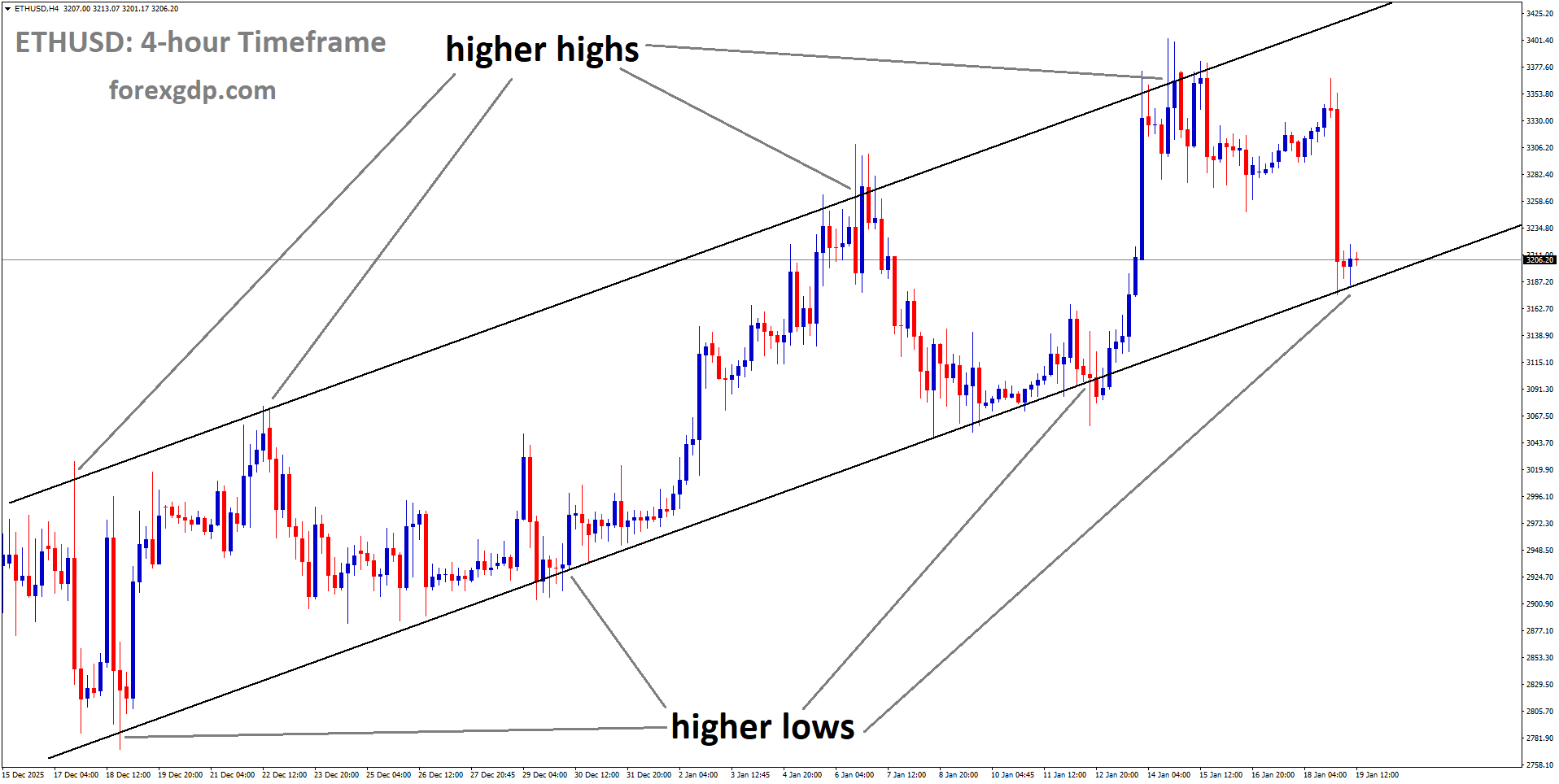
ETHUSD is moving in an uptrend channel, andthe market has reached a higher low area of the channel
That combination tells a clear story: Ethereum is being used more, but it’s also running more efficiently than many people are used to seeing during high-demand periods. Instead of the network becoming clogged and expensive, it is handling the pressure with fewer signs of stress.
This shift matters for everyday users, developers, and long-term supporters of the ecosystem. It also changes the way people think about Ethereum’s future, especially when it comes to scalability, staking, and how the network behaves when demand rises.
A New All-Time High for Daily Transactions
Ethereum recently set a new record for daily transaction volume. On Friday, the network processed 2,885,524 transactions in a single day, the highest number ever recorded for Ethereum.
This wasn’t just a random spike. It’s part of a bigger trend that has been building for weeks. Activity has been climbing steadily and pushing into early 2026 with strong momentum.
For anyone who has followed Ethereum through past cycles, this is a notable change. In previous periods of heavy network use, rising activity often came with rising congestion, slower processing times, and higher costs. But this time, Ethereum seems to be moving in a different direction.
What’s driving this increase?
While the data doesn’t point to one single cause, record transaction counts usually come from a mix of factors, such as:
-
More people using decentralized apps (dApps)
-
Higher stablecoin transfers and everyday on-chain movement
-
Increased activity from games, marketplaces, and token platforms
-
Growth in networks built around Ethereum, including scaling solutions
The key takeaway is simple: Ethereum is being used more often, by more people, in more ways than before.
The Comeback After a Slower 2025
One of the most important parts of this story is the timing. Ethereum’s activity didn’t rise overnight. In fact, the network had been showing signs of a gradual slowdown through much of 2025.
Then things started to change.
Since mid-December, transaction activity has accelerated quickly. That trend has now reversed the earlier slowdown and pushed the network into record territory.
This kind of shift can mean several things at once. It can suggest renewed interest from users. It can also show that Ethereum’s ecosystem is still expanding, even if the pace changes from year to year.
It also reminds people of something important: network growth is not always a straight line. Sometimes it moves slowly, and then suddenly picks up again when new applications, tools, or user behaviors start to gain traction.
Fees Stay Low Even as Demand Climbs
Normally, when Ethereum gets busier, users expect one thing to happen next: fees jump.
That has been one of the most common complaints about Ethereum for years. When demand rises, people rush to get their transactions processed faster, and costs often rise with it.
But this time, the situation looks different.
Even with the surge in transactions, average fees remain near recent lows. That’s a big deal because it suggests Ethereum is no longer as fragile under pressure as it used to be.
Why low fees during high activity matters
Low fees during record transaction counts send a strong message:
-
The network is handling higher usage more smoothly
-
Users are not being priced out during busy periods
-
Developers can build applications without assuming fees will explode
-
Ethereum’s scaling strategy appears to be working better in real-world conditions
This doesn’t mean fees will always stay low. Ethereum still has moments where costs rise, especially during sudden spikes in demand. But staying near low levels while activity breaks records is a sign of progress.
How Upgrades and Layer-2 Networks Are Changing Ethereum
Ethereum’s ability to process more transactions without higher fees isn’t happening by accident. It is closely tied to two major improvements in the ecosystem:
-
Ongoing network upgrades
-
The growing role of layer-2 networks
Recent upgrades have helped Ethereum improve how it handles data and transactions. At the same time, more activity is shifting away from the main Ethereum chain and into layer-2 networks.
Layer-2 networks are built to run on top of Ethereum while offering faster and cheaper transactions. They still benefit from Ethereum’s security, but they take pressure off the main network.
The bigger picture: Ethereum is spreading the workload
Instead of trying to force every single action onto one crowded network, Ethereum is becoming more like a connected system of networks. The main chain stays secure and reliable, while layer-2 networks handle a growing share of daily activity.
This approach helps Ethereum scale without losing its core strengths.
It also makes Ethereum feel more usable to the average person. When fees are lower and transactions are smoother, people are more likely to actually use apps instead of just holding assets.
Validator Queues Show a More Balanced Staking Environment
Ethereum’s staking system is another part of the story that’s changing.
Right now, Ethereum’s validator exit queue has dropped to zero, while the entry queue remains long.
That might sound technical at first, but it’s actually easy to understand once you break it down.
What does it mean when the exit queue is zero?
A zero exit queue means validators who want to stop staking and withdraw their ETH can do so almost immediately. There is no long line of people waiting to exit.
This is a sign that there isn’t panic or a mass rush to leave staking. If there were a major loss of confidence, the exit queue would likely fill up as many validators try to withdraw at the same time.
Instead, the system looks calm.
What does it mean when the entry queue is still long?
A long entry queue means people still want to stake ETH and join as validators, but they have to wait because the network only allows a certain number of new validators to enter over time.
This shows steady interest in staking, but not a sudden explosive surge.
A steady signal, not a hype wave
Together, these two queue signals suggest something important:
-
Ethereum staking is stable
-
People aren’t rushing in or rushing out
-
Participation is continuing at a consistent pace
In other words, staking looks healthy, but it’s not in a frenzy.
Ethereum Handles Heavier Use Without Major Bottlenecks

When you put all these pieces together—record transaction activity, low fees, and stable staking behavior—it paints a clear picture of a network that is managing growth in a more controlled way.
Ethereum is processing more transactions than ever, yet it is not showing the same strain people have come to expect during high-demand periods.
That’s good news for:
-
Users who want affordable transactions
-
Developers who need reliable performance
-
Businesses that want predictable infrastructure
-
The broader ecosystem that depends on Ethereum’s stability
This also supports the idea that Ethereum’s scaling path is maturing. Instead of relying on the network becoming expensive and crowded to prove demand, Ethereum is showing it can grow without breaking.
Why This Changes the Old Fee Narrative
For a long time, one popular storyline around Ethereum was simple: more activity would lead to higher fees, and higher fees would create stronger economic pressure on ETH.
But if Ethereum can keep fees low while usage rises, that old narrative becomes less central.
That doesn’t mean Ethereum’s economics stop mattering. It just means the network’s success may rely less on fee spikes and more on something bigger: consistent real-world use.
Ethereum doesn’t need to be painful to use in order to be valuable. In fact, the opposite may be true. A smoother, cheaper experience could bring in more users, more apps, and more long-term activity.
And if Ethereum can keep scaling without sacrificing reliability, it becomes easier to imagine it supporting much larger adoption over time.
What This Could Mean for Ethereum in 2026
Ethereum’s early 2026 momentum is sending a signal that the network is still evolving. Record activity combined with efficient performance suggests Ethereum is entering a phase where growth may look different than it did in earlier years.
Instead of growth being limited by congestion and high fees, Ethereum may be moving toward a future where:
-
usage expands without constant friction,
-
layer-2 networks take on a bigger role,
-
staking stays stable and accessible,
-
and the network remains reliable even when demand rises.
For many users, this is the kind of progress that matters most. Not just big headlines, but real improvements that make Ethereum easier to use day after day.
Final Summary
Ethereum has reached a new milestone by processing nearly 2.9 million transactions in a single day, setting an all-time record and continuing to climb into early 2026. At the same time, transaction fees have stayed close to recent lows, showing the network is handling heavier demand more smoothly than in the past. With the validator exit queue dropping to zero and entry queues still long, staking activity appears steady and balanced. Overall, Ethereum’s latest performance suggests a stronger, more efficient network that can support growing usage without the usual bottlenecks.
Don’t trade all the time, trade forex only at the confirmed trade setups
Get more confirmed trade signals at premium or supreme – Click here to get more signals, 2200%, 800% growth in Real Live USD trading account of our users – click here to see , or If you want to get FREE Trial signals, You can Join FREE Signals Now!