

BTCUSD is moving in a downtrend channel, and the market has rebounded from the lower low area of the channel
BTCUSD Feels the Heat After Massive Bitcoin ETF Withdrawals
Last week was rough for Bitcoin exchange-traded funds (ETFs) in the U.S. — really rough. We’re talking about a jaw-dropping $1.1 billion in outflows. That makes it the fourth-largest weekly outflow on record for spot Bitcoin ETFs. That’s not just a minor dip; that’s a major exit of funds from institutional players, and it raises an important question: what’s going on behind the scenes?
For three straight weeks now, these ETFs have been experiencing consistent withdrawals. This is especially important because these spot Bitcoin ETFs were initially seen as a big win for crypto. They were meant to bring in fresh institutional money — the kind of capital that could help stabilize and grow the market over time. But right now, the flow is moving in the opposite direction.
So, what does this mean for the average investor? While retail investors are often guided by excitement and social media trends, institutional investors usually make calculated decisions based on macroeconomic signals, risk management, and long-term growth forecasts. When they pull back, it’s worth paying attention.
Why the Crypto Market Feels Stuck Right Now
The Slowdown in Momentum
According to Matrixport, a well-known crypto analytics platform, the current state of the market resembles a “mini bear market.” There’s no real momentum, no fresh wave of optimism, and no significant external events to kickstart another rally. In simpler terms, the market is kind of just… dragging.
Investors who typically hold for the long haul — often called “HODLers” in crypto circles — seem to be reducing their exposure. That’s not a great sign for confidence. When long-term holders start selling or stop accumulating, it can create a domino effect, especially when combined with weak inflows from institutions.
Macroeconomic Shadows Loom Large
One major piece of the puzzle is the broader economic picture. Interest rate decisions from the U.S. Federal Reserve, inflation updates, and other economic indicators are weighing heavily on investor confidence — both in traditional markets and crypto. Matrixport pointed out that Fed policy decisions are likely to be a huge factor in where Bitcoin heads next.
When inflation is high or interest rates are uncertain, riskier assets like cryptocurrencies tend to take a back seat. Investors lean toward safer bets like bonds or cash-heavy portfolios. That’s probably one reason why ETFs are seeing less love these days.
Solana and Ethereum: A Tale of Two Trends
Interestingly, not all coins are facing the same kind of turbulence. Let’s talk about Solana and Ethereum, two other major players in the crypto world, especially when it comes to institutional products.
Solana’s Small But Steady Wins
Spot Solana ETFs have quietly managed to attract $12 million in new inflows — just last Friday. And that’s not a one-off event. For thirteen consecutive trading days, Solana has been pulling in fresh investments. Even though the coin itself hasn’t seen a massive price rally during this time, the consistent inflows show that there’s some level of trust building up among investors.
It could be that Solana’s strong performance in previous months or its growing ecosystem is keeping investors interested. Either way, it’s a bright spot in an otherwise cloudy crypto sky.
Ethereum Faces Withdrawals
Ethereum, on the other hand, is having a harder time. Ether ETFs saw $177 million in outflows on Friday alone — their fourth straight day of negative flows. That’s a red flag and might signal waning interest or uncertainty among large investors.
Interestingly, even though Ether and Solana both faced price drops — 11% and 15% respectively — their ETF flows told two completely different stories. It just goes to show that price isn’t always the best indicator of investor sentiment.
So, Where Does Crypto Go From Here?
The big takeaway right now is that the crypto market is in a tricky phase. There’s no overwhelming bullish momentum, and institutional investors seem hesitant. The heavy outflows from Bitcoin ETFs show that big money is either taking profits, reducing risk, or waiting on the sidelines for more favorable conditions.
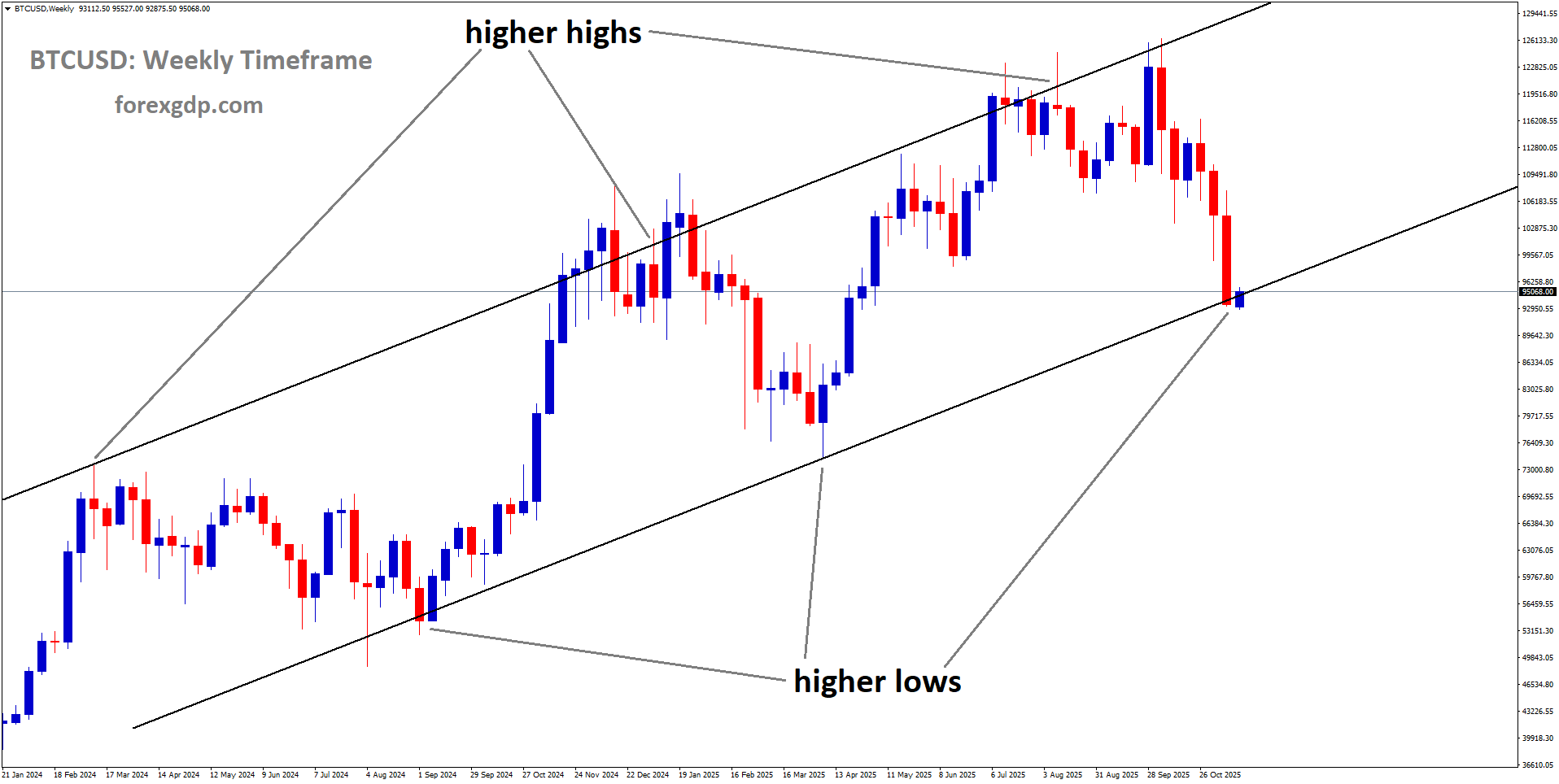
BTCUSD is moving in an uptrend channel, and the market has reached the higher low area of the channel
At the same time, coins like Solana are quietly gaining ground, suggesting that not all hope is lost. Some investors are still exploring opportunities — just maybe not in the most obvious places.
What’s also clear is that macroeconomic factors like Fed decisions and global market health are playing a larger role in crypto now than ever before. Crypto is no longer an isolated playground for tech enthusiasts and retail traders. It’s a part of the broader financial ecosystem, and that means it moves with the tides of economic policy and investor psychology.
Final Summary
The past week’s $1.1 billion outflow from U.S. spot Bitcoin ETFs is more than just a headline — it’s a reflection of the current uncertainty in the crypto space. While Bitcoin continues to struggle with institutional sentiment and wider macroeconomic pressures, other assets like Solana are showing quiet signs of strength.
Ethereum seems to be stuck in the middle, losing both inflows and price momentum. Meanwhile, the entire crypto market appears to be waiting — for clarity from central banks, for a shift in economic policy, or for a new wave of enthusiasm to take hold.
Whether you’re a long-term investor or just exploring crypto, this is a moment to stay informed, avoid impulsive moves, and watch closely how institutions and the broader market behave. Things might feel stuck now, but in the world of crypto, the next breakout could be just around the corner.
EURUSD stays pressured as investors await fresh US economic updates
The Euro began the week on a weaker footing, slipping further as global markets turned cautious. After attempting a mild recovery at the end of last week, the currency once again moved lower as investors reassessed the economic landscape and waited for several delayed economic reports from the United States. These delays have added a layer of uncertainty, encouraging investors to shift toward safer assets and strengthening the US Dollar in the process.
The financial environment has been uneasy for days, with traders showing little interest in taking large risks. Concerns continue to build around economic stability, international political tensions, and ongoing debates about inflation and interest rates. All these factors combined have created a setting where the Euro struggles to find solid ground.
Eurozone Sentiment Remains Fragile Despite Policy Remarks
Earlier in the day, European Central Bank Vice President Luis De Guindos expressed confidence that inflation across the Eurozone would gradually move toward the bank’s preferred range. While his comments aimed to reassure the market, they also came with cautionary notes. He warned about the broader impact of tariffs, rising sovereign debt, and the possibility of sudden changes in market sentiment.
These concerns overshadowed his optimism, leaving investors unconvinced and putting additional pressure on the Euro. Markets often react strongly to even subtle hints from policymakers, and in this case, the mixed message did little to shift the prevailing cautious mood.

In another part of the global landscape, US President Donald Trump rolled back tariffs on over 200 imported goods. Products such as coffee, tropical fruits, and other everyday items were included in the decision. The move acknowledged the strain rising import prices have been putting on inflation. Still, despite the potential domestic impact, market reaction remained muted. Investors were far more focused on the delayed economic reports and upcoming statements from Federal Reserve officials.
Growing Geopolitical Tensions Add to Market Uncertainty
Another major concern weighing on global sentiment came from Asia. Japanese Prime Minister Sanae Takaichi issued a warning that any hostile move by China toward Taiwan could trigger a military response. Statements like these tend to unsettle investors, as geopolitical tensions can have sudden and far-reaching financial consequences.
China’s response was swift, urging its citizens not to travel to Japan. This development only deepened the sense of unease across Asian markets and eventually spilled over into Europe and the United States. When geopolitical conflict intensifies, markets often experience heightened volatility, which tends to push investors toward safer currencies like the US Dollar.
A Stream of Upcoming Economic Releases Keeps Traders on Edge
In the coming hours, several reports and speeches are expected to shape the market narrative even further. The European Commission is preparing to publish new projections for Eurozone economic growth. These forecasts are closely watched because they provide insight into how policymakers expect the economy to evolve and can shape expectations for future policy decisions.
On the US side, the New York Empire State Manufacturing Index will offer a snapshot of business conditions, while speeches from influential Fed officials may reveal how the central bank views the path ahead for inflation, employment, and interest rates. Comments from figures like Philip Jefferson, John Williams, Neel Kashkari, and Christopher Waller often have the power to influence short-term currency movements, as traders look for clues on the timing of possible rate adjustments.
Market Forces Driving the Euro’s Decline
Lingering Worries Over Inflation and Interest Rates
Traders have grown increasingly cautious about predicting early interest rate cuts from the Federal Reserve. Last week, multiple Fed officials emphasized that inflation risks remain elevated and must be managed carefully. They also signaled that concerns about the labor market weakening too quickly may be overstated. This combination has led many investors to reconsider the likelihood of an interest rate reduction in the near term.
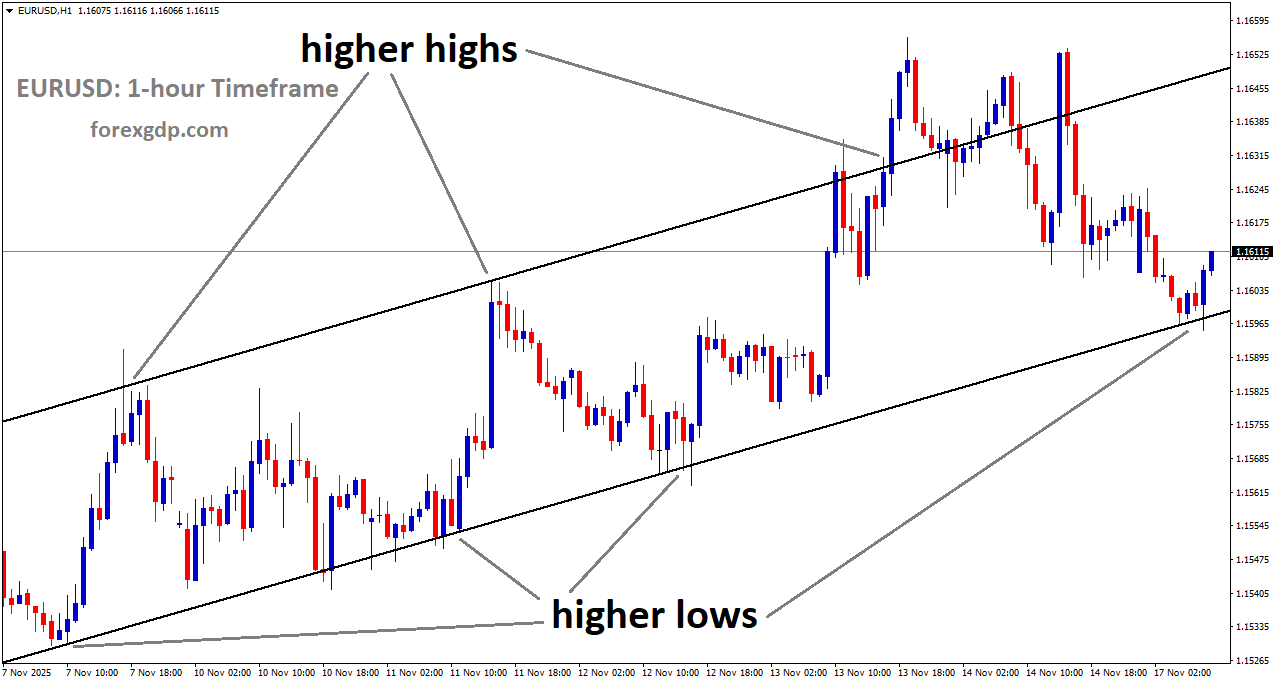
EURUSD is moving in an uptrend channel, and the market has rebounded from the higher low area of the channel
Only a month ago, there was strong belief that a rate cut could arrive soon. However, expectations have shifted significantly as investors now view early cuts as less likely. This shift has supported the US Dollar while creating additional headwinds for the Euro.
Declining Risk Appetite in Asia and Europe
In Asia, geopolitical warnings have sharply reduced investor appetite for risk, while in Europe, inflation data from Italy highlighted the region’s continued struggle with slow price growth. Italy’s consumer prices showed another monthly decline, reinforcing the idea that inflation remains subdued in many parts of the Eurozone. Lower inflation reduces pressure on the ECB to act aggressively, but it also signals ongoing economic softness.
Such economic indicators typically influence how investors evaluate a currency’s long-term outlook. When inflation remains low and growth is uncertain, a currency can lose some of its appeal, as seen with the Euro in recent sessions.
Anticipation of US Data Tightens Market Conditions
The market is also preparing for the release of delayed US economic figures, which could provide important signals about the state of the economy. Because these reports have been postponed, traders have had to operate without full visibility, adding to the cautious tone in global markets.
As long as uncertainty persists, the US Dollar tends to benefit from its reputation as a safe-haven currency. The Euro, by contrast, often struggles during periods of uncertainty, as investors prefer assets perceived as more stable.
Final Summary
The Euro’s recent decline reflects a broader environment of caution and uncertainty. Delayed US economic reports, shifting expectations about interest rate cuts, and fresh geopolitical tensions have all played a part in pushing investors toward safer assets. Remarks from European and US policymakers added further layers of complexity, as traders tried to interpret their significance against an already sensitive global backdrop.
While the Euro is facing clear challenges, the next wave of data and central bank commentary will help guide investor sentiment. For now, cautious trading, geopolitical concerns, and shifting expectations around monetary policy remain the dominant factors shaping the currency’s direction.
GBPUSD rebounds but stays under pressure from UK budget fears
The British Pound has been trying to gain some strength against the US Dollar, but it keeps ending up in the same place: no clear breakout, no major breakdown, just a lot of back-and-forth. Instead of trending strongly in one direction, the currency pair has been moving within familiar territory, reflecting a market that is cautious, uncertain, and waiting for something more decisive.
On the surface, it might look like the Pound is finding support from occasional bursts of buying interest. But when you look at the bigger picture, there are two main forces stopping it from really pushing higher:
-
Ongoing worries about the UK’s public finances
-
Growing expectations that the Bank of England (BoE) will cut interest rates in the coming months
At the same time, investors are also watching the US very closely. The recent reopening of the US federal government means a batch of delayed economic reports is finally coming out, and these numbers could easily shift the mood across global markets. In this kind of environment, traders are reluctant to take big risks, and that hesitation shows up clearly in how the Pound is behaving.
UK Public Finances And Policy Uncertainty Weigh On Sentiment
One of the key stories behind the Pound right now is not just about interest rates, but about trust — specifically, trust in the UK government’s ability to manage its finances.
Tax U-Turn Sparks Fresh Questions
Recently, the UK Prime Minister, Keir Starmer, and the Chancellor, Rachel Reeves, made a notable U-turn on their earlier plan to raise income tax at the upcoming budget. On the face of it, this might feel like positive news for households. After all, keeping more of your paycheque is always welcome, especially when living costs remain elevated.
But financial markets tend to think a step further. If the government steps back from tax increases, investors immediately ask: how will the country pay its bills? The UK already faces a significant fiscal deficit, and changing course on tax policy raises doubts about how that gap will be closed.
Those doubts matter for the Pound. When investors are unsure about a government’s long-term budget path, they become more cautious about holding that country’s currency. They worry that future borrowing could rise, that credit ratings might come under pressure, or that future governments may be forced into more drastic measures. All of this adds a layer of uncertainty that keeps enthusiasm for the Pound limited.
Public Finances And The BoE’s Dilemma
These fiscal concerns also complicate life for the Bank of England. On one hand, weaker growth and softer data argue for interest rate cuts to support the economy. On the other hand, if investors are already uneasy about public finances, aggressive rate cuts could risk undermining the Pound further, especially if they make UK assets look relatively less attractive.

This push-and-pull between supporting growth and maintaining financial stability is a major theme behind current Pound movements. Markets know the BoE cannot ignore slowing activity, but they also know it cannot act as if the fiscal backdrop doesn’t matter.
Weak UK Data Is Fueling BoE Rate Cut Expectations
The macroeconomic backdrop in the UK has not helped the Pound’s cause either. Recent data releases have painted a picture of an economy that is struggling to gain momentum.
Preliminary figures for Gross Domestic Product showed that the UK economy actually contracted in the third quarter, when many analysts had expected a small increase or at least some sign of resilience. That disappointment was reinforced by declines in both manufacturing and industrial production. These sectors often act as a kind of early warning system for broader economic conditions, so when they weaken, investors take notice.
From a market perspective, this kind of data usually triggers one immediate thought: will the central bank step in with support?
Right now, many traders believe the answer is yes. Expectations are building that the Bank of England will be pushed into cutting its benchmark interest rate sooner rather than later, with some investors already looking toward the possibility of a move as early as December. Even if the timing is uncertain, the direction of travel seems clearer: fewer hikes on the horizon, and growing talk of cuts.
Lower interest rates typically make a currency less attractive because they reduce the return investors can earn on assets denominated in that currency. That’s one reason why, despite occasional bursts of strength, the Pound is finding it hard to deliver a sustained rally against the US Dollar.
Why US Economic Data Still Drives The GBP/USD Story
While the UK side of the equation is obviously important, the other half of the GBP/USD pair is just as critical. And right now, the US story is creating its own tension in the market.
Delayed US Reports Are Back In Focus
The recent reopening of the US federal government means that a backlog of economic data is finally being released. Traders around the world are paying close attention, because these reports will help shape expectations for what the Federal Reserve does next.
One of the standout releases on the calendar is the US Nonfarm Payrolls report for September. This jobs report is always a big event for markets, and its delayed release has only increased the anticipation. Strong numbers could signal that the US economy remains robust, while softer figures might revive talk of future rate cuts.
Fading Hopes Of A Fed Cut Support The Dollar
For now, hopes of a near-term Federal Reserve interest rate cut have been fading. The combination of resilient US data earlier in the year and cautious messaging from Fed officials has pushed traders away from the idea of an immediate policy easing.
This matters for the Pound because currencies are constantly being compared against each other. If investors expect UK rates to fall, while US rates stay higher for longer, the US Dollar naturally looks more appealing. This “interest rate gap” between the two central banks has been providing some underlying support for the Dollar, making life tougher for the Pound even when UK news isn’t particularly negative.
Add in the general risk-averse tone in global markets — with many investors preferring safer, more liquid assets — and you get a backdrop where the Dollar tends to benefit while other currencies, including the Pound, struggle to gain sustained traction.
What Traders And Investors Might Watch Next
With the Pound caught between domestic worries and global forces, what comes next will depend heavily on upcoming events and data releases.
On the UK side, any fresh information on government budget plans, public borrowing, or tax policy will be watched closely. If investors see a credible path to stabilising public finances without overly damaging growth, that could help ease some of the pressure on the Pound. Conversely, signs of further uncertainty or policy reversals might deepen concerns.
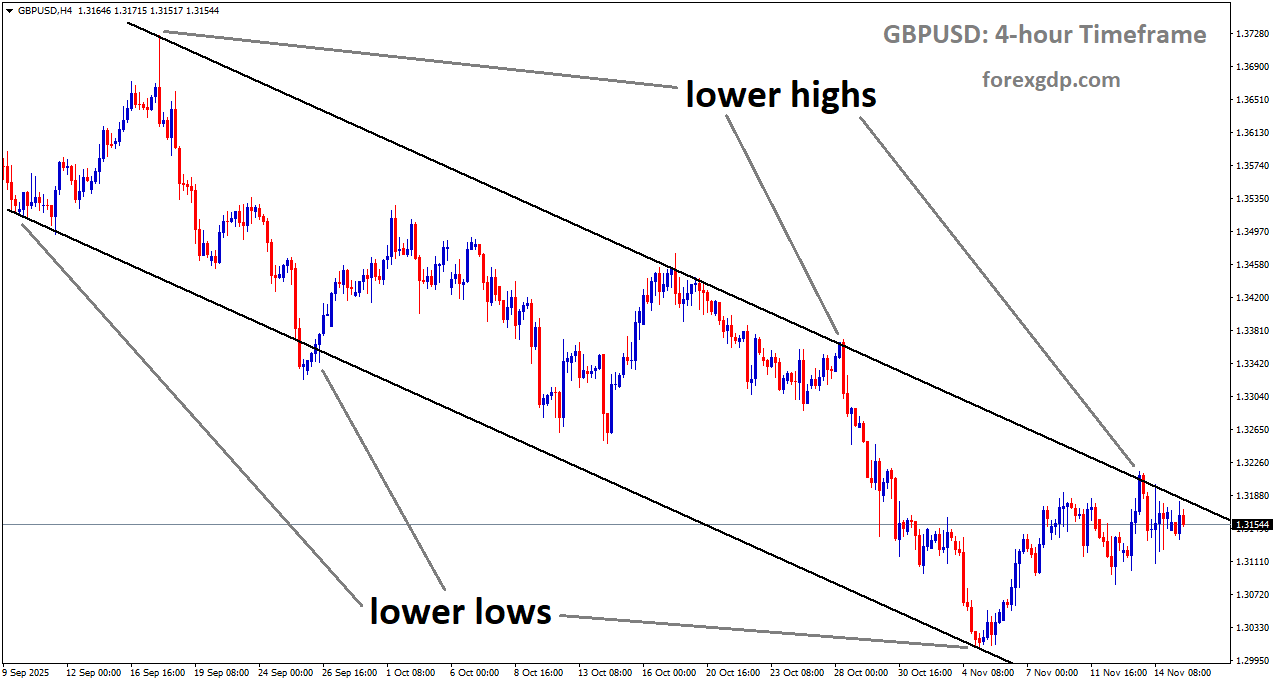
GBPUSD is moving in a downtrend channel, and the market has reached the lower high area of the channel
New data on growth, employment, and business activity in the UK will also be important. If the numbers continue to disappoint, market expectations for BoE rate cuts are likely to strengthen even further. If the data stabilises or improves, it may give the central bank a bit more room to be patient, which could provide some breathing space for the Pound.
On the US side, the main focus will be on how the newly released economic reports affect expectations for the Federal Reserve. Strong labour market and inflation data would likely keep the Fed cautious about cutting rates, supporting the Dollar. Weaker readings, on the other hand, could shift the conversation back toward easing, which might give the Pound a chance to recover some lost ground.
Final Summary
Right now, the British Pound finds itself in a delicate balance against the US Dollar. It is not collapsing, but it is not powering ahead either. Instead, it is being pulled in different directions by:
-
Concerns over the UK’s public finances and recent tax policy reversals
-
Weak UK economic data that increases pressure on the Bank of England to cut interest rates
-
A stronger US Dollar supported by fading expectations of near-term Federal Reserve rate cuts and renewed attention on delayed US data
For traders, investors, and even everyday observers of the currency market, the key themes are clear: fiscal credibility, central bank decisions, and the constant comparison between the UK and US economic outlooks. Until there is a decisive shift in one of these areas, the Pound is likely to remain in this cautious, reactive mode, moving more on headlines and data surprises than on any confident long-term trend.
USDJPY Nears Fresh Highs While Japanese Yen Falters on Economic Worries
The Japanese Yen (JPY) is starting the week on a softer footing, and there’s a lot happening in the background. From Japan’s slowing economy to uncertainties around central bank policies, the currency is facing some serious pressure. On the flip side, the US Dollar (USD) is holding strong, and that’s making things even tougher for the Yen.
Let’s break down what’s really happening with the JPY, what’s driving the moves, and why all eyes are on what’s next from Japan and the US.
A Sluggish Start: What’s Pulling The Yen Down?
To understand why the Yen is underperforming right now, we’ve got to look at both domestic and international factors. It’s not just one thing—it’s a whole mix of economic signals, government actions, and global market reactions.
Japan’s Economy Is Slipping
Japan’s economy shrank in the third quarter of the year. That’s the first contraction in six quarters, and it’s a sign that things aren’t quite on track. Official figures show a 0.4% dip between July and September, which translates to an annualized decline of 1.8%. Compared to previous periods of growth, that’s a clear setback.
While the drop wasn’t as bad as some had feared, it still shows that Japan is facing real challenges. Consumers are dealing with high living costs, and business investment hasn’t been strong enough to offset weaker areas.
No Quick Rate Hike From The Bank of Japan
When the economy weakens, central banks often step in with supportive policies. But in Japan’s case, the Bank of Japan (BoJ) has already been running a very loose monetary policy for years. Many had hoped that signs of recovery would push the BoJ to finally hike interest rates. Now, with growth fading again, those hopes are fading too.

Investors are backing off bets that the BoJ will raise rates anytime soon. That’s weighing on the Yen because higher interest rates usually attract foreign investment—and Japan isn’t offering that incentive right now.
Government Plans, Political Tensions, And Verbal Warnings
The situation in Japan isn’t just about economics. There are political developments and even international tensions that are adding more uncertainty to the mix.
Japan’s Government Tries To Cushion The Blow
In response to the economic slowdown, Japan’s Prime Minister Sanae Takaichi is working on a fiscal stimulus package. The aim? Help households struggling with rising prices and inject some life into the economy.
Takaichi also hinted at a new fiscal target that could stretch over several years. That would give the government more flexibility in spending—basically, more freedom to support the economy without being too restricted by short-term budget limits.
But while that may help in the long run, it doesn’t change the immediate challenges. The economy is still cooling, and the market isn’t seeing any major shifts in central bank action just yet.
Tensions With China Stir Market Jitters
Geopolitical worries are back in the spotlight, too. After Takaichi made comments about the possible use of military force in a Taiwan conflict, China responded strongly. Beijing warned of serious consequences, and that raised concerns about a deeper diplomatic standoff between the two major Asian economies.
These kinds of tensions can spook investors. And while the Yen is traditionally seen as a safe-haven currency, the overall nervousness in the market doesn’t seem to be boosting it much this time around.
Japanese Officials Send A Message To Currency Traders
The Yen’s recent weakness hasn’t gone unnoticed by Japan’s policymakers. In fact, there have been several public statements suggesting the government is watching currency movements very closely.
Finance Minister Satsuki Katayama made it clear that authorities are keeping an eye on the situation “with a sense of urgency.” Meanwhile, Economy Minister Minoru Kiuchi warned that a weaker Yen could drive up inflation by making imports more expensive.
These types of comments are often aimed at calming the market—or even scaring off aggressive currency traders. For now, it looks like those warnings have at least slowed down the Yen’s decline, but it’s not enough to reverse the trend just yet.
The Strong US Dollar: Why It’s Adding Pressure On The Yen
While Japan is dealing with its own set of challenges, the US Dollar has been doing relatively well. And that contrast is making things even more difficult for the Japanese currency.
The Fed Isn’t Rushing To Cut Rates
One big reason the Dollar is staying strong? Fewer people believe the US Federal Reserve is going to cut interest rates soon. Some Fed officials have been signaling caution, saying that they want to wait for more data before making any moves.
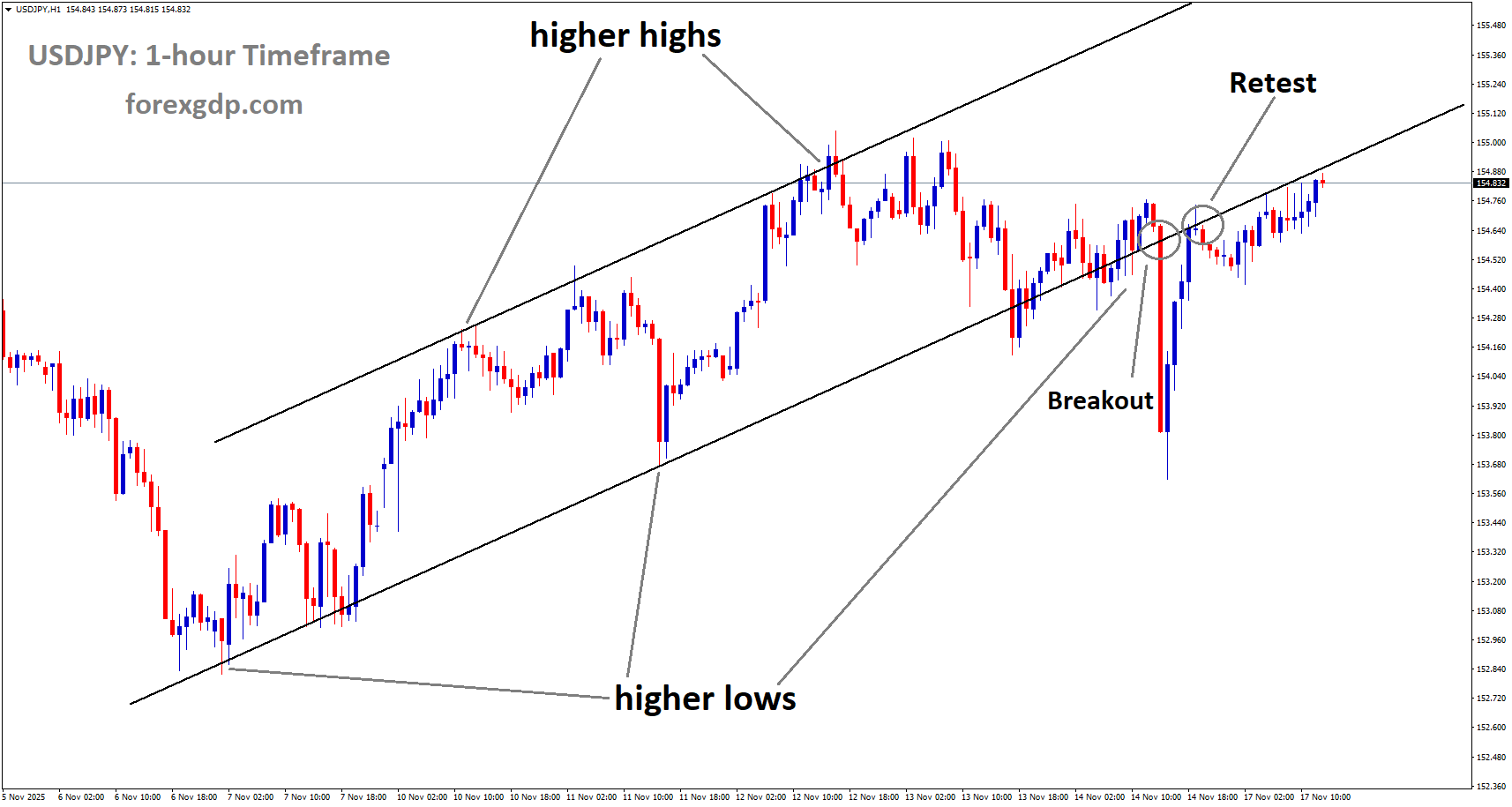
USDJPY reached the retest area of the Ascending channel
With no clear sign of a December rate cut, investors are sticking with the Dollar. That’s making it harder for the Yen to bounce back, especially since Japan’s central bank is nowhere near raising rates.
Key US Data Coming Soon
Markets are also waiting on some big reports from the US this week, including the delayed Nonfarm Payrolls (NFP) data and the Federal Open Market Committee (FOMC) meeting minutes. These updates could give clues about where the US economy is headed—and whether the Fed might actually change its tone in the months ahead.
Until then, the Dollar is likely to stay firm, and that means continued pressure on the Yen in the short term.
Final Thoughts: What This All Means For The Yen
Right now, the Japanese Yen is caught in a tough spot. The economy is showing signs of slowing down, the central bank is unlikely to raise interest rates soon, and geopolitical tensions are making things more uncertain. At the same time, the US Dollar is being supported by steady monetary policy and cautious optimism about the American economy.
All of this creates a challenging environment for the Yen. While there are some efforts to support the currency through government messaging and potential interventions, the underlying factors still point to weakness—at least for now.
As we move forward, a lot will depend on whether Japan’s stimulus plans can spark any real momentum and whether the Bank of Japan decides to shift its stance. Until then, the Yen is likely to remain under pressure, especially if the US economy continues to show signs of strength.
EUR/JPY Holds Steady as Japan’s Economy Shows Resilience and Euro Finds Fresh Momentum
If you’ve been watching the EUR/JPY currency pair lately, you might’ve noticed something interesting: it’s not really going anywhere. Right now, the Euro and the Japanese Yen are kind of balancing each other out. On one side, we’ve got Japan dealing with a slower economy but some surprising resilience. On the other, the Eurozone is getting a small boost thanks to an upgraded economic forecast. It’s a bit like watching a seesaw that just won’t tip.
Let’s break down what’s actually behind this sideways movement and why both the Euro and the Yen have reasons to hold steady for now.
Japan’s Economic Dip Isn’t as Bad as Expected
Japan recently released new GDP data, and while the economy did shrink, the news wasn’t quite as grim as people were expecting.

The country’s gross domestic product (GDP) fell by 0.4% in the third quarter. That sounds bad — and, well, it’s not great — but it’s better than the 0.6% drop experts had predicted. When you look at the annual figures, Japan’s economy declined by 1.8%, which again, is softer than the anticipated 2.5% contraction.
Now, what does all that mean?
Basically, Japan’s economy is showing signs of strain, but it’s not falling off a cliff. That subtle difference matters a lot in the world of currencies. A massive drop could have pushed the Bank of Japan toward more drastic action. But since the numbers aren’t that bad, there’s no rush to shake things up just yet.
What’s the Bank of Japan Thinking?
So far, Japan’s central bank is sticking to its cautious approach. Prime Minister Sanae Takaichi is still backing easy money policies to help everyday people, while the central bank’s head, Kazuo Ueda, is pointing out some bright spots — like people spending more and the job market tightening up.
He’s also hinted that inflation might be slowly crawling up toward the bank’s 2% target, which is a key number for them. If that continues, they might adjust their policy down the road — but not right now. For now, they’re just watching and waiting.
Tensions in Asia Are Giving the Yen a Boost
Apart from the economic data, politics in the region are playing a big role, too.
Tensions between China and Japan over Taiwan have recently flared up again, and that’s made global investors nervous. When that happens, they tend to move their money into safer places — and the Japanese Yen has long been seen as one of those “safe-haven” currencies.
That increased demand for the Yen helps support its value, which puts pressure on the EUR/JPY pair to move lower. But again, with no major shocks, the pair is just sort of stuck for now.
The Euro Gets a Little Help from Europe’s Updated Growth Forecast
Over in Europe, there’s some mildly good news that’s giving the Euro a bit of strength.
The European Commission recently raised its economic growth forecast for 2025, saying they now expect the Eurozone to grow by 1.3%, instead of the previous estimate of 0.9%. That may not sound like a huge change, but in the currency world, even small adjustments can have an impact.
Why the Upgrade?
There are a few reasons behind the more optimistic outlook:
-
Investments have been stronger than expected.
-
Earlier this year, exports picked up more than usual.
-
Bulgaria is joining the Eurozone soon, and its inclusion automatically boosts the region’s overall average.
All of these factors helped the European Commission feel a bit more positive about what’s ahead. Still, they were quick to add that risks remain — from global financial instability to geopolitical uncertainty and possible trade issues.
ECB Isn’t in a Rush Either
Much like Japan, the European Central Bank (ECB) seems comfortable hitting the pause button for now. They’re not making any big policy changes, and that steady hand is helping support the Euro — even if just a little.
EUR/JPY Caught in the Middle of a Balancing Act
So here we are. The Euro’s got some wind in its sails thanks to Europe’s improved outlook. The Yen, on the other hand, is holding firm due to cautious economic optimism and rising global tensions.
Put these together, and you get a market that’s just… hovering. EUR/JPY isn’t really moving much, as both sides have enough support to keep things steady, but not enough to drive any big moves in either direction.
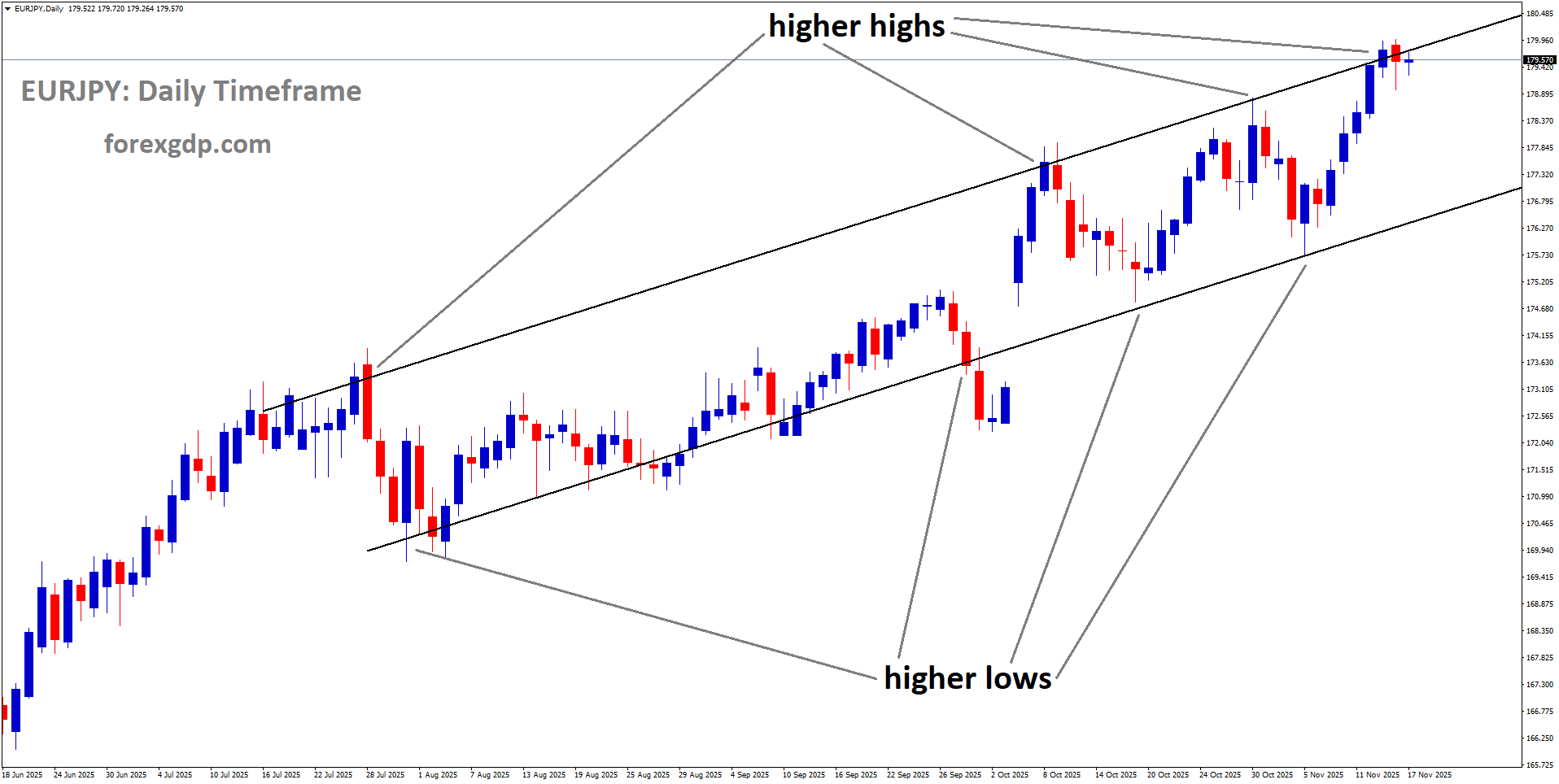
EURJPY is moving in an uptrend channel, and the market has reached a higher high area of the channel
Traders and investors are likely waiting for something new to shake things up — maybe a major policy shift from one of the central banks, or fresh data that changes the mood.
Final Thoughts: Calm Before the Storm?
Right now, the EUR/JPY currency pair is in a bit of a holding pattern. Japan’s economy is still soft but not falling apart, and the Eurozone is seeing a bit of sunshine through the clouds. That balance is keeping things stable — for now.
But the stability might not last forever.
With geopolitical risks bubbling in Asia and central banks keeping a close eye on inflation and economic activity, there’s always the chance that new developments could spark movement again. Until then, we’re likely to see this pair continue its sideways journey, just waiting for its next big reason to move.
If you’re keeping an eye on this currency pair, it’s a good time to stay informed and be patient — because while the market might be quiet now, it rarely stays that way for long.